
Laser Hair Removal Underarms Before and After: 7 Examples
You've picked a sleeveless outfit for an upcoming event, but your underarms still show stubble soon after shaving. It's tempting to book laser treatment and expect a single appointment to erase years of grooming. A more believable transformation is gradual: fewer visible hairs, potentially finer regrowth, and a routine that becomes easier to manage. Calmer-looking skin may matter just as much, especially if shaving leaves you uncomfortable.
When comparing laser hair removal underarms before and after photos, look beyond the smoothest final image. Consistent lighting, arm position, and time since shaving make comparisons more useful. Captions should identify skin tone, hair characteristics, completed sessions, treatment intervals, comfort, aftercare, and whether the client chose individual appointments or a package.
The journeys below are illustrative scenarios, not documented patient case studies or guaranteed outcomes. The supplied images illustrate presentation styles rather than verified clinical results. Even detection tools for image authenticity shouldn't replace treatment records and comparable photographs. A convincing transformation needs context, not just an attractive after shot.
1. Dark, Coarse Underarm Hair After a 3-Session Series for Fitzpatrick Types I–III
A client with light skin and dark underarm hair might arrive with a familiar complaint: shaving removes the length, but the area still looks shadowed. Their useful baseline isn't necessarily a close-up of freshly shaved skin. It's a clearly labeled image showing the usual density and appearance at a recorded point in their grooming routine.
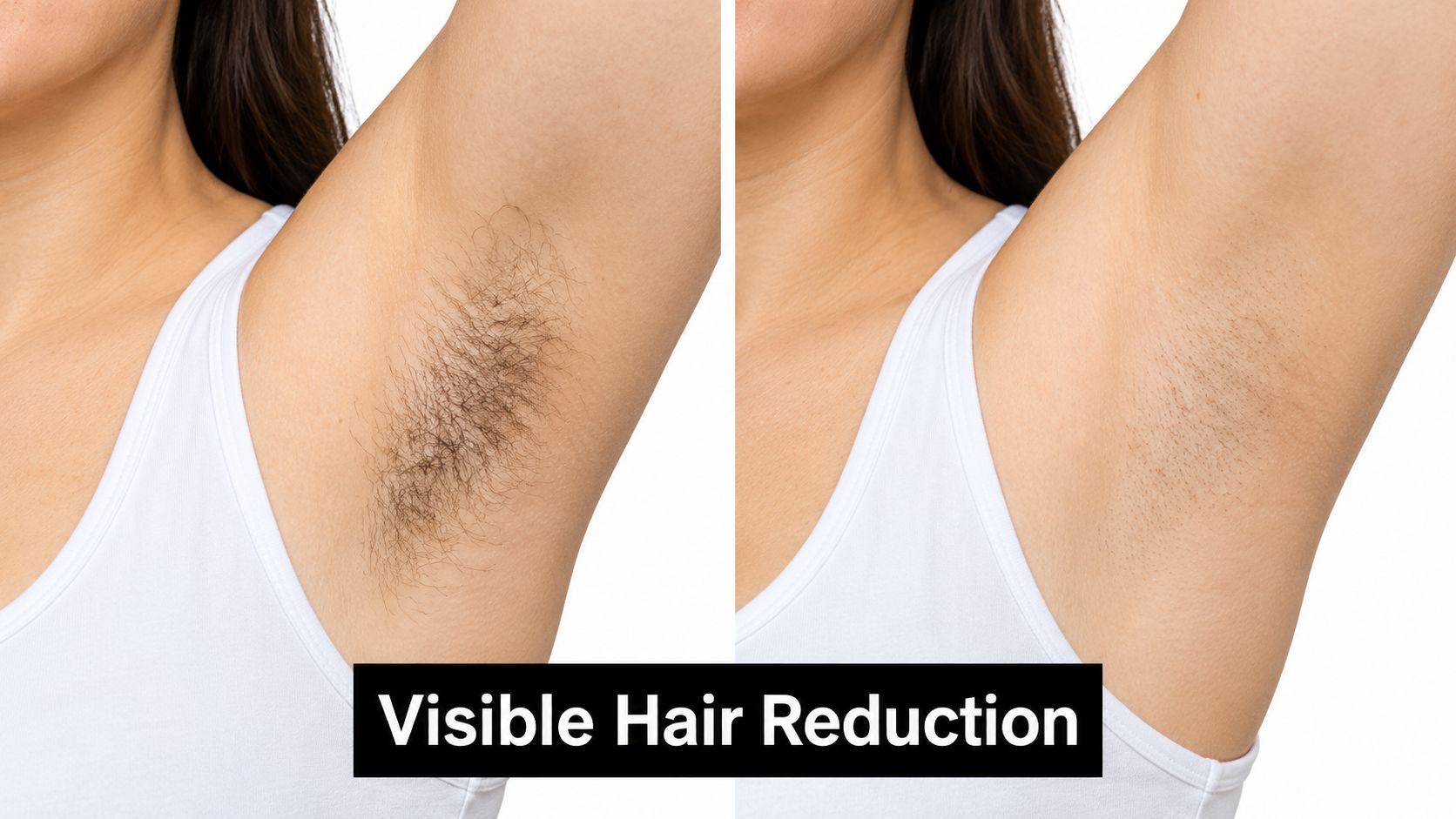
There's clinical support for substantial change after a short series, but not for promising everyone the same outcome. In a controlled study involving 40 women with Fitzpatrick types II–III, three alexandrite treatments at four-week intervals produced reported reductions of approximately 91.4% and 94.0% in the treatment groups, measured one month after the final session, according to the controlled axillary hair-count study.
Those results don't establish an equivalent response for type I skin or every person with coarse hair. They're study-specific findings, not a standard package guarantee.
Document density, not just smoothness
Candidacy: Ask the practitioner to assess your actual hair characteristics and skin tone rather than relying on resemblance to a gallery model.
Timing: Record completed appointments and follow the clinic's individualized interval recommendations.
Comfort and aftercare: Discuss cooling, report discomfort during treatment, and obtain written grooming and product instructions.
Caption checkpoint: Record the skin assessment, dark/coarse hair description, session count, interval, time since shaving, comfort response, aftercare, and package choice. Compare visible coverage and thickness, not whether the latest photo looks freshly groomed.
2. Darker Skin Tones and Results With Appropriate Wavelength Selection
For a client with brown or Black skin, the first question may be about discoloration rather than hair density. An illustrative type V client might want fewer underarm hairs while preserving their existing skin tone. A responsible consultation should address both goals without treating a device brand as proof of suitability.
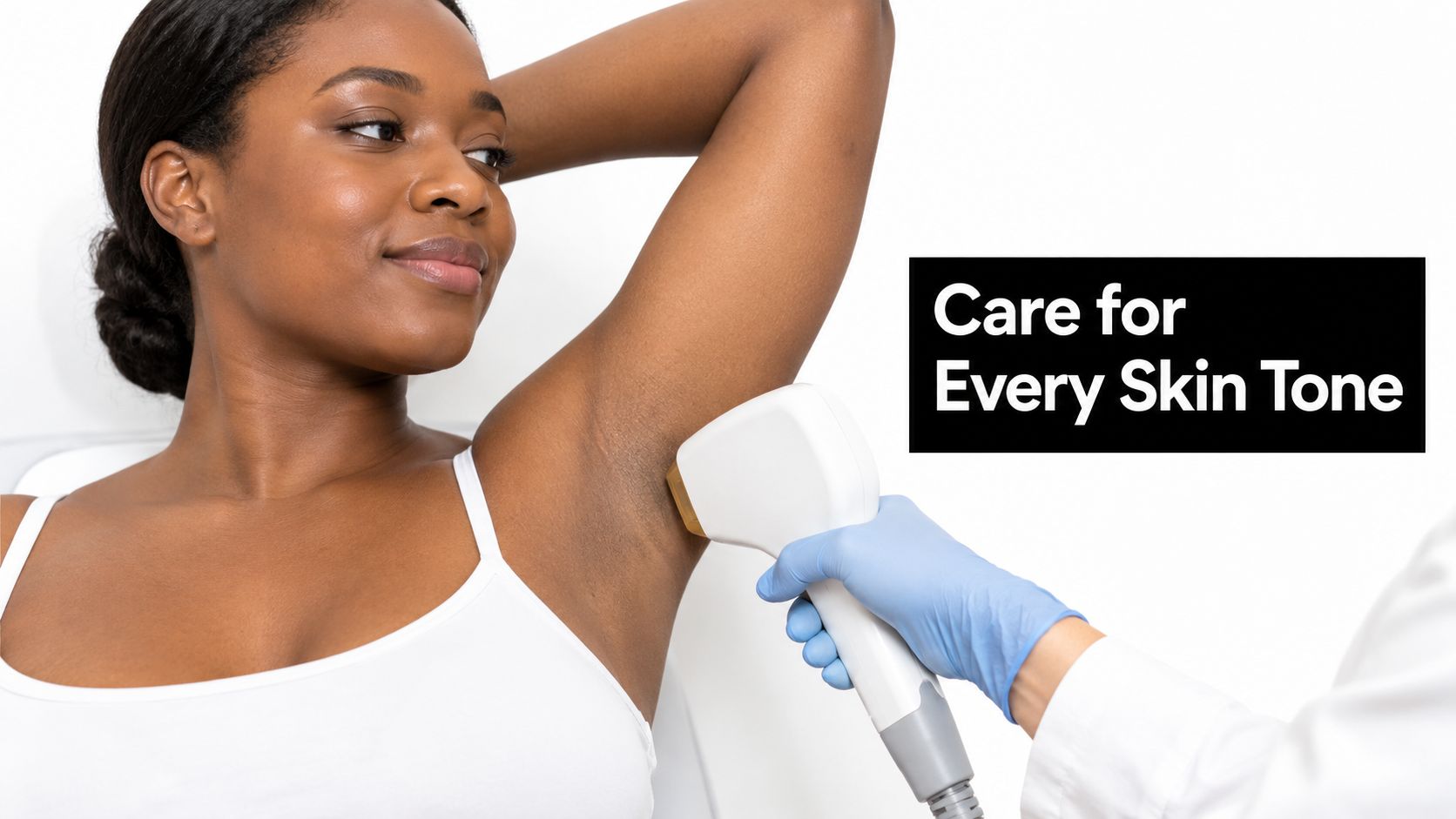
A 2025 prospective study of 10 Sudanese women with Fitzpatrick types IV–VI found mean underarm reduction of 57.9%, ranging from 45.7% to 66.7%, after three sessions with an 808-nanometer diode laser; one participant experienced pain and another developed a mild superficial blister that resolved after fluence adjustment, with no observed pigmentary changes or scarring, as documented in the darker-skin diode laser study.
That small study demonstrates possible reduction, not universal safety. Its findings also shouldn't be transferred automatically to another device or protocol.
Safety priority: Ask how the practitioner selects wavelength, energy settings, cooling, and test-spot procedures for your skin, not just whether the machine treats diverse skin tones.
The clinic's information on laser hair removal for brown skin can help you prepare questions. Confirm the test-spot observation period, sun-avoidance instructions, and what changes warrant contacting the provider.
Caption checkpoint: Include baseline pigmentation, hair texture, device details, treatment interval, comfort, and aftercare. Judge hair reduction and skin-color changes separately; don't mistake brighter lighting for a more even complexion.
3. Razor Bumps and Ingrown Hairs With Shaving-Related Irritation
The client who hesitates before applying deodorant because their underarms sting may care less about perfect hairlessness than comfortable skin. In this illustrative journey, the baseline photograph records visible bumps and irritation alongside hair growth. The follow-up should assess those concerns separately rather than assuming less hair means every skin problem has resolved.
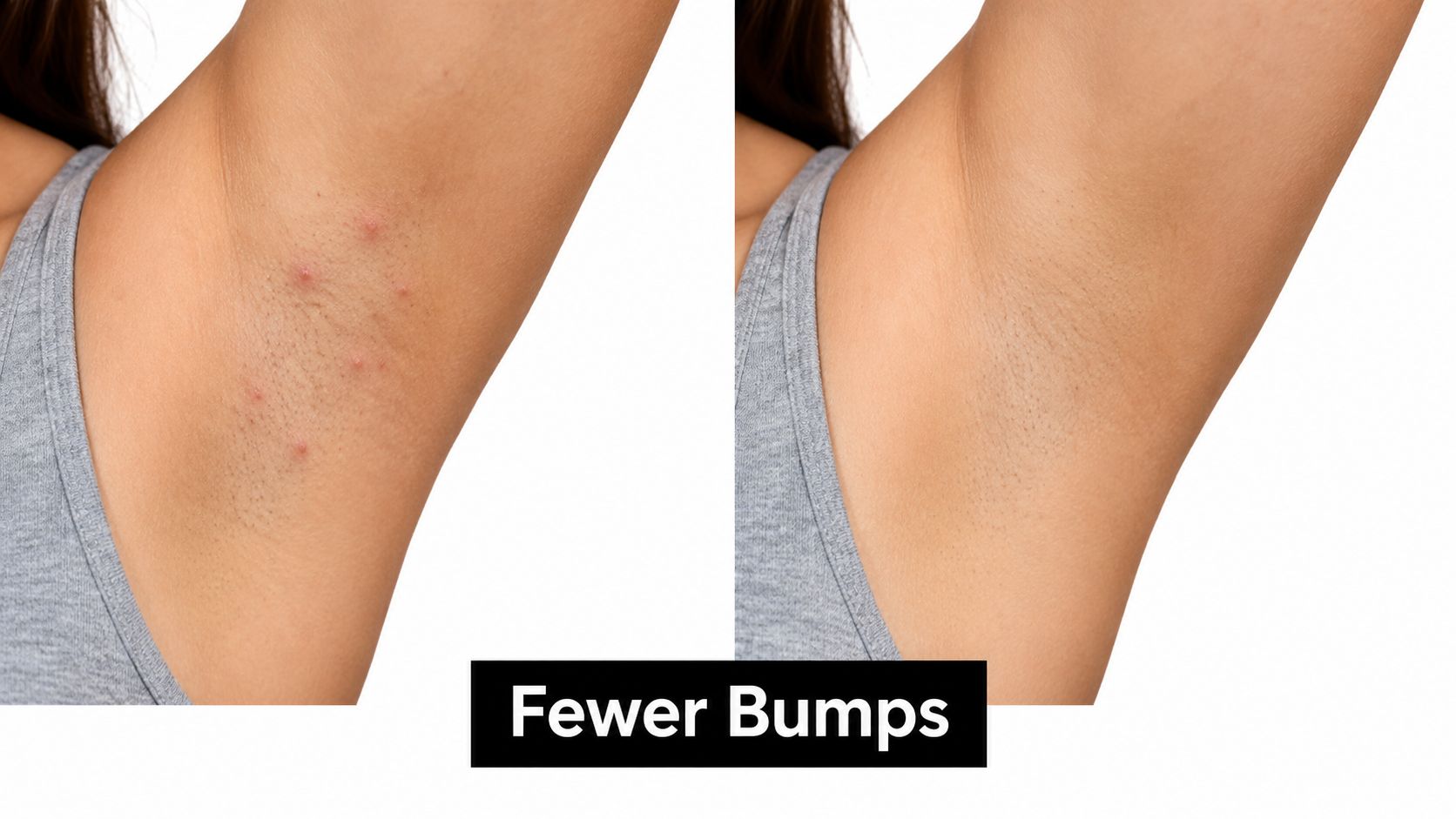
Hair reduction isn't a diagnosis or a promise to clear discoloration. Ask a practitioner to assess persistent bumps before buying treatment, especially if the skin is painful, broken, or appears infected. The clinic's discussion of razor bumps and laser hair removal is a useful starting point for that conversation, not a substitute for assessment.
Keep the skin-care comparison honest
Before treatment: Disclose irritation, deodorant reactions, exfoliants, and other products used on the area.
Between appointments: Ask when shaving and gentle skin care can resume; don't scrub tender skin to accelerate progress.
After treatment: Follow the provider's instructions about deodorant, heat, friction, and irritating products.
For broader preparation context, published pre- and post-treatment instructions discuss these care considerations. Your treating provider should confirm the instructions appropriate for you.
If you're browsing cheap ingrown hair oil options, bring ingredient lists to the consultation rather than adding an unfamiliar product during recovery.
Caption checkpoint: Record bumps, tenderness, grooming frequency, and product changes independently. A calmer after image is more informative when readers know whether the client also changed their razor or skin-care routine.
4. A Full 6-Session Package With Progress Tracked Over Time
An event-driven client wants a finish date. A long-view client wants to know whether they'll still see less regrowth after the appointments stop. For the latter, a sequence of matched photographs is more useful than a dramatic image taken immediately after the final treatment.
A split-underarm study of 31 adults with Fitzpatrick types I–IV compared six treatments at four-week intervals: clearance was 71.30% with alexandrite and 72.16% with diode after the course, and 71.90% and 73.71%, respectively, at an 18-month follow-up, with no statistically significant between-device difference, according to the alexandrite-versus-diode axillary study.
That evidence supports durable reduction in the studied population. It doesn't establish that every package has the same schedule or that all clients will maintain the same result.
The strongest after photograph is a matched follow-up showing regrowth over time, not merely smooth skin at the last appointment.
Separate the purchase from the treatment plan
A bundle describes what you're buying; it doesn't guarantee biological response. Ask how the practitioner adjusts scheduling, reviews progress, and handles postponed appointments or residual hair.
Caption checkpoint: Use baseline, mid-course, end-of-course, and later follow-up images with comparable grooming conditions. Record every interval, comfort issue, aftercare change, and any maintenance treatment rather than presenting a maintained result as untouched.
For an illustrative client juggling work in Nassau County, reserving appointments ahead may help with consistency. Still, leave room for the practitioner to reassess timing instead of treating the calendar as fixed.
5. Men's Underarm Treatment With Dense Growth and Individual Goals
A man who wants less underarm bulk may not want completely bare skin. Another may want to reduce the grooming required before swimming or wearing fitted gym clothing. These are different goals, and the consultation should establish which result the client wants.
Dense growth shouldn't automatically be described as a male characteristic or a reason to expect better results. Assess hair density, thickness, treatment boundaries, and desired reduction individually. If chest or back treatment is also planned, document those areas separately instead of assuming an underarm result predicts the rest.
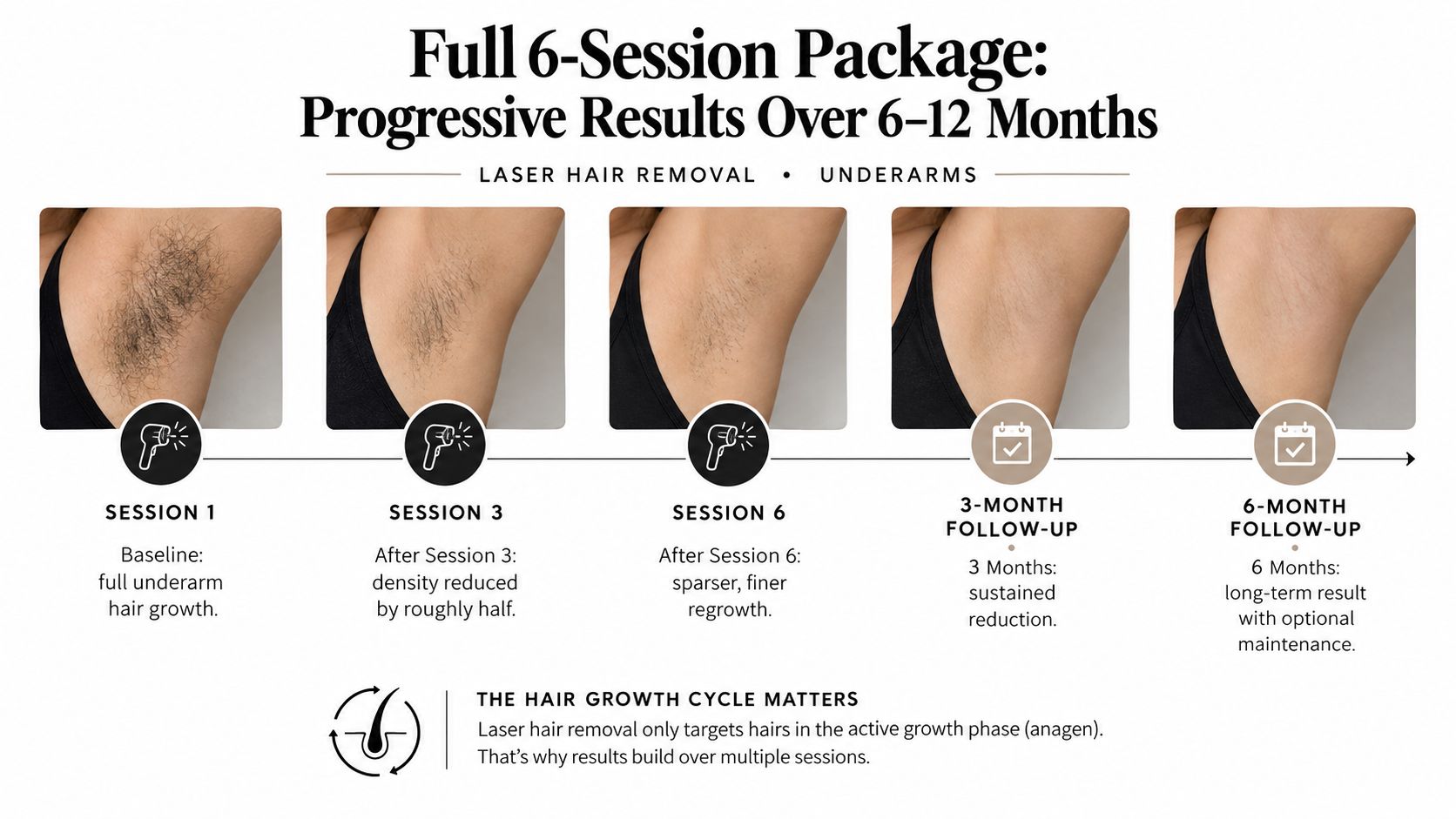
The supplied timeline illustrates how progress might be organized, not what a particular man will achieve. Use the clinic's guide to underarm hair removal for men to prepare questions about coverage, grooming, and maintenance.
Anatomy: Agree on where the underarm treatment stops and nearby arm or chest hair begins.
Comfort: Tell the practitioner if positioning strains your shoulder or if treatment feels difficult to tolerate.
Timing and aftercare: Discuss exercise, friction from clothing, and when your normal grooming routine can resume.
Caption checkpoint: Keep arm elevation and camera distance consistent so the exposed area doesn't change between images. Record the chosen goal, treated boundaries, session count, interval, comfort, and package details.
For this illustrative client, a meaningful outcome might be reduced bulk rather than an entirely smooth appearance. The photographs should reflect that agreed goal instead of presenting every remaining hair as a failure.
6. Light, Fine, or Gray Underarm Hair and a Limited-Response Journey
A client with graying underarm hair may arrive with a gallery saved on their phone, only to discover that its dark-haired examples aren't a useful comparison. Another client with fine, light hair may be more interested in whether treatment is worth purchasing at all. An honest before-and-after journey can begin with a candidacy discussion and end without a package purchase.
The Cleveland Clinic overview of laser hair removal frames the outcome as permanent hair reduction, not guaranteed permanent removal of every hair, and explains that response varies with hair and skin characteristics. That distinction matters particularly when the likely benefit is uncertain.
Ask for an assessment before a commitment
Hair-specific expectations: Ask the provider to explain candidacy for the actual mix of light, gray, and darker hairs in your underarms.
Trial options: Discuss whether a limited trial would be informative and how its outcome would be assessed.
Alternatives: Ask what other grooming or hair-removal options merit consideration if laser isn't appropriate.
Buying rule: A larger package doesn't resolve uncertain candidacy. Understand the expected benefit before committing.
Caption checkpoint: Record mixed hair colors and fine growth clearly, using the same exposure and background. A brighter after image can make light hairs harder to see without demonstrating that they've disappeared.
In this illustrative scenario, the responsible result may be modest change, an adjusted strategy, or a decision not to proceed. Comfort and aftercare still deserve discussion if treatment is attempted, even when the cosmetic benefit is expected to be limited.
7. Moving From Waxing or Shaving to a Laser Routine
A regular waxer may have few photographs showing their natural underarm growth. A daily shaver may have plenty of smooth-skin pictures but no comparable record of regrowth. Both need a baseline that explains the old routine before anyone can fairly assess a new one.
Ask the clinic how to transition from waxing or plucking and when to shave before treatment. A laser preparation and aftercare guide discusses avoiding root-removing methods, preparing clean skin, and caring for the area afterward. Follow your own provider's instructions rather than combining conflicting schedules from different websites.
Track routine changes and unusual growth
Grooming history: Record the previous removal method and any transition-related changes in visible density.
Photo conditions: Note time since shaving so longer hair isn't mistaken for increased growth.
Unexpected changes: Contact the practitioner if nearby or remaining hair seems unusually thicker; don't purchase more appointments.
Paradoxical hypertrichosis means increased growth rather than reduction. A 2024 study of 7,381 laser-hair-removal patients identified 25 cases, an incidence of 0.34%, most commonly on the upper arm and periareolar area rather than the underarm itself, according to the paradoxical hypertrichosis study.
That finding doesn't establish an underarm-specific risk rate. It does support documenting treatment boundaries and reporting unusual changes.
Caption checkpoint: Include grooming history, treatment dates, intervals, comfort, aftercare, and package choice. For this illustrative former waxer, fewer grooming appointments might be a practical goal, but it shouldn't be presented as an assured outcome.
Laser Hair Removal Underarms: Before-and-After Comparison
A close-up may show fewer dark hairs after treatment, while another person's photos may mainly reveal calmer skin or slower regrowth. These comparisons are useful when they show both a visual change and the conditions behind it. The table is a consultation tool: use the photo checkpoints to make images comparable, and take the questions to a practitioner who can assess your skin and hair.
Journey | Photo checkpoints to capture | Questions to bring to the consultation |
|---|---|---|
Dark, coarse hair, Fitzpatrick I–III | Record the same view before treatment and at follow-up, with similar time since shaving. | How many sessions might be appropriate, and what changes should I look for between visits? |
Darker skin tones, Fitzpatrick IV–VI | Include a clear baseline of the treatment area and follow-up images that show both hair and surrounding skin. | Which wavelength and settings suit my skin tone, and is a test spot recommended? |
Razor bumps and ingrown hairs | Photograph bumps and irritation before treatment, then document changes after the skin has settled. | Should any inflamed areas heal before treatment, and what aftercare is suitable for my skin? |
Full six-session package | Take a checkpoint before the series, during treatment, and after the final appointment. | How will we review progress, and when might maintenance be considered? |
Men's underarm treatment | Use consistent arm position and framing to show the treated area without changing the crop. | How might dense growth affect the plan, and can goals for other areas be discussed separately? |
Light, fine, or gray hair | Capture hair close enough to show its color and texture, alongside a view of the full underarm. | Is my hair likely to respond, and would a trial session help clarify expectations? |
Transition from waxing or shaving to laser | Note the last grooming method and photograph the area under consistent conditions. | When should I stop waxing or plucking, and how should I shave before appointments? |
For each journey, keep captions consistent: note the session stage, time since grooming, and any visible skin irritation. These details help distinguish gradual hair reduction from differences in lighting, framing, or hair length. Comfort and aftercare can also shape the experience, so ask how the clinic wants those changes recorded.
A photo series can show progress without promising complete or permanent removal. The most useful comparison makes the treatment context clear and leaves room for individual variation.
How to Read Your Own Before-and-After Progress
Your most useful comparison starts before treatment, with a documented grooming history and baseline skin assessment. Don't compare a long-growth before image with a freshly shaved after image and call the difference laser reduction. Match lighting, camera distance, arm position, and time since grooming as closely as practical.
Keep observations specific. You might notice fewer visible hairs without a change in pigmentation, or improved comfort without a completely smooth appearance. Those are separate outcomes, and recording them separately makes your consultation more productive.
Baseline: Document hair color, thickness, density, existing bumps, skin tone, and your usual removal method.
Treatment record: Log each appointment, interval, device information provided by the clinic, and any changes to the plan.
Regrowth: Compare coverage, thickness, and growth speed under similar grooming conditions.
Skin and comfort: Record tenderness, bumps, discoloration, and how treatment or aftercare felt.
Maintenance: Identify follow-up treatments clearly rather than implying the final image required no ongoing care.
As the clinical examples above demonstrate, meaningful reduction can coexist with residual hair. Consistent appointments, appropriate candidacy assessment, individualized settings, sun-protection guidance, and possible maintenance belong in the expectation, not in the fine print. Ask the practitioner how they'll judge progress if your photographs show less change than expected.
For Long Island residents, NYCLASER in Westbury offers underarm treatment using Splendor X technology, customized settings, single-session options, and 3- or 6-session bundles. Those choices describe available services, not promised outcomes. During consultation, confirm whether your skin and hair are suitable, what reduction is realistic, and how the proposed course fits your schedule.
Before booking, also confirm package terms, comfort policies, preparation requirements, and aftercare guidance. Bring photographs of your ordinary regrowth and a list of products used on your underarms. A provider who understands your starting point can discuss a more relevant plan than a gallery alone can offer.
NYC Laser Hair Removal offers personalized underarm treatment with Splendor X and flexible single-session or bundle options. Visit NYC Laser Hair Removal to request a consultation and discuss candidacy, realistic before-and-after expectations, and a photo-tracking plan before booking.
Comments