
Best Laser Hair Removal Deals That Actually Save Money
The most popular advice is to hunt for the biggest discount. I wouldn't. A low advertised price can turn into an expensive course if it covers only one visit, excludes the area you want treated, or leaves you paying full price for the sessions that follow. The best laser hair removal deals make the total expected cost clear and match the treatment to your skin, hair, and goals.
Start by comparing the price for the treatment area across a realistic course, then check the device, provider, and exclusions. Laser hair removal reduces hair over time; it isn't a guarantee that every hair will be gone forever. A deal that sets honest expectations and spells out what you're buying is more useful than a dramatic discount with fine print.
Why the Lowest Price Is Rarely the Best Deal
A bargain per visit can look compelling until you add up the visits. Because hair grows in cycles, most patients need about six to eight sessions, commonly spaced six to eight weeks apart, according to Cleveland Clinic's laser hair removal guidance. The right course varies by person and treatment area, so compare offers using the number of sessions a provider expects for your case, not a promotional headline.
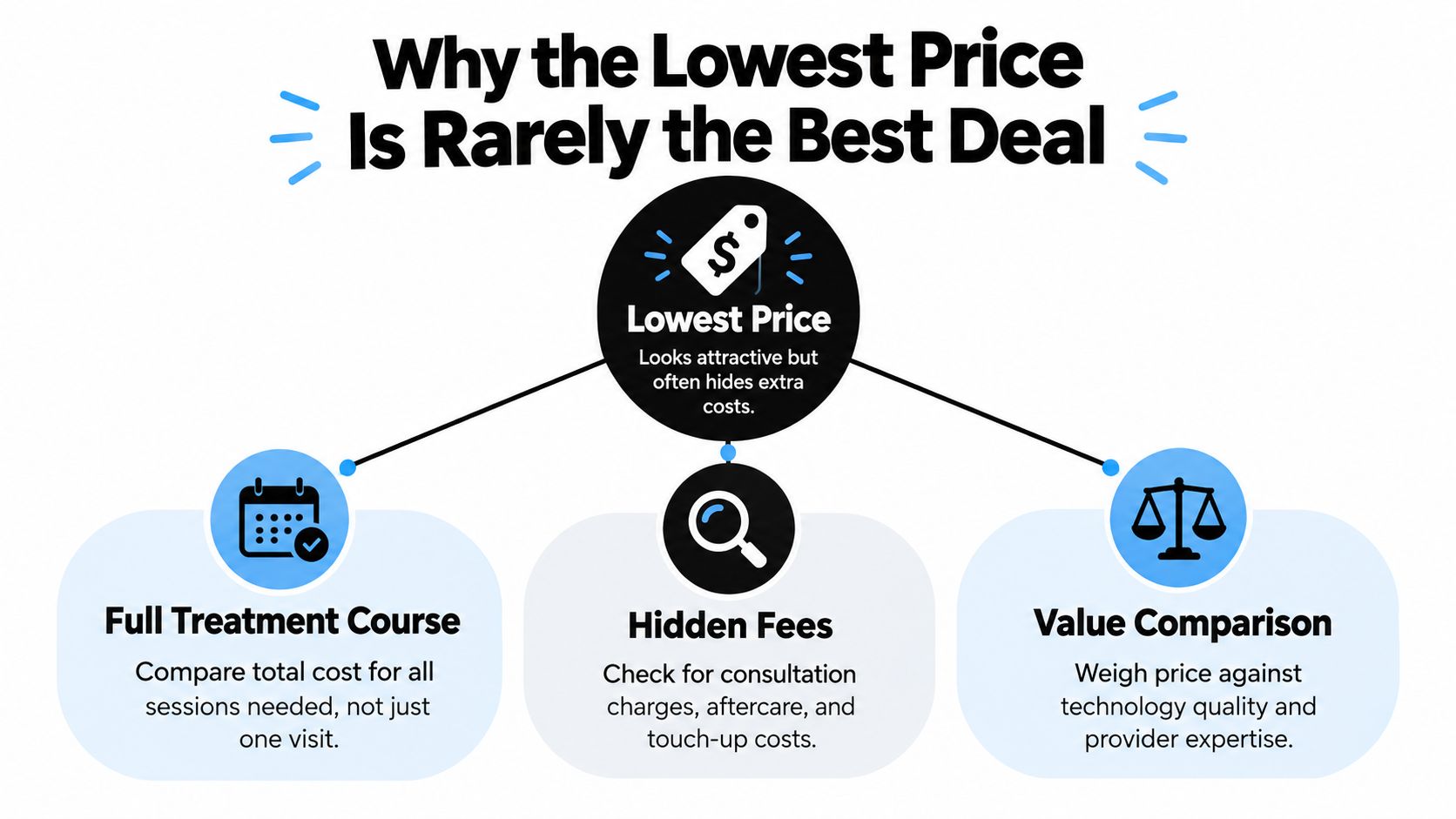
A useful historical reference is the American Society of Plastic Surgeons' report of about $350 per session on average in 2007. At that historical price, six visits would total $2,100 before a package discount. That's context for thinking about course cost, not a current Long Island quote. Treatment-area size, session count, and required visits can all change the final bill. The underlying historical report also lists a typical session price range, reinforcing why one advertised price can't represent every area or plan.
My rule: Don't ask only, “What's the price today?” Ask, “What will I pay to complete the plan you recommend for this exact area?”
Compare the per-session equivalent, the package total, and what happens if you need more visits than the bundle includes. A multi-session package may be better value than a low single-session price if you're likely to complete a full course. But don't assume the biggest bundle is automatically the right buy: find out whether it expires, whether sessions transfer, and whether maintenance is extra.
Be clear about the result, too. Laser hair removal is best understood as long-term hair reduction, not a promise of total, permanent eradication. A reputable provider should describe likely outcomes for your skin and hair profile and explain what the quoted course does and doesn't cover. A real deal names the treatment zone, session count, technology, and relevant exclusions before you pay.
Where to Find Legitimate Laser Hair Removal Deals
Look in more than one place, but judge each offer by the same standard: can you confirm who treats you, what the package covers, and what the complete cost might be?

Compare channels, not just discounts
Clinic websites: Start with the provider's own price list. A clear menu should define each treatment area, show single-session and package options, and make it easy to ask about expiration, consultation, and touch-up costs. Direct offers are also easier to verify with the clinic than a listing you found through a reseller.
Groupon and local deal sites: These can surface promotions, but treat the listing as an introduction, not a complete quote. Confirm the actual provider, exact area, session count, expiry date, refund process, and whether the clinic itself performs the treatment. Don't buy before you've checked the clinic's credentials and discussed whether the advertised treatment suits you.
Seasonal promotions and referral offers: Ask clinics directly about current specials, referral arrangements, and event pricing. A legitimate promotion should still disclose the same package details as a regular offer. A deadline isn't a reason to skip the safety conversation.
Consultation offers: A consultation can help you assess the device and provider before committing. Ask whether there's a charge, whether it's credited toward treatment, and whether you can take the written quote home.
If a deal comes from an unfamiliar seller, use the same careful approach you'd take when checking any beauty purchase. This Gift Me Japan authenticity checklist offers a useful reminder to verify who's behind an offer rather than relying on presentation alone.
For a local reference, NYCLASER lists Small, Medium, Large, and Extra Large treatment zones, with single-session and multi-session options. That kind of defined structure is easier to compare than a vague “full-area special.” You can also review laser hair removal client reviews, then ask the clinic to confirm current pricing and terms directly. Treat reviews as one input, not a substitute for a consultation or a written offer.
How to Read Package Structure and True Cost
Two offers with the same headline price can cover different treatment areas, numbers of visits, and follow-up costs. Convert the package into a per-session equivalent, then check whether the included sessions are likely to fit the plan the provider recommends. A low equivalent price doesn't help if the offer excludes your chosen area or expires before you can use it.
Use the table as a calculation template. The examples are arithmetic comparisons, not current Long Island clinic quotes. For a full course, the provider should explain whether the quoted package is likely to be enough and what additional visits would cost.
Package Format | Per-Session Equivalent | Sessions Included | Estimated Course Cost |
|---|---|---|---|
Single session at $200 | $200 | 1 | $1,200–$1,600 for six to eight visits |
Six-session bundle at $1,400 | About $233 | 6 | $1,400 for the included sessions, plus any additional visits |
First three sessions for $799 | About $266 | 3 | $1,598–$2,131 for six to eight visits if later sessions cost the same per visit |
The last two estimates assume additional sessions are priced at the same per-session equivalent as the original offer. That may not be true, especially if an introductory price applies only to the first visits. Ask for the price of every additional session in writing before comparing packages. Also verify that the package covers the exact treatment area you want, not a similarly named zone with different boundaries.
Don't let “unlimited” do the math for you. Ask how long the package lasts, which visits it includes, and whether touch-ups, consultation, or aftercare cost extra.
Before paying, request a written quote that answers the following:
Area: What body zone is covered, and where are its boundaries?
Course: How many sessions are included, and what's the expected total plan for my profile?
Price: What is the package total and per-session equivalent? What do extra visits cost?
Terms: When does the offer expire? Can I transfer it? What are the cancellation and refund rules?
Exclusions: Are consultation, test patch, maintenance, and touch-up visits included?
For another way to think through bundle details, compare laser hair removal deals alongside your written clinic quote. You can also review laser hair removal package options as one local example of how bundled sessions may be presented. The important comparison is the full written offer, not the bundle label.
Verifying Splendor X and Provider Credentials
A package price tells you what you might pay. It doesn't tell you which laser the clinic will use or whether the provider will tailor treatment to your skin and hair. Ask for the device name and wavelength, then ask why that setup is appropriate for you. If the answer is just “we use a strong laser,” keep asking.
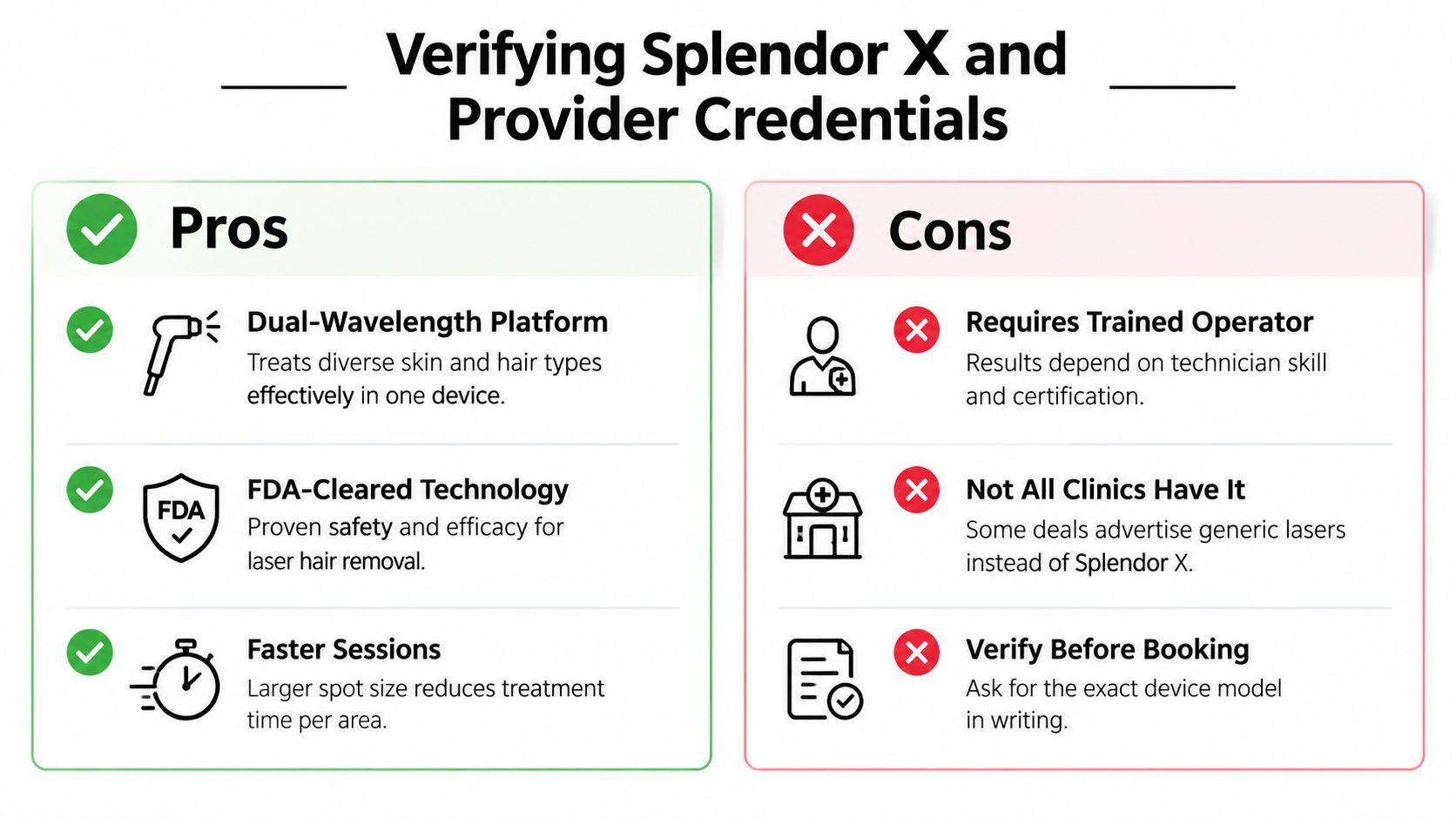
Splendor X is described by NYCLASER as its treatment platform. When comparing it with a clinic's older diode system or IPL equipment, don't decide from the device name alone. Ask the provider to explain the technology's wavelength, cooling approach, how it's selected for your skin, and whether it's appropriate for your hair. Different systems aren't interchangeable, and claims about speed or results deserve a specific explanation tied to your treatment area.
Match the technology to your skin
Skin tone, recent tanning, hair color, and treatment area can affect the settings and approach a clinician chooses. In one study of a long-pulsed 1064 nm Nd:YAG laser, treatment was provided to patients across Fitzpatrick skin types I–VI. At six months, reported average reduction was 41–46% on facial sites and 48–53% on the body. Those results are study-specific, not a promise for an individual patient, and the researchers' clinical study illustrates why follow-up timing and skin-appropriate settings matter.
A claim that one device works for everyone shouldn't replace a skin assessment. For darker or recently tanned skin, ask whether the provider will assess your skin, consider a test spot, adjust settings, and explain sun-exposure precautions. An offer that skips those steps to keep the appointment moving isn't a bargain.
Check the people and the process
Ask who performs the procedure and who oversees the clinic's laser services. Check what training the treating technician has, whether the clinic performs patch testing when appropriate, and whether it records settings and treatment progress. You're entitled to clear answers about how the clinic handles equipment maintenance and what it does if your skin reacts.
NYCLASER describes its services as using Splendor X and offering treatment across different skin and hair types. That's a starting point for a conversation, not a reason to skip your own assessment. For a practical credential checklist, review what to know about licensed laser technicians, then ask the provider to explain their own training, oversight, and treatment process in plain language.
Questions to Ask Before You Pay for Any Deal
Bring these questions to the consultation or send them before you buy. If a provider answers with polished generalities, ask for the detail that applies to your skin, hair, and chosen area.
Which device and wavelength will you use? Ask for the exact device and why its wavelength fits your skin tone, hair, and treatment area. “We customize every treatment” isn't enough unless the provider explains what gets customized.
Who will perform the treatment, and what training do they have? Confirm who operates the device and who provides medical oversight. Ask who you can contact if you have a reaction afterward.
Do you recommend a test spot? Ask whether the clinic assesses your skin first and when a patch test is appropriate, especially if you have darker skin or recent tanning.
How will you adjust settings for different areas and skin? Ask whether the same settings are used everywhere. A sound answer should explain that the provider considers skin, hair, and treatment area rather than applying one preset to everyone.
How many visits do you expect for my specific plan? Ask for a range and what factors could change it. A single fixed promise without an assessment should make you cautious.
What happens if progress stalls? Ask how the clinic evaluates a plateau and whether changing settings, spacing, or the plan could affect your price.
What does the package exclude? Get the costs for extra visits, maintenance, consultation, and touch-ups in writing.
What are the cancellation, expiration, transfer, and refund terms? Ask to see the actual policy before paying, not just a verbal summary.
Does financing create a separate obligation? Confirm the total repayment amount, payment schedule, and consequences of cancelling treatment. Don't confuse a monthly payment with the total price.
Hair growth cycles mean appointments need to be spaced appropriately. A controlled study using a 755 nm alexandrite laser gave treatments at four-to-six-week intervals and reported an average of 5.6 treatments; the researchers also recorded temporary pigment changes and other adverse effects. The study details underline why device settings, skin assessment, and follow-up belong in the conversation, not just the package price.
If the provider can't answer in plain language, pause the purchase. You're not being difficult by asking how the treatment will be tailored and what you'll owe.
Red Flags and Hidden Costs to Watch For
A bold discount doesn't rescue a vague contract. Be wary of “unlimited” offers that don't define included areas, appointment windows, or maintenance, and of countdown pricing that pressures you to buy before you've had a consultation. Ask for the full terms in writing. If the clinic won't give them, walk away.
An exact body-zone definition matters. “Medium area” can mean different things from one provider to another, and an offer that covers only a portion of the area you expect can lead to extra charges. The same goes for a low headline price that excludes consultation or touch-up visits. Compare what's included, not just the percentage-off language.
Read the contract like a buyer
Consumer-protection cases show why the written offer matters. In a case about advertising individual and package prices for permanent hair removal, the court rejected the idea that a later in-person explanation was enough to fix a misleading impression created online. A separate consumer advisory describes complaints about hair-removal contracts costing more than €10,000, involving deposits and recurring instalments. These examples come from consumer-protection reporting, not Long Island price data, but the lesson travels: know the whole financial commitment before signing. Read the consumer-protection ruling on misleading hair-removal advertising.
Be cautious if a provider offers no skin assessment, skips a test spot when one is appropriate, or proposes identical settings regardless of skin tone and treatment area. Especially if you've recently tanned or have darker skin, ask how the clinic will select and adjust the treatment. A cheap appointment isn't worth a provider who can't explain their safety process.
Groupon and similar listings deserve one extra check: who will perform the treatment? The seller may not be the clinic, and the listed provider may use a partner location. Verify the clinic, operator, device, and package terms directly before buying.
Run this quick check before you pay:
Can't name the area? Don't buy until it's defined.
Can't show the total cost? Ask for a written quote.
Can't explain the technology or safety process? Choose a provider who can.
Pressured to sign today? Take time to compare.
Contract or financing terms unclear? Don't commit.
Timing, Booking, and Getting the Most From NYCLASER
Plan around your schedule and sun exposure, not just a promotion calendar. Treating skin that's recently tanned can affect the safety conversation, so tell the clinic about recent sun exposure and ask whether to postpone. Book with enough lead time if you're planning around an event, and don't expect a package to deliver an instant, finished result.
Keep appointments on the schedule your provider recommends. Cleveland Clinic describes a common interval of six to eight weeks between sessions, while facial treatment timing may differ based on the area and clinician's advice. If an offer has an expiration date, make sure it gives you enough flexibility to complete appointments at an appropriate pace.
Make the first appointment count
Before you arrive, gather your medical history, current medication list, and details of recent sun exposure. Tell the provider about relevant skin concerns and any prior reactions to laser treatments. Ask which preparation and aftercare instructions apply to your treatment area; don't rely on generic advice if your clinician gives you different guidance.
For Long Island shoppers, NYCLASER lists treatment areas by size, including options from small zones to larger areas, and offers single sessions and multi-session bundles. Use its online booking to request a consultation, then confirm current pricing, which exact zone applies, what the package includes, and whether any restrictions or additional costs apply. The clinic is located in Westbury and lists its hours as Monday through Saturday.
A deal is worth considering when the price is clear, the package fits your expected course, and the provider can explain why the technology and settings suit you. Don't let a deadline or a low headline price make that decision for you. Get the offer in writing, compare the full cost, and book only after your questions have been answered.
If you're comparing laser hair removal deals on Long Island, NYC Laser Hair Removal offers treatment zones across multiple areas, with single-session and multi-session package options using Splendor X. Review the current pricing, ask for a consultation, and confirm the exact area, treatment plan, and terms before booking.
Comments