
Skin Smoothing Laser Treatments: A Practical 2026 Guide
You've compared clinic pages and found the same promise attached to several different machines: smoother skin, less visible sun damage, softer scars. But “skin smoothing laser” isn't one treatment. The right choice depends on what you want to improve, how much recovery you can manage, and how your skin responds to inflammation.
The basic idea is straightforward: a clinician uses focused light energy to create a controlled response in the skin. The details matter, especially whether the treatment removes surface tissue, heats beneath the surface, or treats tiny columns while leaving surrounding skin intact. Understanding those differences makes it easier to ask useful questions and set realistic expectations.
What Skin Smoothing Laser Treatments Do
A skin smoothing laser is a category of resurfacing treatment, not a single device. It directs energy into the skin to address concerns such as uneven texture, fine lines, acne scars, or sun-related changes. The effect depends on how the laser interacts with tissue: it may remove damaged surface layers, heat deeper tissue, or combine these approaches.
Ablative lasers remove or vaporize targeted tissue, creating a controlled injury that prompts healing and remodeling. Non-ablative lasers heat tissue without removing the outer surface, which means a different balance of treatment intensity and recovery. Fractional describes the pattern, not whether a laser is ablative: treatment affects microscopic columns, with untreated skin between them to support healing.
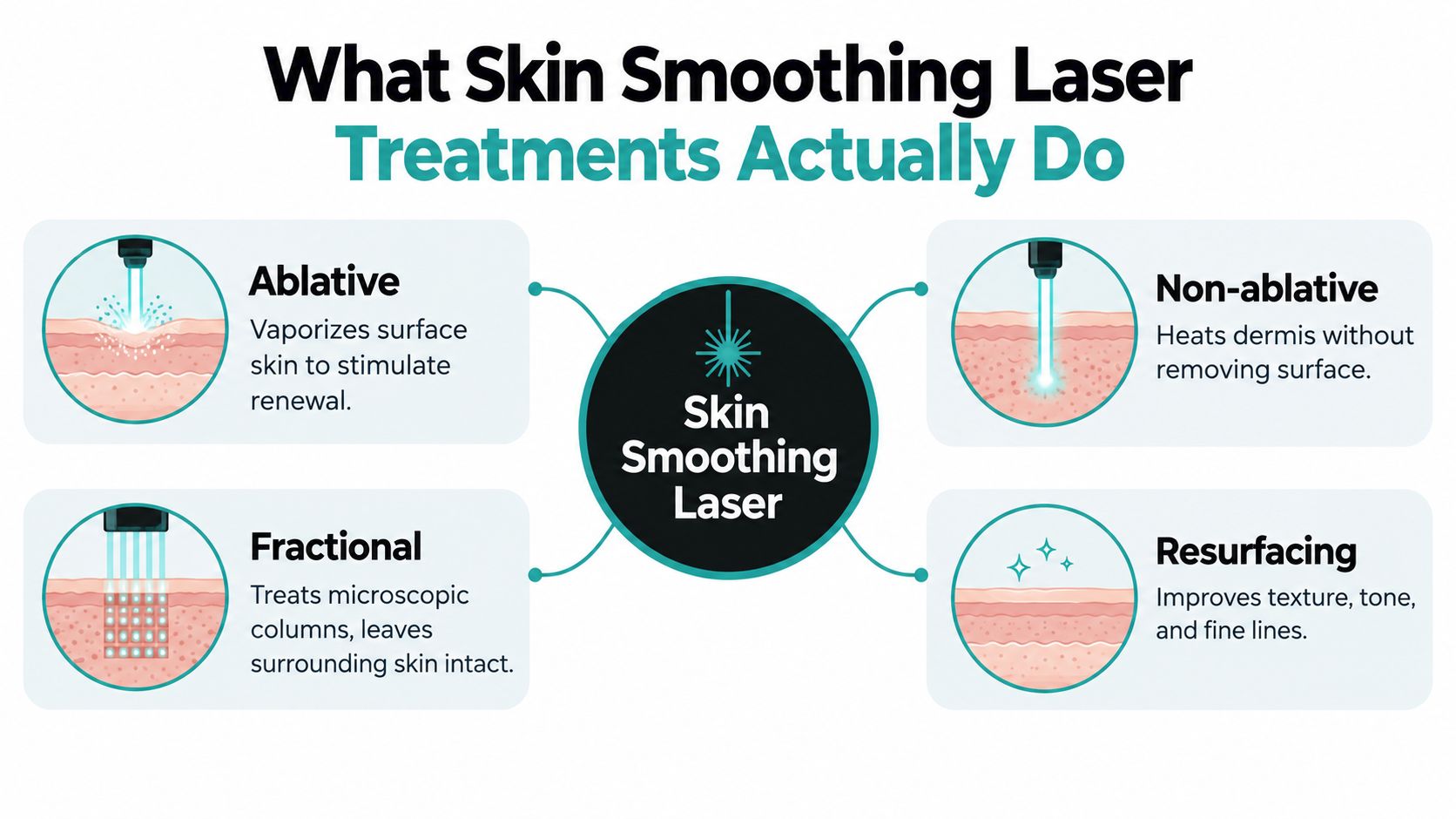
Ablative versus non-ablative describes what happens to the tissue; fractional describes how the treatment is distributed across the skin. The terms can overlap. Fractional CO₂, for example, is ablative fractional treatment. When discussing a device with a clinic, ask about its treatment mode, target, and intensity, not just its name. Those details help you judge whether it fits your concern and how much recovery to expect.
Why improvement takes time
Healing begins after treatment, while skin remodeling continues afterward. With fractional CO₂, microscopic columns of controlled thermal injury stimulate dermal remodeling, including collagen contraction and new collagen formation. As a result, early changes and later changes may look different.
Treatment intensity also affects the trade-off. A course of lighter treatments may suit someone seeking gradual change with less recovery, while a more intensive approach may be considered for a deeper texture concern. Neither is automatically better. The relevant question is whether the expected improvement justifies the inflammation and downtime for your skin and goals.
Practical rule: Ask which tissue the device targets, whether it removes surface skin, and what recovery the clinician expects. The word “laser” alone does not answer those questions.
The Main Laser Types and What Each One Targets
A consultation may offer CO₂, erbium, or a hybrid treatment for the same texture concern. These names describe different tools, each with its own balance of surface removal, tissue heating, and recovery. Wavelength is like a tool's design; pulse settings and treatment intensity affect how it is used.
Laser type | Action in the skin | Recovery considerations | Common targets |
|---|---|---|---|
Ablative fractional CO₂ | Removes tissue in microscopic columns and creates dermal thermal injury | More recovery than non-ablative options; redness may persist | Pronounced texture changes, including atrophic acne scars |
Er:YAG | Removes surface tissue, with effects adjusted through system and pulse settings | Often faster recovery than CO₂, depending on treatment settings | Wrinkles, uneven texture, scars, and sun-related changes |
Non-ablative fractional | Heats tissue without removing the surface | Generally shorter recovery than ablative resurfacing | Gradual texture improvement with less surface disruption |
Hybrid fractional | Combines fractional approaches in one treatment | Faster healing than CO₂ in a clinical comparison | Fine lines, tactile roughness, and mottled pigmentation |
The wavelength alone does not predict downtime.
CO₂ uses a 10,600 nm wavelength; comparative clinical evidence on fractional CO₂ found it more likely than erbium-based fractional lasers to achieve more than 50% clinical improvement in atrophic acne scars, with greater pain and longer downtime. Fractional treatment leaves untreated skin between treatment columns to support healing.
Er:YAG received its first U.S. Food and Drug Administration approval for cutaneous resurfacing in 1996, according to this review of Er:YAG laser history and complications. Early systems used short pulses; later systems offered variable and longer pulses, allowing more control over tissue interaction. Comparisons with CO₂ found comparable efficacy and a trend toward faster recovery. Faster healing still carries risks.
A comparison of CO₂ and hybrid fractional treatment found stronger clinical scores with CO₂, while hybrid treatment produced faster healing, fewer complications, and greater patient satisfaction. Those findings describe a treatment trade-off, rather than a universal winner. For Fitzpatrick IV–VI skin, pigment-change risk also needs consideration when interpreting these options.
Use this overview of skin texture laser options to prepare questions about the proposed device and settings. This guide to CO₂ laser treatment on Long Island provides a local explanation of that approach.
Who Makes a Good Candidate for Each Laser
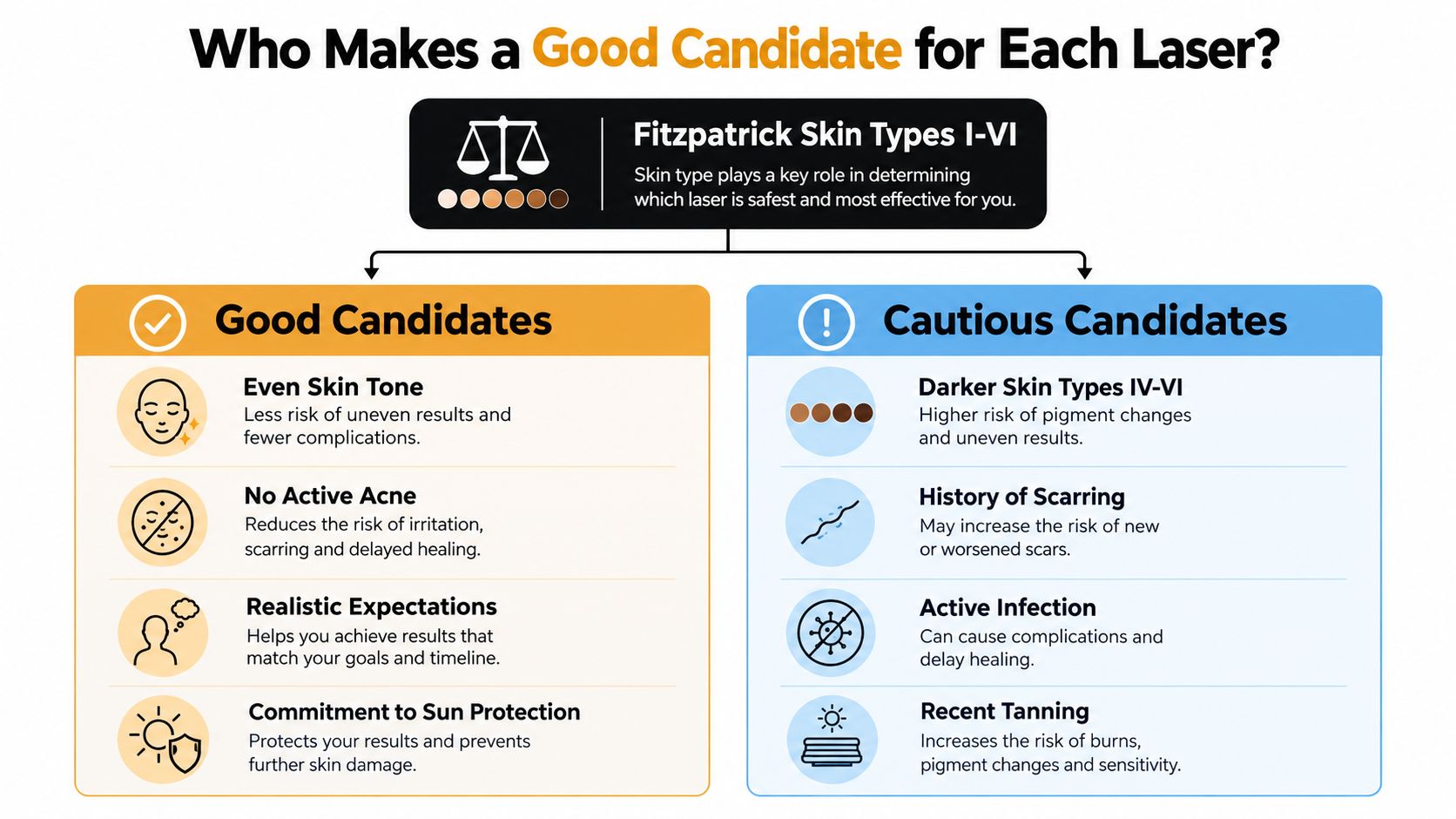
A person considering resurfacing may wonder whether their skin tone rules out treatment. Clinicians assess more than a device name or ethnicity label. The Fitzpatrick skin type scale describes how skin tends to respond to sun exposure, ranging from I to VI, from very fair skin that burns readily to highly pigmented skin that rarely burns. It helps guide screening, but does not replace an individual evaluation.
The concern, skin history, and healing risks all shape the choice. For skin types III–VI, clinicians give particular attention to pigment changes after inflammation. Brown and Black skin is not automatically excluded from resurfacing, though treatment settings and aftercare should account for the possibility of persistent post-inflammatory hyperpigmentation or hypopigmentation. An overview of Fitzpatrick skin types and laser candidacy illustrates why skin response matters alongside the treatment goal.
Match the treatment to the risk profile
When limiting surface injury and recovery is a priority, a clinician may consider a non-ablative or hybrid approach. These options are not interchangeable, and a less invasive choice does not guarantee a particular result. The comparison discussed earlier found faster healing and fewer complications with hybrid fractional treatment, while CO₂ produced stronger clinical scores. That trade-off can help frame the consultation, but suitability still depends on the individual.
Recent tanning, active infection, melasma, active acne, a history of keloid scarring, and medications that affect healing all warrant discussion. Do not stop prescribed medication on your own. Ask the clinician to review your medication history, current skin activity, and timing before recommending a plan.
For someone with greater pigment-change risk, the consultation can cover whether a test spot, conservative settings, or staged treatment is appropriate. The useful question is not whether treatment is possible. Ask which laser approach, settings, and follow-up plan fit your concern while limiting pigmentary risk. A careful clinician should explain the trade-offs in plain language.
What Happens During and After a Session
A client arriving for resurfacing should first discuss the treatment, not be handed a device choice. The clinician reviews the client's goals, skin history, medications, past reactions, and suitability for the proposed approach. Before consent, the team should explain preparation, likely recovery, risks, and aftercare. The details can differ substantially between ablative CO₂, erbium, non-ablative fractional, and hybrid treatments.
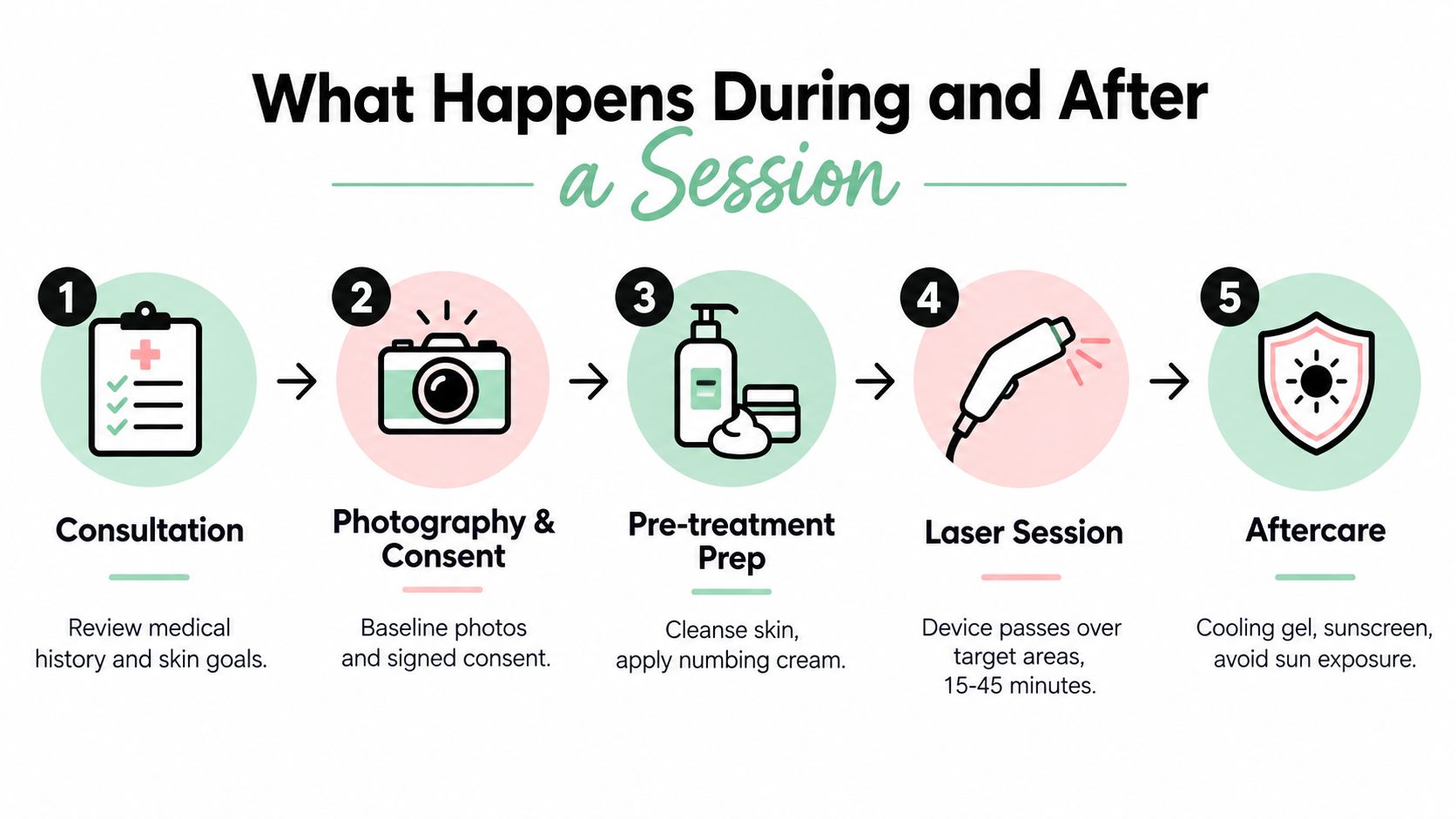
Before treatment, the skin is cleansed and protective measures are put in place. Numbing depends on the procedure and clinician's protocol. Some treatments use topical anesthetic, while others may use local anesthesia. Ask what is planned and whether sedation is involved, rather than assuming every laser session follows the same process.
Recovery is part of the treatment
Redness and swelling can follow resurfacing. Ablative treatments may also involve peeling and healing of the skin's surface; non-ablative fractional treatments generally leave that surface intact. The depth, coverage, device, and individual skin response all affect recovery, so a general timeline cannot predict exactly what your skin will do.
A review of fractional CO₂ treatment assessed 101 treatments in 97 patients over 19 months, with an average follow-up of 4.5 months. Redness lasted fewer than five weeks in 93% of patients, five to eight weeks in 5.9%, and longer than eight weeks in 0.9% (fractional CO₂ treatment review). These results describe that clinical series, not a guaranteed recovery timeline for every person or laser type.
Some people may feel ready to return to routine after a week away from work, while visible redness can persist longer, particularly after stronger resurfacing. Before booking, ask the clinic what healing may look like with your specific treatment and whether you should plan around work, sun exposure, or an upcoming event.
A video can show the general sequence of a session, but it cannot predict an individual response.
How Lasers Compare to Peels, Microneedling, and IPL
The best comparison starts with your main concern. A resurfacing laser may be considered for textural change, while a treatment aimed at pigment or redness may make more sense if surface irregularity isn't the primary issue. Ask a clinician to compare options using the same criteria: target, depth, recovery, pigmentary risk, and likely treatment plan.
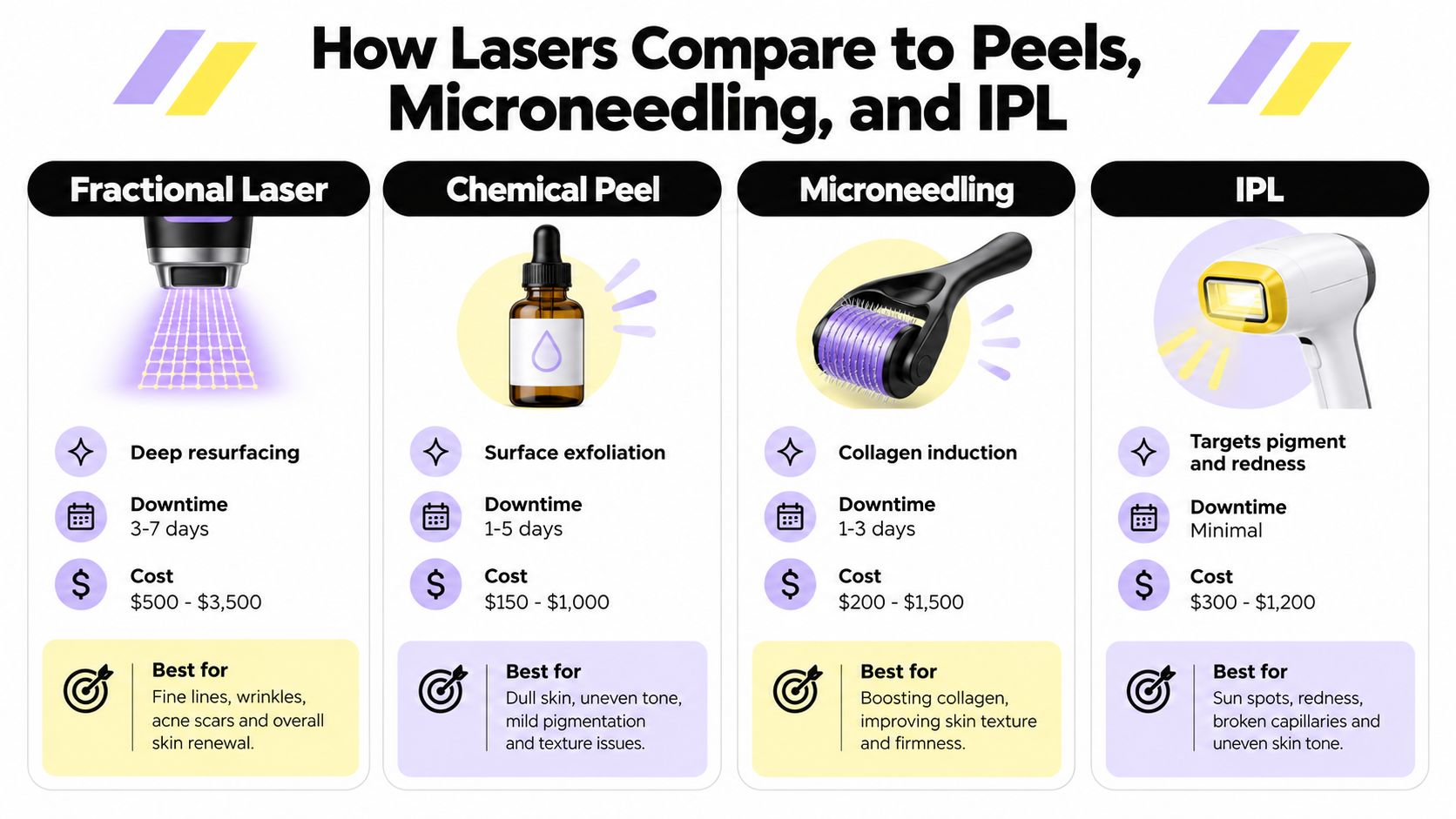
Option | Main target | Recovery and suitability |
|---|---|---|
Fractional laser | Texture and dermal remodeling | Recovery varies with laser type and intensity; ablative options require more caution around pigment changes |
Chemical peel | Surface exfoliation and selected tone concerns | Depth and recovery depend on the peel; ask how the specific formula fits your skin |
Microneedling | Collagen induction and selected texture concerns | A possible alternative when a clinician judges that laser resurfacing isn't the best first choice |
IPL | Pigment and visible redness | Not a resurfacing substitute for texture concerns; discuss whether its targets match your goal |
IPL is often grouped with lasers in casual conversation, but it uses broad-spectrum light rather than a laser beam. Its targets include pigment and redness, so it shouldn't be presented as equivalent to a resurfacing laser for texture. For a closer look at IPL and treatment expectations, see this guide to IPL before and after treatment.
Choose by concern, not by popularity
If your main issue is atrophic acne scarring, fractional CO₂ may offer stronger textural correction than erbium-based fractional treatment, with the trade-off of more pain and downtime. If your concern is mainly pigment or visible redness, ask whether IPL or another approach addresses that target more directly. For someone who wants collagen induction but is cautious about ablative resurfacing, microneedling may be worth discussing with a qualified clinician.
There's no responsible universal ranking. Skin type, medical history, the area being treated, and your tolerance for recovery all shape the decision. A useful consultation ends with an explanation of why one modality fits your concern better than the alternatives, not just a recommendation to buy a particular device.
Risks, Side Effects, and Aftercare That Matters
A treated area may look and feel irritated before it begins to heal. Laser resurfacing creates a controlled injury, so redness and swelling are common short-term effects. Depending on the device and treatment, pinpoint bleeding, acne flare-ups, milia, or reactivation of herpes simplex virus can also occur. Less common complications include bacterial or fungal infection. Post-inflammatory pigment changes and scarring are important risks to discuss before treatment (Er:YAG laser complications).
Risks vary with the laser approach. Ablative treatments remove or vaporize tissue, while fractional methods leave untreated skin between treatment zones, which can support healing. Neither approach removes the need to discuss your skin's response, treatment settings, and recovery plan with the clinician. Pigment changes deserve particular attention for people with darker skin tones.
Aftercare protects healing skin
Follow the written instructions from the treating clinician. Care generally includes gentle cleansing and the ointment or moisturizer recommended for your procedure. Wait for the clinician's guidance before restarting retinoids, exfoliating acids, or other potentially irritating products.
Sun protection matters during healing, when inflammation can be followed by pigment changes. Avoid unnecessary sun exposure, and ask when to restart sunscreen and normal activities based on how the treated skin is healing. Heat and exercise may worsen flushing, so check with the clinic about when to resume them rather than guessing.
If redness worsens instead of settling, or you develop signs of infection, unusual pain, or delayed darkening, contact the treating clinic for guidance.
Before treatment, confirm whom to contact afterward and which symptoms need prompt review. For recovery instructions, read this guide to post-laser skin care.
Preparing for a Consultation on Long Island
Bring information that helps the clinician evaluate your skin, not just a preferred device name. Tell them what you want to improve, what treatments you've tried, how your skin reacted, and how much recovery you can realistically manage.
Before you book, prepare this short checklist:
Skin response: Ask the clinician to assess your Fitzpatrick type and discuss any past pigment changes or prolonged redness.
Medications and products: List prescriptions, supplements, and active skincare ingredients. Don't stop medication without the prescriber's advice.
Sun and event timing: Explain recent tanning, upcoming travel, and events that may make visible redness difficult to manage.
Past reactions: Bring photos or a clear description of previous irritation, scarring, or changes in pigmentation.
Treatment details: Ask which device and mode they recommend, how they'll select settings, whether a test spot is appropriate, and how they'll respond if pigmentation changes appear.
For Fitzpatrick IV–VI, make sure the conversation includes a plan for conservative parameters, photoprotection, and follow-up. The clinician should be able to explain why the proposed approach suits both your concern and your skin's risk profile.
Book a consultation when you're ready to compare options, but treat the visit as a chance to evaluate the plan as much as the device. A good recommendation should make sense for your goals, skin history, and recovery limits.
Common Questions About Skin Smoothing Laser
How many sessions will I need?There isn't one session count that suits everyone. Treatment depth, device, concern, and tolerance for downtime shape the plan, so ask the clinician whether a staged course or a more intensive approach makes sense for you.
Are results permanent?Laser treatment can improve existing texture and damage, but it can't stop future sun exposure or the skin's ongoing changes. Ask how maintenance and sun protection fit into your plan.
When's the best season to schedule treatment?Choose a time when you can follow sun-avoidance guidance and manage visible recovery. Your clinician can advise based on your treatment and calendar.
Can lasers be combined with injectables or microneedling?Sometimes, but timing and sequencing depend on the treatments and your skin's response. Don't schedule combinations without a clinician's plan.
How do I know if redness is a complication?Redness can be part of healing, but worsening symptoms, signs of infection, or delayed darkening deserve a call to the treating clinic.
If you're comparing skin treatments in Long Island, NYC Laser Hair Removal offers laser hair removal with Splendor X technology, personalized care, and treatment options for different body areas and skin tones. Visit NYC Laser Hair Removal to learn about the clinic's services and decide whether a consultation is the right next step.
Comments