
Underarm Hair Removal Men
You lift your arm in a meeting and suddenly notice the hair. The same thing happens under harsh gym lighting, during a date, or when a fitted shirt traps sweat against your skin. You're not necessarily chasing a perfectly bare look. You're trying to solve a practical annoyance without replacing it with razor burn, painful bumps, or another grooming chore.
For most men, the decision comes down to odor control, skin comfort, and low-maintenance results. Aesthetics may start the thought, but one of those three goals usually determines whether a method survives beyond the first attempt. The right choice depends on which problem matters most, because trimming, shaving, waxing, creams, IPL, and professional laser don't deliver the same result.
A polished appearance can involve more than hair removal. If you're refining your broader presentation, a practical grooming routine for red carpet offers useful context on preparation, skin condition, and finishing details. For your underarms, though, keep the standard simple: choose the method that improves your actual day.
The Real Reason Men Are Removing Underarm Hair
Underarm grooming is no longer an unusual experiment. In a Men's Health survey of 4,044 men, 68% said they trim their armpit hair, with 52% naming aesthetics and 16% naming athletic reasons, while about one in ten said they never trim it (survey details). The useful takeaway isn't that every man should remove his hair. It's that the habit has become ordinary enough for men to judge it by results rather than by outdated ideas about masculinity.
Start with the problem, not the tool
Odor control is the clearest functional reason. Hair doesn't create sweat, but it can hold moisture and make washing or product application less efficient. If you leave the gym feeling damp and your deodorant seems to disappear quickly, shortening or removing hair may make the area easier to manage.
Skin comfort is a different goal. A bare underarm can feel cooler and less congested, but close shaving can introduce stubble, friction, nicks, and ingrown hairs. If your skin reacts easily, a guarded electric trimmer may improve comfort more than a perfectly smooth shave.
Low-maintenance results favor a different strategy again. Trimming is quick but requires regular attention. Waxing gives a longer bare interval but adds pain and appointments. Laser requires an upfront commitment, yet it can reduce the need for repeated shaving once a suitable treatment plan is complete.
Practical rule: Don't remove more hair than your main problem requires.
If odor is the issue, start with a short trim or close shave and test your washing and antiperspirant routine. If bumps are the issue, move away from blade contact. If you're tired of repeating the same cycle, investigate professional laser rather than endlessly buying another razor.
A Quick Look at the History of Men's Body Hair Removal
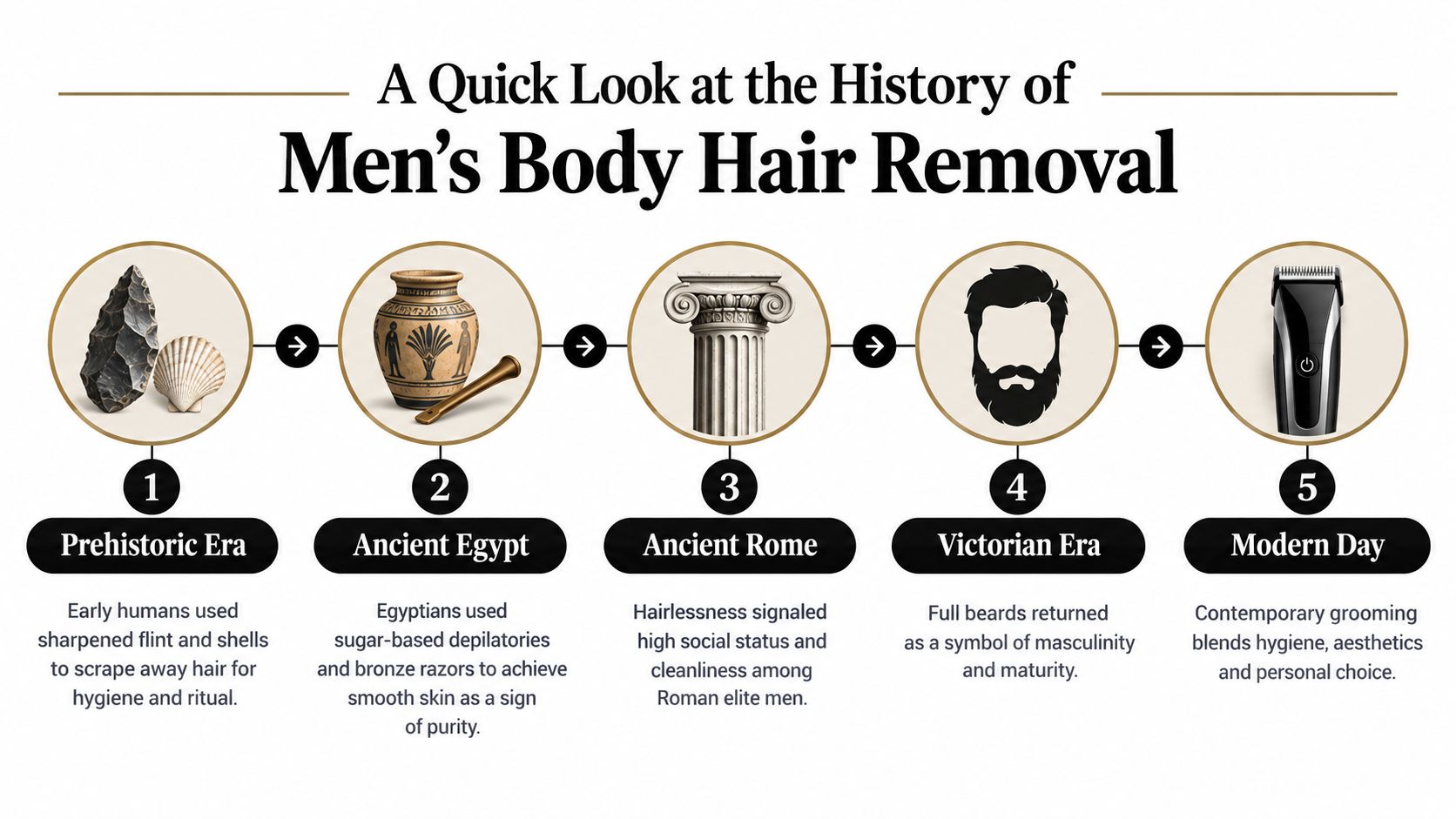
Men's body-hair removal isn't a modern rebellion against tradition. It sits inside a grooming practice that reaches back at least 30,000 years, based on the dating of early flint razors (historical overview). Early tools were crude, but the motivation was familiar: managing hair for hygiene, ritual, comfort, or appearance.
Ancient Egyptian grooming included depilatory preparations and bronze razors. Roman men associated hairlessness with cleanliness and social presentation, particularly among the elite. Later, Victorian culture pushed full facial hair back toward the center of masculine appearance, and male body depilation became less visible in everyday grooming.
Why the razor became the default
The major consumer shift came in 1901, when King C. Gillette introduced the double-edge safety razor, making at-home shaving more practical and helping routine hair removal spread across the twentieth century (historical overview). The exact year matters because it explains why men still reach for a razor automatically. The tool was affordable, familiar, private, and easy to use without professional help.
That history created a habit, not proof that shaving is the best answer. Men inherited a system built around repeated removal at home. Modern gym culture, closer-fitting clothing, increased visual exposure, and professional laser technology have widened the choices.
The sensible conclusion is straightforward: your razor is a historical default, not a biological requirement. Test it against your skin and your priorities. If it produces irritation without solving odor or maintenance, tradition isn't a good enough reason to keep using it.
Every Method Compared Side by Side
There are six realistic routes for underarm hair removal men can choose today. The table uses practical ratings rather than pretending that every man will experience the same pain or cost. Annual cost varies by product quality, treatment area, location, and how often you repeat the method, so the cost column is qualitative rather than fabricated.
Method | Pain (1-5) | Cost Per Year (USD) | Maintenance | Results Last | Best For |
|---|---|---|---|---|---|
Electric body groomer | 1 | Low | Frequent trimming | Short | Skin comfort and tidy appearance |
Manual razor | 1-3 | Low | Frequent shaving | Short | Smooth skin at minimal expense |
Depilatory cream | 1-2 | Low to moderate | Repeat as regrowth appears | Short | Blade-free removal when skin tolerates it |
Hot or strip waxing | 3-5 | Moderate to high | Repeat appointments or home sessions | Longer than shaving | Longer bare intervals |
At-home IPL | 1-2 | Moderate upfront | Repeated use, then periodic upkeep | Gradual reduction | DIY reduction for suitable hair and skin |
Professional laser | 2-3 | High upfront | Planned treatment series, then maintenance | Long-term reduction | Low maintenance and persistent reduction |
The practical read
Electric trimming is the safest first move for most beginners. A guarded body groomer shortens hair without scraping the skin, and it suits men who want less sweat retention or a cleaner outline without demanding complete smoothness. It won't deliver a bare finish, and it won't significantly improve odor control in the clinical comparison described later.
Manual shaving is cheap, fast, and close. Use a clean, sharp razor with fragrance-free gel, because underarm skin bends and creases more than the cheek or leg. Coarse or curly hair raises the chance of bumps, especially when you shave against the grain or make repeated passes.
Depilatory cream dissolves hair at the surface without a blade. Products such as Nair can work, but underarm skin is a poor place to gamble with chemical irritation. Read this practical guide to underarm hair removal cream, patch test first, and don't exceed the stated contact time.
Waxing removes hair from the root and generally lasts longer than shaving. The trade-off is pain, temporary redness, and a greater chance of irritation if you already have folliculitis, eczema, psoriasis, or recently damaged skin.
At-home IPL, including systems such as Philips Lumea and Braun Silk-expert, can reduce regrowth for some users. Marketing often makes coarse underarm hair sound easier than it is. IPL depends on pigment contrast and consistent use, and it isn't suitable for every skin tone or hair color.
Professional laser is the strongest long-term option when the hair contains enough pigment and the provider selects an appropriate wavelength. Diode, alexandrite, and Nd:YAG systems aren't interchangeable, so device selection matters as much as the promise on the treatment menu.
Verdict: Trim for comfort, shave or wax for stronger short-term odor control, and choose professional laser when low maintenance matters most.
What Underarm Hair Removal Actually Does to Odor
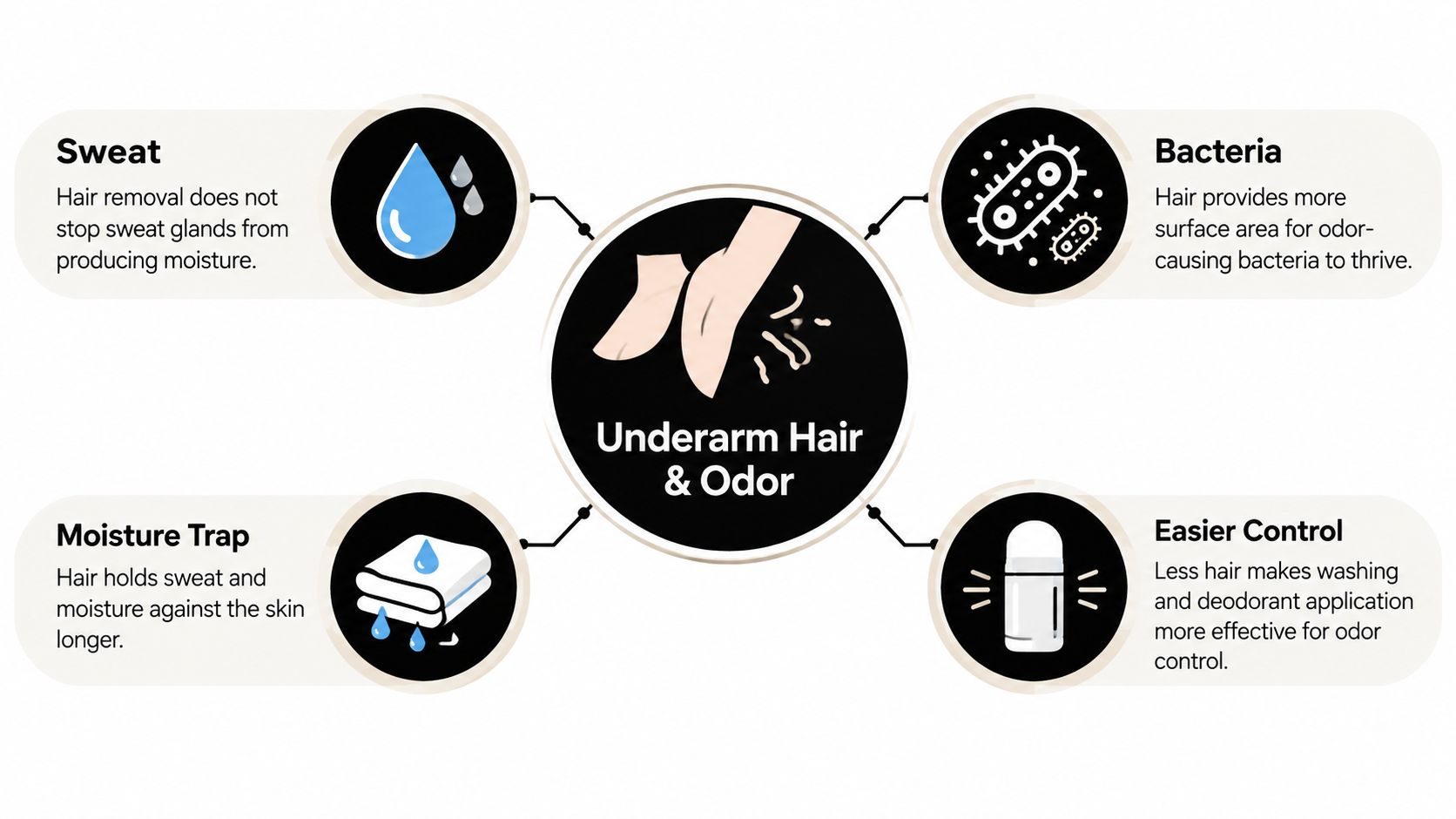
Hair removal doesn't stop sweating and it won't permanently erase body odor. Sweat glands keep producing moisture, but hair can retain moisture and debris close to the skin, giving odor-producing bacteria more usable surface area.
A clinical comparison in men found that shaving followed by standard soap washing reduced immediate axillary odor by 57.3% compared with washing alone, while waxing plus washing reduced it by 75.3%. The shaving effect persisted for 24 hours, while clipping with scissors didn't significantly improve odor control (clinical comparison).
Run a fair test
Don't judge the result after a random rushed shave followed by heavy fragrance. Use a controlled routine:
Remove hair cleanly: Shave with a suitable razor or use a close trimmer if blades irritate you.
Wash thoroughly: Use an unscented cleanser and rinse away product residue.
Dry completely: Damp skin lets moisture and bacteria remain active.
Apply antiperspirant: Antiperspirant reduces sweat, while deodorant mainly addresses odor and fragrance.
Wait after shaving: Freshly shaved skin can sting when exposed to antiperspirant, especially if the formula contains fragrance or alcohol.
The goal is a drier, easier-to-clean environment, not odor elimination. If strong odor continues despite consistent washing and antiperspirant, or if you develop itching, rash, pain, or a sudden change in smell, speak with a clinician. Hair removal won't correct an underlying skin or medical problem.
The study also explains why simple clipping often disappoints men expecting a hygiene upgrade. Shorter hair may look neater and reduce bulk, but it doesn't necessarily remove enough hair from the skin surface to change odor measurably.
Matching the Right Method to Your Skin and Hair
Gender isn't the deciding factor. Hair thickness, pigment, curl pattern, skin sensitivity, and your desired finish determine whether a method will help or irritate you.
Skin or Hair Profile | Best Starting Options | Caution |
|---|---|---|
Coarse, dark hair with lighter skin | Professional laser, careful shaving, trimming | Close shaving may cause bumps |
Medium-to-deep skin with coarse hair | Experienced laser provider using suitable wavelength, guarded trimming | Incorrect settings can cause burns or pigment changes |
Curly or ingrown-prone hair | Guarded trimming, carefully selected laser consultation | Repeated close shaving can worsen ingrowns |
Light, red, gray, or white hair | Trimming, shaving, or waxing | IPL and laser rely on pigment and may respond poorly |
Sensitive or dry skin | Guarded trimming, cautious shaving | Creams and waxing can trigger irritation |
Hair and skin suitable for DIY IPL | Device-specific IPL guidance and patch testing | Follow skin-tone restrictions exactly |
Use the device class that fits the pigment
Laser targets melanin in the hair while trying to protect pigment in the epidermis. The 755 nm alexandrite and 694 nm ruby are generally aimed at lighter Fitzpatrick skin types I to III. The 810 nm diode extends use across a broader range up to type V, while 1064 nm Nd:YAG is considered the safest option for darker skin types V to VI because its longer wavelength penetrates deeper and is less absorbed by epidermal pigment (wavelength and dark-skin guidance).
That doesn't mean a darker-skinned man should avoid laser. It means he should avoid casual settings and inexperienced operators. Ask which wavelength is being used, how your Fitzpatrick type was assessed, and how the provider plans to reduce the risk of burns or post-inflammatory hyperpigmentation.
Laser works best on coarse, dark hair. It has less value for blond, gray, white, red, or very fine hair because the treatment target is pigment. If your main concern is sensitive skin rather than long-term reduction, start with a guarded trimmer and learn how your skin behaves before committing to a close method.
How to Prepare for and Care for Each Method
Preparation prevents more trouble than most aftercare products can fix. Underarms contain folds, friction, sweat, and delicate skin, so rushing the process is a reliable way to create burning or bumps.
Before removal
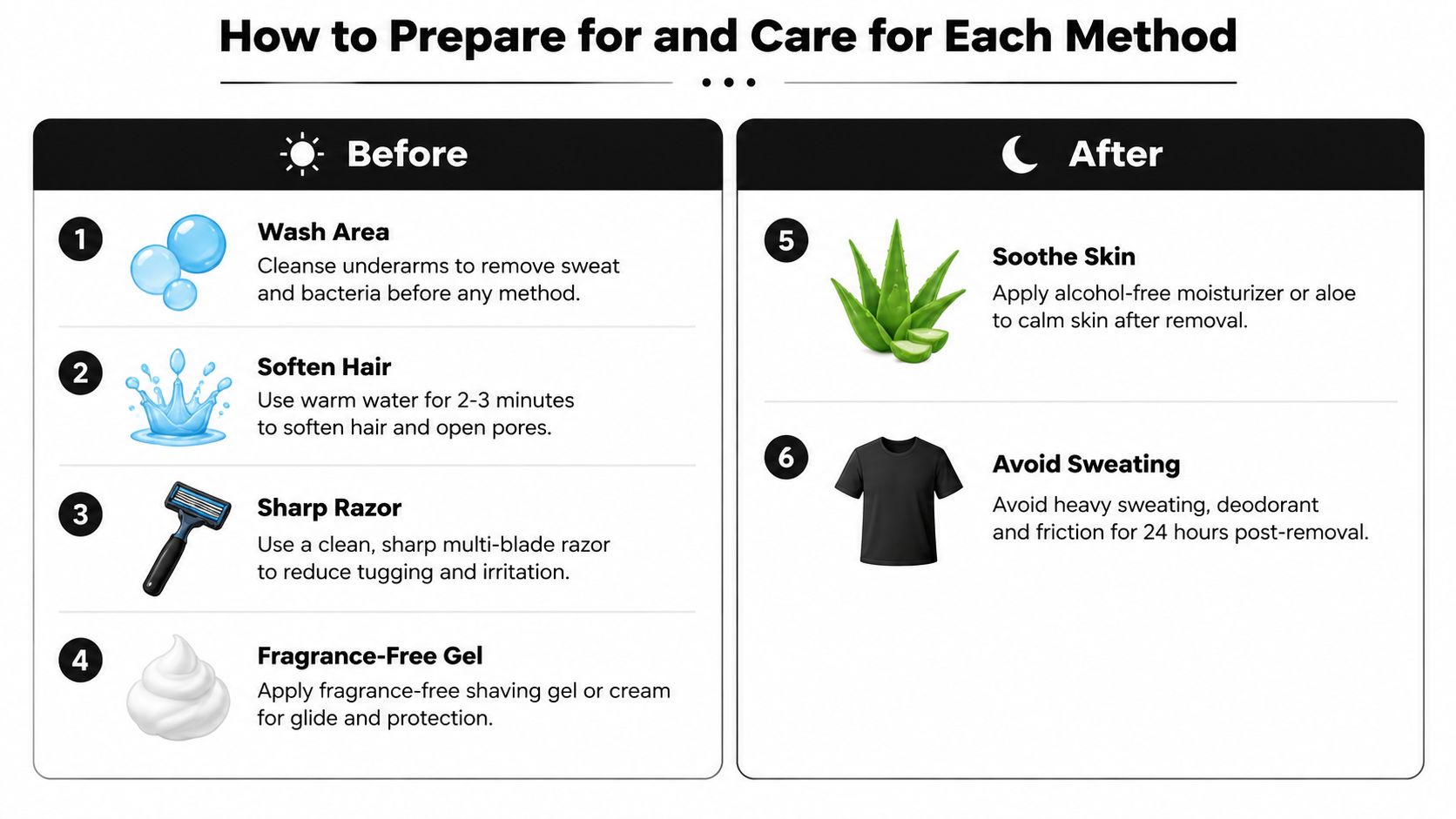
Wash first: Cleanse away sweat, deodorant, and residue before shaving, trimming, waxing, or using cream.
Soften before shaving: Warm water can make the hair easier to cut. Use fragrance-free shaving gel and a clean, sharp razor.
Shave with the grain: Start in the direction of growth. Rinse the blade often and don't keep making dry passes over the same patch.
Trim dry: Guarded clippers work more predictably on dry hair. Move slowly and stretch the skin only enough to create a flat surface.
Patch test cream: Test depilatory cream on a small area and wait 24 hours before broader use. Never apply it to broken or already irritated skin.
Prepare for waxing: Let hair grow to roughly one-quarter to three-eighths of an inch, and tell the practitioner about blood thinners, active skin disease, or recent treatments.
Don't exfoliate immediately before or after waxing. Extra abrasion doesn't improve the result and can increase inflammation.
After removal and around laser sessions
After shaving or cream, pat the skin dry and use a simple moisturizer. Skip strong deodorant, alcohol-based fragrance, heavy friction, and strenuous exercise until burning or redness settles.
For professional laser, follow the clinic's shaving instructions. Avoid tanning, waxing, plucking, and depilatory creams before treatment because the provider needs a safe, predictable target. Afterward, mild warmth and redness can occur. Cool compresses, gentle cleansing, broad-spectrum SPF, and avoiding heat or intense workouts can help. Contact the provider about blistering, marked swelling, worsening pain, or pigment changes.
This short video provides a visual refresher on basic preparation and skin care:
Sensitive Skin and Conditions That Change the Answer
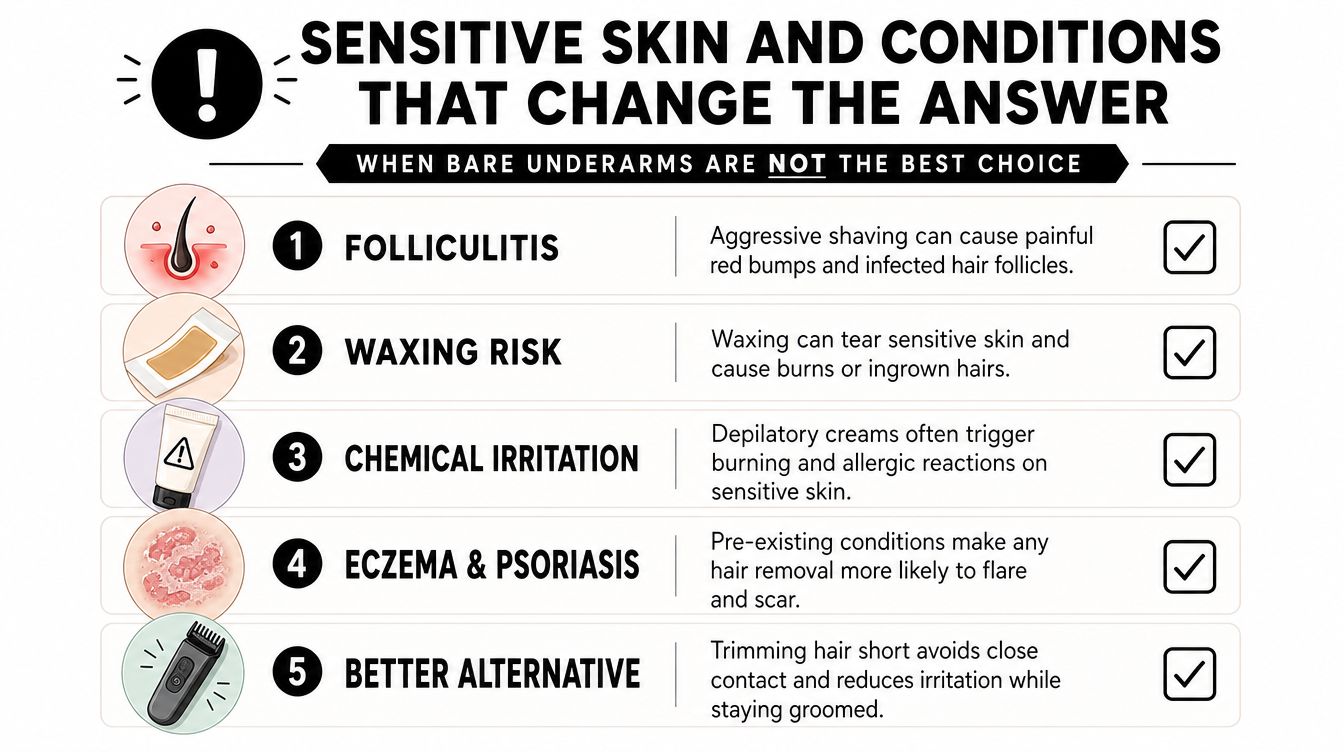
Bare isn't automatically better. Aggressive shaving can trigger folliculitis, and repeated friction can leave a sensitive underarm worse than a neatly trimmed one. Waxing may pull at already fragile skin, while depilatory creams can burn or inflame people with reactive skin.
Men with eczema, psoriasis, recurrent ingrowns, or suspected hidradenitis suppurativa need a different decision rule. A survey of people living with axillary hidradenitis suppurativa reported laser hair removal among the more beneficial hygiene practices, while razor shaving and solid stick deodorant were associated with worse severity. A review also found that men are underrepresented in laser hair-removal trials, so male-specific evidence remains limited (review and survey discussion).
Use irritation as a stop signal
If a method has caused ingrowns twice in a row, stop treating it as a technique problem. Switch to a guarded trimmer or get professional advice instead of pressing harder with the same razor.
Waxing and cream deserve extra suspicion when the skin is already inflamed. Patch test every depilatory product before full use, and don't test it on a day when the area is raw from shaving or exercise. For broader principles on how to protect sensitive skin naturally, focus on reducing fragrance, friction, and unnecessary product layering.
If you're dealing with a persistent underarm bump, drainage, scarring, or repeated painful flares, get a diagnosis before choosing laser or waxing. This guide to an ingrown underarm hair bump can help you recognize why not every lump should be treated as a routine ingrown.
For gym-heavy men, keeping a short layer of hair may be the comfortable compromise. It creates less blade contact while still reducing bulk, sweat retention, and the visual mess that prompted grooming in the first place.
Why Professional Laser with Splendor X Stands Out
If your priority is low maintenance, professional laser is the method worth serious consideration. Not because every man needs a completely bare underarm, but because repeated shaving, waxing, and DIY light treatments keep charging you in time, irritation, or inconsistency.
Splendor X combines 755 nm Alexandrite and 1064 nm Nd:YAG wavelengths. A trained clinician can select and adjust the wavelength, energy, fluence, and pulse duration around your skin tone and hair profile. That dual-wavelength approach is designed to support treatment across Fitzpatrick types I through VI when the provider performs an appropriate assessment and operates the system correctly. The underlying principle is the same one described earlier: lighter wavelengths can target suitable pigment efficiently, while Nd:YAG offers a deeper, more epidermis-conscious option for darker skin.
Why the clinic setting matters
DIY IPL asks you to interpret skin-tone restrictions, choose settings, maintain a schedule, and judge whether irritation is normal. A clinic can examine your skin, identify tattoos or active inflammation, account for recent sun exposure and medications, and modify treatment as your response becomes clear.
Splendor X is also built for speed and cooling. Both underarms can be treated together in roughly 5 to 10 minutes, with integrated cooling and smoke evacuation, no treatment gel, and no expected downtime beyond mild redness according to the stated protocol. That matters because convenience is part of the result. A treatment you can fit into a normal day is easier to maintain than a complicated home routine.
The best laser plan is adjusted to your skin before it is applied to your hair.
What results and sessions should you expect?
The stated Splendor X protocol describes roughly 70% to 90% permanent reduction after 6 to 8 sessions, with sessions spaced 4 to 6 weeks apart. Those figures come from the clinic protocol supplied for this article, so treat them as an expected treatment range, not a guarantee for every man. Hair cycles, pigment, hormones, skin tone, and settings all influence the outcome.
“Permanent” should mean long-term reduction, not a promise that every follicle disappears forever. Occasional annual touch-ups may be needed, particularly when hormones, medications, or natural growth patterns change. If you miss a maintenance session, you haven't erased all progress. You may allow more active follicles to grow before the next treatment can target them.
The sensation is usually described as a snapping rubber band. Most men find it tolerable, and the stated protocol doesn't require numbing cream. Tell the clinician about medications, tattoos in the treatment area, recent sun exposure, hormonal conditions, and any history of pigment changes before the first session.
Cost requires an honest comparison. Professional laser costs more upfront than a razor or trimmer, but the relevant comparison is not one session against one cartridge. Compare the treatment plan with years of repeated shaving, replacement blades, waxing appointments, creams, and the time spent managing irritation. If your goal is to stop making underarm grooming a recurring task, that is where laser earns its place.
You can learn more about wavelength selection and device capabilities in this overview of advanced laser technology. Ask direct questions before booking: which wavelength fits your skin, how the clinic handles darker skin, what reduction is realistic, and what happens if your hair responds unevenly.
NYC Laser Hair Removal offers underarm laser hair reduction with Splendor X, personalized treatment planning, and session options for clients with different skin and hair profiles. If you're tired of shaving bumps or repeating short-term fixes, visit NYC Laser Hair Removal to review the underarm service and book a consultation in Westbury, Long Island.
Comments