
Unlimited Laser Hair Removal: What It Really Means
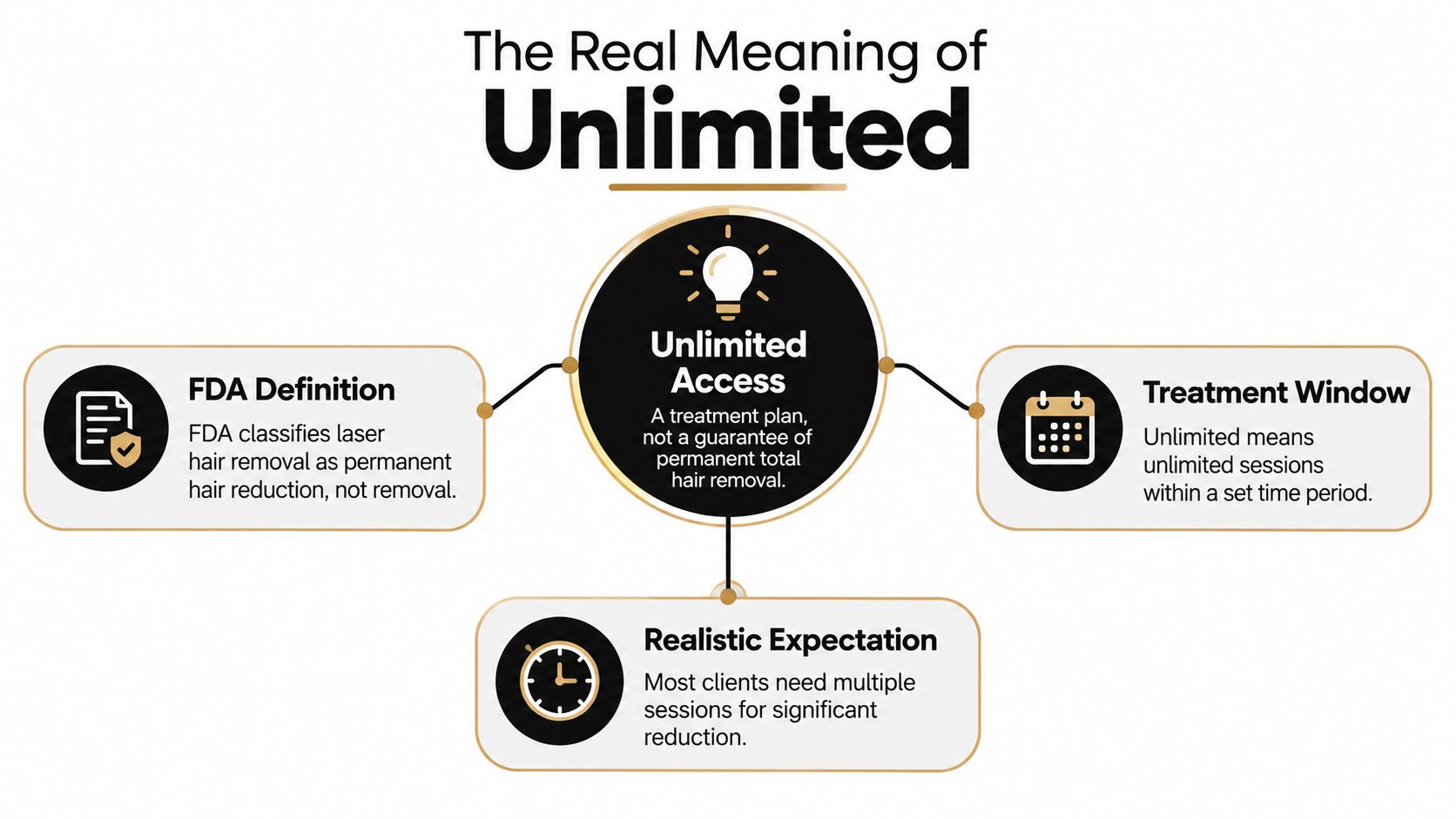
Unlimited laser hair removal means unlimited access to a treatment plan within its stated terms, not unlimited permanent elimination of every hair, and it is most valuable when it insures you against needing more sessions than average. Individuals often need repeated treatments because early sessions deliver only partial reduction, so the package pays off only if your biology, treatment area, and the fine print line up.
Ignore the popular advice to just grab the plan with the most sessions. I've sat through enough Long Island consultations to know that clients don't lose money because they picked the wrong laser. They lose money because they bought certainty that biology never promised, and they didn't read what "unlimited" covered.
Why "Unlimited" Is the Most Misunderstood Word in Laser Hair Removal
You're not buying a result. You're buying access. That's the distinction most marketing buries, and it's the only one that matters when you're deciding whether an unlimited plan is smart or wasteful.
Laser hair removal is best understood as long-term hair reduction, not guaranteed permanent removal. The formal language matters here because the FDA definition of permanent hair reduction as a long-term, stable decrease measured at 6, 9, and 12 months after a treatment regimen makes clear that durable reduction is not the same as total elimination of every follicle.
What Biology Actually Allows
Hair doesn't respond evenly. Laser energy primarily affects follicles in the anagen growth phase, while follicles in resting phases are less susceptible, which is why you can't clear an area in one visit no matter how generous the package sounds. A follicle that isn't actively growing during your session may enter growth months later, including follicles influenced by hormones.
That uneven timing explains the wide range in published outcomes. One treatment may reduce hair by approximately 10% to 40%, while repeated treatments can produce reductions of up to 90%, according to a 2020 clinical review of laser hair reduction outcomes and variability. The same review notes average clearance from 20% to 75% during follow-up of one to six months, and commonly 30% to 50% clearance six months after the final session in repeated-treatment studies.
Judge success by reduced density, slower regrowth, finer hair, and less frequent shaving. If you're measuring by whether every single hair is gone forever, you'll call a good result a failure.
Outcomes vary by laser type, body area, hair characteristics, skin type, treatment settings, and follow-up period. That's not a disclaimer clinics add to protect themselves. It's the reason an unlimited plan exists at all.
The Real Value Proposition
An unlimited plan is a hedge against biological uncertainty. You don't know in advance whether you'll respond quickly or slowly. You don't know whether a hormonal area will keep producing new growth. The plan is most defensible when it protects you against landing on the high end of that variance.
It's least defensible when it's sold as peace of mind for an area that typically responds predictably. You're then paying a premium to insure against a risk you probably don't carry. My recommendation is blunt. Don't ask whether unlimited sounds generous. Ask whether your specific area, hair, and history make extra sessions likely enough to justify prepaying for them.
What an Unlimited Package Usually Includes
Every unlimited contract controls value through the same four levers. If a salesperson can't state all four clearly, don't sign.
The Four Levers That Define the Plan
Treatment duration: Sessions are unlimited only inside a defined window. Ask for the start date, end date, and what happens if life interrupts your schedule.
Eligible zones: The plan covers named areas, not your whole body by default. A zone framework like Small, Medium, Large, and Extra Large determines what's included and what costs extra.
Session spacing: You can't come in weekly and accelerate results. Spacing rules exist because follicles need time to cycle into the phase where treatment works.
Maintenance and touch-ups: Some plans cover follow-up work after the initial reduction. Others stop once the clinic decides you've reached an endpoint.
A plan is most technically defensible when its terms specify duration, eligible zones, session spacing, maintenance policy, and clinical endpoint in writing. Vague language on any one of those points transfers discretion to the clinic, not to you.
Zone definitions deserve special attention on Long Island, where clients commonly treat combinations like lip and chin, underarms and bikini line, or full legs with a Brazilian. Two clinics can both say "unlimited" while defining a Large zone completely differently. Get the zone map in writing and confirm whether both sides of the body, the full front and back of a leg, or the entire bikini area count as one zone or several.
Clinic Plans Versus Membership Programs
Local clinic plans usually tie unlimited access to specific zones you choose at purchase. National membership-style programs often sell broader access with more standardized rules, but sometimes less flexibility on scheduling or provider continuity. Neither model is automatically better.
What matters is who decides when you're done. Ask whether completion is based on standardized photographs, hair-count estimates at consistent intervals, or a provider's visual impression at a single visit. Short-term smoothness right after a session is a poor measure, because treated hairs shed and untreated follicles haven't cycled yet.
Also confirm practical rules before you pay. Can you pause for pregnancy, a medication change, or summer sun exposure incompatible with treatment? Can you add a new area mid-term at the plan rate, or does it start a separate purchase? Can you transfer unused value to another zone if your goals change?
Practical rule: If the written plan doesn't name the zones, the end date, and the maintenance policy, you're not looking at an unlimited plan. You're looking at a marketing phrase with a price attached.
Don't assume "unlimited" covers missed appointments either. Some clinics count a late cancellation as a used session window, which can push your next treatment out and waste part of your term. That detail sounds administrative until it costs you a full growth cycle.
Why Some Clients Need Far More Sessions Than Others
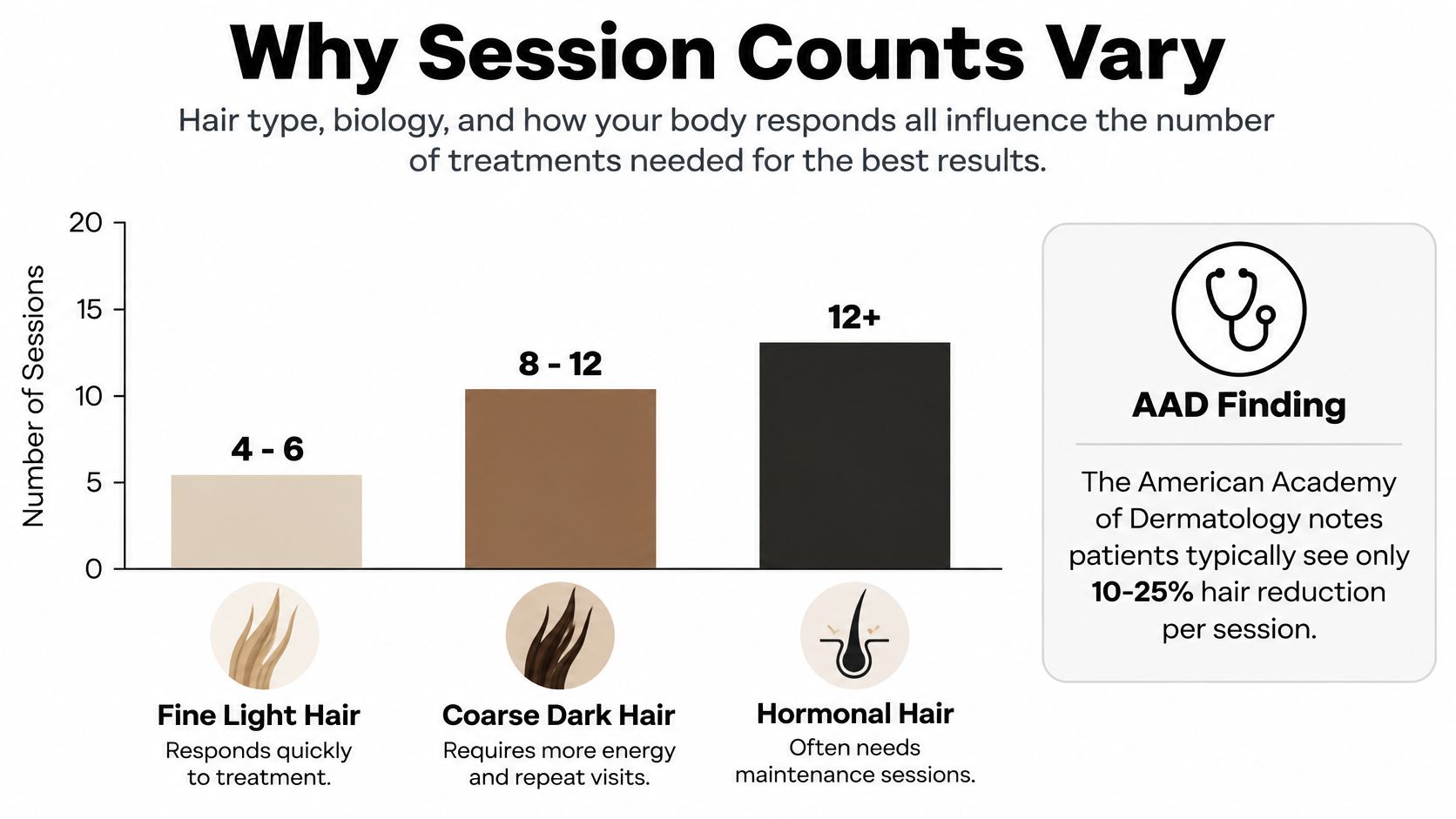
Session counts vary because bodies vary, and anyone who quotes you a single universal number is guessing. The evidence gives you ranges, not promises.
The American Academy of Dermatology reports that patients typically see only 10% to 25% reduction after the first treatment and usually need 2 to 6 treatments, with maintenance sometimes required when hair regrows, as summarized in clinical guidance on treatment counts and maintenance intervals. Clinical references in that same summary commonly describe an initial series of 4 to 6 treatments spaced 4 to 6 weeks apart, followed by maintenance approximately every 6 to 12 months.
Variables That Push Your Count Higher
Hormonal influence is the biggest one I see under-discussed. Facial hair in women is particularly likely to need ongoing treatment, while many body areas may remain hair-free for months or years. Conditions affecting hormone levels, including PCOS or thyroid conditions, can keep activating follicles after an initial series looks successful.
Area size and density matter next. A man's back or chest, or dense hair along the bikini line, presents more follicles cycling at different times than a small, sparse area. More follicles out of phase at any given visit means more visits to catch them in growth.
Hair color and diameter set hard limits. Lasers can't effectively target blonde, white, gray, or red hair because those colors provide insufficient pigment for the device to detect. If your target area mixes dark and light hairs, an unlimited plan won't fix the light ones. You'll reduce the dark hair and still see the rest, which can look like poor progress if nobody warned you.
Technology choice also shifts outcomes. Long-term average reductions ranged from 30% to 73.61% for Nd:YAG, 35% to 84.25% for Alexandrite, and 32.5% to 69.2% for diode lasers in a 2022 systematic review comparing long-term laser hair reduction results. Repeated treatment also outperformed single sessions in trial data summarized there, with three Alexandrite treatments producing 55% reduction at nine months versus 32% after one treatment.
If you want a fuller walkthrough of how those ranges play out in practice, the 6 to 12 sessions explained guide from Omega Lasers is a useful companion, and you can compare it against a candid breakdown of how many laser sessions most clients actually need by area before your consultation.
My direct advice is to locate yourself on the distribution. Hormonal area, dense coarse growth, or a history of hair returning after waxing or prior laser work puts you on the high end. That's where unlimited coverage earns its price.
Comparing Unlimited Plans With Single Sessions and Multi-Session Bundles
There are three ways to buy this treatment, and the right one depends on how much uncertainty you're carrying, not on which one has the lowest sticker price.
Package Structures Side by Side
Package Type | Typical Structure | Best Fit Client |
|---|---|---|
Single session | Pay per visit, no commitment | Testing response, small zone, or occasional touch-up after a completed series |
3 or 6 session bundle | Prepaid set of sessions for one zone at a lower per-session cost | Standard course on a predictable body area |
Unlimited period plan | Unlimited sessions for named zones within a set term | Large zones, hormonal areas, or anyone likely to need sessions beyond a standard bundle |
Where Each Structure Wins and Loses
Single sessions protect you from overcommitting. They're the right move if you've never had laser treatment, you're unsure how your skin will react, or you only need isolated maintenance. The downside is obvious. You pay the highest per-session cost, and if you end up needing a full series, you've spent more than either alternative.
Bundles are the best fit for the majority of people treating body areas with predictable response. You commit to enough sessions to complete a standard initial course, you pay less per session than pay-as-you-go pricing, and you don't prepay for sessions you may never use. For underarms, lower legs, arms, and similar non-hormonal areas, a bundle usually beats unlimited on value. You can review how different laser hair removal packages are structured and priced by zone to see how bundle tiers compare before deciding.
Unlimited plans win when variance is your main risk. Large areas like full legs or a full back involve long sessions and many follicles. Hormonal areas can demand work well past an initial series. If your realistic session count could plausibly exceed a bundle by a wide margin, unlimited converts an unpredictable total into a fixed one.
Don't compare packages by dividing the unlimited price by the sessions you hope you'll need. Compare it against the cost if you land on the high end of your likely range. That's the scenario you're insuring.
Run the math both ways before you buy. Price the bundle, then price the bundle plus several additional single sessions at full rate. If that second total approaches or exceeds the unlimited price, and the unlimited terms cover maintenance, the plan makes sense. If you'd need an implausible number of extra sessions to break even, you're overbuying.
Risk cuts in both directions. Bundles risk under-buying, leaving you purchasing expensive add-ons. Unlimited plans risk over-buying, and they also concentrate your money with one clinic. If you move, dislike the provider, or can't attend during the term, prepaid access you don't use has no value. That concentration risk is real, and honest clinics will acknowledge it rather than pressure you.
My recommendation for most first-time Long Island clients is to start with a bundle unless you have a specific reason to expect a high session count. Upgrade your thinking only when the biology argues for it.
Hidden Terms and Fine Print That Change the Math
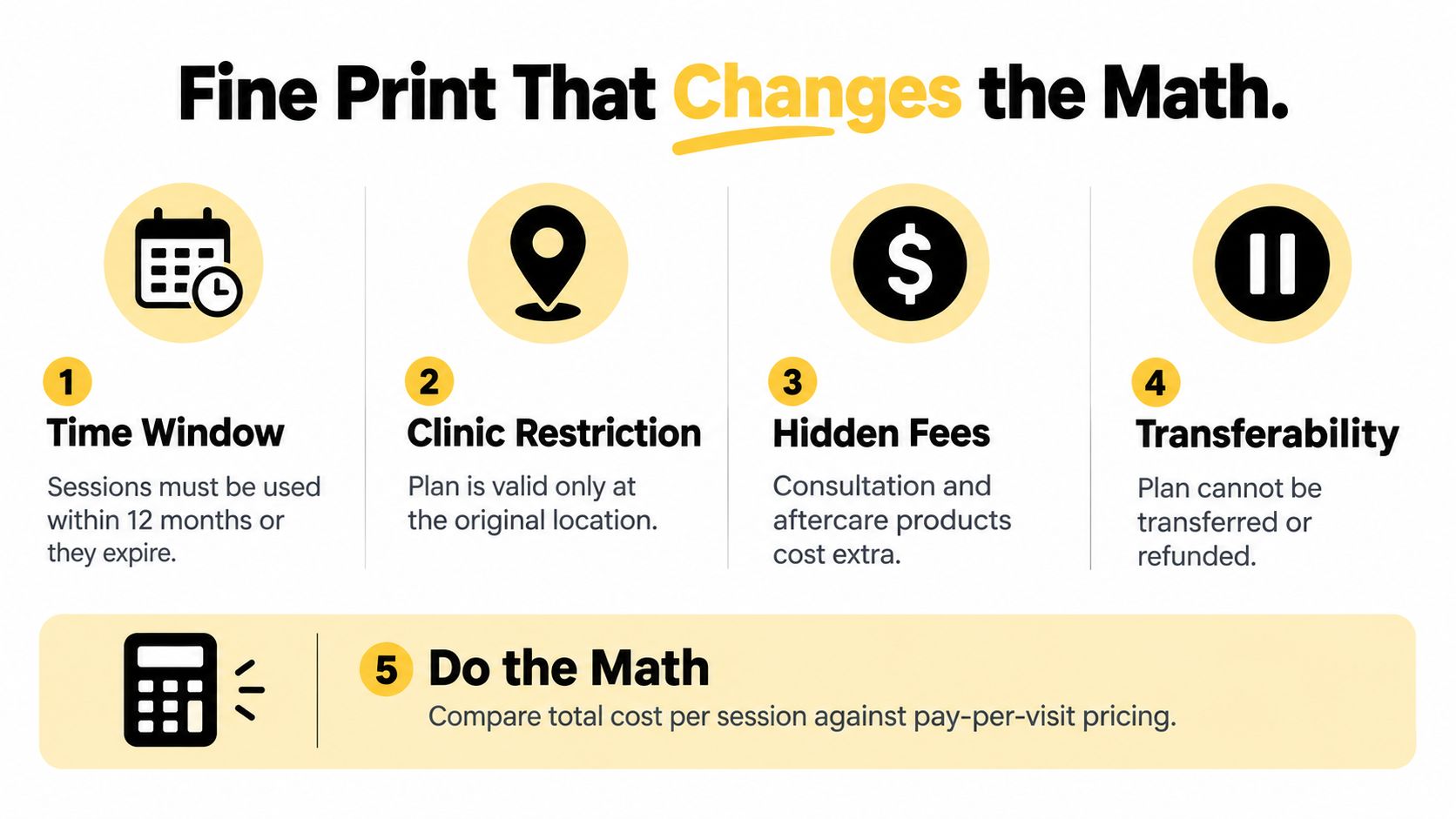
An unlimited plan is only as protective as its least obvious clause. These are the terms that cap value, and I want you to read them before you look at the price.
Clauses That Quietly Limit You
Time window: Sessions must be used within the term or they expire. A short window combined with mandatory spacing can make "unlimited" mathematically limited.
Zone exclusions: Touch-ups, newly added areas, or areas adjacent to your named zone may fall outside coverage.
Missed appointment rules: Late cancellations or no-shows may forfeit a treatment window, shrinking the number of sessions you can realistically fit in.
Maintenance definition: Some plans end when initial reduction is achieved. Others include periodic maintenance. Those are very different products at the same headline price.
Freeze, transfer, and refund policies: Pregnancy, illness, relocation, or a skin issue requiring postponement can burn your term if pausing isn't allowed.
Watch for language like unlimited "at clinic discretion" or sessions provided "as deemed clinically appropriate" without any stated endpoint. Clinical judgment legitimately governs spacing and safety, but discretion without criteria means the clinic can slow your schedule, declare you complete, or deny touch-ups, and you'll have little recourse.
Safety Terms Are Fine Print Too
Postponement rules aren't bureaucratic. They're clinical. Melanin in the epidermis competes with melanin in the hair shaft for absorbed energy, and a systematic review of skin types III to VI reported greater susceptibility to laser-related adverse events in pigmented skin, with long-pulsed Nd:YAG showing lower pooled risk of post-inflammatory hyperpigmentation than IPL at an odds ratio of 0.26, as detailed in research on laser safety outcomes in pigmented skin types. Recent tanning, hair diameter, body site, and prior reactions all affect your safety margin alongside Fitzpatrick classification.
That means a good clinic will sometimes tell you to wait. If your unlimited term keeps running during a clinically required pause, you lose value for following safety advice. Ask directly whether medically advised postponements extend your end date.
Also confirm basics that marketing skips. Treatment shouldn't be performed over tattoos. Patch testing, conservative initial settings, cooling, and test spots matter when risk is high. A clinic that treats every skin and hair combination identically to keep you on schedule is protecting its calendar, not your skin.
Bring these clauses to any consultation, at any provider, and get answers in writing. Verbal reassurance isn't a contract term.
Who Unlimited Plans Actually Fit Best
Forget generic verdicts. Match yourself to an archetype and buy accordingly.

Four Clients I See Every Week
The small-zone first-timer treating a lip or underarms should skip unlimited. Your area is small, sessions are brief, and a bundle covers a standard course without tying up extra money. Buy the bundle, finish the series, and pay for rare touch-ups individually if you ever need them.
The large-area client treating full legs, or a man's back or chest, is the strongest candidate. These zones cost more per session, take longer, and involve enough follicles that exceeding a bundle is plausible. If the unlimited term is long enough and maintenance is included, the hedge usually pays.
The maintenance client who already finished an initial series faces a different question. You don't need unlimited full sessions. You need predictable, occasional touch-ups when dormant or hormonally influenced follicles activate. An unlimited plan only fits if its maintenance definition matches that pattern. Otherwise, single sessions on demand are cheaper and more honest.
The client with a darker skin tone needs provider expertise before package math. The American Academy of Dermatology emphasizes that provider experience with your specific skin tone is essential and warns that inexperienced treatment can cause burns, blisters, infection, or dark spots, as explained in its guidance on safe hair removal by skin tone. Technology like Splendor X that supports adjusted settings across skin types helps, but settings, cooling, and conservative progression matter more than the device name. For this client, unlimited coverage has one genuine advantage. Settings can be adjusted and progress reassessed across sessions without re-buying access each time.
Whatever your archetype, your plan should be built around your skin, hair, and area rather than a preset menu, which is the thinking behind building a personalized laser treatment plan around individual response. If a clinic recommends the same package to all four clients above, walk out.
Questions to Ask Before You Sign Anything
Take this list into the room. Don't rely on memory, and don't accept verbal answers for contract terms.
End date: What's the exact start and end date, and can the term be paused for medical or safety reasons?
Zones: Which zones are covered by name, and what does adding an area cost mid-term?
Maintenance: Does coverage continue after initial reduction, and how does the clinic define completion?
Missed appointments: What happens if you cancel late, and does it consume part of your term?
Progress measurement: Does the clinic track results with standardized photographs or hair counts at consistent intervals?
Skin and hair fit: What device settings, patch testing, and postponement rules apply to your skin tone, tanning status, and hair color?
Evaluate your progress by density, regrowth speed, and hair fineness, not by how smooth you feel the week after a session. That early smoothness misleads almost everyone.
My closing opinion hasn't changed in years. Unlimited is worth the premium when your area, hormones, or history make a high session count likely, and the written terms cover maintenance inside a usable window. For everyone else, a 3 or 6 session bundle is the smarter spend. Buy the hedge only when you're carrying the risk.
If you're weighing an unlimited plan against a bundle for full legs, a back, or a hormonal area, bring the questions above to a consultation at NYC Laser Hair Removal, where treatment is planned by zone using Splendor X technology across diverse skin and hair types. You'll get clear pricing, a realistic session estimate for your specific area, and a straight answer on whether unlimited coverage or a 3 or 6 session bundle fits you better. Book online and decide with the fine print in front of you, not after you've paid.
Comments