
How Soon Does Hair Grow Back After Waxing? a Timeline
Visible regrowth may begin during the first 1–3 weeks after waxing, with more noticeable hair commonly returning over roughly 3–6 weeks, depending on your body area and individual growth cycle. That means feeling a few hairs while getting dressed doesn't necessarily mean your appointment failed.
Perhaps your legs still look smooth, but your underarms already feel prickly. Or you've noticed small bumps and aren't sure whether they're new hairs, ingrown hairs, or irritation. Understanding what's happening beneath the skin helps you decide whether to wait, adjust your next appointment, or get medical advice.
What Regrowth Looks Like After Waxing
Regrowth isn't a single event. A few isolated hairs, a patch of short stubble, and a fuller return of hair are different stages of what you might notice after treatment. They shouldn't all be interpreted as the end of your waxing results.
The American Academy of Dermatology describes waxing results as lasting a few weeks or longer, rather than promising an identical hair-free interval for everyone. Its guidance on removing unwanted hair also makes the central distinction clear: waxing is temporary removal, not permanent elimination of the follicle.
Scattered hairs versus a fuller return
Think about looking at your lower legs under bright bathroom lighting. You might see a few hairs but still consider the overall result smooth. Later, when hair becomes visible across more of the treatment area, you may feel ready to plan another appointment.
The timeline below illustrates that progression, not a deadline that every treatment area must follow.
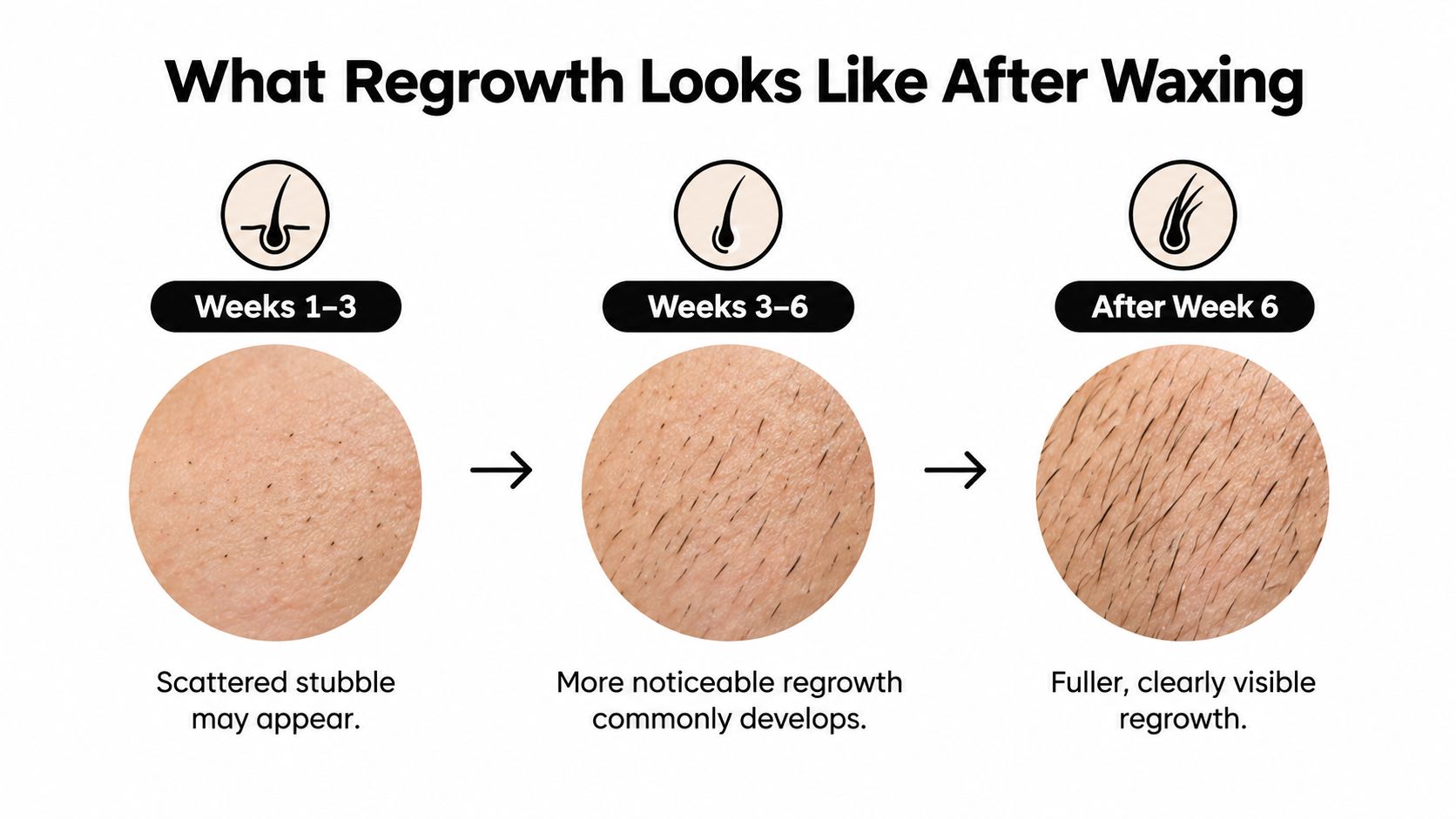
Use the illustration as a broad guide. Its final panel doesn't mean everyone will have the same amount of hair by that point, or that you should wait for a full return before discussing another appointment.
Practical rule: Judge the result by how much hair you can actually see and how comfortable your skin feels, not whether you've reached an arbitrary calendar day.
What to observe before booking again
Instead of treating the first noticeable hair as a reason to wax immediately, distinguish between these observations:
A few isolated hairs: Notice whether they remain scattered or gradually become more widespread.
Uneven short stubble: Ask your provider whether incomplete removal could have contributed.
Broader visible return: Discuss whether there's enough hair for another effective appointment.
Bumpy or uncomfortable skin: Assess the skin reaction before assuming you need more hair removal.
This approach gives you a more useful answer to “How soon does hair grow back after waxing?” than counting days alone. Visibility, coverage, and skin comfort tell you different things, and each matters when deciding what to do next.
How the Hair Growth Cycle Controls Regrowth
A hair follicle is the structure within the skin that produces hair. Waxing pulls out the shaft and its root, but leaves the follicle's regenerative structures intact. Before a replacement hair becomes visible, the follicle must produce a new shaft that reaches the skin's surface.
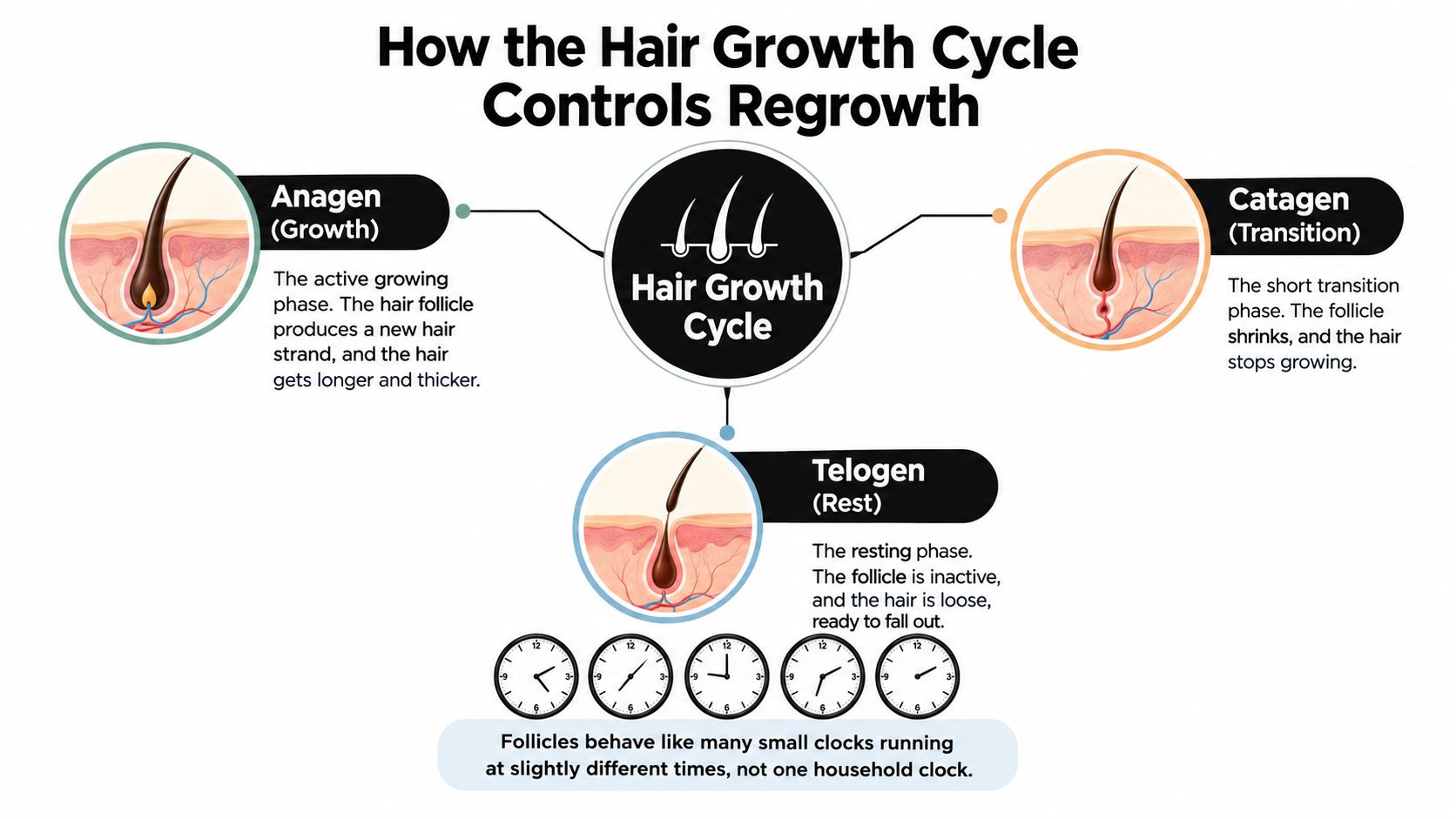
Think of neighboring follicles as many small clocks showing slightly different times, rather than one household clock. Waxing treats an area together, but that doesn't mean every follicle was at the same biological stage.
The diagram shows the stages behind those different schedules.
From the follicle to the surface
The names can sound technical, but the underlying sequence is straightforward:
Anagen means active growth. Cells within the follicle produce the hair shaft.
Catagen means transition. The follicle moves away from active shaft production.
Telogen means rest. The follicle is relatively inactive before another growth phase begins.
This cycle explains the delay between removal and visible return. It also explains why a hair-free surface doesn't tell you exactly what every follicle beneath it is doing.
In a 2003 clinical study involving 13 men, researchers waxed defined areas of back skin and evaluated them two weeks later. Human research discussed in that study indicates that plucked or waxed follicles can begin re-entering active growth within approximately three days, even though visible regrowth may not yet be obvious.
Biological activity isn't visible stubble
That distinction is important: a follicle becoming active is not the same as a hair appearing above the skin. You can't turn a laboratory observation about follicle activity into a precise countdown to your next appointment.
Experimental depilation research also helps explain the mechanism, but animal findings require care. Research on depilation and follicle regeneration includes mouse models whose fur cycles are faster and more synchronized than human body-hair cycles. Those observations help explain how replacement shafts develop, not exactly when your bikini line or legs will show hair.
For an additional visual explanation, watch the following video.
The practical takeaway is to plan waxing as recurring removal. A smooth surface means the treatment removed accessible hairs, not that the underlying structures have stopped functioning.
How Long Regrowth Takes by Area
Your chin and calves aren't interchangeable treatment areas. Comparing them as though they should stay smooth for exactly the same interval can make a normal result seem disappointing.
A 2019 in-vivo study of body-hair growth examined axillary, cheek, chin, leg, and upper-lip hair and reported rates of approximately 0.18–0.49 millimeters daily, equivalent to roughly 1.3–3.4 millimeters over one week or 2.5–6.8 millimeters over two weeks once a shaft is growing.
Published cycle estimates associated with that body-area context are approximately 6 months for facial hair, 7 months for axillary and pelvic hair, 8 months for forearm hair, and about 1 year for thigh, calf, and buttock hair, as reported in the body-hair research cited above. Those are cycle estimates, not recommended waits between waxing appointments.
Approximate body-area context
Area | Cycle context | What this means for visibility |
|---|---|---|
Face | Shorter cycle context than the listed limb areas | Facial hair may become noticeable sooner, but lip and chin results still vary |
Underarms | Axillary hair has its own regional pattern | Don't use leg smoothness to decide when underarms should need attention |
Bikini region | Pelvic hair differs from facial and limb hair | Assess the actual return rather than borrowing someone else's schedule |
Legs | Longer cycle context in the thigh and calf | Legs may appear smooth longer while follicles continue cycling beneath the surface |
Back | Requires an individual assessment | There isn't a back-specific countdown established by these measurements |
Growth speed isn't the same as waiting time
The daily measurements describe shaft extension, not how long a follicle waits before starting to produce visible hair. Applying the fastest measured rate to every follicle immediately after waxing would give a misleading prediction.
For example, you might notice facial hairs while your legs still look largely bare. That doesn't prove the leg treatment worked better. It means the areas can differ in cycle timing and in how quickly their returning hairs become visible.
A body-area average provides context. It doesn't identify the exact day your own hair will return.
For underarms and bikini treatments, use your previous result as a starting point for discussion with your provider. For back waxing, avoid assuming that a large treatment area automatically means either a longer or shorter result.
Before booking, describe which area you're treating, what you can see, and whether the skin has settled. That information is more useful than asking for one universal interval for every part of your body.
Factors That Change Your Regrowth Timeline
Two people can receive the same type of wax and describe very different results. Even your own experience can change between treatment areas or appointments.
The useful comparison is between biological variation and removal quality. The former affects when hair becomes available to see; the latter affects whether the original hair was fully removed.
Different causes can look similar
Body location, hair thickness, hormonal status, age, and individual cycle timing all belong in a regrowth assessment. Genetics is part of your broader individual background, but it doesn't provide a practical appointment date on its own.
Technique adds another variable. A hair that breaks instead of being removed from the root can become noticeable sooner than a replacement shaft would. DermNet's explanation of waxing distinguishes temporary removal from lasting changes in growth and notes that the long-term effects of repeated waxing remain uncertain.
What you notice | A useful question | What not to assume |
|---|---|---|
Scattered hair while most skin remains smooth | Could this reflect different follicle timing? | Every hair has returned |
Short, uneven hairs soon after treatment | Could some hairs have broken? | Your entire growth cycle accelerated |
Different results on different areas | Am I comparing unlike body sites? | One area received ineffective treatment |
Hair appearing finer after repeated visits | Is the appearance changing? | Permanent reduction is established |
A self-assessment before changing your routine
Use observations rather than blame when discussing an unexpectedly short result:
Compare the same area: Your previous underarm treatment is a more relevant comparison than a friend's leg wax.
Describe the pattern: Explain whether you see isolated hairs, widespread stubble, or patches that never seemed fully clear.
Separate hair from skin changes: Mention tenderness, itching, or raised bumps rather than calling everything regrowth.
Review the removal: Ask whether hair length or breakage may have affected the appointment.
Consider your health context: If your hair-growth pattern has changed noticeably, mention relevant hormonal or health changes to a clinician.
Thinner-looking hair isn't proof of permanent follicle damage. You can appreciate an improvement in appearance without treating it as a guaranteed long-term outcome.
Likewise, waxing sooner isn't automatically the solution to early stubble. A discussion about technique, sufficient regrowth, and skin tolerance may be more useful than shortening every interval.
Tips to Extend Smoothness After Waxing
Aftercare can help you maintain comfortable skin, but it can't stop the normal growth cycle. The aim is to avoid adding irritation to an area that has just undergone hair removal, not to force it to remain hair-free.
Start with a simple routine rather than several new products. Choose gentle cleansing and moisturization, and avoid anything that stings or makes the area feel more inflamed.
Keep maintenance gentle and practical
Wait for enough regrowth: Ask your provider whether the hairs are long enough for the wax to grip before arranging another treatment.
Reduce friction: Choose loose clothing when fabric rubs against a freshly treated area.
Let irritated skin settle: Avoid heat and products that feel harsh while the area remains sensitive.
Don't scrub immediately: Aggressive exfoliation isn't a substitute for allowing skin to recover.
Keep track of your experience: Note the treatment area, when visible hair becomes bothersome, and how your skin responds.
For area-specific preparation and maintenance questions, consult this Brazilian waxing tips guide. Use advice alongside your provider's instructions and your own skin's response, rather than as a reason to repeat treatment on irritated skin.
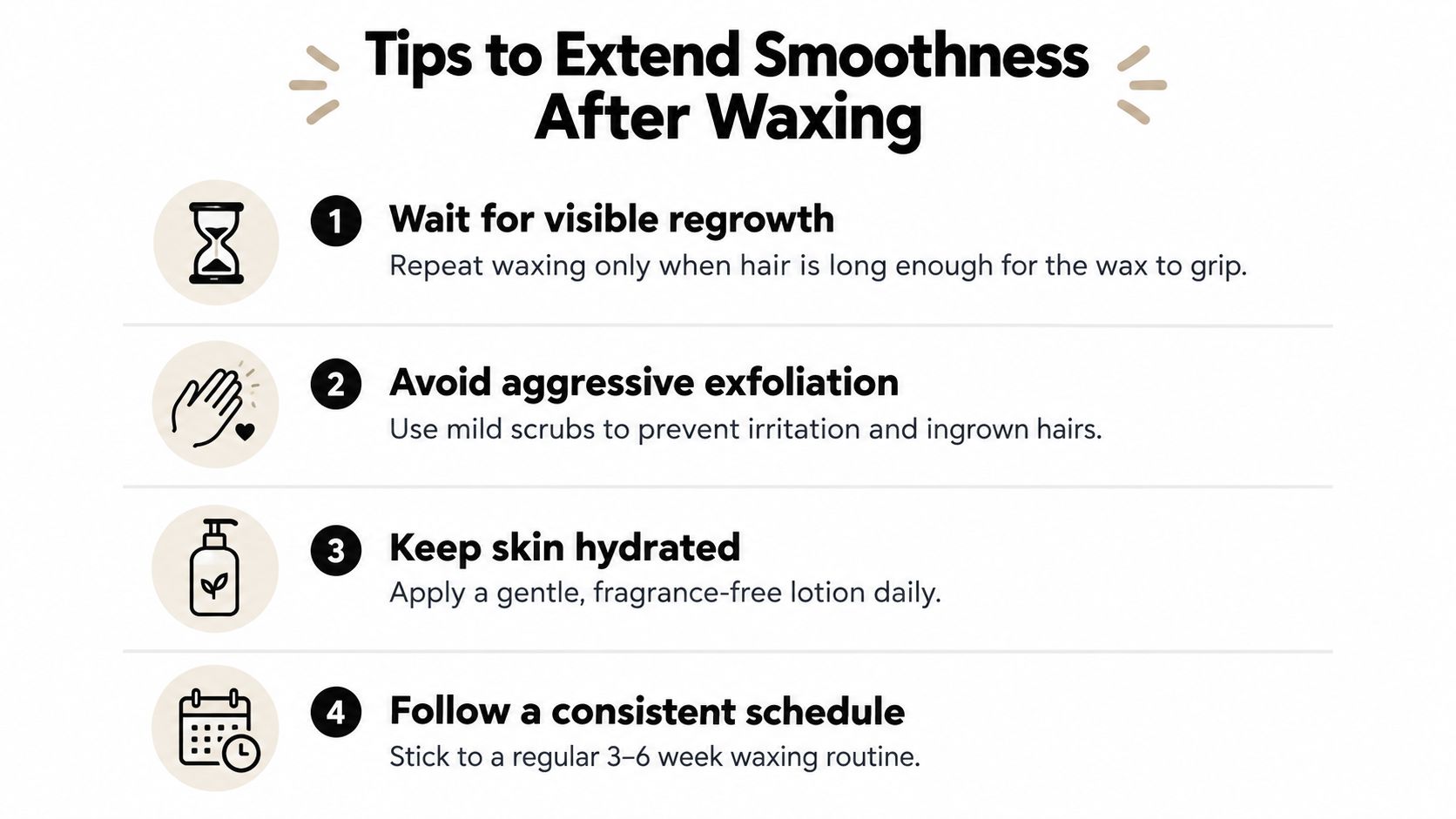
The infographic offers a maintenance reminder, but its calendar and exfoliation suggestions shouldn't override individual assessment.
Comfort matters more than a rigid schedule
Don't interpret a suggested schedule as permission to wax skin that hasn't recovered. Likewise, don't exfoliate a painful or inflamed patch just because a maintenance checklist mentions scrubs.
A better aftercare goal: Keep the skin comfortable enough that normal returning hair doesn't become confused with avoidable irritation.
If your skin is calm but there isn't enough hair to grip, waiting may be more sensible than chasing isolated hairs. If there's ample hair but persistent discomfort, address the skin first.
A repeatable routine doesn't need to be elaborate. Gentle care, an appropriate appointment interval, and a willingness to pause when something feels wrong are more useful than promises that a product can prevent regrowth.
When Bumps Mean More Than Normal Regrowth
A raised bump isn't automatically a returning hair. You may be noticing an ingrown hair, follicle inflammation, irritation, or a reaction to heat rather than ordinary hair emerging through the surface.
Ingrown hairs can appear about a week after waxing, when a returning hair curves into or grows sideways within the skin. They may cause itchy, painful, pimple-like bumps and can sometimes become infected, as described in Medical News Today's discussion of bumps after waxing.
Distinguish hair visibility from inflammation
Ordinary visible regrowth means you can see or feel hair. An ingrown hair involves an abnormal path through the skin, while folliculitis refers to inflammation around a follicle. You can't reliably diagnose the cause of every bump by touch alone.
Waxing-related complications can also include burns, irritation, hyperpigmentation, and scarring. Genital-area waxing requires additional caution because swelling, bleeding, and infection are possible, and hot wax near mucosal tissue can cause thermal injury.
Observation | Sensible next step |
|---|---|
Visible hairs without significant skin symptoms | Monitor the return and discuss maintenance timing |
Itchy or tender pimple-like bumps | Consider an ingrown hair or inflammation rather than assuming normal regrowth |
Persistent darkening or scarring | Arrange professional assessment rather than repeatedly treating the area |
Worsening or spreading symptoms | Seek medical care |
Know when home care isn't enough
The dermatology guidance cited earlier recommends evaluation by a board-certified dermatologist if redness or swelling persists beyond two days. Don't continue waxing over a reaction while waiting for it to resolve.
Seek medical assessment for:
Spreading redness or worsening pain: Especially when the area is becoming more uncomfortable rather than settling.
Pus or fever: These require attention rather than a cosmetic touch-up.
Persistent lesions: Recurrent or unhealed bumps deserve a diagnosis.
Darkened or scarred skin: Discuss these changes before trying additional irritating treatments.
For prevention-focused questions once active symptoms have been addressed, this practical guide to preventing ingrown hairs after a Brazilian wax provides additional context.
Don't dig at a bump or try to scrub away painful inflammation. A skin problem needs an assessment, not another removal session.
Waxing Compared With Laser Hair Reduction
Choosing between waxing and laser starts with your goal. Do you want temporary smoothness that you maintain with recurring removal, or do you want to explore a treatment series aimed at longer-term reduction?
The distinction isn't how smooth you feel immediately afterward. As explained earlier, waxing leaves the follicle able to regenerate hair. Laser hair reduction targets the follicle rather than relying on pulling out the shaft, so its intended outcome and maintenance pattern differ.
Waxing and laser hair reduction at a glance
Consideration | Waxing | Laser hair reduction |
|---|---|---|
Main approach | Removes hair from the root | Uses laser treatment to target follicles |
Intended outcome | Temporary hair removal | Longer-term reduction in unwanted hair |
Planning | Repeat removal when regrowth and skin condition allow | An individualized treatment series and follow-up plan |
Main expectation to clarify | How much regrowth is acceptable between visits? | What reduction is realistic for this area and hair type? |
Important limitation | Doesn't reliably establish permanent reduction | Doesn't guarantee complete permanent removal |
For a fuller discussion of the decision, review this comparison of laser hair removal and waxing. Treat either option as a choice that should fit your skin, priorities, and willingness to maintain the result.
Ask about the maintenance you actually want
Waxing may suit you if you're comfortable allowing hair to return between appointments and prefer temporary removal. Laser may be worth discussing if recurring regrowth is the main reason you're reconsidering your routine.
Before committing to a laser plan, ask your provider:
Suitability: How do my skin and hair characteristics affect the recommendation?
Treatment area: What should I expect for my face, bikini line, legs, or back?
Preparation: How should I manage hair removal before and between treatments?
Follow-up: How will we assess my response and decide what comes next?
A package is a purchasing option, not a prediction of your final result. Your response can vary by client, area, hair type, and treatment plan, so avoid interpreting any bundle as a guarantee.
The most useful outcome of a consultation is a clear plan: what the treatment aims to achieve, what its limitations are, and how maintenance fits your life.
NYC Laser Hair Removal provides individualized treatments using Splendor X technology in Westbury for areas including the lip, chin, underarms, bikini line, Brazilian, full legs, and back. If waxing regrowth has you considering longer-term reduction, visit NYC Laser Hair Removal to discuss your treatment area, suitability, and single-session or 3- or 6-session bundle options.
Comments