
Laser Hair Removal Brown Skin
The most popular advice about laser hair removal for brown skin is also the least useful: “Just find an Nd:YAG.” Wavelength matters, but it's only one part of a safe treatment. Your Fitzpatrick type, hair thickness, treatment area, recent sun exposure, cooling method, fluence, and the operator's judgment all affect the result.
Brown skin isn't automatically unsuitable for laser hair removal. The key question is whether the clinic can distinguish melanin in the hair follicle from melanin in the surrounding epidermis, then choose parameters that heat the follicle without overheating the skin. Modern reviews report that darker skin can be treated effectively, with average clearance rates of 20% to 75% after 1 to 6 months of follow-up when appropriate technology and settings are used (National Laser Institute).
That doesn't mean the treatment is risk-free. Fitzpatrick types IV to VI have greater susceptibility to post-inflammatory hyperpigmentation, thermal injury, and scarring, so a careful consultation is more valuable than a broad promise that any laser works for everyone (StatPearls).
Why Brown Skin Deserves a Different Laser Conversation
Laser hair removal became more precise over time. The first FDA-cleared hair-removal laser arrived in 1995, followed by the first cosmetic laser cleared to target melanin in hair follicles in 1998 (National Laser Institute). Earlier systems offered a narrower safety margin for melanin-rich skin because their energy could heat the epidermis as well as the follicle. That history explains why many brown and deep-brown clients were excluded from treatment or remain concerned about burns and pigment changes.
Brown skin can respond well to laser hair removal when the treatment plan accounts for competing pigment. Long-pulsed Nd:YAG devices use 1064 nm light, which sits toward the safer end of the melanin absorption curve. In practical terms, the wavelength can reach follicular pigment while the epidermis absorbs less energy than it would from shorter wavelengths. The trade-off is that Nd:YAG may require careful parameter selection and may work less efficiently on very fine, lightly pigmented hair.
Practical rule: Ask which wavelength will be used, how the settings will be adapted to your skin, and whether the clinic will test a small area first.
A useful consultation examines the hair as closely as the skin. Coarse, dark hair generally provides a stronger target, while fine hair may clear more slowly. Facial or body areas affected by hormonal growth can also respond differently and require ongoing management. Recent tanning or irritation may increase risk, and the forearm, bikini line, underarm, and beard area can need different settings because hair calibre, skin thickness, and pigment vary across the body.
Dual-wavelength platforms create a middle option between a single-wavelength Nd:YAG and a traditional alexandrite device. Splendor X combines 755 nm alexandrite with 1064 nm Nd:YAG output, allowing an experienced practitioner to select or blend wavelengths for the treatment area. That flexibility does not replace clinical judgment, but it can help balance follicular targeting with epidermal protection.
Where Brown Skin Sits on the Fitzpatrick Scale
The Fitzpatrick scale is a clinical starting point, not a complete treatment plan. It groups skin by baseline pigmentation and its response to ultraviolet exposure, from type I, which burns very easily and tans minimally, to type VI, which has the deepest pigmentation. For laser hair removal, the scale estimates how much epidermal melanin may compete with pigment in the hair follicle for the laser's energy.
Brown skin commonly falls within types IV and V, although an individual's classification can vary by body area and recent sun exposure. StatPearls describes type V as skin that rarely burns but tans darkly easily (StatPearls). Type VI has a higher concentration of epidermal melanin and therefore calls for particularly careful parameter selection. A recent tan can also increase pigment risk even when your usual Fitzpatrick type has not changed.
Fitzpatrick Skin Types and Laser Hair Removal Suitability
Fitzpatrick type | Skin tone | Sun response | Typical ethnicity | Preferred laser wavelength |
|---|---|---|---|---|
I | Very light | Burns easily, tans minimally | Often Northern European ancestry | Alexandrite may be suitable |
II | Light | Usually burns, tans gradually | Often European ancestry | Alexandrite or diode may be considered |
III | Light to medium | May burn, tans moderately | Diverse backgrounds | Alexandrite, diode, or Nd:YAG depending on assessment |
IV | Medium brown or olive | Burns less readily, tans easily | Diverse backgrounds | Nd:YAG is commonly preferred when pigment risk is higher |
V | Brown | Rarely burns, tans darkly easily | Diverse backgrounds | Long-pulsed Nd:YAG 1064 nm |
VI | Deep brown to deep black | Very rarely burns, deeply pigmented | Diverse backgrounds | Long-pulsed Nd:YAG 1064 nm with careful parameters |
The table cannot account for every treatment variable. Two type V clients may need different starting protocols: one with stable, untanned skin may proceed after a test spot, while another with a recent tan or uneven darkening may need treatment postponed, a smaller test area, and more cautious energy selection. The same distinction applies when one area is darker than another, such as the bikini line compared with the forearm.
Your practitioner should examine the skin directly, ask about tanning and pigment changes, and review how it responded to previous irritation or procedures. Hair matters too. Coarse, dark hair usually gives the laser a clearer follicular target than fine hair, while hormonal facial or body growth may require a different treatment plan and ongoing management.
Device settings follow that assessment. The operator may adjust fluence, the energy delivered over an area, as well as pulse duration, spot size, repetition rate, and cooling. In darker skin, clinicians may use lower fluence than they would for lighter skin, but the correct setting depends on the device, body area, hair calibre, current pigmentation, and test-spot response. A chart cannot safely choose those parameters for you.
How Laser Wavelengths Interact with Brown Skin
The safest laser for brown skin is not automatically the one with the strongest follicle response. Laser hair removal uses selective photothermolysis: pigment in the hair shaft and follicle absorbs light, then converts it into heat that disrupts growth. Brown skin adds another target, melanin in the epidermis. If the wavelength deposits too much heat near the surface, the skin may be injured before the follicle receives a useful dose.
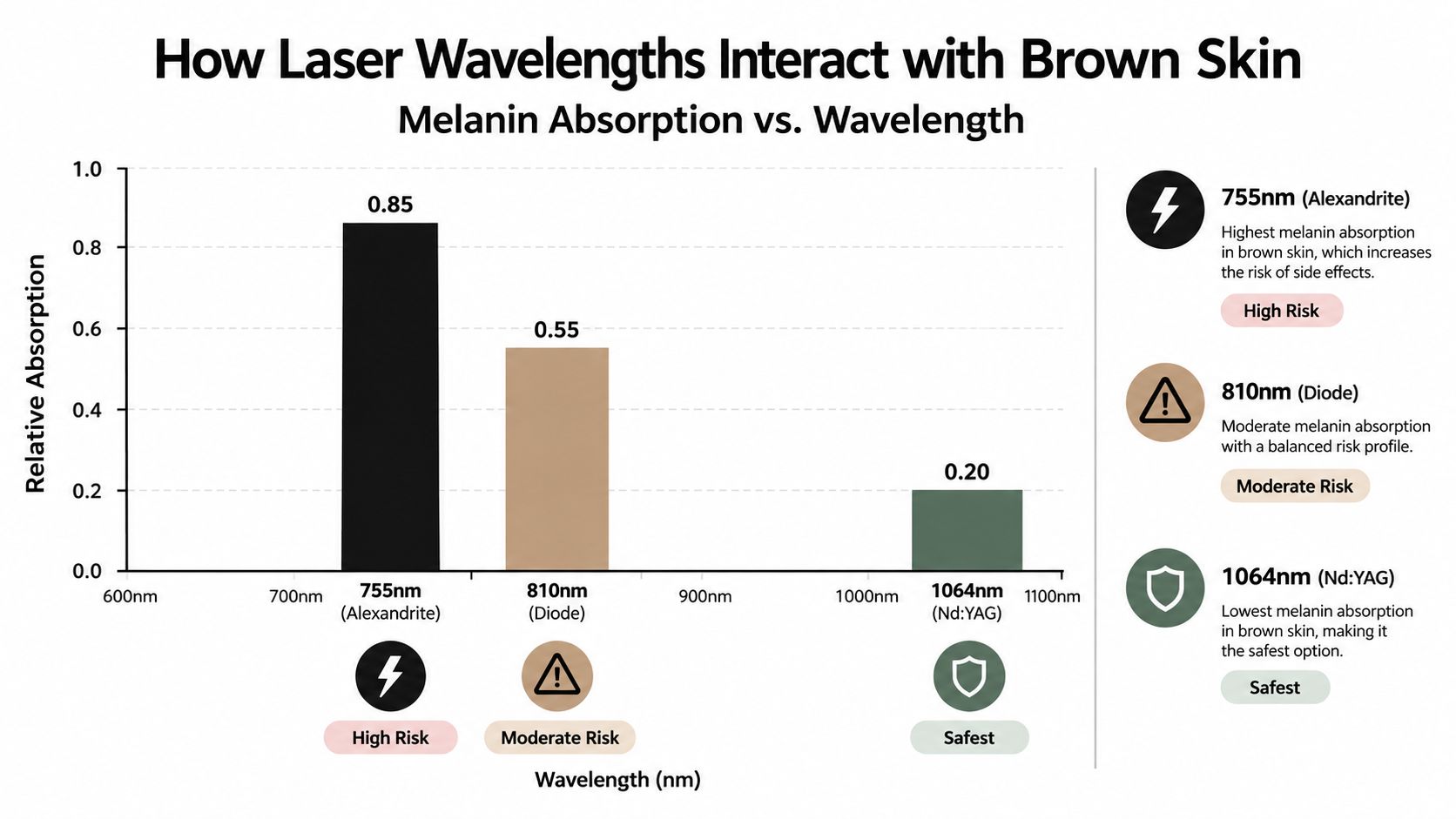
The melanin absorption curve explains why 1064 nm Nd:YAG generally sits at the safer end for Fitzpatrick IV to VI. Melanin absorbs this longer wavelength less strongly, allowing more energy to pass through the epidermis toward the deeper follicle. Shorter wavelengths, including 755 nm alexandrite, interact more readily with surface pigment. A clinical review describes Nd:YAG as a preferred option for darker skin because it can affect coarse, dark follicles while giving epidermal heat more opportunity to dissipate (Journal of Cosmetic and Laser Therapy review).
Comparing the main wavelengths
755 nm alexandrite is absorbed strongly by melanin. It can work well when the skin is lighter and the hair is dark, but that strong surface interaction gives it less margin for deeper brown skin.
810 nm diode occupies a middle position in practical pigment behavior. It may suit selected skin and hair combinations, provided the operator accounts for epidermal melanin, body area, and current pigmentation.
1064 nm Nd:YAG penetrates more with lower melanin absorption. It is usually the safety-first choice for brown and deep-brown skin, especially when pigment changes are a concern.
Hair characteristics still affect clearance. Coarse, dark hair offers a clearer follicular target than fine hair, while hormonal facial or body growth may need ongoing management. Nd:YAG can also feel warmer because its energy travels deeper. Lower melanin absorption does not promise faster clearance or eliminate the need for careful settings. The operator must balance sufficient follicle heating with epidermal protection.
A dual-wavelength platform such as Splendor X sits between a single-wavelength Nd:YAG and a traditional alexandrite device. Its blended 755 nm and 1064 nm output can be adjusted to the contrast between hair and skin, so one area does not have to receive the same approach as another. The clinical idea behind dual-wavelength laser treatment is useful, but the practical safeguard is clinician judgment: who selects the blend, and how do they test your skin's response?
Why Splendor X Stands Out for Diverse Skin Tones
Splendor X addresses a practical limitation of single-wavelength treatment. One area may contain coarse, dark hair against moderate skin contrast, while another may have deeper pigmentation or greater sensitivity. Its handpiece combines 755 nm alexandrite and 1064 nm Nd:YAG, allowing the clinician to select or blend wavelengths for the area being treated.
The physics explains the trade-off. Melanin absorbs shorter wavelengths more readily, so 755 nm can target pigment efficiently but interacts more strongly with epidermal melanin. At 1064 nm, absorption by melanin is lower and penetration is deeper. That places Nd:YAG at the safer end of the melanin absorption curve for brown and deep-brown skin, although the operator still has to deliver enough heat to the follicle. Lower absorption does not guarantee faster clearance.
Hair biology remains part of the result. Coarse, dark hair provides a stronger target than fine hair, while hormonal facial or body growth may require ongoing management. A dual-wavelength device cannot remove those limitations. It gives the clinician more ways to work with them.
The square spot geometry may help cover an area with fewer overlaps and skipped strips than a round spot, but technique still determines coverage. Integrated smoke evacuation can improve the treatment environment, and real-time fluence calibration may support more controlled settings. These features assist clinical judgment. They do not make every protocol suitable for every client.
The trade-off between three platform types
Feature | Splendor X, dual 755 + 1064 | Nd:YAG 1064 nm only | Alexandrite 755 nm only |
|---|---|---|---|
Wavelength choice | Can use or blend two wavelengths | One deeper-penetrating wavelength | One shorter wavelength |
Brown-skin flexibility | High, when operated by a trained clinician | Strong for deeper pigmentation | More limited for Fitzpatrick V to VI |
Coarse dark hair | Can select the wavelength that fits the area | Effective, though treatment may be more conservative | Often highly responsive on suitable lighter skin |
Pigment safety | Depends on the selected blend and parameters | Generally offers the safer melanin profile | Greater epidermal melanin interaction |
Best use | Mixed skin and hair profiles across body areas | Consistent conservative treatment for darker skin | Lighter skin with strong hair-to-skin contrast |
A single-wavelength Nd:YAG is a sound choice for Fitzpatrick IV to VI. Its 1064 nm output gives the clinic a clear safety rationale, though conservative settings can make progress more gradual as the operator balances comfort, cooling, follicle heating, and pigment protection.
An alexandrite-only system may work efficiently on lighter skin with strong hair-to-skin contrast. For brown skin, ask whether the clinic regularly treats Fitzpatrick V and VI, rather than relying on broad device specifications.
NYC Laser Hair Removal presents laser hair removal machine options that include Splendor X and 1064 nm treatment for darker skin types. Use that information to form questions, then let an in-person assessment determine the wavelength blend and settings.
What Happens During Your First Consultation and Session
A safe first visit starts with questions, not a laser pulse. The practitioner should ask about keloid formation, isotretinoin use, hormonal conditions, photosensitivity, recent tanning, active irritation, and previous pigment changes. Mention dark marks left by ingrown hairs or minor burns, because that history may call for more conservative settings or closer follow-up.
Your Fitzpatrick type should be assessed in person, alongside the hair's colour, thickness, density, and treatment area. Coarse, dark hair gives the laser a stronger target. Fine or very light hair contains less melanin, so it may respond slowly or poorly even when the wavelength suits your skin.
The clinician should explain why a 1064 nm Nd:YAG setting is commonly selected for brown skin. Its longer wavelength reaches the follicle while interacting less with epidermal melanin than shorter wavelengths, giving the operator more room to balance follicle heating, comfort, cooling, and pigment protection. A dual-wavelength platform may combine 1064 nm with a shorter wavelength, but the blend and settings still need to match your skin and hair.
The test spot matters
A test spot, often behind the ear or in the underarm, shows how your skin reacts to a conservative fluence before a larger area is treated. During consent, the team should discuss hyperpigmentation, hypopigmentation, blistering, thermal injury, and scarring. Skipping skin typing, risk discussion, or testing leaves you without information needed for an informed decision.
Prepare by following these steps:
Shave the area, rather than waxing or plucking, so the follicle remains available to target.
Arrive with clean skin, without deodorant, fragrance, oils, or heavy products on the treatment zone.
Wear the required protective eyewear throughout the procedure.
Tell the practitioner about recent sun exposure or any new medication before treatment begins.
The pulses may feel like quick rubber-band snaps or brief heat. A chilled sapphire tip or another cooling system reduces surface heat before and after each pulse. Temporary redness or perifollicular swelling can look pronounced on deeper skin tones, but the clinician should explain what a normal response looks and feels like.
Your first appointment may cover only a test patch or limited area. After treatment, the clinic should provide a cooling period of approximately 10 to 15 minutes, written aftercare instructions, expected reactions, products to avoid, and a direct contact for concerning skin changes.
Realistic Results, Session Counts, and Special Cases
Laser hair removal provides long-term hair reduction, not guaranteed permanent removal of every follicle. Results depend on how much melanin the hair contains, how the follicle sits, and how safely the practitioner can heat it without overheating surrounding skin. Coarse, dark hair usually offers a stronger target. Fine hair contains less pigment and may respond more slowly, while blonde, white, gray, and red hair are poor targets because the laser depends on melanin.
A course of treatment is best judged by changing density, thickness, and shaving frequency rather than by a single session. Hair grows in cycles, so one appointment reaches only follicles in an active growth phase. The number of sessions therefore varies with the treatment area, hair coarseness, and growth pattern. Facial hair can require more maintenance than underarm or bikini hair.
Hair profile changes the forecast
Hormones can keep stimulating follicles after an otherwise successful course. People with PCOS-related facial growth may need ongoing maintenance, especially around the chin, jawline, or neck. Discuss that possibility before buying a package, and ask how the clinic will measure progress over time.
Brown skin may respond well to an Nd:YAG 1064 nm laser because its longer wavelength sits at the safer end of the melanin absorption curve. It penetrates toward the follicle while reducing, rather than eliminating, energy absorbed by epidermal pigment. A dual-wavelength platform such as Splendor X can sit between a single-wavelength Nd:YAG and a traditional alexandrite device, combining 1064 nm with a shorter wavelength when the practitioner considers the hair and skin contrast suitable. The trade-off remains practical: a cautious fluence may protect the epidermis but make clearance more gradual.
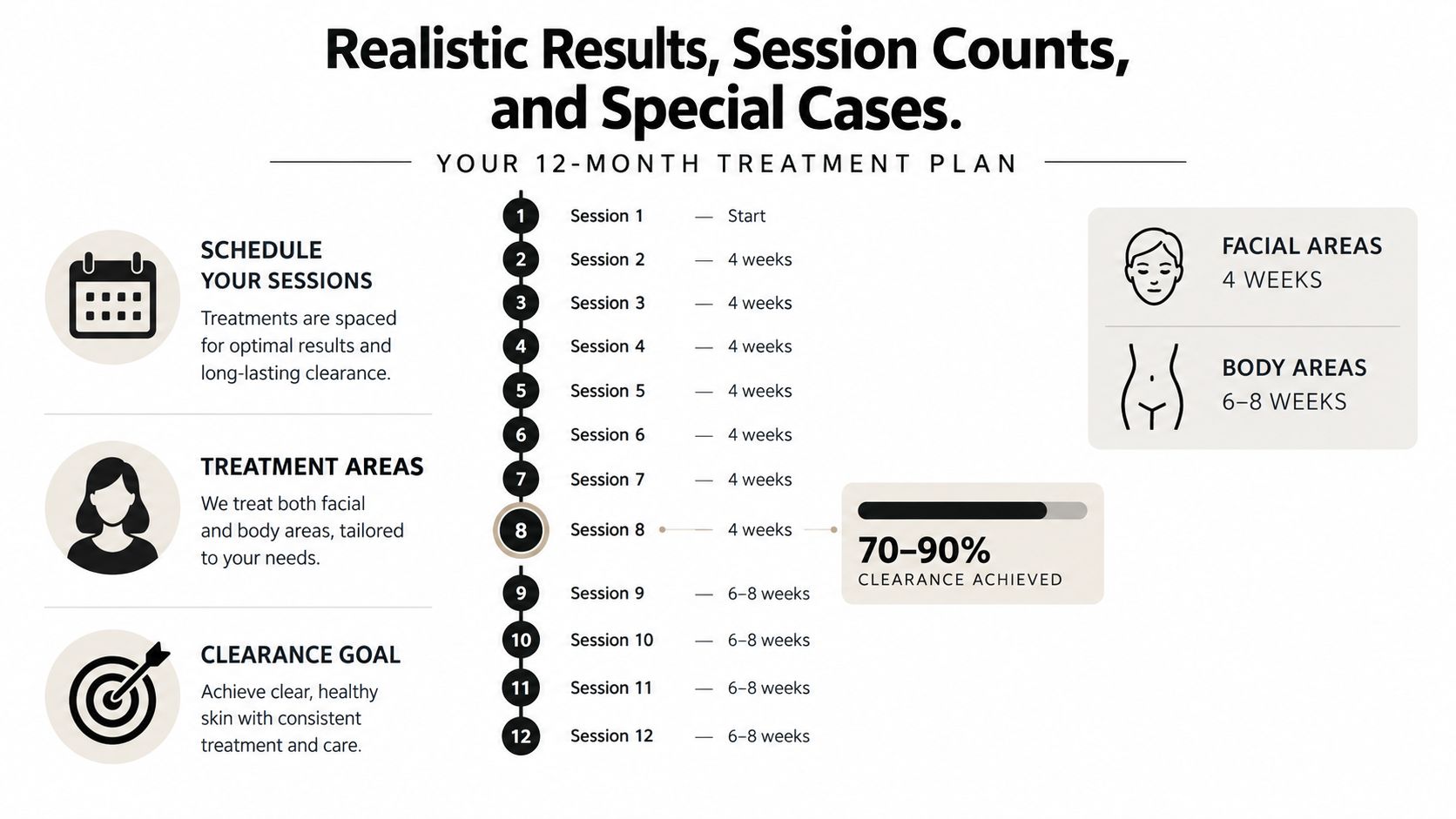
Take photographs under similar lighting and at consistent intervals. Day-to-day regrowth can mislead you, while baseline images show whether density, thickness, and shaving frequency are changing. Ask the provider to review them and adjust the plan if the hair becomes finer or a hormonal area behaves differently from the body.
Aftercare and How to Spot Complications Early
Treat the first 72 hours as active recovery, especially because brown skin can show pigment changes after inflammation. Immediately after treatment, apply a cool compress, never direct ice, and use fragrance-free aloe or the post-laser balm recommended by your clinic. Keep the area clean. Avoid heat, fragrance, and rubbing while the skin settles.
A practical first-week timeline
On day one, mild redness, follicular swelling, or a light sunburn sensation may be normal. The reaction should match the pattern your practitioner explained. Wear loose clothing when possible, and avoid hot showers, saunas, strenuous gym sessions, and other heat-producing activities during this early period.
By day three, small dark specks can appear as treated hairs shed from the follicles. They are not a signal to scrub harder. Do not pick, wax, or pluck them. Cleanse gently according to the clinic's instructions and let the skin recover.
By day seven, watch any lingering pigment closely. Expanding or increasingly dark areas need a call to the clinic. For treated skin exposed to daylight, apply mineral sunscreen with SPF 30 or higher, particularly during the 7 to 10 days after treatment, because ultraviolet exposure can intensify post-inflammatory hyperpigmentation.
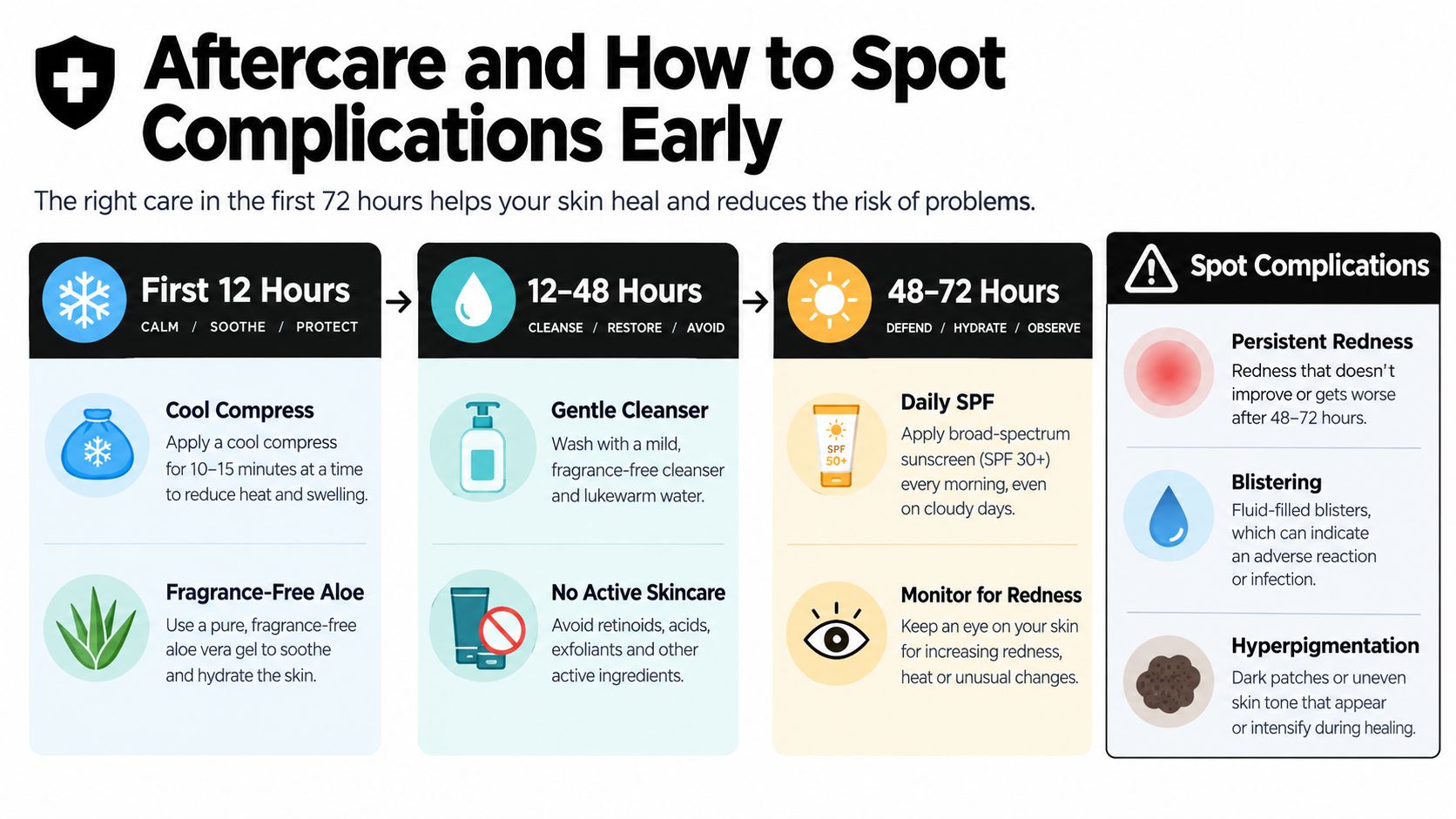
Contact the clinic promptly for pinpoint bleeding, expanding blisters, significant pain, or a dark patch larger than your handprint. Report redness that remains unchanged instead of steadily easing. The guide to laser hair removal and hypopigmentation explains one pigment-related concern, but an article cannot replace an examination.
Do not treat a suspected burn yourself with strong acids, retinoids, bleaching products, or exfoliating scrubs. Send the clinic a clear photograph, state when the change began, and follow the practitioner's instructions.
Choosing the Right Clinic for Brown Skin
A suitable clinic should answer three questions before recommending treatment: What device do you use? Who operates it? How do you control risk? “We treat all skin types” is only an opening claim, not an explanation.
Device inventory
Ask for the exact platform and wavelength. For brown or deep-brown skin, the practitioner should explain long-pulsed Nd:YAG 1064 nm. Its longer wavelength reaches the hair's target while sitting toward the lower-melanin-absorption end of the curve, which helps limit energy absorbed by the epidermis. It still requires careful settings, cooling, and a test spot.
If the clinic uses Splendor X, ask how it selects or blends 755 nm and 1064 nm. A dual-wavelength device can sit between a single-wavelength Nd:YAG and a traditional alexandrite approach. The choice should reflect your skin tone, hair coarseness, treatment area, and tanning history, rather than the device name alone.
Operator training
The operator should explain Fitzpatrick scoring, fluence, pulse duration, cooling, and how test-spot results affect the plan. Confirm who will perform the treatment and whether that person is licensed and trained to treat skin of color.
Ask for anonymized results on brown or deep-brown skin, preferably for the body area you want treated. Hair that is coarse and dark often responds differently from fine hair, while hormonal growth can require maintenance or assessment for an underlying condition. A clinic should discuss those variables instead of promising identical clearance for everyone.
Protocol transparency
A sound consultation covers your medical history, pigment risk, test spot, preparation, aftercare, and expected treatment timeline. The dermatology specialties covered by PatientNotes can help you identify questions for a dermatologist if pigmentation, scarring, unusual hair growth, or a possible hormonal condition affects your plan.
Watch for these red flags:
Package pressure: Staff request payment for several sessions before examining your skin.
No skin typing: Nobody asks about tanning, pigment response, or Fitzpatrick type.
Limited equipment: The clinic offers only alexandrite or IPL without explaining the trade-off for your skin.
Risk avoidance: The practitioner dismisses hyperpigmentation, burns, or test spots.
Vague settings: Nobody explains how fluence, pulse duration, or cooling will change by treatment area.
Choose a clinic that discusses 1064 nm, Fitzpatrick scoring, and patch testing plainly. It should explain trade-offs, show how settings are controlled, and avoid promises of perfect clearance.
NYC Laser Hair Removal offers Splendor X treatments and 1064 nm Nd:YAG options for clients seeking hair reduction across diverse skin tones. Visit NYC Laser Hair Removal to review treatment areas and ask about a consultation and patch test.
Comments