
Laser Hair Removal Nipple Area: Safety and Sessions
Breast-area laser treatments achieved 66% physician-rated hair clearance after three sessions in a 2020 real-world study published in Lasers in Surgery and Medicine. That's meaningful reduction, but it isn't complete removal, and the study didn't report nipple-only results separately.
For anyone considering laser hair removal around the nipple area, that distinction matters. So does the treatment boundary: hair-bearing breast skin and the darker areola, the pigmented circle around the nipple, shouldn't automatically receive the same treatment. A sensible plan starts with realistic expectations and a specific strategy for protecting pigmented tissue.
How Many Sessions Nipple-Area Treatment Takes
Nipple-area laser hair removal is possible for suitable candidates, but it requires a series rather than a single appointment. The aim is long-term hair reduction, not a guarantee that every hair will disappear forever.
The study introduced above provides useful planning context because it included breast treatments alongside other body regions. Its breast category is relevant to surrounding hair-bearing skin, but it doesn't establish how every individual areola will respond.
Expected clearance across a nipple-area treatment course
These are the milestones reported in that study, with broader treatment-site results distinguished from breast-specific results.
Milestone | Result from the study | What it means for you |
|---|---|---|
After 3 sessions | 66% physician-rated clearance in breast-area treatments | Early progress, not the finish line |
After 5 or more sessions | About 80% clearance in breast and abdomen regions | Plan for a series rather than a single appointment |
Average course | 5.31 sessions, range 3 to 16, among patients completing at least three treatments | A package isn't a prediction of your exact needs |
Physician-rated clearance, all patients | 74% rated as having 75–100% clearance | Clinic ratings can differ from personal impressions |
Patient-reported clearance | 48% | Your assessment may be less favorable than the clinician's |
Sustained at 11.5 years | 87.9% of 173 respondents reported sustained improvement | Lasting improvement doesn't mean guaranteed elimination |
The early-treatment result is encouraging, but it shouldn't become a promise about your own course. Hair characteristics, treatment boundaries, skin response, and the appearance of new growth all affect the plan.
The average-course row also needs context. It describes people who completed a minimum treatment course across different body sites, not an ideal number prescribed specifically for nipple-area hair.
Measure progress in a way that matters to you
A clinician may judge clearance by comparing the treated area with baseline photographs. You might judge it by whether a conspicuous coarse hair still appears or whether you're still reaching for tweezers. Those are different assessments, so discuss both.
Practical rule: Agree on what success looks like before treatment starts, fewer visible hairs, less frequent grooming, or a smaller patch of coarse growth.
Ask for baseline documentation and consistent follow-up photographs, with your consent and appropriate privacy safeguards. Compare the same area under similar lighting rather than judging the entire course by how the skin looks immediately after an appointment.
Build a multi-session plan, then review progress against the milestones above. If improvement stalls, reassessment is more useful than automatically purchasing additional sessions.
Who Can Safely Treat Darker Areolas
Dark hair alone doesn't establish candidacy. A visible hair shows where a follicle sits, not what the skin around it can tolerate. The provider has to read the pigment in the surrounding skin and in the areola itself before choosing any setting. The areola is a densely pigmented, sensitive zone, not a small patch of ordinary skin, so it needs its own safety plan.
Providers should shield the central nipple and areola and take particular care wherever pigment is dense. Wavelength, pulse duration, and fluence that suit a pale forearm can overheat darker tissue, causing burns, blistering, patches that heal darker or lighter, and scarring. Those pigment-related risks run higher in Black and brown skin. Our guide to laser hair removal for brown skin explains how skin tone shapes the choice of device and settings.
Laser also reduces hair rather than guaranteeing permanent removal, so judge the plan by fewer coarse hairs, not by a promise of none.
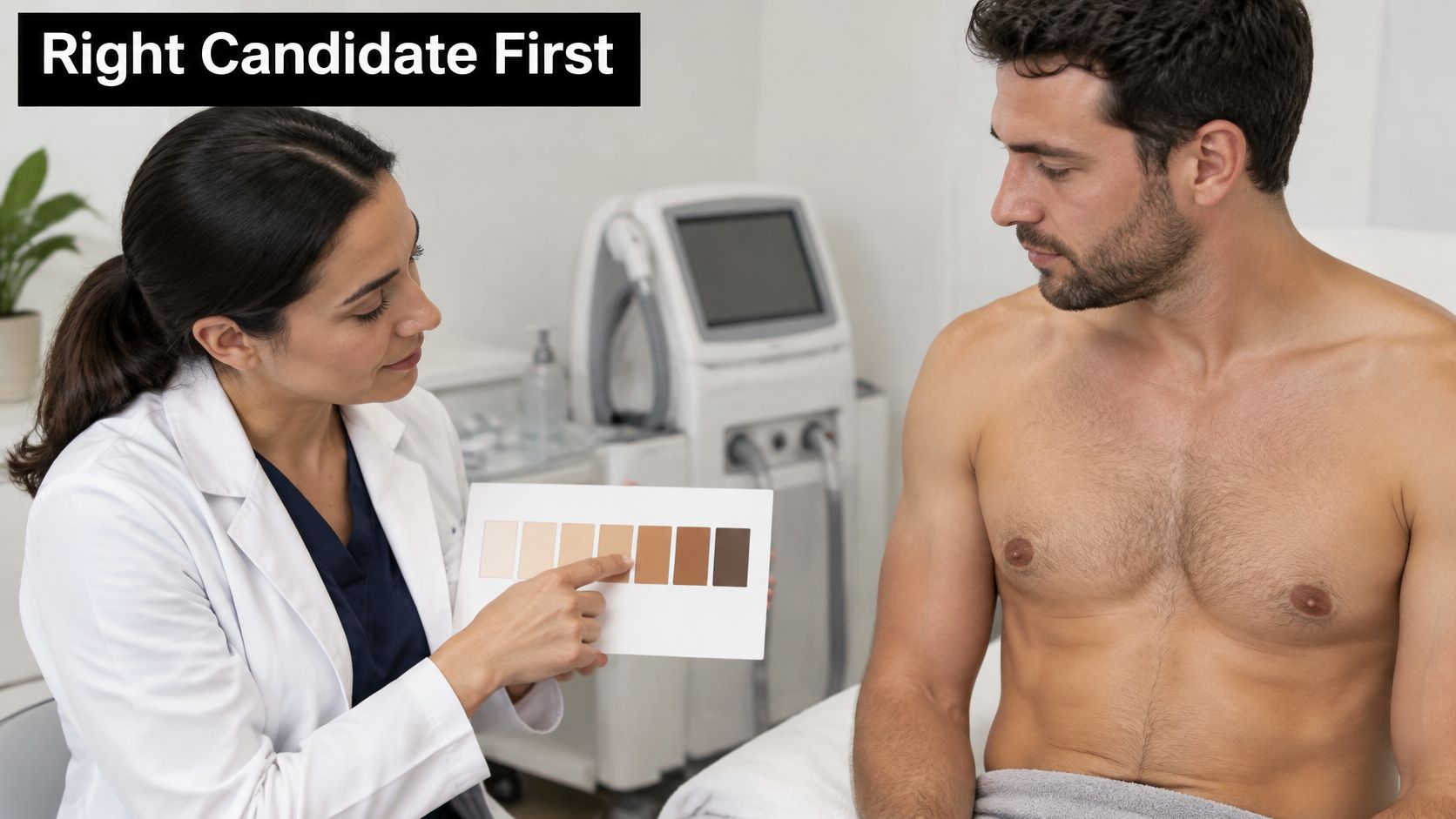
Candidacy factors and what to disclose
At our initial consultation, experienced professionals assess your skin type and hair color to create a personalized plan. Bring the details below rather than relying on a photograph of the hair alone.
Factor | Why it matters | What to disclose |
|---|---|---|
Fitzpatrick skin type | Skin pigmentation and response to sunlight inform energy selection | Your burning or tanning tendency and past treatment reactions |
Areola pigmentation | Heavy pigment can increase burn and pigment-change risk | Previous darkening, lightening, or scarring |
Hair color and coarseness | Dark, coarse hairs generally respond better than blond, gray, or fine hairs | Exactly which hairs bother you |
Recent tanning or sun exposure | A tan changes the skin's current treatment risk | Recent outdoor exposure, tanning beds, or tanning products |
Active dermatitis or lesions | Inflamed or unusual skin needs clinical assessment first | Rash, irritation, a changing mark, or an unexplained lesion |
Hormonal symptoms | New coarse growth may require medical assessment | Irregular periods, acne, or sudden increased growth |
“Suitable for darker skin” doesn't mean every device or setting is equally appropriate, and a test spot placed at the edge of the areola belongs to that judgment.
A darker areola and a recent tan
Consider someone with coarse hairs outside a pigmented areola who has just returned from a sunny vacation. The consultation should address the tan before proceeding, including whether treatment needs postponing, where a test spot could safely go, and which tissue must remain shielded.
A test spot doesn't override tanning or other contraindications. It is a cautious step once the skin is suitable for treatment.
Choose a professional who explains these decisions clearly and recognizes when medical evaluation is needed. The areola deserves its own safety plan, not merely the label “small area.”
Hormonal Hair, Pregnancy and When to Pause
Pregnancy is a reason to pause. We don't recommend laser hair removal for pregnant clients. Our guide to pregnancy and laser hair removal explains how to approach treatment planning during this period.
Our medication policy also requires clients not to be taking Accutane, Retin-A, or Gold Therapy currently or within the preceding six months. This is our treatment eligibility policy, not advice to stop prescribed medication; discuss any medication change with your prescriber.
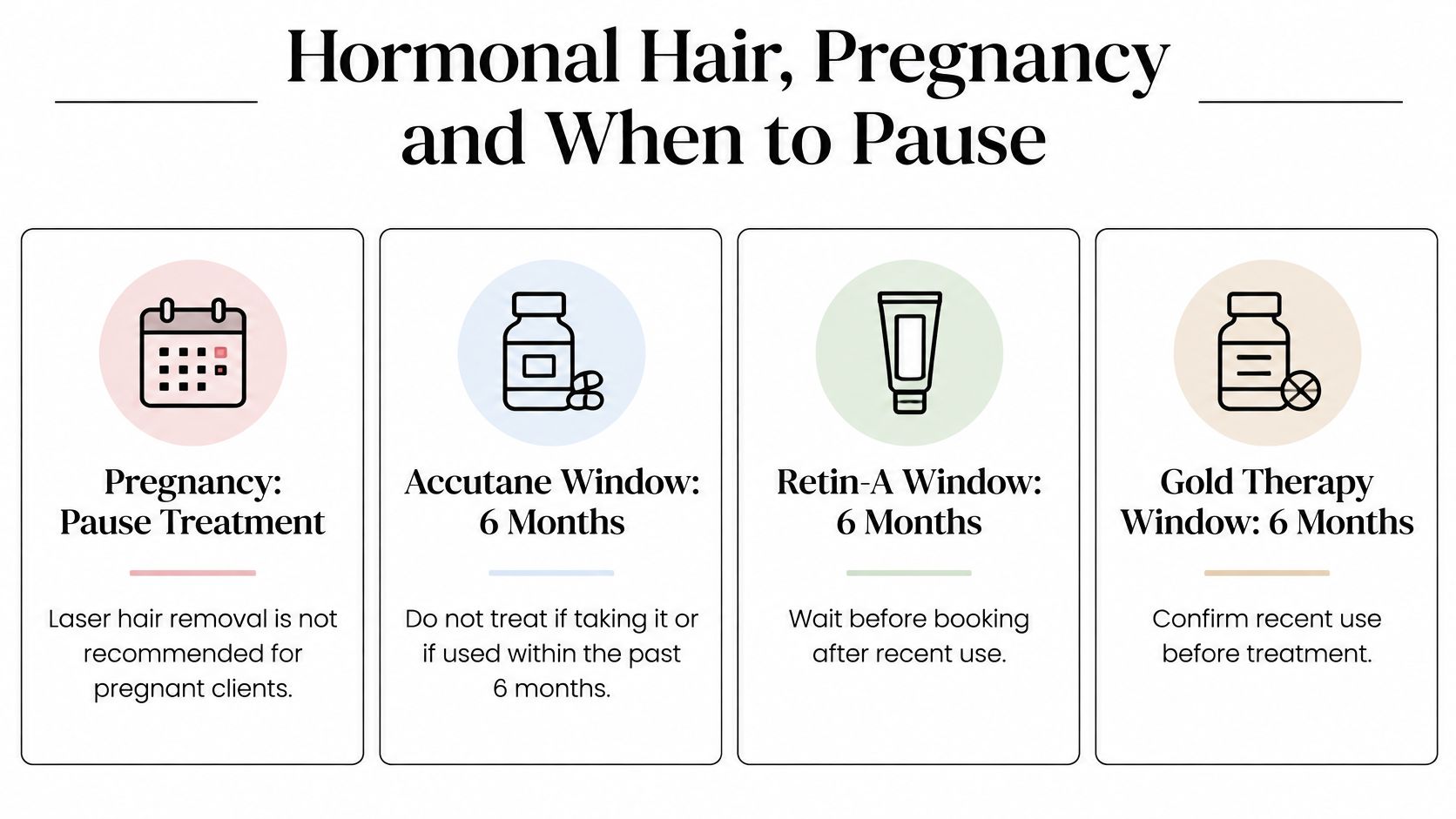
Pregnancy can also change how people experience their hair growth. For accessible background, Feed Mom & Me on hair changes discusses pregnancy-related changes, but it doesn't replace individual medical advice or treatment clearance.
When more hair needs a medical explanation
Stable, isolated hairs are different from a rapidly changing pattern. The Mayo Clinic's laser hair removal overview explains treatment limitations and uncommon risks; cosmetic reduction shouldn't substitute for investigating a possible underlying hormonal problem.
Arrange medical evaluation before a cosmetic series if increased chest or areolar hair accompanies:
Menstrual changes: Irregular or newly disrupted periods.
Other androgen-related changes: Acne or scalp hair thinning.
Rapid progression: Sudden coarse growth or a changing voice.
Laser can target existing pigmented hairs, but it doesn't diagnose or correct the hormonal driver. Tell us about endocrine diagnoses, new symptoms, and changes in hormonal medication so treatment planning reflects the full picture.
When laser appears to increase growth
Paradoxical hypertrichosis means new or apparently increased hair following laser or light treatment. A systematic review in the American Journal of Clinical Dermatology found approximately 3% overall prevalence, but 0.08% at non-facial, non-neck sites, with periareolar cases reported sporadically.
These aren't nipple-specific risk estimates. Fine hairs beside coarse hairs, darker skin, and hormonal conditions deserve particular attention when deciding what to treat.
Don't expand treatment across surrounding fine fuzz simply to make the treatment area look uniform.
If growth increases, document its location and arrange reassessment. Appropriately selected professional treatment may sometimes be preferable to abandoning laser entirely, but that decision needs a clinician's review rather than an automatic increase in energy.
Safety Risks and How Providers Limit Them
Calling laser “safe” leaves out the decisions that make treatment safer. Serious complications are uncommon, but a low overall complication rate doesn't establish that every device, setting, or treatment boundary is appropriate for an individual areola.
A 2024 tertiary dermatology-center study assessed 16,900 laser hair-removal patients over one year and recorded complications in 0.69% of cases. The table separates the overall patient rate from the distribution of reported complications, which are different measures.
Reported complications, risk factors and how to reduce them
Complication or factor | Reported finding | What lowers the risk |
|---|---|---|
Petechiae, purpura or ecchymosis | 31.66% of reported complications | Conservative fluence and active cooling |
Pigmentation changes | 20.0% of reported complications | Test patch, individualized settings, and sun protection |
Overall complication rate | 0.69% of 16,900 patients over one year | Skin assessment and trained operators |
Higher fluence | Identified risk factor | Energy settings chosen for the individual |
Alexandrite laser | Identified risk factor | Wavelength matched to skin characteristics |
Burns, blistering, crusting | Uncommon but recognized laser complications | Pigment protection and conservative test treatment |
Petechiae are pinpoint bleeding spots; purpura and ecchymosis describe larger areas of bleeding or bruising beneath the skin. The complication percentages in those rows describe the complications recorded, not the proportion of all patients who experienced each problem.
The study also identified head and neck treatment as a risk factor. That doesn't make breast treatment risk-free, and it doesn't mean an alexandrite laser is always unsuitable. It means device choice and treatment location need interpretation alongside individual skin characteristics.
What a conservative plan actually means
Expected local reactions can include temporary redness and swelling around follicles. Burns, blistering, crusting, persistent pigment changes, irritation, and unwanted increased growth are different concerns and shouldn't be dismissed as proof that treatment is working.
The central nipple shouldn't be treated as an ordinary patch of breast skin. A qualified professional should assess unusual anatomy, pigmentation, or lesions before any treatment is considered, and protect the most pigmented tissue.
Energy selection also involves a balance. Using a stronger setting to accelerate results can increase injury risk, while indiscriminate low-energy treatment of unsuitable fine hairs isn't a sound alternative.
Safety checkpoint: The provider should be able to describe the treatment boundary before the laser is switched on.
Bring these questions to your consultation:
Wavelength: Why is the proposed wavelength appropriate for my surrounding skin and areola pigmentation?
Fluence: How will you choose the energy level and assess the test response?
Pigment protection: Which tissue will be shielded, and how will you prevent accidental exposure?
A clear explanation is more useful than reassurance that the appointment will be quick.
How a Nipple-Area Session Runs, Step by Step
A well-planned session starts before you enter the treatment room. The preparation instructions matter because surface hair, recently removed roots, tanning, and irritated skin can all affect whether treatment should proceed.
The American Academy of Dermatology's laser hair removal overview emphasizes professional assessment and the possibility of burns and pigment changes. The practical aim is controlled heating of suitable follicles while protecting the surrounding skin.
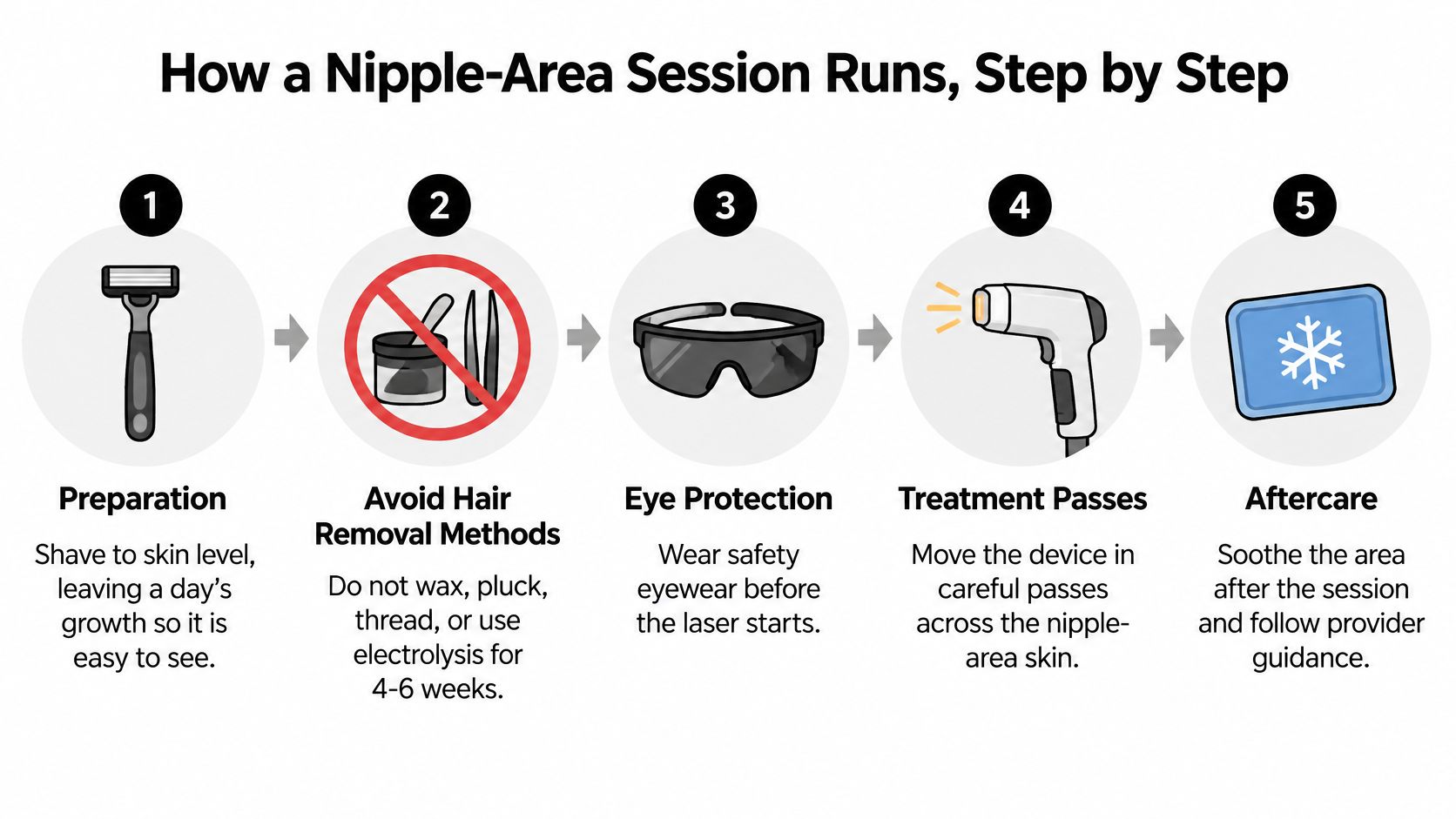
Before and during the appointment
Prepare the hair and skin. Our instructions require avoiding waxing, plucking, threading, and electrolysis for four to six weeks, and avoiding sun exposure for two weeks before treatment. Shave to skin level as instructed; a day's growth may help identify the area, so confirm the timing rather than deliberately leaving long hairs.
Arrive with a clean treatment area. Wash the skin and leave it free of makeup and topical medication, following the preparation plan agreed with your clinician. Don't independently discontinue a prescribed product; resolve that question before appointment day.
Review the proposed treatment boundary. The specialist checks skin type, hair color, areola pigmentation, recent tanning, and medication history. Point out the actual hairs you want addressed so surrounding fine hair isn't automatically included.
Complete a conservative test treatment. A small suitable patch of hair-bearing skin is treated to assess response. The professional determines how that response should be reviewed before broader treatment proceeds.
Put protection in place. The client and staff wear appropriate laser safety eyewear before treatment begins. The central nipple and areola are shielded, with the intended surrounding treatment area clearly identified.
Select settings and deliver controlled passes. Wavelength, pulse duration, and fluence are selected for the skin and hair characteristics, with active cooling used to protect the skin. Treatment stays on the agreed hair-bearing surrounding skin rather than intentionally passing over the nipple.
Check the skin and plan follow-up. The specialist reviews the immediate reaction, records the settings and response, and provides aftercare instructions. The next appointment is timed to regrowth and recovery rather than booked just because the same interval suits everyone.
Why the preparation isn't interchangeable
Shaving and waxing don't prepare the follicle in the same way. Shaving leaves the follicular target in place, while removing hair from the root can leave less suitable pigment for the laser to target.
Our treatment requires hair at skin level to effectively target the follicle. Long surface hairs aren't an advantage, so don't substitute “leave it visible” for the shaving instructions.
For a broader explanation of appointment preparation, use our laser hair removal procedure guide. Your nipple-area instructions should still specify how to handle the curved, sensitive skin without nicking it.
Judge the course by progressively reduced regrowth, not by an expectation that every treated hair vanishes during the appointment. If you can't tell whether the remaining marks are hairs, irritation, or pigment changes, send the clinic a clear description and request assessment before treating again.
What the Session Feels Like and How to Recover
A pulse may feel like a quick rubber-band snap or a warm prick. The nipple-adjacent area is sensitive, so tell the operator if the sensation changes from a brief sting to sustained heat or burning.
Active cooling can make treatment more manageable, but it shouldn't be used to persuade you to tolerate escalating pain. You can ask for a pause, a skin check, or clarification about what you're feeling.
A practical appointment-day scenario
Say you schedule a midday appointment and bring a loose, soft shirt. Afterward, the treated follicles look slightly red and raised, and the skin feels warm rather than very painful.
You return to your usual activities but avoid clothing that rubs the area. That evening, you cleanse gently, leave the bumps alone, and follow the clinic's cooling instructions if the skin feels uncomfortable.
Our stated downtime is typically none, although that doesn't mean every person has no visible reaction or needs no temporary activity adjustments.
Comfort should improve after treatment, not become progressively harder to manage.
Keep aftercare simple
Use a gentle cleanser and avoid scrubbing the treated skin. Choose a bland moisturizer if your clinician recommends one, rather than introducing exfoliating acids, fragranced products, or a new active ingredient during recovery.
Reduce heat and friction: Avoid very hot baths, tanning, and activities or clothing that make the treated skin sting.
Protect against sunlight: Keep the area covered and use broad-spectrum sunscreen when it could be exposed.
Leave follicles alone: Don't pick bumps, pull at shedding hairs, or scratch irritated skin.
Mild redness, swelling, and warmth can settle over the following days. Your own recovery instructions should account for your skin response, not just the small size of the treatment zone.
Warning signs that need a prompt call
Contact the clinic promptly for blistering, crusting, spreading redness, increasing pain, or new darkening or lightening of the skin. Describe when the change began and whether it's getting worse.
Don't apply bleaching cream or try to exfoliate a suspected burn away. Seek urgent medical care if symptoms are severe or you feel unwell.
Questions to Settle Before You Book
Book only after the treatment boundary, skin-safety plan, and likely ongoing costs are clear. A small treatment area doesn't remove the need for a thorough consultation.
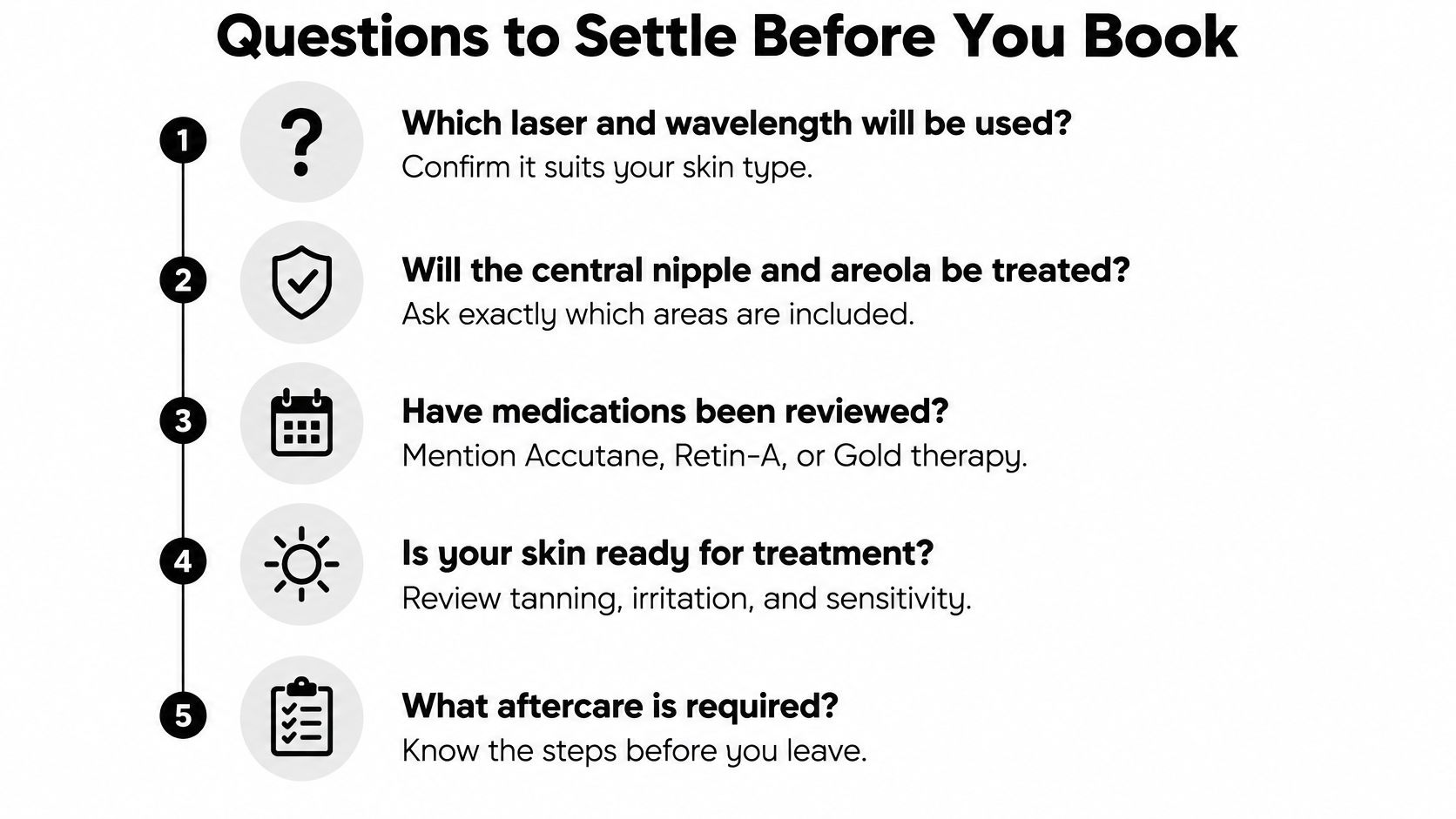
Reported nipple-area laser prices, 2026
These published listings use different currencies and package structures. “Not listed” means the cited listing doesn't provide that price, not that the service is free.
Provider | Single session | Package | Maintenance |
|---|---|---|---|
$75 for one 15-minute session | $375 for six sessions | $35 per session | |
Not listed | Eight sessions at $1,232, promotional price $616 | Not listed | |
$60 | $299 for six sessions | Not listed | |
€49 per zone with diode; €59 per zone with Alexandrite/YAG | Not listed | Not listed |
The Laser ONE entries are alternative single-zone treatment prices, not a package comparison. Confirm current quotes, consultation charges, package expiration terms, and whether maintenance is included before paying.
Our Small Areas service costs $25.00 and includes the areola. The initial assessment determines a personalized plan rather than assuming the advertised area label establishes candidacy.
Bring a booking checklist
Device and settings: Which wavelength is proposed, and why?
Protection: What will be shielded, and where will the test patch go?
Course expectations: What session plan and maintenance costs should I anticipate?
Changing growth: What happens if new or thicker hairs appear?
Eligibility: Have pregnancy, medications, tanning, irritation, and hormonal symptoms been reviewed?
If those answers remain vague, postpone treatment. You should understand both the intended benefit and the reason the proposed approach suits your skin.
NYC Laser Hair Removal offers individualized hair-reduction consultations for clients considering treatment around the areola in Westbury and the surrounding Long Island area. Visit NYC Laser Hair Removal or call 516-321-4959 to arrange an assessment of your skin type, hair color, and treatment options before starting a series.
Comments