
Numbing Cream Before Laser Hair Removal: Safe Use Guide
Most advice about cream before a laser session sounds the same. Buy the strongest tube you can find, coat the skin, seal it under plastic wrap, and wait until you feel nothing. That plan treats an upper lip and a full back as the same job. They are not.
Numbing cream before laser hair removal is a comfort tool for a limited patch of intact skin, used at a known strength, for a set time, then wiped off. Spread across a back, chest, or full legs, the same cream is a dose problem. More surface means more drug that can enter the blood. Wrap and extra sitting time push that further. Less sting does not make the laser settings safer.
I would skip a mystery tube from an online shop and let the clinic decide whether any cream belongs on that area. The label has to name the strength, the contact time, and how much skin it is meant for. If it doesn't, it doesn't belong in the routine.
Which Numbing Creams Are Safe to Use
Safe means a named formula, a named strength, and a set time on a limited patch of intact skin. Dose changes with area. A thin layer on an upper lip behaves differently than the same tube spread across a back, chest, or full legs, where more surface allows more drug into the blood. Plastic wrap and long contact push absorption higher still.
Numbing cream options by strength and status
Product type | Strength | Status for laser prep | What it means for you |
|---|---|---|---|
Lidocaine 2.5% with prilocaine 2.5% | 2.5% / 2.5% | FDA-labelled for intact skin | Use only under a clinician-approved protocol |
Clinician-prepared lidocaine with tetracaine | 23% lidocaine / 7% tetracaine | Compounded product studied under controlled conditions | Requires prescriber and pharmacy; not a home product |
Commercial lidocaine | 4% lidocaine | Top of the over-the-counter range | Confirm area and contact time on the label |
TKTX Numb Maximum Strength | 22% lidocaine | Above the 0.5%-4% OTC range; FDA identified it | Avoid |
No cream | None | Standard practice when the clinic does not advise numbing | A valid choice; ask the clinic whether your procedure needs it |
Lidocaine 2.5% with prilocaine 2.5% is the combination labelled for intact skin. In practice I recommend it only inside a clinician set protocol, with a measured amount and a fixed clock. It is not a product to coat thickly over a large zone at home.
A clinician-prepared 23% lidocaine with 7% tetracaine is compounded for a specific patient. A prescriber orders it and a pharmacy prepares it. A published result does not make a high strength internet tube equivalent, and similar packaging does not mean similar safety.
Commercial 4% lidocaine sits at the top of the over-the-counter band. Even a small facial tube has to match the box for area, amount, and minutes. The label controls the decision.
In 2024, the FDA identified TKTX Numb Maximum Strength Pain Reliever, labeled with 22% lidocaine, as exceeding the 0.5%–4% lidocaine concentration range permitted for the relevant over-the-counter topical category, according to the FDA warning letter to TKTX Company.
No cream is a normal plan when the clinic does not advise numbing. Device cooling and a measured pass often carry a lip, chin, or underarm without a topical at all.
What those rows mean in practice
A tested cream can lower discomfort when formula, dose, and minutes on skin match the studied conditions. Those conditions stay with that product. They do not transfer to another jar because the front says maximum strength.
A clinic approved cream on a sensitive, limited area is a reasonable comfort option. A high strength cream bought to cover legs, chest, or back at home is not. If you want a plain explanation of using lidocaine cream for localized pain, keep that frame. One limited patch, a named strength, and a label you can read.
Practical rule: If the label does not state the strength, the contact time, and the maximum area, don't use it.
When to Skip the Cream or Postpone Treatment
Broken, irritated, sunburned, or dermatitis-affected skin: Apply nothing and move the date. Damaged skin takes up more drug than intact skin, and a laser pass on a fresh burn is a poor idea on its own.
Large zones such as the back, chest, full legs, or a Brazilian area: That is where dosing errors happen. The FDA's March 2024 warning advised consumers not to use OTC products containing more than 4% lidocaine, and it named large-area application, prolonged contact, use on irritated or broken skin, and plastic wrap or another dressing as factors that can increase absorption and lead to irregular heartbeat, seizures, and breathing difficulties. Warning letters in February 2025 further targeted products promoted for laser cosmetic procedures whose formulas exceeded permitted OTC concentrations or lacked appropriate authorization.
Medications: You must not be on Accutane, Retin-A, or Gold Therapy now, or within the past 6 months. Don't book until that history is cleared. If you aren't sure what counts, we'll give you the list of medications that affect treatment.
Pregnancy: Laser hair removal treatments aren't recommended for pregnant clients. Say so at booking and postpone. Breastfeeding belongs in the same conversation, before any product is chosen.
Known allergy to lidocaine, tetracaine, or another anesthetic, or a prior reaction: Disclose it before a cap comes off. A "natural" or "cosmetic" label doesn't cancel an allergy.
Small facial zones such as the upper lip or chin: Total dose is lower than a back or full legs, but the label rules don't relax. Still no broken skin, no home wrap, and no second anesthetic stacked on the first.
A cream marketed hard online is a weaker bet than a lower-strength regulated option, or no cream at all.
Our notes on what not to do before laser hair removal sit beside this list. At the consult, disclose allergies, medicines, pregnancy or breastfeeding, irritation, and past reactions. We choose the product, the amount, and the time.
Timeline From Patch Test to Treatment Day
Preparation timeline before laser treatment
When | Action | Reason |
|---|---|---|
4-6 weeks before | Stop waxing, plucking, threading, or electrolysis | The laser needs hair at skin level |
4-6 weeks before | Optional hydroquinone bleaching cream, after consulting a technician | Can optimize results under professional guidance |
2 weeks before | Avoid sun exposure | Reduces pigment change risk |
3 days before | Patch-test the cream on a small area and watch it for 48 hours | Checks for reaction before the full zone |
Day before | Shave to skin level, leaving about a day's growth | Lets the technician see the hairs |
Day of | Wash the treatment area; no makeup or medication on the skin | Clean skin for the cream and the laser |
Walk the dates backward
On the morning of treatment, the area is fully washed and bare. No makeup, no lotion, and no medication left on the skin. That clean surface is what the session needs, whether a cream is in the plan or not.
The day before, shave to skin level and leave about a day's growth. That short stubble makes the area easy to recognize. Shaving is the right tool here. Pulling hair out is not.
Three days out, patch-test only if a cream is planned. A small dab, watched for 48 hours, shows a reaction while there is still time to drop the cream or move the visit. Don't run that test on the morning of a full-leg booking.
Two weeks out, avoid sun exposure. A fresh tan raises pigment-change risk, and sunburned skin is already a reason to postpone rather than to numb.
The window people miss
Four to six weeks before treatment, stop waxing, plucking, threading, and electrolysis. The laser needs the hair at skin level to destroy the follicle. Pull the hair out in that window and the session has little to treat. In that same stretch, a hydroquinone bleaching cream may be started to support the result, but only after you talk it through with the technician. Don't start one because a friend did.
Put those dates in your phone next to the appointment. One missed step, usually the wax-free window, costs the visit. The procedure for laser hair removal only works if the hair is still there.
How to Apply Numbing Cream Before Treatment
Contact time and amount reference
Situation | Contact time | Amount | Note |
|---|---|---|---|
Routine procedure, intact skin | At least 1 hour | 1-2 g per 10 cm² | Remove fully before the laser |
More painful procedure | Up to 2 hours | 1-2 g per 10 cm² | Clinician sets the time |
Large zone (back, chest, full legs) | Clinician sets the time | Total dose confirmed from the label | Absorption risk rises with the area |
Small facial zone (upper lip, chin) | At least 1 hour per label | Per label, confirmed by clinician | Lowest total dose of the options |
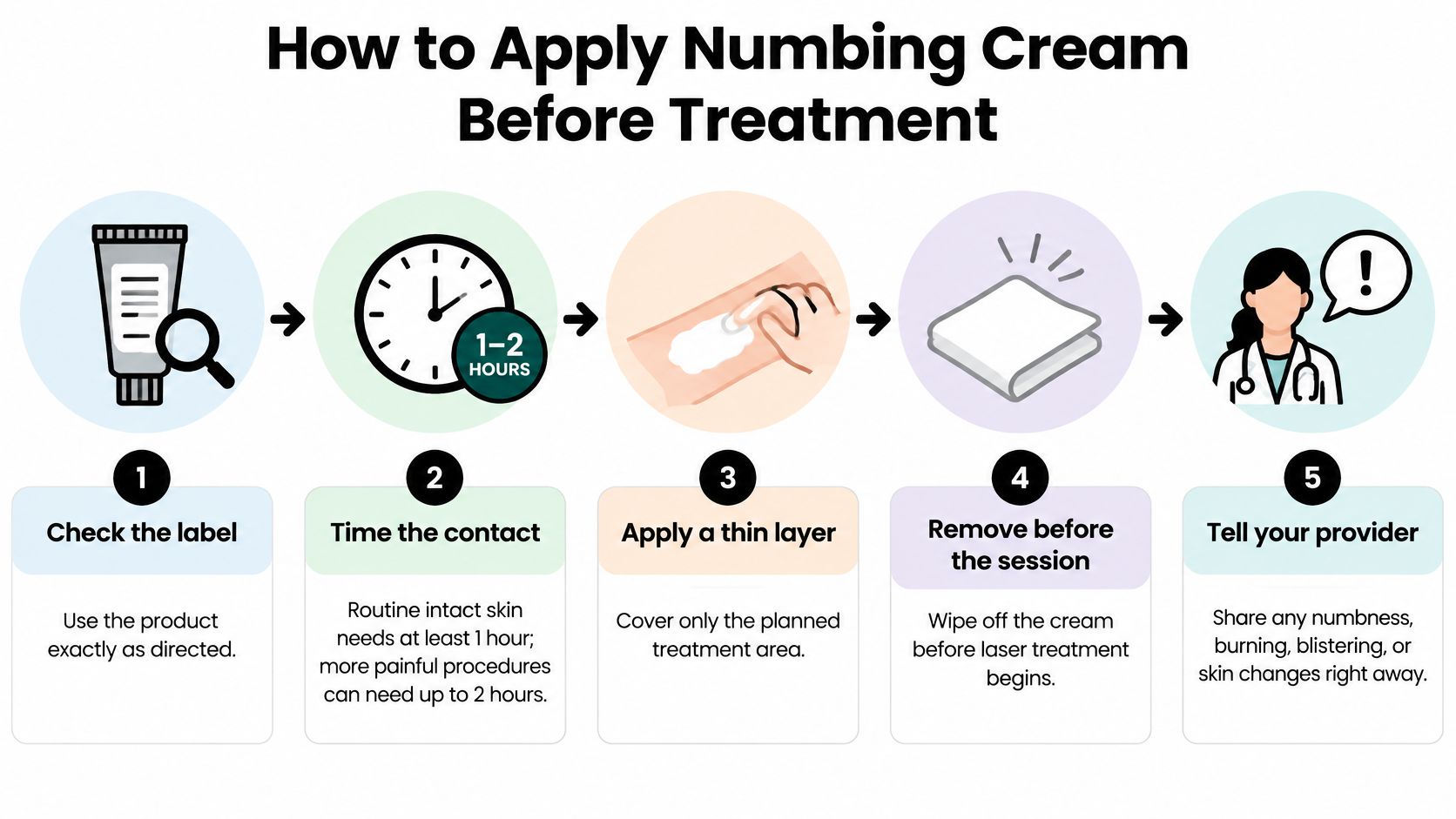
For intact skin, FDA labeling for lidocaine 2.5% / prilocaine 2.5% specifies a thick layer, with routine procedures generally needing at least 1 hour of contact and more painful dermatologic procedures needing 2 hours, at typical amounts of about 1–2 g per 10 cm², while the maximum total dose must come from the exact label because large areas raise systemic absorption, per the FDA lidocaine/prilocaine label.
A phase 2 double-blind, placebo-controlled study of 60 people split each area so one side received lidocaine/tetracaine cream and the other received placebo, with applications tested after 30, 45, and 60 minutes. Pain ratings were significantly lower with the anesthetic cream than with placebo at P < 0.001, and participants reported significantly more adequate anesthesia at P < 0.001. A separate analysis reported mean visual-analog pain scores of 26.7 with lidocaine/tetracaine versus 44.3 with placebo in one study, and 23 versus 31.7 in another, as described in the phase 2 laser hair-removal trial. Those figures belong to specific formulas, doses, and conditions, especially sensitive zones such as the face, bikini region, underarms, or groin. They are not a blank check for every over-the-counter tube.
The routine, in order
Confirm the history. An anesthetic allergy, or a contraindication already on file, stops the cream before the cap comes off.
Check the skin. It should be unbroken and free of dermatitis, irritation, or sunburn. Damaged skin takes up more drug.
Apply the prescribed amount in a thick layer. Don't rub it in. Rubbing thins the film the timing assumes.
Cover the area only if we direct it. A dressing or plastic film increases absorption. The default is uncovered skin.
Start a timer and note the start time. The window is the label's, or the one we set, not "until it feels stronger."
Remove all cream before the laser. Residue is still a dose, and it sits between the light and the skin.
Inspect, then tell the operator. Abnormal whitening, redness, swelling, or irritation gets reported before the first pulse.
Keep the cream away from the eyes, off mucous membranes, and off open wounds. Don't combine a second anesthetic "for extra help."
After a full wipe, a normal check is mild redness that fades within hours. Spreading redness, blisters, or pain that builds is a stop, not a side note.
Say the planned patch is 100 cm², about a small zone on the upper thigh. At 1–2 g per 10 cm², that is roughly 10–20 g. A back or full legs is many times that surface, so the total is calculated from the label and confirmed before anyone applies it.
Settle the Numbing Plan and Pain Warnings With Your Provider
Less pain is not a safer session. Numbing can quiet the signal that would have made you say the skin is too hot, and it does not stop thermal injury.
A 2024 double-blind randomized trial of 74 women and 256 diode-laser hair-removal procedures compared 4% lidocaine with a compounded 23% lidocaine / 7% tetracaine formulation applied 60 minutes before treatment. The compounded cream produced statistically lower pain scores in every region evaluated, and no adverse effects were reported in that study. Those results should not be generalized to unsupervised compounded use: the high-concentration product requires a licensed prescriber and pharmacy, and the study does not establish safety for large treatment zones or every skin type, as reported in the 2024 diode-laser comparison.
Cooling, conservative fluence, and a continuous read of the skin reaction stay in place because complications can include burns, blistering, infection, scarring, and persistent pigment changes. Tell the operator at once if the skin feels hot, stinging, or unusually tight, even when it doesn't hurt. We document the product, the concentration, the amount, the application time, and the removal time, and we treat a test area when that's appropriate. Comfort options are covered in our guide to laser hair removal pain management, and none of them replace that watch.
Bring this list to the consult
Name, strength, time, and amount. Ask for the exact product for your zone, not a generic "some numbing cream."
Who supplies it, and whether a test spot comes first. A small area treated before a back or full legs tells you more than a guess at the counter.
The medication list, including the past 6 months. A drug you stopped in the spring can still change whether we treat.
Wax-free dates and sun dates. Confirm both are already on track before you talk about cream.
Pregnancy, allergies, irritation, and past reactions. This is the point where we drop the cream or move the date.
What happens if you feel heat or stinging. The operator should pause, cool, and reassess the endpoint, not push through because you were numb at the start.
During the initial consultation, we assess skin type and hair color and build a personalized plan on Splendor X around that, not around a cream already applied in the car.
If we advise against numbing cream for your area or your history, that is a sound answer, not a failed appointment.
NYC Laser Hair Removal is at 355 Post Avenue, Suite 102, Westbury, NY 11590. Call 516-321-4959 or email INFO@NYCLASER.COM and ask these questions before you book.
We size each Splendor X session to the zone, from a lip or chin through full legs, back, or chest, and we decide on numbing only after that plan is clear. If you want the product, the amount, and the timing set for your skin rather than copied from a viral tube, book a consult with NYC Laser Hair Removal. We'll tell you when a labelled cream fits, and we'll tell you when the right plan is no cream at all.
Comments