
Laser Hair Removal Neck Men: Sessions, Pain and Results
A single laser treatment isn't the same as a finished neckline. A medical review of early laser hair-removal evidence describes an average 30% decrease in hair regrowth three months after one treatment, with complete regrowth after some early procedures. Those historical results aren't a forecast for modern equipment, but they challenge the idea that one appointment can erase a dense beard-line shadow.
For men considering laser hair removal on the neck, the decision involves more than smoothness. Coarse beard hairs, recurring ingrown bumps, skin pigment and fine hairs along the treatment boundary all affect how a clinician should plan treatment.
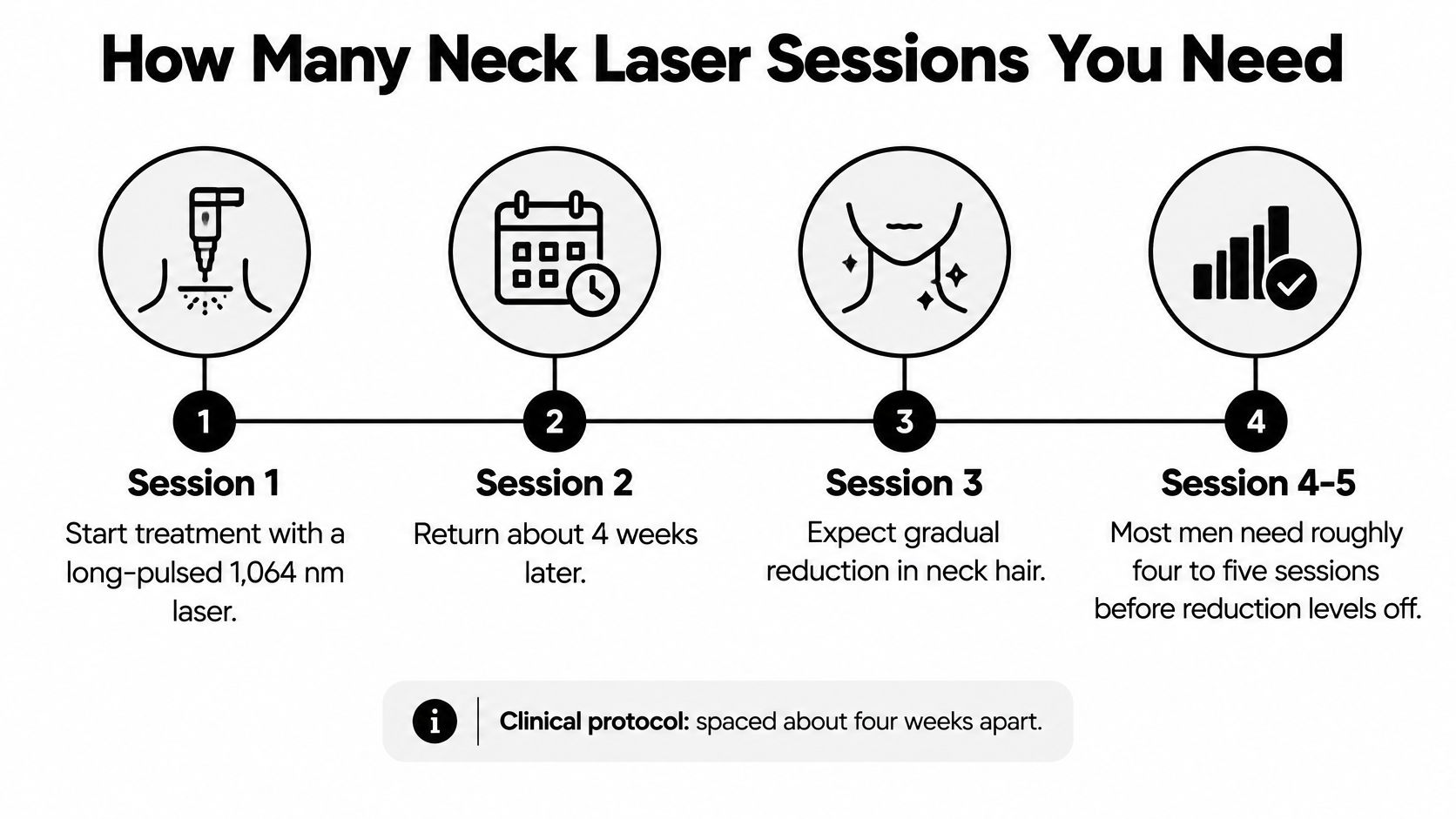
How Many Neck Laser Sessions You Need
Plan for a series, not a single appointment. The neck-specific clinical protocol discussed below supports an initial course with regular reassessment, but it doesn't establish that most men finish after a fixed number of sessions or that reduction reliably levels off then.
That distinction matters when you're buying appointments. A study schedule tells you how researchers delivered treatment, not how many visits your neckline will ultimately need.
Neck treatment schedule and timing
Stage | Timing | What the research shows |
|---|---|---|
Baseline and first session | Before treatment begins | Starting point for measuring reduction and checking for paradoxical growth |
Clinical neck protocol | Every four weeks | Studied for 16 weeks, approximately four to five treatment opportunities depending on endpoint scheduling |
End-of-study result check | At the protocol endpoint | Reduction was measured here; follow-up ended here |
Long-term maintenance | Set after assessing regrowth | Not established by the neck trial; confirm how touch-ups will be assessed |
The timeline below illustrates the proposed treatment sequence. Its suggestion that most men reach a plateau within that sequence should be treated as an illustration, not an established clinical finding.
Why spacing matters
Laser treatment targets pigmented hairs most effectively during active growth. Your neck follicles aren't all in that phase together, so repeating treatment gives the operator another opportunity to treat responsive hairs.
Coming back too soon isn't automatically better. The clinician needs to assess regrowth, skin recovery and the response to the previous settings rather than fit another appointment into the calendar.
A beard-line shadow also needs a clear definition. Tell the clinician whether you want less visible stubble beneath the skin, fewer hairs below a defined border, or less shaving across the entire neck. Those are different treatment goals.
Planning rule: Buy a treatment plan with reassessment, not a promise that a particular appointment will be your last.
Before starting, record how long your neck stays comfortable and visibly clear after shaving. Photograph the front and both sides under consistent lighting, then discuss a series with review points rather than booking an isolated visit. Keep your desired beard boundary visible in those photographs so you and the clinician agree on what should remain untouched.
Which Laser and Skin Tone Suit Men's Neck
Three laser families handle most neck treatments, and the right choice depends on your skin tone more than on the machine's marketing name.
Laser types and long-term reduction ranges
Laser type | Wavelength | Long-term reduction range | Best fit |
|---|---|---|---|
Nd:YAG | 1,064 nm | 30–73.61% | Often favored for darker skin because of lower epidermal melanin absorption |
Alexandrite | 755 nm | 35–84.25% | Commonly considered for lighter skin with dark, coarse hair |
Diode | 800–810 nm | 32.5–69.2% | Selected according to the device, skin assessment and hair characteristics |
The broad ranges summarized in the American Academy of Dermatology laser hair-removal guidance are approximately 30–73.61% for Nd:YAG, 35–84.25% for alexandrite and 32.5–69.2% for diode systems, and they describe whole studies rather than neck-specific guarantees. The same guidance supports careful wavelength selection, particularly for darker skin, and counseling about pigment changes and other complications.
Don't read the highest percentage as a reason to pick that machine. Studies enroll different patients, treat different body areas and measure results at different endpoints. A platform that cleared someone else's legs may be a poor match for a beard line, where coarse hair grows over curved skin that men often shave daily.
Why skin pigment changes the decision
Melanin absorbs laser energy the way dark fabric absorbs sunlight: the more pigment in a spot, the more energy converts to heat there. Your hair follicles carry melanin, but so does the epidermis around them. The operator wants enough heat at the follicle without overheating that surface layer.
Darker skin needs particular care because surface pigment competes with the hair for the same energy. Long-pulsed Nd:YAG is often favored here because its wavelength penetrates deeper with less absorption in the epidermis. The wavelength alone doesn't make treatment safe: pulse duration, fluence, cooling and the skin's response all matter.
A systematic review of 12 comparative trials in skin of color found broadly similar outcomes across laser and intense pulsed light approaches, while long-pulsed Nd:YAG had lower odds of post-inflammatory hyperpigmentation than IPL (OR 0.26, 95% CI 0.10–0.78). The same review reported higher pain scores with laser treatments, so comfort and pigment safety deserve separate discussion at consultation.
Men's necks add one more reason for careful device selection. Coarse beard hair, curved contours, and a documented tendency toward stimulated regrowth in some male facial areas mean conservative settings are the safer starting point, with adjustments based on how your skin responds.
Our guide to laser hair-removal technology explains the terminology before your visit. Our center uses Splendor X technology, and the clinician still selects settings from your assessment rather than relying on the device name alone.
What to disclose before treatment
At your initial consultation, experienced professionals assess your skin type and hair color to build a personalized plan. Bring details that separate your usual tone from temporary change:
Sun and tanning history: Our policy requires avoiding sun exposure for two weeks before treatment, so mention recent outdoor exposure, tanning beds and any visible tan.
Current neck condition: Point out acne, open bumps, tenderness, crusting or suspected infection.
Medication and product use: List prescriptions, topical treatments and supplements, including products you apply only occasionally.
Healing history: Disclose keloid formation, cold sores and previous reactions to cosmetic procedures.
Our policy excludes treatment while taking Accutane, Retin-A or Gold Therapy, or within the past six months of their use. Don't stop a prescribed medication yourself to qualify for laser. Discuss timing with the prescriber and our team.
Laser hair removal also isn't recommended for pregnant clients, and active infection, significant irritation or recently tanned skin calls for postponement and reassessment.
Before proceeding, get clear answers about which device will be used, why it suits your skin, and how settings will accommodate coarse neck hair. Every platform aims for lasting reduction rather than guaranteed permanent removal.
Stopping Shaving Bumps and Ingrown Hairs
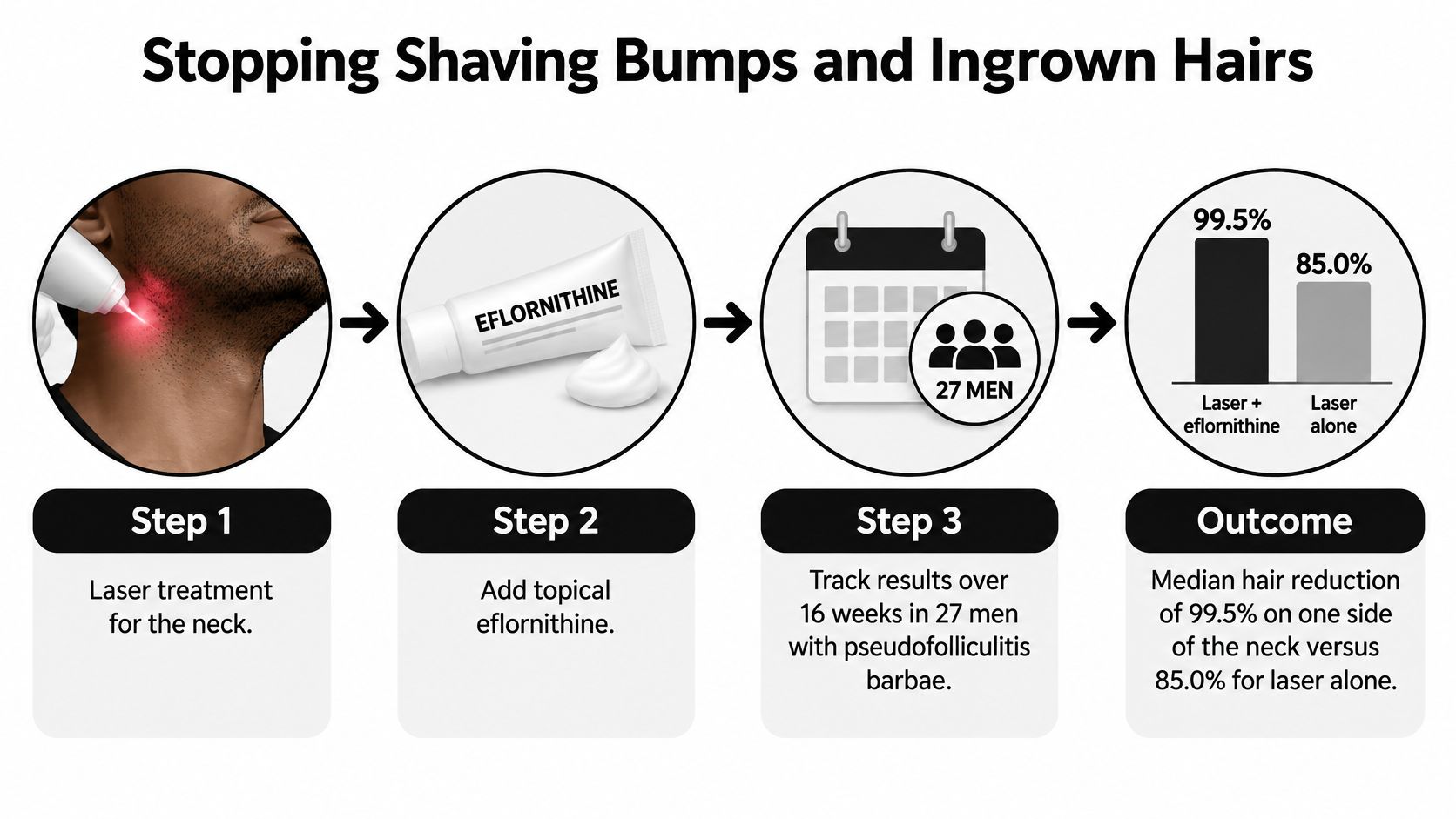
In a clinical trial of 27 men with pseudofolliculitis barbae, treatment every four weeks for 16 weeks produced median hair reduction of 99.5% with laser plus topical eflornithine, compared with 85.0% with laser plus placebo on the opposite side of the neck. The combination also significantly decreased inflammatory papules, but follow-up ended at that endpoint.
These are encouraging results for men whose main problem is recurring bumps. They don't mean laser alone produced the combination result, and they don't establish lifelong clearance. Eflornithine was part of a clinician-directed protocol, not an instruction to add a topical product yourself.
The visual below summarizes that comparison.
Prepare without aggravating the bumps
Leave the root intact. Our preparation policy requires avoiding waxing, plucking, threading and electrolysis for four to six weeks before treatment. Removing hairs from the root interferes with the target the laser needs.
Follow the shaving instructions. We require hair at skin level, although a day's growth can help identify the area. Confirm the timing with our team rather than arriving with long stubble or repeatedly shaving already inflamed skin.
Arrive with clean skin. Wash the neck and leave it free of makeup and topical medication before treatment, following instructions about prescribed products. Don't scrub, dig out ingrown hairs or open bumps beforehand.
Between appointments, a less irritating shave may help you avoid repeatedly scraping tender skin. AloeCure's guide to aloe gel for a gentler shave offers an option to discuss if your usual shaving product stings, but it isn't a treatment for infection or a replacement for clinical assessment.
Our explanation of razor bumps and laser hair removal can help you describe your symptoms more precisely.
Say your bumps cluster beneath the left jaw after shaving against the grain. Record that pattern, the shaving direction and whether the lesions become painful or drain. That gives the clinician more useful information than reporting sensitive skin.
Pain, Redness and Sun Care After Each Session
Neck laser treatment can feel like quick snaps accompanied by heat. Pain varies, so ask about cooling and whether clinician-directed topical numbing is appropriate before you arrive.
Mild redness and small raised areas around treated follicles can be expected treatment responses. They should improve rather than become progressively more painful, widespread or blistered.
Protect the skin between appointments
Our policy requires avoiding sun exposure for two weeks before treatment. Between visits, use broad-spectrum sunscreen on exposed neck skin, add shade or protective clothing, and avoid tanning beds.
Sun protection also belongs in the discussion about unexpected hair stimulation. A 2024 analysis of 7,381 laser-hair-removal patients recorded 25 cases of paradoxical hypertrichosis, an overall incidence of 0.34%, and found daily sun protection associated with lower risk after adjustment for skin type, OR 0.41. That association doesn't prove sunscreen prevents the complication, but it reinforces the importance of consistent photoprotection.
Don't request inadequately low energy to make treatment painless. The clinician needs to balance adequate follicular heating with skin safety, using appropriate settings and cooling rather than comfort alone.
Cooling should support a suitable treatment setting, not substitute for one.
Know when to call
Blistering or crusting: Contact the clinic rather than picking or exfoliating the area.
Spreading redness or pus: Seek prompt assessment for possible infection.
Persistent darkening or worsening pain: Report the change before another treatment.
On treatment day, arrive with prepared, clean skin and disclose any new medication or sun exposure. That evening, use gentle cleansing, avoid rubbing the neckline and follow your individualized instructions rather than adding acids or unfamiliar soothing products. Our post-laser hair-removal care guide provides a useful reference for the routine discussed at your visit.
Paradoxical Hair Growth Risk for Men
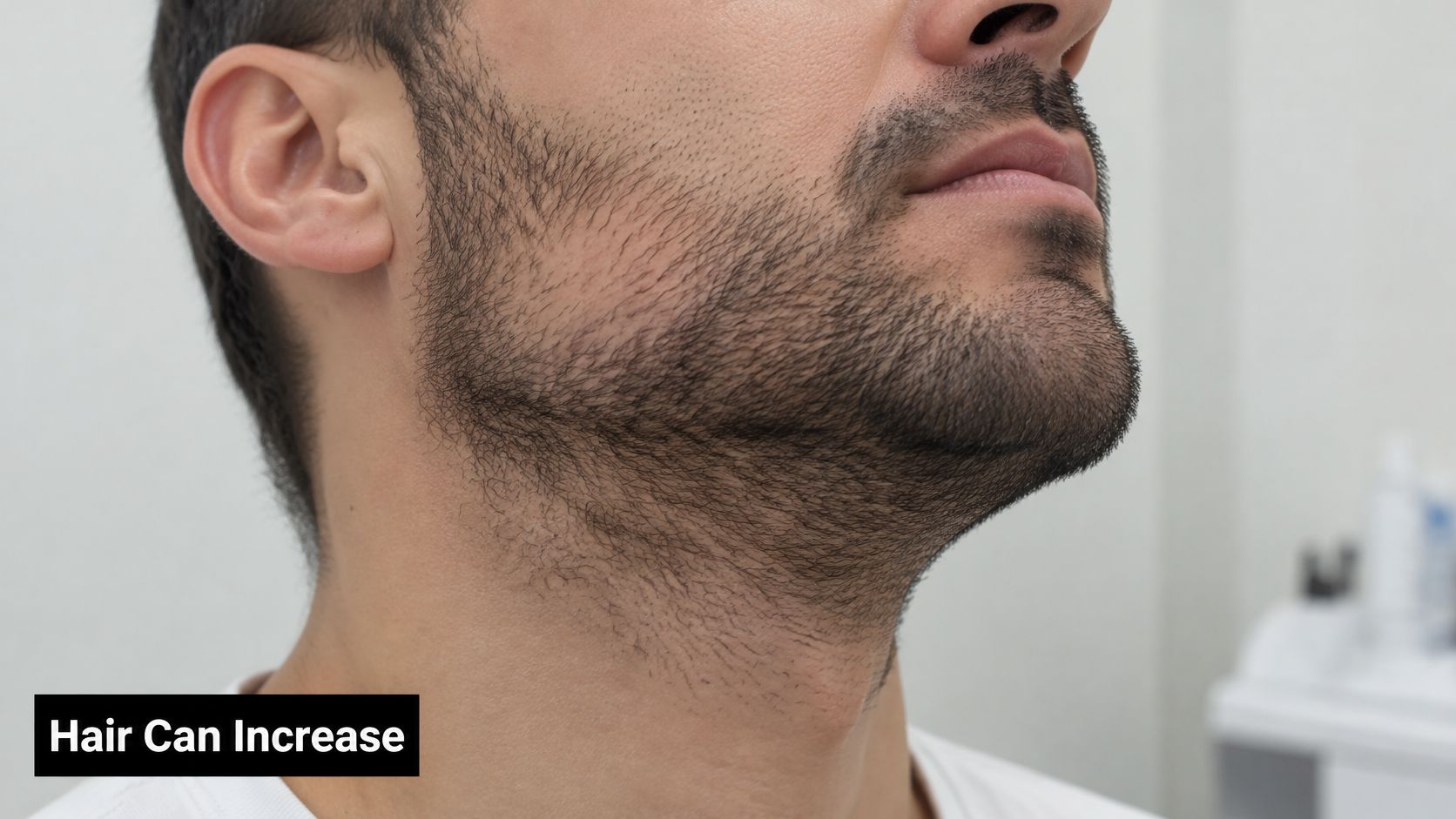
Paradoxical hypertrichosis means hair grows back thicker or spreads beyond the treated area instead of thinning. For a man shaping a beard line, even a faint band of new growth along the border can undo the clean edge he came for.
Some studies have observed higher rates of this reaction in men than in women, so treat the neck as an area that deserves extra caution rather than assuming a generic risk level applies to you.
Map your stubble pattern before the first session. Note where coarse beard hairs fade into the finer, lighter hairs around them. That transition zone is where the treatment boundary gets drawn, and the fine hairs sitting near it respond differently to the same energy that clears dense growth.
Detect a change before expanding treatment
A careful clinic documents baseline photographs, marks the treatment boundary, records device settings and checks hair density at follow-up visits. Test spots can show how your skin responds to the energy, though they can never guarantee a growth change will not appear later.
New stubble in a treated zone is not automatically paradoxical growth. Shedding cycles, follicles entering a fresh growth phase and the contrast between a cleared patch and untouched hair can all make the pattern look uneven. Consistent photographs, taken from the same angles and distances each visit, let the clinician separate appearance from genuine thickening.
This video can serve as a discussion prompt during your consultation.
If unexpected growth does appear, the right response is reassessment. The clinician should revisit the device choice, the boundary line and the settings, especially where fine peripheral hairs were pulled into the treatment field. The settings still need enough heat to reach the follicle, so the fix is a considered adjustment rather than a reflex to dial everything down.
Bring these questions to consultation:
Settings: How will you select and document settings for my hair and skin?
Baseline: How will you record the untreated border and compare later growth?
Response plan: What will you reassess if new hair appears outside the original neckline?
Report any unexpected change before your next session, and bring fresh photographs to compare against your original front and side views.
Book a Neck Consultation in Westbury
Book a consultation if beard-line shadow, recurring bumps or uncertainty about your skin makes you hesitant to start. You do not need to decide on complete neck clearance before the appointment. You should arrive knowing which hairs you want to keep, because the boundary between beard and neck shapes the treatment plan and the risk of stimulating fine hairs at the margin.
During the visit, an experienced professional assesses your skin type and hair color to build a personalized plan. Tamar, our specialist with over 17 years of experience and a reputation as a "laser whisperer," can help you mark that boundary and decide whether your priority is appearance, shaving comfort or both.

Pricing and visiting details
We use Splendor X technology, and the neck falls within our medium-area category.
Neck treatment pricing and packages
Item | Price |
|---|---|
Medium area, single session, including neck | $39.99 |
Three-session package | $99.99 |
Six-session package | $189.99 |
Our address is 355 Post Avenue, Suite 102, Westbury, NY 11590. Hours are Monday through Saturday, 10am to 6pm. Call 516-321-4959 or email INFO@NYCLASER.COM to arrange your visit.
Beauty professionals comparing workspace options elsewhere can also review a local salon listing for workspace seekers, a salon entry in Milton Keynes separate from our Westbury clinic and its booking process.
For your own consultation, take clear front and side photographs, write down where bumps recur, and prepare your medication list. Medicines such as Accutane, Retin-A or Gold Therapy must be disclosed before treatment, and avoiding recent sun exposure helps the clinician read your true skin tone rather than a fresh tan. Then call to arrange an assessment so we can discuss a neck-specific plan without guessing from a generic treatment schedule.
NYC Laser Hair Removal offers personalized assessment and laser hair reduction for men's neck and beard-line concerns in Westbury. Visit NYC Laser Hair Removal to arrange a consultation and discuss your desired neckline, preparation requirements and treatment options.
Comments