
Facial Hair Growth in Women: Causes and Next Steps
You lean toward the bathroom mirror and notice coarse hairs along your chin that weren't part of your routine before. Shaving removes the length, but the dark shadow still bothers you, and you're wondering whether to book laser or ask someone to check your hormones. The right next step depends more on what's changing than on how many hairs you can count.
When Facial Hair Needs a Doctor First
Facial hair patterns and the right next step
Pattern | What it may mean | Next step |
|---|---|---|
A few fine lip or chin hairs, stable for years | Normal variation or mild idiopathic hair growth | Cosmetic care if it bothers you |
Coarse hair on lip, chin, chest, or back that is spreading | Possible hirsutism; ethnicity changes the cutoff | History and clinical hair score |
Irregular periods, acne, or scalp thinning with new facial hair | Androgen excess, often PCOS | Endocrine evaluation before relying on laser alone |
Sudden rapid growth, deeper voice, or increased muscle | Rare tumor or severe androgen excess | Prompt specialist referral |
Hair starting after a drug, hormone, or supplement | Medication effect | Medication review, then decide on hair reduction |
Start with the row that describes your change over time, not the one that resembles a photograph online. Fine hairs you've had for years belong in a different conversation from newly spreading coarse hair, even when both are frustrating.
Say you've always removed a little upper-lip fuzz, your periods haven't changed, and nothing else feels different. That pattern can stay a cosmetic decision. If you're now shaving your chin more often and your periods have turned unpredictable, a hair-removal consultation shouldn't be your only appointment.
Look beyond the number of visible hairs
Hirsutism affects a small share of women overall, but it appears far more often among women with PCOS. One chin hair proves nothing on its own; the symptoms around it decide what a clinician needs to investigate. Someone who removes hair daily may show little visible growth at an appointment and still have a history worth examining.
Pay attention to:
Cycle changes: Tell the clinician about missed, infrequent, or newly unpredictable periods.
Skin and scalp changes: New acne or scalp thinning can help identify an androgen-related pattern.
Voice or muscle changes: A deeper voice or unexpected increase in muscle alongside rapid hair growth needs prompt assessment.
Product exposure: Include prescribed hormones, bodybuilding products, supplements, and anything marketed for energy or hormone support.
When cosmetic care should wait
Rapid progression with voice or muscle changes deserves a prompt medical appointment before any laser sessions. A clinician needs to separate common hormonal conditions from uncommon but consequential causes before follicles become the focus.
If the timing points to a medication effect, don't stop a prescribed drug on your own. Bring the product name, dose, and start date to the prescriber.
Practical rule: Removing the visible hair can improve your day, but it doesn't explain a new change in your body.
When a concerning pattern fits, follow the table's medical next step first and book cosmetic sessions once the cause is clear.
What Hirsutism Means Beyond a Few Chin Hairs
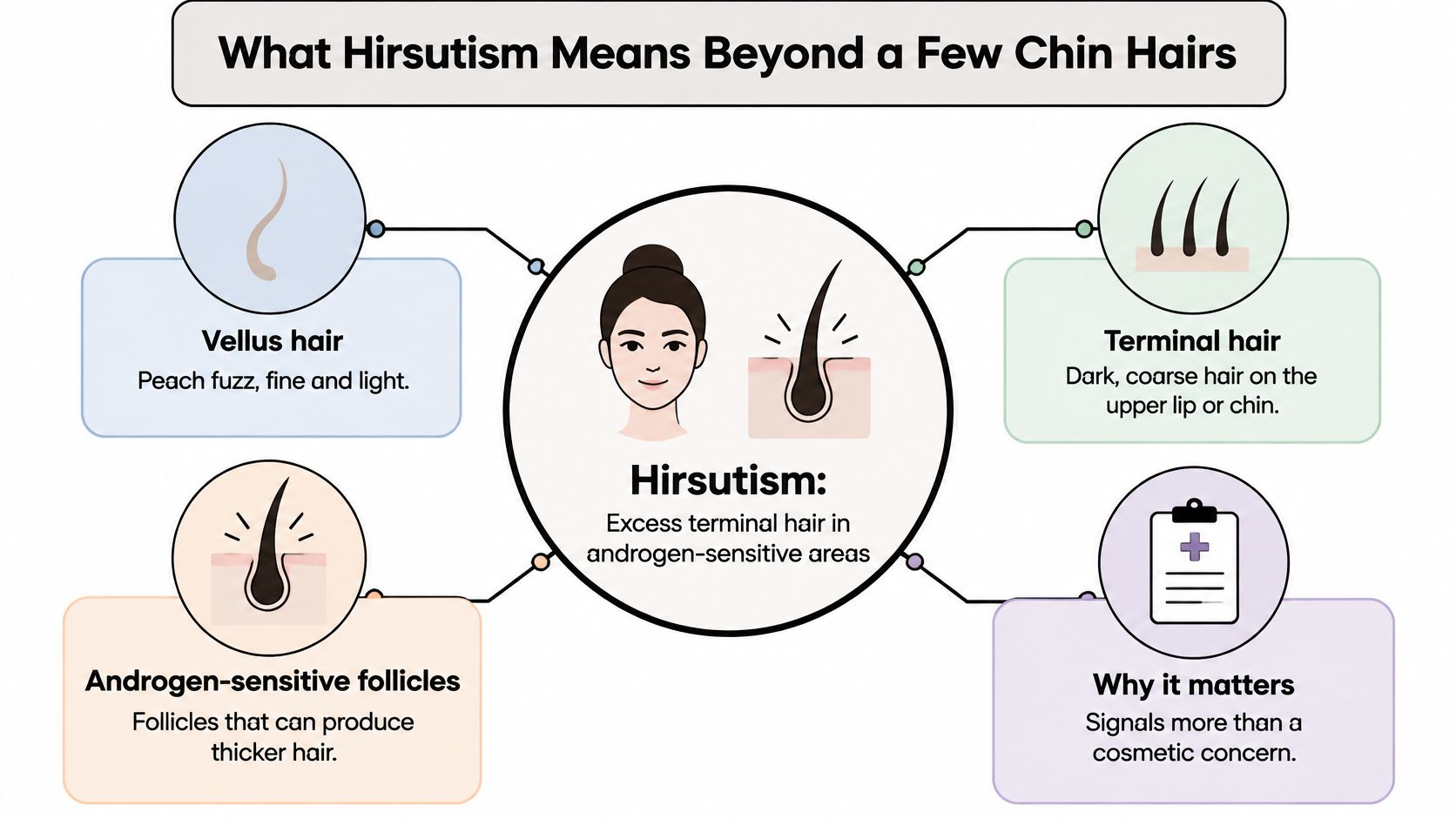
Consider the difference between soft cheek fuzz and a stiff, dark chin hair. The first is vellus hair, the fine, light hair often called peach fuzz. The second is terminal hair, a thicker strand produced by a different pattern of follicle activity.
Hirsutism means terminal hair growing in androgen-sensitive areas in a pattern typically considered male-pattern growth. It is not just having more peach fuzz than someone else, and it is not a judgment about femininity, grooming, or attractiveness.
The distinction starts at the follicle.
How clinicians measure the pattern
A clinical hair score works a little like a tailor's tape: a measurement needs context before anyone decides what it means. The same visible distribution doesn't carry identical significance across every population.
The contemporary endocrine review in The Journal of Clinical Endocrinology & Metabolism estimates hirsutism in about 10% of women worldwide, describes the modified Ferriman-Gallwey score across nine body regions, and contrasts the historical 8-or-higher cutoff for Black and White women in the United States and United Kingdom with newer ethnicity-sensitive thresholds generally around 4 to 6.
The modified Ferriman-Gallwey score, often abbreviated mFG, looks beyond the face. A clinician assesses the upper lip, chin, chest, upper and lower back, upper and lower abdomen, arm, and thigh. That broader view helps distinguish isolated facial hair from a more extensive androgen-sensitive pattern.
A separate review in the Journal of Dermatology and Dermatologic Surgery gives a wider worldwide prevalence estimate of 5% to 20%. Different populations and diagnostic cutoffs help explain why published estimates aren't identical.
What a score can't tell you
A score helps describe distribution, but it can't establish the underlying cause by itself. It also can't measure how much time you spend removing hair or how distressed you feel about it.
Before an examination, tell the clinician which areas you shave, wax, thread, or pluck. There's no need to feel embarrassed about arriving freshly groomed, but the clinician needs that information to interpret what's visible.
A hair score is a starting map, not a diagnosis or a measure of how much your concern deserves attention.
Isolated facial hair can occur without an identifiable hormonal disorder. Equally, a low visible score shouldn't override a convincing history of recent change.
The Causes Behind Female Facial Hair
Likely causes of excess facial hair
Cause | How often among hirsute women | Typical clues |
|---|---|---|
PCOS | A common underlying diagnosis in clinical evaluation | Irregular cycles, acne, scalp thinning |
Idiopathic hirsutism | A recognized minority of diagnosed cases | Coarse hair with normal androgens and no other endocrine signs |
Nonclassic congenital adrenal hyperplasia | Less common; ancestry and family history matter | Early or pronounced growth and a suggestive family pattern |
Medication or supplement effect | Consider when growth follows an androgenic product | Onset after a drug, hormone, or supplement |
Androgen-secreting tumor or ovarian hyperthecosis | Uncommon causes requiring targeted evaluation; they don't share a single prevalence estimate | Rapid progression or virilization |
Androgens can encourage sensitive follicles to produce thicker terminal hairs. That makes facial hair growth in women a question of both the hormonal signal and the follicle's response, rather than the number of follicles present.
This distinction explains why people with similar blood-test results can have different amounts of visible hair. It also explains why removing hair and investigating its cause are separate jobs.
Why PCOS gets so much attention
The International Evidence-Based Guideline for PCOS estimates that PCOS affects approximately 10% to 13% of women globally; clinical estimates summarized in this field place PCOS in approximately 80% to 90% of women presenting with hirsutism, although referral populations and study methods affect that proportion.
Those groups aren't interchangeable. The proportion of women with PCOS in the general population doesn't tell you the likelihood of PCOS from an isolated chin hair. Women already presenting for clinically significant hirsutism are a more selected group.
PCOS becomes more plausible when coarse hair accompanies cycle disruption or other androgen-related symptoms. Central weight gain and darkened, thickened skin around the neck can also prompt assessment for associated metabolic issues, but neither establishes the diagnosis.
A clinician must consider the overall presentation and exclude relevant alternatives. Buying a laser package doesn't confirm or rule out PCOS.
When another explanation fits better
Idiopathic hirsutism describes unwanted terminal hair when androgen testing is normal and no other endocrine disorder explains the presentation. Normal results don't mean the hair is imaginary or that treatment is unnecessary.
Other possibilities include nonclassic congenital adrenal hyperplasia, which affects adrenal hormone production, and hyperprolactinemia when the wider symptom pattern supports testing. Medication-related growth requires a careful product history, especially for testosterone products or anabolic exposure.
Useful distinctions include:
Longstanding family pattern: Similar hair distribution among relatives helps place your own growth in context.
A clear product timeline: Hair appearing after a hormone product deserves a prescribing review.
Abrupt physical changes: Rapid progression calls for a different investigation from gradual, longstanding growth.
Ovarian or adrenal androgen-secreting tumors and ovarian hyperthecosis belong in the differential diagnosis when the history or results point there. They shouldn't be assumed from ordinary facial hair, but neither should striking changes be dismissed as a grooming issue.
The most likely explanation still needs confirmation. Otherwise, you may reduce existing hair while leaving an active hormonal driver unaddressed.
How Doctors Test Hormones and History
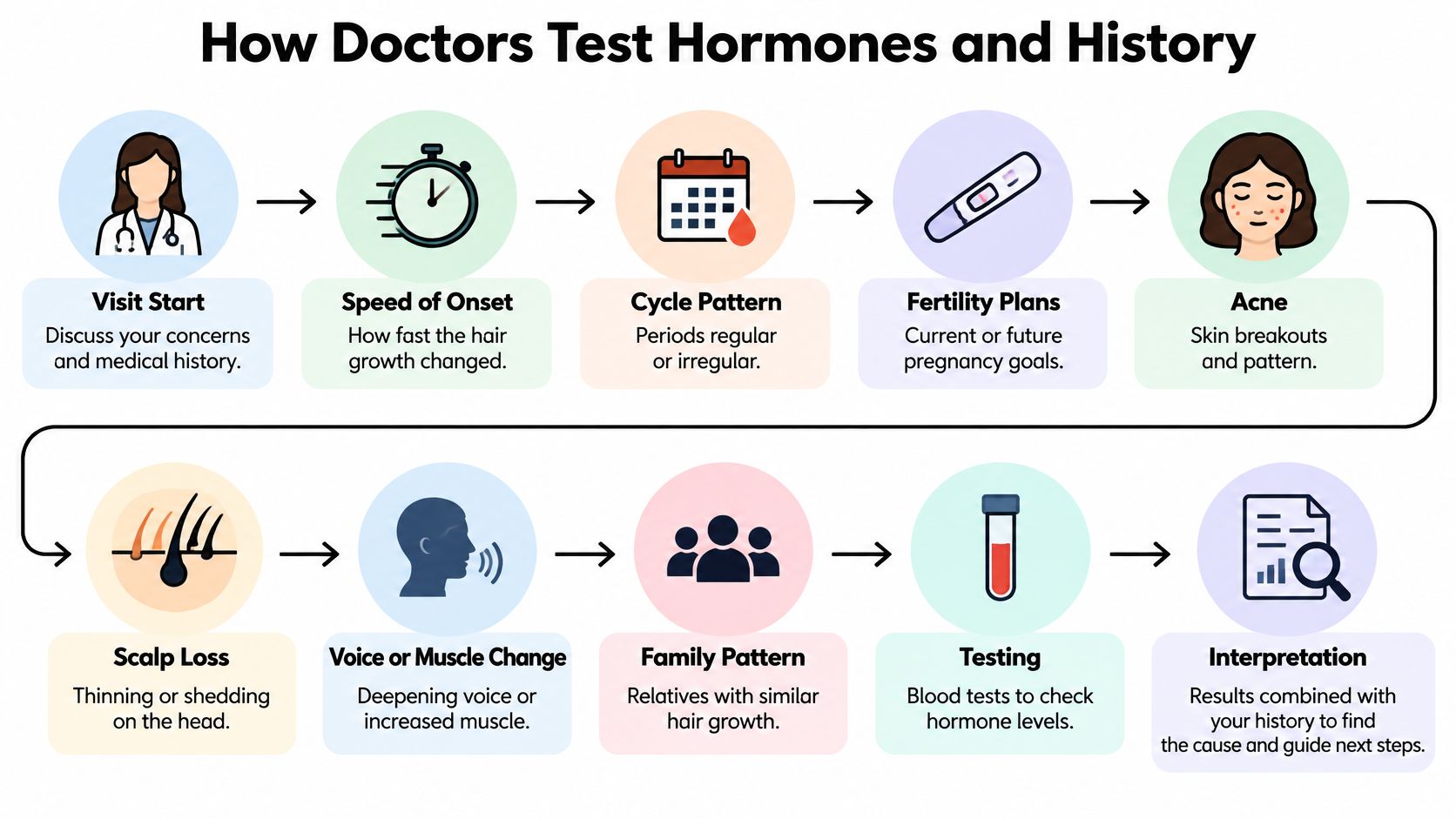
A useful appointment starts with a timeline, not a shopping list of blood tests. Your clinician needs to know when the hair appeared, whether it's spreading, and which other changes happened around the same time.
Expect questions about cycle pattern, fertility plans, acne, scalp thinning, voice or muscle changes, family hair distribution, and every hormone, steroid, medicine, and supplement you use. A few chin hairs that have sat unchanged for years usually prompt a lighter workup. Growth that arrives over months, or arrives alongside irregular cycles, earns a fuller one.
History shapes which labs get ordered. Each result either answers the clinical question or points to the next test, rather than every symptom being treated as proof of the same condition.
The usual testing path
The Endocrine Society hirsutism guidance recommends biochemical assessment for an abnormal hirsutism score, and markedly high total testosterone or DHEA-S above approximately 700 µg/dL raises concern for a tumor, ovarian hyperthecosis, or an adrenal source.
Start with reliable morning total testosterone. The assay matters because testing must accurately assess the lower concentrations encountered in women. Your clinician should interpret the result alongside symptoms and the laboratory's reference range, and an unexpected value deserves a repeat draw before it drives decisions.
Add accurately measured free testosterone when indicated. This can help when the initial result doesn't adequately explain a convincing clinical presentation. A specialty method may be necessary.
Assess DHEA-S when an adrenal source is possible. The result helps the clinician decide whether adrenal evaluation deserves greater attention.
Choose further tests from the findings. Tests such as 17-hydroxyprogesterone or prolactin, and imaging when appropriate, should answer a specific clinical question rather than form an automatic panel for everyone.
A red-flag result isn't a diagnosis by itself. It changes how urgently the clinician investigates and which possible causes need attention first.
How to use the results
Normal bloodwork doesn't erase distressing hair or prevent you from considering reduction. Abnormal findings mean a cosmetic-only plan is incomplete, even if removing the hair remains important to you.
Stable, localized growth without other endocrine symptoms is less likely to reveal a condition that changes management. Sudden or rapidly worsening growth needs medical assessment before treating it solely as a cosmetic concern. When the pattern is new, spreading, or paired with cycle changes, I would schedule the blood draw before the laser consult.
If you're also exploring lifestyle support, The Axelrad Clinic's resource on natural strategies for women's hormone balance can help you prepare questions. Don't use a general hormone-support plan or supplements in place of evaluating a concerning change.
Bring a cycle log, a complete medication and supplement list, and photographs only if they demonstrate progression. A clear timeline is more useful than a collection of close-up images taken under different lighting.
Treatment Paths From Hormones to Laser
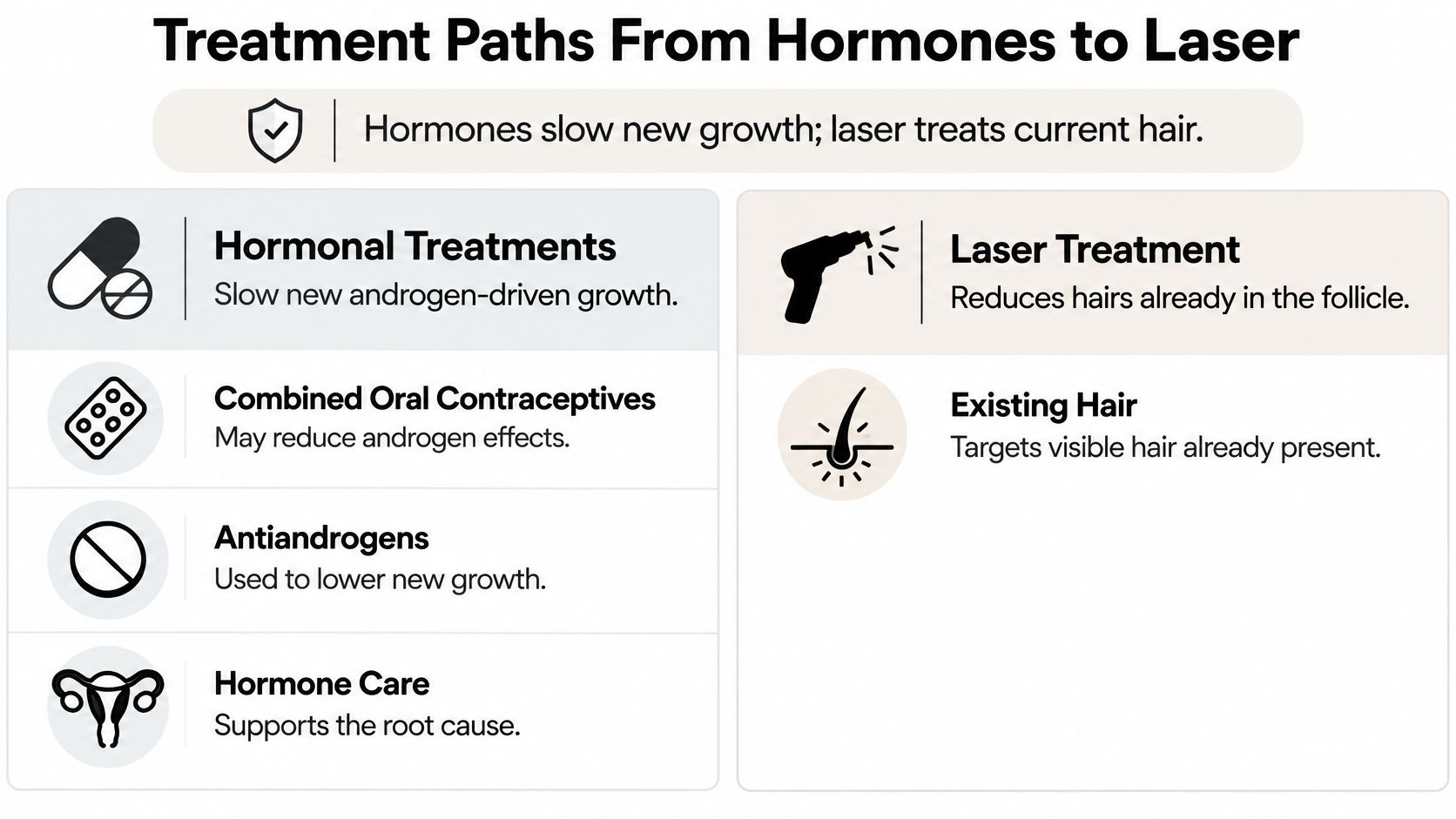
Hormonal treatment and hair removal have different jobs. Medical care can reduce androgen-driven stimulation, while laser targets suitable hairs already present. Neither should be sold as a substitute for the other.
What each facial-hair treatment changes
Approach | What it changes | When change shows | Best fit |
|---|---|---|---|
Hormonal therapy | Reduces new androgen-driven growth | Gradually, over a prolonged treatment period | Appropriate hormonal diagnosis and compatible reproductive goals |
Laser or light-based reduction | Reduces existing suitable terminal hairs | Across a treatment series | Bothersome hair after medical red flags are addressed |
Shaving | Cuts hair at skin level | Immediately | Everyday control and preparation for laser |
Waxing, threading, or plucking | Pulls hair out rather than cutting it | Immediately | Temporary control when laser isn't imminent |
Match the method to the job
The clinical endocrine treatment review describes hormonal responses taking 8 to 18 months and supports laser and light-based treatment for facial hirsutism and related quality-of-life concerns. That long medical timeline reflects slow hair growth, not a reason to increase medication without review.
Combined oral contraceptives and, when appropriate, anti-androgens require individualized prescribing. Pregnancy plans, contraindications, and other medicines affect whether they're suitable.
For context when comparing hormone-related services, Restore Osteopathic Medicine's resource on understanding bio identical hormone optimization addresses a different category of hormone care. Hormone optimization isn't interchangeable with treating hirsutism, and adding an androgen can be counterproductive for androgen-sensitive facial hair.
This comparison shows why combined care may be useful.
Prepare for reduction, not guaranteed elimination
Laser should be discussed as long-lasting reduction, not a promise that no facial hair will ever return. Our guide to permanent facial hair removal for women can help you distinguish the language used for removal from realistic reduction goals.
At our clinic, clients must avoid waxing, plucking, threading, or electrolysis for 4 to 6 weeks before treatment. Shaving can continue because it leaves the target hair within the follicle. The treatment area must ultimately be shaved to skin level, with timing confirmed during preparation.
Our medication policy also requires that clients aren't currently using Accutane, Retin-A, or Gold Therapy, and haven't used them within the past 6 months. Disclose these products during consultation rather than stopping a prescription independently to qualify.
Treatment checkpoint: A stronger setting or an earlier appointment can't compensate for the wrong target, unsuitable skin conditions, or an unresolved medical concern.
Facial sessions are generally brief, and our stated downtime is typically none, but that isn't a guarantee that everyone will have no redness or sensitivity. Scheduling and aftercare should reflect your response rather than a fixed promise.
Confirmed androgen excess calls for an appropriate medical plan, with optional reduction for visible hair. Stable bothersome hair without a concerning clinical pattern can proceed to an individualized reduction assessment.
Why Regrowth Differs by Skin and Life Stage
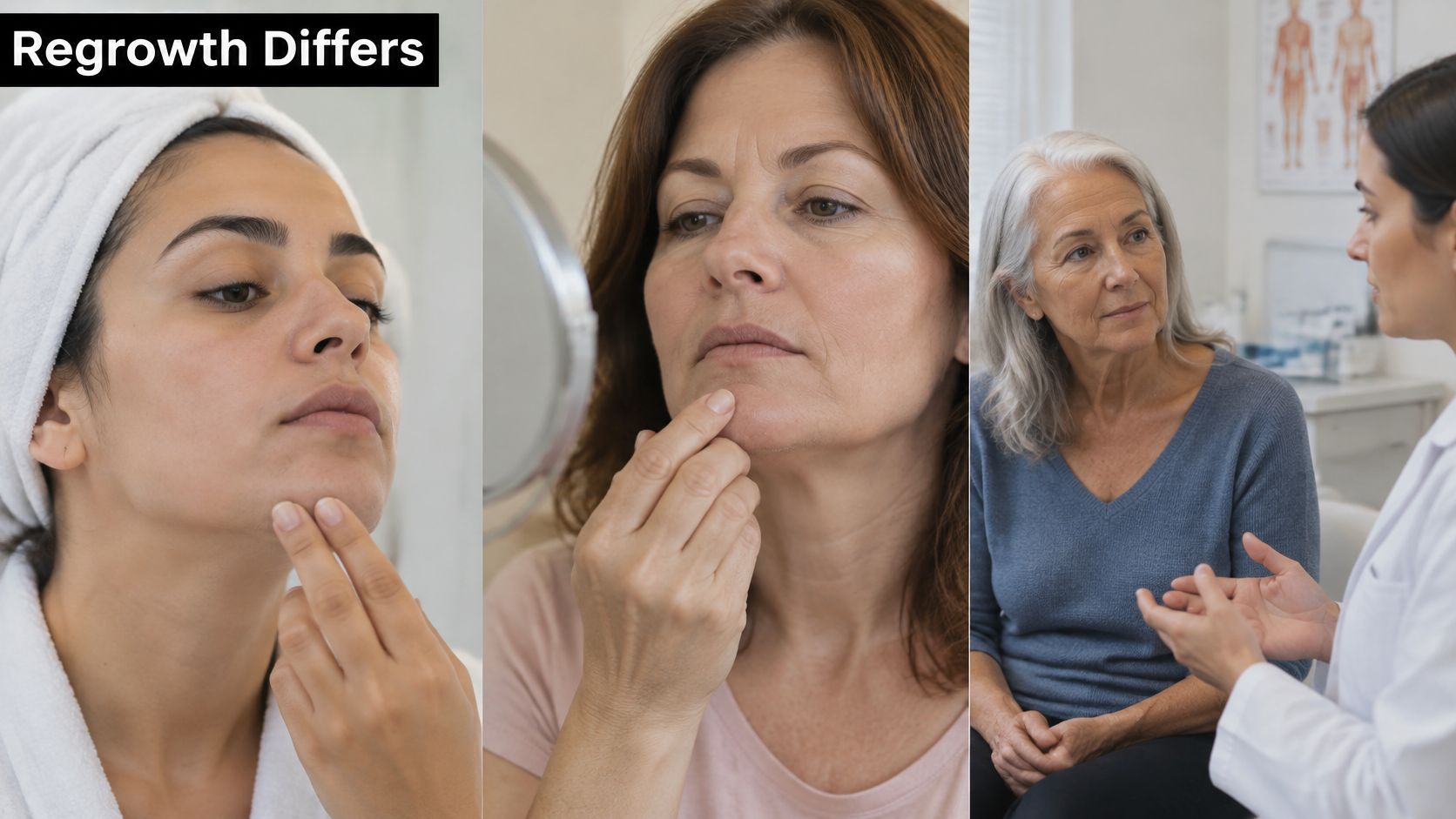
The same treatment plan won't suit every face. These hypothetical situations show why a consultation needs to assess the person, not just name the area to treat.
Different histories can lead to different recommendations.
Different reasons for a different response
A woman with PCOS notices improvement, then fresh coarse hairs. Her treated hair may become less prominent while ongoing androgen activity stimulates other follicles. Her clinician should reassess medical management, while the laser provider evaluates whether maintenance is appropriate.
A reader with pale blonde or gray chin hair gets little change. Laser relies on pigment as a target, so very lightly pigmented hair can respond poorly. Repeating the same unsuitable treatment isn't a sensible substitute for discussing another method, such as electrolysis.
A reader with deeper skin wants reduction without discoloration. Her provider needs to consider skin pigment as well as hair pigment when selecting the device approach and settings. A careful assessment is more useful than reassurance that a device works identically for everyone.
During our initial consultation, experienced professionals assess skin type and hair color to create a personalized plan. Skin assessment and, when appropriate, test settings help guide treatment rather than relying on hair color alone.
Pregnancy and medication changes need their own plan
Laser hair removal isn't recommended for pregnant clients. Pregnancy also changes which medical treatments are appropriate, so temporary shaving can provide control while energy-based treatment is deferred.
When a medicine appears to trigger growth, the prescriber should review the indication and possible alternatives. Changing the medicine may reduce further stimulation, but existing terminal hairs may still need separate management.
The following video offers another way to consider treatment expectations.
Hair appearing during a working series doesn't automatically mean failure. Follicles pass through different growth phases, so the visible pattern changes between appointments; our explanation of whether hair grows back after laser hair removal helps frame that distinction.
Judge progress by the overall burden of hair and upkeep, not an isolated strand. Revisit the medical plan when androgen activity continues, reconsider the method when pigmentation limits response, and postpone energy treatments during pregnancy.
Choose a Doctor Visit or a Laser Consult
Book medical care first if the pattern includes a red flag. If your hair is stable, already assessed, or unaccompanied by endocrine symptoms, a reduction consultation is a reasonable next step.
If you're unsure which clinician fits your symptoms, Pause Medical's guide can help you compare hormone imbalance specialists. Choose based on the concern that needs investigating, not a promise to balance every hormone.
Make the appointment useful
For a medical visit: Bring your cycle history, product list, and evidence of change. Ask which hormone tests your history justifies rather than requesting an indiscriminate panel.
For a reduction consult: Discuss skin type, hair color, recent medicines, and pregnancy plans. Our guide to what to look for in a laser hair removal clinic provides practical selection criteria.
For treatment day: Arrive with the area washed and free of makeup or topical medication, following the preparation instructions given at consultation.
We use Splendor X technology, and our Small Areas service costs $25.00, covering areas including the lip, chin, sideburns, and cheeks. Confirm the intended treatment zone, current pricing, availability, and booking options before committing.
Our center is at 355 Post Avenue, Suite 102, Westbury, NY 11590. Experience matters alongside the device: our specialist Tamar has over 17 years of experience in laser hair removal.
Make one booking decision based on your pattern: a medical appointment for concerning change, or a facial reduction consultation for stable unwanted hair.
NYC Laser Hair Removal offers personalized facial hair reduction for Long Island residents who want less daily shaving and upkeep. If your pattern is stable and medical concerns have been addressed, visit NYC Laser Hair Removal to book a consultation that matches your skin type, hair color, and treatment goals.
Comments