
What to Look for in a Laser Hair Removal Clinic
You've got two browser tabs open, both clinics advertise the same laser, and the prices look close enough that you're tempted to pick whichever one can see you first. Then you call. One clinic asks about your skin, your last tan, and the medicines you take. The other offers to book your first full session in five minutes. That difference in questions is often the first real clue about what to look for in a laser hair removal clinic.
Why the Clinic Matters More Than the Laser Brand
Two clinics can own the same device and deliver very different experiences. Think of the laser like a well tuned piano. The instrument sets what's possible, but the person playing it decides the pressure, the tempo, and whether the result sounds right for the room. In laser treatment, the clinic makes those daily calls about settings, screening, spacing, and follow up.

A brand name on a website doesn't tell you who checks your skin that day, who decides to lower the energy because you've been in the sun, or who notices that one area is responding slower than another. Those choices affect comfort and safety in every session. That's why it's useful to read background on what to consider before laser hair removal and then judge each clinic by its process, not just its equipment list.
The Six Things You Are Really Comparing
When you compare clinics, you're comparing more than a machine. You're comparing how each place handles a full course of care.
Technology fit: Does the device and wavelength suit your skin tone and hair color, based on an actual assessment?
Staff and safety: Who treats you, what training do they have, and what protections are routine?
Consultation policy: Do they examine you and explain limits before selling a package?
Pricing clarity: Can you see the total expected cost, not only a bundle headline?
Aftercare: Do you leave with written instructions and a clear way to report a reaction?
Proof and practicality: Do reviews, photos, and location make it realistic to finish the series?
A useful test: If you removed every brand name from a clinic's website, would its questions, paperwork, and follow up still give you confidence?
That question keeps you focused. A good clinic should be able to explain its reasoning in plain language, document what it did, and adjust the plan when your skin or hair responds differently than expected. The laser matters, but the clinic decides how that laser is used on you.
Matching Technology to Your Skin Tone and Hair Color
Laser hair removal works because energy is absorbed by melanin, the pigment in the hair follicle. The complication is that melanin isn't only in hair. It's also in skin, so the surrounding skin can absorb some energy too. That's why the same setting that's fine for one person can be too much for another.
This matters most for Fitzpatrick skin types IV to VI and for skin that's recently tanned. With excess fluence or the wrong wavelength, the risks include burns, blistering, post inflammatory hyperpigmentation, or hypopigmentation, and those risks are described in Mayo Clinic guidance on laser hair removal and skin type. Darker skin isn't a reason to assume you can't be treated. It's a reason to insist the clinic chooses the right laser type and settings for you.
What a Proper Assessment Should Record
A clinic shouldn't apply identical settings to every client. Before treatment, ask whether staff record your information and use it to set the plan.
Skin type and tanning history: Including sun exposure, tanning beds, and self tanner use
Hair color and coarseness: Because pigment and thickness affect how hair responds
Medications and prior reactions: Anything that could change skin sensitivity or healing
Scarring tendency: Including a history of keloid scarring or unusual pigment changes
Test spot decision: Whether a conservative test spot is appropriate before a full area
Ask who decides fluence, pulse duration, spot size, and treatment interval. If nobody can explain that clearly, you don't yet know who's making the clinical judgment.
Hair color sets expectations too. Light blond, gray, and white hairs contain less target melanin, so they respond poorly compared with darker hair. A credible clinic tells you that upfront instead of promising uniform results for every color. For additional plain language background on candidacy and device fit, BotoxBarb's Maple Grove laser hair removal guide is a helpful starting point to compare with what a local clinic tells you.
NYC Laser uses Splendor X for clients with diverse skin and hair types, but the device name shouldn't replace your assessment. Your skin tone, hair pattern, sun exposure, and goals should drive the decision. If you have brown skin and want area specific context before a consultation, this overview of laser hair removal for brown skin helps you prepare better questions. The right answer is rarely that a device works for everyone. It's that your assessment shows a suitable plan for you.
Verifying Staff Credentials and Safety Protocols
Safety isn't a vibe you get from a clean reception area. It's a set of controls you can ask about before anyone treats you. Start with the basics you should be able to see and hear explained without hesitation.
The infographic below summarizes four checks to make during your first conversation with any clinic.
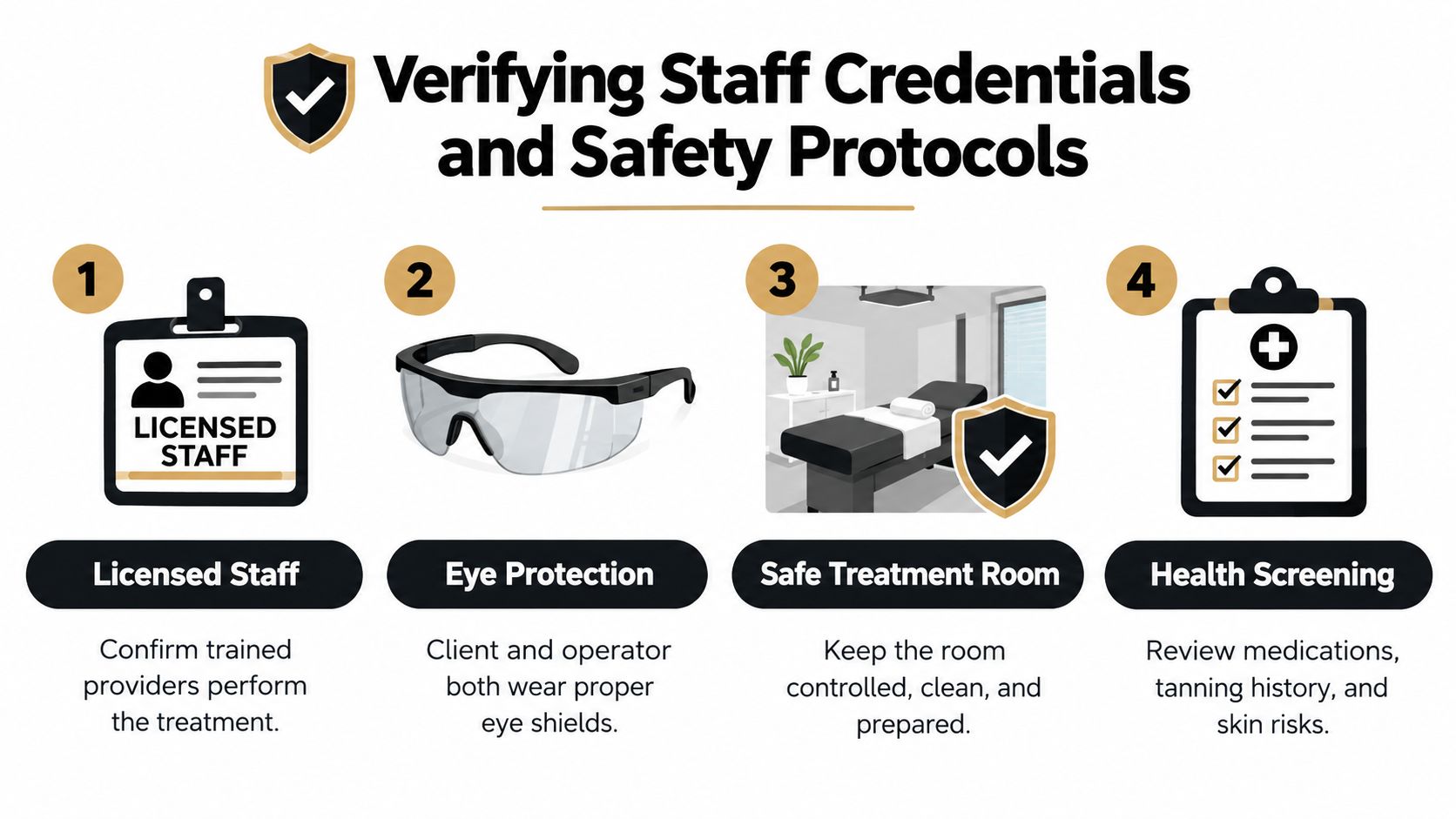
High intensity infrared or near infrared laser radiation can injure eyes, so protective eyewear for both patient and operator is non negotiable. The room should also be arranged to prevent unintended beam exposure, with access controlled while the laser is in use. If eyewear is treated as optional or staff can't explain which eyewear matches the device, that's a serious warning sign.
Questions That Reveal How Careful a Clinic Is
Ask for specifics, then listen for specifics in return.
Exact device model: Not just a brand family or a marketing name
Wavelengths used: And why that choice fits your skin and hair
Cooling method: Such as a chilled contact tip, cryogen spray, or cooling gel
Maintenance and calibration: How the clinic checks that output stays as intended
Operator training: Who treats you, what training they've completed, and who supervises care
Cooling reduces epidermal heat load and can improve comfort, but it doesn't compensate for unsafe parameters or poor technique, a distinction reflected in FDA device documentation for laser safety and cooling. Think of cooling like oven mitts. Mitts help, but they don't make it safe to grab a pan at any temperature for any length of time.
Don't accept a vague claim such as FDA approved as a complete safety answer. Ask what the device is, who operates it, and how settings are chosen for your skin.
A careful clinic also screens for recent tanning. You should be told to avoid tanning and use broad spectrum SPF 30+ sunscreen, because UV induced melanin in the skin competes for laser energy and raises pigment change risk. That's especially practical on Long Island, where beach weekends, outdoor sports, and self tanner can change your skin between visits. Tell the clinic if your exposure changes, even if it means rescheduling.
The video below gives a visual sense of how a treatment setting should be organized before a session begins.
Credentials deserve the same direct approach. Ask whether a licensed or clinically trained provider performs or oversees treatment, and what happens if your regular operator is away. This explanation of licensed laser technician roles can help you frame those questions. A good answer names roles and training plainly. It doesn't rely on years in business alone.
Reading Consultation and Patch-Test Policies
Your consultation is where marketing ends and care begins. Before any energy is delivered to a full area, the provider should review your medical history, look at the treatment area, and talk through what laser can and can't do for your hair. You should leave understanding the plan, not just holding a price sheet.
A strong consultation feels a bit like a fitting, not a sales pitch. The provider checks the details that change the settings, asks what outcome matters to you, and explains where results may be slower. If your hair is very light in one area or your skin is tanned, you should hear that discussed openly.
What a Patch Test Is For
A patch test, or test spot, treats a small area first so the clinic can watch how your skin responds. It isn't needed in every situation, but when it's clinically appropriate, it gives both of you useful information before a larger area is treated. A clinic that skips it should be able to explain why it's not needed in your case.
Ask these questions before you agree to a series.
Consultation cost: Is the consultation free or charged, and what does it include?
Patch test terms: Is there a fee, and is it credited toward a package if you continue?
Who sets parameters: Who decides settings at the first session and at later sessions?
Consent and records: Will you sign written consent and receive a copy of key instructions?
Your exit path: What happens if you decide not to continue after the consultation?
Warning sign: A clinic pushes you to buy the largest package during the first visit, before anyone has documented your skin, hair, medicines, and tanning history.
Pay attention to pace. You're allowed to take the written plan home, compare it with another clinic, and come back with questions. Pressure to decide on the spot doesn't improve your results, and it makes it harder to notice missing details such as cancellation terms or maintenance costs.
Also notice whether the provider invites follow up questions after a test spot. You should know how long to watch the area, what a normal response looks like, and whom to contact if redness, pain, or pigment change looks unusual. That small exchange tells you a lot about how the clinic will handle the full series.
Judging Package Prices and Total Treatment Cost
A package price can look simple while hiding the parts that determine what you'll pay. Laser targets hairs that are actively growing, and not all hairs are in that phase at once. That's why a series is needed and why results vary by body area, hair color, hormonal status, skin phototype, and treatment interval.
Facial or hormonally influenced hair may need maintenance even after an initial series. So when a clinic says permanent, ask what that word means in its written plan. A realistic plan states expected reduction rather than guaranteed removal, explains why multiple sessions are spaced out, and tells you when maintenance might be recommended.
Compare the Whole Bill, Not the Headline
Request the pieces below in writing before you compare two offers. This is also where a regional price overview such as laser hair removal pricing in Columbia can help you understand common cost categories, even though your local quote will depend on area size and package structure.
Cost item | What to ask the clinic |
|---|---|
Initial series | How many sessions are included, and at what interval? |
Treatment area definition | Exactly which borders count as small, medium, large, or extra large? |
Consultation and patch test | Are they free, charged separately, or credited toward treatment? |
Maintenance sessions | What will touch ups cost after the package ends? |
Cancellation and rescheduling | How much notice is required, and do missed sessions expire? |
Slower than expected progress | Will settings be reassessed, and are extra sessions discounted or full price? |
Package expiry | How long do prepaid sessions remain valid? |
Comparing the total expected cost, including maintenance, consultation or patch test fees, cancellation rules, and treatment area definitions, is more reliable than comparing bundle headlines alone, as outlined in recent literature on laser hair removal safety and treatment planning. That same approach supports asking for baseline photographs, session by session settings, and a clear reassessment policy.
At NYC Laser, areas are grouped into Small, Medium, Large, and Extra Large zones, with single sessions and 3 session and 6 session bundles. Use the zone definition as your comparison unit. A lower price isn't lower if the other clinic defines your area more narrowly, charges separately for a patch test, or prices maintenance much higher.
Package size isn't proof of value. A 6 session bundle is only a good buy if the area definition, interval, reassessment policy, and maintenance price fit your hair and goals.
Ask how progress will be measured. Baseline photos under consistent lighting, notes on settings used, and a scheduled review give you something concrete to discuss if one area lags. Without those records, you're left arguing from memory about whether the package worked.
Managing Side Effects and Aftercare Plans
Picture the evening after your first session. The treated skin may feel warm and look a little red, a bit like you've spent time in the sun, and then it settles. For many clients, that short lived response is the whole story, and they return to work or errands the same day.
NYC Laser sessions are described as quick and comfortable and typically require no recovery time, which suits busy schedules. Still, no downtime doesn't mean no aftercare. The habits in the days after treatment protect your skin while it's more sensitive and help the clinic judge your response accurately at the next visit.
What Good Aftercare Looks Like on Paper
You should leave with written instructions you can check at home, not rely on remembering a quick chat at the door. Those instructions should cover sun protection, what to avoid on the treated area, and how to care for temporary redness or warmth.
Avoid tanning: Skip deliberate sun exposure and tanning beds for the treated area
Use sunscreen daily: Apply broad spectrum sunscreen as instructed, especially on exposed skin
Follow product guidance: Use only the soothing products or cleansers the clinic recommends
Note changes: Write down when redness fades and whether you notice darkening, lightening, or blistering
Keep the next appointment honest: Tell staff about sun exposure, new medicines, or reactions since the last visit
Now picture a less typical response. A small blister forms, pain increases instead of fading, or a patch of skin keeps darkening over several days. Those are reasons to contact the clinic promptly rather than wait for your next session. Blistering, unusual pain, or developing pigment changes should be documented, and the clinic should explain whether settings, spacing, or skin preparation will change before you are treated again.
A clinic's aftercare plan is a promise about what happens when things don't go perfectly. Ask who you call, how quickly you'll hear back, and what gets written in your record.
Compare two endings. One clinic hands you written aftercare, confirms your next interval, and tells you exactly which symptoms warrant a call. Another says you should be fine and waves goodbye. The treatment itself might have been identical, but your ability to recover well and judge progress is not.
Comparing Reviews, Before-and-After Photos, and Location
Reviews are useful when you read them like a technician reads a chart, looking for patterns rather than a single dramatic entry. One glowing review doesn't prove consistent care, and one angry review doesn't prove a clinic is unsafe. The repeated details matter.
Look across many reviews for comments about consultations, comfort, pricing surprises, and how staff respond when something goes wrong. If several clients say they felt rushed into packages, or several praise careful skin checks, you've found a pattern worth testing in your own consultation. For a structured way to sort that feedback, this guide to reading laser hair removal reviews helps you separate service complaints from treatment concerns.
Reading Photos and Judging Convenience
Before and after photos should be boring in the right ways. The lighting, angle, distance, and body area should match, so you're comparing hair change rather than photography. A trustworthy set also notes how many sessions were completed and gives honest context about skin and hair type.
Consistent lighting and angle: Shadows can hide or exaggerate remaining hair
Same treatment area: Cropping changes can make progress look larger than it is
Session count stated: A result after a full series shouldn't be presented as a single session outcome
Skin and hair context: Dark coarse hair and fine light hair don't respond the same way
Then weigh the unglamorous factor that decides whether you finish. A series means returning on schedule, so travel time, parking, and booking flexibility affect results indirectly. Missing or stretching sessions because a clinic is hard to reach can make progress harder to judge.
NYC Laser is in Westbury at 355 Post Avenue, Suite 101, serving Long Island and Nassau County, including Westbury and Jericho residents. Its hours are Monday through Saturday from 10am to 6pm, with online booking for consultations and sessions. For someone balancing work and family schedules, a local appointment you can keep consistently may be worth more than a distant clinic with slightly prettier photos.
Simple comparison rule: Give the most weight to documented assessment and safety, then total cost clarity, then reviews and photos, then convenience. Convenience matters, but it shouldn't outrank safe settings.
How to Choose Your Clinic and Book a First Visit
You don't need to research forever. A short, orderly process will tell you most of what you need to know, and it keeps you from buying a series before a clinic has earned your trust.
The steps below turn your shortlist into a first consultation you can evaluate calmly.
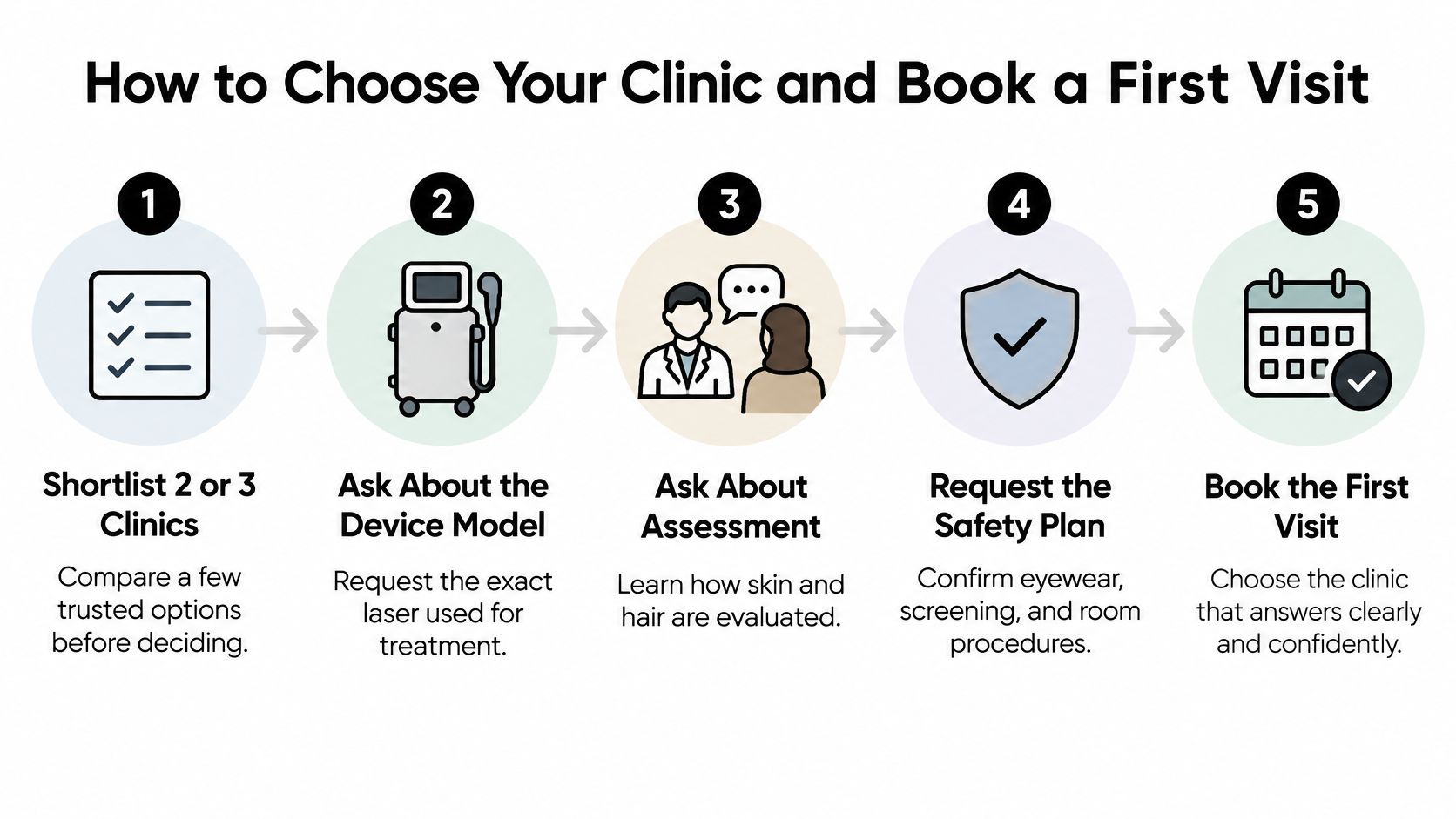
Shortlist two or three clinics: Choose places you can realistically visit for a full series.
Ask for the exact device model: Request the wavelengths, cooling method, and operator training.
Ask how assessment works: Confirm that skin type, tanning, hair color, medicines, and prior reactions are recorded.
Request the consultation policy: Clarify patch test terms, consent, and what happens if you decline a package.
Compare written total cost: Use the same area definition and include maintenance and cancellation rules.
Book a consultation first: Treat it as a low risk test of listening, documentation, and clear answers.
During that first visit, notice small things. Does the provider look at the actual area, ask follow up questions, and explain limits without you having to drag answers out? Do you receive a written plan that states expected reduction, session spacing, and how progress will be reviewed? Those details predict how the clinic will behave at session four, not just session one.
NYC Laser fits into this kind of comparison as a Westbury clinic using Splendor X technology for diverse skin and hair types, with personalized care, hours Monday through Saturday, and online booking through its website. Whether you're starting a first series or maintaining earlier results, bring the same checklist with you. The right clinic won't mind the questions. It will answer them, write down the plan, and let the quality of that process make the case.
Bring your checklist to a consultation at NYC Laser Hair Removal in Westbury, where the team can assess your skin and hair, explain how Splendor X treatment would be planned for your goals, and lay out package and maintenance costs in writing before you commit. Book that first conversation through NYC Laser Hair Removal and use the visit to confirm the assessment, safety controls, and follow up process for yourself.
Comments