
Laser Hair Removal Mens Face
If a clinic promises you'll never shave again after a facial laser session, what does that promise really mean for a dense, hormonally influenced beard? The useful answer isn't just whether laser works. It's which hair you want reduced, how your skin can be treated safely, and what improvement you can realistically maintain.
For men comparing facial laser options on Long Island, those distinctions matter more than a dramatic before-and-after photograph. A thoughtful treatment plan starts with your face, not with a standard package or results borrowed from another body area.
Why Men's Facial Laser Hair Removal Is Different
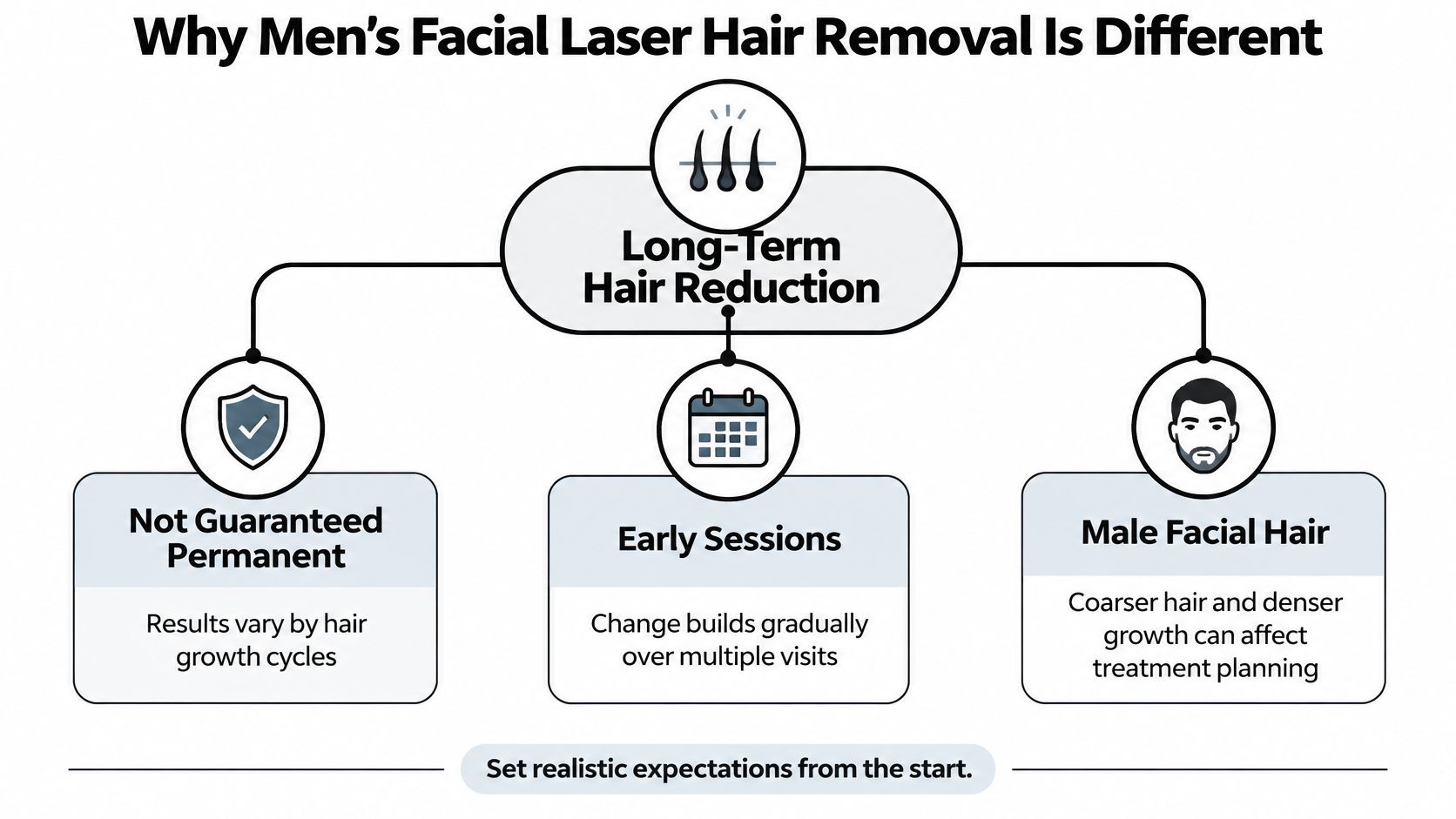
Facial laser treatment is long-term hair reduction, not guaranteed permanent elimination. That distinction has been important since the technology's earliest clinical use. The first laser approved for hair removal in 1995 produced initial removal, but follow-up found complete regrowth by six months; subsequent ruby-laser research in 1996 showed energy-dependent delays in growth rather than a universal cure, as described in this review of laser hair-removal development.
Those early results don't predict what a modern device will accomplish on your beard. They explain why an honest consultation distinguishes hair disappearing immediately from hair staying reduced over time.
The main considerations fit together like this.
Start with the beard you want to keep
A beard isn't just body hair in a more visible location. Its coarse structure, density, and hormonal sensitivity make treatment planning especially important. Those characteristics help explain why an initial course may need maintenance rather than ending with a promise that every follicle is permanently gone.
There's also a research limitation: men are underrepresented in hair-removal studies, and the available findings don't establish a reliable, male-specific beard-removal formula. The clinical figures discussed below need to be read with that limitation in mind.
Before discussing a device, separate your goals:
Beard-border cleanup: Identify unwanted growth outside the shape you intend to keep.
Density reduction: Explain whether you want less bulk rather than a bare face.
Broader facial reduction: Discuss the upper lip, chin, jawline, cheeks, sideburns, and neck individually instead of treating them as interchangeable.
Planning principle: Decide what should remain before deciding what should be treated.
For example, someone who wants a cleaner neckline needs a different treatment map from someone seeking substantial reduction across the chin and cheeks. Neither should be handed a standard beard outline without a conversation about future grooming preferences. A useful consultation makes those boundaries explicit before treatment begins.
What Happens During a Facial Laser Session
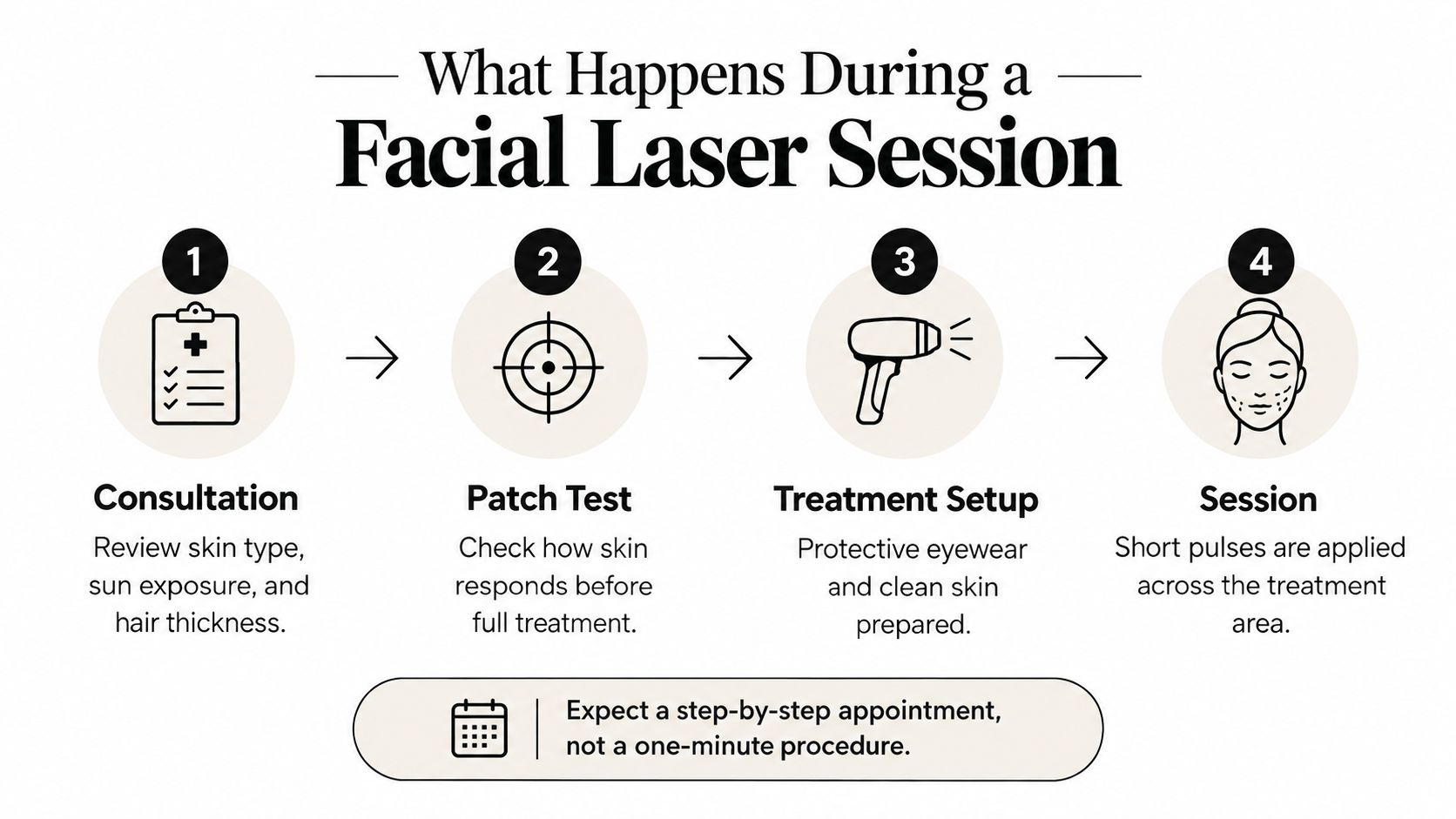
Your appointment should begin with a conversation, not a laser pulse. The clinician needs to review your skin tone, recent sun exposure, hair thickness, and intended beard borders, then determine whether a test spot is appropriate before treating the full area.
This is the basic appointment sequence.
From assessment to treatment
During preparation, confirm the exact treatment boundaries with the operator. If you want to preserve your cheek line or sideburn shape, say so before protective eyewear goes on. Ask how the clinic will record that map for later appointments.
During treatment, the operator uses eye protection, a cooling method, and controlled pulses across the agreed areas. Cooling is part of managing heat at the skin surface, not just an optional comfort feature.
During the skin check, the operator watches for the intended response and any signs that settings need adjustment. Clinical terms such as perifollicular edema and erythema mean swelling around follicles and redness. These can be treatment endpoints, but redness alone doesn't prove that a session was effective.
Ask the clinician to explain what you should feel and when to speak up. Don't assume you need to tolerate escalating pain because your beard is dense. Comfort, skin response, and treatment settings should be assessed together.
For a visual companion to the appointment walkthrough, you can view the following video.
Before you leave
Ask for written instructions that distinguish expected temporary changes from reasons to call. Your skin may look red or show swelling around treated follicles, but the clinic should explain what's acceptable for your particular treatment rather than giving everyone the same reassurance.
Also confirm when your skin should be reassessed. A quick appointment isn't a reason to skip the post-treatment check, and fitting treatment into a workday shouldn't depend on a guarantee that your face will look unchanged immediately afterward.
How Coarse Beard Hair and Skin Tone Shape Treatment Settings
The treatment challenge is straightforward: the clinician wants sufficient heat in the hair follicle without excessive heat in the surrounding skin. Both hair pigment and epidermal melanin, the pigment in the skin's outer layer, affect that balance.
A dermatology review of laser hair reduction describes long-pulsed diode wavelengths around 800–1,000 nm and Nd:YAG at 1,064 nm, which penetrate toward follicles while generally reducing epidermal melanin absorption compared with shorter wavelengths. That doesn't make either device automatically suitable at any setting.
Diode laser fluence ranges by Fitzpatrick skin type
Fluence means energy delivered over a given area. The following diode ranges are reported in the dermatology review linked above; they're clinical context, not settings to request or copy.
Fitzpatrick skin type | Typical diode fluence | Why settings change |
|---|---|---|
II–III | Approximately 30–35 J/cm², as reported in the review above | The operator balances follicular heating with the skin's response. |
Darker skin types | Approximately 20–24 J/cm², as reported in the review above | Lower ranges may help reduce thermal injury risk from epidermal pigment absorption. |
A dense, dark beard can absorb energy efficiently, but that doesn't mean the operator should just turn the energy up. Darker skin requires an appropriate safety margin, effective cooling, and careful adjustment. Pulse duration, wavelength, and cooling also matter, so fluence alone can't tell you whether a treatment is appropriate.
Why appointments must be repeated
Facial follicles don't all grow in synchrony. Only those in susceptible growth phases respond optimally during a given visit, which is why repeated treatment is necessary rather than merely a package-selling convention.
A documented plan should include:
Skin assessment: Skin type, recent tanning, and pigment changes.
Hair assessment: Thickness, density, and the distinction between coarse beard hair and fine surrounding hair.
Device parameters: Wavelength, pulse duration, fluence, and cooling method.
Observed response: The skin and follicular changes the clinician uses to guide adjustments.
The clinic's guide to laser hair removal for coarse hair provides related context. The practical question remains personal: how will the operator adapt treatment to your combination of beard hair and skin?
Choosing the Right Technology and Clinic for Your Face
Compare providers by how they make decisions, not just by the machine name on their website. A clinic should explain why its technology fits your skin, how it protects surrounding tissue, and what would make the operator postpone or modify treatment.
Experience with your specific skin tone matters. Ask for a clear description of the operator's experience treating similar patients, rather than accepting a broad statement that the device treats everyone.
Compare the plan behind the equipment
What to compare | What to ask |
|---|---|
Technology | Which wavelength and cooling approach would you use for my face, and why? |
Skin-tone experience | How do you assess patients with skin like mine? |
Test-spot policy | Would a test spot be appropriate before broader treatment? |
Beard mapping | How will you record the hair I want preserved? |
Pricing | Which facial areas are included, and how are additional areas charged? |
Follow-up | Who reviews unexpected skin changes or regrowth? |
For a local option, the Westbury clinic uses Splendor X and organizes treatments into Small, Medium, Large, and Extra Large zones. Lip and chin treatments can be discussed within that zone-based system, but ask how your particular jawline, cheeks, and neck would be classified rather than assuming all facial work belongs to the same category.
Its website is shown below.

Make flexibility part of the comparison
The clinic offers individual appointments and multi-session bundles. That gives you different purchasing options, but a bundle is a payment arrangement, not a clinical prediction of how much reduction you'll achieve.
Review its explanation of laser hair-removal technology, then ask how the equipment will be used for your treatment map. For Long Island and Nassau County residents, location convenience also deserves consideration because attending follow-up appointments should be practical.
A useful provider can explain both why treatment might help and why a particular area might be better left untreated.
A consultation that identifies unsuitable fine hair or recommends postponement after tanning isn't a failed sales conversation. It's the kind of individualized decision you're looking for.
How Many Sessions Men Actually Need
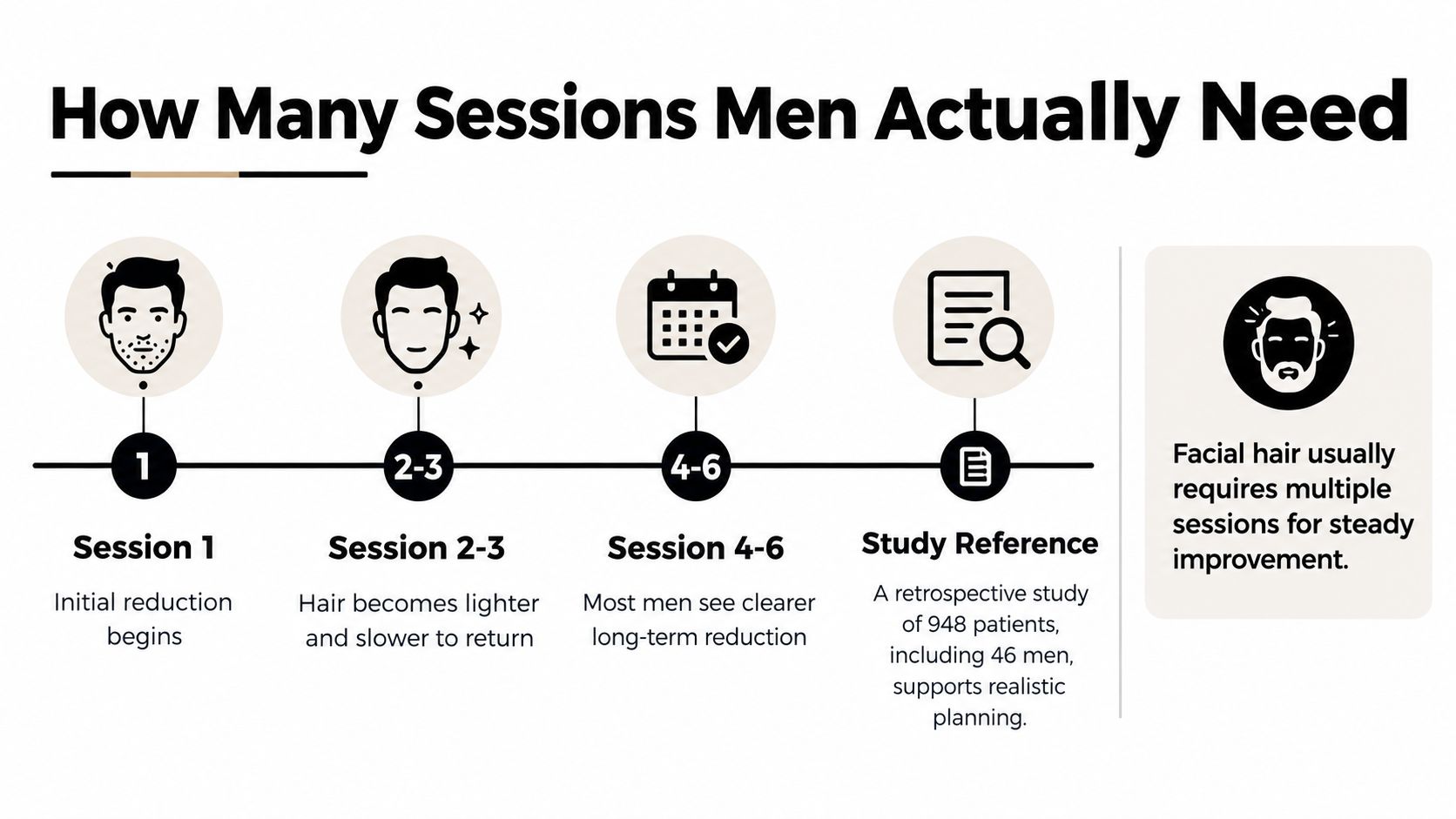
There isn't a well-supported universal session count for a man's beard. The research gap is substantial: a 2023 review included 28 studies involving 3,882 patients; among studies reporting sex, 88.7% were female and 11.0% were male, and none analyzed outcomes separately by sex, according to this discussion of men's underrepresentation in laser hair-removal research.
The same clinical discussion describes a retrospective study of 948 patients, including 46 men, reporting 66% facial clearance after three sessions, with five or more treatments needed to approach 79% clearance in its 75–100% clearance category. These are study findings, not a personal forecast or a male-beard-specific result.
Use the following timeline as a discussion aid, not a guaranteed sequence of changes.
Track progress against your original goal
Instead of judging success from a photograph taken immediately after treatment, agree on what you and the clinician will monitor between visits.
Density: Is there less hair within the mapped treatment area?
Regrowth: Does it return differently in thickness or speed?
Border accuracy: Is the beard you wanted to preserve still clearly outside the treatment field?
Skin response: Have pigment changes or irritation affected the next treatment decision?
Ask the clinician to explain appointment spacing based on your facial regrowth and skin response. Don't substitute an unsupported fixed calendar for an individualized schedule, and don't assume more frequent appointments will produce a better result.
Plan for reassessment and maintenance
Maintenance means reviewing returning growth and deciding whether further treatment is worthwhile. It shouldn't mean automatically treating the same area indefinitely without checking what remains.
Safety history also belongs in this conversation. The retrospective study discussed above reported uncommon long-term adverse events, including one facial scar and four herpes infections, so disclose any cold-sore history before treatment near the mouth. Those findings don't establish your individual risk, but they explain why a medical history matters even for a cosmetic appointment.
The Real Risk of Thicker Regrowth on the Face
Yes, unwanted growth can occasionally become more noticeable after laser treatment. The complication is called paradoxical hypertrichosis, meaning unexpected hair growth in or around the treated area.
A systematic review and meta-analysis of paradoxical hypertrichosis covering 9,733 patients found a pooled prevalence of approximately 3% overall, compared with 0.08% outside the face and neck. The overall figure isn't a precise facial-only rate, and the review found insufficient evidence to attribute risk reliably to sex or skin type.
Pay attention to the beard boundary
The practical concern isn't just that you're male. It's that facial and neck treatment deserves particular caution, especially where dense beard hair transitions into sparse, fine hair.
The proposed mechanism is insufficient heating of partially pigmented or fine follicles. Instead of sustaining enough thermal injury to reduce their activity, those follicles may be stimulated. This is a proposed explanation, not proof of what happened in every individual case.
Consider a cheek with coarse beard hair below the intended border and scattered fine hairs above it. Treating the entire cheek as though all those hairs were equivalent may overlook an important candidacy difference.
Map selectively: Ask which hairs are suitable targets and which should be excluded.
Avoid broad low-energy treatment of fine hair: A gentler-sounding approach isn't automatically the safer or more effective choice.
Review before expanding: The clinician should assess the response before enlarging the treatment field.
What happens if growth increases?
Contact the clinic rather than assuming the next routine appointment will resolve it. Bring comparable photographs if you have them, and identify whether the new growth is within the treated area or around its edges.
The review describes management using appropriately selected higher-fluence, shorter-pulse treatment with enhanced cooling in some cases. That's a professional reassessment, not a reason to request maximum energy. Excessive energy can increase burns and pigment changes.
If growth changes unexpectedly: Ask for a revised diagnosis and treatment plan before purchasing more sessions.
For isolated fine hairs, discussing alternatives such as electrolysis may be more sensible than repeatedly expanding a laser treatment field.
Preparing Your Skin and Aftercare That Works
For Long Island beachgoers, recent sun exposure is a treatment-planning issue, not a minor detail. Tell the clinic about tanning, outdoor time, and any new pigment changes before arriving for your appointment.
The American Academy of Dermatology's guidance on removing unwanted hair advises waiting until a tan has completely faded and protecting treated skin from the sun until it heals. It also emphasizes choosing someone experienced with your skin tone because incorrect treatment can cause burns, blisters, infection, or dark spots.
Before your appointment
Disclose skin changes: Mention tanning, irritation, darkening, or other changes since the consultation. Let the clinician decide whether postponement is appropriate.
Confirm shaving instructions: Ask when and how to shave the mapped area. Don't improvise with waxing or plucking while preparing for a laser series.
Review your products: Bring a list of facial cleansers, exfoliants, and other skin treatments so the clinic can give product-specific instructions.
Ask about a test spot: Clarify whether your skin history or recent changes warrant checking a limited area first.
The clinic's guide to what not to do before laser hair removal can help you prepare questions. Your treating clinician should give you the final instructions for your appointment.
After treatment
Keep the routine simple and follow the clinic's written plan for gentle cleansing, moisturizing, and sunscreen. Ask when to restart exfoliants, close shaving, and workouts that expose your face to substantial heat or friction. Don't assume a routine that felt comfortable before treatment will feel the same immediately afterward.
Temporary redness or follicular swelling should come with clear instructions about what to expect and when it needs review. Ask before leaving how the clinic wants you to report changes and whether photographs would help.
Call for clinical advice about blistering, post-treatment darkening, worsening discomfort, or unexpected growth near the treated zone. You don't need to decide on your own whether a change is a burn, pigment alteration, or paradoxical growth. That assessment belongs with the treating professional.
Your Next Step Toward a Smoother Face
Arrive at the consultation with a grooming goal, not just a request for facial hair removal. A photo showing the beard shape you want to keep can make the conversation more concrete, especially if your main concern is the neckline or scattered cheek growth.
Also describe what bothers you in everyday terms. You might want less bulk under the jaw, a more manageable border, or broader reduction across several areas. Those are different requests, and the treatment map should reflect the difference.
Make the decision in stages
Get assessed: Have the clinician evaluate your skin, hair thickness, recent sun exposure, and intended borders.
Check the proposed approach: Discuss a test spot where appropriate, the planned cooling method, and how the clinic will assess your response.
Choose the purchasing arrangement afterward: Consider an individual appointment or bundle only once you understand the treatment area and follow-up plan.
The Westbury practice offers online booking and zone-based treatment options, so ask for an itemized explanation of which facial areas your appointment includes. Confirm current availability directly, particularly if you're coordinating appointments around a commute from elsewhere in Nassau County or Long Island.
Leave with answers you can use
Before committing, make sure you know who will perform the treatment, who handles concerns afterward, and what would prompt a change in the plan. Ask how the clinic distinguishes insufficient reduction from a reason not to keep treating a particular area.
You don't need to master laser physics to make a sound decision. You do need a provider who can explain the choices plainly, acknowledge uncertainty, and record your preferences.
Facial laser is a series, not a switch. Start with an assessment, judge your own response, and keep follow-up or maintenance appointments when your clinician recommends them.
NYC Laser Hair Removal offers personalized Splendor X treatments in Westbury, with zone-based options, individual sessions, and multi-session bundles. Visit NYC Laser Hair Removal to book a consultation and discuss your beard borders, skin tone, and facial hair-reduction goals before choosing a treatment plan.
Comments