
How Long Does a Laser Hair Removal Session Take
A small zone is often under 5 minutes of laser treatment, while a back or full legs can take 45 to 60-plus minutes. Use the zone table below to choose your starting time block, then allow extra time for preparation and the rest of the appointment.
The distinction that matters is active treatment time versus total office time. A quick laser pass doesn't mean you can arrive, check in, get treated, and leave within the same few minutes, especially on your first visit.
Session Times by Treatment Zone
Typical laser time by treatment zone
Zone | Typical laser time | What to book around |
|---|---|---|
Upper lip | Under 1 minute to a few minutes | Under 5 minutes of treatment, plus check-in and setup |
Underarms | About 5 minutes | A brief visit, still longer than the laser time door to door |
Bikini, full area | About 15 minutes | A short appointment with preparation and cooling |
Full legs | About 45 minutes, up to more than 1 hour | An hour-scale appointment with additional buffer |
Back | Up to 60 minutes or more than 1 hour | Don't squeeze it into a short gap |
Chest | Can approach or exceed 1 hour when dense | Plan like a large area, with less time for a smaller treatment zone |
These are treatment estimates, not guaranteed appointment lengths. Baylor College of Medicine's laser hair removal guidance describes treating approximately a quarter-sized area every second, with an upper lip potentially taking less than 1 minute and large areas such as the back or legs taking up to 60 minutes.
That coverage rate explains the broad difference between facial and body treatments. It doesn't tell you how long your particular appointment will occupy your calendar, because the practitioner still needs to prepare the skin and treat the complete agreed area.
Read the zone name before choosing the slot
A bikini line isn't the same treatment footprint as a full bikini area or Brazilian. Similarly, an upper back isn't a full back, and a chest appointment may or may not include the abdomen.
Before booking, use our guide to laser hair removal areas to identify the actual boundaries you want treated. Describing the coverage precisely is more useful than asking for a generic body appointment.
For full legs, clarify whether your intended coverage includes the feet. For a back, mention whether you also want the shoulders or neck addressed rather than assuming they're included.
Keep the office clock separate
A first appointment can include consultation, skin assessment, residual-hair trimming or shaving, protective eyewear, cooling, and aftercare instructions. Those tasks sit outside the brief period you may be thinking of as the treatment.
Booking rule: Reserve for the whole visit, not just the minutes when the laser is operating.
Also make sure you're comparing the right procedure. Skin Perfection's guide to understanding facial laser resurfacing is useful if you're sorting through facial laser terminology, but resurfacing and hair removal aren't interchangeable services, and their appointment expectations shouldn't be borrowed from each other.
Choose the matching zone, describe any added coverage, and leave a buffer when combining areas. Don't build a tightly timed visit by adding together the shortest advertised estimates.
Why the Laser Clock Follows Skin Area
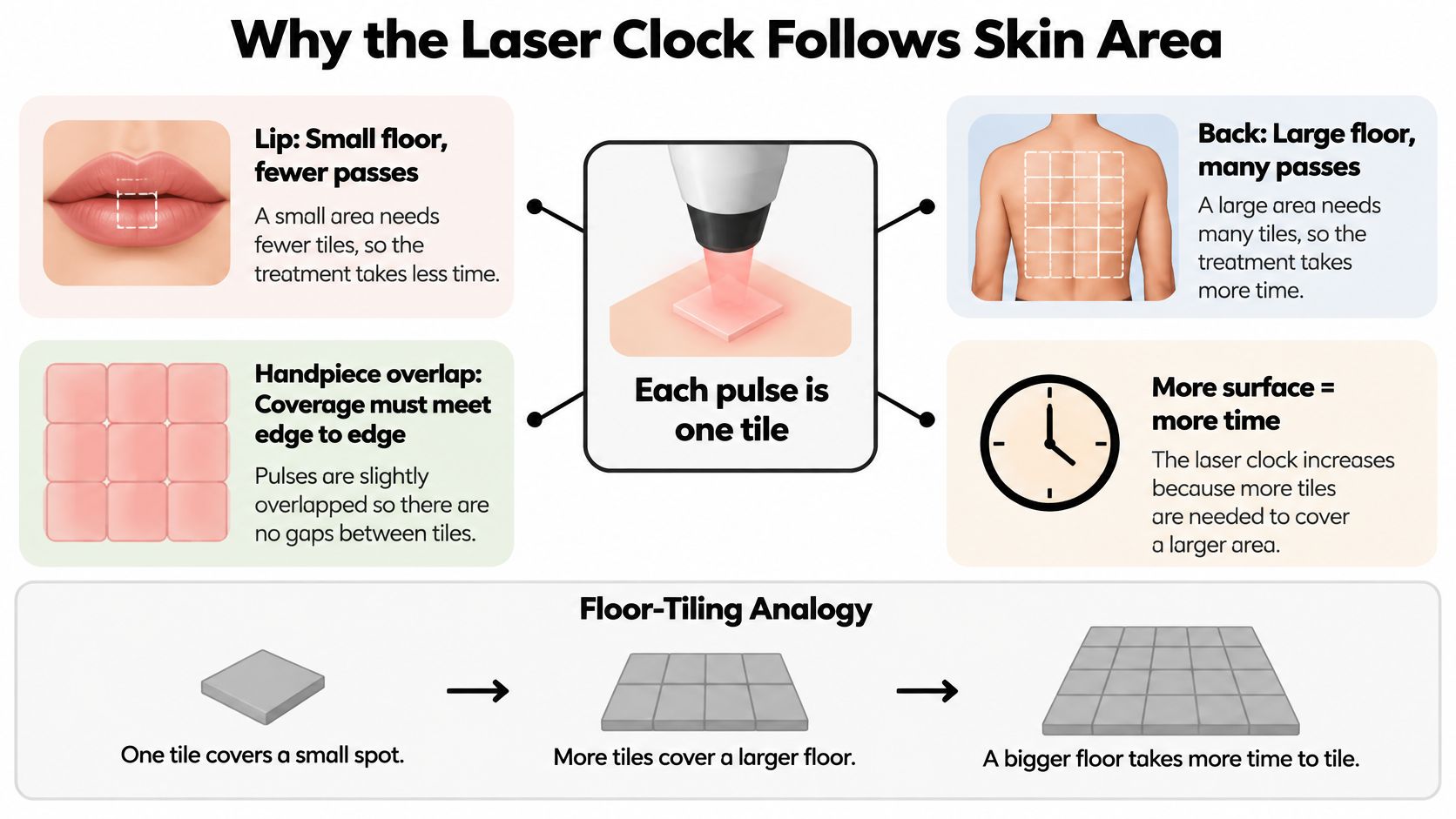
Think of treating skin like laying floor tiles. Each pulse is a tile, and the practitioner must place those tiles in an orderly pattern rather than jump randomly between visible hairs.
A lip is a small floor. A back is a much larger floor, with more places to cover and more handpiece movements before the job is complete.
The American Academy of Dermatology's laser hair removal FAQ makes that contrast concrete: an upper lip takes a few minutes, while a large area such as the back or legs can take more than an hour. The practical difference is the amount of skin the practitioner must cover, not how quickly the device can fire.
This diagram shows why surface area is the starting point for estimating treatment length.
Coverage takes more than pulse delivery
The practitioner has to map boundaries, maintain appropriate overlap, and reposition the handpiece. Around curves, keeping contact and coverage consistent can require a different pace than moving across a broad, accessible patch.
Dense growth also calls for careful, systematic coverage. That doesn't mean repeatedly firing at the same skin to chase every hair, it means working methodically enough to avoid both missed strips and excessive overlap.
For a Long Island client, this translates into different kinds of calendar commitments:
A small isolated zone may suit a lunch-break appointment when travel is manageable.
A broad body area needs a protected block without a meeting immediately afterward.
Combined areas require planning for changes in position and access, not just more laser pulses.
A back appointment isn't a stopwatch exercise
Say you're booking your back before an afternoon work call. Estimating the visit from a device's pulse rate alone leaves out boundary marking, turning or repositioning, cooling pauses, and any discussion needed before treatment begins.
You could arrive punctually and still feel rushed because your estimate measured only device operation. The better question is whether the reserved appointment includes all the work required to finish the area properly.
Schedule large areas around the practitioner's full appointment estimate, not a calculation based on pulse count.
That approach matters when you're driving between Westbury, Jericho, and another Nassau County commitment. Treatment should finish when coverage and skin checks are complete, not when your parking reminder goes off.
What Speeds Up or Slows the Same Zone
Handpiece spot size affects how many placements are needed to cover an area. A larger treatment window can reduce that number, but it does not guarantee a proportionally shorter appointment.
A clinical review of laser hair removal discusses a randomized underarm comparison using a 9 × 9 mm chilled tip and a 22 × 35 mm vacuum-assisted handpiece, with comparable hair reduction after five sessions at lower fluence with the larger spot. Geometrically, the larger rectangle covers roughly 9.5 times the area of the smaller tip per pulse. That ratio does not translate into an equivalent increase in real-world treatment speed.
Overlap, repositioning, body contours, pulse repetition rate, and cooling all affect the pace. A larger handpiece still needs to be positioned and used appropriately for the person and area being treated.
Factors that change session length
Factor | Effect on time | Planning move |
|---|---|---|
Larger handpiece spot | Fewer placements may cover the same skin | A large spot can shorten work across a broad area when coverage stays even |
Dense or thick hair | Calls for methodical coverage and checking | Allow time beyond the simplest estimate for the zone |
Skin tone and conservative settings | May change repetition pace and cooling needs | Keep skin safety ahead of a shorter booking |
Curved or sensitive anatomy | Requires more careful positioning | Allow time to work around contours |
Several zones in one visit | Adds treatment time and changes in position or setup | Book for the combined areas rather than guessing from short individual slots |
Settings matter more than a speed claim
Fluence is the energy delivered per unit area. Pulse duration, wavelength, hair thickness, skin type, and cooling also affect how treatment can be performed safely.
Lower energy does not automatically make a treatment better or faster. Higher energy does not guarantee a shorter visit either. The practitioner still needs suitable coverage and skin protection.
Darker skin tones may call for different settings and cooling than lighter skin tones. That decision is individualized, so complexion alone cannot determine how long every appointment will take.
Ask about the factor that affects your booking
Ask specific questions before reserving your time: Does the appointment include both shoulders? Will adding the bikini line require a change in position? Is the time allowance suitable for the hair density across the whole back?
A tight deadline is not a reason to rush. Excessive overlap or inadequate cooling can increase the risk of skin-surface injury, so neither should be sacrificed to finish sooner.
Safety sets the pace. A suitable appointment allowance gives the practitioner time to cover the intended area evenly and complete the necessary checks.
What a Typical Appointment Includes
A return visit can feel straightforward because you already know the routine. A first appointment has more decisions to settle, including whether the proposed area and treatment plan match your skin and hair.
At our initial consultation, experienced professionals assess skin type and hair color to create a personalized treatment plan. That assessment is part of the appointment's purpose, not an administrative delay before the work begins.
The appointment flow makes the extra setup time easier to understand.
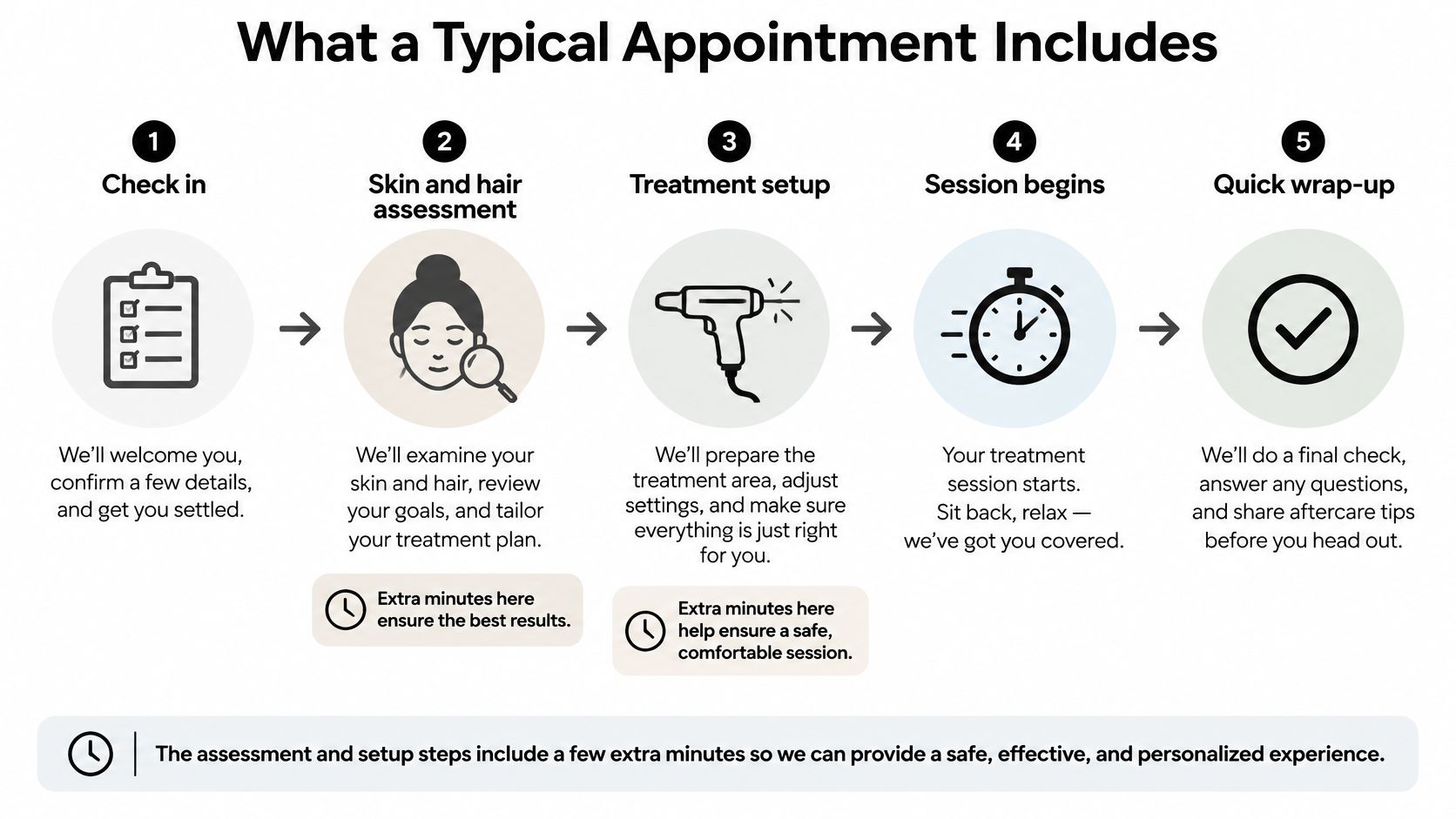
The visit in order
Check in and confirm the plan. Identify the area being treated and discuss relevant changes in skin condition, sun exposure, or medication. On the first visit, allow for the skin and hair assessment rather than expecting immediate laser treatment.
Prepare clean skin. Our policy requires the treatment area to be fully washed and free of makeup and medication. Tell us about prescribed topical products beforehand, rather than making medication changes yourself.
Bring the hair to skin level. The area must be shaved to skin level before treatment. A day's growth may help identify the borders, but long surface hair isn't the goal.
Put on protective eyewear and get positioned. Clothing adjustments, privacy, and access to the complete zone all matter. Legs or a back can require more repositioning than a small facial area.
Complete the laser pass with cooling. This is the active treatment portion many clients have in mind when they ask how long does a laser hair removal session take.
Check the skin and review aftercare. The appointment isn't finished until the practitioner has assessed the immediate response and explained what to do afterward.
Compare the whole visit, not just the pass
A returning underarm client may arrive knowing exactly how to prepare and position. A first full-bikini appointment can feel longer because boundaries, privacy, and comfortable positioning need attention.
For a full back or full legs, the larger treatment footprint becomes the central commitment of the visit. Trying to fit either into the same kind of gap as a small return appointment creates unnecessary pressure.
Our stated downtime after treatment is typically none, but that isn't a promise that every activity is appropriate immediately afterward. Follow your aftercare instructions, and distinguish recovery expectations from the time you need inside the office.
Use our laser hair removal appointment guide to prepare before arriving. Clean skin, correctly prepared hair, and a clearly identified treatment area help prevent avoidable setup problems without rushing the treatment itself.
Whether Later Sessions Get Shorter
No, every later session won't automatically be faster. Hair may become sparser while the treatment footprint remains exactly the same, and the practitioner may still need to cover that footprint systematically.
Use follow-up discussions to decide whether your reserved block should change, rather than assuming that less visible regrowth means a shorter appointment.
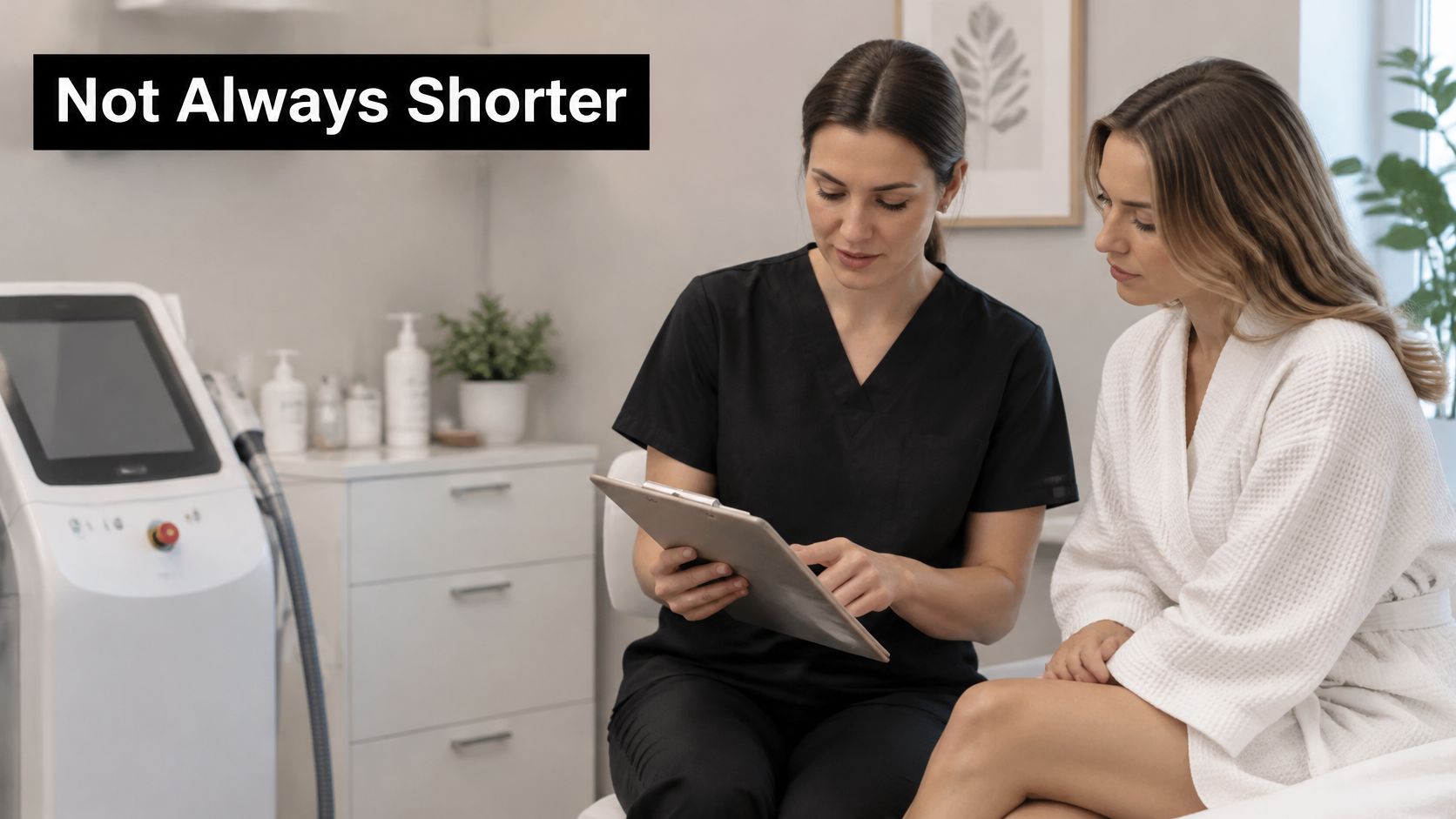
Less hair doesn't guarantee the same settings
A 2025 clinical report on a rotational laser regimen described Nd:YAG, diode, and Alexandrite wavelengths across three initial sessions, with subsequent treatment guided by regrowth and hair miniaturization. The relevant lesson is that treatment planning can change as hair changes, so elapsed time doesn't have to decline predictably.
Reduced density may shorten checking and cleanup. However, a practitioner may adjust settings or maintain deliberate cooling to preserve safety and effectiveness.
That distinction matters for darker skin tones, where parameter selection remains important even when regrowth looks lighter. It also matters for a large male back or chest, where fewer hairs don't necessarily eliminate the need for a complete, methodical pass.
A short visit isn't a short course
A 2022 study of hair removal before gender-affirming vaginoplasty reported a mean laser-session duration of 13.7 minutes in its full-depth procedure group and 26.0 minutes in its shallow-depth group. The full-depth laser group had a mean interval of 5.3 weeks between sessions.
Those are procedure-specific cohorts, not time promises for ordinary underarm or leg appointments. They illustrate why session duration and course duration are separate questions: relatively brief treatments can still be distributed across a much longer schedule.
When reviewing treatment videos, pay attention to the distinction between the laser pass and the full appointment.
Keep your existing appointment allowance until the specialist confirms that your treatment consistently needs less time.
Don't shorten a booking just because shaving has become easier. Rebooking should reflect the current coverage, skin response, and treatment plan, not just the amount of hair you notice in the mirror.
How to Block Time on a Busy Calendar
Start with the appointment's role in your day. A small return visit may fit beside lunch, while a larger treatment is better placed where a delay won't collide with a school pickup or a work call.
For commuters, the useful unit is door-to-door time, including travel and parking. A short treatment isn't a practical lunch-break choice if reaching Westbury uses most of the available gap.
Use this checklist to separate the treatment block from the rest of your day.
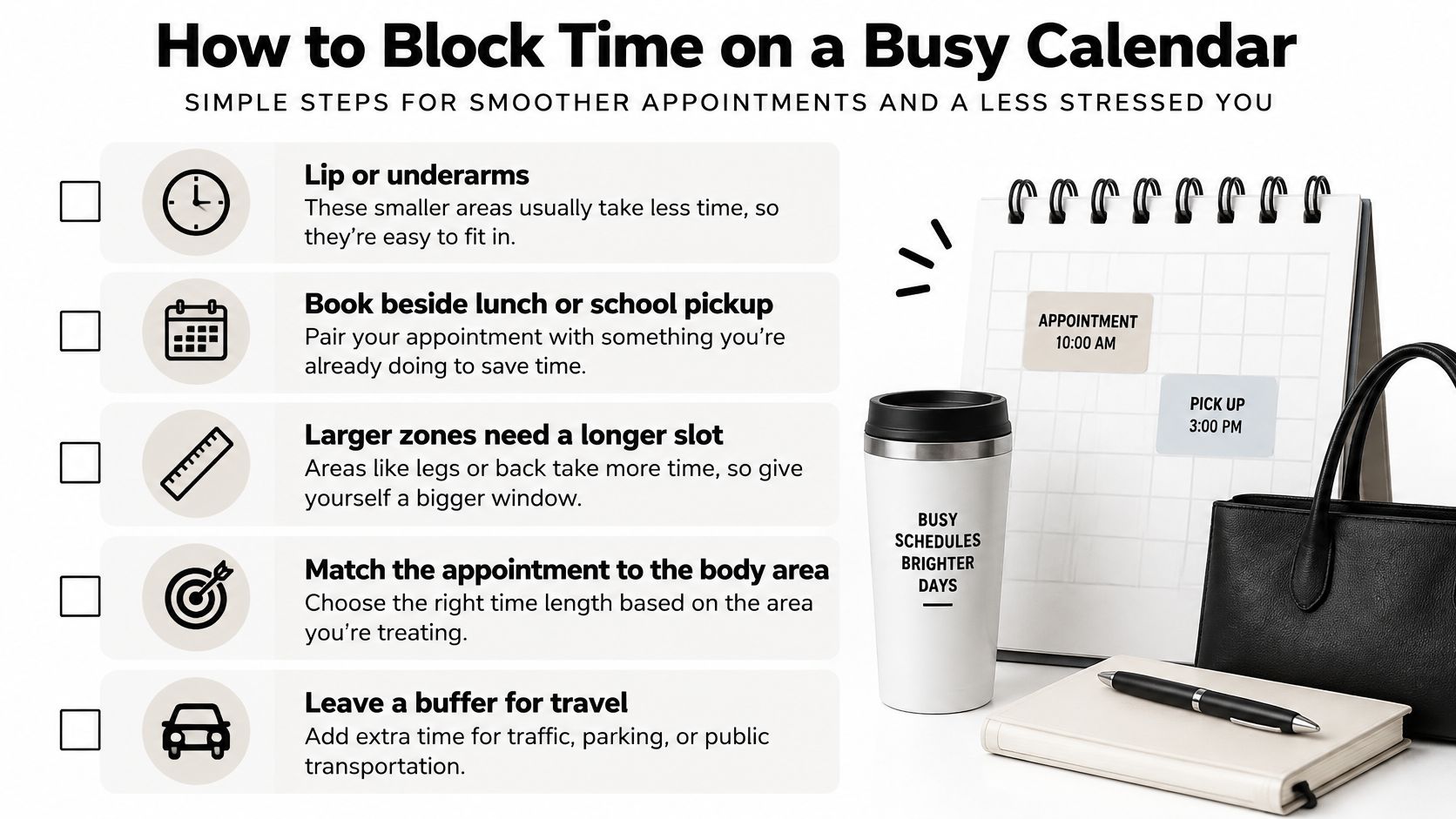
Protect the preparation window
Preparation can determine whether an appointment can proceed at all. Our requirements include the following:
Leave the follicle available for treatment. Avoid waxing, plucking, threading, or electrolysis for 4 to 6 weeks beforehand. Shave the treatment area to skin level instead.
Plan around sun exposure. Avoid sun exposure for 2 weeks before treatment. Tell us about recent tanning before you arrive.
Disclose medication early. Our policy excludes treatment while taking medications such as Accutane, Retin-A, or Gold Therapy, or within the past 6 months of those medicines. Don't stop prescribed medication to fit a cosmetic appointment, discuss it with your prescriber and our team.
Discuss any proposed bleaching cream in advance. If a technician recommends a cream such as hydroquinone, that conversation may involve starting it 4 to 6 weeks before treatment. Don't start it independently as a last-minute preparation step.
Reserve the next visit deliberately
Don't choose the earliest open appointment just to feel that you're moving faster. Return timing should fit the treatment area, regrowth, and individualized plan.
Our guide to how long to wait between laser hair removal treatments helps you distinguish the spacing between appointments from the length of an individual visit. Put both on your calendar, along with any travel or sun exposure that could interfere with preparation.
For parents, a useful safeguard is to avoid making treatment the final task before a fixed pickup. For someone traveling from Jericho during a workday, a quieter calendar gap is more valuable than the shortest possible booking.
If your schedule can't accommodate the preparation requirements and the appointment buffer, move the date. Don't solve a scheduling problem by trimming the treatment.
Book the Right Length in Westbury
Book by treatment zone and first-versus-return status, not by a generic promise that laser hair removal is quick. Tell us the complete coverage you want so the reserved appointment matches the work.
At NYC Laser Hair Removal, we use Splendor X and organize treatments into Small, Medium, Large, and Extra Large areas. Single sessions are $25.00 for Small Areas such as the lip or chin, $39.99 for Medium Areas such as underarms or the bikini line, $65.00 for Large Areas such as the chest or Brazilian, and $99.99 for Extra Large Areas such as full legs or full back; multi-session bundles are also available.
Make the booking specific
Our specialist Tamar has over 17 years of experience in laser hair removal. Skin and hair assessment helps establish a realistic plan rather than treating the menu category as a universal timer.
When booking, include:
The exact area. Say full back rather than back if that's the coverage you want.
Any combined zones. Mention additions before arriving so they can be accounted for.
Your visit status. A first consultation and a familiar return visit don't involve identical preparation.
Relevant changes. Flag sun exposure or medication questions before committing to treatment.
Our center is at 355 Post Avenue, Suite 102, Westbury, NY 11590. Call 516-321-4959 or email INFO@NYCLASER.COM to discuss the appointment; business hours are Monday through Saturday, 10am to 6pm.
Choose a time when you can complete the visit without watching the clock. The right booking is the one that accommodates your assessment, setup, and full intended coverage.
NYC Laser Hair Removal offers personalized laser hair reduction for small facial zones through larger body areas, with appointment planning based on your skin, hair, and intended coverage. Visit NYC Laser Hair Removal to book, and tell us which areas you want treated and whether it's your first visit so we can help you reserve the right amount of time.
Comments