
Hair Removal Cream for Underarms: How to Use It Safely
You're getting ready to wear something sleeveless, and shaving sounds like another round of prickly regrowth or razor irritation. A tube of hair removal cream looks simpler, until you start wondering whether it's safe to use near deodorant, on sensitive skin, or before a laser appointment.
The useful decision isn't which package promises the softest skin. It's whether your underarms are ready for the product, whether a patch test stays clear, and whether you can follow the contact time without stretching it.
How Underarm Cream Dissolves Hair and Why Results Fade
Hair removal cream for underarms can suit healthy, intact skin after a successful patch test. It shouldn't go on skin that's shaved raw, sunburned, inflamed, or affected by active eczema or psoriasis.
What happens to the hair
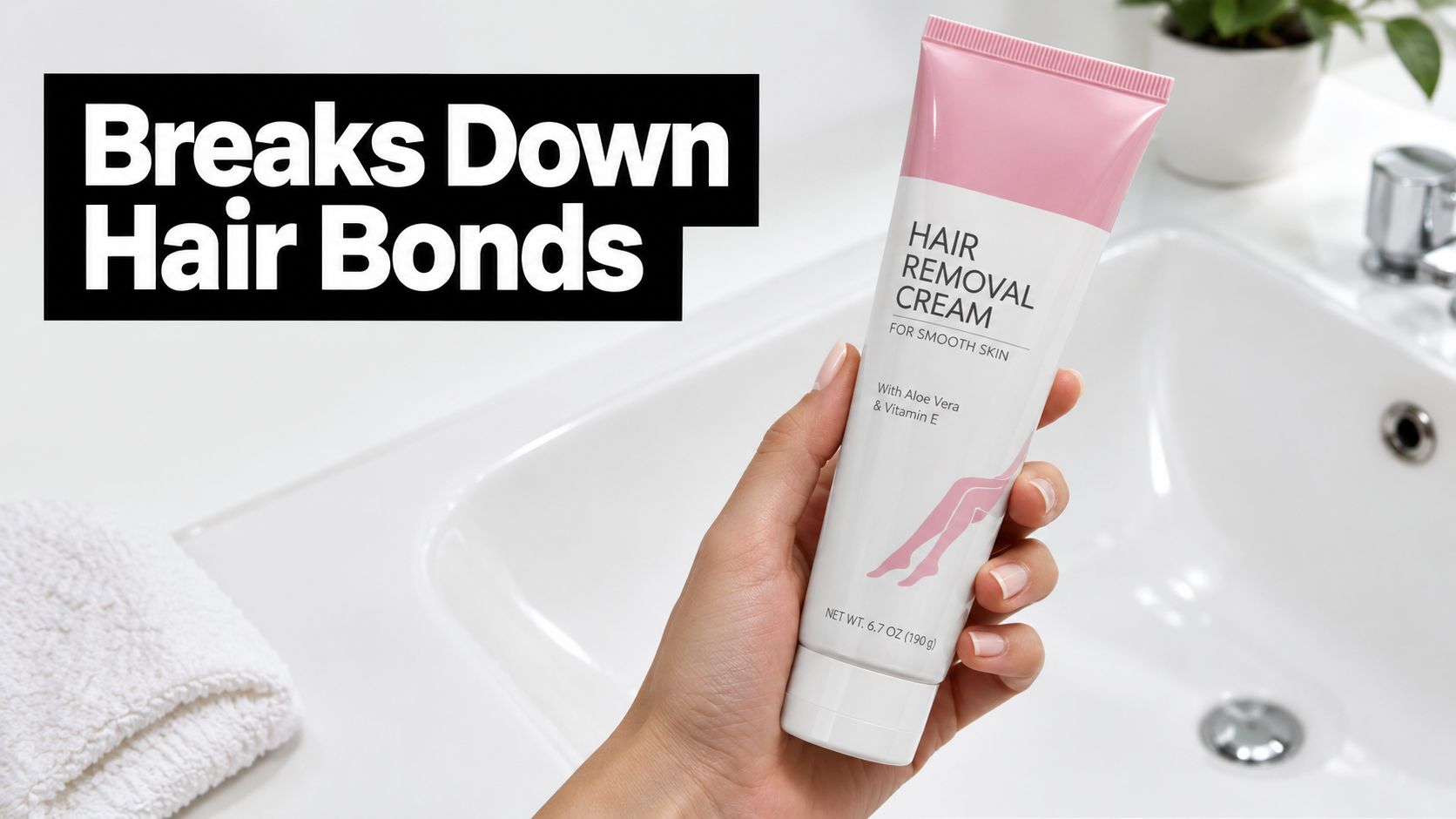
Hair is made largely from keratin, a structural protein held together partly by chemical connections called disulfide bonds. Depilatory creams contain thioglycolate compounds that disrupt those connections, weakening the exposed hair until it wipes away.
Think of the hair as a rope emerging from the skin. The cream loosens the connections holding the exposed rope together, but it doesn't pull out the anchor underneath.
The e-PG Pathshala technical text on depilatories describes thioglycolate preparations at approximately 2.5–4% concentration, with depilation in roughly 5–15 minutes, depending substantially on formulation pH. Those are formulation characteristics, not a timing instruction for the tube in your bathroom.
You can't judge a product's safe contact time by its ingredient percentage alone. The complete formula, its alkalinity, and its intended application area all affect how it behaves.
Why extra time doesn't mean better removal
The chemistry that weakens hair can also injure skin. Leaving the cream on longer doesn't produce a proportional improvement, especially when coarse hairs remain after finer ones have dissolved.
Underarms make timing particularly important because the skin folds against itself and experiences moisture and friction. Chemical injury can be more serious than temporary redness, so burning isn't something to tolerate for a smoother finish.
Practical rule: If some hair remains when the maximum time arrives, remove the cream anyway. An incomplete result is safer than an extended exposure.
The follicle remains active after treatment. New hair continues growing, which is why cream provides temporary grooming rather than lasting reduction, and why the exact return of visible hair differs between people.
Keep these distinctions clear:
Where it works: At or near the skin surface, not by removing the root.
How it works: Through a timed chemical reaction, not friction or pulling.
What it changes: The exposed hair shaft, not the follicle's ability to produce another hair.
Which Underarm Skin Should Skip Cream
Check your skin before comparing products. This table separates situations that usually call for a pause from those that need a clinician's review before another attempt.
Underarm skin states and whether cream is suitable
Underarm skin state | Cream suitable? | Safer next step |
|---|---|---|
Healthy, intact skin with no past reaction | Yes, after a patch test | Complete the label check, test, timed application and aftercare routine |
Freshly shaved or nicked skin | Not yet | Wait until the skin is healed and calm |
Sunburned or sun-stressed skin | No | Let it recover fully and protect it from UV |
Eczema or psoriasis flare | No | Ask a dermatologist for a safe removal plan |
Acne, boils or broken skin | No | Treat the skin first, then reassess |
Recent retinoid use | No, check first | Ask a clinician before any depilatory |
Previous reaction to a depilatory | No | See a clinician before trying again |
Irritation from deodorant or antiperspirant | Not yet | Pause until the skin settles, then reassess |
Damaged skin lets irritants penetrate more readily. A formula tolerated on intact skin may cause substantial irritation or a burn when the protective barrier is compromised.
A pause isn't the same as a permanent ban
A shaving nick or deodorant rash may resolve, allowing you to reconsider cream once the skin has fully recovered. Don't use the absence of pain alone as clearance if the area is still visibly raw, scaly or inflamed.
Active eczema, psoriasis, recurrent boils or a previous depilatory reaction need a different approach. A clinician can help distinguish a temporary barrier problem from a condition or allergy that makes another application inappropriate.
The FDA consumer guidance hosted by Drugs.com describes depilatory risks including stinging, rashes, peeling, blisters and burns. Gentle, natural, aloe-containing and sensitive-skin descriptions don't cancel those risks, because the hair-removing chemistry, fragrance or preservatives can still irritate.
When the skin is compromised, the question isn't which cream is gentlest. It's whether cream belongs on that skin at all.
If eczema affects other parts of your routine, Misaj's mosquito repellent precautions for eczema offers a related resource for evaluating another leave-on product category. Repellent advice doesn't establish that a depilatory is safe, but checking intended use and skin condition is a useful habit across both routines.
While your underarms recover, leaving the hair alone is a valid option. Once the skin is healthy, shaving with a fresh blade and a lubricating, fragrance-free shave product may be practical, provided shaving itself doesn't trigger irritation.
Frequent reactions deserve a dermatology discussion before switching methods or booking laser. You don't need to keep testing products to prove your skin can tolerate hair removal.
Cream, Shaving, Waxing or Laser Compared
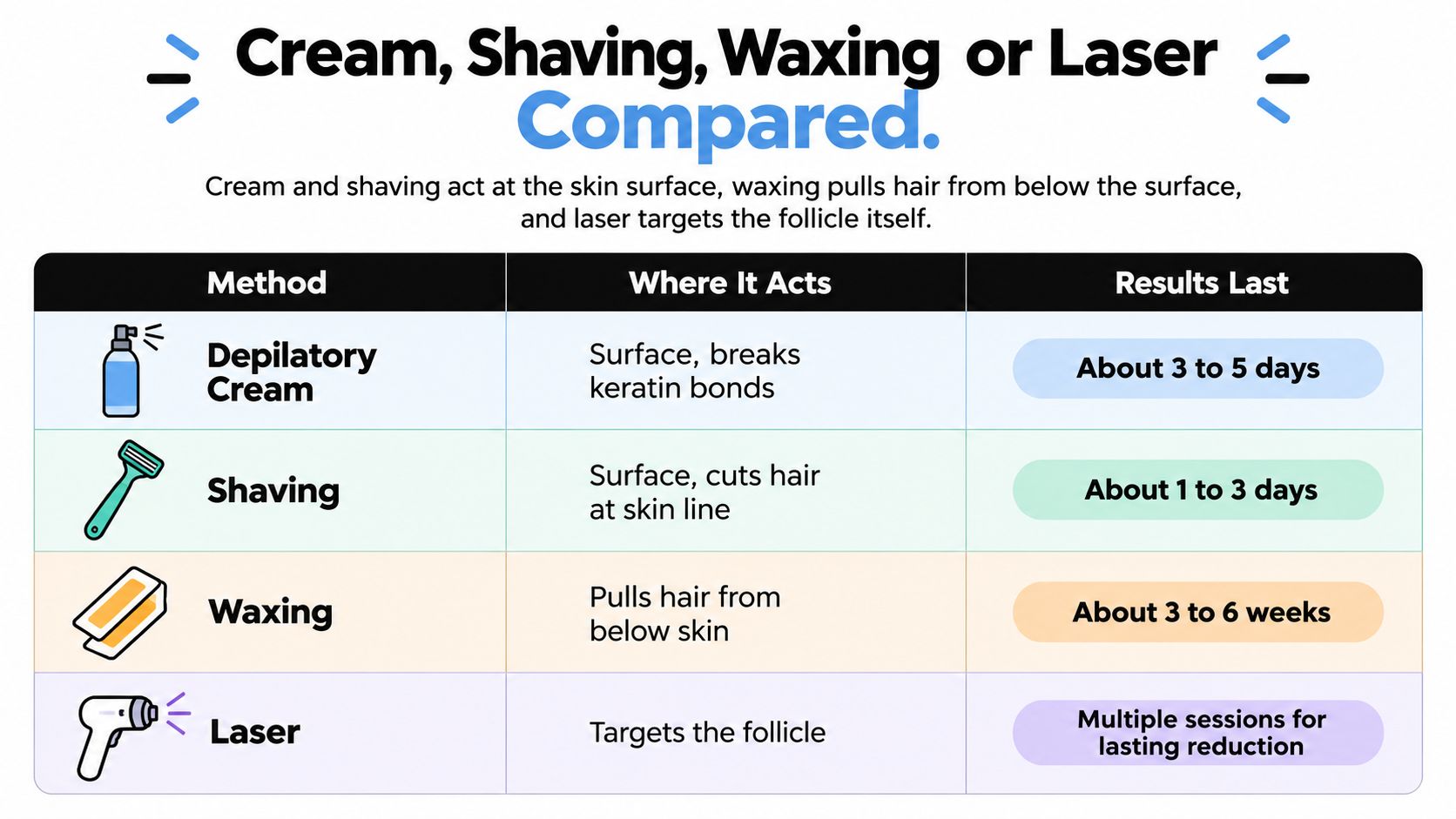
Cream and shaving act near the skin surface, waxing pulls hair from below it, and laser targets the follicle. That difference helps explain why these methods require different maintenance routines.
The Skin Inc. overview of hair-removal methods distinguishes temporary chemical depilation from waxing and follicle-targeting laser treatment. For cream, the essential choice-related precautions are straightforward: follow directions, avoid broken or irritated skin, and patch test.
Underarm hair removal methods compared
Treat duration estimates in comparison graphics as broad illustrations, not promises. Your growth pattern, the method's effectiveness and your tolerance for visible regrowth determine when you'll want another treatment.
Method | How it works | Typical result duration | Main skin risk | Best fit |
|---|---|---|---|---|
Depilatory cream | Weakens keratin bonds near the surface | Temporary, until visible regrowth | Chemical burns, rash or irritation | Occasional touch-ups on healthy skin |
Shaving | Cuts hair at skin level | Short-lived, with regular upkeep | Razor burn, nicks and ingrown hairs | Same-day grooming |
Waxing | Pulls hair from below the surface | Longer between treatments than surface removal | Pain, ingrown hairs, irritation or skin lifting | Less frequent removal when skin tolerates pulling |
Laser hair reduction | Light energy targets the follicle | Repeated sessions for long-term reduction | Burns or pigment changes if treatment is unsuitable | A planned approach to reducing ongoing growth |
Choose the routine, not just the finish
Start with maintenance. Shaving may fit someone who wants a quick touch-up during a shower, while cream requires dry preparation, an uninterrupted timer and thorough rinsing.
Waxing trades more discomfort during removal for less frequent grooming. It still isn't appropriate over damaged skin, and forceful removal can injure a vulnerable skin barrier.
Laser involves appointments rather than a single bathroom routine. It's a reduction strategy, not a guarantee that every hair disappears permanently or that maintenance will never be needed.
Your underarms' reaction matters more than convenience alone. If shaving repeatedly causes bumps, switching to cream may replace mechanical irritation with chemical irritation rather than solve the problem.
Our guide to laser hair removal and shaving explains how shaving can fit into a professional treatment routine. That distinction matters because preparing for laser isn't the same as choosing an independent grooming method.
For laser, hair colour and skin tone affect suitability because treatment relies on light absorption. Darker skin isn't automatically excluded, but device choice, settings and professional assessment matter; very light hair can be harder to target effectively.
Choose according to what you can maintain comfortably:
Occasional grooming: Consider the preparation and recovery time, not just application speed.
Reactive skin: Identify the cause of irritation before changing methods.
Longer-term reduction: Plan for assessment and repeated treatment rather than expecting an immediate final result.
Steps and Timing Around Deodorant and Laser
Set up your supplies before opening the tube: the instructions, a timer, the supplied spatula or a soft cloth, and access to running water. Don't start when you're rushing out or expecting an interruption.
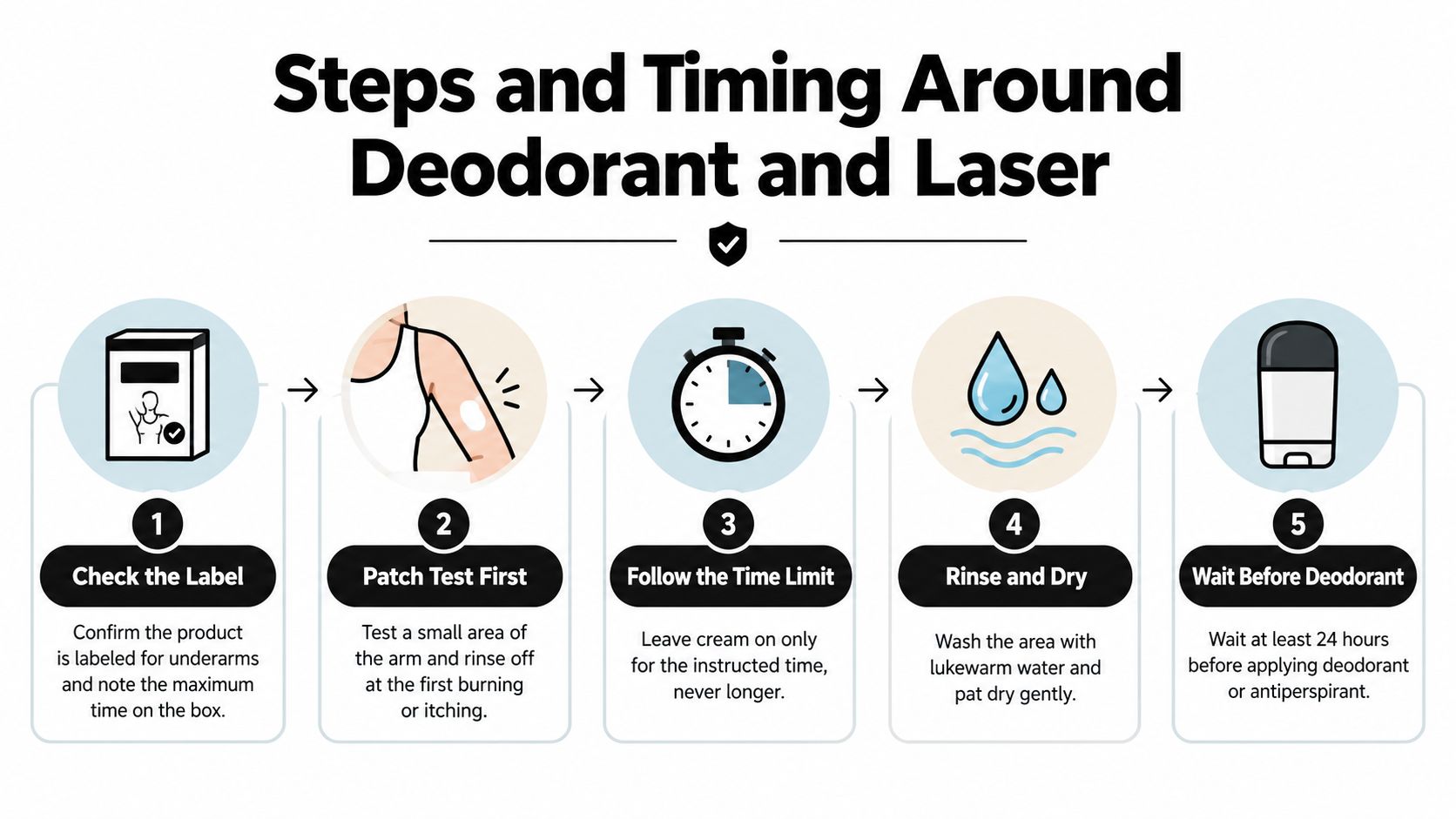
For deodorant, use the product's aftercare directions and your skin's recovery rather than treating a fixed waiting period in a graphic as universal clearance. If the area remains uncomfortable, it isn't ready for another potentially irritating product.
A controlled application routine
Read the intended-use and timing instructions. The label must explicitly permit underarm use. Find the earliest checking time, maximum total contact time and minimum interval between applications before you begin. A common slip is assuming that a cream approved for legs is automatically suitable everywhere.
Test a small patch in the intended treatment area. The American Academy of Dermatology recommends leaving the test on only for the instructed duration, removing it sooner for burning or stinging, and observing the area for 24 hours before broader use. Testing only your forearm doesn't directly check how your underarm will respond. Don't interpret an immediately comfortable test as a completed test.
Wash gently and dry completely. Remove deodorant, lotion and oil without scrubbing. Check in good light for nicks, a rash or tender patches that weren't obvious earlier. The common mistake is adding exfoliation to make the cream work better. A scrub, cleansing brush or exfoliating acid adds another potential source of irritation.
Cover the hair evenly without rubbing. Use the supplied applicator and the layer thickness specified by the manufacturer. Aim for consistent coverage rather than a thick mound, and don't massage the product into the skin. More cream isn't a substitute for the right product or application technique.
Start timing as directed and stay present. Keep track of when cream first touches the skin, and follow the manufacturer's checking procedure. Remove everything by the maximum time, even if a small test area still has coarse hairs. The risky shortcut is adding extra time because one patch looks unfinished.
Remove gently with the recommended tool. Use the supplied spatula or a soft damp cloth as instructed. Lift away loosened hair without repeated scraping, especially in the underarm fold. If you have to scrub to get a hair out, leave it. Friction won't make an overexposed area safer.
Rinse thoroughly and pat dry. Use lukewarm water and keep rinsing until the cream is gone. Burning or stinging means removal and rinsing start immediately, not when the timer finishes. A quick wipe alone can leave residue against the skin.
Give the area a quiet recovery period. Avoid deodorant, antiperspirant, fragrance, rubbing and vigorous exercise until the skin has settled, while respecting any longer label restriction. Wear loose clothing and skip additional hair removal. Don't apply deodorant simply to check whether the skin still stings.
A clear patch test lowers risk but doesn't guarantee a clear full application. You're exposing more skin, and sweat, heat, residue and clothing friction can change the conditions.
Timing rules for cream, deodorant and laser
Stage | Do | Avoid |
|---|---|---|
Right after cream | Rinse fully with lukewarm water and pat dry | Deodorant, antiperspirant, fragrance and friction |
Until skin feels normal | Use gentle, unscented care and loose clothing | Other hair-removal methods on the same area |
Before a laser appointment | Tell the clinic about recent cream use and shave to skin level as instructed | Waxing, plucking, threading or electrolysis for 4–6 weeks, and cream on the same area just before treatment |
There isn't a universal deodorant restart time that suits every formula and every skin reaction. Wait until the skin feels normal, then follow the relevant product directions; persistent discomfort warrants advice rather than another application.
If you're comparing deodorant formulas, Buy Me Japan's Japanese deodorant ingredients explained can help you read the ingredient categories. A different formula still shouldn't go straight onto irritated skin.
Coordinate cream use with laser preparation
Tell us when you last used cream and whether it caused redness, soreness or peeling. Don't use it as a last-minute preparation step before laser, and contact us before attending if the area is irritated.
Our preparation policy requires avoiding waxing, plucking, threading or electrolysis for 4–6 weeks before treatment. The treatment area must be shaved to skin level, though a day's growth may help identify the area, so follow the preparation directions given for your appointment.
What to Do If Irritation Starts
During application, burning or stinging is a stop signal. Remove the cream gently and rinse thoroughly with running cool or lukewarm water. Don't scrub, and don't try to neutralize the product with vinegar, baking soda or another household substance.
Match the response to the symptoms
Mild redness that fades can occur, but don't assume every pink patch is harmless. Watch whether discomfort is improving, and avoid adding products to test how much the skin can tolerate.
Itching, a spreading rash, peeling or blisters appearing later also means you should stop using depilatories. A comfortable application doesn't rule out a delayed reaction.
For mild discomfort after complete rinsing: Try a cool compress. A plain, fragrance-free moisturizer may help intact skin if it doesn't sting.
For blistering, persistent pain, marked swelling or peeling: Seek prompt medical assessment instead of trying a different cream.
For severe or worsening injury: Get urgent care, especially if the area looks raw or the pain is substantial.
Don't repeat a depilatory after a reaction until a clinician has reviewed what happened.
Keep the recovery routine simple
Avoid deodorant, fragrance, exfoliants and further hair removal while the area recovers. Don't pick blisters or pull away peeling skin.
For routine product selection after recovery, Fillaree's low-waste body care for sensitive skin offers an unscented-care resource. A cleanser isn't a treatment for a chemical burn.
Record the product name, application duration and when symptoms began; photographs can help a clinician understand the sequence. If you notice an isolated bump rather than a spreading reaction, our guide to an ingrown underarm hair bump explains another possible cause, but a painful, hot or enlarging lump needs assessment.
Choose a Cream or Book a Laser Consult
Before buying, check that the product fits your intended use. Before applying, check that your skin fits the product.
Underarm approval: The packaging explicitly lists underarms.
Clear timing: You can identify the maximum contact time and reapplication restrictions.
Readable ingredients: You can check for ingredients linked to past reactions.
Usable packaging: The product is within any marked expiry or period-after-opening limit.
Suitable skin: The area is healthy, and the intended-area patch test stays clear.

Choose according to your goal
Cream can be reasonable for occasional touch-ups when your skin tolerates it. If you react to depilatories, frequently develop ingrown hairs or want less ongoing grooming, consider a professional assessment rather than another product experiment.
At our Westbury, Long Island clinic, we assess skin type and hair colour during the initial consultation to create a personalized plan. We use Splendor X technology, and specialist Tamar has over 17 years of experience as a laser hair removal specialist.
Book a consultation and bring the names of your recent cream and deodorant products, plus details of any reaction. Our information on underarm laser hair removal can help you prepare questions without assuming laser is automatically the right choice.
NYC Laser Hair Removal offers personalized laser hair reduction for people who want an alternative to repeated underarm grooming. Visit NYC Laser Hair Removal to arrange a consultation and discuss your skin, hair colour and recent product use before choosing your next step.
Comments