
Laser Hair Removal and Shaving: A Complete Comparison
You're standing in the bathroom, razor in one hand, shirt in the other, trying to decide if you've got time to shave again before the beach, or if this is finally the summer you stop doing the same routine every few days. That's the core laser hair removal and shaving question for a lot of Long Island people. It's not “which one wins,” it's “which one fits my skin, my schedule, and how tired I am of dealing with this.”
Criterion | Shaving | Laser Hair Removal |
|---|---|---|
What it does | Removes hair at the skin surface | Reduces hair by targeting the follicle |
Same-day result | Smooth right away | Needs a series of sessions |
Regrowth | Fast | Slower, with less visible regrowth over time |
Skin irritation | Can be frequent | Usually limited, but skin can be red briefly |
Best for | Quick fixes, light hair, low upfront cost | Coarse hair, recurring ingrowns, long-term reduction |
If you live in Nassau or Suffolk, you're probably doing the same mental math every week. Razor cartridges, shower time, ingrown bumps under summer clothes, and whether you really want to keep planning around hair again next month. Laser starts making sense when you're done paying the “maintenance tax” on areas that always bother you, while shaving still makes perfect sense for quick touch-ups and for hair that laser can't target well.
Why Long Island Clients Compare Laser and Shaving
A lot of clients come in after a very specific morning. They're in front of the mirror, one eye on the calendar, thinking about a Jones Beach weekend, a work trip, or a last-minute dinner where they don't want to deal with stubble again by dinnertime. That's where laser hair removal and shaving stop being abstract beauty choices and start being lifestyle decisions.
The real trade-off is not beauty, it's friction
Shaving is a short-term fix with a recurring cost. You pay in time, irritation, and the constant reset. Laser asks for more commitment upfront, because it's a series, not a one-and-done move, but it's built for people who want less day-to-day maintenance.
Practical rule: If the same area keeps showing up on your “I have to shave this again” list, laser deserves a serious look.
That's why people compare them in the first place. Shaving is fast when you're already late. Laser starts to matter when you're tired of doing the same body-area math every week, especially for legs, underarms, bikini, back, chest, and beard-edge cleanup.
The market growth around laser hair removal says the same thing in broader terms. One industry summary places the market at about $1.2 billion in 2022, rising to $1.9 billion by 2025, with a projection of $3.4 billion by 2030 and a 14.1% CAGR across that forecast period, while another tracker cites a 2023 valuation of $1.6 billion with 8.2% annual growth through 2030 (laser hair removal statistics). That growth matters because it reflects a shift away from niche treatments and toward routine long-term hair reduction.
The practical takeaway is simple. If you want to keep your routine cheap and immediate, shaving still works. If you want to reduce the number of mornings you spend negotiating with a razor, laser is the better long game.
How Each Method Works
Shaving cuts at the surface
A razor does not remove hair from the root. It cuts the shaft off at skin level, so the follicle stays active and the growth cycle keeps moving. That is why skin feels smooth right after a shave, but the result fades quickly.
The blunt tip left behind by shaving is why regrowth often feels coarser, even though the hair has not thickened. That is a perception issue, not a change in thickness or growth rate. Skin therapy literature also notes that shaving does not interrupt the anagen phase, so it does not change the biology of the hair cycle (skin therapy letter on hair removal practices).
Laser targets the follicle, not the surface
Laser hair removal works on a different target. The light energy is absorbed by pigment in the hair and carried down into the follicle, which is why shaving before treatment matters so much. The laser needs the hair inside the follicle, not a long shaft sitting above the skin.
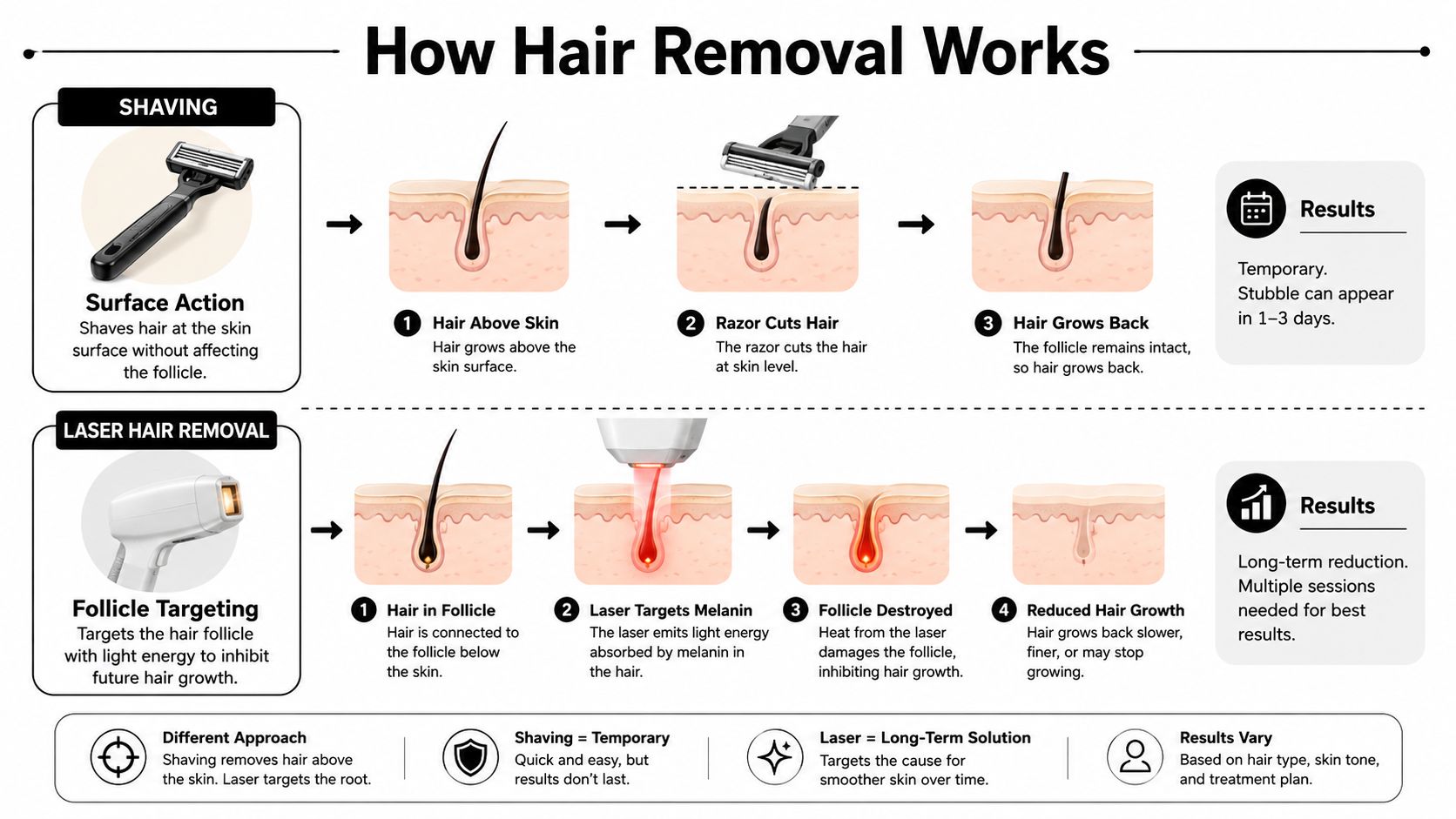
Repeated sessions are necessary because follicles cycle in and out of the growth phase. That makes laser a reduction strategy, not a same-day removal fix. The point is to weaken active follicles over time, so regrowth becomes thinner, slower, and less noticeable.
A dermoscopic comparison found about 1 mm of hair growth after 4 weeks in a laser-treated area versus 7 mm in a shaved area (PMC comparison of post-treatment regrowth). That is the difference in plain English. Shaving clears the surface now. Laser changes what shows up later.
For a clear clinical explanation of the science and process, this guide from NYC Laser Hair Removal is worth reading if you want the mechanics without the fluff.
Side by Side on Results, Pain, Downtime, and Cost
Results are not in the same category
Shaving gives you immediate smoothness. Laser gives you a gradual reduction plan. If you need to look good tonight, shaving wins. If you want less hair next month, and less still after that, laser is the stronger tool.
Historical usage data back up the idea that laser is typically a series-based service, not a one-off convenience. One compiled dataset reports 893,054 U.S. procedures in 2009, compared with 735,996 in 2000, with an average of 4 treatments needed and an average cost of $273.25 per treatment at that time (laser hair removal statistics). Those numbers are old, but the treatment pattern still matters. Laser has never been a “do it once and forget it” service.
Pain, downtime, and money follow the method
Shaving can nick, sting, and trigger bumps, especially if you're rushing or using dull blades. Laser usually feels like quick snapping or heat on the skin, and the skin may be red for a bit afterward. A laser pain-management resource from NYCLASER covers the comfort side of treatment in more detail (laser hair removal pain management).
Downtime is usually the easiest part of the comparison. Shaving has none in theory, but irritation can make your skin feel raw. Laser also usually has minimal downtime, though sensitive skin may stay pink or tender briefly.
If your only goal is a smooth result for today, shave. If your goal is to stop repeating the same grooming work every few days, laser is the smarter investment.
Criterion | Shaving | Laser Hair Removal |
|---|---|---|
Short-term result | Immediate smoothness | Gradual improvement over multiple visits |
Long-term result | Hair returns quickly | Progressive reduction with maintenance for many people |
Pain profile | Razor burn, nicks, bumps | Brief heat or snapping sensation |
Downtime | None if skin tolerates it | Usually minimal, with occasional redness |
Cost pattern | Low upfront, ongoing forever | Higher upfront, better value over time for problem areas |
The budget question is not just “which costs less today.” It's whether you want to keep spending small amounts forever, or make a bigger commitment to cut the recurring work.
Which Method Fits Your Skin Tone, Hair, and Area
Skin tone changes the answer
Darker skin tones need more careful laser selection, not automatic exclusion. Older systems made people nervous for good reason, but modern technology has improved the options available for more diverse skin types. If a provider can't explain how they match the device to your skin, that's a problem.
That said, shaving remains universal. It works on every skin tone because it never relies on pigment detection. So if your skin is reactive, or you're still comparing options, shaving is the safer stopgap while you evaluate laser technology and provider skill.
Hair thickness and treatment area matter too
Laser makes the most sense for coarse, dense, or hormonal hair, especially on the face, bikini area, underarms, chest, back, and full legs. Those are the places where shaving becomes a repetitive chore and ingrowns are more likely to become part of the routine. Fine vellus hair is a different story, because there may not be enough pigment or thickness for laser to be worth it.
Large areas favor laser because the time burden of shaving scales badly. Smaller areas, like the lip or chin, can go either way depending on how much the hair bothers you and how well your skin tolerates shaving.
My blunt take: If shaving is causing bumps, irritation, or dread, you're not “being dramatic.” That area is telling you it wants a different plan.
For people with eczema-prone or sensitive skin, repeated blade contact can be a bad match. For anyone prone to ingrowns or pseudofolliculitis barbae, shaving can keep the cycle going. In those cases, laser is often the better starting point, provided the skin type and device are matched correctly.
Shaving Rules Before and After Laser Sessions
Before treatment, shave. Don't remove the root
The reason clinics tell you to shave before laser is simple. Hair above the skin can absorb energy at the surface and interfere with the treatment, while shaving leaves the follicle intact for the laser to target. The American Academy of Dermatology says shaving is the preferred between-session method because it removes hair above the skin without disturbing the follicle (AAD laser hair removal FAQs).
The safest pattern is to shave 12 to 24 hours before your appointment, using a clean, sharp razor and gentle products. Shave with the grain when you can, use fragrance-free shaving cream or gel, and don't dig at rough spots. The internal prep guide at NYCLASER's shave-before-laser instructions gives a practical clinic-facing version of the same advice.
After treatment, be gentler than you think you need to be
Post-laser shaving is fine once the skin has settled, but don't rush it if the area is still red or raised. If shaving feels irritating, wait. That's not being cautious for no reason, it's protecting skin that just went through a heat-based treatment.
Here's the cleanest post-session protocol:
Use a new or very sharp razor: Dull blades tug and create irritation.
Choose a mild cleanser or body wash: A fragrance-free option is smarter for sensitive skin, and a gentle body wash for sensitive skin is a useful type of product to look for after treatment.
Shave in the direction of growth: Going against the grain can be rough on already warm skin.
Skip waxing, plucking, and tweezing: Those remove the follicle, which works against laser.
If you see persistent redness, raised bumps, or skin that feels hot enough to bother you in the shower, delay shaving and call the clinic. The goal is smooth skin, not extra trauma.
Why Splendor X Changes the Comparison for Diverse Skin
Technology matters more than marketing
A lot of people were told laser just wasn't for them, especially if they had deeper skin tones or mixed hair textures. That old advice came from older systems that weren't built as flexibly. Splendor X changes the calculation because it combines alexandrite and Nd:YAG wavelengths, which gives providers more room to match treatment to skin tone and hair type.
It also uses a square spot size, which helps cover larger areas more efficiently, and built-in cooling to improve comfort during treatment. Those details matter because they affect whether a full-back or full-legs series feels like a manageable appointment or an ordeal.
The right device changes who can realistically consider laser
The comparison shifts from theoretical to practical. A Nassau County client with skin type IV, V, or VI is not asking for a beauty slogan. They want to know whether a clinic has a setup that respects their skin instead of forcing a one-device-fits-all approach.
Splendor X is relevant because it gives providers more flexibility for diverse skin and hair profiles, especially on larger zones where treatment speed matters. It's also a better fit when the hair pattern changes across the body, which is common in real life and not something glossy ads like to admit.

So yes, technology is part of the decision. If a clinic uses a more adaptable system, laser becomes a realistic option for people who previously had to default to shaving, even if they hated it.
The Honest Recommendation for Long Island Readers
Laser wins for three kinds of people
If you get ingrowns, laser is usually the better long-term move. If you have coarse dark hair on large areas, laser is the more efficient plan. If your shaving routine is stealing real time every week, laser pays back in convenience.
That's my straight answer. Not because shaving is “bad,” but because shaving is a maintenance habit, and some body areas are too annoying to keep feeding that habit forever.
Shaving still wins for some people
If your hair is very light or fine, shaving may still be the more practical choice because laser needs pigment to work well. If your budget is tight right now, careful shaving can absolutely carry you for a year while you figure out whether you want to commit later.
The smartest path for a lot of people is mixed. Start laser on the areas that bother you most, then keep a good shaving routine for the rest and between sessions. That gives you relief where it matters, without forcing an all-or-nothing decision.
NYCLASER's zone-based setup, with Small, Medium, Large, and Extra Large areas and single-session or 3- and 6-session bundles, is built around that kind of practical planning. It's a cleaner way to approach hair reduction than pretending every body area deserves the same solution.
Common Questions and Booking Next Steps
A few questions people ask before they book
Can you do laser in summer if you have tan skin? The answer is that you need a provider who can assess your current skin and choose the right settings, not someone who throws a generic answer at you. Sun exposure changes the risk profile, so be honest at the consult.
What about pregnancy or acne medication? Don't guess. Bring a full medication list to the visit and let the provider decide what's appropriate for your skin and treatment plan.

What happens at the first visit? At a place like NYC Laser Hair Removal, the consult is where skin tone, hair pattern, and treatment areas get matched to a plan, not where you're pushed into something you're not ready for. If you're comparing body areas, packages, or whether to start with one zone first, that's the visit where the map gets drawn.
For busy Long Island schedules, the logistics are straightforward. The Westbury clinic is at 355 Post Avenue, Suite 101, Westbury, NY 11590, with business hours Monday through Saturday, 10am to 6pm. The clinic also offers online booking, which is the right move if you want to stop debating the razor and get an actual plan on the calendar.
If you're done treating shaving like a weekly chore and you want a smarter plan for the areas that bother you, book a consult with NYC Laser Hair Removal. Bring your questions, your skin concerns, and your real schedule, because that's how you get a treatment plan that fits your life instead of fighting it.
Comments