
How Does Laser Hair Removal Work A Guide to the Science and Process
Ever wondered how a beam of light can get rid of unwanted hair for good? It’s not magic, it’s just really smart science. Laser hair removal works by sending a highly concentrated beam of light directly into the hair follicle. That light is absorbed by the dark pigment in the hair, instantly converting to heat. This heat then strategically damages the follicle at the root, making it unable to grow new hair, all without harming the surrounding skin.
It’s a precise and incredibly effective path to long-term hair reduction.
The Science of Selective Photothermolysis
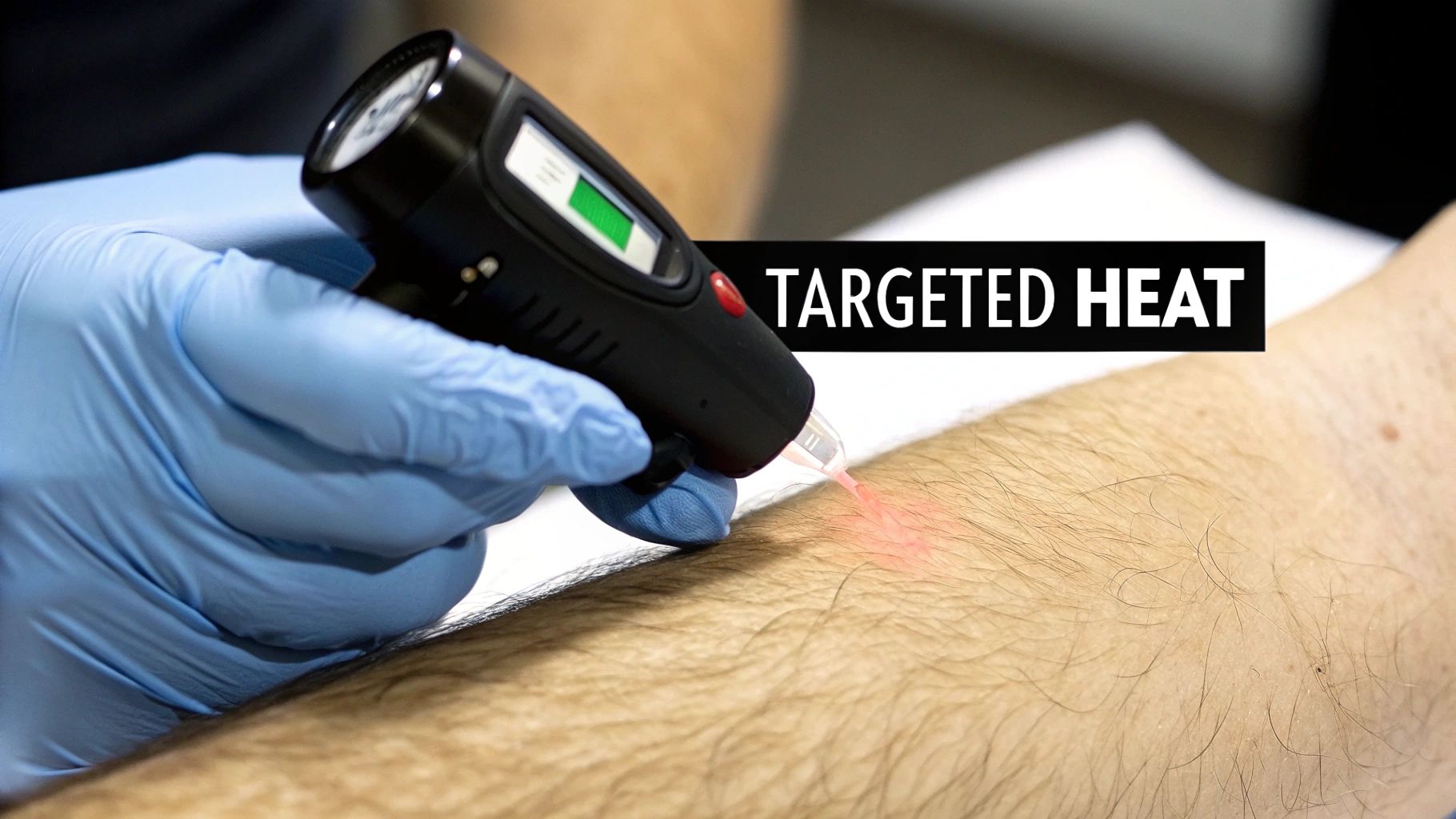
To really get how this works, we need to talk about the core principle: selective photothermolysis. It sounds like something out of a sci-fi movie, but the idea is actually quite simple. Think of it as a targeted mission to neutralize unwanted hair follicles, leaving everything else untouched.
Let's break down that big word:
Selective: The laser is specifically programmed to select and target one thing: the dark melanin pigment inside your hair follicles.
Photo: This just means light, referring to the energy the laser emits.
Thermolysis: This means to destroy something with heat.
So, putting it all together, the laser sends out a powerful pulse of light that the dark pigment in your hair eagerly soaks up. This energy instantly becomes heat, which travels right down the hair shaft to the root, damaging the parts of the follicle responsible for making new hair.
To put it in context, here's a quick rundown of the whole process.
The Core Process at a Glance
Concept | Simple Explanation |
|---|---|
Target | The laser hones in on melanin, the dark pigment in your hair. This is why it works best when there's a contrast between hair and skin color. |
Mechanism | Light energy from the laser is absorbed by the melanin and converts into heat. This targeted heat zaps the follicle's growth center. |
Outcome | The damaged follicle can no longer produce hair effectively. With enough treatments, growth is significantly and permanently reduced. |
This table shows just how focused and intentional the technology is. It’s not a blunt instrument; it’s a precision tool.
Why You Can't Just Do One Session
Now, here’s the million-dollar question: why do you need more than one treatment? It all comes down to your hair’s natural growth cycle.
This whole process is only truly effective when a hair is in its active growth stage, called the anagen phase. During this phase, the hair is physically attached to the follicle's root, creating a perfect little superhighway for the laser's heat to travel down and do its job.
But here’s the catch: at any given time, only about 20% of your hair is actually in this active phase. The rest is either in a transitional (catagen) or resting (telogen) stage, where it isn't properly connected to the root. A laser can’t do much to a follicle if the hair isn't there to deliver the message.
This is exactly why you need a series of sessions, usually spaced a few weeks apart. It’s the only way to systematically catch every single hair as it cycles into its most vulnerable anagen phase.
The goal is to methodically treat every follicle over time, ensuring each one is targeted when it's most receptive to the laser's energy. This systematic approach is the secret to achieving that smooth, long-lasting hair reduction we’re all after.
Ultimately, the science is solid. By aiming concentrated light at the melanin in hair follicles, the resulting heat impairs future growth while keeping your skin safe. For a deeper dive into the research, studies like those highlighted by Cognitive Market Research confirm why a consistent series of sessions is the most reliable way to get the smooth skin you're looking for.
Your Laser Treatment Journey From Start to Finish
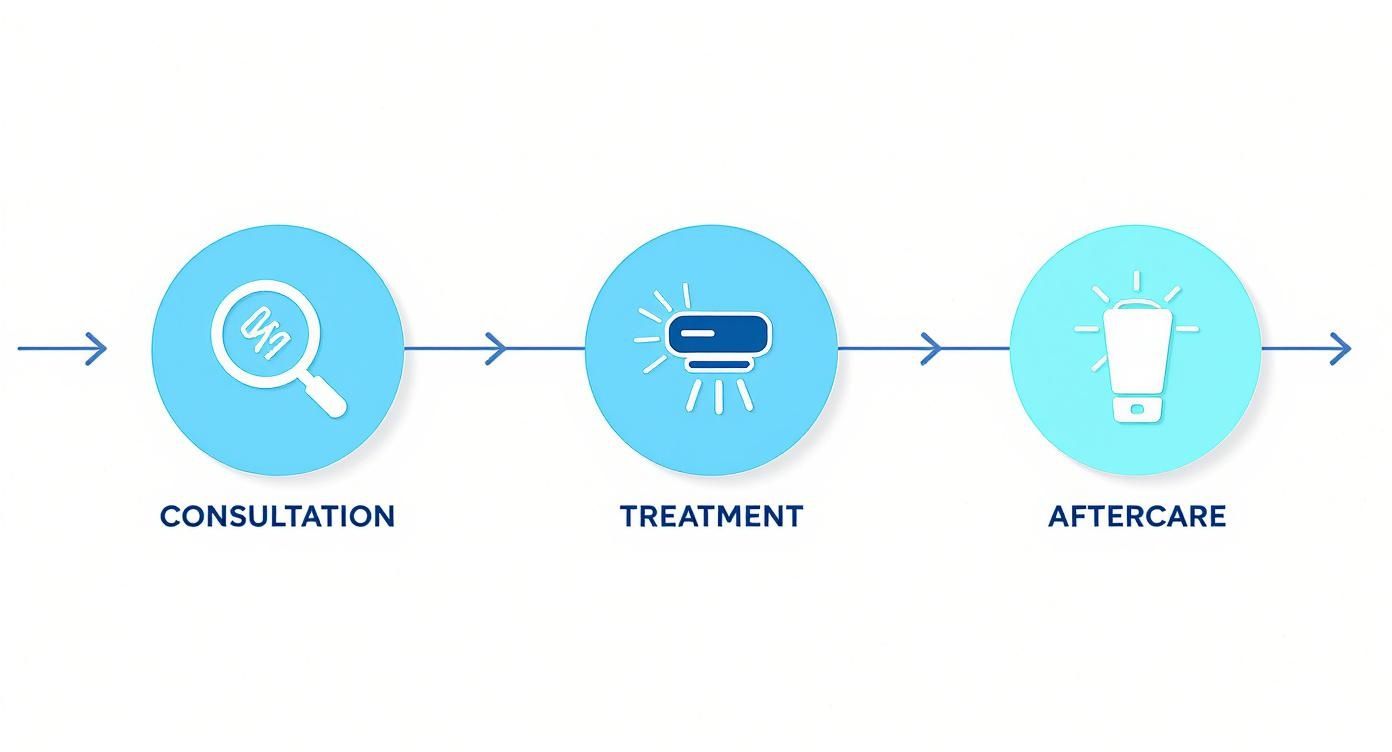
Knowing exactly what to expect can turn any nerves about a new treatment into pure excitement. At NYCLASER, we map out every single step of your journey to smooth skin, making sure you feel confident and cared for from the moment you walk through our doors. This isn't just a procedure; it's a process, and understanding it is the first step.
Your path to being hair-free doesn't start with a laser—it starts with a conversation. That initial consultation is where we get to know you, your skin, and exactly what you're hoping to achieve.
The Initial Consultation and Patch Test
During this first meeting, one of our expert technicians will take a close look at your skin tone and hair type to confirm you're a great candidate for the treatment. We'll chat about your medical history and answer every last question you have. No rush.
This is also when we do a patch test on a small, hidden area. This quick test is crucial; it shows us exactly how your skin will react and helps us dial in the perfect laser settings just for you. It’s all about maximizing safety and getting you the best possible results.
Once we've built your personalized treatment plan, you're ready to start your sessions. Getting ready for your first appointment is simple but important. For a complete rundown, check out our guide on how to prepare for laser hair removal. It has everything you need to know.
During Your Laser Session
On treatment day, you'll get settled in a private, comfortable room. We'll give you protective eyewear, and the technician will cleanse the area we’re about to treat. As the session starts, you'll feel a sensation that most people describe as a quick snap from a rubber band.
That feeling is the laser pulse doing its work, but our advanced Splendor X technology makes the whole experience incredibly manageable. It has a built-in cooling system that blasts chilled air onto your skin at the exact same time as the laser pulse, which seriously cuts down on any discomfort.
The dual cooling system is a total game-changer for comfort. It actively soothes your skin in real-time, making the sensation super brief and easily tolerable for pretty much everyone.
How long your session takes really just depends on the size of the area we're working on.
Small Areas (like Upper Lip, Chin): We can have you in and out in as little as 5-10 minutes.
Medium Areas (like Underarms, Bikini Line): These usually take around 15-20 minutes.
Large Areas (like Full Legs, Back): Plan for about 30-60 minutes.
After Your Treatment
Right after your session, it's totally normal to see some mild redness and maybe a little swelling in the treated area—think of it like a very light sunburn. This is actually a good sign! It means the follicles have responded to the laser energy, and these effects typically fade within a few hours.
We’ll send you home with simple aftercare instructions. The number one rule is to protect your skin from the sun. Stay out of direct sunlight and use a broad-spectrum SPF 30+ on the treated areas every day. You should also skip hot showers, saunas, and intense workouts for the first 24 hours. Following these simple rules ensures a smooth recovery and sets you up for amazing results.
Understanding Your Treatment Schedule and Results
Getting that beautifully smooth, hair-free skin you’re after is a partnership between our technology and your body's natural rhythms. Patience and consistency are key. It’s a common question: "Why can't it all be gone in one session?" The answer lies in the way your hair grows.
Think of it this way: your hair doesn't grow all at once in a single, coordinated wave. Instead, each follicle is on its own unique schedule, cycling through three distinct phases. Timing our treatments to catch each hair in the right phase is the secret to making laser hair removal truly effective.
The Three Phases of Hair Growth
Our lasers are incredibly precise. They need a direct connection to the hair follicle's root to work, and that connection only exists during one specific stage: the anagen phase. This is the active growth phase, where the hair is physically attached to the follicle, creating a perfect pathway for the laser's energy to travel down and disable it.
The other two phases are where the laser can't get the job done.
Catagen Phase: A brief transitional period where the hair stops growing and detaches from the follicle.
Telogen Phase: The final resting stage. The old hair is just sitting there, ready to shed as a new hair begins to form beneath it.
During the catagen and telogen phases, there’s no bridge for the laser's energy to cross. That's precisely why a series of treatments isn't just a recommendation—it's a requirement for success.
Your Treatment Plan and What to Expect
Here’s a number that surprises most people: at any given time, only about 20% of your hair is in that active, treatable anagen phase. This means each session targets just a fraction of the total hair in an area.
The goal is to systematically treat the area over several months. By doing so, we ensure we catch every single hair as it cycles into its active growth window. This methodical approach is what delivers that significant, long-lasting reduction.
For most of our clients, we map out a plan of 6 to 8 sessions, typically spaced 4 to 6 weeks apart. This isn't an arbitrary schedule; it's carefully designed to align with your hair's growth cycles, making every appointment as effective as possible. You can see a full breakdown of what this journey looks like by reading about the ideal NYC laser hair removal timeline and what happens between each visit.
It’s also crucial to set the right expectations. The industry standard and our goal is permanent hair reduction, not 100% eradication for life. After you complete your full series of treatments, you can expect a 70% to 90% reduction in unwanted hair. For most people, a quick touch-up session once or twice a year is all that's needed to maintain that perfectly smooth finish.
Finding the Right Laser for Your Skin and Hair
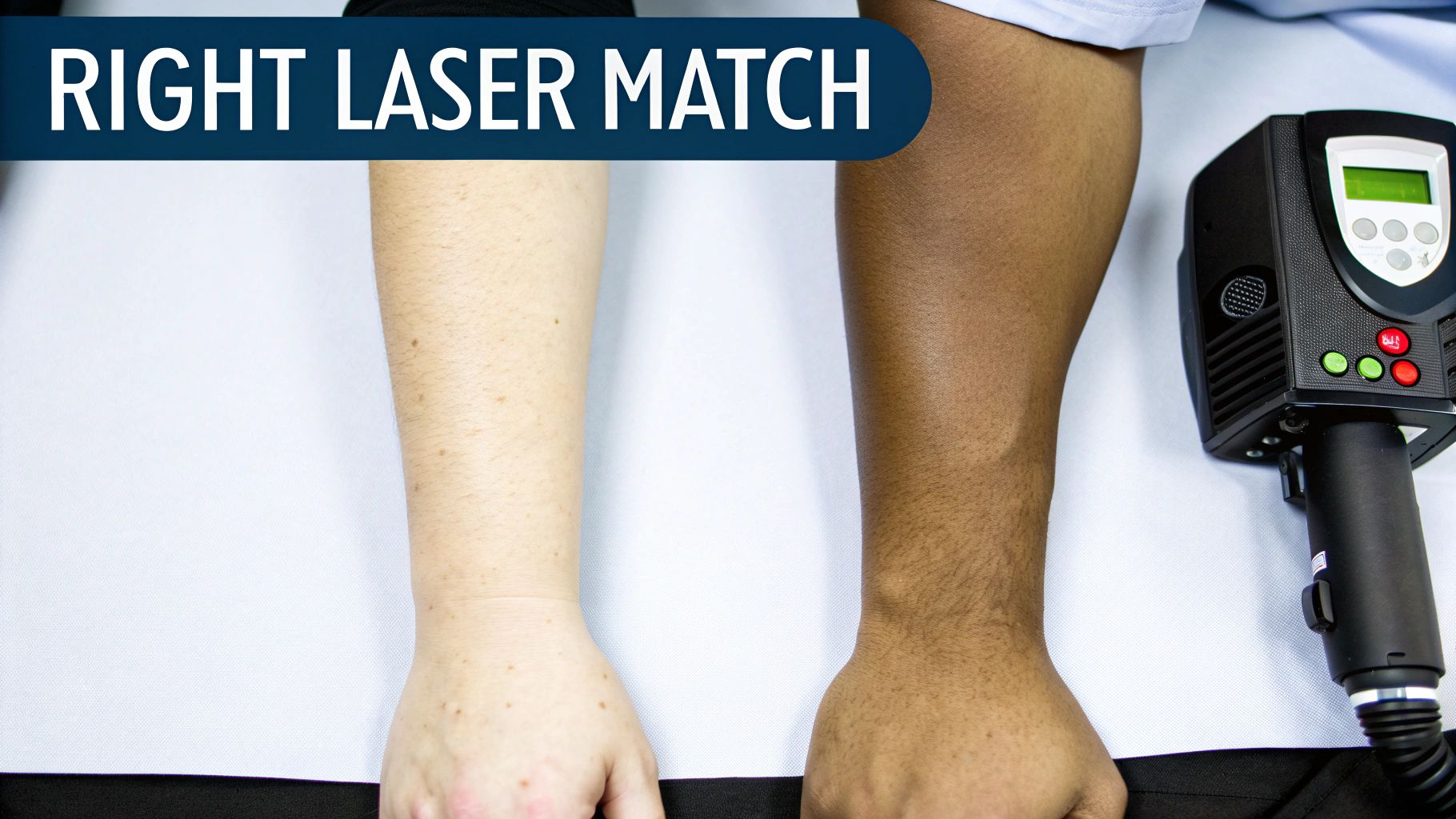
One of the biggest myths about laser hair removal is that it’s only for people with fair skin and dark hair. While that might have been the case with older technologies, modern advancements have completely changed the game. Today, the treatment is safe and effective for a much wider range of clients.
The key is matching the right technology to your unique combination of skin and hair.
It all comes back to how the laser works. The device sends out a beam of light that’s absorbed by melanin, the pigment that gives your hair its color. But your skin has melanin, too. The real challenge for older devices was telling the difference between the pigment in the hair and the pigment in the surrounding skin, especially on darker skin tones. This created a higher risk of burns or discoloration.
Thankfully, we now have a much more sophisticated approach.
Matching Technology to Your Skin Tone
To ensure every treatment is both safe and effective, professionals rely on the Fitzpatrick scale. This system classifies skin types based on how they react to UV light, which helps us determine the perfect laser wavelength for you. Early lasers used a single wavelength that was great for high-contrast individuals (light skin, dark hair) but wasn't a safe bet for everyone else.
Technology has evolved past this one-size-fits-all model. Modern systems can now safely treat a complete spectrum of skin tones by using different wavelengths of light, each suited for different levels of melanin in the skin.
This is exactly why choosing a provider with the right equipment is non-negotiable. It’s the only way to get the results you want without compromising on safety.
The Splendor X Dual-Wavelength Solution
At NYCLASER, we use the Splendor X system because it solves this problem beautifully by blending two of the most effective and trusted laser wavelengths available.
Alexandrite (755nm): This wavelength is the MVP for lighter skin tones (Fitzpatrick I-III). It's highly absorbed by melanin, making it incredibly efficient at zapping dark hair on fair skin.
Nd:YAG (1064nm): This one is the gold standard for darker skin tones (Fitzpatrick IV-VI). Its longer wavelength cleverly bypasses the melanin in the top layer of your skin, penetrating deeper to target the hair follicle directly. This dramatically reduces any risk.
The best part? The Splendor X can fire both wavelengths at the same time, letting us create a customized blend for your exact skin and hair type. This dual approach ensures we’re delivering powerful, effective energy right to the follicle while keeping your skin safe and protected, no matter your tone.
It's a truly personalized method that makes safe, effective hair removal a reality for virtually everyone. This is a huge step forward in understanding how does laser hair removal work for all skin types.
The Splendor X Advantage for Better Results
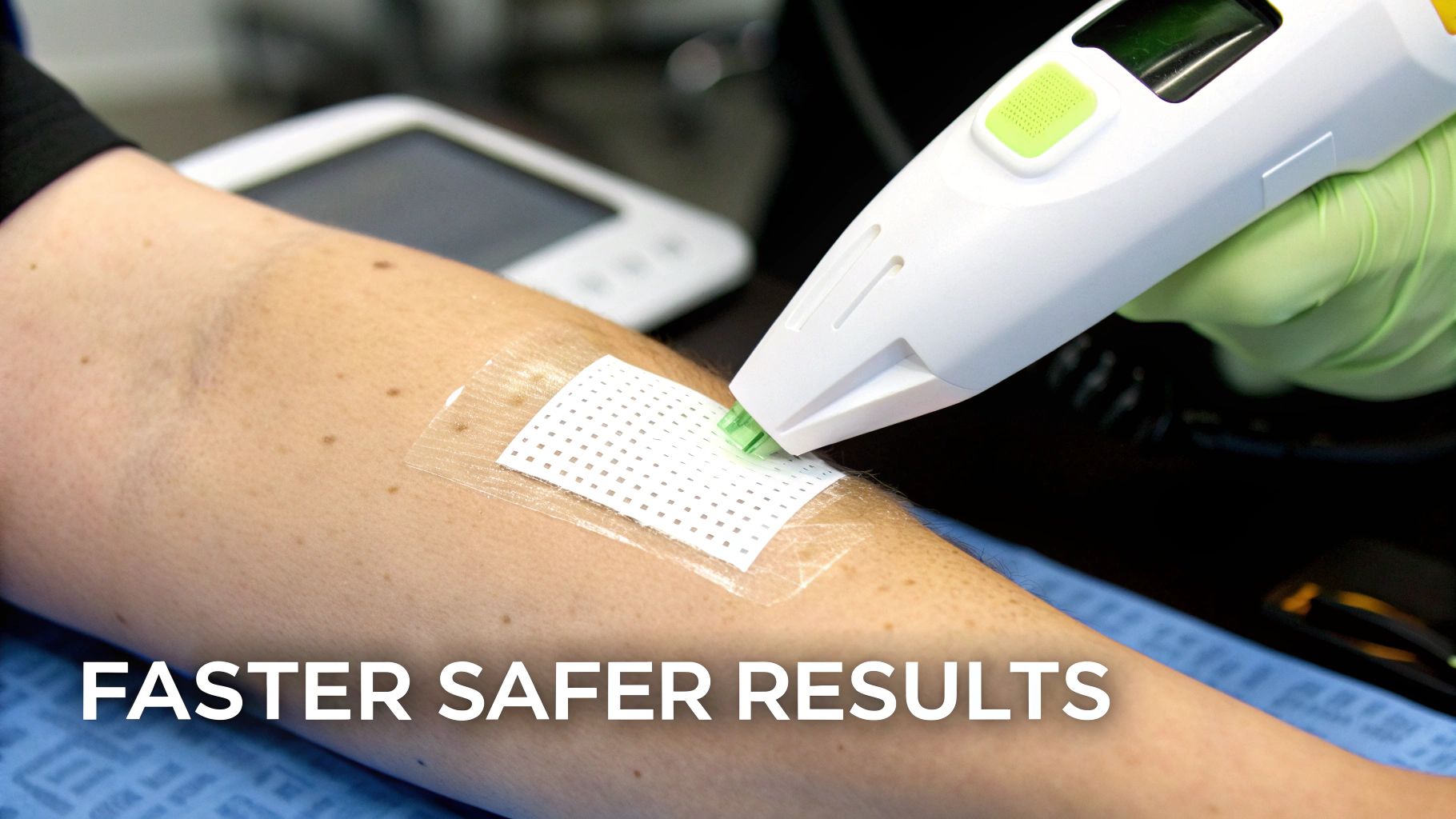
Not all laser technology is created equal. While the core science of targeting melanin stays the same, the quality of the device makes a huge difference in your results, comfort, and the overall experience. At NYCLASER, we use the Splendor X system because it’s a massive leap forward in laser hair removal, and it delivers the superior outcomes our clients expect.
One of its smartest features is its square-shaped laser spot. Older lasers use a round spot, which almost always leads to missed patches or excessive overlapping as technicians try to provide full coverage. Think of it like trying to paint a wall with a round brush—it’s just inefficient and leaves gaps.
The Splendor X’s square spot works more like a roller, ensuring clean, edge-to-edge coverage with every single pulse. This means no missed spots and far more consistent, polished results.
Faster and More Comfortable Sessions
Splendor X doesn't just improve results; it completely changes the treatment experience. Its large spot size lets us cover more skin in less time, dramatically cutting down on your appointment. A full-back treatment, for instance, can be done in a fraction of the time it takes with older, clunkier systems.
On top of that, it has a powerful, integrated cooling system. This isn't just an afterthought; it’s built right into the design to make your session as comfortable as possible.
Dual Cooling System: A constant stream of chilled air is aimed at your skin’s surface at the exact same moment as the laser pulse.
Enhanced Comfort: This continuous cooling action minimizes that "hot snap" sensation, making treatments much easier to handle.
Increased Safety: By keeping the skin's surface cool, it adds an extra layer of protection, allowing for a safer and more effective treatment.
This combination of speed and comfort means you get better results with less time in the treatment chair and a much more pleasant experience from start to finish.
The demand for better technology like this is skyrocketing. The laser hair removal market was valued at $1.02 billion in 2023 and is projected to hit $7.7 billion by 2035. This growth is fueled by systems like Splendor X, which are making treatments more effective and accessible for everyone.
By investing in this specific technology, we make sure every client at NYCLASER benefits from quicker, safer, and more thorough treatments. You can learn more about the specific benefits of the Splendor X system we use and see exactly why we believe it’s the best choice for achieving perfectly smooth skin.
Answering Your Top Questions About Laser Hair Removal
Even after you understand the science, it's totally normal to have a few lingering questions about the actual experience. What does it feel like? When can you start? What happens if you miss a session?
We get it. Here are the straight-up answers to the most common questions we hear from our clients, so you can walk into your first appointment feeling completely prepared and confident.
Does Laser Hair Removal Hurt?
Most of our clients say the sensation is like a tiny, quick snap of a rubber band against the skin. It’s over in an instant.
Plus, at NYCLASER, we use the Splendor X system, which has a game-changing feature: a built-in cooling tip that blasts cold air onto your skin right as the laser pulses. This makes a huge difference in comfort and keeps the entire experience very tolerable.
Can I Get Laser Hair Removal On Tanned Skin?
This is a big one: you'll need to avoid sun exposure, tanning beds, and even self-tanners for at least two weeks before your treatment. Tanned skin contains more pigment, which can confuse the laser, drawing energy away from the hair follicle and increasing the risk of side effects.
For the best—and safest—results, we only treat untanned skin.
Think of it this way: for the laser to work its magic, it needs a clear contrast between the pigment in your hair and the pigment in your skin. Untanned skin provides the perfect canvas for the laser to do its job effectively.
What Happens If I Miss A Scheduled Session?
Consistency really is key here. We time your sessions specifically to catch the hair in its active growth phase. If you miss an appointment, don't panic—you won't lose all your progress.
However, it can throw off the treatment cycle, and you might need an extra session down the line to get back on track. Just give us a call to reschedule as soon as you can, and your technician will help you figure out the best timing for your next visit.
Is Laser Hair Removal Truly Permanent?
The industry standard term is permanent hair reduction, and that's the most honest way to describe it. After you complete your full series of treatments, you can realistically expect a 70-90% reduction in hair.
A few fine or light hairs might eventually pop up again over time, which is completely normal. That’s why most of our clients come in for a quick maintenance session once a year or so to keep their skin perfectly smooth.
Ready to start your journey to smoother, carefree skin? The expert team at NYCLASER is here to create a personalized plan just for you. Book your consultation today and discover the difference advanced technology and professional care can make.
Comments