
Laser Skin Tightening Legs Compared by Goal
The most popular advice for loose leg skin is also the most misleading, book a laser and expect it to lift. Energy treatments don't remove skin, and they don't work the same way for dimpling, fat, veins, and thin, lined skin. If you sort the problem first, laser skin tightening for legs becomes a narrower, more honest choice, useful for some concerns and the wrong tool for others.
What Tightening Can Change on Legs
A laser is often booked to lift loose thigh or knee skin, yet most noninvasive work changes firmness and surface texture rather than removing extra skin. A fair result is milder laxity, less crepiness, or skin that feels smoother to the hand. It isn't a surgical thigh lift, and it shouldn't be sold as one.
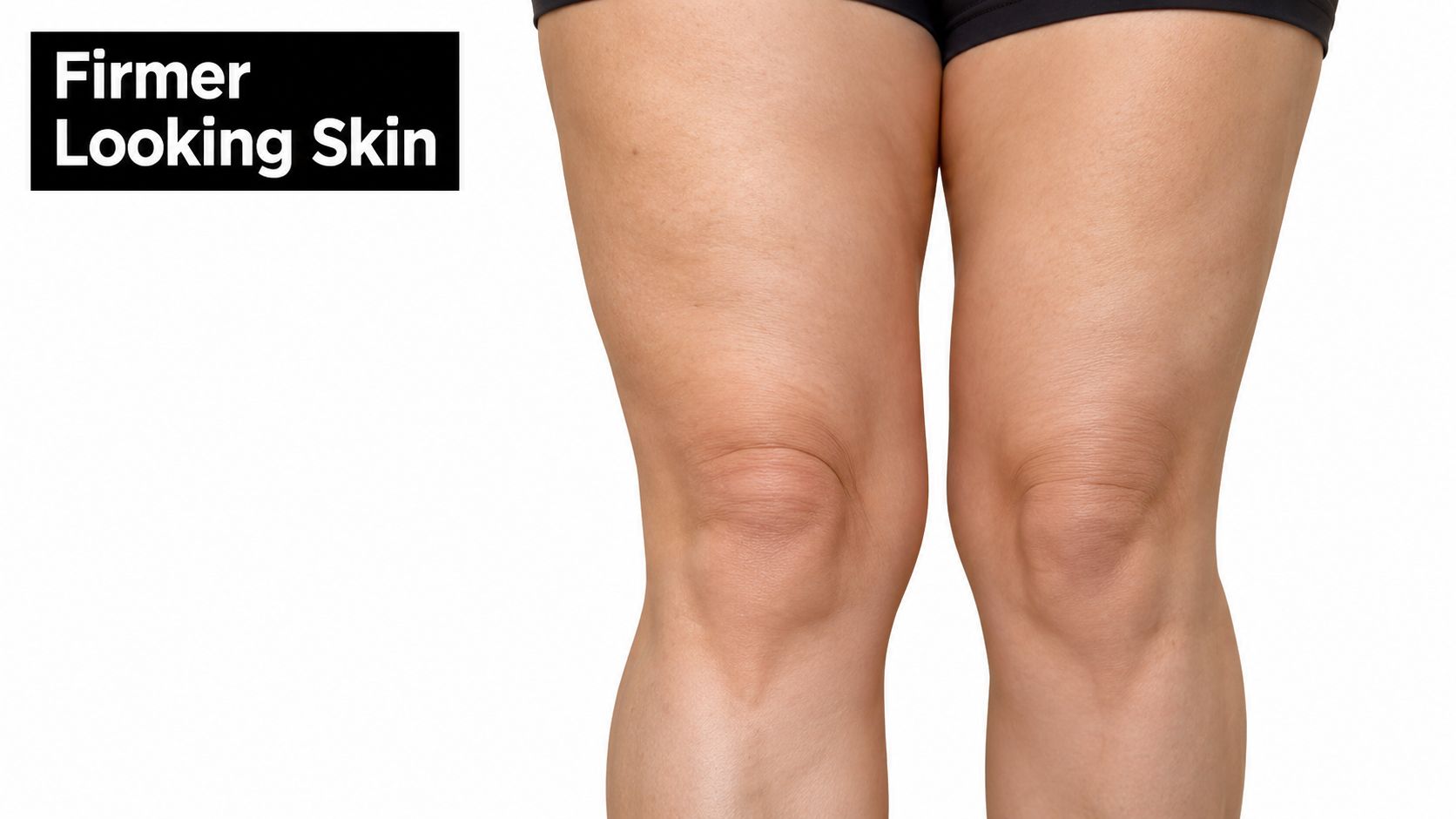
Four Look-Alike Problems
Readers often use one word, loose, for four different findings. Separating them changes the treatment plan.
Laxity: Skin folds when the leg is relaxed. You'll see inner thigh drape or a crease above the knee when you stand.
Crepey texture: Thin, finely lined skin with little pinchable excess. The surface looks crinkled more than it hangs.
Cellulite: Dimpling where tissue is tethered over fat. The skin can feel firm while the surface looks uneven.
Localized fat: Circumference changes even when skin feels firm. A tape measure moves, but the skin itself may not be loose.
Visible veins and ankle swelling are different again. They're vascular or fluid problems, not reasons to heat skin.
The American Society for Laser Medicine and Surgery page on skin tightening lists sagging or thinning skin on the thighs and knees as potential treatment areas, describes typical treatments as short with minimal pain and little or no downtime, and stresses that results depend on the technology and patient factors. A systematic review of microfocused ultrasound found apparent benefit but said larger, better standardized studies are still needed to confirm results and reduce bias.
If you can't name whether the issue hangs, creases, dimples, or bulges, you're not ready to choose a device.
That caution applies across technologies. A guide to radiofrequency skin tightening and fat reduction is useful background because radiofrequency, not laser light, accounts for much of the published leg work. If your main goal is surface smoothness alone, compare that goal with other approaches to getting smoother skin on your legs before you assume tightening is the answer.
Before you book, name the zone, above the knee, inner thigh, outer thigh, or lower leg. Then ask whether weight stability, age, skin type, and prior surgery affect candidacy. Most published leg groups are women with mild laxity, so dramatic marketing photos aren't the baseline you should expect.
Energy Options for Leg Skin at a Glance
Start with the complaint, then pick the row. The table below keeps device type, target, and recovery in one place so you don't compare a texture laser with surgery as if they're versions of the same treatment.
Option | Main target | Best leg concern | Typical sessions | Downtime |
|---|---|---|---|---|
Nonablative laser such as 1064 nm or 1550 nm fractional | Mid dermis and collagen | Crepey texture and mild laxity | 3 to 6 | Little to none; brief redness |
Ablative fractional laser | Surface plus dermis | Texture, lines, some scars; weak for hanging skin | 1 to 3 | Several days to about 2 weeks |
Radiofrequency, monopolar, bipolar, or multisource | Bulk dermal heating, sometimes fat | Mild laxity with some contour change | Often 4 to 8, or a short dense series | Hours of warmth or redness |
Radiofrequency microneedling | Dermis through needle channels | Crepey knees and thin inner thigh skin | Usually 3 to 4 | About 1 to 3 days of redness and swelling |
Microfocused ultrasound | Deeper focal coagulation points | Focal laxity, including above the knee | Often 1 to 2 | Soreness or swelling for a few days |
Thigh lift or tumescent liposuction | Skin excision, or fat removal | Hanging skin, or fat without much laxity | 1 procedure | About 1 to 6 weeks depending on procedure |
How the Energies Differ
Nonablative lasers and fractional devices heat or injure the superficial to mid dermis to push collagen remodeling. They're aimed mainly at crepey texture. Ablative fractional work goes further by removing surface tissue, so you trade fewer sessions for real surface healing that needs wound care and sun avoidance.
Radiofrequency heats a larger tissue volume. Monopolar, bipolar, and multisource systems form the body of the leg evidence for mild laxity plus contour, which is why they're often discussed alongside lasers even though they aren't lasers at all. For a plain language overview of that category, see the radiofrequency treatment insights from Georgia Plastic.
Radiofrequency microneedling adds mechanical channels through fine needles, then delivers heat into the dermis. Clinics reach for it on crepey knees and thin inner thigh skin where surface quality matters as much as firmness. Microfocused ultrasound places deeper focal points instead, so it suits a defined patch of laxity rather than a whole thigh reduction. If texture is your chief complaint, compare those options with dedicated skin smoothing laser treatments before committing to a body series.
Selection rule: Match the row to what bothers you in the mirror at rest, not to the device a clinic happens to own.
Session ranges in the table are planning ranges, not promises. A nonablative series often runs 3 to 6 visits, radiofrequency body work often runs 4 to 8 or a dense short cluster, and ultrasound often stops at 1 to 2. Downtime follows the depth of injury. Nonablative laser and many radiofrequency visits leave redness for hours, microneedling leaves swelling for a few days, ultrasound can leave tenderness for several days, and a thigh lift takes weeks.
Hair removal lasers don't belong in this table. They target pigment in the follicle, not dermal collagen, so a smooth result from hair reduction shouldn't be confused with tighter skin. Typical tightening treatments involve minimal pain for many patients, which makes the downtime column, not discomfort, the main recovery cost to plan around.
Measured Results Sessions and Durability
The numbers below come from radiofrequency cohorts, because that's where leg measurements exist. Read the scale first, centimeters and single digit percentages, before you read satisfaction scores.
Cohort | Protocol snapshot | Measured change | Reported satisfaction | Limit |
|---|---|---|---|---|
Rotational radiofrequency, 39 adults | 8 sessions, 45 to 50 minutes, every 72 to 96 hours | Up to 4% thigh contour; about 1 cm upper thigh and 2.12 cm lower thigh; fat layer about 6% thinner | 80% satisfied | Circumference is not the same as a surgical lift |
Monopolar radiofrequency plus pressure, 30 adults | Hips, thighs, abdomen, and arms | Mean thigh minus 3.45 cm with spread of 4.50 cm; minus 3.18 cm with spread of 3.57 cm still present at 6 months | 82% better laxity; 86% satisfied with cellulite; 90% improved to blinded reviewers | Radiofrequency result, not a laser platform guarantee |
What Each Cohort Actually Shows
In the prospective study of rotational radiofrequency in 39 adults, eight sessions of 45 to 50 minutes, spaced 72 to 96 hours apart, reduced thigh contour by up to 4%, about 1 cm in the upper thigh and 2.12 cm in the lower thigh, while ultrasound fat layer thickness fell about 6% and 80% of participants reported satisfaction, with no severe adverse events.
Treat that as mild contour plus some firmness. A tape measure change tells you the leg got smaller; it never proves the dermis lifted. Good clinics separate the two by repeating standardized photographs, tape measurements at fixed landmarks, and ultrasound measurements where appropriate.
A separate cohort of 25 adults treated on the abdomen and legs also reported strong satisfaction. A group that small can only signal interest. It cannot predict the change on your legs, which is why it stays out of the table.
This summary visual sets out session burden and durability in one view.
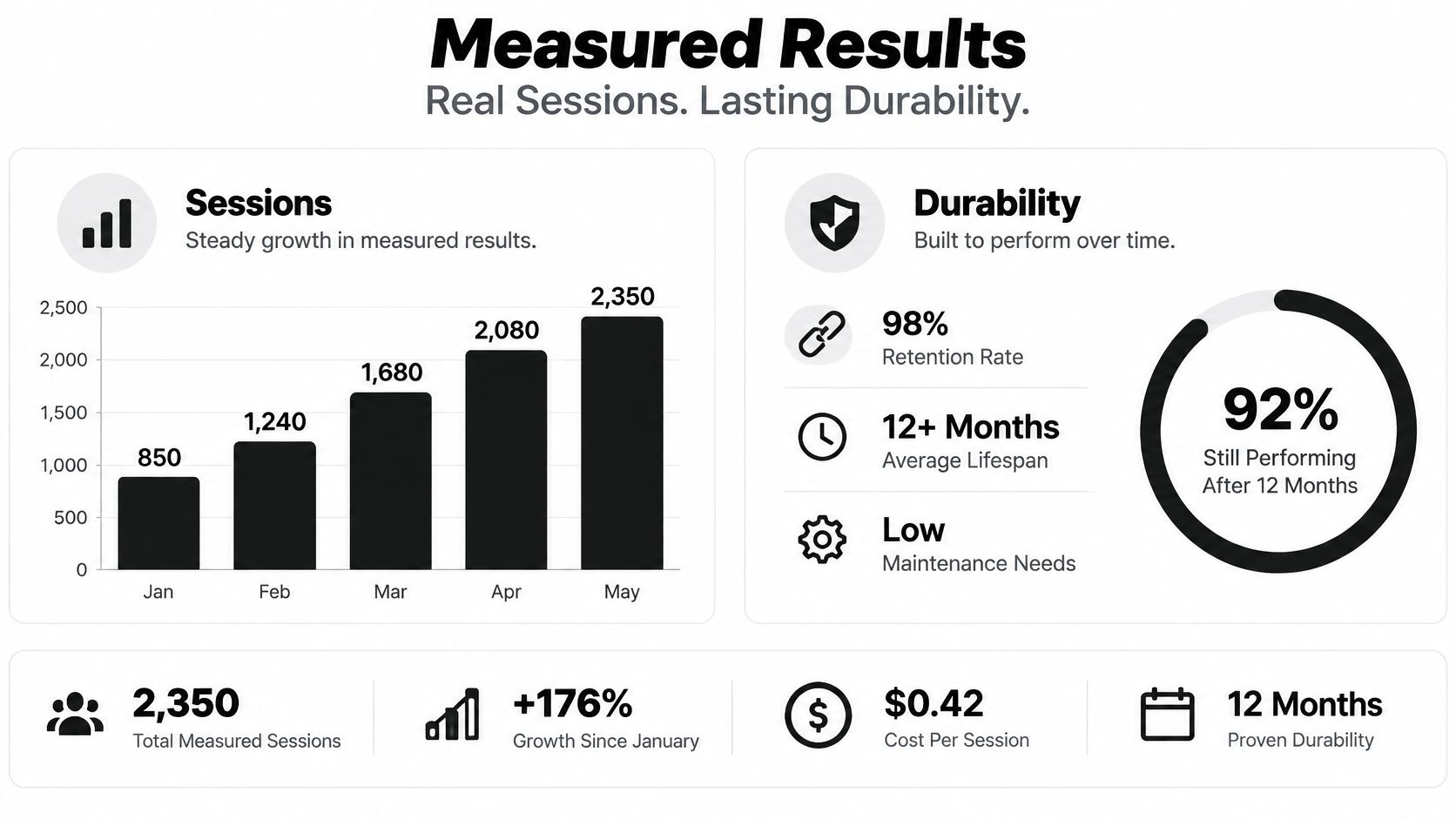
The strongest durability signal comes from the controlled study of monopolar radiofrequency plus targeted pressure in 30 adults, where mean thigh circumference fell 3.45 ± 4.50 cm after the final treatment and 3.18 ± 3.57 cm remained at six months, blinded evaluators judged improvement in 90%, 82% reported better laxity, 86% were satisfied with cellulite improvement, and cellulite improved from moderate to mild in 95%.
That cohort scored laxity, cellulite, and circumference separately, which is exactly how you should think about your own leg. Loose skin, dimpled fat, and a smaller tape reading are three different outcomes, and a series can improve one while barely touching another.
Notice the spread around that mean. Some participants gained far more than the average, others much less, which is exactly why one person's before and after photo can't predict your result. Radiofrequency also heats tissue through a different mechanism than a laser, so wavelength, temperature control, contact technique, skin type, and treatment endpoint all matter when you compare platforms.
This short video gives a visual sense of how an energy session is delivered.
The Evidence Limit You Should Keep
A systematic review of radiofrequency studies for skin laxity reported women comprised 95.17% of the pooled study population, typical ages ranged from 35 to 65 years, 96% of reviewed studies lacked a control group, and 88% had limited methodological quality, leading the authors to conclude the evidence was insufficient.
So expect a subtle change that builds over weeks to a few months as collagen remodels. Six months is the longest clear durability shown in these cohorts, not proof of a permanent lift, and optimal settings still aren't settled.
Risks and Who Should Wait

Start with the mildest reported picture, then widen it. In the clinical study of multisource phase controlled radiofrequency in 25 Japanese patients, participants were aged 27 to 72 years with Fitzpatrick skin types III and V, slight burning and mild erythema resolved within one hour, and no side effects were observed during the study.
That is a reassuring result for one device in one small group. A full thigh treated with a different platform, higher energy, or a recent tan is a different situation, so read that clean safety record as a floor rather than a guarantee.
Reactions a Consultation Must Cover
Heat based treatments can cause blistering or a burn when energy is set too high or the handpiece loses even contact. Pigment can darken or lighten, especially after recent sun, and that change can outlast the first day's redness by weeks. Prolonged redness is more typical after ablative work, while bruising and swelling show up more often after microneedling or ultrasound. Scarring stays uncommon, but the risk climbs when an ablative laser covers a large leg area.
Legs forgive less than a small facial spot for practical reasons. The surface area is larger, clothing rubs the skin for days afterward, and uneven fat pads make it harder to keep device contact and temperature consistent. The handpiece works like a clothing iron: held flat and moving, it heats evenly; tipped onto an edge or paused in place, it scorches one spot. On the inner thigh, where skin curves and thins, keeping that iron flat is the operator's real skill.
A mild one hour reaction in a small study describes that study. Your risk depends on the device, settings, skin type, and recent sun on the day you are treated.
Reasons to Pause or Choose Someone Else
Wait if your weight is still moving, you have an active tan, you are pregnant, you have used isotretinoin in recent months, or there is an open rash or infection in the treatment zone. A history of poor wound healing or keloids should also pause treatment, particularly for ablative laser or microneedling. Our clinic does not recommend laser treatments for pregnant clients, and clients are asked to avoid sun exposure for 2 weeks before laser treatment and to disclose medications such as Accutane, Retin-A, or Gold Therapy used now or within the past 6 months.
Medium and deeper skin tones are not automatic exclusions, since the multisource cohort included types III and V. They do call for test spots and conservative settings, because pigment change is the complication most likely to outlast redness.
The good candidate pattern is easy to check yourself. Your weight is stable, the laxity or crepe is mild to moderate, and your goal matches a centimeter scale or texture change rather than removed skin. Energy tightening firms the envelope; it does not excise tissue, close varicose veins, or drain fat. Those are different problems with different specialists, and mixing them up is how people end up paying for a third session of the wrong treatment.
Bring three things to a consult: the exact zone that bothers you, photos taken at rest in flat light, and a one sentence goal. That gives the clinician something measurable to agree or disagree with, instead of a vague wish for tighter legs.
When Surgery Beats Another Energy Series
Use pinch and hang, not brand names, to draw this line. Pinch the inner thigh while standing. If skin stays folded on its own, the fold reaches toward the knee, or weight loss left a deflated apron of skin, another energy series won't remove that tissue.
What a Thigh Lift Does Differently
A medial thigh lift excises excess skin and repositions what remains. That's a mechanical fix for a mechanical problem, too much skin for the leg underneath it. It leaves a scar in the groin crease and sometimes down the inner thigh, and it requires activity limits for several weeks while incisions heal.
The trade is visibility. Surgery is the option when the goal is a clear change in drape that you can see in shorts or a fitted trouser. Measured noninvasive changes on the thigh run in the range of a few centimeters or a few percent of contour, which will disappoint anyone expecting folds of skin to disappear.
Recovery is the price of that change. Energy visits fit around a workweek with redness or a few days of swelling. A lift can mean compression garments, incision care, drains in some techniques, time away from exercise, and months of scar care. Neither choice is wrong in itself, but they're not interchangeable.
Where Liposuction Fits and Where It Doesn't
Tumescent liposuction, sometimes with energy added by the surgeon, removes fat volume. In a younger patient with good elasticity, skin can retract a little once the volume drops, so it works when pinchable fat is the main complaint.
It's the wrong primary tool when the thigh feels empty. If you pinch mostly thin skin with little fat between your fingers, removing more volume can make laxity look worse, not better. Say your outer thigh has a firm fat pad and smooth skin, that's a contour conversation. Say the inner thigh is soft, thin, and folded with almost nothing to pinch, that's a skin conversation. For surface work after a surgical plan is settled, some patients also review options such as CO2 laser treatment on Long Island for texture rather than lift.
Combined paths work only in sequence. If fat dominates, a surgeon may address fat first, then reassess skin once healing settles. If hang dominates, the lift comes first and energy later has a limited role for texture. Stacking procedures without that order usually means paying for the smaller effect while the larger problem stays.
Referral rule: Hanging skin goes to a board certified plastic surgeon, pinchable fat goes to that same surgical consult, and bulging veins go to a vein specialist.
Ask for that referral directly if a clinic keeps offering another package. A practice willing to send you elsewhere is telling you something useful about how it reads your legs.
Match Your Leg Concern and Book Wisely
Name one dominant problem before you price anything. Most legs show a mix, but one finding drives the result you'll judge in the mirror, and that finding should drive the booking. Use the scenarios below to pick one path, one reason, and one way to measure success.
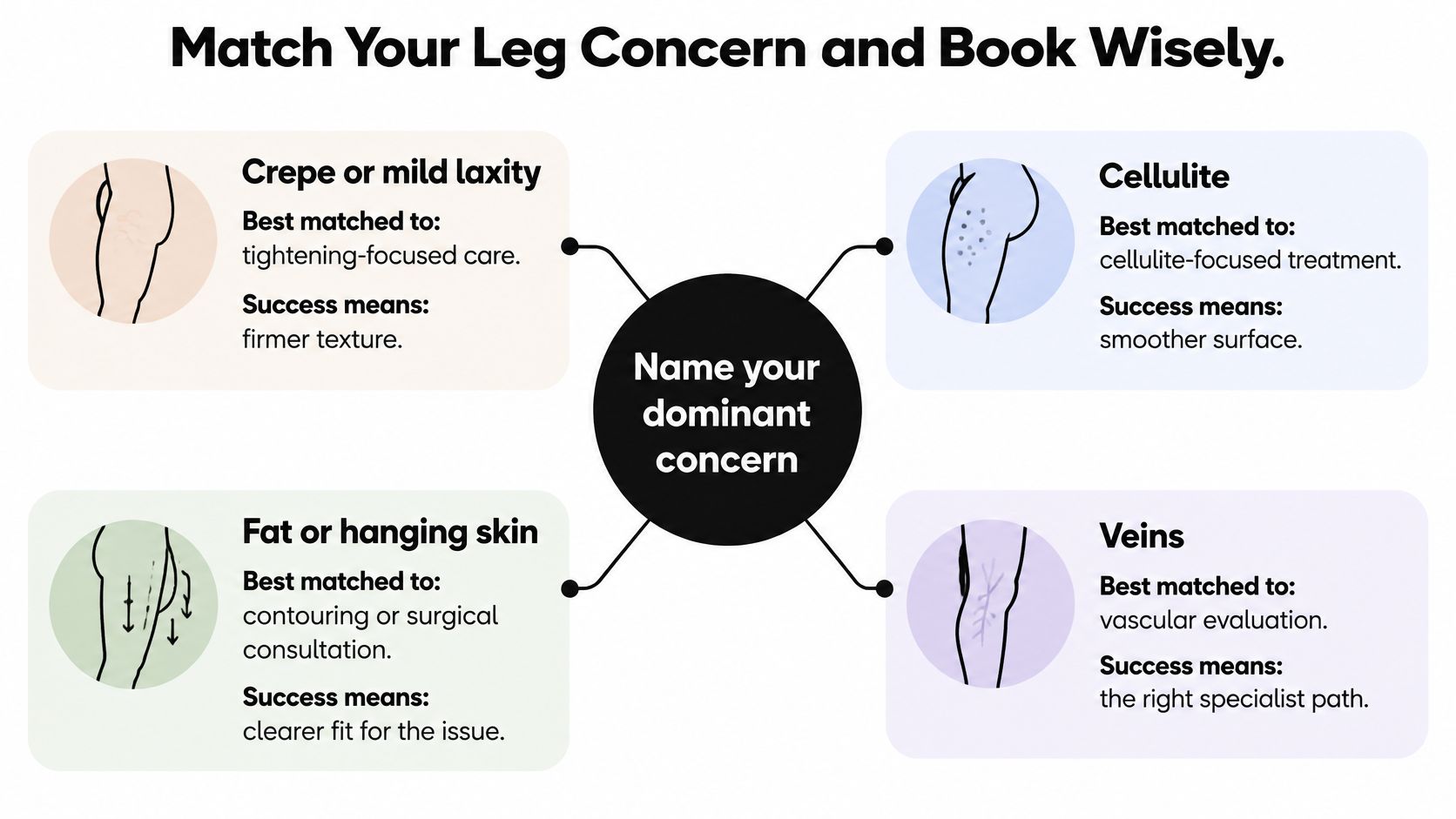
Five Matches That Cover Most Legs
1. Above knee crepe with little hanging skin. A nonablative fractional laser or radiofrequency microneedling series fits because the target is thin, lined dermis, not excess skin. Judge it by smoother, less lined texture in matched photos taken in the same light, and protect the area from sun between visits so pigment doesn't become the story.
2. Inner thigh drape with mild laxity and softness. A radiofrequency body series fits because you want modest firming across a broad area. Judge it by tape measurements at the same landmarks each visit, marked with a pen before the first session. Don't accept a promise that folds will disappear, because firming soft tissue and removing a fold are different outcomes.
3. Outer thigh dimpling that bothers you more than looseness. Monopolar radiofrequency plus targeted pressure fits because it's been assessed with cellulite grading, not just circumference. Judge it by a cellulite grade recorded at baseline and checked again months later. If a clinic only offers a tape measure for a dimpling complaint, it isn't measuring your problem.
4. Hanging skin or deflation after major weight loss. Book a surgical consult, because the issue is skin quantity. Energy can be discussed later as a texture add on once the skin decision is made. Judge the consult by whether the surgeon shows you scar placement and talks through what won't change, not only what will.
5. Visible veins or prominent veins under thin skin. Get a vein assessment before any heat device, because heating skin doesn't treat the vessel underneath it. Judge that visit by whether you're told the veins are cosmetic, symptomatic, or worth monitoring. Hair only goals sit outside all five matches, they belong to hair reduction, where hair needs to be at skin level for the laser to reach the follicle, so don't let a hair package be reframed as tightening.
Five Questions Before You Pay
Ask these in order and write down the answers.
Which device and energy type: Laser, radiofrequency, microneedling, or ultrasound, named specifically rather than described as the latest technology.
How many sessions and how far apart: A range with spacing, so you can judge the actual time cost against your calendar.
Which measurements repeat: Photos, tape landmarks, cellulite grade, or ultrasound, and who takes them each time.
What downtime applies to that exact device: Hours of redness, days of swelling, or open surface healing, stated for legs rather than for a small facial area.
What happens if three month photos are unchanged: A review, a setting change, a partial refund policy, or an honest stop, agreed before money changes hands.
Also ask whether pricing is per session or by package. A package only helps you if you'd still buy the later sessions after seeing early results.
Keep your weight stable within a few pounds during a series, or you'll never know whether the device or the scale changed the tape measurement.
Two habits protect your result more than any add on. Don't stack three modalities in the same month, because you won't know which one helped or which one irritated your skin. And take your own baseline photos at rest, feet hip width apart, in flat daylight, so you're not relying only on clinic lighting.
Finish with one action, not a shortlist. Book the surgical consult, book the named energy series with measurements agreed, or choose no treatment yet because the concern is veins, fat, or unstable weight. Any of those three is a better outcome than a package bought for the wrong problem, and it's the decision laser skin tightening for legs should lead to when it's explained clearly.
If you're sorting leg skin concerns on Long Island and your real goal turns out to be smoother, hair free legs rather than tighter skin, NYC Laser Hair Removal in Westbury uses Splendor X technology for long lasting hair reduction with typically no downtime. Book a consultation where we assess your skin type and hair color to build a personalized plan, or call 516-321-4959 to talk through full leg options before you commit. Visit NYC Laser Hair Removal to see treatment areas, package options, and current booking times.
Comments