
Razor Bumps Laser Hair Removal Explained
You shave in the morning, feel the familiar sting by afternoon, and wake up the next day with a line of tender bumps along your neck or jaw. Some develop whiteheads, others leave dark marks, and nearly all make the next shave more uncomfortable. If this cycle keeps repeating, the problem isn't just that your skin is “sensitive.” The hair itself is helping create the injury.
Razor bumps laser hair removal works by reducing the coarse hair shaft that curls, re-enters the skin, and triggers inflammation. It isn't an instant cure, and it doesn't make every follicle disappear permanently, but it can change the mechanical conditions that keep pseudofolliculitis barbae active.
Breaking the Cycle of Chronic Razor Bumps
A typical client arrives after trying everything that seems reasonable. They've changed razors, shaved with the grain, applied exfoliating acids, and stopped picking at the bumps. For a few days, the skin may look calmer. Then the beard or body hair grows back, the sharp ends press against the follicular opening, and the same painful pattern returns.
That pattern continues because shaving treats the visible hair without changing its ability to curve back toward the skin. A tightly curled or coarse hair can leave the follicle at an angle, bend as it grows, and penetrate nearby skin. The body reacts to that hair as an intruder, creating the raised, inflamed papule commonly called a razor bump.
Laser takes a different approach. Its energy is absorbed by pigment in the hair and converted into heat around the follicle. With repeated, correctly timed treatments, the follicle produces less hair, and the regrowth often becomes finer and less rigid. A finer shaft has less physical strength and less diameter available to pierce the follicular wall or re-enter the surrounding skin.
Practical rule: For chronic razor bumps, reducing the trigger is more useful than repeatedly calming the reaction.
The distinction matters. A soothing gel may reduce discomfort around an existing bump, while an exfoliant may help release some surface debris. Neither one reliably changes the behavior of every coarse hair beneath the skin. Laser hair removal is valuable because it targets the source of the re-entry cycle rather than only its aftermath. The clinical review of laser and light-based hair removal describes long-term hair reduction across different devices, with results varying by wavelength and treatment conditions, as documented in this systematic review of long-term outcomes.
Laser isn't a luxury for someone whose daily grooming causes persistent inflammation. It can be a practical treatment strategy, particularly when shaving is unavoidable for work, comfort, or personal preference. The most useful starting point is a consultation that evaluates skin tone, hair color, hair texture, active inflammation, and the device being used. A focused explanation of laser treatment for ingrown hairs can also help clarify why follicle reduction is different from surface care.
The Root Cause of Pseudofolliculitis Barbae
Pseudofolliculitis barbae, or PFB, begins with hair re-entry. It most often affects the beard and neck, but the same mechanical problem can occur anywhere repeated hair removal leaves a curved or sharpened shaft near the skin surface.
Two routes are important:
Extrafollicular penetration: A shaved hair exits the follicle, curves back, and pierces nearby skin from the outside.
Transfollicular penetration: A growing hair pierces the follicle wall before it fully exits, creating inflammation within the follicular structure.
Coarse, tightly curled hair is especially prone to both patterns because its natural curve gives it a trajectory back toward the skin. Shaving adds another problem by leaving a sharp, angled tip. When that tip presses into tissue, the immune system treats the hair as a foreign object. The result may be a firm papule, a pustule, tenderness, redness, or discoloration after the inflammation settles.
Why surface care has a ceiling
Salicylic acid, glycolic acid, moisturizers, and shaving adjustments can improve the skin environment. They may loosen surface buildup, reduce friction, or make existing irritation feel less severe. They don't remove the physical tendency of a coarse hair to curl and re-enter the skin.
Waxing and tweezing can create a different version of the same problem. A hair pulled from the root may break or regrow beneath the surface without a clear outward path. Depilatory creams dissolve hair chemically, but they can irritate an already compromised skin barrier and don't offer a follicle-reduction strategy.
Laser succeeds where these methods reach their limit because it acts below the surface. The goal isn't to scrub the hair out after it has caused trauma. The goal is to reduce the amount and rigidity of hair capable of causing that trauma.
What the clinical evidence means in practice
A clinical review of PFB reports greater than 50% improvement in long-standing cases after laser hair removal, and identifies Nd:YAG treatment as a safe and effective option for reducing hair and subsequent papule formation, as described in the clinical review of PFB management. That doesn't mean every bump disappears after one appointment. It means the treatment has a mechanism that matches the disease mechanism.
The practical expectation is progressive control. Existing inflammation still needs sensible care, and follicles respond according to their growth cycle. But as fewer coarse hairs emerge, fewer hairs are available to bend, pierce, and restart the inflammatory response.
Clinical Timelines and Expected Session Counts
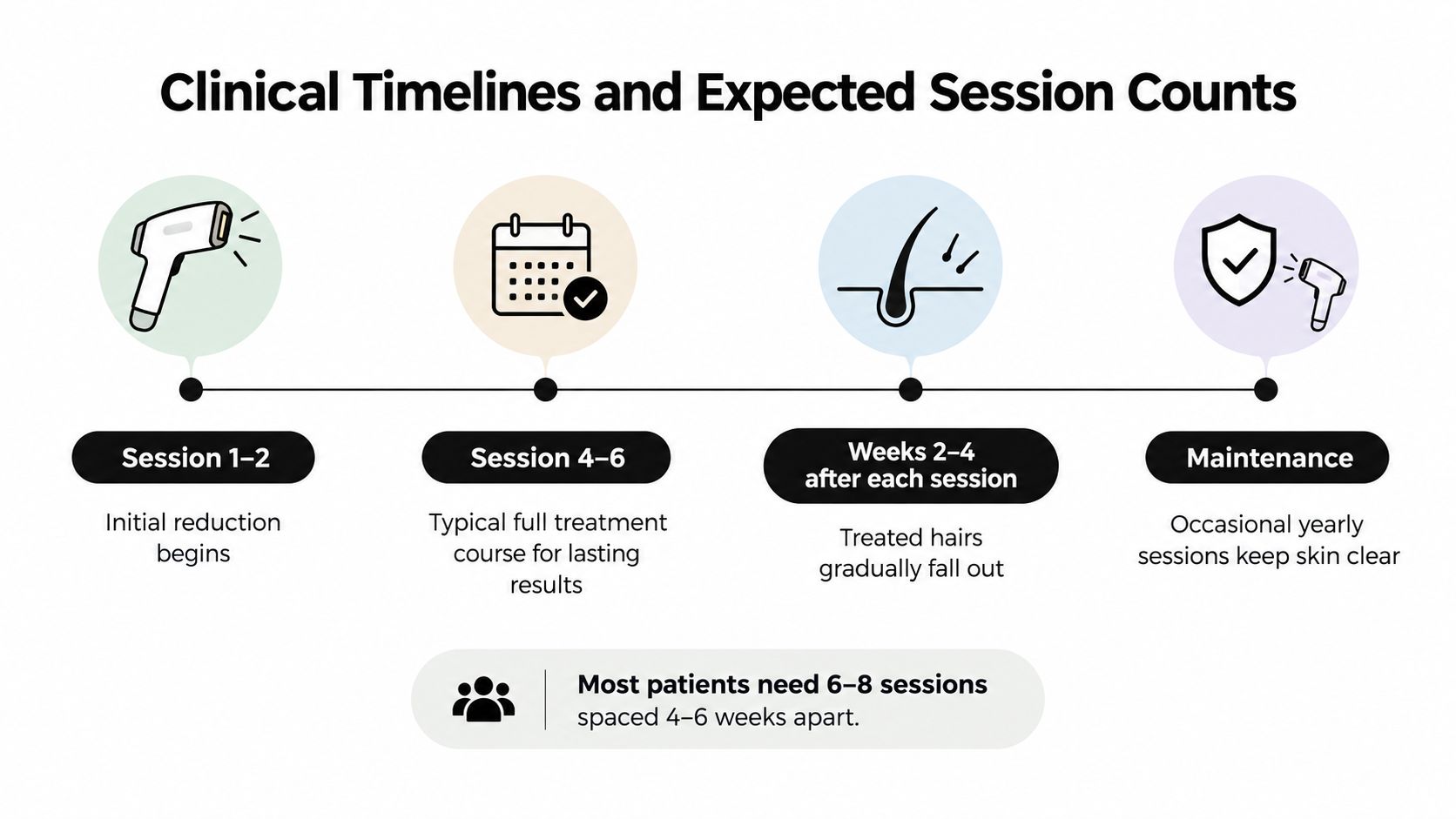
Laser hair removal works best when the treatment schedule follows hair biology rather than impatience. Hair follicles move through active growth, transition, and resting phases. Laser is most effective when the hair contains enough pigment and is connected to an actively responsive follicle, so one appointment can't treat every hair equally.
That's why a series is necessary. Some clients notice less aggressive regrowth early in the course, but visible improvement in razor bumps usually depends on treating enough of the active follicles to reduce the overall supply of re-entering hairs.
How to judge progress
Use the condition of your skin, not just the number of hairs visible on a particular day, to assess progress. Useful signs include:
Less frequent flare-ups: New papules appear less often after shaving or trimming.
Softer regrowth: Hair that returns feels less coarse and is less likely to create a sharp, rigid point.
Reduced density: Fewer hairs emerge in the treated area.
Calmer recovery: The skin settles more quickly after grooming.
Clinical evidence gives a range rather than a universal promise. A systematic review reported long-term hair-reduction outcomes ranging from 30% to 84.25%, depending on the device and protocol. The reported ranges were 30% to 73.61% for Nd:YAG, 35% to 84.25% for alexandrite, and 32.5% to 69.2% for diode lasers, as detailed in the review of long-term laser hair-removal outcomes. These figures describe hair reduction, not a guaranteed percentage decrease in bumps for every individual.
Why stopping early can mislead you
A partial course may reduce some hairs while leaving enough untreated or newly active follicles to continue the cycle. That can make the treatment seem inconsistent when the issue is incomplete coverage of the growth pattern.
Older evidence syntheses estimated roughly 50% partial hair reduction after three to five sessions, while the strongest long-term axillary outcomes reached 84% to 85% hair reduction 12 months after four treatments, according to the same systematic review. Those are historical evidence estimates, not a schedule that should be copied without considering the body area, hair characteristics, device, and skin response.
A provider should set intervals based on the area and observed regrowth. Treating too close together can miss the intended growth phase, while waiting too long can allow the original shaving pattern to regain momentum. Maintenance is also normal. Laser creates long-term reduction, not a promise that every treated follicle will remain inactive forever.
Choosing the Right Laser Technology for Your Skin
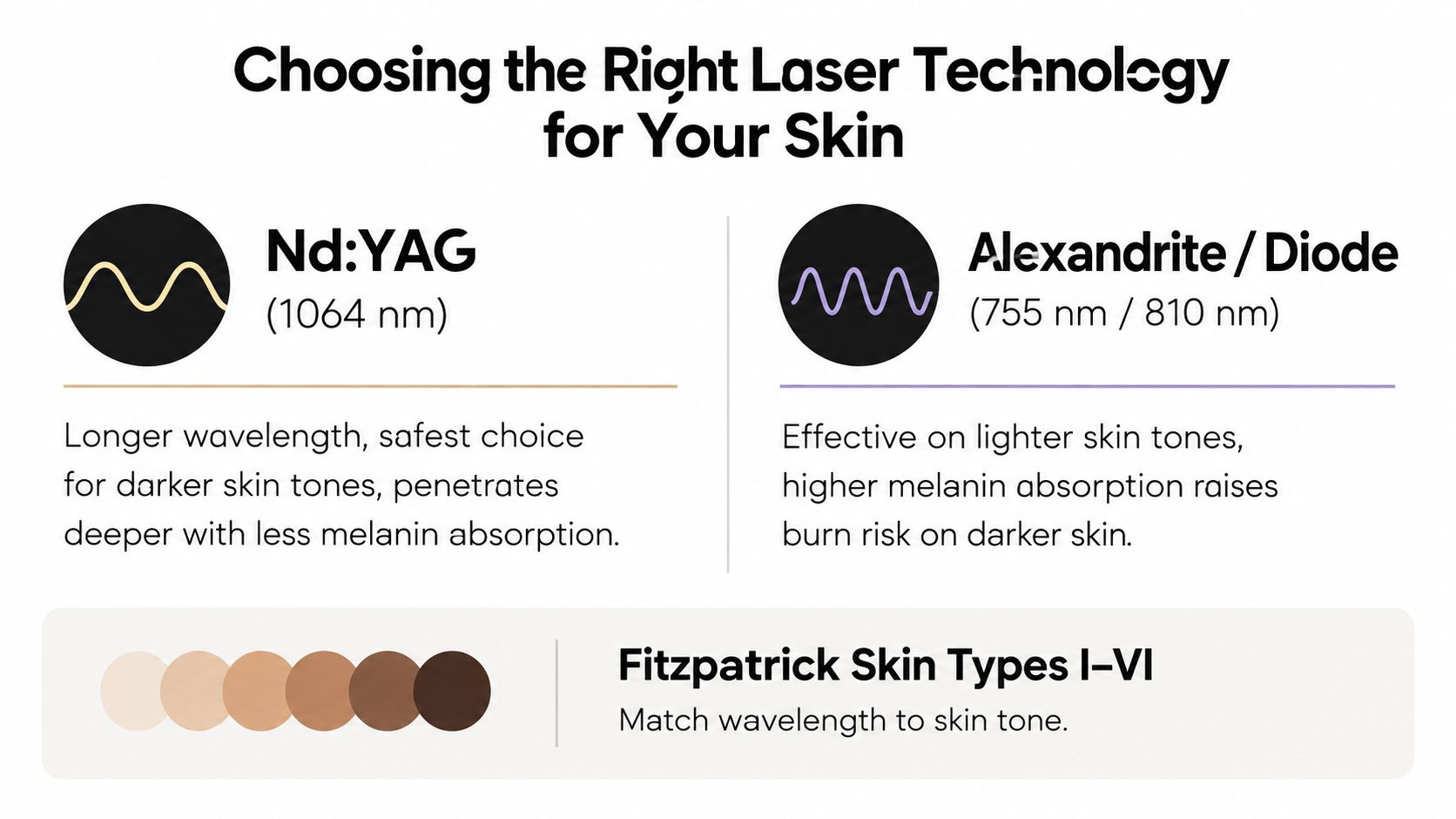
The wavelength matters because laser energy must reach the follicle while limiting unnecessary absorption in the surrounding skin. That balance becomes especially important for darker skin tones, where epidermal melanin can compete with hair pigment for the laser's energy.
Nd:YAG, alexandrite, diode, and IPL
For Fitzpatrick skin types IV to VI, 1064 nm Nd:YAG has a particularly important clinical role. Its longer wavelength penetrates to greater depths and is less strongly absorbed by epidermal melanin than shorter wavelengths, which can provide a wider safety margin when the provider uses appropriate settings and cooling.
Alexandrite and diode systems can be effective in suitable candidates, especially when the contrast between hair and skin allows the device to target the follicle selectively. They require careful assessment for clients with more melanin because excessive epidermal absorption can increase the risk of burns or post-inflammatory color changes. IPL isn't a laser, and its broad spectrum creates a different treatment profile. In one comparative PFB study, long-pulse Alexandrite produced about 80% improvement in papules after seven sessions, while IPL required 10 to 12 sessions for roughly 50% improvement, with minimal recurrence over one year on the Alexandrite-treated side, as reported in this comparative PFB study.
Where Splendor X fits
Splendor X is a platform designed to use blended wavelengths, including Alexandrite and Nd:YAG, with a square spot profile intended to distribute energy consistently across the treatment area. The advantage isn't that one machine eliminates the need for judgment. The advantage is flexibility when a provider must match energy delivery to skin tone, hair thickness, body area, and treatment response.
A competent consultation should include questions about recent tanning, medications, pigment changes, active lesions, and prior reactions. The technician should explain which wavelength will be used and why. For darker skin, the clinical benchmark is especially relevant: in a military cohort of patients with Fitzpatrick types IV to VI treated with 1064 nm Nd:YAG, 70% reported at least a 75% reduction in PFB lesions immediately after treatment, and 96% were able to resume shaving. The same cohort found 84% eventually experienced recurrence, with 56% of recurrences appearing within six months, according to the ClinicalTrials.gov study record.
That combination of strong initial suppression and possible recurrence is exactly why technology selection and maintenance planning belong in the same conversation. A device can be appropriate, yet poor settings, inadequate cooling, rushed assessment, or unrealistic expectations can still produce a disappointing experience. For an additional explanation of device selection, see this guide to laser hair-removal technology.
Essential Aftercare and Between-Session Grooming
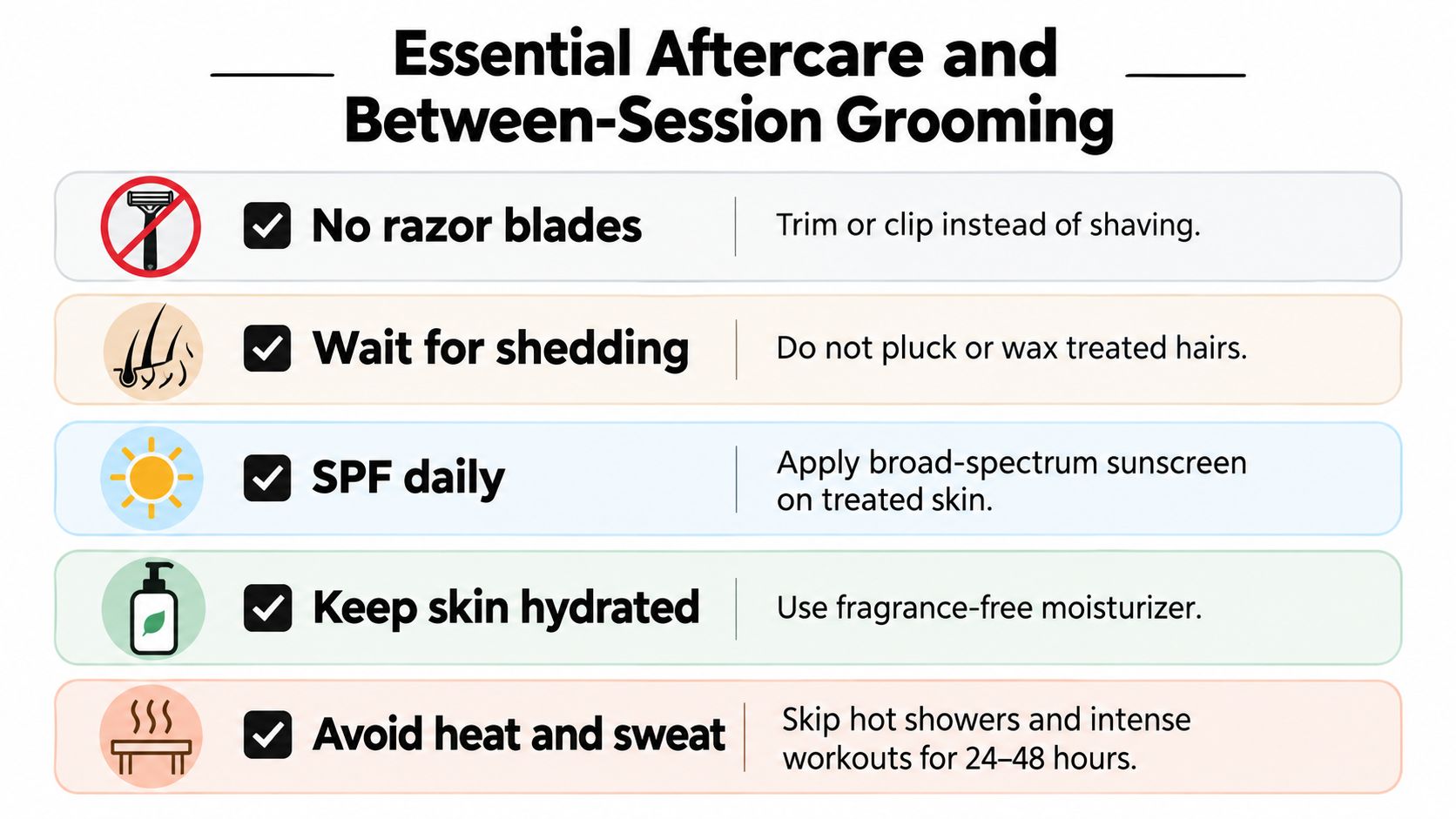
The days after treatment are when many clients accidentally restart the irritation they're trying to escape. The treated hairs need time to shed, and the skin may be temporarily more reactive around the follicles. Aggressive grooming can turn a manageable recovery into another flare-up.
Immediately after treatment
Follow the provider's specific instructions first, particularly if your skin develops pronounced redness, swelling, blistering, or crusting. For ordinary short-term sensitivity, keep the area clean, avoid unnecessary friction, and use a fragrance-free moisturizer if recommended.
Avoid hot showers, saunas, and intense workouts for 24 to 48 hours when your provider gives that instruction. Heat and sweat can aggravate freshly treated skin, especially on the neck, bikini line, underarms, or other areas covered by tight clothing.
While hairs are shedding
Don't pluck or wax treated hairs. Those methods remove the structure the laser targeted and can interfere with the follicle's natural shedding process. Let the hairs loosen and fall away on their own instead of trying to force them out with tweezers, scrubs, or fingernails.
If you need to control visible length, ask whether careful electric trimming is appropriate. A clipper that doesn't drag a sharp blade across the skin is often a more sensible interim option than close shaving, but the correct choice depends on the body site and your skin's response.
Protecting the skin barrier
Use gentle, non-comedogenic products and avoid adding strong acids, abrasive scrubs, or fragranced products immediately after treatment unless your provider has specifically approved them. Daily broad-spectrum sunscreen matters on exposed areas because inflammation and ultraviolet exposure can make uneven pigmentation more noticeable.
Between-session advice: The safest grooming method is the one that controls length without scraping or traumatizing the treated skin.
If bumps become increasingly painful, spread, drain, or show signs of infection, contact a qualified medical professional rather than trying to exfoliate harder. A practical guide to preventing ingrown hairs can supplement, but shouldn't replace, individualized aftercare instructions.
Comparing Laser to Topical and Manual Alternatives
Topical products have a legitimate place in razor-bump care, but they solve a different problem. Salicylic acid can help loosen surface material, glycolic acid can support exfoliation, and a bland moisturizer can reduce friction. These measures may make the skin more comfortable, yet they don't reliably stop a coarse hair from curling back into tissue.
Manual grooming has the same limitation. Shaving cuts the hair and leaves a new tip. Tweezing and waxing remove hair temporarily but can cause breakage, irritation, or regrowth beneath the surface. Depilatory creams dissolve exposed hair, but they can irritate the barrier and still don't create progressive follicular reduction.
Approach | What it can do | What it can't reliably do |
|---|---|---|
Salicylic or glycolic products | Loosen surface buildup and support smoother skin | Change the growth direction or strength of every coarse hair |
Close shaving | Create a freshly groomed appearance | Prevent sharp regrowth from re-entering the skin |
Waxing or tweezing | Remove hair temporarily from the visible area | Guarantee clean outward regrowth |
Depilatory cream | Dissolve hair near the surface | Reduce follicle activity over time |
Laser hair removal | Reduce follicle output and hair-shaft thickness progressively | Guarantee permanent removal or eliminate the need for all maintenance |
The trade-off clients need to understand
Laser requires planning, multiple visits, and a provider who can match the device to the person. It also works best when the target hair contains pigment, so very light, gray, or white hairs may respond poorly. Skin that is recently tanned, irritated, or affected by certain medications may require postponement or modified treatment.
Topicals are easier to start and usually fit into a daily routine, but that routine continues as long as the trigger remains. For someone with occasional bumps, conservative grooming and skin care may be enough. For someone with painful PFB after nearly every shave, repeatedly buying surface products can become a cycle of maintenance without mechanical correction.
Laser doesn't replace sensible skin care. It changes the role of skin care from trying to prevent every re-entry event to supporting the skin while the number and coarseness of those events decline. That is the reason it can be a more logical long-term strategy for chronic cases, even though the initial commitment is greater.
Taking the First Step Toward Bump-Free Skin
The most useful first decision isn't choosing a package or booking the earliest available appointment. It's finding out whether the device, wavelength, settings, and treatment plan fit your skin and hair. A proper assessment should identify whether the bumps are consistent with PFB, whether active infection or another skin condition needs attention, and which areas are realistic targets.
Bring specific information to the consultation. Explain how soon bumps appear after shaving, whether they leave dark marks, what products you've tried, and whether you've had reactions to waxing, depilatories, or previous laser treatments. Clear details help the provider distinguish a hair-reentry problem from irritation, folliculitis, acne, or another condition that may require medical evaluation.
Questions worth asking
Which wavelength will you use for my skin tone?
How will you protect darker or recently reactive skin?
Should I trim, shave, or leave the area untouched before treatment?
What level of reduction is realistic for my hair color and texture?
How will we handle maintenance if regrowth returns?
The goal is smoother skin with fewer inflammatory triggers, not an unrealistic promise that every follicle will vanish. Results can be substantial, but recurrence remains possible, especially when regrowth restores the original shaving pattern. A maintenance plan protects the progress made during the initial series.
NYC Laser Hair Removal in Westbury offers laser treatments for areas including the neck, jawline, bikini line, and legs, using Splendor X technology and adapting care to different skin and hair profiles. Treatment planning should still be individualized, particularly for clients with darker skin, active bumps, or a history of pigmentation changes.
Start by documenting your current routine and taking clear photographs of a typical flare-up. Then arrange a consultation, ask the wavelength and aftercare questions above, and commit to the complete plan rather than judging the approach after one appointment.
NYC Laser Hair Removal offers personalized Splendor X treatments for razor-bump-prone areas, with consultations focused on skin tone, hair texture, and safe treatment planning. Visit NYC Laser Hair Removal to review available treatment areas and book a consultation for a practical path toward fewer painful bumps.
Comments