
Swimming After Laser Hair Removal: How Long to Wait
Wait at least 24–48 hours before swimming after laser hair removal, preferably 48–72 hours for pools and oceans, and follow cautious clinic protocols of up to 7 days for hot tubs, saunas and hot baths. These are starting points, not automatic clearance: your treated skin must also be calm and intact.
Maybe your appointment is finished, your swimsuit is packed, and a pool party or Long Island beach day is approaching. You feel well enough to go, but the treated area still looks slightly pink. That's the confusing part of aftercare: being ready for work or errands doesn't necessarily mean your skin is ready for soaking, pool chemicals or a hot tub.
The practical approach is to use the calendar as the earliest start, then check your skin before choosing a particular swim.
How Long to Wait Before Swimming After Laser Hair Removal
Your appointment is over, and a swim is on the calendar. The first safe time depends on both the type of water exposure and how your skin responds after treatment.
For general swimming, TMM Hospital's laser hair removal guidance recommends avoiding water for 24–48 hours. Ulike's swimming guidance describes 48–72 hours as a commonly recommended interval and cites 24–48 hours for arms and legs. These are general starting points, not a guarantee that treated skin is ready.
A more cautious protocol comes from Leeds Teaching Hospitals NHS Trust, which advises avoiding swimming, strenuous exercise, saunas, steam rooms, hot baths and hot showers for 7 days after laser hair reduction. It also advises contacting the department if scabs or blisters develop.
Recommended wait before swimming after laser hair removal
Use the table to plan, then follow your clinic's written aftercare. For heat-based activities, the conservative Leeds protocol advises waiting 7 days, and your clinic's heat restriction takes priority if it is longer.
Water exposure | Common minimum wait | Cautious wait | Main reason to wait |
|---|---|---|---|
Lukewarm shower | Gentle rinse when your clinic permits | Follow your bathing instructions | Hot water and scrubbing can aggravate sensitivity |
Chlorinated pool | General swimming interval above, with calm skin | Follow the conservative hospital protocol when instructed | Pool chemicals can irritate reactive skin |
Ocean or salt water | Longer general swimming interval above | Until redness and tenderness settle | Salt, sand and waves add irritation |
Hot tub | Follow your clinic's heat restriction | Wait 7 days, or longer if your clinic advises | Heat, chemicals and soaking combine |
Hot bath | Follow your clinic's heat restriction | Wait 7 days, or longer if your clinic advises | Prolonged warmth and moisture can aggravate skin |
Sauna or steam room | Follow your clinic's heat restriction | Wait 7 days, or longer if your clinic advises | Sustained heat can worsen discomfort |
When to choose the cautious approach
Use the longer wait if the treated area remains sore or visibly irritated. For bikini and Brazilian treatments, swimsuit seams can rub the area; with larger treatment zones, check the full area rather than just one spot.
If you're prone to pigment changes, discuss that history when reviewing aftercare. Subtle redness alone may not tell you how the skin will respond to a swim.
At NYC Laser Hair Removal, stated downtime is typically none. That refers to recovery from the treatment, not automatic clearance to swim immediately. Leave time between treatment and a beach day or hot-tub visit, and let your skin's condition guide the final decision.
Why Water, Heat and Chemicals Irritate Freshly Treated Skin
Say your legs feel comfortable while you sit indoors, then warm shower water makes them sting. Treatment has not failed. An exposure your skin usually shrugs off is meeting skin that is temporarily more reactive. The date your clinic gives you is only the earliest moment to consider water. Whether that particular swim is reasonable still depends on how the skin looks and feels that day.
Laser energy targets pigment in the hair and heats the follicle. Nearby skin can answer with perifollicular inflammation: redness and swelling in a small ring around each follicle. It can feel like mild sunburn, although a laser session and a sunburn are not the same injury. Think of the follicle as a heated wire inside a thin sleeve of skin. The wire is the target. The sleeve is what stings when you add heat, salt, or a harsh chemical.
The diagram illustrates why several ordinary exposures can become uncomfortable during this period.
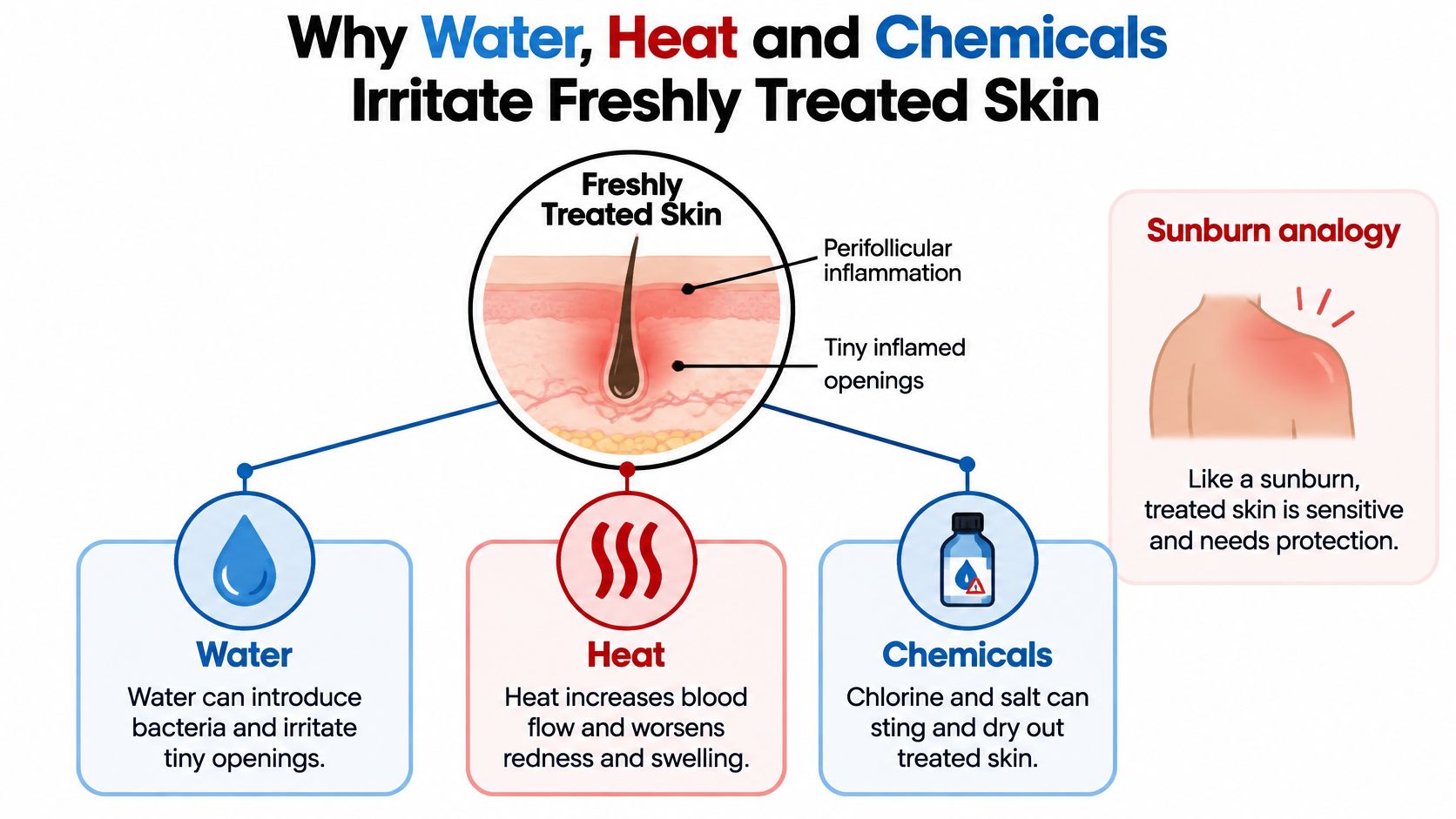
What each exposure adds
Pool disinfectants are the sharpest everyday example. Chlorine and related compounds can sting or dry skin that is already flushed. Bromine-treated spa water can irritate in a similar way. Salt water can sting a tender surface and leave it dry or tight, the way salt on chapped lips does. Heat works differently: hot water and steam raise warmth and blood flow while the area may already feel warm. Friction is mechanical. Swimsuit seams, straps, and vigorous towel drying rub the same tender spots. Prolonged soaking is a third problem. A long immersion softens the outer surface, so a soak is not the same as a brief, gentle rinse.
A successful session does not require every follicle to become an open wound. Blistering, crusting, and broken skin are not signs you need in order for treatment to work, and they are not routine permission to swim.
The StatPearls review of laser hair removal identifies redness, pain, and burning as common adverse effects, while describing blistering, crusting, pigment changes, and occasional scarring among more serious complications. Those findings support gentle aftercare. They do not predict that a swim will cause a complication.
Keep everyday exposures gentle
Heat and friction matter outside the pool, too. A guide to safe workouts after laser hair removal helps you plan exercise while the skin settles.
If household shower water regularly feels drying, Water Filter Advisor's best carbon filter shower head options provide a starting point for comparing filtration features. A filter isn't a treatment for laser irritation and doesn't make hot showers appropriate during a heat restriction.
Skip heat and skip rubbing while the area settles. Lukewarm water and a light pat are enough until the sting and flush ease.
For additional visual context on laser hair removal, watch the video below.
A Ready-to-Swim Checklist for Treated Skin
A waiting interval answers when you may begin considering a swim. It doesn't answer whether your skin is ready today.
For example, skin that looks normal under bathroom lighting may still feel tender when a swimsuit seam touches it. Use appearance, sensation and surface condition together rather than relying on a photograph alone.
The calendar gets you to the starting line. Your skin clears you to swim.
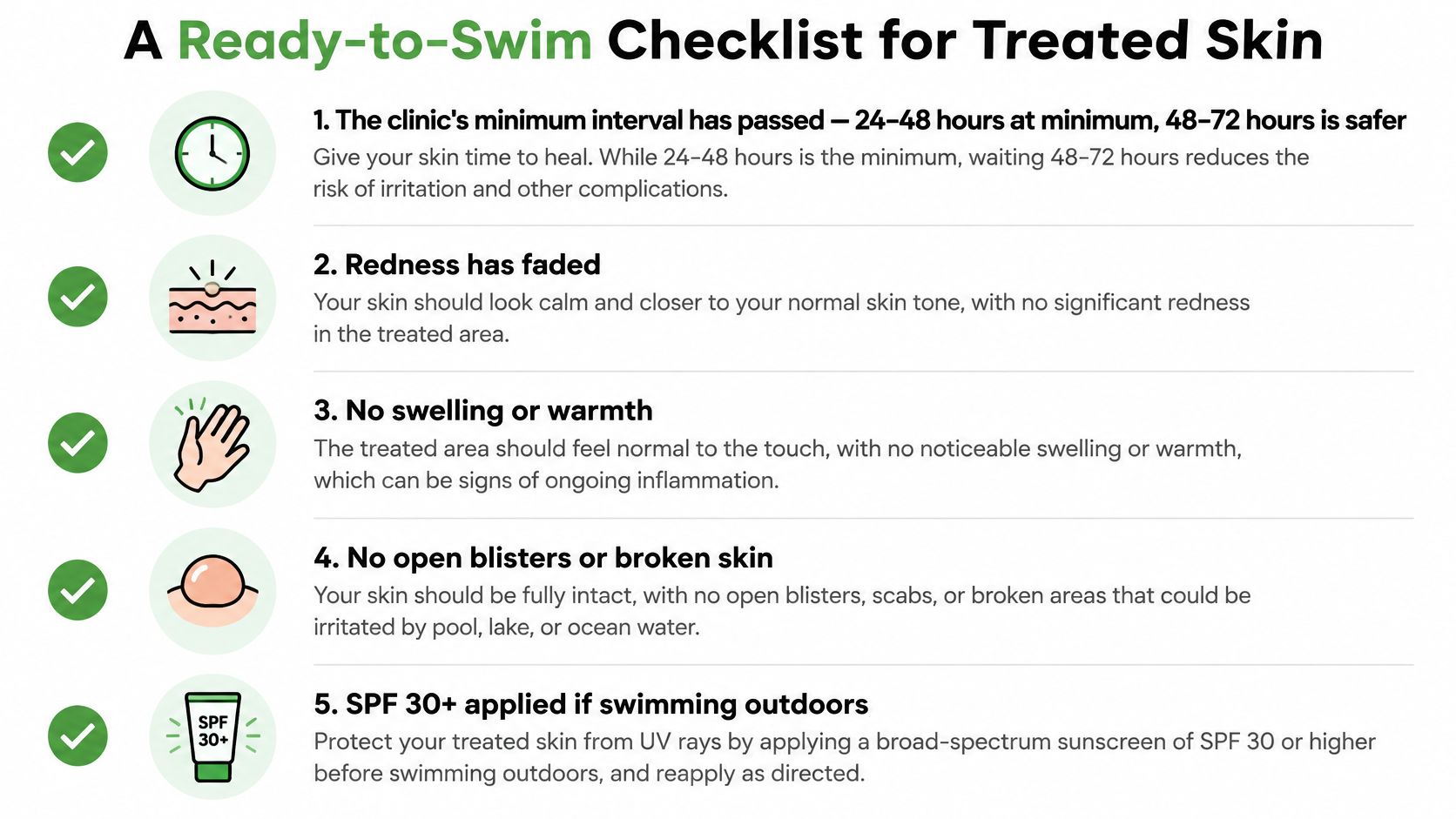
Five green lights before entering the water
Your clinic's restriction has ended. Check the written instructions and treatment date. Feeling comfortable doesn't cancel an unfinished restriction.
Unusual redness has faded. Compare the area with its usual appearance. On darker skin tones, also look for swelling or a change in color rather than expecting bright pinkness.
The area feels comfortable. It shouldn't feel unusually hot, tender, tight or swollen while resting or moving.
The surface is intact. There should be no blisters, crusts, raw spots or broken skin. Don't pick at a questionable patch to test it.
Gentle contact doesn't sting. A light pat with a clean, soft towel shouldn't hurt. Don't rub deliberately or apply salt water as a test.
Geria Dermatology's aftercare instructions note that redness typically lasts 2–24 hours, can continue for up to 72 hours, and should subside before swimming. That range is a reason to assess your own response, not assume everyone heals on the same schedule.
Keep this visual reminder alongside your written clinic instructions.
Stop signs outweigh green lights
Small, fading bumps around follicles can be part of a temporary treatment response. Blistering, worsening pain, drainage, spreading redness or scabbing call for contacting the treating clinic instead of swimming.
Water quality matters even after your skin settles. The CDC's healthy swimming guidance explains that chloramines and improper pool chemistry can cause skin irritation and advises reporting irritation associated with pool water.
Passing a skin check isn't a guarantee against irritation. It's a sensible way to avoid adding an optional exposure when your skin is already signaling discomfort.
How Pool, Ocean and Hot Tub Swims Differ After Laser
A quiet indoor pool, a windy beach and a steaming spa aren't equivalent exposures. Temperature, water quality, sun and friction all matter, so there's no setting that's automatically safe because it isn't chlorinated.
The American Academy of Dermatology's laser hair removal FAQs describe temporary discomfort, redness and swelling and emphasize following aftercare instructions. Use those instructions to choose the setting, not just the date.
A controlled pool is easier to manage
Indoor chlorinated pool. A comfortably cool, well-maintained pool can be a manageable first return because you can avoid direct sun and leave easily. Choose an easy swim rather than a demanding workout, and get out if the area starts stinging.
Outdoor pool. The water may be similar, but your skin also encounters sunlight, warm paving and more time outdoors. Plan shade and protective clothing, and use a sunscreen your skin tolerates once your clinic permits it. Sunscreen doesn't turn an otherwise unsuitable swim into a suitable one.
For either setting, consider where the suit sits. A tight waistband against a treated bikini line may be more troublesome than water touching a comfortable forearm.
Beaches and natural freshwater add uncertainty
Ocean or bay. A Long Island beach visit might include walking through sand, sitting in a damp swimsuit and being knocked by waves. If every skin-check item passes and your restrictions have ended, choose calm conditions and arrange access to fresh rinse water.
Lake or river. Natural freshwater isn't automatically gentler than a pool. Water quality can change, and you can't assume untreated water is free of microbes. Don't enter with broken skin, and follow local swimming advisories.
There's no need to prove your skin is ready by tolerating a sting. Discomfort is a reason to stop, not something to push through.
Leave hot tubs until the heat restriction ends
A hot tub combines sustained heat, disinfectants and soaking. Turning down the jets doesn't remove those exposures, and a private spa isn't exempt from aftercare restrictions.
Choose the outing you can control: Easy water access, shade, a fresh-water rinse and an uncomplicated exit matter more than completing your usual swim.
Body area also changes the practical decision. Full-leg treatment may affect where sand rubs; a Brazilian treatment may make swimsuit pressure the deciding factor. Judge the actual contact points, not just the size of the appointment.
Caring for Treated Skin Before and After Swimming
Once you're cleared to swim, keep the routine simple. You don't need a collection of active products or an aggressive cleansing routine to remove every trace of pool water.
Our aftercare instructions should guide your individual routine. If a general skincare suggestion conflicts with your treatment instructions, follow the treatment instructions.
Before the swim
Inspect the area before dressing. Run the skin check while you can see the whole treatment zone. Once you're at the beach, it's easier to overlook a tender patch because everyone else is entering the water.
Plan sun protection. Choose shade, suitable clothing and broad-spectrum, water-resistant sunscreen on exposed, intact skin when permitted. Follow the product's application and reapplication directions.
Skip unnecessary products. Leave fragranced body lotion, self-tanner and exfoliating products out of your pre-swim routine. Don't try a new product immediately before immersion, when identifying the cause of a reaction would be harder.
Bring a clean, soft towel. You'll want to pat the area dry rather than use a sandy towel or rub with clothing.
The illustration offers a simple before-and-after reminder. Treat any suggested duration as secondary to your clinic's restrictions and your skin's response, not as a universal safe exposure limit.
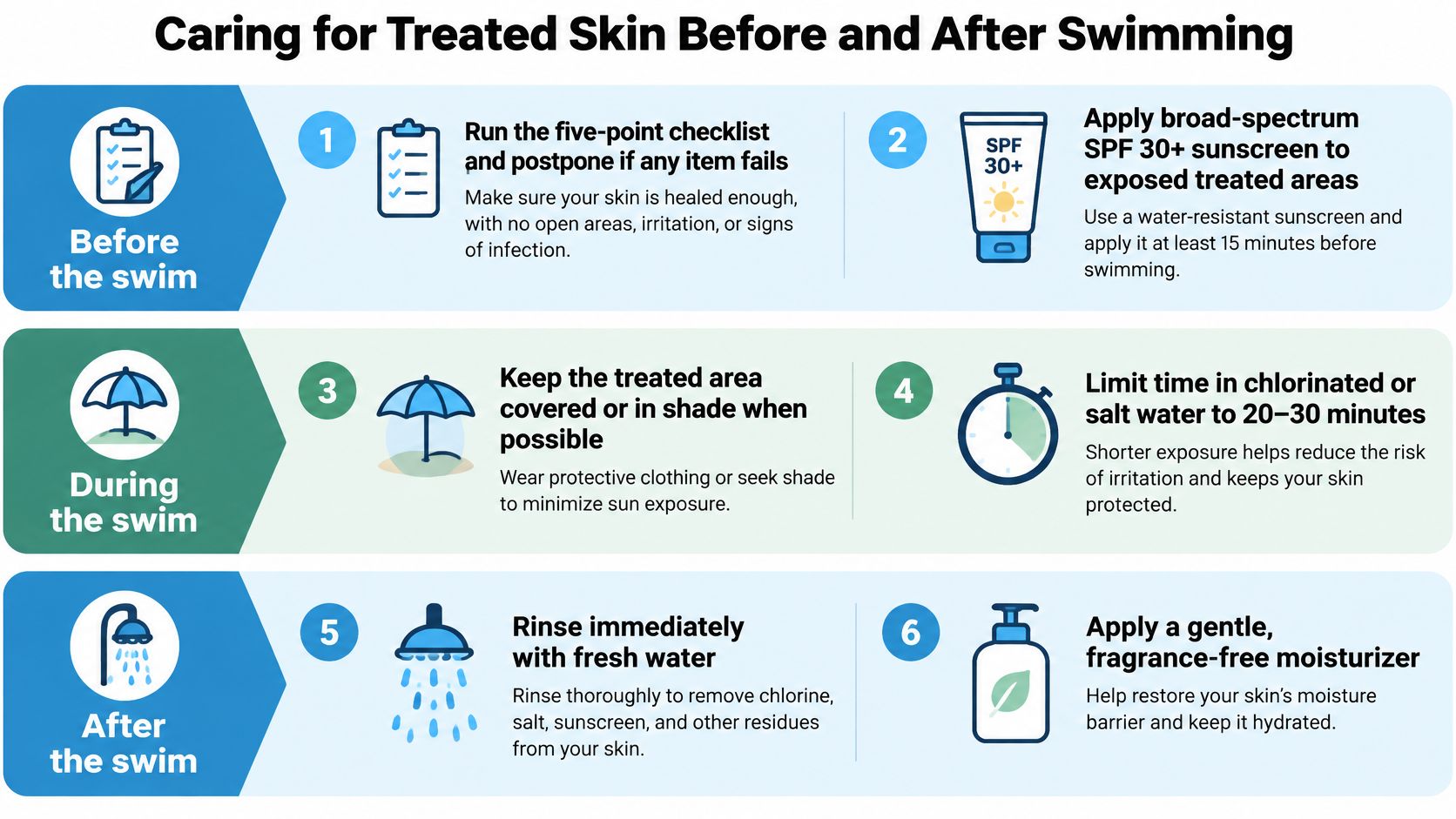
During the swim
Keep the first return easy. Avoid rough play, repeated rubbing against pool edges and swimsuit adjustments that scrape treated skin. Leave the water at the first sign of burning or discomfort rather than waiting for a planned finish time.
After the swim
Rinse promptly with fresh water. Use cool-to-lukewarm water to remove salt or pool residue. Don't replace rinsing with vigorous wiping.
Cleanse gently if needed. Use your hands and a mild, fragrance-free cleanser. Skip loofahs, brushes and exfoliating scrubs, then pat dry.
Moisturize with a familiar product. Choose a plain, fragrance-free moisturizer your skin already tolerates. If you're reviewing affordable options, Finding Favourites lets you compare budget barrier repair dupes; check ingredients rather than assuming a similar-looking product is appropriate after laser.
Restore sun protection before heading outdoors. Follow sunscreen directions and return to shade where possible.
Between appointments, shave only when the skin is comfortable enough. Our preparation policy requires avoiding waxing, plucking, threading or electrolysis for 4–6 weeks before treatment. Laser treatment needs hair at skin level to effectively target the follicle; pulling hair out works against that preparation.
Finally, shower before entering a shared pool. Removing sweat, oils and personal-care residue is a useful hygiene habit for everyone using the water.
What to Do If a Swim Irritates Treated Skin
New pinkness after swimming may be irritation, but don't assume a fresh reaction is the normal laser response. Notice whether it began in the water, where it appears and whether it improves once you stop the exposure.
You don't need to diagnose the cause before taking gentle first steps. You do need to recognize when home care isn't enough.
Stop the exposure and simplify care
Leave the water immediately. Don't finish the lap or stay in the hot tub to see whether the sensation passes.
Rinse with cool fresh water. Remove water residue, then pat dry without scrubbing.
Keep products minimal. If the surface is intact, use a familiar, plain fragrance-free moisturizer. Stop any product that stings; don't put new creams on blistered or weeping skin without clinical advice.
Avoid further heat and rubbing. Change out of the wet swimsuit into loose clothing and keep the area protected from direct sun.
Watch the direction of change. Improving comfort is different from increasing pain, spreading discoloration or new drainage.
Know when to call
Contact the treating clinic promptly for blisters, worsening burning, spreading redness, pus, drainage or scabbing. Seek urgent medical care if you also feel unwell, develop fever or have rapidly worsening symptoms.
Our guide to side effects of laser treatment can help you describe the reaction, but it doesn't replace an assessment. Don't return to swimming with an unresolved concerning reaction.
Save the treatment date, swim setting, products used and photographs of visible changes. If dark or light patches appear later, arrange a review even if the initial sting has disappeared.
Your Next Step Before You Swim Again
The safest practical decision combines time, skin condition and the outing itself. A restriction that has ended, comfortable intact skin and an easy-to-control swim are different from a barely settled treatment area and a long spa visit.
Before leaving home, check your written aftercare, inspect the treated area and make sure you can rinse afterward. Be willing to change the plan if the swimsuit rubs or your skin feels different once you're dressed.
When to contact us before making plans
Unresolved skin changes: Blisters, crusts or persistent irritation need assessment, not another test swim.
A history of pigment changes: Tell us so that aftercare planning reflects your skin's response.
A treatment close to a trip: Share the beach, pool or spa plans before scheduling, particularly when several areas will be treated.
During our initial consultation, experienced professionals assess your skin type and hair color to create a personalized treatment plan. You can call 516-321-4959 or email INFO@NYCLASER.COM to discuss how planned water activities fit around an appointment.
Treat the clock as the minimum and your skin as the final say.
NYC Laser Hair Removal offers personalized laser hair removal with Splendor X technology and guidance on caring for treated skin. Visit NYC Laser Hair Removal to arrange a consultation, and bring your pool, beach or travel dates so we can help you plan treatment around them.
Comments