
Full Arms Laser Hair Removal: Sessions, Results and Costs
Most advice about full arms laser hair removal leans on one word: permanent. That word oversells the result. What the treatment is built to deliver is a lasting drop in the hairs that grow back, not a promise that both arms stay bare forever.
A full-arm series covers the upper arms, the forearms, and the elbows. Wrists and hands are often booked as their own small zones, or left off the plan, because the hair there is finer and the skin is easier to overheat. The beam is absorbed by pigment in the hair and turned into heat that injures the follicle. Picture a magnifying glass held over one dry leaf. The leaf scorches. The grass around it stays intact when the energy, the cooling, and your skin are matched.
If you want less shaving and slower stubble, this can fit. If you want every pale hair gone after a single visit, it can't.
What Full-Arm Laser Hair Removal Actually Delivers
The gap between the brochure and the device file is the word permanent. Marketing uses it to mean the hair is gone. Regulators use it to mean something you can count.
U.S. Food and Drug Administration device documentation defines "permanent hair reduction" as a stable decrease in the number of hairs that regrow, measured at 6, 9, and 12 months after the regimen is complete. It does not mean every hair in the treated area disappears. FDA-cleared systems have been indicated for Fitzpatrick skin types I through VI, including tanned skin. Settings and device choice still need a professional read of your skin that day.
Why one visit can't finish both arms
Follicles on the arms are not all growing at once. Laser energy is most effective when a follicle is in an active growth phase. Quiet follicles don't take the hit, so several visits are the normal plan rather than one complete treatment.
A useful result is a durable reduction in the number and thickness of regrowing hairs, with a touch-up when growth becomes noticeable again. Judge a package against that outcome, not against a bare-arm guarantee.
We don't recommend treatment for pregnant clients. A series is easier to judge when hormones aren't shifting the growth pattern under the plan.
If a durable drop in shaving is the goal, the series matches it. If you need total clearance of pale hair, say so before anyone sells you visits.
Full-Arm Session Timeline and Expected Results
A series you can follow runs about six to eight sessions. Early gaps are about four to six weeks. Later gaps widen once fewer follicles are actively growing.
The timeline below maps that pace from the first clearing through touch-ups.
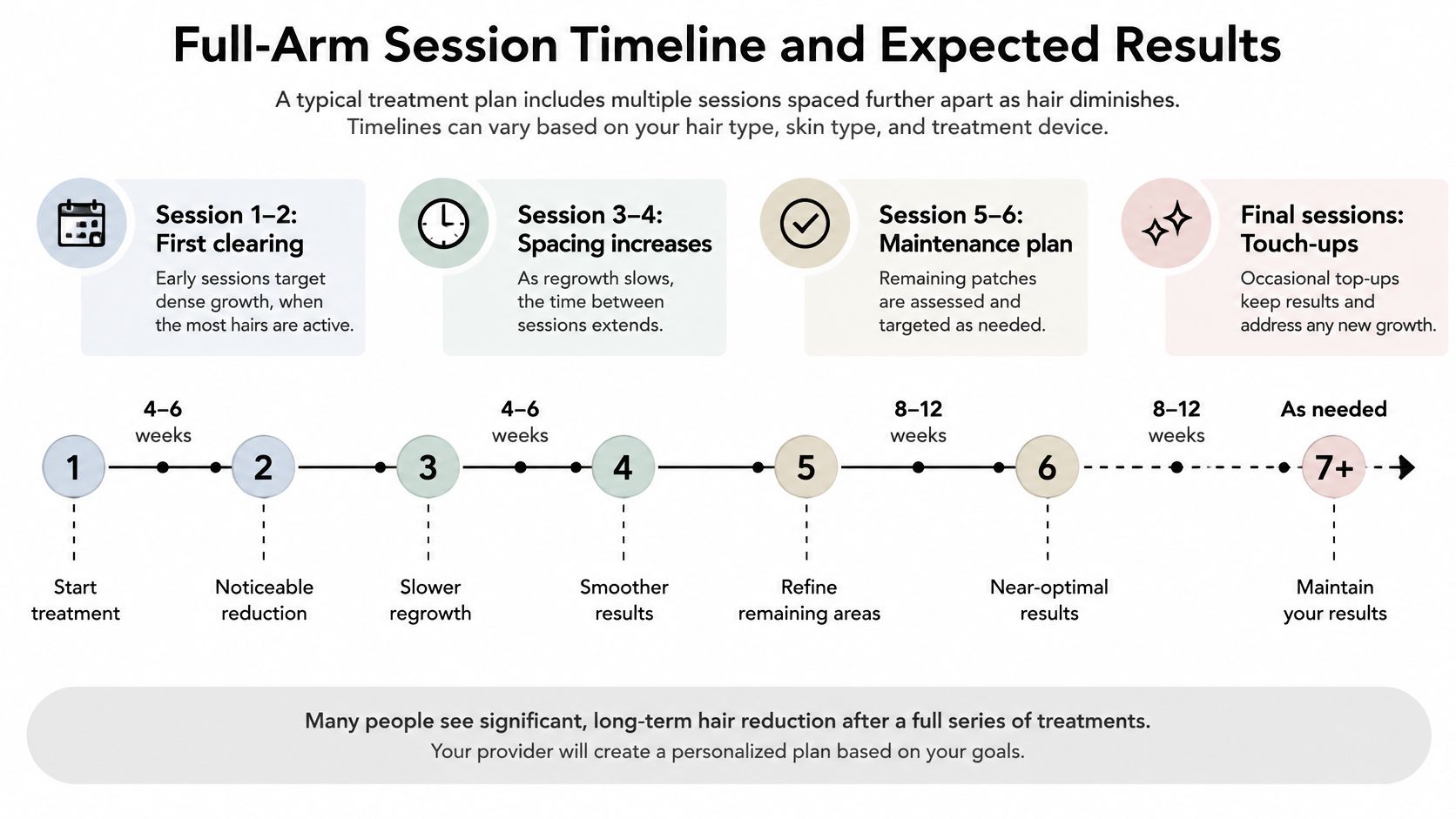
Stage | Typical timing | What changes |
|---|---|---|
Sessions 1-3 | Every 4-6 weeks | Coarse dark hairs in the growth phase respond most; visible thinning begins |
Sessions 4-6 | Every 6-8 weeks | Remaining active follicles are treated; regrowth slows and fine hairs reduce |
Maintenance | Once or twice a year, or as needed | Touch-up sessions for regrowth that becomes noticeable |
Reassessment | 6, 9 and 12 months after the last session | Regrowing hair count compared with the baseline |
Reading your own calendar
The early block does the heavy work on coarse, dark hair. Those shafts hold more pigment, so each pulse has a clearer target. Someone with dense dark arm hair often finds that shaving drops from several times a week to about once a week around the third session.
The middle block is slower on purpose. Follicles that were resting during the first visits enter the active phase later. Spacing them every six to eight weeks lets those hairs show up so the next pass can reach them. Finer hairs thin here, but they rarely clear as cleanly as the coarse ones.
Maintenance is not a failed series. One or two touch-ups a year, or a visit when a patch fills back in, can help maintain the reduction. The check at 6, 9, and 12 months after the last session compares hairs that returned with your starting count.
Two arms, two starting points
Say the hair is dark and coarse from shoulder to wrist. By session three, the morning shave takes less time and the skin stays smoother between appointments.
Say the hair is fine and light. Those same three sessions can look almost flat. The beam still fires. There just isn't much pigment for it to heat.
A short video makes the interval logic easier to see than a calendar alone.
The plan is working when three things line up. You shave less. Stubble takes longer to return. The hairs that remain feel finer. A missed week is not a reset. Tell us, and the next visit goes where active hairs are likely to be.
When Fine, Light or Sparse Arm Hair Responds Poorly
A laser can pass over an arm without making fine, pale fuzz disappear. Its light needs pigment in the hair shaft to heat the follicle. Coarse, dark hair usually absorbs more energy, while fine, light, gray, or vellus hair may respond weakly or not at all. That difference can make a full-arm treatment worthwhile for some hairs and a poor fit for others.
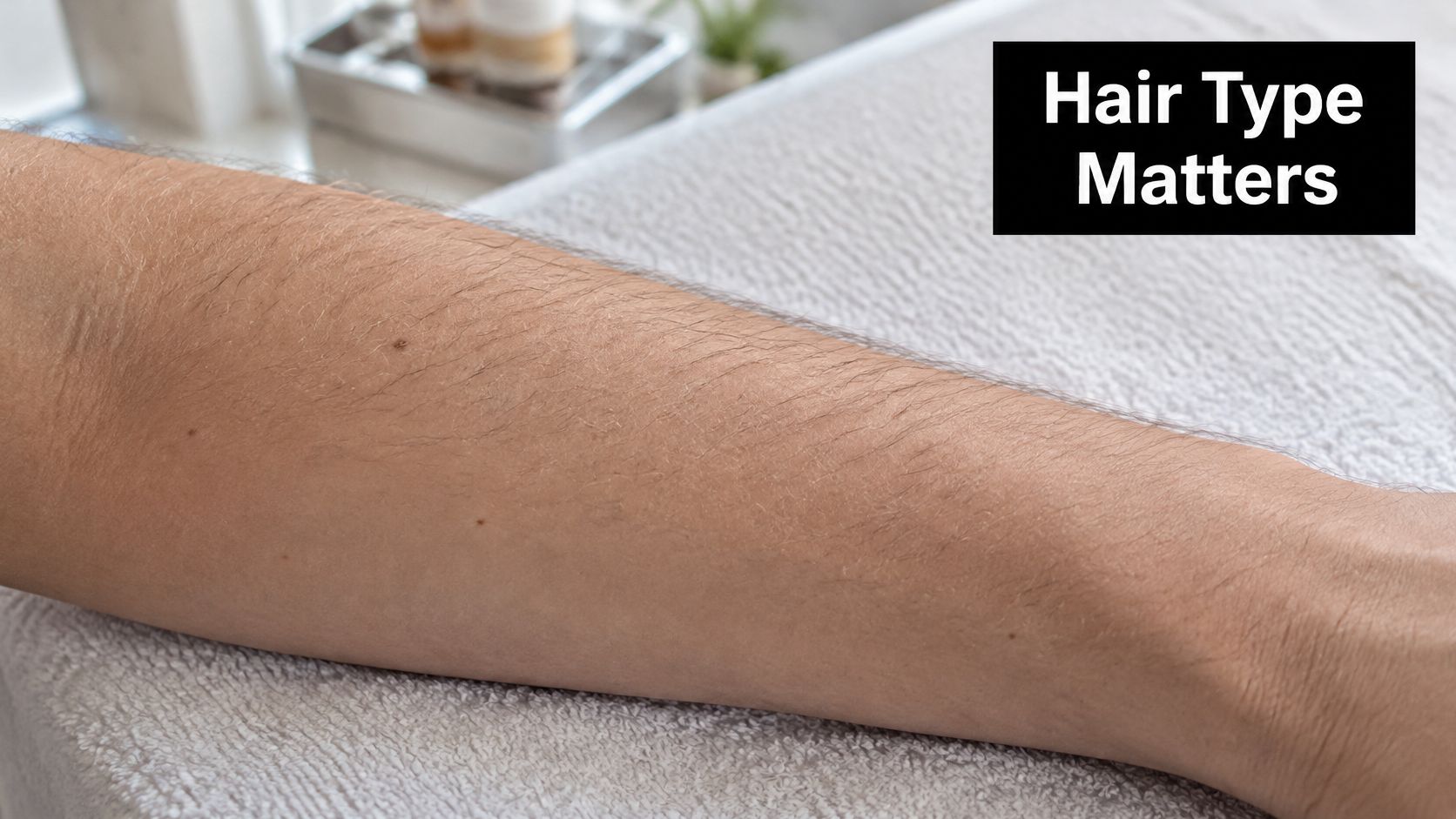
Skin tone and hair color help determine whether laser is likely to work; the American Academy of Dermatology explains that results depend on this contrast. Paradoxical hypertrichosis, where hair appears thicker or denser after treatment, is uncommon on the arms and is reported more often on the face and neck. A test spot can help show whether borderline-pigmented hairs respond before you commit to treating a larger area.
Hair type | Expected response | Suggested plan |
|---|---|---|
Coarse, dark terminal hair on light or medium skin | Usually the strongest reduction across a series | Consider a full series, then assess whether maintenance is needed |
Fine, light or gray hair | Often little response because the hair has too little pigment | Treat only clearly pigmented hairs, or consider electrolysis |
Sparse, borderline-pigmented hair | Results may be modest or unpredictable | Use a test spot to assess response before choosing a package |
Paradoxical growth | Uncommon on arms, more often reported on the face and neck | Stop and reassess if a patch appears denser |
When hair looks thicker after treatment
Paradoxical hypertrichosis describes hair that appears thicker or denser after laser or intense pulsed light. It is not the routine expectation for arms, but a denser returning patch deserves reassessment, particularly if the hair was very fine to begin with.
Shaving only shortens the visible hair; it does not add pigment to the follicle or make pale fuzz more responsive. For barely visible hair, treating only clearly dark strands or considering electrolysis for pale ones may be more sensible than treating the whole arm automatically. Read more about laser hair removal for peach fuzz before deciding which approach fits the hair you want removed.
At a consultation, ask which hairs are pigmented enough to treat and which are better left alone.
Matching Wavelength and Settings to Your Skin
Melanin in the skin and melanin in the hair compete for the same light. Wavelength is how the operator picks a winner.
The Mayo Clinic notes that laser hair removal can be used on Black and brown skin when an experienced professional performs it, but darker skin carries a higher risk of temporary or lasting pigment changes, especially when sun exposure isn't avoided. The strongest setting is not automatically the best one.
Device | Wavelength | Best suited to | Trade-off |
|---|---|---|---|
Alexandrite | 755 nm | Lighter skin (Fitzpatrick I to III) with dark hair | Strong absorption, higher burn risk on darker skin |
Diode | 810 nm | Broad range, including tanned skin, with settings tuned per client | Balanced efficacy and comfort; settings are critical |
Nd:YAG | 1064 nm | Darker skin (Fitzpatrick IV to VI) | Greater epidermal protection, with lower absorption in fine hair |
How the three rows apply to arms
Alexandrite at 755 nm is greedy for pigment. On light skin with dark arm hair, that greed helps. On deeper skin, the same absorption can heat the surface.
Diode at 810 nm covers a wide range, including tanned skin, only when fluence, pulse length, and cooling are set for that person.
Nd:YAG at 1064 nm gives darker skin more protection at the surface. Fine hair absorbs less of it, so a pale arm may still respond poorly on the "safer" wavelength.
A review of laser hair reduction in skin of color found that long-pulsed Nd:YAG had lower odds of post-inflammatory hyperpigmentation than IPL, with an odds ratio of 0.26 and a 95% confidence interval of 0.10 to 0.78, while alexandrite was superior to IPL for hair-count reduction. The Journal of the European Academy of Dermatology and Venereology review makes the trade-off plain. Device choice follows pigmentation and settings. Our comparison of the best laser for hair removal sets the platforms side by side.
When one arm is darker
Don't copy one setting from shoulder to wrist on both sides. Diameter, color, and a summer tan can differ between arms, and between the inner forearm and the outer upper arm. Each area is set after a test spot. If one arm is clearly darker, that arm gets its own settings, or we wait.
After treatment, shield the skin from direct sun with broad-spectrum SPF 30 or higher for six weeks, or as your clinician directs. Ask for a medical review if redness lingers, blisters form, or a pigment mark doesn't fade.
How to Prepare Your Arms Before Treatment
The beam can only injure a follicle that is still in the skin, in the right growth window, on skin that isn't freshly tanned or irritated. Preparation is how you show up in that window.
Stop pulling hair out for 4 to 6 weeks. Waxing, plucking, threading, and electrolysis remove the target. A Lasers in Medical Science review notes that treatment works best in anagen, when the follicle is actively growing and still connected to its growth center, and that shaving is preferred because it clears hair above the skin while leaving that target in place.
Shave to skin level the day before. A day's growth can make the area easy to recognize. You are not "growing it out" for the laser. You are leaving a short marker and an intact root.
Stay out of the sun for 2 weeks beforehand. A recent tan changes how much energy the surface absorbs and raises the chance of burns and pigment change. Self-tanner on the arms counts too. Skip it in that window.
Review medicines before you book the date. You must not be on Accutane, Retin-A, or Gold Therapy now, or within the past 6 months. Other prescriptions belong on the list you bring, even if they feel unrelated to skin.
Arrive with fully washed skin. No lotion, makeup, deodorant residue, or medication film on the arms. Anything sitting on the surface can block or scatter the beam.
If a step was missed
Tell us and move the date. Treating over a fresh wax, a new tan, or a restricted medicine wastes the visit and raises the risk. A delayed session is cheaper than a burn.
Practical rule: If you waxed last weekend or sat in the sun this week, you are not ready. Reschedule.
What Happens During a Full-Arm Session
You should be able to picture the hour before you book it. Nothing in the room should be a surprise.
From the chair to the first pulse
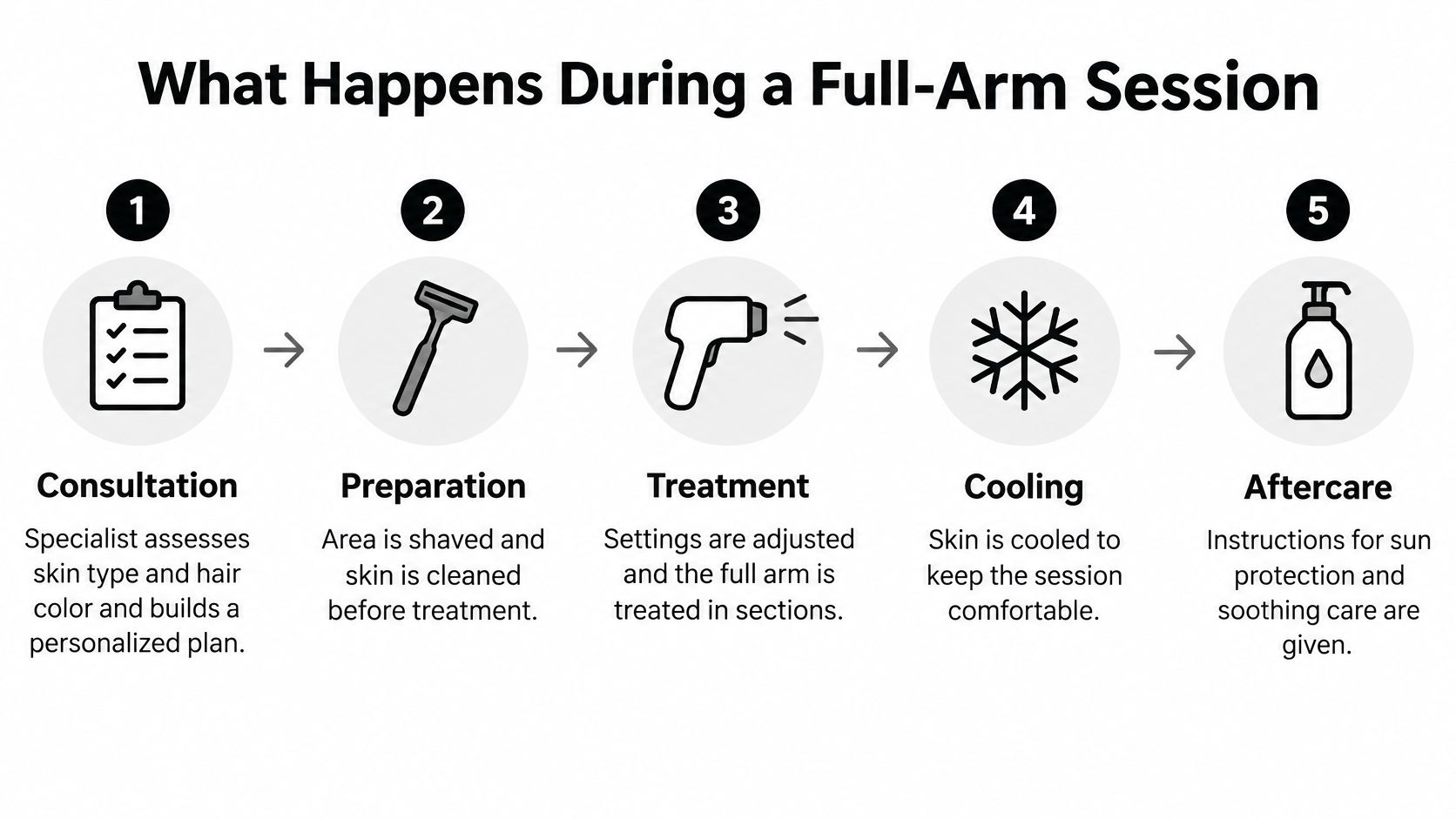
The consult sets the numbers. We look at skin type and hair color and build a personalized plan before a full arm is treated. That plan is the settings for the day, not a generic "arms" preset.
A test spot comes next when skin tone, a recent tan, or the chosen energy is uncertain. A small patch is treated and watched. If the skin reacts more than expected, the settings change or the visit stops.
Eyes and cooling are essential. You wear protective eyewear. Cooling runs on the skin before, during, and after pulses so the surface sheds heat the follicle is meant to keep.
The hair has to be at skin level. Laser treatment needs that shaft to reach the follicle. If the arms were waxed bare, there is nothing to conduct the heat.
The pass itself is sectional. The handpiece moves in short pulses. Many describe a quick snap, like a small rubber band flicking the skin. With cooling, that snap is usually tolerable. Say one forearm feels sharper than the other. Speak up. We adjust before the next row.
What the skin should do afterward
Pinkness and warmth for a few hours are common. Stated downtime is typically none, so many return to ordinary plans the same day. Skip direct sun on the treated skin, and don't scrub or pick at follicles that look like tiny raised dots.
Call us if pain escalates, blisters appear, or a dark or light patch spreads instead of fading. Mild warmth is expected. Broken skin is not.
Book a Consultation Before Your First Arm Session
A package chosen before anyone sees your arms is a guess. The consult is the decision.
Book the assessment first. We check skin type, hair color, and medication history, and we use a test spot before a package is sold.
Bring a written list. Include medicines, recent sun, and any waxing, plucking, or electrolysis in the last two months.
Ask for the calendar in writing. You want the expected session count, the spacing, and how regrowth will be rechecked at 6, 9, and 12 months.
Turn a per-session price into a series price. A 2024 U.S. pricing article from Laser by Aleya listed full-arms laser hair removal at $175 per session. Six sessions at that rate come to about $1,050, and eight come to about $1,400, before one or two yearly touch-ups. Our Large Areas service, which includes full arms, is $65.00 a session, so run the same multiplication on any quote you compare.
Confirm what the quote includes. The test spot and the later rechecks should be part of the plan, not surprise add-ons.
Clinics that keep a long series from drifting often use spa appointment scheduling software so each interval stays on the calendar. You can compare bundles on our pricing and plans page, then call 516-321-4959 or email INFO@NYCLASER.COM. The center is at 355 Post Avenue suite 102, Westbury, NY 11590.
NYC Laser Hair Removal plans full arms laser hair removal around your skin tone, hair color, and a real session count, not a one-size package. If you want fewer, finer arm hairs with a clear maintenance plan, visit NYC Laser Hair Removal and book a consultation before your first session.
Comments