
NYC Laser Pricing and Plans for Smooth, Lasting Results
You've walked into a Westbury consultation expecting one simple answer: “How much does laser hair removal cost?” Instead, the advisor shows you Small, Medium, Large, and Extra Large zones, then adds single-session, 3-session, and 6-session options. A financing note sits at the bottom of the page, and suddenly the cheapest-looking choice feels impossible to judge.
That confusion is understandable. Laser hair removal pricing and plans depend on the body area, treatment timeline, hair characteristics, technology, and the number of visits required for meaningful reduction. The right question isn't which package advertises the biggest discount. It's which plan fits the area you're treating and how long you're prepared to stay on schedule.
Why Laser Hair Removal Pricing and Plans Feel Confusing
A first-time client booking a chin consultation at a Westbury med-spa often compares prices line by line. That's the wrong starting point. A chin is a small treatment zone, while full legs or a back may require far more treatment time, pulses, cooling, and staff attention. Comparing those quotes as though they represent the same service will always produce a misleading conclusion.
Clinics usually organize pricing around area size, then offer different levels of commitment. The price sheet may include one visit, a short bundle, and a fuller course. Beneath those choices sits hair-cycle biology. Laser treats hair most effectively during particular growth phases, so one visit rarely represents the complete treatment horizon.
Why the headline price hides the real decision
Technology matters too. A platform such as Splendor X can be adjusted for different treatment areas and client characteristics, but the device doesn't eliminate the need for a planned series. Your provider still has to assess skin tone, hair color, density, and the surface area being treated before confirming the appropriate settings and schedule.
The biggest mistakes I see are consistent:
Zone mismatch: Comparing an upper-lip quote with a full-leg quote makes the smaller area look artificially inexpensive.
Package overconfidence: Treating a 6-session bundle as a guaranteed finish line ignores individual response and possible maintenance.
Maintenance blindness: Focusing only on the initial course leaves out occasional future visits that some clients may choose.
Discount fixation: Choosing the package with the deepest advertised reduction can create unnecessary upfront cost if the treatment horizon is shorter.
Advisor's rule: Buy for the body area and the realistic treatment horizon, not for the largest percentage printed on the price sheet.
Before committing, compare the clinic's zone structure with other service pricing systems. For example, compare Suby's pricing tiers can help you see how tiered offers are presented, although a software pricing page and a medical-aesthetic treatment plan naturally measure different things. The useful lesson is the same: identify what each tier includes before comparing the headline price.
How NYC Laser Organizes Zones and Pricing
Per-area pricing exists because treatment areas aren't interchangeable. A small upper lip takes less time than a full back, while larger zones require more passes, more cooling, and more attention to even coverage. With Splendor X, the provider also selects settings according to the client's skin and hair characteristics, so the final quote is confirmed during consultation rather than assumed from a generic menu.
A useful structure is the four-tier model used by NYCLASER. Small zones generally include the upper lip, chin, underarms, and basic bikini line. Medium zones can include the full face, extended bikini, and lower arms. Large zones commonly cover full legs, the full back, or broader chest combinations. XL zones typically group full-body or multiple large-area treatments.
The important distinction is that zone assignment follows surface area, not just hair density. Someone with sparse hair on a large back still occupies a large treatment field. Someone with dense hair on a small chin remains in a small zone, although hair characteristics may affect settings and the provider's planning.
NYC Laser Zone Tiers at a Glance
Zone Tier | Typical Areas | Approx. Session Time | Pricing Driver |
|---|---|---|---|
Small | Lip, chin, underarms, basic bikini line | Shorter appointment | Limited surface area and fewer treatment passes |
Medium | Full face, extended bikini, lower arms | Moderate appointment | Broader coverage and additional cooling needs |
Large | Full legs, full back, chest combinations | Longer appointment | Large surface area, more pulses, and more treatment time |
XL | Full body or multi-area combinations | Longest appointment | Multiple zones, scheduling complexity, and total coverage |
These categories make package comparisons easier because they give you a consistent frame. They don't replace a consultation. Skin tone, hair color, hair thickness, prior hair-removal methods, and the exact boundaries of a requested area can all affect the quote.
A clinic should list each zone separately when you combine areas. “Full body” can sound convenient, but you need to know whether it includes the face, bikini area, back, chest, or only a defined group of zones. A clear plan tells you exactly what you're paying for and what happens if you add an area later.
Single Session vs 3-Session vs 6-Session Packages
A single session is the most flexible option, but it usually carries the highest rate per visit. A 3-session bundle lowers the average cost while keeping the commitment moderate. A 6-session bundle generally gives the strongest package value, but it asks you to commit the largest upfront amount before you know exactly how your hair will respond.
Use a representative Medium zone, such as the full face or extended bikini, to compare the structures. The figures below are intentionally illustrative rather than a quoted NYCLASER price. Exact rates should be confirmed during consultation.
Package Comparison: Single vs 3-Session vs 6-Session
Package Type | Per-Session Rate | Savings vs Single | Total Upfront |
|---|---|---|---|
Single session | Highest listed rate | None | Lowest immediate commitment |
3-session bundle | Lower than single-session rate | Moderate package reduction | Moderate upfront commitment |
6-session bundle | Lowest typical per-session rate | Deepest package reduction | Largest upfront commitment |
The math is simple. If the single-session rate is R, the one-visit option costs R. A 3-session package costs three discounted rates, while a 6-session package costs six discounted rates. The 6-session option can produce the lowest average price, but it doesn't automatically produce the lowest total spend for every client. A client treating a small area may value flexibility more than the lowest possible average.
Which commitment fits your situation
Single sessions make sense when you're testing tolerance, confirming how your skin responds, or treating a small one-off area. They're also useful when you're unsure whether you can maintain the recommended schedule.
Three-session bundles suit first-time clients who want an initial course without making the largest commitment immediately. After the third visit, you and the provider can assess reduction, regrowth pattern, and whether continuing with a larger package makes sense. For more details on how bundle structures are commonly presented, review NYC Laser's guide to laser hair removal packages.
Six-session bundles are the practical choice for clients who already know they want a complete course, especially when the target area is broad or hair is dense and coarse. The value comes from consistent scheduling and a lower average rate, not from treating the package as a promise of permanent, uniform clearance.
Ask three questions before paying:
What areas does the package include?
How long do I have to use the sessions?
What happens to unused visits if my schedule or treatment plan changes?
Those terms can matter more than the advertised discount.
What a Full Treatment Series Actually Costs
The per-session rate is only the entry point. Independent industry pricing guidance commonly describes a course of 6 to 8 sessions, so a realistic budget should multiply the area rate by the likely number of visits rather than stopping at the first appointment. CareCredit's laser hair removal cost study places the national average between $207 and $913 per treatment area, with underarms at about $207, bikini at about $458, legs at about $412, and the back at about $913 per treatment area.
Those figures are national reference points, not a Westbury quote. They show why the total changes sharply by body area. A small zone can remain a manageable series investment, while a large zone can become a substantial financial commitment even when each appointment appears reasonable on its own.
Total Series Cost by Zone Size
Zone Size | Example Areas | Per-Session Est. | 6-Session Total Est. | Sessions Needed |
|---|---|---|---|---|
Small | Underarms, upper lip, chin | About $207 national average for underarms | About $1,242 at that benchmark | Typically 6 to 8 |
Medium | Bikini, lower legs, full face | About $412 to $458 at cited area benchmarks | About $2,472 to $2,748 at those benchmarks | Typically 6 to 8 |
Large | Full legs, back, broad chest area | About $913 at the cited back benchmark | About $5,478 at that benchmark | Typically 6 to 8 |
The table uses six visits only to expose the basic arithmetic. It isn't a guarantee that six sessions will be sufficient, and it doesn't account for package discounts, different local rates, or additional maintenance. A clinic may quote a smaller or larger amount based on the exact boundaries of the zone and the treatment plan.
For a larger combination, the total can rise quickly. A full-body plan is not just a bigger version of an underarm package. It combines multiple treatment fields, longer appointments, and a more demanding schedule. Before comparing a full-body offer, read NYC Laser's full-body package guidance and ask which areas are included.
The cheapest per-session rate isn't necessarily the cheapest complete plan. Calculate the expected series first, then compare the package reduction.
CareAboutYourHair's pricing guide describes package discounts that can range from 10% to 20% depending on the number of sessions, while another 2026 guide places typical package savings at 20% to 30% compared with pay-per-session pricing. Treat those ranges as market context, not as a guaranteed local offer. The decisive question remains whether you'll use the sessions included.
Matching Packages to Real Client Situations
Package selection becomes easier when you start with the person rather than the price sheet. The same 3-session plan can be sensible for one client and wasteful for another, depending on body area, deadline, hair pattern, and willingness to continue.
A bikini-line client planning around summer
A client maintaining a bikini line before summer may prefer a 3-session Medium-zone bundle scheduled backward from the date she wants consistent reduction. This approach limits the initial commitment while creating a structured treatment window. If regrowth has thinned by the third visit, she can decide whether to add a single session or continue with a larger course.
The key is not booking the final appointment too close to a trip or event. Your provider should explain how much spacing the area needs and whether shaving, sun exposure, or other hair-removal habits could affect the schedule.
A man treating the back and chest
Back and chest treatment covers a much larger field than a facial zone. A 6-session Large or XL plan generally makes more sense for a client who is committed to reducing dense growth across both areas. Buying each visit separately can create a higher cumulative cost and makes it easier to postpone appointments when the schedule becomes inconvenient.
The consultation should separate the back and chest on the quote. That makes it clear whether you're buying two Large zones, a combined offer, or an XL plan with defined inclusions.
A client managing hormonal chin hair
Hormonal chin hair needs realistic expectations. A Small-zone 3-session plan can be a sensible starting point for a facial touch-up, followed by a review of regrowth and maintenance needs. The objective is to evaluate the response without assuming that a short bundle will remove every future hair cycle.
For individualized decisions, a written plan such as NYC Laser's personalized treatment plan guidance is more useful than a generic package label. It should identify the target zone, expected visit sequence, and what the provider will reassess.
A first-timer testing tolerance
A cautious first-timer should start with one session on the Small zone that matters most. This lets the provider evaluate comfort, skin response, and hair behavior before the client commits to multiple visits. It's a slower financial start, but it can be the right decision when uncertainty matters more than the lowest average rate.
A good package reduces friction. It shouldn't pressure you into buying treatment you haven't yet decided to complete.
Choosing the Right Plan for Your Body Area and Goals
Use three filters before choosing between single sessions and bundles: body area, hair density and color, and treatment horizon. The first determines the size tier. The second affects how the provider plans the treatment. The third determines how much commitment is sensible.
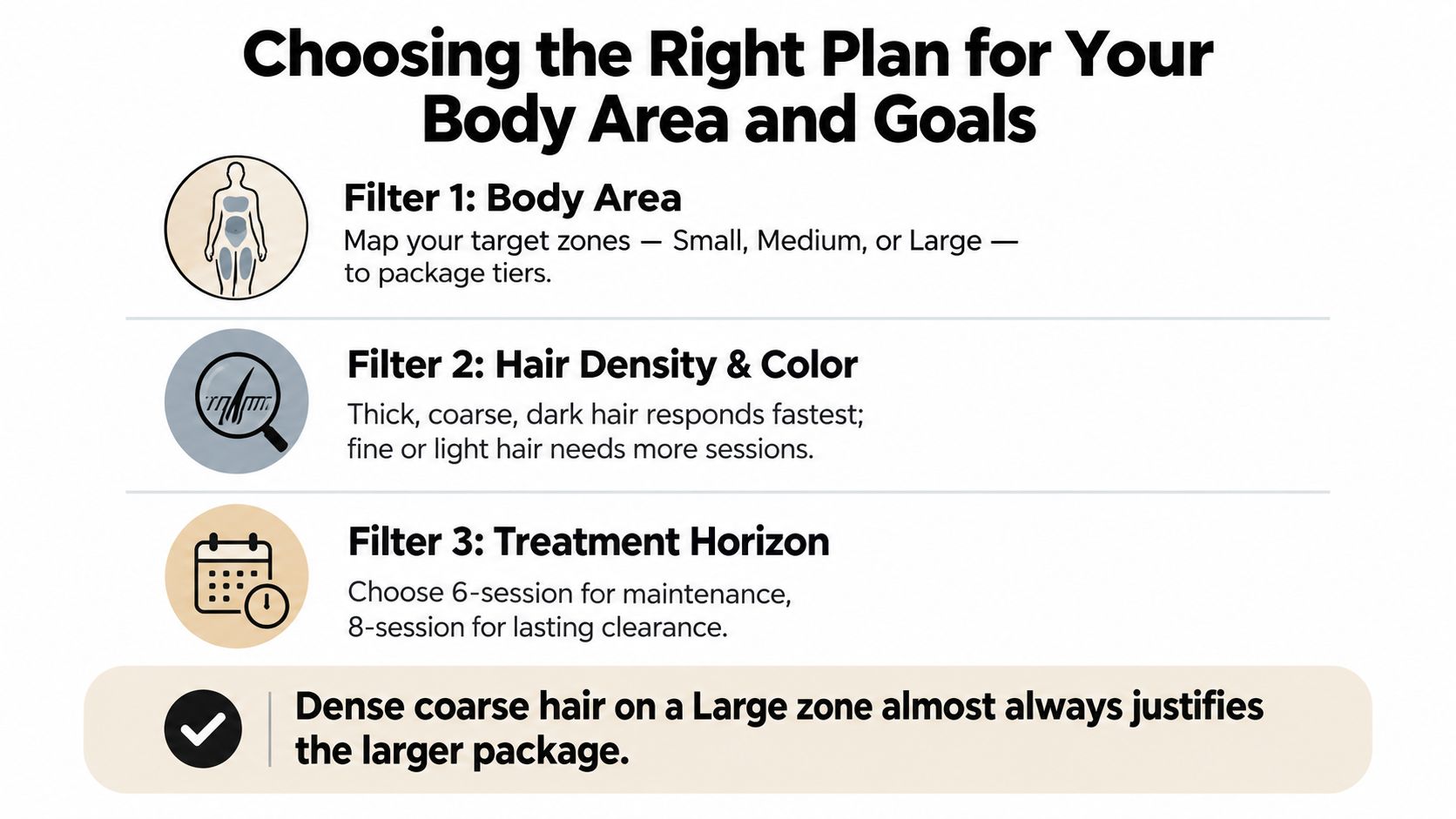
Filter one is the body area
Small zones are easier to test and usually create less financial exposure. Medium zones need more planning because the series cost rises with each visit. Large and XL zones deserve a written breakdown of every included area, especially when a package uses terms such as “full body” or “multi-area.”
Filter two is hair density and color
Dense, coarse, dark hair on a large zone usually supports a longer commitment because the treatment field is broad and the reduction process takes time. Fine or light hair may require a more individualized conversation about expected response and whether laser is appropriate for the target hair.
Skin tone also belongs in this discussion. The provider should explain how Splendor X settings are selected for your skin and hair combination, rather than treating every client with the same assumptions.
Filter three is your treatment horizon
If you're working toward a specific event, plan backward. Body sessions are commonly spaced 4 to 6 weeks apart, while facial sessions are commonly spaced 4 weeks apart, according to the treatment-planning guidance in the brief. That schedule means your desired finish date should be discussed before you purchase a package, not after.
Before paying for a bundle, confirm:
Session spacing: Ask when each visit should occur.
Expiration rules: Check how long you have to use the sessions.
Price protection: Verify whether prepaid pricing remains locked.
Maintenance terms: Ask whether future visits are separate.
Area boundaries: Confirm exactly what “bikini,” “full legs,” or “full body” includes.
If the clinic also uses digital support, a smarter help desk with AI can make routine questions easier to answer before your appointment. It can't replace a clinical consultation, but it can help you collect the practical details that affect your decision.
Booking, Consultation, and Financing Considerations
A sound plan begins before the first treatment. Start with the booking form, identify every target area, and request a consultation that produces a written quote. At the Westbury, NY location, the consultation should cover your skin and hair assessment, Splendor X suitability, relevant medical history, and any patch testing the provider considers appropriate.
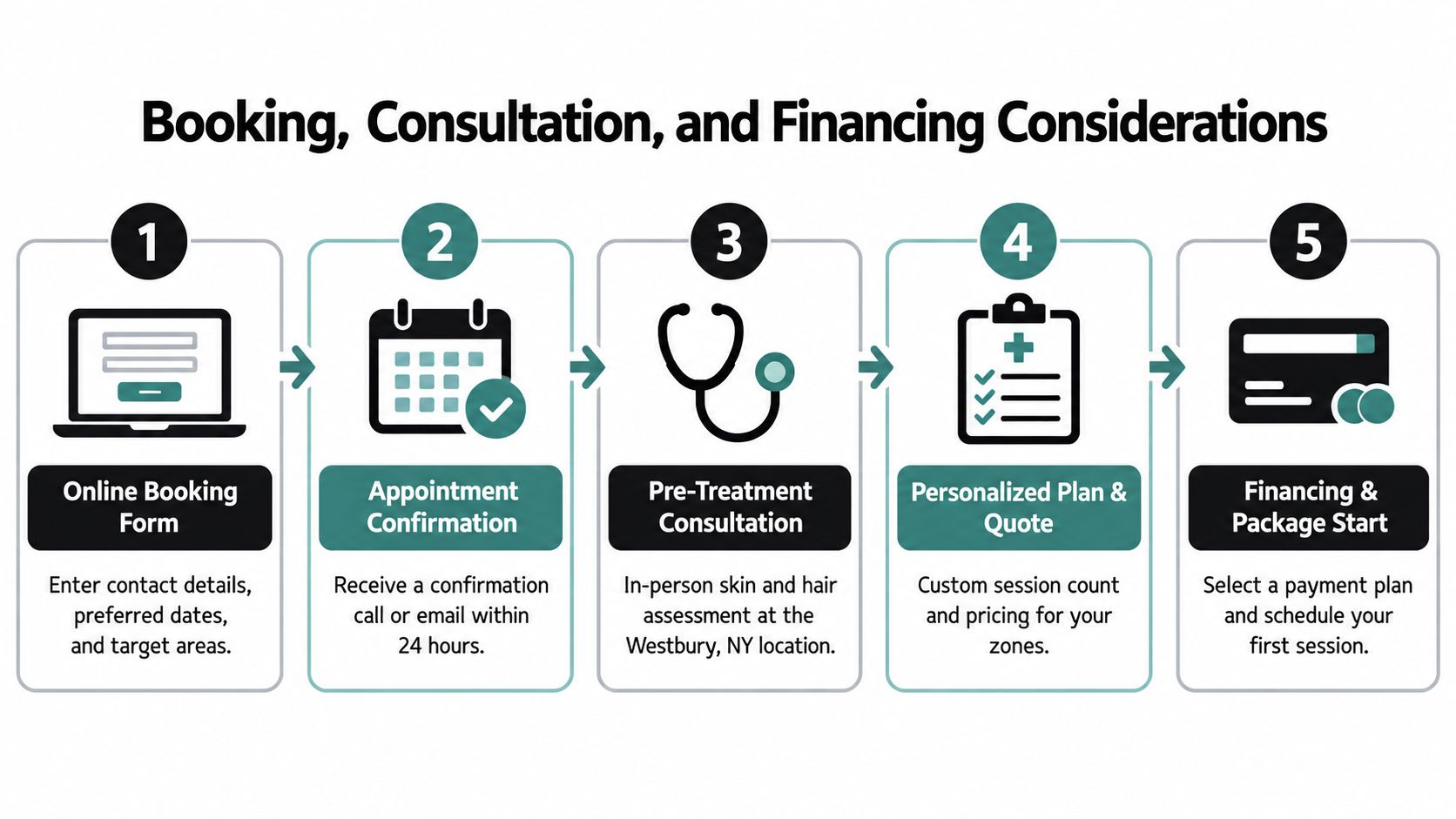
What the written quote should show
A useful quote separates Small, Medium, Large, and XL zones instead of blending every area into one vague total. It should also state the session count, package price, payment schedule, expiration window, cancellation terms, and policy for rolling unused sessions.
Ask how single visits fit alongside bundles. Some clinics require package sessions to follow a defined schedule, while others may allow more flexibility. Don't assume unused visits can be transferred, extended, or converted into another zone.
Financing changes the cash-flow question
Financing can make a Large or XL package easier to budget because the cost may be split into monthly installments. It doesn't make the treatment free, and the total repayment terms still matter. Ask about interest, fees, down-payment requirements, promotional periods, and what happens if you stop treatment before using the package.
CareCredit offers a useful reference point for understanding how cosmetic treatment costs are commonly discussed, but the financing option available to you depends on the clinic and your approval. Bring identification, payment information, a list of medications, and any relevant medical history so the consultation and plan review don't stall.
For appointment questions, tools such as Expressify AI live chat can help organize basic inquiries before you speak with the clinic. Use that kind of support for scheduling or policy questions, not for replacing a provider's assessment of your skin and hair.
Quick Plan Recommendations by Body Area
The practical recommendation is straightforward. Small zones often justify a 6-session bundle when the client is committed to a full course, while a cautious first-timer can begin with one visit. Medium zones frequently work well with a 3-session bundle followed by a single-session reassessment. Large and XL zones usually reward clients who plan for the full series instead of paying the highest single-visit rate repeatedly.
The plan should still reflect your timeline. A client preparing for a seasonal goal may value a shorter commitment and a scheduled review. A client treating a broad area with dense growth should focus on continuity and total-series budgeting.
Recommended Package by Zone
Body Zone | Zone Size | Recommended Plan | Notes |
|---|---|---|---|
Underarms | Small | 6-session bundle for committed clients | A compact area with a manageable series budget |
Upper lip or chin | Small | 3-session bundle, or single session for testing | Facial hair may need realistic maintenance planning |
Bikini line | Small to Medium | 3-session bundle, then reassess | Match visits to the client's calendar |
Full bikini | Medium | 3-session bundle plus possible top-up | Confirm exact treatment boundaries |
Lower legs or arms | Medium | 3-session bundle for initial commitment | Review reduction before extending the course |
Full legs | Large | 6-session bundle | Paying per visit can become costly across a long course |
Back and chest | Large or XL | 6-session Large or XL plan | Separate areas on the quote and confirm inclusions |
Full body | XL | Defined multi-area package | Check what “full body” includes before paying |
For first-timers with limited budgets, start with one Small zone and use the response to guide the next purchase. For clients already committed to treating a Large area, avoid letting the lower upfront price of single sessions obscure the likely total. Ask for the complete expected course cost, the bundle savings, and the maintenance policy in writing.
NYC Laser Hair Removal offers Splendor X treatments across defined Small, Medium, Large, and XL zones, with single-session and bundled options for different commitment levels. Visit NYC Laser Hair Removal to review the available treatment areas and book a Westbury consultation focused on your body area, timeline, and total-series budget.
Comments