
When Does Hair Fall Out After Laser? a Week-by-Week Guide
Most treated hair falls out about 1-2 weeks after a session, usually across 1-3 weeks, and not on treatment day. The follicle is already injured while the shaft is still sitting in the skin, so day one is the wrong day to score the result.
People search when does hair fall out after laser because the usual line, "it falls out over days to weeks," never explains the stubble in the mirror. That stubble often looks like fresh growth. It usually isn't. Treated hair is only working its way out, and follicles that were resting were never in reach of that pulse. A calm week-by-week reading beats a single promised fallout day.
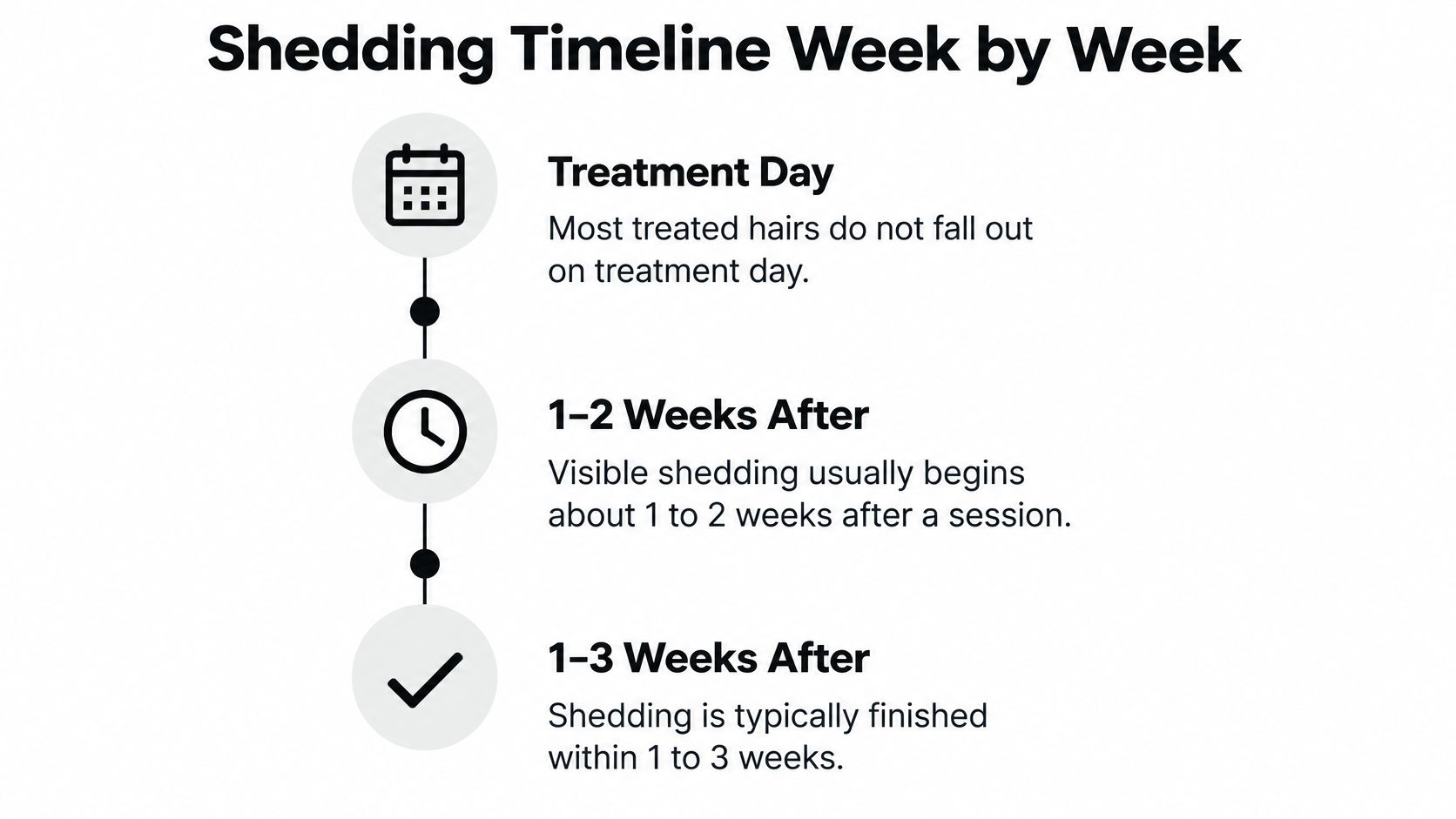
Shedding Timeline Week by Week
Treated hairs don't drop in the chair. Visible shedding generally begins about 1-2 weeks after treatment, as damaged hairs are gradually expelled from the follicle. The American Academy of Dermatology explains that laser treatment progressively damages follicles, and that hair commonly returns thinner and finer after successive treatments. It also notes that approximately 6 dermatologist-performed treatments are often needed to destroy a follicle, though results vary by body area, hair color, skin type, and hormones.
The pulse heats pigment in the shaft and follicle on the day of treatment. The shaft can stay anchored for days before it works outward. Hair that appears to be "growing" in that stretch is often being shed rather than actively regenerated. A clinical review describes the same process as targeting anagen, the active phase, and inducing a temporary resting or kenogen-like state. Short-term stubble is not a failed session.
Window | What You See | What Is Happening |
|---|---|---|
Days 0 to 2 | Nothing visible falls out | Treated shafts stay anchored in the follicle |
Days 3 to 7 | Stubble may look unchanged or longer | Damaged hairs begin loosening |
Week 1 to 2 | Hairs slide out with gentle washing | Main shedding window |
Weeks 2 to 3 | Remaining treated hairs release and skin settles | Late shedding finishes |
Weeks 3 to 4 | Clearer area; any new hair likely from untreated follicles | Resting follicles entering growth |
Days 0 to 2. Pink skin is common, and every hair stays seated. Nothing you can see has fallen out yet.
Days 3 to 7. Stubble may look unchanged or even longer, because loosened treated hair is only starting to emerge. That longer look is the part that fools people.
Week 1 to 2. This is the main shedding window. Hairs slide out with gentle washing. Picking or scraping isn't needed and can irritate the skin.
Weeks 2 to 3. Remaining treated hairs release, and the skin settles.
Weeks 3 to 4. The area should look clearer. Any new hair is more likely coming from follicles that were resting during the session.
Practical rule: Use week two as your first checkpoint, not the first few days.
That clock still shifts by body area. Faster zones and slower zones don't share one fallout day.
Why Hair Sheds in Stages, Not All at Once
One laser session cannot affect every follicle equally because only a portion are in the active growth phase at any given time. Hair cycles are like a set of lights switching on at different times: follicles outside the active phase may respond less, then produce visible hair later.
Hair-cycle timing varies by body area. The hair-cycle analysis in the International Journal of Dermatology describes a short active-growth phase for facial hair and a longer resting phase. A systematic review describes catagen, the transition phase, as roughly 3 weeks and telogen, the resting phase, as about 3 months. Leg hair may remain in telogen for approximately 3-6 months. These differences help explain why treatment is scheduled across multiple visits rather than expected to clear an area at once.
Phase | Typical Length | Response to Laser |
|---|---|---|
Active growth (anagen) | Varies by body area; roughly 3-4 weeks on the face | Most responsive; target pigment is present |
Transition (catagen) | About 3 weeks | Less responsive; target pigment is less accessible |
Resting (telogen) | About 3 months; roughly 3-6 months on the legs | Least affected; hair may appear later |
Laser works best on pigmented hairs in active growth. Hairs in transition or resting phases are less susceptible, so some may grow later as their follicles enter an active phase. The telogen phase of hair growth explains why a month with little visible hair does not necessarily mean the area is finished.
For example, a leg may look clearer after one session, then show fine hairs several weeks later. Those hairs may come from follicles that were resting during treatment. Their appearance alone does not show that the session failed.
Visible hair after the shedding window can reflect follicles moving through different growth stages. This cycle is why long-lasting reduction takes a series of treatments rather than one session.
Telling Shedding From Stalled Results and Rare Regrowth
When does early stubble signal a problem, and when is it just part of shedding? Hair may look as though it is still growing for a while after treatment because treated hairs loosen and work their way out gradually. Stubble in the first days alone does not show whether treatment worked.

Three lookalikes
Days 3 to 14: normal shedding. Loose hairs may remain visible or seem to grow before they release. Gentle washing can help them slide out; judging the result from stubble alone is like judging a page before the ink has dried.
After the shedding window: new growth or uneven response. Some follicles may not have been in a responsive growth phase during treatment, so hair can appear later. A small amount of visible regrowth does not by itself mean the session failed. A systematic review and meta-analysis found pooled paradoxical hypertrichosis prevalence of about 3%, concentrated mainly on the face and neck, with 0.08% of cases occurring outside those areas.
Progressively denser, darker, or spreading hair: ask about rare regrowth. A 2025 prospective facial study reported paradoxical hypertrichosis in 16.2% of its study population, with associations including PCOS, irregular menstrual cycles, family history of hirsutism, and Fitzpatrick skin types III and IV. That finding describes the study's facial population, not the broader pooled estimate. If hair is becoming denser or spreading, contact the provider before the next session rather than assuming it is ordinary shedding.
A poor response is better assessed across the planned treatment series than from one stubbly week. Keep dated photos in consistent lighting so changes are easier to compare, and tell the provider about relevant hormonal history. NYC Laser Hair Removal does not recommend laser treatment during pregnancy, so let the provider know before booking.
Situation | What It Usually Means | What to Do |
|---|---|---|
Stubble or loose hair in days 3 to 14 | Normal shedding of treated hair | Wash gently and wait |
Little change after the expected shedding window | Resting follicles or an uneven response | Keep the schedule and review at the next visit |
Denser, darker, or spreading hair, especially on face or neck | Possible paradoxical hypertrichosis, which is uncommon | Call the provider before the next session |
Worsening irritation, bumps, or skin changes | Skin reaction, not shedding | Contact the provider promptly |
Pregnancy | Treatment not recommended | Tell the provider before booking |
If you are unsure, send dated photos to your provider before the next session instead of relying on memory.
Aftercare During the Shedding Window
Loose treated hairs usually slide out during gentle washing. Picking or scraping can irritate the skin without helping the follicle release the hair.
Avoid waxing, plucking, threading, and electrolysis between sessions. These methods remove the hair at skin level, which the laser needs as a target. Shaving leaves the follicle in place and is generally fine once the skin is no longer tender.
If the area feels hot or raw, treat it gently until the redness settles. Avoid acids, fragrance, and heavy ointments, and contact your provider if irritation worsens. General advice on what not to put on burns can help you recognize products to avoid on healing skin.
Wash gently. Use mild soap and lukewarm water. Skip scrubs and loofahs while hairs are loosening.
Let loose hairs slide out. Light pressure from a washcloth is enough. If a hair does not release, leave it alone.
Pause active products and procedures. Avoid chemical exfoliants and other laser or chemical treatments until the skin has settled.
Check the skin daily. Watch whether redness, bumps, or swelling are fading or spreading.
Record symptoms and dates. These notes can help you describe what changed. Read the laser hair removal aftercare instructions for more guidance during this period.
Treatment typically involves no downtime, so normal activities and clothing can continue. Wait until the skin feels calm before exercising. Call your provider if pain increases after the first day, or if the skin blisters or crusts.
Sessions and Intervals for Lasting Reduction
A single session usually clears only part of the hair. The American Academy of Dermatology reports an expected range of roughly 10%-25% after the first treatment. A clinical review reports approximately 10%-40% reduction, depending on device settings, body site, hair characteristics, and treatment quality. Heat is absorbed by melanin and passed toward the follicle as selective thermal injury. The damaged shaft is then expelled, commonly over approximately 1-3 weeks. What looks like "new growth" in that stretch is often loosened treated hair, not viable regrowth. Hairs that slide out with gentle washing are shedding. Plucking removes the structure the next session needs to absorb light.
Spacing exists so later visits meet follicles that have since entered active growth. One appointment can't reach every hair.
Area | Interval Between Sessions |
|---|---|
Upper lip | 4-8 weeks |
Facial areas | 4-6 weeks |
Body areas | 6-8 weeks |
Back | 12-16 weeks |
Upper-lip hair is booked on the short end. The back waits much longer. Facial areas and broader body zones sit between those poles. More detail on spacing lives in this note on how long between laser hair removal treatments.
Record the area and the start date. Write down what was treated so later photos match the same zone.
Book the next session on the interval we set. Don't pull the date forward because a few hairs returned.
Compare photos at every visit. Same light beats a memory of how thick the area used to look.
Reassess after the full series. A thin first session isn't the finish line. Reduction builds as more follicles are caught in an active phase.
The whole process is a series of sessions, not one visit with a delayed payoff.
Preparing for Your Next Session
Once shedding winds down, around week three or four, put the interval date on the calendar and book from there. Showing up with the root still in the skin, and the surface calm, is what makes the next pulse useful.
Shave a day before. The area should be at skin level, with a day's growth only if it helps you see the borders. Laser treatment needs the hair at skin level to reach the follicle.
Stay out of the sun for two weeks before the session, including tanning beds.
Stop waxing, plucking, threading, and electrolysis for 4-6 weeks. Those methods remove the target.
Wash the area the day of treatment. It should be free of makeup and medication. Skip Accutane, Retin-A, and gold therapy now and for the past six months, and tell us if any of those apply.
Book a consultation in Westbury. During that visit we assess your skin type and hair color and build a personal plan. Call 516-321-4959 or email INFO@NYCLASER.COM.
Downtime after a session is typically none, so the next appointment can sit inside a normal week. Bring the dated photos. They're a better record than how the stubble felt on day four.
NYC Laser Hair Removal maps your shedding window to the area you're treating, then spaces Splendor X sessions so later visits catch follicles the first pulse couldn't reach. If you're starting legs, back, chest, or face and want a plan built around your skin type and hair color, visit NYC Laser Hair Removal and book a Westbury consultation before you judge a single session.
Comments