
Laser Hair Removal for Peach Fuzz: Does It Work?
The most repeated advice about laser hair removal for peach fuzz is that it doesn't work. The second most repeated advice is that today's lasers handle everything, so go ahead and book the package. Both versions skip the part that decides your result, which is how much pigment sits in the hair and how thick each hair is.
The sorting rule: laser energy needs melanin to aim at. More visible pigment and a thicker hair shaft make the outcome more predictable. Peach fuzz describes a hair type, not a treatment verdict.
Two people can be told they have peach fuzz and sit at opposite ends of the spectrum. One has fine facial hair that still shows clearly in daylight. The other has fuzz you can only see when the light hits it sideways. Same word, very different outcomes.
Which Facial Hair Types Laser Can Actually Treat
Laser is a reasonable bet on dark, coarse facial hair and an unreliable one on soft, pale fuzz. The reason is not weak machines. The hair itself has to hold enough pigment to absorb the light and carry heat down to the follicle that grows it.
Sorting your own hair by pigment and thickness tells you more than any before-and-after gallery. Use this table as the starting map.
Hair type | Pigment | Typical thickness | Laser suitability |
|---|---|---|---|
Coarse terminal hair (beard, body) | Dark, high melanin | Thick | Most predictable target |
Darker intermediate facial hair | Clearly visible pigment | Medium | Often responds, less predictably than coarse hair |
Pigmented vellus hair | Some visible pigment | Fine | Variable; test before committing |
Peach fuzz (fine, light vellus) | Little melanin | Very fine | Poor; little visible response expected |
Blond, gray, white or red hair | Very low or none | Any; pigment is the limiting factor | Generally poor |
Read the pigment column first, then the thickness column. Width is a guide rather than a hard cutoff: a slightly finer hair with clear colour can respond better than a thicker one with almost none. Visibility tells you more than texture. A hair you can see clearly against the skin in daylight is a better candidate than one you can only find by touch.
Three Checks You Can Run in Daylight
Stand at a window with no makeup on, in indirect light, and answer three questions.
Visibility: does the hair show clearly against your skin when you look straight into the mirror? If you only notice it when light catches it at an angle, you're in the peach fuzz row.
Feel: can you pinch a single hair between two fingertips without a magnifier? Hair you can grip and roll is usually thick enough to treat, provided it carries colour.
Colour: does it read as pale, blond, gray, white or red? Those hairs hold very little melanin, and the device has almost nothing to absorb.
Darker intermediate hairs land in a grey zone. They aren't beard-coarse, and they aren't invisible either. They often respond, just more slowly and patchily than terminal hair, which makes them the group where a test spot earns its keep.
If most of your facial hair sits in the peach fuzz row, treat laser as an experiment on a small area rather than a fix to buy in a six-pack. Fine facial hair also carries a real risk of paradoxical regrowth, where treatment stimulates thicker hair instead of reducing it, so a small-area test is the sensible first step rather than a cautious extra. And if the actual goal is smoother texture or better makeup application rather than less hair, Facial aesthetics treatments cover that ground without asking a laser to change hair it cannot see.
Why Pale Fine Hair Gives Lasers Little to Work With
A laser treats hair the way sunlight treats a T-shirt. A black shirt soaks up the energy and gets hot. A white shirt reflects most of it and stays cool against your skin. The machine has no idea you want the hair gone. It only knows where the dark material is.
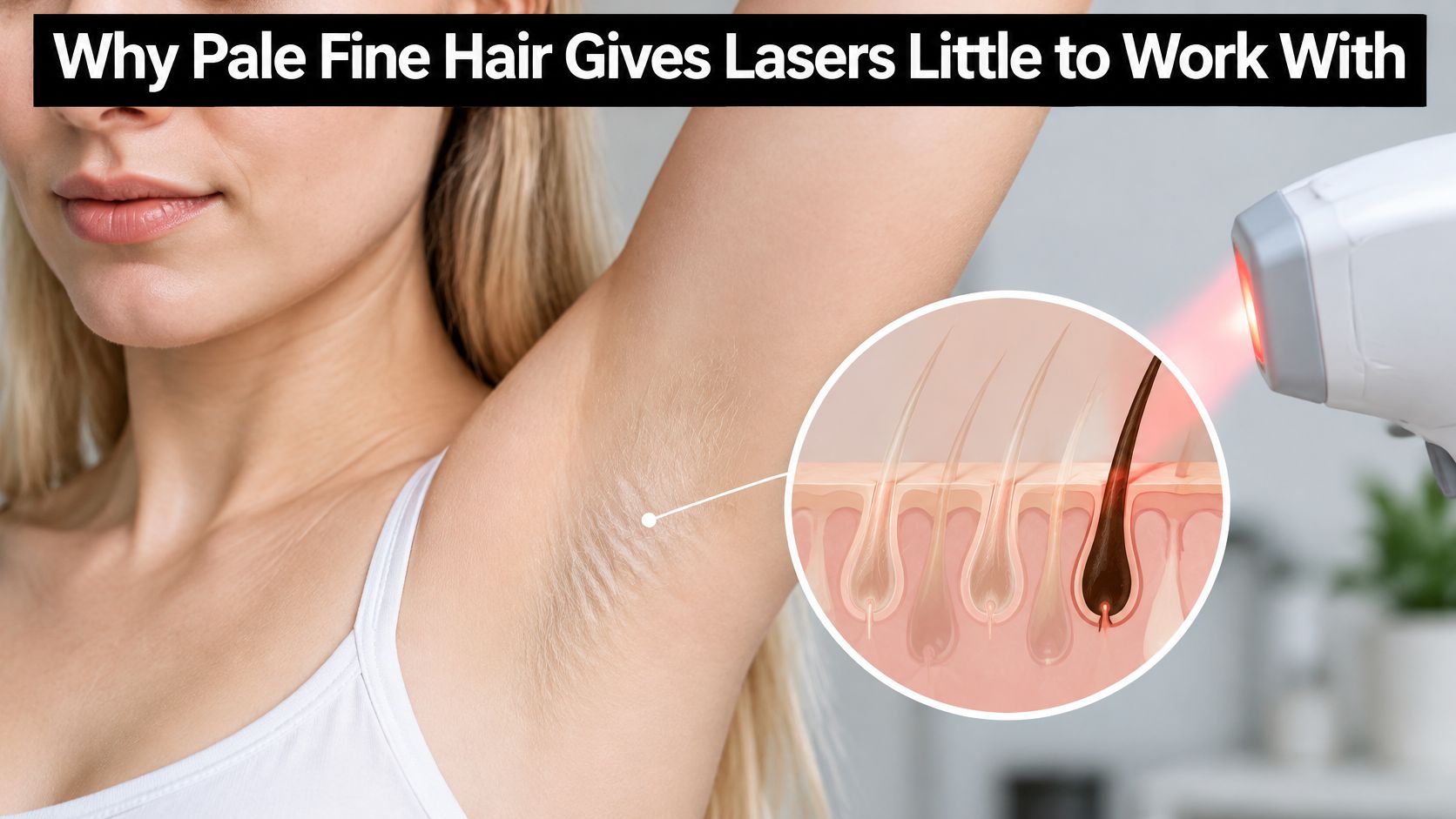
Laser hair removal runs on selective photothermolysis, the process in which melanin absorbs optical energy, converts it to heat and damages the follicular growth structures, as set out in this clinical review of laser hair removal. Vellus hair, the fine, lightly pigmented hair we call peach fuzz, holds substantially less melanin than a coarse terminal hair. Less pigment means less absorption, less heat delivered, and a follicle that carries on growing as before.
Why More Power Isn't the Fix
Turning up the fluence looks like the obvious answer. It usually isn't. Epidermal melanin in the surrounding skin can absorb the extra energy before the follicle ever reaches a therapeutic temperature, so your skin takes the risk while the hair gets very little of the reward. The same review describes thin, fine hair as a poor treatment target even after multiple sessions, and notes that light blond, gray, white and extremely fine facial hair may show little benefit.
The practical consequence is the one that stings. You can complete a full session on fine facial hair and see almost no change, having paid to treat the whole face. A small test patch, treated and then reviewed once the shedding window has passed, tells you more than another round of guessing.
Hair that looks white or gray at the root sits at the far end of the same problem. This guide to laser hair removal for white hair explains why those hairs resist so stubbornly.
The laser needs something dark enough to aim at. No pigment means no target, whatever the session count on your package.
Realistic Reduction Numbers for Facial Hair
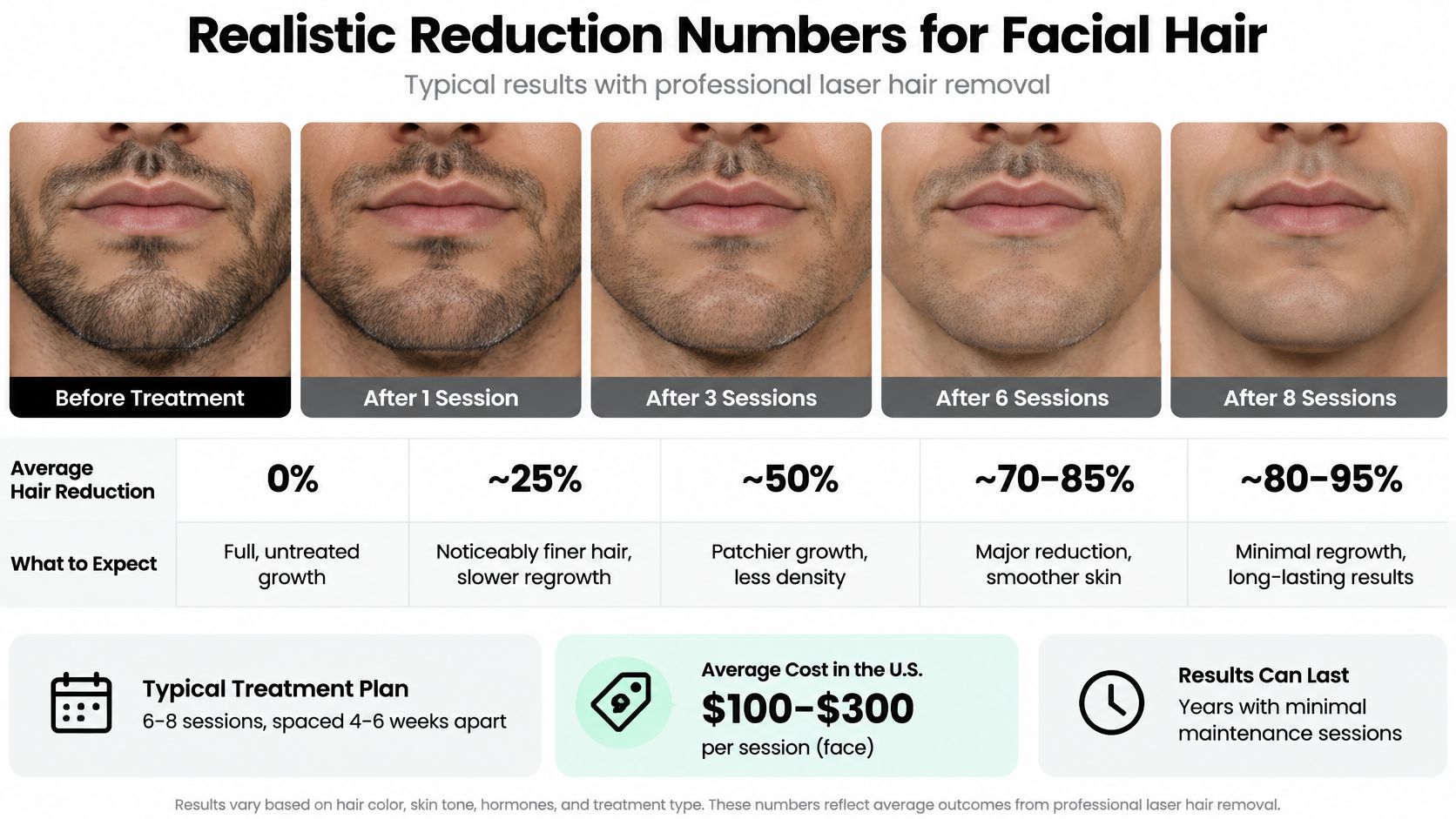
Every figure below is an average across a group of people. None of them promises your result. Treat them as ranges with a wide middle, then plan around the spread rather than the headline.
A dermatology review published in Dermatology Practical & Conceptual reports that one treatment can reduce hair by approximately 10% to 40%, with repeated treatments producing greater reductions, and it notes weaker results on areas such as the upper lip because vellus hairs there carry less chromophore for the laser to absorb. The same review cites a randomized split-face study in which alexandrite laser produced a mean hair-count reduction of 46%, against 27% for intense pulsed light.
Hair type or study | Reported reduction | Context |
|---|---|---|
Facial hair, one treatment, dermatology review | Approximately 10%-40% | Repeated treatments produce greater reductions |
Vellus hair, 1064-nm long-pulsed Nd:YAG | 36.51% ± 25.46% mean | Prospective study, measured two months after final session |
Vellus hair thickness, same study | 39.44% ± 18.30% mean | Thickness reduction rather than hair count |
Facial hair, alexandrite vs intense pulsed light | 46% vs 27% mean | Randomized split-face study cited by the review |
Now the number that matters most for peach fuzz. In a prospective study of 1064-nm long-pulsed Nd:YAG treatment, mean vellus hair reduction was 36.51% with a standard deviation of 25.46%, and mean hair thickness reduction was 39.44% with a standard deviation of 18.30%, both measured two months after the final session. Those deviations are enormous. One person lost most of the visible fuzz while another lost almost none, and both sat inside the same study.
What Counts as Success on Fine Facial Hair
The study authors flagged their limited session numbers and sample size, so nobody can hand you a fixed session count with a straight face. Plan for several spaced sessions rather than one appointment, and judge progress against standardized photographs taken at the same angle, in the same lighting, with the same camera.
Thickness counts as a win. If the hair count drops modestly but each hair grows finer and softer, that's a real change, and it's often the one you notice in the mirror before anyone measures anything.
Ask the clinic what benchmark they expect, in numbers, before you pay. A promise of 60 to 80 percent removal on pale fuzz is a figure borrowed from coarse terminal hair, where the evidence doesn't stretch to cover you.
When Treatment Makes Hair Grow Back Thicker
Say you book a series on fine cheek fuzz. Two sessions in, the fuzz looks darker and there seems to be more of it, not less. That isn't your imagination and it isn't a shedding phase. It's a recognised reaction called paradoxical hypertrichosis, where the treated area grows new or denser hair instead of less.
The figures should neither frighten you off nor let you shrug. A 2021 systematic review and meta-analysis pooled data from 9,733 patients across two randomized controlled trials and 20 cohort studies, estimating an overall prevalence of 3% with a 95% confidence interval of 1% to 6%. The reaction clustered on the face and neck, and outside those areas it appeared in only 0.08% of cases.
A 2024 analysis of 7,381 laser hair removal patients found increased hair growth in 25 of them, or 0.34%, and its authors named poorly responding sites such as the cheeks, jawline, upper arms and upper back, plus areas of fine or vellus hair, as commonly reported locations (Aesthetic Surgery Journal). A prospective facial-hair study reported a much higher 16.2% prevalence in its own population, linking added risk to PCOS, irregular menstrual cycles, Fitzpatrick skin types III to IV, and six to ten treatment sessions.
Stop rule: if fine facial hair becomes thicker or denser after treatment, end the series and arrange a dermatology review. More passes is the wrong response to more hair.
This is why the classification conversation matters. Someone with light facial hair should ask, before the first pulse, how the team will watch for this reaction, what would make them stop, and whether a smaller test area makes more sense than a full-face plan. Hormonal hair behaves differently too, and the patterns worth knowing are covered in this look at facial hair growth in women.
Preparing for a Consultation That Classifies Your Hair
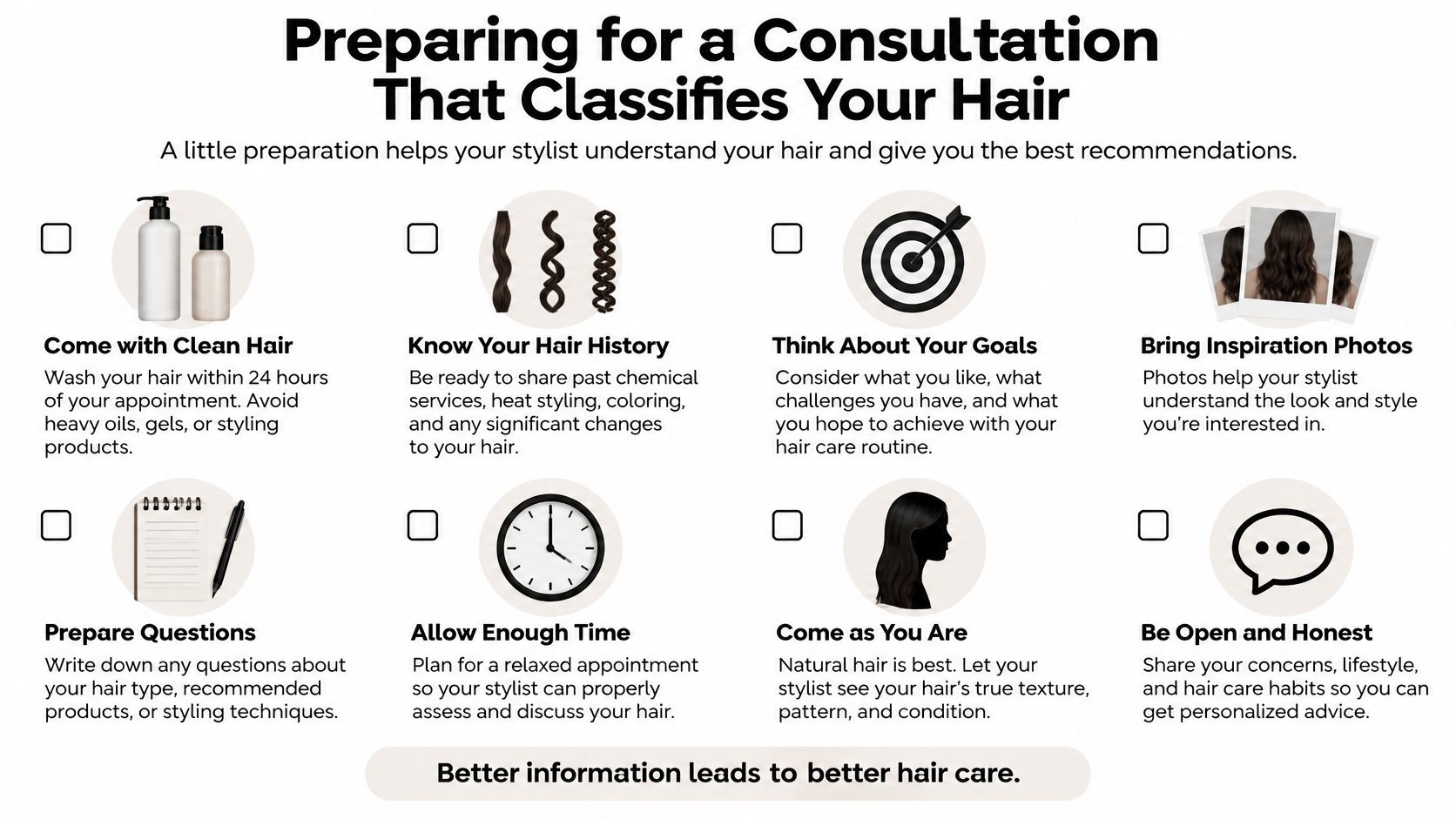
Bring one question to a consultation above all others: what does the provider call the hair on your face? The answer should come in three categories, because each predicts a different outcome. Pigmented terminal hair is dark and coarse, the easiest target a laser gets. Pigmented vellus hair carries some colour inside a fine shaft, a fainter mark. Nonpigmented vellus hair is classic peach fuzz, pale enough that the light finds almost nothing to lock onto. Pigment works like a bullseye here: the lighter and finer the hair, the smaller the target.
At our Westbury clinic, that sorting happens during the initial consultation, where experienced professionals assess skin type and hair colour together and build a plan around your specific hair. Specialist Tamar has spent over 17 years making exactly this call. If a provider cannot tell you which label applies to your hair, ask why before you book.
What to Do Before You Arrive
Stop all hair removal at the root. No waxing, plucking, threading or electrolysis for 4 to 6 weeks before treatment. The follicle has to be present and intact for the laser to destroy it.
Shave to skin level the day before. Hair sitting at skin level is what the treatment targets, though a day's growth can help the team see the pattern and recognise the area easily.
Arrive with clean skin. The treatment area needs to be fully washed and free of makeup and medication, because residue on the surface interferes with the light.
Bring your medication list. Include hormonal treatments and anything you stopped recently, and mention pregnancy, since treatment is not recommended then.
Ask whether a prep cream applies to you. For some skin tones, a bleaching cream such as Hydroquinone started 4 to 6 weeks ahead can improve results, but only after a technician reviews your skin.
Request a patch test and a written follow-up plan. A small treated area reviewed weeks later beats a promise made at the front desk.
If your skincare routine includes retinoids, acids or other actives, ask how far in advance to stop them. Guidance on pausing actives before your appointment covers the timing logic, which matters just as much before a light-based treatment.
Expect temporary redness or mild swelling afterwards and typically no downtime beyond that. Keep the treated skin out of direct sun, and report any pigment change that persists rather than waiting for the next visit, since darkening or lightening that lingers deserves a proper medical look.
Skin Tone, Sun Exposure and Medical Limits
Laser suitability depends on both the device and the skin in front of it. A device cleared for a range of Fitzpatrick skin types does not guarantee equal results across skin tones, and it does not remove the need to assess tanning, active skin conditions, or a history of abnormal scarring. The FDA clearance documentation for a hair removal device, for example, lists Fitzpatrick skin types I through VI, including some devices cleared for use on tanned skin.
The laser must reach pigment in the hair while limiting its effect on pigment in the skin. Darker skin or a recent tan can affect treatment settings and timing. Persistent darkening or lightening of the skin calls for medical review before another session. Redness or swelling that fades within a few days is different.
NYC Laser Hair Removal asks clients to avoid sun exposure for 2 weeks before treatment and to postpone if the skin is actively tanned or irritated. Treatment is not recommended for clients who are pregnant. The center also does not treat clients currently taking medications such as Accutane, Retin-A or Gold Therapy, or who have taken them within the past 6 months.
The Sunscreen Finding Worth Knowing
A 2024 analysis in the Aesthetic Surgery Journal found that daily sunscreen use was associated with lower incidence of paradoxical hypertrichosis, a reaction in which hair grows thicker or more densely after treatment. The finding does not establish that sunscreen prevents this reaction, but consistent sun protection is a reasonable habit during a treatment series.
Device choice and skin pigment also matter in other procedures. This article on microneedling safety across skin types addresses microneedling, not laser hair removal, so it cannot establish which laser settings suit a particular complexion.
Ask the provider which wavelength they plan to use and why, how they will cool the skin, whether they use a test spot, and who will assess pigment changes afterward. Sun exposure and tanning can affect when a session is appropriate. This guide to timing laser hair removal after tanning explains the scheduling considerations.
Choose Your Peach Fuzz Plan Before Booking

Peach fuzz does not automatically call for laser. First sort facial hair by color and thickness: laser targets pigment in the follicle, so darker, coarser hairs are a better match than pale, fine ones. For finer fuzz, compare the options by how they remove hair and what each asks of you.
Option | How it works | Fit for peach fuzz | Main limit |
|---|---|---|---|
Shaving | Cuts hair at the surface | Quick and simple | Regrows within days; no lasting reduction |
Waxing or sugaring | Pulls hair from the follicle | Works on fine hair | Needs regrowth to length; can irritate and cause ingrown hairs |
Depilatory cream | Dissolves hair at the surface | Quick and painless | Short-lived; can irritate sensitive skin |
Electrolysis | Treats each follicle individually | Works on fine hair of any colour | Slow; many sessions for a large area |
Prescription eflornithine cream | Slows facial hair growth | Suits facial hair without destroying follicles | Requires ongoing use; results fade when stopped |
Laser hair removal | Heats melanin in the follicle | Better suited to darker hairs | Unreliable on peach fuzz |
Electrolysis can treat fine hair of any colour, but each follicle is addressed individually, so treating a large area takes time. Eflornithine slows growth rather than removing hair, and its effect fades when use stops.
At a consultation, ask how the provider classifies your hair and whether a test spot is appropriate. Also ask how results will be assessed, since fine facial hair may not respond as hoped. Specialist Tamar has over 17 years of experience as a laser hair removal specialist. NYC Laser Hair Removal is located at 355 Post Avenue suite 102, Westbury, NY 11590. Its Small Areas service costs $25.00 and covers the lip, chin, sideburns, cheeks, ears, areola, feet, hands and happy trail.
A consultation can help you decide whether your hair has enough pigment for laser to be worth considering. NYC Laser Hair Removal uses Splendor X technology for hair removal. Call 516-321-4959 or email INFO@NYCLASER.COM to ask about a consultation and discuss how hair type affects the choice.
Comments