
Laser Hair Removal Myths: What the Evidence Shows
Buy a package, finish the sessions, and you'll never see hair again. That's the most popular advice about laser hair removal, and it's the least accurate place to start. Most laser hair removal myths aren't pure inventions. They're true for one skin tone, hair color, or body area, then get sold as if they apply to everyone.
That distinction matters before you book. A claim that's reasonable for dark, coarse underarm hair can fail for fine hair on the cheeks. A safety warning that matters for recently tanned, pigment-rich skin doesn't mean darker skin can't be treated. If you're comparing clinics on Long Island, don't ask only whether laser works. Ask where, on whom, and under what settings each claim holds.
Laser Hair Removal Myths at a Glance
"Permanent" was the promise early marketing made. Lasting reduction is the result the evidence supports: fewer hairs, often finer ones, without a guarantee that every follicle is gone after a fixed number of sessions. Maintenance can still be needed when hormones stimulate new growth.
A 2022 systematic review of five randomized controlled trials found that laser and light devices can produce long-term reduction. That evidence was limited, and no one device was consistently superior to another. Later clinical evidence also showed treated hair can regrow, so reduction is the more accurate term.
How to Read the Verdicts
Three labels sort the claims. Partly true means the claim holds for some skin types, hair colors, or body areas and breaks for others. Mostly false means the evidence contradicts it for many people. True limitation means the claim holds and should shape what you expect.
Common laser hair removal claims and the evidence
Myth | What the evidence shows | Verdict |
|---|---|---|
Hair is removed permanently after a fixed number of sessions | Lasting reduction in regrowth, with maintenance sometimes needed | Partly true |
Treatment is very painful | Discomfort is usually modest rather than severe | Mostly false |
Complications are common | Complications are uncommon when settings match the skin | Mostly false |
Darker skin cannot be treated | Treatable with wavelength, cooling and settings chosen for the skin | Partly true |
Blond, grey or white hair responds well | Little pigment for the laser to target | True limitation |
Paradoxical growth is impossible or routine | Documented but uncommon, concentrated on the face and neck | Partly true |
The useful split is not "works" versus "does not." Coarse, dark hair gives the laser pigment to absorb, so reduction is a fair expectation there. Blond, grey, or white hair offers little target, and that limit does not move just because another area on the same person responded. Darker skin is treatable when wavelength, cooling, and settings are chosen for it, which is a different question from whether every protocol is safe. Paradoxical growth is neither a myth nor a routine outcome. It is documented, uncommon, and concentrated on the face and neck. Pain and complication warnings fail as blanket claims, yet both still depend on the area treated and on settings matched to skin tone. Because the trial evidence did not crown one device, hair color, skin tone, and body area explain more of the result than the permanence language on a package.
Why Results Are Reduction and How Many Sessions You Need
Follicles on one body do not grow on the same clock. On any treatment day, some hairs are in active growth, some are transitioning, and some sit dormant under the skin. The laser can injure only the follicles it can heat that day. A single visit never finishes an area, and booking the next session as soon as the skin looks calm misses hairs that were not yet treatable.
This visual shows why timing matters more than booking sessions as close together as possible.
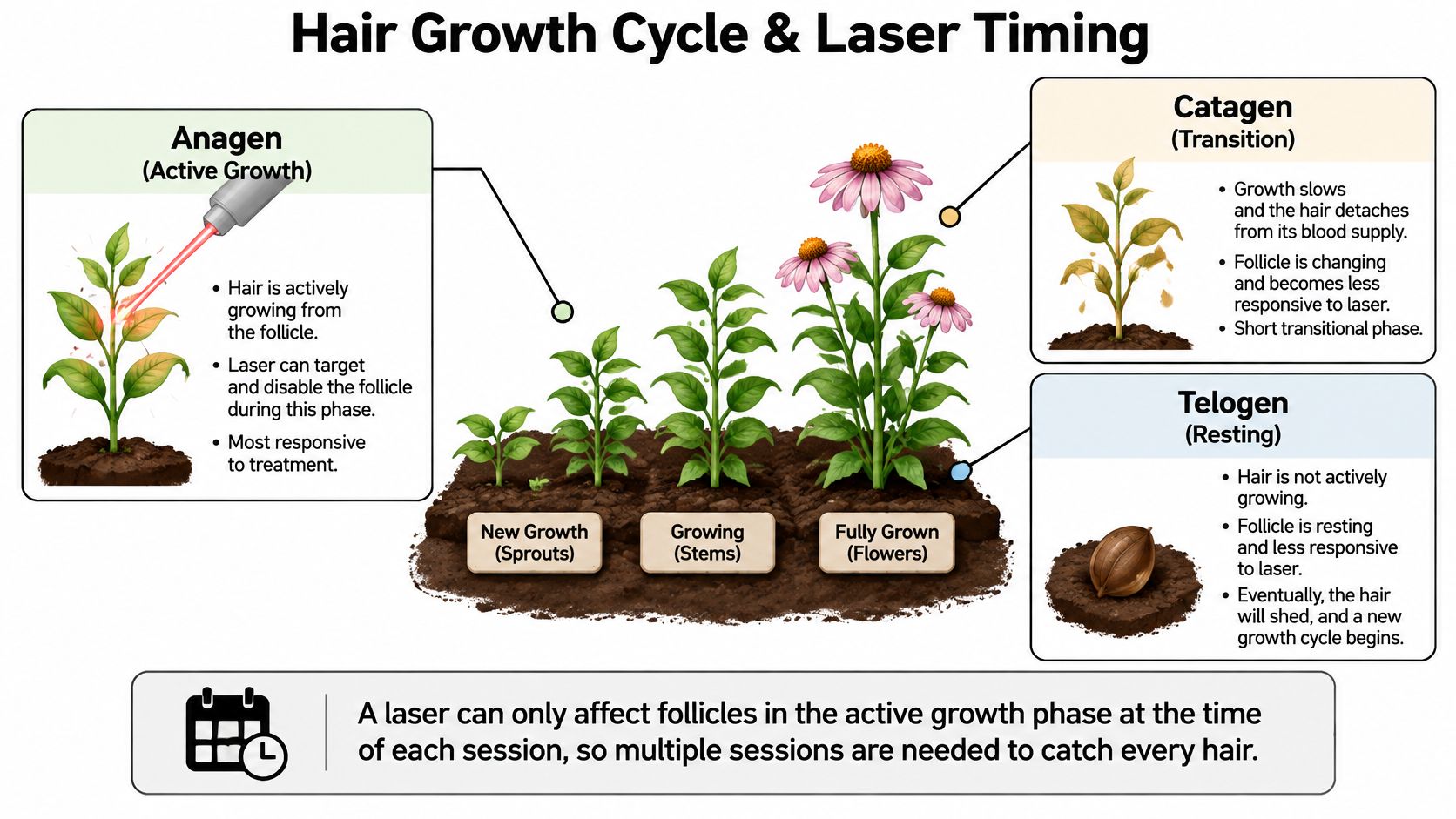
Why Only Some Hairs Respond at Each Visit
Laser energy is absorbed primarily by melanin in the hair shaft and follicular structures. Treatment works best during anagen, the active growth phase, when the follicle contains more pigment and stays connected to the dermal papilla. Hairs in catagen or telogen often take too little heat to destroy the follicle. They become candidates on a later cycle, once they return to active growth.
That limit is why the recognized outcome is permanent hair reduction. FDA documentation defines it as a long-term, stable decrease in the number of regrowing hairs, assessed at 6, 9, and 12 months after treatment concludes. How far apart visits should sit is a separate clinical judgment. It follows the growth speed of that body area. It is not a spacing schedule set out in that clearance file.
The idea of one session count for every client holds only in a narrow case. Coarse, well-pigmented hair on the trunk and limbs spends long stretches at rest, so a wider gap lets dormant follicles enter anagen before the next pass. The same schedule breaks on the face, where cycles turn over faster and visits need to sit closer together. It breaks again on the chin and jaw when hormones keep forming new hairs after a series already looks successful. Pale or lightly pigmented hair is a different failure mode: less melanin means less heat in the follicle, whatever the calendar says.
Judge progress by density, speed, and texture. Fewer hairs, slower regrowth, and finer residual hair are the signs of success. The endpoint is a stable reduction.
Session spacing and resting periods by body area
Body area | Typical gap between sessions | Resting interval between growth cycles |
|---|---|---|
Face | Closer spacing, matched to faster visible regrowth | Shorter cycle than the trunk and limbs |
Underarms, bikini line, legs, chest and back | Longer gap so resting follicles can enter a treatable phase | Longer rest than facial hair, so early repeat visits miss dormant follicles |
Chin and jaw (hormonally influenced) | Often needs maintenance after the series | New growth can continue because hormonal stimulation does not stop when the series does |
Signs a Series Is Working
If you're weighing how settings change with pigment, a primer on laser hair removal for different skin tones helps you separate device claims from what a consultation should assess. Your own checkpoints are simpler. You're looking for change that stays stable between visits, not a smooth week followed by full regrowth.
At the 6, 9, and 12-month marks after a series, a working result looks like this.
Reduced density: Whole patches stay clear, and regrowth covers less of the treated area than before.
Slower regrowth: You shave less often because returning hairs take longer to appear above the skin.
Finer residual hair: Hairs that do return are thinner and softer than the coarse hair you started with.
Predictable maintenance: Chin and jaw hair may need periodic sessions, but each visit treats less hair than the first series did.
Hormonally influenced follicles on the chin and jaw are the main exception to a neat finish line. A series can still thin that hair and slow what returns. New follicles can appear later because the hormone signal remains, so a maintenance visit there is the growth pattern of that area, not evidence that the earlier sessions failed.
How Painful and Risky Laser Hair Removal Really Is
Unbearable is the myth. Typically, the sensation is a quick snap, similar to a rubber band flick, delivered in short pulses. It isn't comfortable, but unbearable overstates what the measured evidence shows.
The treatment below gives you a realistic sense of pace and positioning during a session.

A 2025 clinical study in Lasers in Medical Science followed 60 patients receiving three laser hair-removal sessions and found average discomfort of 2 out of 4. That's a midpoint score, not a ceiling. Your experience will shift with body area, pulse settings, and your own pain tolerance. The bikini line and upper lip usually feel sharper than the legs or forearms. Cooling and topical numbing, where your provider offers them, reduce the sting.
Risk follows a similar pattern. A 2024 case-control study in Lasers in Medical Science evaluated 16,900 laser hair-removal patients over one year and found a complication incidence of 0.69%. Complications happen, but they're uncommon. For a fuller picture of reactions and recovery, see our guide to the side effects of laser treatment.
Normal Discomfort Versus Warning Signs
Mild warmth and redness that settle are expected. Three symptoms aren't, and you should report them promptly.
Blistering: Raised blisters or broken skin in the treated area.
Persistent color change: Dark or light patches that don't fade as expected after the session.
Severe ongoing pain: Pain that continues or worsens rather than easing after treatment ends.
This short video walks through what a typical appointment involves.
Your practical steps are simple. Report unusual symptoms instead of waiting them out. Follow aftercare instructions. Choose a provider who explains settings in advance, so you know what sensation to expect and what counts as a reason to call.
Paradoxical Hair Growth by Treatment Area
Online advice splits into two extremes. One says laser cannot increase hair. The other says it routinely makes hair thicker. The first fails on the face and neck. The second fails almost everywhere else.
Paradoxical hypertrichosis is an unexpected increase in hair after laser or intense pulsed light. A 2021 systematic review and meta-analysis in Aesthetic Surgery Journal pooled 9,733 patients from two randomized controlled trials and 20 cohort studies and estimated 3%, with a 95% confidence interval of 1% to 6%. Read that interval before the headline. It is wide, so the true rate is uncertain, and the pool mixes sites that do not share one risk.
Where the Risk Actually Sits
Site is the split that matters. In that same analysis, paradoxical hypertrichosis outside the face and neck occurred in 0.08% of cases. Events clustered on the face and neck. A body-wide percentage therefore overstates risk for legs or underarms and understates it for the jaw, cheeks, and neck.
Site rule: Treat paradoxical growth as a face and neck question first. For most other areas, the documented rate is a fraction of one percent.
Risk also runs higher with facial or neck treatment and in patients with darker or more pigment-rich skin. Informed consent and individualized settings matter most in those cases. For the front or back of the neck, the overview of laser hair removal on men's necks covers how that area is handled. Do not mix this unintended effect with treatments built to stimulate growth, such as low level laser therapy for hair, which pursues the opposite goal with different technology.
Fine hair is where the "thicker afterward" warning is most worth taking seriously. Light, fine hair on the cheeks or jawline is a poor match for a treatment that depends on dark, coarse pigment in the follicle. Ask whether that hair should be treated at all, and ask for a small test on the face or neck, reviewed before a full session. A test gives evidence about one person's response. If surrounding hair later looks denser, the plan should be reassessed rather than intensified by default.
Sun protection around treatment remains a sensible habit. It is not proof that avoiding the sun prevents paradoxical growth.
Skin Tone, Hair Color and Who Should Avoid Treatment
One setting for every complexion is where this myth breaks. The problem is competing melanin absorption. Pigment in your epidermis can absorb laser energy meant for the follicle, and that raises the risk of burns or post-inflammatory hyperpigmentation when wavelength, fluence, pulse duration, and cooling are poorly selected.
That risk doesn't amount to a ban on treating darker skin. A systematic review of 12 comparative trials in Journal of Cosmetic and Laser Therapy involving Fitzpatrick skin types III to VI found broadly similar outcomes across several in-office laser and IPL approaches. Long-pulsed Nd:YAG showed a lower pooled odds of post-inflammatory hyperpigmentation than IPL, with an odds ratio of 0.26 and a 95% confidence interval of 0.10 to 0.78. For darker skin, longer wavelengths, longer pulse durations, effective epidermal cooling, and conservative test areas are the recommended safeguards.
Candidacy Checks to Run Before You Commit
Hair contrast is the other half of the equation, and it doesn't bend to marketing. Dark, coarse hair provides more follicular melanin for selective photothermolysis. Blond, gray, or white hair may respond poorly because there's little pigment to target, a limitation we explain further in our article on white hair and laser treatment.
Bring this checklist to your consultation.
Hair color and thickness: Dark, coarse hair is a strong target. Blond, grey, or white hair is a true limitation, not a settings problem we can promise to fix.
Recent tanning: You must avoid sun exposure for 2 weeks before treatment, because tanned skin changes how epidermal pigment absorbs energy.
Pregnancy: We don't recommend laser hair removal treatments for pregnant clients, so timing moves until after pregnancy.
Medications: You must not be on medications such as Accutane, Retin-A, or Gold Therapy at present or within the past 6 months before treatment. Bring a current list rather than relying on memory.
"Safe for all skin tones" isn't a blanket guarantee. It's a claim that has to be matched to your skin, your tan history, and a specific device setting.
For Long Island's diverse skin tones, the useful question at consultation is direct. How will the device and settings be matched to my skin? A good answer names wavelength choice, pulse duration, cooling, and whether a conservative test area comes first. It also covers strict sun avoidance and realistic session timing. If the answer is that everyone gets the same setup, you've learned something important.
Preparation Mistakes That Undermine Results
Waxing or plucking between sessions looks tidy, and it's the most common way clients sabotage a series. Laser treatment needs the hair at skin level to target the follicle. Pull the hair out by the root and you've removed the target the next session depends on.
This checklist sums up the three habits that protect your result.
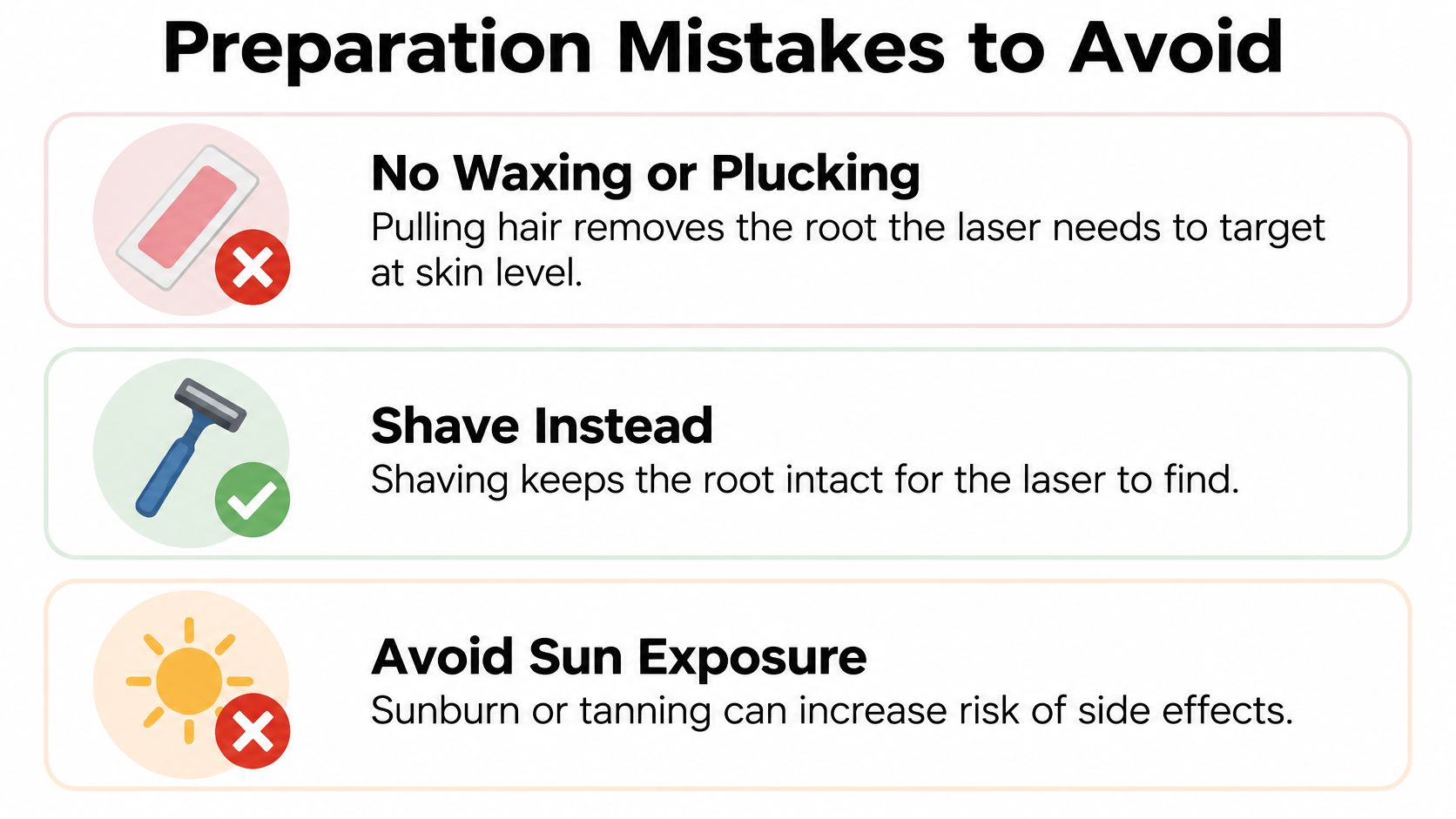
The Five Preparation Steps
Stop root removal early: Avoid waxing, plucking, threading, or electrolysis for 4 to 6 weeks before treatment. The common slip is one last tidy-up wax two weeks out, which leaves follicles without a target.
Shave to skin level: Shave the area before treatment, though a day's hair growth may be helpful so the area is easy to recognize. Shaving too close or rushing with a dull razor irritates skin we'd rather treat while it's calm.
Arrive with clean skin: The treatment area must be fully washed and free of makeup and medication before treatment. Leftover products sit between the device and your skin and muddy what we can see.
Keep out of the sun: Avoid sun exposure for 2 weeks before your session. Skipping this step raises pigment-related risk and can force us to reschedule.
Review your medications: Go through current medications with us before treatment. A product you consider routine can change whether it's safe to proceed that day.
Shaving between sessions is fine, and it's the method to use. It trims hair at the surface while leaving the root in place for the laser to find. That single swap, razor instead of tweezers, protects weeks of progress.
On the day itself, the goal is unglamorous. Your skin should look calm, clean, and unexposed, with hair at skin level and nothing sitting on the surface. Arrive that way and the session tests the laser, not your preparation.
Confirm Your Candidacy Before You Book
Laser hair removal reduces hair durably, and the right setup depends on your skin tone and hair color. That one sentence decides whether you're a strong candidate, a cautious candidate, or someone who should wait.
Sessions fit most schedules because the downtime after treatment is typically none. The harder part isn't recovery. It's matching device, settings, and spacing to your follicles before the first session starts.
Your First Consultation Checklist
During our initial consultation, our experienced professionals assess your skin type and hair color to create a personalized treatment plan. Bring specific questions, and you'll leave with specific answers.
Device fit: How will the device and settings suit my skin tone and hair color?
Expected course: How many sessions should I plan for this body area, and what maintenance visits follow?
Symptoms to report: Which reactions, such as blistering, persistent color change, or pain continuing after the session, should prompt a call?
Test area: If I'm treating my face or neck, how will a small test area be handled and reviewed first?
Our center is located at 355 Post Avenue, suite 102, Westbury, NY 11590, so Long Island clients can start with a consultation before any session. Bring a current medication list. That one page lets us confirm candidacy, check the timing issues that delay treatment, and set realistic expectations for your area.
If you're ready to separate laser hair removal myths from your own candidacy, NYC Laser Hair Removal will assess your skin type and hair color and build a personalized plan around durable reduction, not promises of zero hair forever. Book your consultation, bring your medication list, and get clear answers on settings, sessions, and maintenance before you commit. Start today by visiting NYC Laser Hair Removal.
Comments