
Back Laser Hair Removal: Sessions, Prep and Costs
What if the number of sessions quoted for a small area tells you almost nothing about your back? Back laser hair removal covers a large surface, the hair is often dense and uneven, and the published evidence specific to the back is thinner than most ads suggest. You'll get a clearer plan if you start with the session count, understand what the numbers can and can't prove, then work through prep, the appointment itself, and the safety questions worth asking before you book a package.
How Many Back Laser Sessions You Need
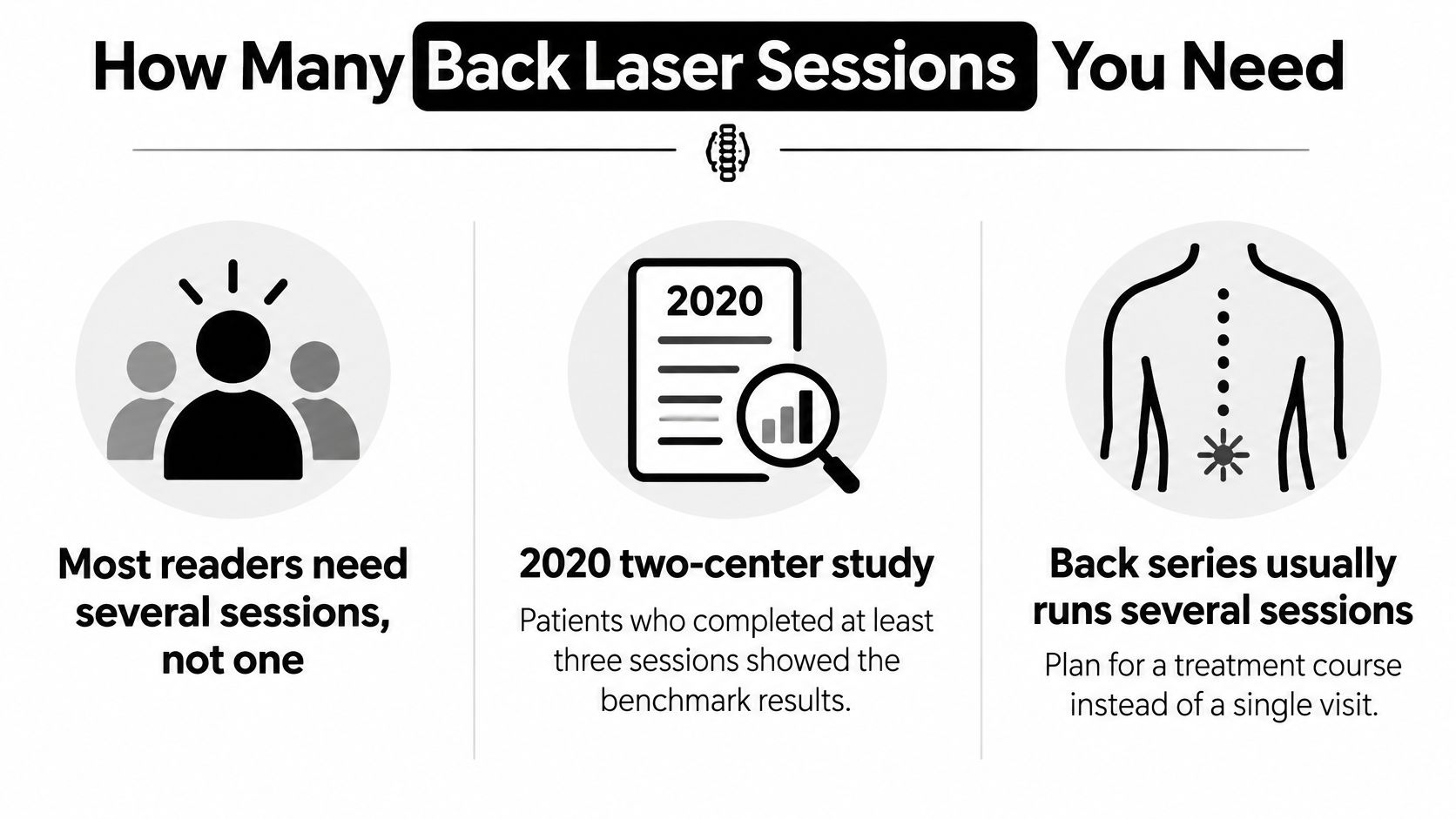
Plan for several sessions, not one. Laser energy works best on hair in its active growth phase, and back follicles don't move through that phase together. One visit can only affect the follicles that are susceptible on that day, so the next visits catch a different share as they cycle in.
That timing problem is why a single impressive photo after one treatment doesn't answer your main question. You need to know how reduction builds over a course and how long you're asked to wait between visits.
What the benchmarks actually show
The 2020 two-center study of long-pulsed 755-nanometer treatment included 948 patients treated on areas including the back, and among 574 patients who completed at least three treatments the average was 5.31 sessions, with a range of 3 to 16 treatments. Physicians in that study reported 75% to 100% clearance for 74% of those evaluated, while patients reported comparable clearance for 48%. That gap matters. It tells you the clinician's hair count and your own sense of "clear enough" aren't the same measure, so ask how progress will be judged at your review.
Read those figures with care. The study cautioned that physician-rated back cases were too few for a separate back conclusion, so the whole-study result isn't a back-specific guarantee. It's a useful planning benchmark, not a promise for your shoulders, mid-back, or lower back.
Earlier work points in the same direction, even when the percentages are lower. The 2006 evidence-based review summarizing back and extremity treatment reported about 28% to 33% reduction after one treatment and 34% to 53% after two treatments. If you're judging a series, a two-session result is an early checkpoint. It is not the finish line, and it won't tell you how the back will look after a full course.
Two narrower benchmarks help you picture the middle of a course, though neither replaces a back-only trial. The 2023 Journal of Cosmetic Dermatology diode study on men's trunk areas, including the back recorded 80.6% mean hair reduction after four sessions spaced 40 days apart. The 2025 Archives of Dermatological Research rotational multi-laser study across areas including the back reported 75.07% reduction six months after three sessions. Both covered mixed sites or a trunk area, so treat them as evidence that reduction can build, not as your expected result.
Study benchmark | Treatments | Reported result | Study type |
|---|---|---|---|
Back and extremities, early controlled review, mixed areas | 1 | 28% to 33% reduction | Controlled review |
Back and extremities, early controlled review, mixed areas | 2 | 34% to 53% reduction | Controlled review |
Men's trunk including back, diode laser, mixed trunk sites | 4, 40 days apart | 80.6% mean reduction | 2023 clinical study |
Multi-area including back, rotational multi-laser, mixed sites | 3, assessed at six months | 75.07% reduction | 2025 study |
Two-center study, patients completing 3 or more treatments, mixed areas | 5.31 average, range 3 to 16 | 74% physician-rated 75% to 100% clearance | 2020 study |
How to turn benchmarks into your calendar
Back sessions are normally spaced about 4 to 6 weeks apart, so even a first course stretches across several months. If you picture a course of at least 4 to 6 sessions, you're looking at a season-long commitment rather than a quick fix before next month's vacation. That's normal, and it gives untreated follicles time to enter a phase where they can respond.
Several variables move your personal count up or down:
Hair color and thickness: Darker, coarser hair gives the laser more pigment to target.
Density and distribution: A back with thick shoulder patches and sparse areas elsewhere may not clear evenly at the same pace.
Skin type: Your skin tone shapes wavelength and starting settings, which can affect how aggressively the team can treat.
Laser type and settings: Wavelength, pulse duration, cooling, and fluence all influence the balance between effect and skin protection.
Practical rule: Budget time and money for an initial course, then review hair count around the six-month mark before deciding that you're done or that maintenance is needed.
You'll also see people mix back treatment with other grooming choices while they wait between sessions. If you're comparing methods for sensitive areas at the same time, gentle grooming advice from ArtNaturals can help you think through irritation and method choice, but don't let a cream or trimmer routine replace the prep rules for your laser series. Your back course needs its own timeline, and that's where the next set of decisions begins.
Prep Timeline for the Weeks Before Treatment
Work backward from your appointment date. Most prep mistakes aren't dramatic. Someone waxes a patch to look tidy, spends a weekend shirtless in the sun, or forgets to mention a medication, and the session has to change or move.
Timing | What to do | Why it matters |
|---|---|---|
6 months before | No Accutane, Retin-A, or Gold Therapy now or in the past 6 months | Medication changes skin response |
4 to 6 weeks before | No waxing, plucking, threading, or electrolysis. Optional hydroquinone after consultation | The follicle must stay intact for the laser |
2 weeks before | Avoid sun exposure on the back | Lowers burn and pigment-change risk |
Day before or morning of | Shave to skin level. A day's growth helps the team see the area | Laser needs hair at skin level |
Day of treatment | Wash the area. No makeup or medication on it | Clean skin for safe pulses |
Six months and four to six weeks out
We need you off medications such as Accutane, Retin-A, or Gold Therapy at present and within the past 6 months before treatment. Bring a current medication list to the consultation rather than trying to recall names from memory. If you're unsure about a prescription or a topical product, ask before your prep window starts. Guessing on the day wastes the appointment.
From 4 to 6 weeks before treatment, stop waxing, plucking, threading, and electrolysis. The reason is simple. The laser needs the follicle in place to target it, and those methods remove or disrupt what the pulse is meant to reach. Shaving is different because it leaves the follicle below the surface.
If you can't avoid waxing for four weeks, rebook rather than rushing the appointment. A delayed session is cheaper than a session delivered when the target isn't there.
Some clients discuss an optional skin bleaching cream such as hydroquinone, which may be started 4 to 6 weeks before treatment after consulting a technician. Don't start it on your own because you read it online. Ask whether it fits your skin type, your pigment risk, and the settings being planned for your back.
For a fuller list of habits that can interfere, read our guide on what not to do before laser hair removal before you lock in the date. That check is most useful at the start of the prep window, not the night before.
Two weeks out and the day itself
Avoid sun exposure on your back for 2 weeks before treatment. A back is easy to tan without noticing, especially if you work outdoors, run shirtless, or spend an afternoon at a Long Island beach. Tell the team if that happens. Tanned skin changes the risk discussion and may mean postponing or altering settings, and the safety section below explains why that decision protects you.
Shave the treatment area to skin level before treatment. A day's hair growth may be helpful so the area is easy to recognize, which is useful on a back where density changes from the neckline to the waistband. Because shaving your own back evenly is difficult, plan help from a partner or use a back shaver with a fresh blade and a mirror. Don't press hard to get a perfect shave. Nicks and razor burn give the team irritated skin to work around.
On the day, the treatment area must be fully washed and free of makeup and medication. Skip lotions and medicated creams on the back that morning unless the team told you otherwise. Arrive with clean, dry skin and a loose shirt you can change out of easily.
Pregnancy also belongs on your prep checklist because it's a reason to postpone the series. Tell the team before booking if that applies to you, rather than waiting until you're in the treatment room.
What Happens During a Back Treatment Session
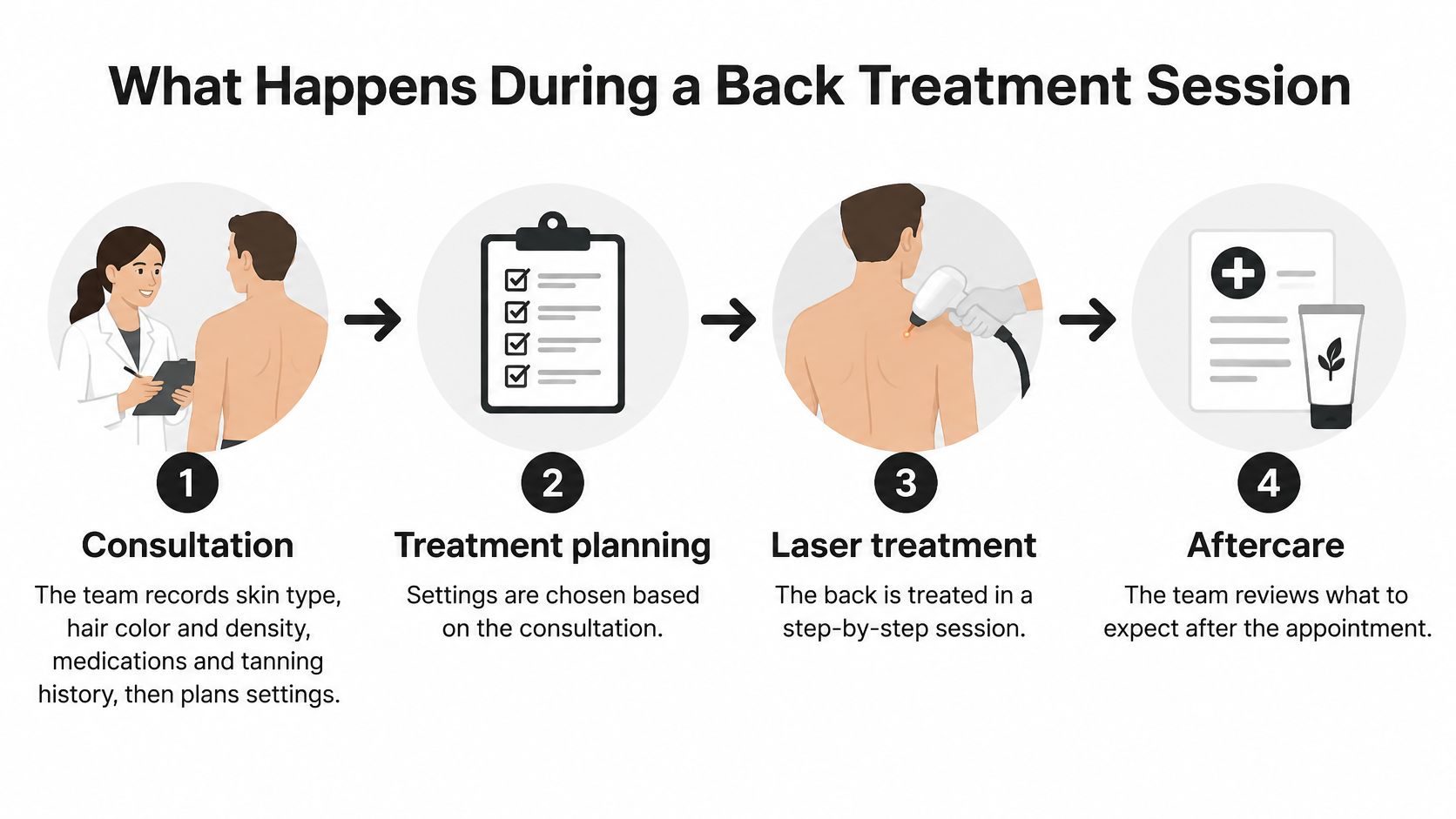
A back session has a clear order, and each step solves a specific problem. Once you know the order, the appointment feels less mysterious and you can spot a rushed process. The first visit usually includes the most discussion because the team has to learn your skin, your hair, and your medical background before choosing settings.
The overview below shows how a session moves from consultation to aftercare.
Before the first pulse
Consultation. During the initial consultation, our experienced professionals assess your skin type and hair color to create a personalized treatment plan. The team also records hair density, medications, tanning history, and conditions that may affect hair growth. Those answers drive the settings, so a short answer like "I'm not on anything" isn't enough if you're using a prescription cream.
Prep check. The technician confirms the back is clean and shaved. Laser treatment needs the hair at skin level to effectively destroy the hair follicle, so long surface hair works against you. If patches were missed during home shaving, say so. It's easier to fix before treatment than to discover uneven coverage later.
Protection and mapping. Eye protection goes on before any pulse and stays on throughout. The back is then worked through in mapped sections, which matters because it's a broad area you can't see yourself. Mapping lowers the chance that a strip along the spine, shoulder blade, or flank is skipped or treated twice by mistake.
Pulses, endpoints, and pacing
Laser passes. The technician selects a wavelength and pulse duration suited to your skin and hair combination, then delivers overlapping but not excessive passes with cooling. Say your upper back is dense and coarse while the lower back is finer. The team may need to treat those zones with the same map but different attention, rather than sweeping the whole back at one mindset and calling it even.
Many clients describe brief snaps of warmth. Tell the technician if one area feels sharply hotter than the rest instead of enduring it without comment. Feedback about heat helps the team check cooling, contact, and settings before irritation builds across a large area.
If you're trying to fit the visit around work, our explanation of how long a laser hair removal session takes will help you plan the rest of your day. A full back naturally takes longer than a lip or underarm because there's more surface to map and cover, so don't schedule it as if it's a five-minute stop.
Endpoint check. The team watches the skin response as they work. Mild redness, called erythema, and swelling around follicles, called perifollicular edema, are the expected endpoints that suggest energy reached the follicles. If the skin reacts beyond that level, settings should be adjusted rather than pushed through to finish the map on time.
The video below gives you a visual sense of the treatment room pace before your first visit.
After the session ends
Aftercare and next booking. You'll review sun protection, what normal redness feels like, and when to call if the reaction looks stronger than expected. The stated downtime after a laser hair removal treatment is typically none, so most clients return to routine activities the same day. The next session is usually set about 4 to 6 weeks later, in line with the spacing used for a course described in the Laser in Medical Science review of treatment protocols, which also describes an initial course of at least 4 to 6 treatments.
Wear a clean, loose shirt home so fabric doesn't rub the treated skin. Don't judge the result that evening. Treated hairs shed over time, and a back is hard to inspect without a mirror and good light, so early impressions can mislead you.
Ask these three questions before your first session ends:
How do you map my back so shoulders, spine, and flanks are all covered once?
Which settings are you starting with for my skin and hair, and what would make you change them?
What endpoint are you watching for on my skin, and how will I recognize it at home?
Clear answers to those questions tell you more about the quality of care than a promise that every hair will be gone.
Who Qualifies, Safety Limits and Side Effects
"Can anyone get it?" is the wrong first question. The better question is whether your skin tone, recent sun, hair color, medications, and pattern of back hair make treatment sensible now, sensible with altered settings, or better postponed. That distinction matters more on the back because a large area gives an incorrect setting more room to cause trouble.
Who is a good candidate and who should wait
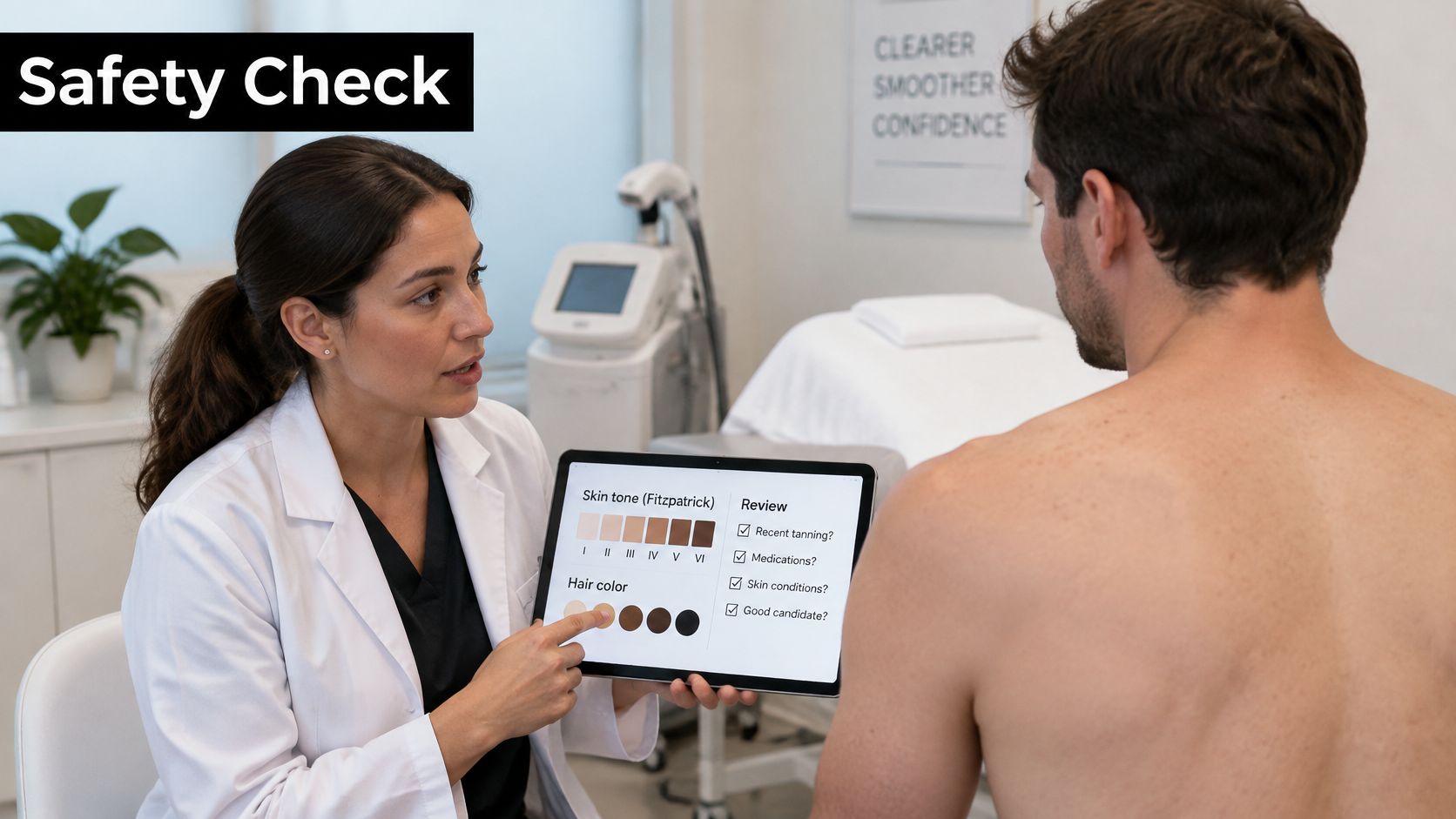
The team checks your Fitzpatrick skin type, recent tanning, hair color, density, medications, keloid risk, and conditions that may cause excessive hair growth before choosing settings. Dark, thick hair generally gives the laser the clearest target. The Mayo Clinic laser hair removal overview summarized in consumer guidance notes laser can be used on black or brown skin when performed by an experienced professional, while darkening or lightening is more likely in darker skin and after sun exposure, and it recommends protecting treated areas from the sun for six weeks or as directed. Blonde, gray, white, and red hair respond less reliably, so a salt-and-pepper back may thin unevenly, with the dark hairs reducing while gray hairs remain.
That's a common source of confusion. "The laser didn't work on me" can mean it worked on the pigmented hairs and had little to target in the gray ones. Ask the team to estimate your mix before you buy a package designed around complete clearance.
Our treatments are not recommended for pregnant clients, so pregnancy means postponing the series. Significant recent tanning is another reason to wait. A safer workflow for darker or tanned skin is to defer treatment, verify skin type and sun exposure, start conservatively, use a test area when indicated, cool effectively, and increase fluence only when the skin response justifies it.
For deeper skin, clinicians often favor long-pulsed 1064-nm Nd:YAG for greater epidermal safety. The systematic review of skin types III to VI found lower post-inflammatory hyperpigmentation odds versus IPL for long-pulsed Nd:YAG, with an odds ratio of 0.26. Lower odds aren't no risk. Burns and pigmentary change remain possible if epidermal pigment absorbs too much energy, which is why conservative starting parameters and cooling aren't optional extras on a large back.
Avoid treating over tattoos, and expect strict eye protection at every visit. Ocular injury is a recognized serious risk when protection or treatment boundaries are inadequate, so don't treat the eyewear as a formality. If you want a broader checklist, our overview of side effects of laser treatment is worth reading before your consultation.
Normal reactions versus warning signs
Transient redness and perifollicular swelling are expected after treatment. Common reactions usually last one to three days, and a back may feel warm or look blotchy around dense follicles during that window. Loose clothing, sun protection, and patience handle most of it.
Call promptly for assessment if you see:
Blistering or crusting rather than simple redness
Pigment change that persists or spreads beyond treated follicles
Scarring, severe pain, or broken skin
New or coarser growth appearing in or around the treated area
For wider context, a 2024 case-control study of 16,900 laser hair-removal patients reported a 0.69% complication incidence for laser hair removal generally, not back treatment alone. That figure can reassure you that serious complications aren't the usual outcome under proper care, but it can't tell you your personal risk from a tanned back, aggressive settings, or an unreported medication.
Sorting rule: Redness and small bumps around follicles that settle are an endpoint. Blistered, crusted, or persistently discolored skin is a clinical problem to report, not something to cover with a shirt and ignore.
The back-specific risk men should discuss
Can laser make back hair thicker? Usually the goal and result is reduction, but paradoxical hypertrichosis means unexpected increased or coarser hair growth after treatment. The 2025 retrospective study of paradoxical hypertrichosis found it occurred in 33.3% of men versus 9.0% of women among 318 patients, and the back was the most affected male treatment area at 10 of 63 men, or 15.9%. The same source describes a separate 2025 analysis of 7,381 patients that identified 25 cases, an overall rate of 0.34%, and found daily sun protection was associated with lower incidence with an odds ratio of 0.41.
Those two percentages look contradictory until you notice they describe different patient groups and methods. The lesson isn't that every man faces the higher figure. It's that risk may not be evenly distributed across body sites or patient groups, and dense male back hair deserves its own conversation. Higher terminal-hair density, androgen-driven follicular activity, and suboptimal fluence may contribute, although the mechanism remains uncertain.
Don't confuse normal shedding with true increased growth. Early in a course, treated hairs loosen and shed, and untreated hairs keep cycling, so the back can look patchy or temporarily busy under close inspection. True paradoxical growth is new, finer, or coarser hair developing in untreated peripheral skin or becoming more noticeable around the treated zone over time. Take a dated photo in the same light each month if you're concerned. Memory is unreliable for an area you rarely see directly.
For dense male back hair, ask for candidacy screening and a conservative test spot before committing to the whole map. Ask how settings will be adjusted if peripheral hair appears, and report new growth early rather than requesting extra passes to chase it. More energy isn't automatically the correct response, and extra passes across a large reacting back can create the pigment or burn problems you were trying to avoid.
Long Island seasonality matters too. If your series runs into summer, your back is harder to shield at the beach, on a boat, or during outdoor work. Plan sessions around vacations and heavy sun exposure, protect the area daily, and tell the team when sun happens anyway. Honest scheduling is part of safety, not a failure of discipline.
Book Your Back Treatment in Westbury
Your zone choice decides the per-session price before any package is discussed. A full back falls under Extra Large, while an upper back or lower back alone falls under Large. If your hair is concentrated across the shoulders and upper spine, you may not need to pay for the full map. If it runs from neckline to waistband, the full-back zone is the honest comparison.
Zone size | Areas included | Listed price |
|---|---|---|
Small | Lip, chin, sideburns, cheeks, ears, areola, feet, hands, happy trail | $25.00 |
Medium | Underarms, bikini line, neck, shoulders, half arms, belly line | $39.99 single session |
Large | Upper back, lower back, chest, abdomen, legs, Brazilian, full arms, buttocks | $65.00 |
Extra Large | Full back, full legs, chest and abdomen, Brazilian, buttocks | $99.99 per session |
Extra Large course, 3 sessions | Full back package | $299.97 at listed per-session rate, confirm package total at booking |
Extra Large course, 6 sessions | Full back package | $599.94 at listed per-session rate, confirm package total at booking |
Single sessions and 3- or 6-session packages are available. Use the table to estimate a full course by multiplying the Extra Large listed price by the 4 to 6 sessions in an initial course, then confirm the current package total at booking because package pricing can differ from simple multiplication. Don't compare a one-session price from one clinic with a six-session package from another. You're buying a course of back laser hair removal, so compare the total course, the zone boundaries, and the review process.
Clinics that publish clear zones make that comparison easier for you as a buyer. Owners thinking about how clear pricing shapes inquiries can learn from marketing strategies for laser hair removal, but as a client your job is simpler. Confirm whether shoulders are included in your back zone, where the lower boundary stops, and what happens if you need to pause for tanning.
Our clinic is in Westbury, NY 11590, serving Long Island and Nassau County. We're open Monday through Saturday, 10am to 6pm. You can call 516-321-4959 or email INFO@NYCLASER.COM to book a consultation, bring your medication list, and schedule the first session once your prep window has started.
Book a consultation for back laser hair removal at our Westbury clinic, where we'll map your upper, lower, or full back, check your skin type, hair color, medications, and sun exposure, and give you a realistic session plan before you commit to a package. Visit NYC Laser Hair Removal to choose your zone, confirm current single-session or package pricing, and reserve a time Monday through Saturday that fits your prep timeline.
Comments