
Laser Hair Removal Certified: What Each Credential Proves
“Choose a certified technician” is common advice for laser hair removal, but it leaves out the most important question: certified to do what, on which device, and for whose skin? A certificate can document training without proving that the operator has the right experience for your complexion or the treatment platform in the room.
If you're searching for “laser hair removal certified” providers on Long Island, look beyond the wording on the clinic's website. The useful evidence is specific: the credential's issuer, the operator's legal authorization, device-specific training, and experience treating skin like yours.
What Certified Means for Laser Hair Removal
Certified generally means a practitioner has documented training, and sometimes a state-issued credential, related to performing laser hair removal. It doesn't automatically establish legal authorization everywhere, competence on every platform, or a guaranteed result.
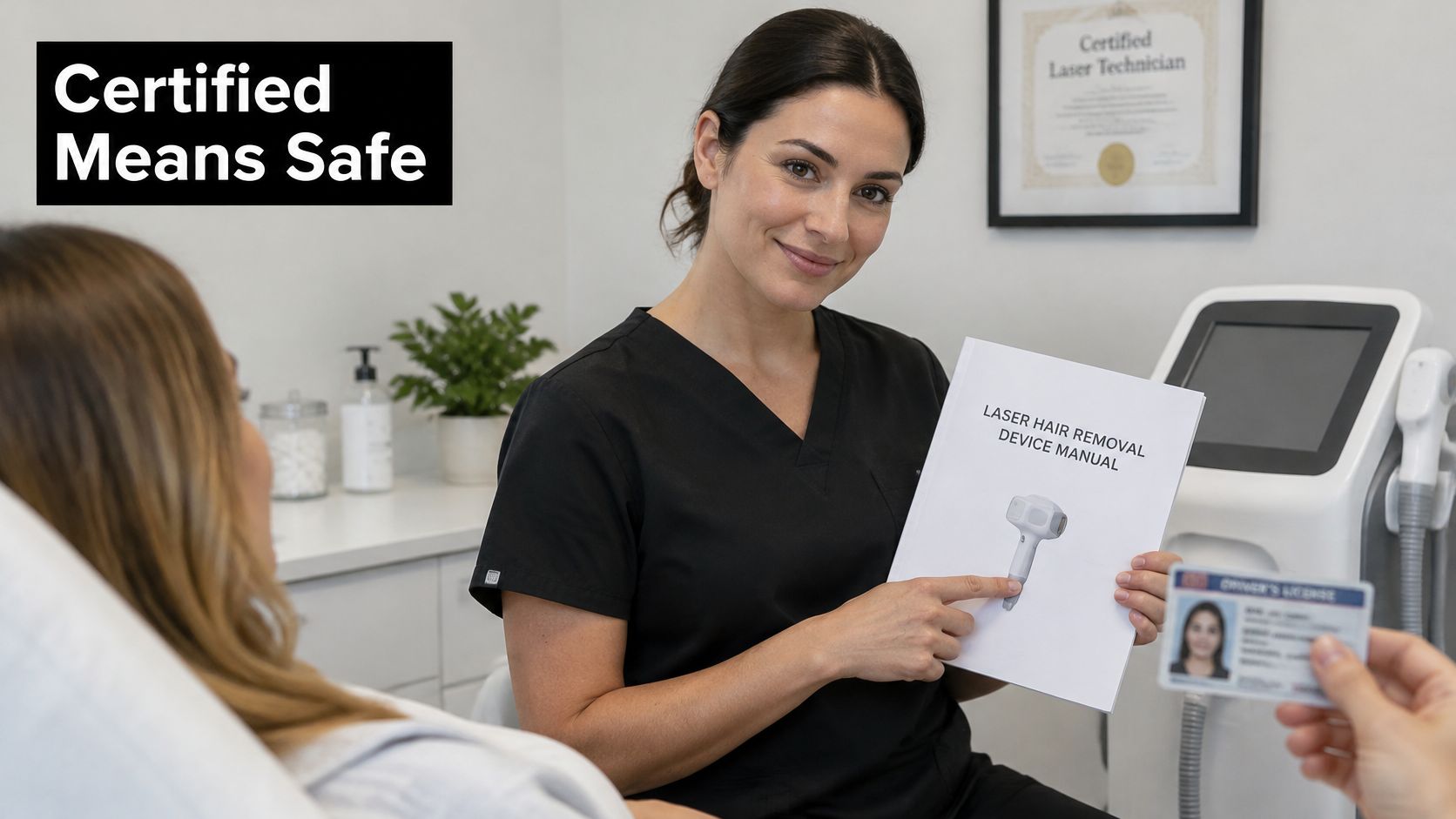
Think of a driver's license. It establishes a category of driving qualification, but it doesn't qualify someone to operate every commercial vehicle. Likewise, a course certificate for one laser platform doesn't establish hands-on competence with another.
The device manual and training record should be part of the conversation, not paperwork that stays out of sight.
Preparation Is Not a Results Guarantee
The distinction between permanent hair reduction and complete, permanent removal matters. The FDA definition describes a long-term, stable decrease in regrowing hairs, evaluated at 6, 9, and 12 months after a completed regimen; the American Academy of Dermatology's laser hair removal guidance also explains why treatment involves repeat appointments and why regrowth can occur.
A reduction claim describes fewer hairs growing back. It doesn't mean every treated follicle will disappear forever, and a practitioner's certificate cannot turn that distinction into a promise.
Hair color, thickness, skin tone, hormones, treatment settings, and the hair-growth cycle all affect the treatment plan. Say two people book the same body area with the same practitioner. Their preparation may be equally careful, yet their treatment schedules and eventual maintenance needs may differ.
Practical rule: Treat a certificate as evidence of preparation, not a warranty for your results.
What Meaningful Training Should Establish
A credible training record should address:
Device competence: Understanding the platform, its controls, and its treatment limitations.
Safety screening: Recognizing circumstances that call for postponement, adjustment, or clinical review.
Supervised practice: Applying classroom knowledge while an experienced practitioner evaluates technique.
Those categories give you something concrete to assess. A certificate that only confirms attendance tells you less than documentation showing what the practitioner learned and demonstrated.
Credentials to Look For, Compared
A certificate can show that someone completed training, but it does not establish skill with every device or suitability for every complexion. Check what the credential covers, then compare it with the operator's authorization, device training, and experience treating skin tones like yours.
Certification Requirements by Credential Type
Credential | Where It Applies | Core Requirement | What It Proves |
|---|---|---|---|
Apprentice-in-training certificate | Texas | An approved 40-hour training program and $50 application fee, according to the Texas application guidance | Entry-level training, not independent mastery |
Laser technician certificate | Texas | At least 100 procedures under direct supervision of a senior technician or certified professional, under the Texas technician statute | Supervised hands-on experience |
Senior laser technician certificate | Texas | Having supervised at least 100 procedures, under the 2024 Texas senior technician statute | Experience supervising procedures |
Renewal for any individual certificate | Texas | 8 hours of continuing education, according to the Texas renewal guidance | Ongoing education |
Electrologist laser route | Florida | Laser or light-based hair-removal coursework, a Certified Medical Electrologist examination, direct physician supervision, and use of devices the operator trained on | A supervised, device-specific route for certain electrologists |
Physician operator | Alabama | 8 hours of training per device | Device-specific physician preparation |
Level 1 delegate | Alabama | 12 hours of training per device, treatment observation, and 10 supervised cases | Supervised preparation for the device used |
Operator authorization | New York | A physician must perform the procedure or delegate it to an appropriately qualified person under physician supervision | Legal authorization depends on the operator's role and supervision |
Texas, Florida, and Alabama demonstrate different regulatory approaches. Their credentials do not establish New York authorization. A certificate earned elsewhere should be assessed separately from the legal basis for performing the procedure in New York.
Why the Exact Platform Matters
Laser treatment uses selective photothermolysis: pigment in the hair absorbs light and converts it to heat, damaging structures involved in follicle growth. FDA device documentation for a diode system describes operation around 808–810 nm. Wavelength alone, however, cannot establish that a treatment is appropriate or safe for a particular person.
The operator must also choose energy, pulse duration, spot size, and cooling settings. Because skin contains pigment too, a hair-removal preset is not a substitute for understanding how the device interacts with different skin tones.
Look for training that covers laser physics, tissue interaction, Fitzpatrick skin-type assessment, contraindications, eye protection, test spots, cooling, and management of burns or pigment changes. Ask whether the practitioner completed supervised treatments on the actual platform, rather than only watching a demonstration. A training certificate can document preparation, but it cannot guarantee results or prove experience with every complexion.
For a comparison of professional background and device training, read this explanation of the laser hair removal nurse.
New York and Long Island Rules That Affect Your Booking
FDA clearance belongs to the device. Legal authorization belongs to the operator and the practice arrangement. A clinic can use a cleared device without that clearance answering who may operate it or what supervision applies.
States generally determine those operator requirements. That's why a certificate issued in another state, a manufacturer's training document, and a professional license must be evaluated separately.
The Alabama laser-use rules illustrate how specific a state framework can be: physicians need 8 hours of training per device, while Level 1 delegates need 12 hours per device, observation, and 10 supervised cases. Those rules also address identifying complications and determining their causes, but they are not New York rules.
The Long Island Verification Test
Before booking in Westbury, Jericho, or elsewhere in Nassau County, establish these points:
Operator authorization: Get the operator's full professional identity and the legal basis under which they perform the procedure in New York.
Supervision arrangement: Establish whether supervision is required for that role and procedure, who provides it, and how that clinician is available.
Matching device training: Confirm that the training record corresponds to the platform that will be used.
Complication procedure: Find out who assesses an adverse reaction, how clinical help is obtained, and how follow-up is documented.
The state examples don't establish New York's current requirements. Confirm those directly with New York State licensing authorities, including the Office of the Professions when a licensed healthcare professional's credentials are involved. Don't assume there must be a standalone laser technician license because another state issues one.
A framed certificate, a clinic website claim, and a manufacturer's clearance are different documents. None substitutes for verifying the operator's legal role.
What a Clear Answer Sounds Like
A useful answer names the practitioner, identifies the credential or authorization being relied on, and explains the supervision arrangement without using vague phrases such as “medically approved.”
If a clinic says its medical director oversees treatment, ask what that means operationally. Is that clinician involved in assessment, available for complications, or only named on the website?
If the clinic cannot identify the relevant state authority and explain its supervision arrangement, treat the credential claim as unverified. That's a reason to pause, not an invitation to accept reassurance instead.
Certification and Darker Skin Tones
The assumption that laser hair removal is only for light skin and dark hair is too restrictive. Its opposite, that any certified operator can safely treat every complexion, is equally misleading.
Darker skin can be treated, but the practitioner must account for pigment in the epidermis as well as pigment in the hair. When skin absorbs unwanted energy, burns and temporary or lasting pigment changes become concerns, as discussed in the clinical review of laser hair removal across skin types.
Eligibility isn't the same as suitability for a particular device, setting, or operator. Someone can be an appropriate candidate for treatment while still needing a more experienced practitioner or a different treatment approach.
Test Experience Against Your Complexion
Ask about experience with Fitzpatrick skin types IV–VI, but don't treat the classification as a complete assessment. Your current tan, previous reactions, pigment-disorder history, and treatment area also belong in the conversation.
Consider a practical scenario: you have brown skin, recent sun exposure, and dark marks left by previous irritation. A credible consultation should address all of those details rather than assign a skin-type label and proceed directly to payment.
Useful questions include:
Comparable experience: Has the operator treated people with a similar complexion and pigment history?
Treatment adjustment: How would recent tanning change the decision to treat?
Protective measures: How will cooling and test-spot assessment fit into the plan?
Response planning: Who evaluates unexpected darkening or lightening afterward?
Expect an Individualized Course
For facial hair, hormonal influences can make the course less predictable, particularly when new growth continues to develop. A practitioner should separate the hairs being treated from the possibility of future growth rather than promise that treatment resolves every cause.
A cautious plan may involve gradual adjustments or a longer course. That's different from undertreating without explanation: the practitioner should tell you what they're balancing and how they'll evaluate progress.
Our guide to laser hair removal for brown skin can help you prepare complexion-specific questions. The important distinction remains documented experience with your skin, not a general claim that the machine works for everyone.
Don't accept “safe for all skin tones” as a substitute for an explanation of your own treatment plan.
Verify Credentials and Questions to Ask Before Booking
A certificate is a starting point, not a complete answer. Before paying for a package, ask who will treat you, what training they have on the device, and how the clinic decides whether that device and treatment plan suit your circumstances. Written answers make it easier to compare clinics, while a conversation with the treating professional can clarify clinical questions.
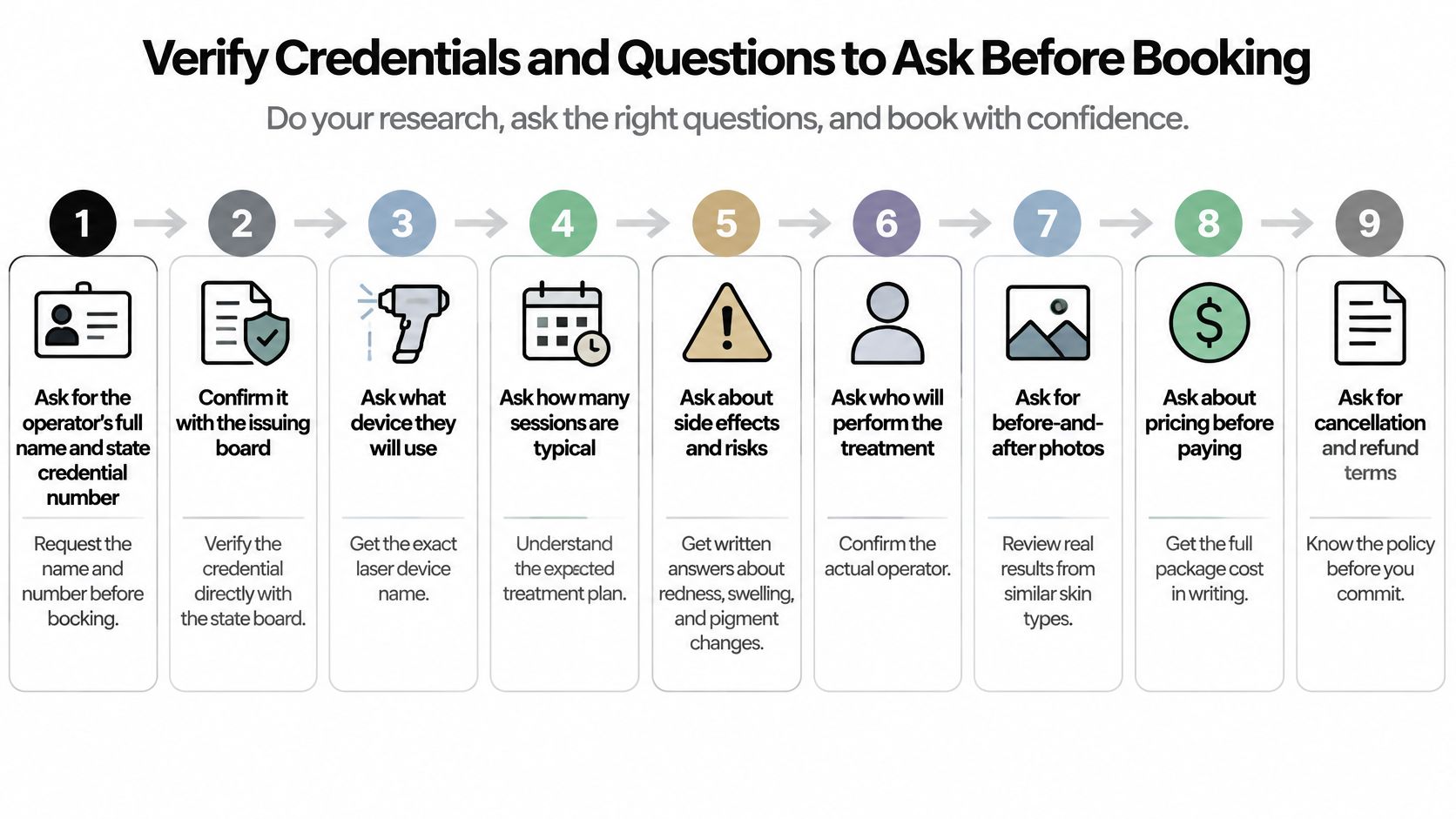
Use this visual to keep track of the details to confirm before booking.
Your Prebooking Checklist
Identify the actual operator. Request their full name, professional role, and state credential number where applicable. Confirm the credential with its issuing authority, and make sure the person scheduled to treat you is the person whose qualifications you checked.
Clarify clinical supervision. Ask for the supervising clinician's name, if applicable, and whether they will be on site or available remotely. A named medical director does not, by itself, tell you who can assess a complication during your appointment.
Match training to the device. Ask for the exact platform name and evidence of training on it. NYC Laser Hair Removal uses Splendor X for hair removal. General laser coursework does not show that an operator knows the controls, cooling, and treatment protocols of a particular platform.
Examine relevant experience. Ask about experience treating your treatment area and complexion, rather than relying on a career total alone. Specialist Tamar has over 17 years of experience as a laser hair removal specialist. That experience is useful context, but your consultation should still address your own suitability.
Review the screening process. During the initial consultation, experienced professionals assess your skin type and hair color to create a personalized treatment plan. Share your complete medication history. Clients currently using, or who have used within the past 6 months, medications such as Accutane, Retin-A, or Gold Therapy are not eligible for treatment. Do not stop prescribed medication to qualify without consulting your prescriber.
Request the treatment rationale. Ask why the proposed wavelength, energy level, and cooling approach suit your skin and hair. Mayo Clinic's laser hair removal guidance explains that skin type affects risk and that treatment should be selected appropriately. Include recent tanning, previous pigment changes, and whether a test spot is appropriate in the discussion.
Confirm session protection. Ask how suitable eye protection and cooling are used, and what sensations or changes you should report during treatment. You should know whom to alert rather than guess whether a reaction needs attention.
Get the adverse-reaction procedure. Request instructions for burns, blistering, or pigment changes, including whom to contact and how clinical assessment is arranged. Clarify which follow-up appointments are included and whether any could carry an additional charge.
Get a realistic written plan. Ask how the practitioner will assess progress, what might change the schedule, and how maintenance is handled. Obtain package pricing, cancellation terms, and refund conditions before committing.
Separate Booking Answers From Clinical Judgment
Reception staff can help with scheduling and administrative details; clinical questions about suitability, settings, and risks belong with the treating professional. Clinics may also use automated reception tools, such as Hyperleap AI for med spa reception, for administrative workflows. A booking response is not evidence of clinical qualifications, so confirm who will address your treatment questions.
Written answers help you compare clinics, but they do not prove that an operator is qualified for every complexion or that treatment will produce a particular result. Check the credentials, assess whether the explanation fits your circumstances, and use this guide to what to look for in a laser hair removal clinic to organize your questions. The embedded video can provide another point of reference, but it cannot assess your individual suitability. Bring any unresolved questions to the consultation and ask the treating professional to address them before you book.
Decide Before You Pay
Make your decision in this order: verify the operator's legal authorization, establish the supervision arrangement, and confirm training on the exact device. Verify professional credentials with the state; assess device-training records through their issuer and the clinic. Those are separate checks, not documents that all come from a licensing board.
For a local consultation, our center is at 355 Post Avenue, suite 102, Westbury, NY 11590. Call 516-321-4959 or email INFO@NYCLASER.COM to discuss booking and the information you should bring.
Compare Answers, Not Certificates
Before purchasing a multi-session package, compare written responses from another clinic. Look for specific explanations of your skin assessment, the proposed approach, and who takes responsibility if treatment doesn't go as expected.
Keep copies of the answers and their dates. If the scheduled operator or device changes, ask whether the relevant qualifications and treatment plan have changed too.
Before payment: Unverified authorization, unexplained supervision, or missing device-training evidence is a reason to postpone treatment.
A clear answer doesn't eliminate risk, but it gives you something you can evaluate. A vague answer leaves you buying reassurance. Choose the practice that explains its decisions and welcomes verification, not the one that expects a certificate on the wall to end the conversation.
NYC Laser Hair Removal offers laser hair reduction using Splendor X, with an initial skin-type and hair-color assessment to develop a personalized treatment plan. Visit NYC Laser Hair Removal to arrange a Westbury consultation and bring your questions about operator qualifications, device training, and treatment for your complexion.
Comments