
Best Laser for Hair Removal by Skin Type and Body Area
A pooled analysis of laser hair-removal trials found that three sessions produced 57.5% hair reduction with a diode system and 42.3% with long-pulsed Nd:YAG, measured at least six months after treatment, according to a meta-analysis of comparative laser trials. Alexandrite came in at 54.7%, ruby at 52.8%.
That ranking is the closest thing to a league table the evidence offers, and it collapses the moment you change the question. The device with the lowest average reduction is the one clinicians reach for on darker skin, because its longer wavelength skips past epidermal melanin instead of heating it. Efficiency and safety pull against each other, and no brand name resolves that tension.
What follows is how the trade-offs break down by wavelength, skin tone, body site, comfort and price, including the one risk most comparison pages skip entirely.
Best Laser for Hair Removal at a Glance
Wavelength is a useful starting point, not a universal ranking. The best choice depends on how the laser interacts with skin pigment and hair, as well as the treatment area and the settings selected for each client.
Laser technologies at a glance
Technology | Wavelength | Best-fit skin tone | Where it works best | Main trade-off |
|---|---|---|---|---|
Diode | about 800 nm | Lighter to medium skin with clear hair-skin contrast | Legs, arms and larger body areas | Settings must be matched carefully to darker skin |
Alexandrite | 755 nm | Lighter to medium skin | Dark, coarse hair on body areas | Higher melanin absorption raises burn risk on darker skin |
Nd:YAG (long-pulsed) | 1,064 nm | Darker skin when conservative settings and cooling are used | Darker skin where safety margin is the priority | Lower pooled efficiency than diode or alexandrite |
Splendor X | Wavelength and settings chosen at consultation | Matched to the client's skin and hair | Treatment plans tailored to the client | Suitability depends on an individual assessment |
At about 800 nm, diode lasers penetrate and absorb moderately in melanin, making them a common option for larger areas. Alexandrite, at 755 nm, is absorbed more strongly by melanin. That can make it effective on dark, coarse hair in lighter-to-medium skin, while increasing burn risk on darker skin.
At 1,064 nm, long-pulsed Nd:YAG is less strongly absorbed by epidermal melanin, which can make it a suitable option for darker skin when settings and cooling are chosen carefully. For clients considering treatment at NYC Laser Hair Removal, the clinic uses the Splendor X platform. The wavelength and settings are chosen for each client during consultation.
No single laser suits every skin tone, hair type and body area. Before a consultation, note your skin tone, whether your hair is dark and coarse or fine and light, and the zone you want treated. That gives the specialist practical starting points for a personalized assessment.
How Effective Each Laser Is Over the Long Term
Long-term data on laser hair removal is thinner than the marketing implies. The 2022 systematic review of long-term hair-reduction evidence located only five eligible randomized controlled trials, covering 223 patients. That is the entire randomized foundation behind most category-level claims you'll read online.
Here's how those numbers translate into a comparison.
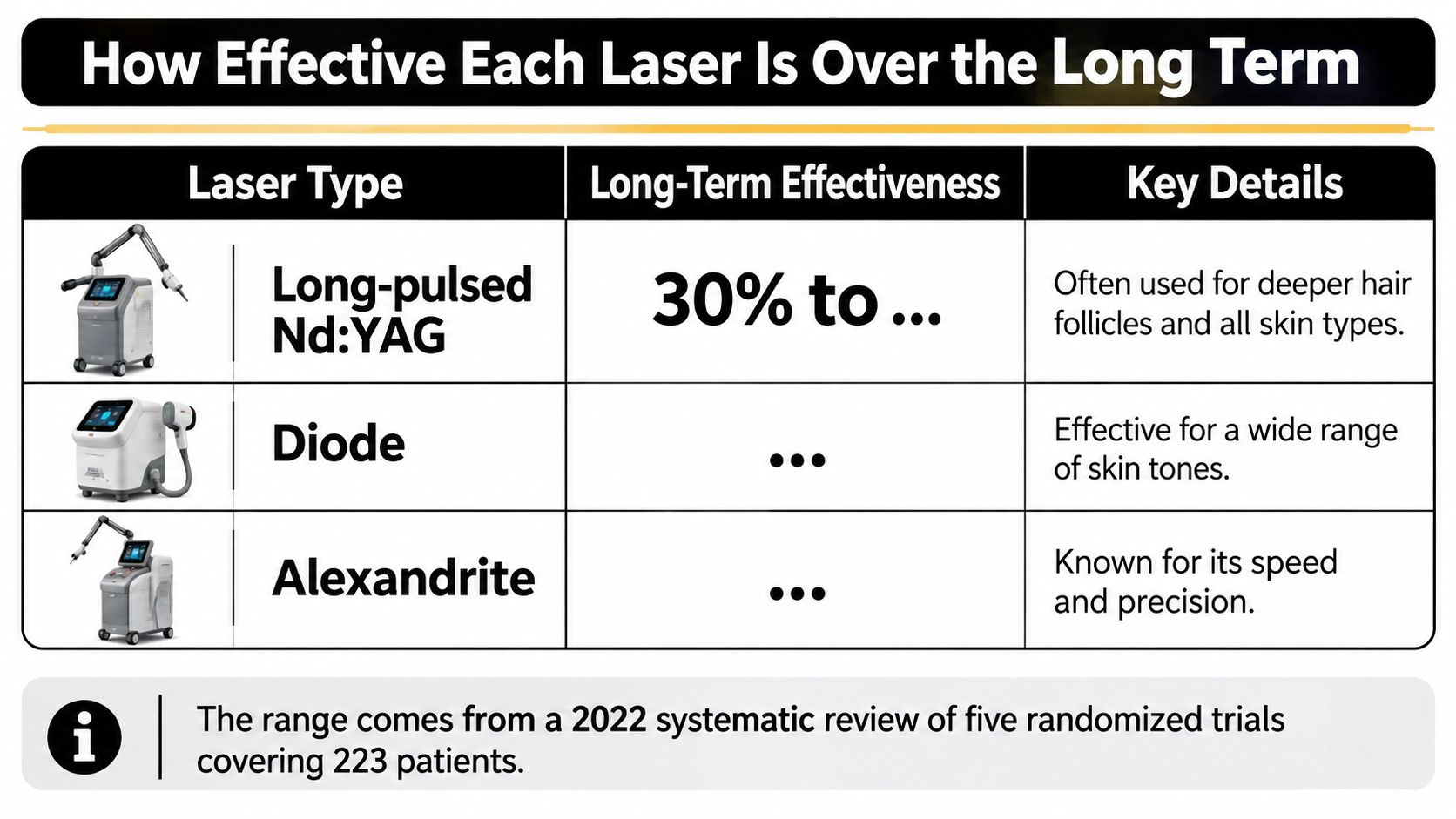
Across those trials, average long-term reduction ranged from 30% to 73.61% for long-pulsed Nd:YAG, 35% to 84.25% for alexandrite, and 32.5% to 69.2% for diode lasers. Every one of those ranges is enormous. A 30% result and an 84% result describe the same technology under different conditions.
Laser | Long-term reduction range | Pooled reduction after three sessions |
|---|---|---|
Diode | 32.5% to 69.2% | 57.5% |
Alexandrite | 35% to 84.25% | 54.7% |
Nd:YAG (long-pulsed) | 30% to 73.61% | 42.3% |
Ruby (reference only) | Not reported in the 2022 review | 52.8% |
The three-session column comes from a separate meta-analysis of trials run between 1998 and 2003, with measurements taken at least six months after treatment. Treat those figures as historical pooled estimates from protocols that differ from modern ones, not as a ranking of the machine in your clinic.
Why the same laser produces a 30% result and an 84% result
Wavelength is only the first variable. Fluence, pulse duration, spot size, cooling, hair pigment density, hormonal status and the treated area all move the outcome, and the review explicitly declined to crown one laser category as universally superior. Its own conclusion was that the best device depends on skin tone, hair pigment, treatment location and clinician-selected settings.
What this means practically: when a clinic quotes you a single reduction percentage for a laser, that number came from an average of a small trial population, not from your skin.
Legs respond best and the face responds worst
The body-site pattern is the most useful finding in the review. The strongest results occurred on the legs, where hair follows an approximately one-year growth cycle. The lowest reductions appeared on the face, where cycles run closer to six months. Faster cycling means a larger share of follicles sit outside the treatable growth phase at any given session.
So when you ask about expectations, ask for two things: the expected reduction for your exact body area, and the specific device and settings planned for it. A general percentage for the technology tells you far less than a number attached to your shin or your chin.
Laser hair removal is therefore assessed as long-term hair reduction, not guaranteed permanent removal.
Which Laser Suits Your Skin Tone and Safety Needs
Skin tone sets the ceiling on how much energy a clinician can safely deliver. For Fitzpatrick types III to VI, a systematic review and meta-analysis of lasers and light devices reached a conclusion that undercuts most rankings: no platform was categorically superior across every patient.

Within that same review, long-pulsed Nd:YAG and diode lasers were not statistically different from intense pulsed light for hair-count reduction, while alexandrite produced significantly greater reduction than IPL, with a standardized mean difference of −1.7 (95% confidence interval −2.6 to −0.78). Outcomes across in-office lasers and IPL were broadly similar overall, with a trend favoring lasers.
Lighter to medium skin, Fitzpatrick III to IV
Say your skin is Fitzpatrick III and the hair on your legs is dark and coarse. That contrast is the ideal case. Diode and alexandrite both perform well because the follicle absorbs energy far more readily than the surrounding epidermis, and you can run higher fluences without chasing pigment in the skin itself.
Alexandrite's strong melanin absorption becomes an advantage here rather than a hazard, and its larger spot sizes make it fast on big areas.
Darker skin, Fitzpatrick V to VI
A darker epidermis holds more competing melanin, which raises the risk of burns and post-inflammatory hyperpigmentation. That's the physics behind the general rule: longer wavelength, conservative parameters, real cooling.
Nd:YAG at 1,064 nm is usually the choice when safety leads the decision, because it bypasses much of the surface pigment. Alexandrite or diode can still be appropriate when hair-to-skin contrast is adequate and the operator controls fluence and pulse duration carefully. The guide to how laser hair removal technology works is worth reading before your consultation so you can follow the settings discussion.
If post-inflammatory pigment has already settled in after a session, at-home LED care for ingrown discoloration is a reasonable maintenance step between treatments, though it doesn't replace a proper assessment at the clinic.
Hair color and the exclusions that override everything
Pigment-rich dark hair responds better than blonde, gray, white or red hair on every platform. If your hair is fine and light, adjust expectations and ask specifically what the clinic does for low-pigment hair.
Two exclusions override the device conversation. Laser hair removal is not recommended for pregnant clients, and recently tanned skin, natural or spray, needs more caution and often a postponement because the tan competes with the follicle for energy.
Bring three items to your consultation: your skin type, your hair color, and your sun exposure in the past few weeks. Those three let a clinician run a test spot and choose conservative settings rather than guessing from the device label.
Session Time, Comfort and Cost Compared
Treatment time depends chiefly on the size of the area: a small zone takes less time than full legs, a full back or a Brazilian. See this breakdown of laser hair removal session times by treatment area for zone-by-zone details.
Downtime after treatment is typically none. You can return to your usual activities, though the laser pass may feel warm or like a snapping sensation. Ask the provider what cooling method they use and what to expect for your treatment area.
NYCLASER treatment zones and listed prices
Zone | Main areas covered | Single session | 3 sessions | 6 sessions |
|---|---|---|---|---|
Small Areas | lip, chin, sideburns, cheeks, ears, areola, feet, hands, happy trail | $25.00 | Not listed (3 × $25.00 = $75.00) | Not listed (6 × $25.00 = $150.00) |
Medium Areas | underarms, bikini line, neck, shoulders, half arms, belly line, two small areas combo | $39.99 | $300 – $99.99 | $500 – $189.99 |
Large Areas | Brazilian, full arms, lower and upper back, lower and upper legs, chest, abdomen, full face, buttocks | $65.00 | Not listed (3 × $65.00 = $195.00) | Not listed (6 × $65.00 = $390.00) |
Extra Large Areas | full legs, full back, Brazilian, buttocks, chest and abdomen | $99.99 | Not listed (3 × $99.99 = $299.97) | Not listed (6 × $99.99 = $599.94) |
The medium-area bundle prices are listed as $300 – $99.99 for three sessions and $500 – $189.99 for six. Since each range gives two different prices, confirm the applicable total in writing before budgeting.
How to compare cost without a spreadsheet
List each area you want treated, then compare the single-session total with the package price for the same coverage. Bundle pricing is only useful if the quoted areas and number of sessions match your plan.
Ask for the package price in writing, including the areas covered, session count and expiry date.
For comparisons with other local providers, request written quotes for the same treatment areas and session count. That makes it easier to compare prices on equal terms.
Paradoxical Hair Growth and the Hidden Risks
Paradoxical hypertrichosis, unexpected increased or denser hair growth after treatment, is uncommon overall but varies sharply by body site. A systematic review and meta-analysis of published cases covering 9,733 patients found a pooled prevalence of about 3%. The reported rate was much lower for areas away from the face and neck.
That difference matters when weighing treatment for a chin or neck against a shin. Fine vellus hair on the face or jawline deserves particular care; ask the provider how they assess the area and decide whether to treat it.
What actually moves the risk
Body site is one factor. Hair density, hormonal factors, treatment settings, and whether the target is coarse terminal hair or fine vellus hair also shape the risk. For facial or neck hair, ask how the provider will monitor the response and what they would do if growth increases.
When increased growth appears, a practitioner may adjust settings, including fluence or pulse duration, and schedule follow-up to track the hair's response over time. Specific treatment decisions depend on the individual area and assessment.
Ingrown hairs are a separate surface issue, not the same as paradoxical hair growth. General skin care, including exfoliating scrubs that prevent ingrowns, addresses ingrowns rather than changes in hair growth. Men considering treatment can read more about laser hair removal for men's necks.
The overall risk is low, but the face and neck warrant closer consideration than many other body sites. A clear assessment and follow-up plan matter more than a broad promise about any laser brand.
Who Should Choose Splendor X at NYCLASER
NYCLASER uses Splendor X for hair removal, with the goal of long-lasting hair reduction. Whether it suits a particular person depends on their skin and hair, the body area being treated, and the settings selected during consultation.

Who it fits
People seeking an individualized assessment. At the initial consultation, experienced professionals assess skin type and hair color to create a personalized treatment plan. They can discuss Splendor X settings and skin-type suitability for the individual.
People planning treatment across several areas. The clinic offers hair removal for small, medium, large and extra-large areas. The right category and price depend on the areas selected.
People who value specialist experience. Specialist Tamar has over 17 years of experience in laser hair removal and is known as a “laser whisperer.”
Where the recommendation stops
A device name alone cannot establish which settings are appropriate for every skin tone or guarantee a particular result. Ask how the clinic will assess your skin and hair, what treatment plan it recommends, and what outcome to expect for the area you want treated.
For context, the FDA premarket summary for a 2025 diode hair-removal device describes intended use across Fitzpatrick skin types I to VI, including tanned skin, and defines permanent hair reduction as a stable decrease in regrowth measured at 6, 9 and 12 months after treatment. That is a device-specific description, not proof that every laser, setting or provider performs equally across skin tones.
The same regulatory documentation describes skin-color sensors in newer home IPL submissions that restrict or adjust treatment outside a validated range. Clearance establishes intended use and substantial equivalence; it does not guarantee identical results across devices or providers.
When another technology is the more efficient pick
For Fitzpatrick II or III skin with dark, coarse leg hair, a diode or alexandrite system may cover the area faster if used appropriately. A slower treatment or different technology may be a better fit for another combination of skin tone, hair and body site. Splendor X is a reasonable option to discuss at NYCLASER, not a universal choice.
Book a Consultation Before Your First Session
Prepare the treatment area carefully. The laser needs hair at skin level to effectively destroy the hair follicle, while the skin should be clean and free of makeup and medication.
Avoid waxing, plucking, threading and electrolysis for 4 to 6 weeks before treatment. These methods remove hair from the root, which the laser needs as its target.
Avoid sun exposure for 2 weeks before treatment.
Ask a technician before using a skin-bleaching cream. Hydroquinone may be started 4 to 6 weeks before treatment to optimize results, but consult a technician about whether and when to use it.
Shave the treatment area to skin level. A day's growth may help make the area easier to recognize, but the hair should be shaved before treatment.
Wash the treatment area thoroughly. Leave it free of makeup and medication.
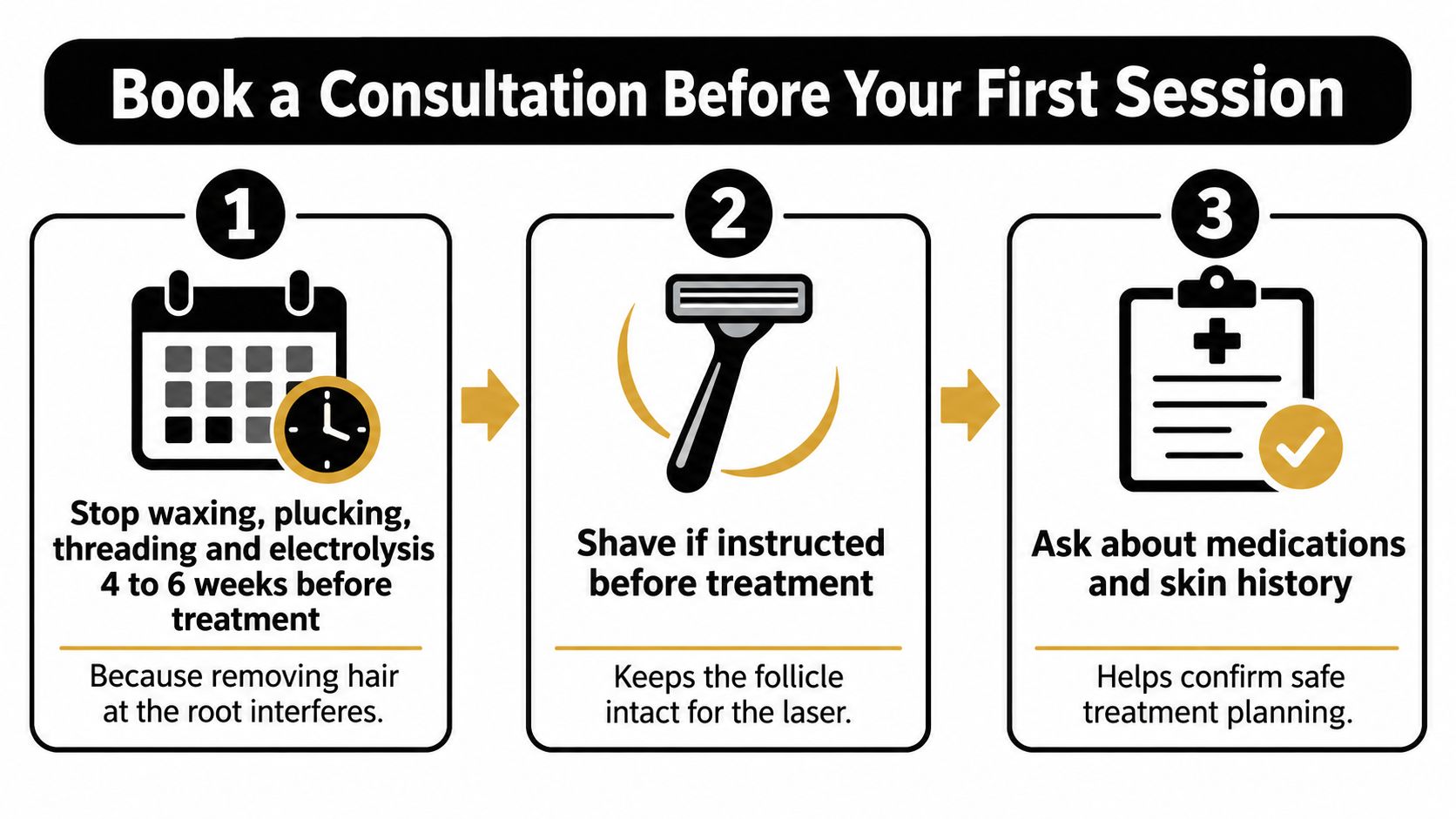
To book or ask a question, call 516-321-4959 or email INFO@NYCLASER.COM. During the initial consultation, experienced professionals assess your skin type and hair color to create a personalized treatment plan.
The questions that separate a real plan from a sales pitch
Ask which device the clinic uses and how treatment will be adjusted for your skin type, hair color and treatment area. Clarify what preparation is needed, including how to manage sun exposure and any skin-bleaching cream.
Ask what long-lasting hair reduction may look like for your target area, and what package options and prices apply before choosing a series.
The right laser treatment depends on your skin, hair and treatment area, as well as how the provider personalizes the plan.
Choose a clinic that can explain its recommendations clearly.
NYC Laser Hair Removal in Westbury uses Splendor X and offers small areas from $25.00, with full legs and full back among the larger areas priced at $99.99. At the initial consultation, experienced professionals assess skin type and hair color to create a personalized plan. To book or ask a question, visit NYC Laser Hair Removal.
Comments