
Is Bikini Laser Hair Removal Painful? What to Expect
Does bikini laser hair removal hurt? Most patients describe brief, manageable discomfort, with clinical averages around 2 to 3 out of 10 in a 2026 alexandrite laser study. Each pulse can feel like a quick rubber-band snap or hot flick.
Bikini skin is sensitive, but location is only one lever. The laser device, energy settings, treatment technique, and your skin and hair characteristics can all change how a pulse feels. Knowing which factors can be adjusted gives you practical questions to ask before treatment begins.
How Painful Bikini Laser Hair Removal Really Is
Bikini laser hair removal usually causes brief, manageable discomfort, not sustained severe pain. You may feel a hot snap, quick pinch, or prickling sensation as the clinician treats each patch.
A 2026 alexandrite laser study reported average pain scores of 2.2 with a brushing technique and 2.7 with stamping on a scale from 0 to 10; the bikini area accounted for 23 of 61 treatment areas, making it the most frequently treated region. Those averages covered the treatment study, not a promise of a bikini-specific score for every patient.
What that feels like in practice
Think of a brief hot flick rather than the continuous pulling sensation of removing hair with wax. The sensation comes with energy delivery, although warmth or sensitivity can remain afterward. Some patches may feel sharper than neighboring patches.
The infographic captures that distinction between a momentary sensation and a sustained ache.
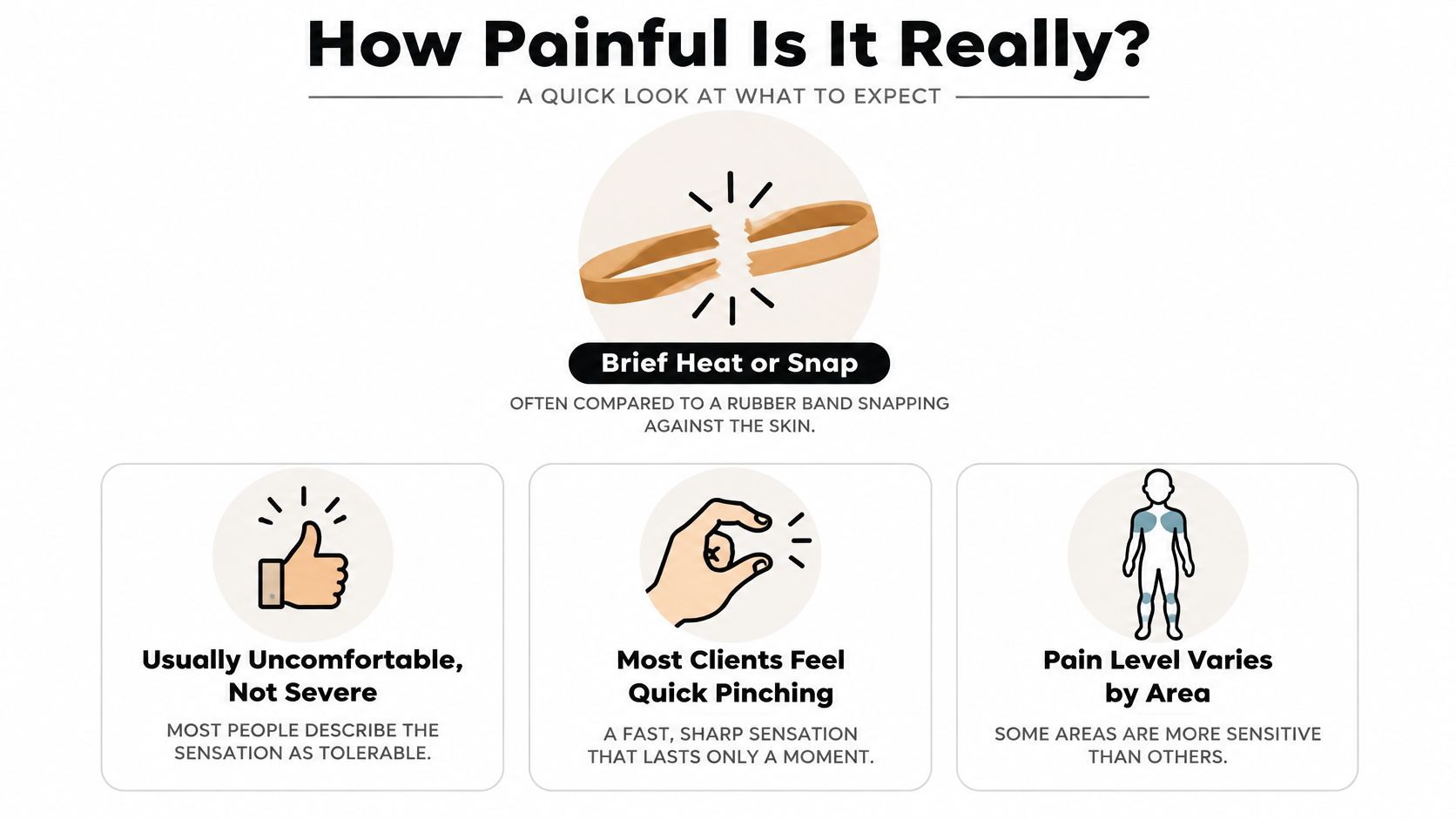
An average isn't a ceiling. Sensitive bikini skin and coarse, dark hair can make treatment feel more intense. Your response also doesn't have to match someone else's description for it to be valid.
For another plain-language explanation of the sensation, ProMD Health Bel Air's honest guide provides useful context alongside a clinical consultation. General descriptions can help you prepare, but they can't predict your individual tolerance.
You don't need to prove you can tolerate a painful setting. Tell the clinician what you're feeling so they can assess your skin and treatment parameters.
The experience comes down to technology and delivery, skin and hair characteristics, and individual sensitivity. You can't change all of those, but you can disclose relevant history, prepare your skin properly, and agree on a comfort plan.
Pain Scores by Laser Type and Technique
A pain score without its scale is like a price without a currency. A 3.5 means very little until you know whether the scale ran to 4 or to 10, and even matching scales do not make separate studies equivalent, since the patients, body areas and methods differ.
A clinical comparison discussed in the dermatology literature reported diode, alexandrite, and Nd:YAG averages of 2.0, 2.3, and 3.5 on a 0–4 scale, respectively; historical results included 5.3 for diode versus 7.8 for long-pulsed Nd:YAG on a 0–10 scale in a small 2001 study of 15 participants aged 19–47.
Reported pain by laser type and technique
Each row below reflects a different study population, body area, treatment method and period. Treat every row as a record of one measurement, taken under one set of conditions.
Laser type or technique | Average reported pain | Scale | Study context |
|---|---|---|---|
Diode | 2.0 | 0–4 | Recent clinical comparison |
Alexandrite | 2.3 | 0–4 | Recent clinical comparison |
Nd:YAG | 3.5 | 0–4 | Recent clinical comparison |
Alexandrite, brushing technique | 2.2 | 0–10 | 2026 study, bikini area most treated |
Alexandrite, stamping technique | 2.7 | 0–10 | 2026 study, bikini area most treated |
Diode | 5.3 | 0–10 | 2001 study, 15 participants aged 19–47 |
Long-pulsed Nd:YAG | 7.8 | 0–10 | 2001 study, 15 participants aged 19–47 |
The Nd:YAG rows show why the scale check comes first. A 3.5 out of 4 sits near the top of its scale, while a 7.8 out of 10 leaves more headroom, so the two results are closer than the raw digits suggest.
The technique rows make a subtler point. Same laser type, same study, different delivery: brushing averaged 2.2 where stamping averaged 2.7. How the clinician moves the handpiece is one of the levers that shapes what you feel, independent of the device name on the machine.
Because these studies used different scales and methods, no single device earns the title of least painful. Light-based options such as IPL sometimes appear in comparisons like these, yet IPL is not a laser, so its scores do not transfer to laser devices.
Choose suitability before a pain ranking
The 2001 figures describe a small group treated with older methods. They give you context for how researchers have measured pain, and they cannot predict how a current device will feel on your skin.
The bikini line is generally more sensitive than the limbs or underarms, so even a study average from another body site travels poorly to your appointment. Our guide to laser hair removal technology explains the device names and terms you may hear during a consultation.
Bring questions to that consultation. Ask which technology and settings suit your skin tone and hair color, and ask the clinician to explain how they adjust delivery for a sensitive area like the bikini line.
What Changes How Much a Session Hurts
The same bikini area can feel different depending on how the clinician delivers treatment. Location matters, but it doesn't determine the experience by itself.
The handpiece is part of that delivery system, as this treatment image illustrates on a different body area.
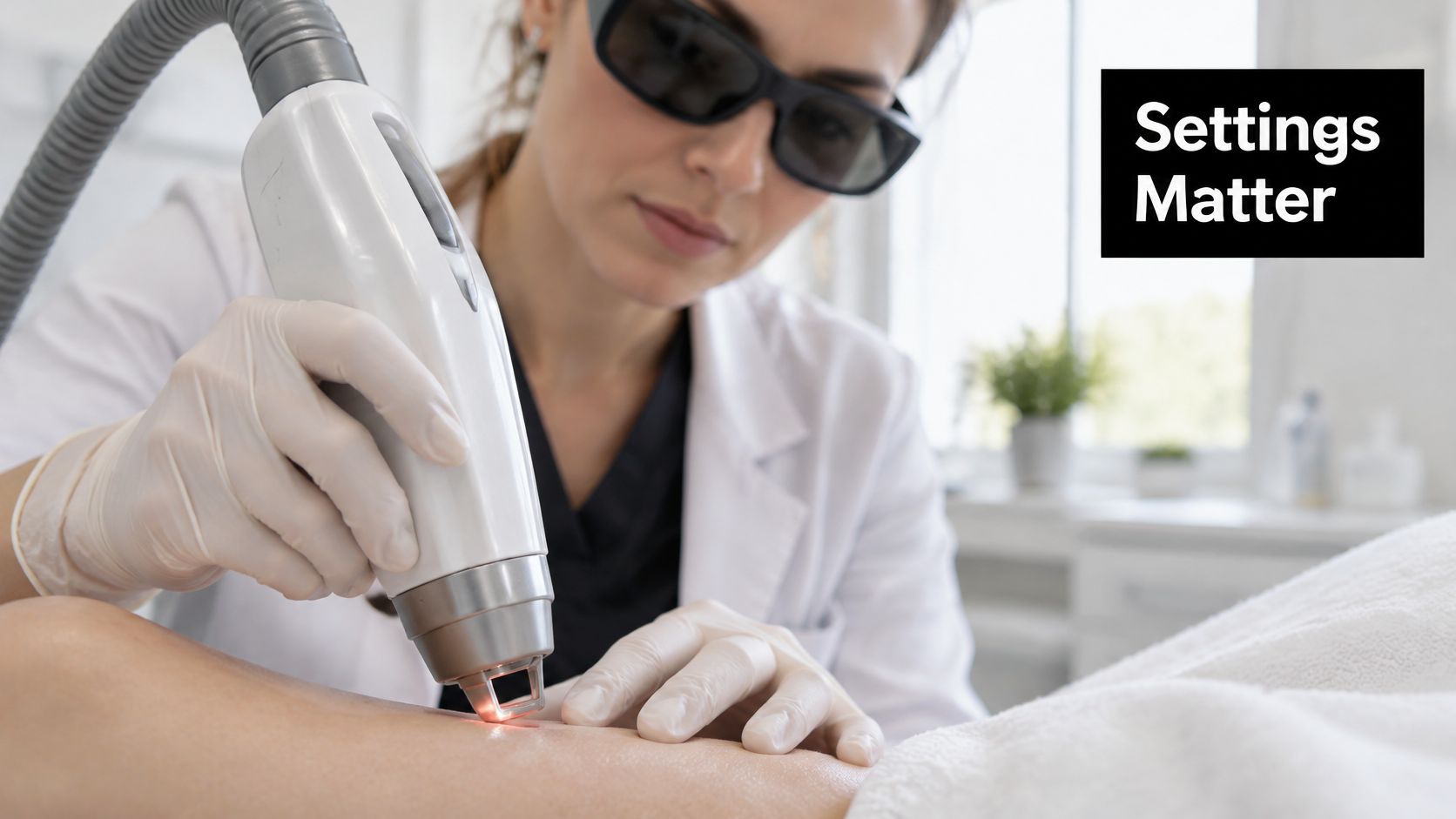
Delivery changes the heat you feel
In clinical evidence on laser parameters and cooling, changing handpiece spot size while keeping energy per area, pulse duration, and surface cooling identical produced mean pain scores of 3.1 versus 4.3 out of 10; an 810-nm cooled-tip diode system produced scores of 2.73 in static mode and 3.49 in dynamic mode.
Those comparisons show why a device name alone doesn't predict comfort. Spot size means the area covered by the laser beam, while delivery mode describes how the clinician applies that energy.
Excess heat at the skin surface activates pain-sensitive nerve endings. Adequate cooling protects that surface while the clinician directs energy toward pigment in the hair follicle. Cooling therefore has a protective role, not just a comfort role.
Your skin and hair change the response
Several personal factors affect how that energy feels:
Hair density and coarseness: Closely packed, coarse, pigmented hairs can create a more noticeable thermal sensation across a treated patch.
Skin tone: Pigment in the skin affects how the clinician selects the wavelength and settings to limit unwanted surface heating.
Recent tanning or sun exposure: A change in skin pigmentation can change treatment suitability, even if you tolerated an earlier appointment well.
Energy selected for your skin: Higher energy can increase discomfort, but lowering it without a clinical assessment isn't a complete treatment strategy.
Personal sensitivity: People can respond differently to the same sensation. Your description of discomfort is useful clinical feedback.
For a visual introduction to treatment, the video below accompanies these practical distinctions.
Say you arrive with a recent tan and dense bikini hair. That isn't merely a reason to expect a sharper sting. It gives the clinician information that may change whether treatment should proceed and which parameters are appropriate.
Practical rule: Describe unusual heat or sharp pain as it happens. Don't assume a stronger sensation means the treatment is working better.
How to Prepare Your Skin for a Comfortable Session
Preparation helps the clinician treat hair without adding avoidable irritation. The goal is accessible hair at skin level and skin that hasn't recently been tanned, irritated, or covered with unapproved products.
Our pre-treatment guide on what not to do before laser hair removal can help you check your routine before an appointment. Use your individualized instructions to resolve any uncertainty, especially if your skin changes after the consultation.
Your preparation checklist
Stop root-removal methods. We require clients to avoid waxing, plucking, threading, and electrolysis for 4–6 weeks before treatment. The laser needs the hair target, so waxing shortly before your visit can interfere with treatment even if the surface looks smooth.
Avoid sun exposure. Our instructions require avoiding sun exposure for 2 weeks before treatment. Don't assume a faded tan or covered bikini area makes recent tanning irrelevant; tell us about exposure so we can assess the skin.
Shave to skin level. The treatment area must be shaved to skin level, although a day's hair growth may help us recognize the area. Confirm the timing with our team rather than leaving long hair or repeatedly shaving an already irritated patch.
Arrive with clean skin. Fully wash the treatment area and leave it free of makeup and medication applied to the skin. Don't stop prescribed medication on your own; discuss it beforehand and clarify which topical products must be removed.
Disclose your health and skin history. Tell us about medications, allergies, broken skin, pregnancy status, and previous reactions. A shaving cut or rash may seem minor, but the clinician needs to see it before deciding whether to treat.
Don't start bleaching cream independently. A cream such as hydroquinone may be started 4–6 weeks beforehand only after consulting a technician. It isn't a routine purchase everyone needs, and adding it without advice can complicate your preparation.
Discuss the first settings and test spot. Ask whether a conservative test spot on the bikini line is appropriate before treating the full area. Don't assume tolerating laser elsewhere predicts your response here.
The preparation graphic offers a reminder, but your appointment-specific instructions take priority over a general timeline.
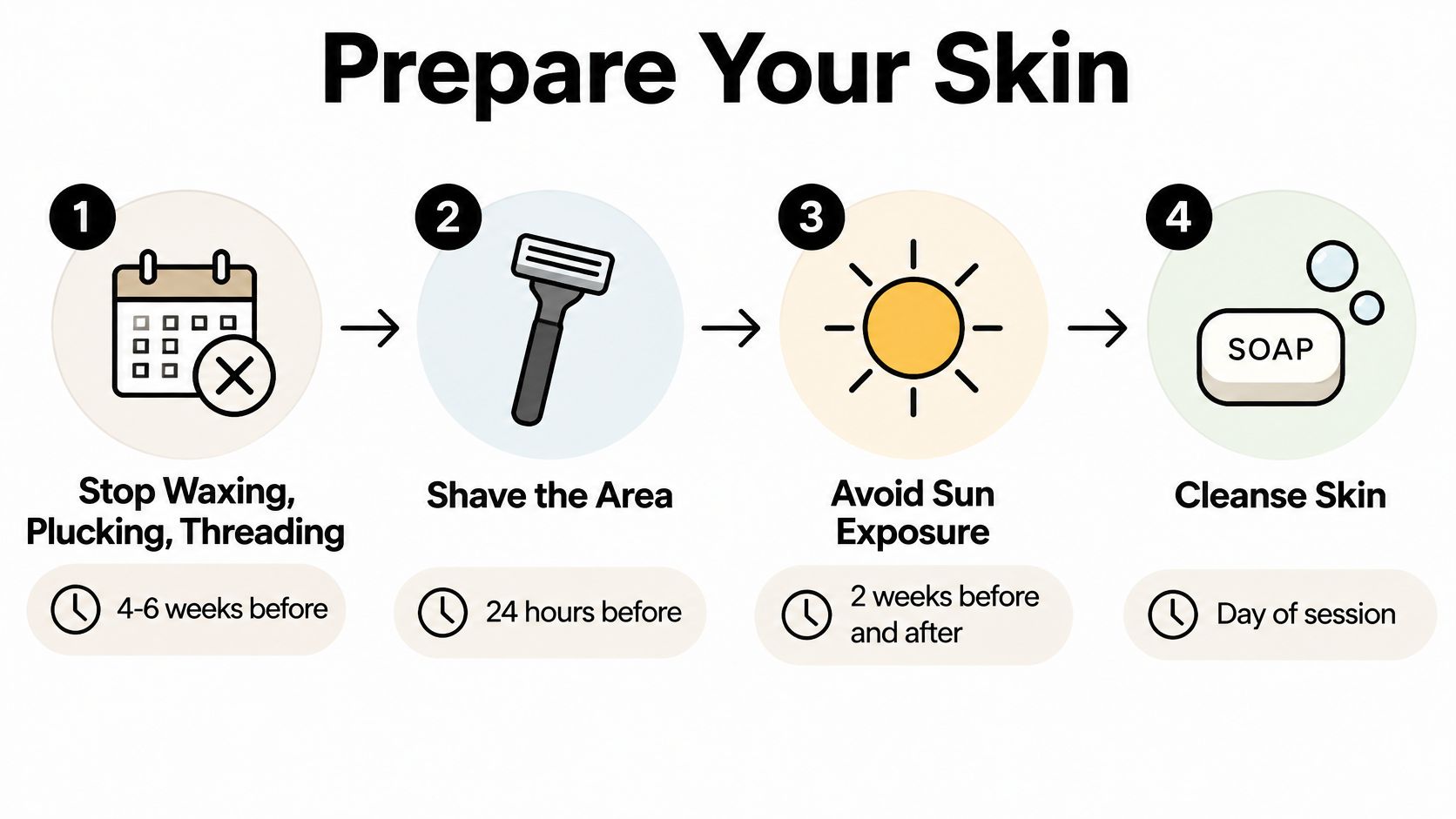
Before treatment begins
Expect a skin check and a discussion of anything that's changed since your consultation. Confirm the treatment boundaries, protective eyewear, and how to request a pause before the clinician starts.
Numbing Cream, Cooling and Other Ways to Ease Pain
Numbing cream is a tool to discuss, not an automatic preparation step. A double-blind randomized anesthetic trial involving 74 women and 256 laser procedures, including groin treatments, found significantly lower pain scores with 23% lidocaine plus 7% tetracaine than with commercial 4% lidocaine, applied 60 minutes before treatment.
That was a controlled comparison, not a home-use recipe. Product strength, amount, treated area, application time, and covering the cream can affect absorption and safety.
Pain-control options compared
Option | What it does | Main limit |
|---|---|---|
Cold compress after treatment | Eases residual heat and soreness | Doesn't reduce sensation during the pulse |
Commercial lidocaine cream | Provides topical anesthesia | Was less effective than the compounded formulation in the controlled trial |
Compounded lidocaine with tetracaine | Produced lower pain scores in the trial | Requires clinician direction, not an over-the-counter instruction |
Conservative first-session settings | Helps establish tolerability with a safety margin | Must still provide an appropriate treatment dose |
Treatment pause between sessions | Gives irritated skin time to settle before further treatment | May delay the schedule; differs from a brief pause during an appointment |
Reduced sensation doesn't mean reduced treatment risk. This matters for first-time Brazilian clients who might otherwise interpret numb skin as permission to tolerate excessive heat or use stronger settings.
Our guide to numbing cream before laser hair removal offers context for that conversation. Ask for exact directions if an anesthetic is approved, and don't add extra cream or cover it unless specifically instructed.
For irritation caused by preparatory shaving, Momotaro Apotheca's guide on how to soothe bikini line irritation addresses a related concern. Razor irritation and a laser-related injury aren't interchangeable, so don't apply a soothing product to newly treated skin without approval.
Ask about the cooling plan first. It addresses heat at the skin surface without relying on reduced sensation alone.
What Soreness to Expect Afterward and When to Call
Pain, burning, redness, and swelling can occur after treatment and are usually temporary. The important distinction is whether symptoms settle or become more pronounced.
A 2025 clinical study covering several body areas, including the bikini line, reported average pain of 2 out of 4, described as slight discomfort. Technology and skin type also affect the pattern of temporary pigment changes, so appearance deserves attention alongside soreness.
Care for temporary irritation
Use simple measures rather than layering multiple products onto sensitive skin:
Apply a cool compress. Use a clean cloth between the skin and a cold pack rather than putting ice directly on the area.
Protect against sun exposure. Keep the area covered where practical and avoid tanning.
Reduce heat and rubbing. Choose loose clothing and avoid hot baths or friction while the skin feels irritated.
A wrapped cooling pack illustrates gentle aftercare.
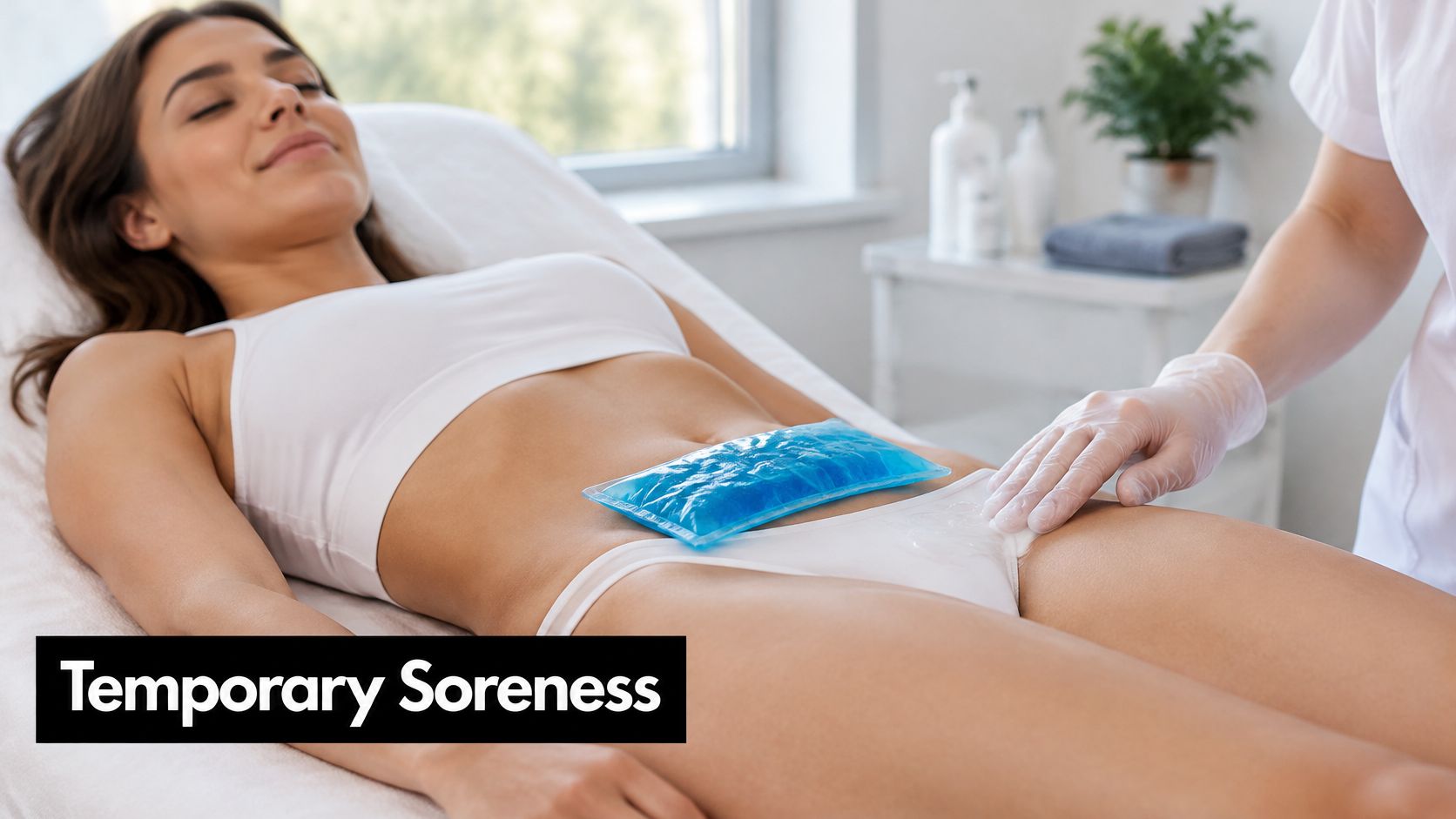
Signs that need a call
Blistering, scarring, and persistent pigment changes are uncommon but clinically important. Lasting discoloration is particularly concerning in Black and brown skin and following sun exposure.
Blisters or broken skin: Contact the clinic instead of treating them as ordinary sensitivity.
Increasing pain: Report discomfort that grows rather than eases.
Persistent darkening or lightening: Ask for an assessment rather than starting a bleaching product.
Temporary tenderness is different from a possible complication. You don't need to identify the cause yourself before calling.
Book a Consultation and Test Spot Before Your First Session
Start with a consultation before committing to a package. Experienced professionals assess your skin type and hair color to create a personalized treatment plan, and this step matters more than most readers expect. Pain is shaped by the device, the settings and your skin, not by the bikini location alone, so a consultation is where those levers get set before the first pulse.
A test spot takes that idea further. The technician treats a small area, watches how your skin responds, and adjusts the settings accordingly. Testing a small patch first follows the same logic as patch testing a cold-pressed face oil: check a limited area, observe the reaction, then proceed with the full application.
Bring these questions:
Technology: Which laser and settings suit my skin and hair?
Test spot: Can we assess the bikini line before a full session?
Anesthetic: Is it appropriate, and exactly how should I apply it?
Cooling: What's used during treatment and afterward?
Schedule: How many appointments might I need, and how should they be spaced?
Treatment isn't recommended for pregnant clients, so disclose any possibility of pregnancy. Call 516-321-4959 or email INFO@NYCLASER.COM, and ask for written confirmation of the proposed test spot and treatment plan before buying a package.
At NYC Laser Hair Removal, personalized hair-reduction treatments use Splendor X technology in Westbury. Book a consultation to discuss bikini-area sensitivity, review your skin and hair characteristics, and agree on preparation and comfort measures before your first session.
Comments