
Procedure for Laser Hair Removal Step by Step
You've cleared a lunch hour, picked the area you want treated, and started wondering whether you should shave before you arrive. It's tempting to think laser hair removal is one appointment followed by smooth skin. The practical reality is a course of carefully spaced visits, with decisions about your skin, hair, and safety made before the laser fires.
The procedure for laser hair removal starts with checking whether the treatment suits your hair and skin, not choosing the strongest setting. For darker skin or fine facial hair, that conversation matters especially. A useful first appointment should leave you understanding what will happen, what could go wrong, and what kind of reduction is realistic.
How Many Sessions the Procedure Takes
One lunch break may accommodate an appointment, but it won't complete an entire treatment course. Laser energy works most effectively on follicles in anagen, the active-growth phase. Neighboring follicles aren't all in that phase together, so a clinician needs to treat the area at different points in its growth cycle.
The American Academy of Dermatology's laser hair removal FAQs describe about 10%–25% less hair after the first treatment, with most patients requiring 2–6 treatments to remove substantially more hair. A working treatment calendar commonly allows an initial course of 4–6 sessions, sometimes 4–8, with gaps of approximately 4–6 or 6–8 weeks, selected for the area and response.
Session spacing by treatment area
Use this as a planning framework, not a prescription. The early-change figure is a general expectation, not a facial-treatment guarantee, and maintenance is only needed when regrowth warrants it.
Area | Gap between visits | Typical course | Early change | Maintenance |
|---|---|---|---|---|
Lip, chin, and other facial zones | 4–6 weeks | 4–6 sessions | About 10%–25% less hair after session 1 | About every 6–12 months if needed |
Underarms and bikini line | 6–8 weeks | 4–6 sessions | Progressive thinning across the series | About every 6–12 months if needed |
Legs, back, chest, and abdomen | 6–8 weeks | 4–8 sessions | Remaining hair often finer and lighter | About every 6–12 months if needed |
Start by choosing the treatment zone. A chin appointment and a full-back appointment shouldn't automatically share the same calendar just because they're purchased together. Your clinician should consider the hair in each area and adjust later appointments according to regrowth and skin response.
Next, protect the gap between visits. If you're planning treatment before a vacation or wedding, moving appointments closer together won't reliably accelerate the result. Follicles that aren't in the responsive growth phase don't become better targets just because your deadline is approaching.
Practical rule: Book around the hair-growth cycle, not around how quickly you want to finish a package.
Reduction is different from clearance
The honest expectation is long-term hair reduction, not guaranteed total permanent removal. You may notice fewer hairs, slower return, or less visible growth rather than a completely bare area.
Remaining hair can become finer or lighter. That can be a useful cosmetic improvement, but it also means the remaining hairs may be less suitable laser targets. Maintenance should address meaningful regrowth rather than follow an automatic promise of lifelong clearance.
For a busy first-timer, the important commitment is therefore more than time in the treatment room. It includes preparing correctly, attending spaced appointments, and allowing enough time to judge the result.
Consultation Patch Test and Prep Rules
Treat the consultation as a clinical assessment, not a sales conversation. During our initial consultation, experienced professionals assess your skin type and hair color to create a personalized plan for the area you want treated.
Bring a medication list and describe any tendency to scar, previous dark or light marks after irritation, and recent tanning. Include prescription creams, supplements, and medicines that increase sensitivity to light. Don't assume that a product applied somewhere else on your body is irrelevant.
This checklist shows the decisions that belong before full treatment.
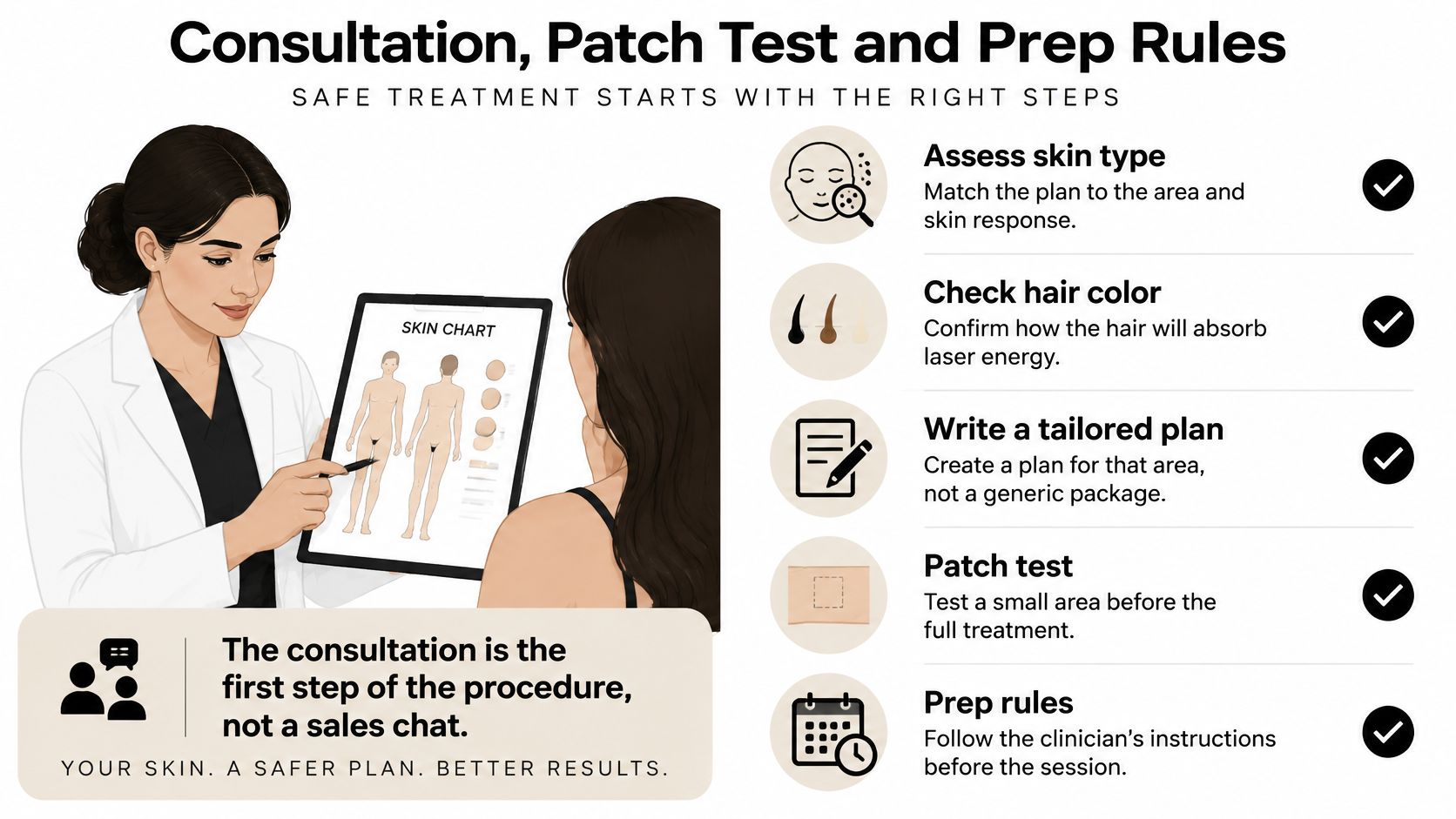
Prepare in the right order
Leave the follicular target in place. Our preparation policy requires avoiding waxing, plucking, threading, and electrolysis for 4–6 weeks before treatment. Shaving is different because it trims the visible shaft rather than pulling the hair out.
Prevent a new tan. We require clients to avoid sun exposure for 2 weeks before treatment. Report a tan or sunburn before arriving rather than hoping a lower setting will automatically make treatment appropriate.
Review restricted medication. Our policy excludes treatment when clients currently use, or have used within the past 6 months, medications such as Accutane, Retin-A, or Gold Therapy. This is our treatment policy, not a direction to stop prescribed medicine. Discuss any changes with your prescriber.
Don't add bleaching products yourself. A cream such as hydroquinone may be considered 4–6 weeks beforehand, but only after consultation with a technician. It isn't a routine do-it-yourself preparation step.
Arrange shaving and clean skin. Confirm the shaving instructions for your zone and arrive without makeup, deodorant, or other products on it. Inform the clinician about prescribed topical medication instead of omitting it without notice.
Use the test spot as a gate. A patch test checks a limited area before broader exposure. Allow the clinician to assess how it settles and decide whether full treatment can proceed.
Questions worth settling before booking
Ask whether consultation and patch testing are included, how your Fitzpatrick phototype affects the plan, and what happens if your skin becomes tanned before the appointment. Fitzpatrick type describes skin's response to sunlight, but the clinician must also examine your current skin condition.
Keep our guide to what not to do before laser hair removal with your appointment instructions. If the instructions conflict with your medication routine or recent skin treatment, resolve that before treatment day.
Settings Skin Tone Safety and Unexpected Growth
A dark roof heats up in sunlight while pale siding stays cooler. That's a useful starting analogy for laser hair removal: pigment absorbs light and converts it into heat. Unlike a roof, however, your skin needs protection while the clinician heats the intended target beneath its surface.
The concept map below separates the target, the surrounding skin, and the choices that influence treatment.
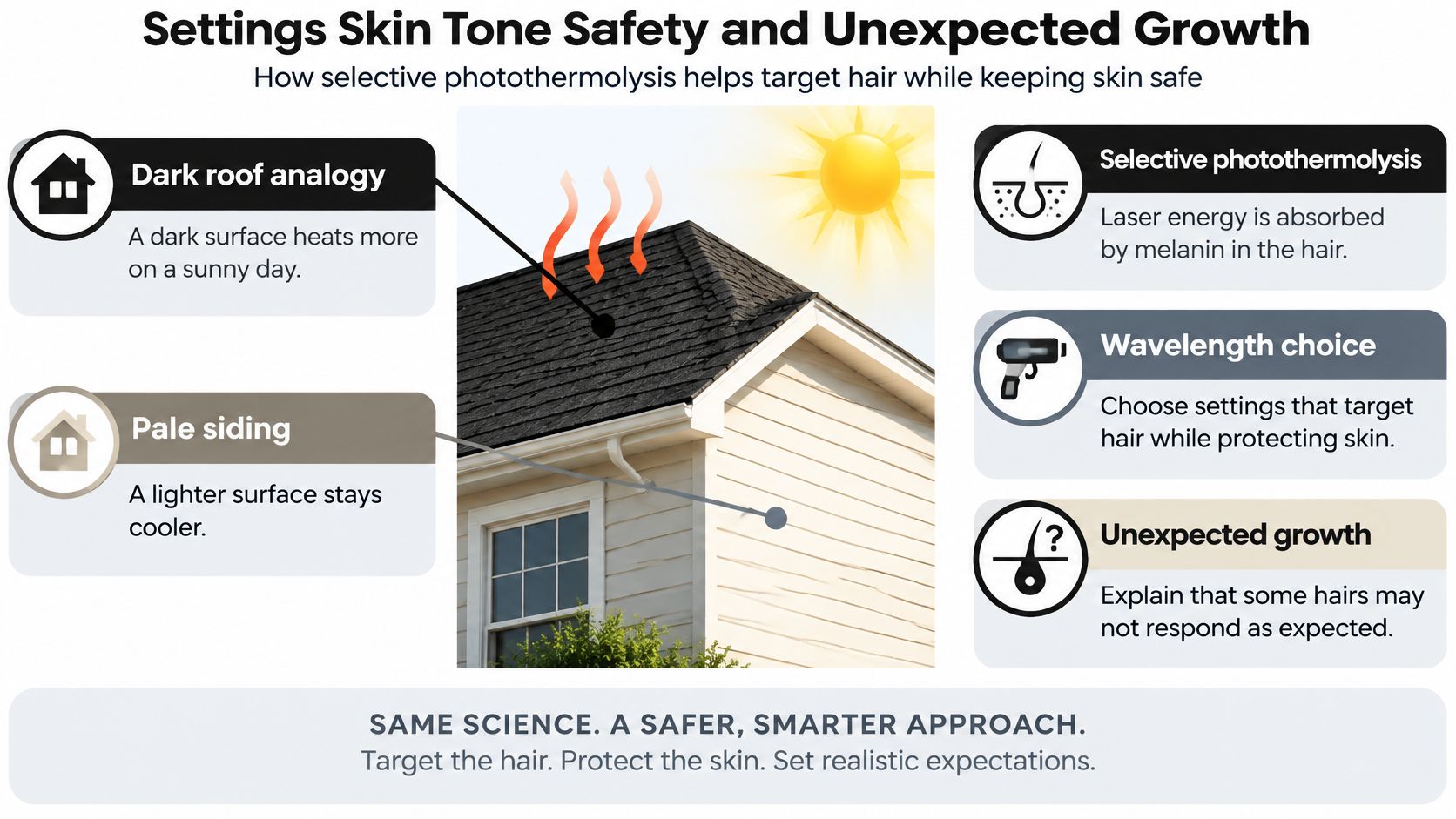
The operator balances more than power
The technical name is selective photothermolysis. A clinical review of laser hair removal explains how melanin in the hair shaft and follicular structures absorbs light, producing heat that damages the follicle while the operator limits injury to neighboring tissue.
Three linked settings matter:
Wavelength affects how the light interacts with pigment and reaches the target.
Pulse duration controls how long the energy is delivered.
Fluence, measured in joules per square centimeter, describes the energy delivered over an area.
The clinician considers the follicle's thermal relaxation time, meaning how quickly it loses heat. Pulse selection should concentrate useful heat in the target rather than allowing excessive heating of surrounding skin.
Those choices require an assessment of your phototype, hair color, shaft thickness, treatment site, recent tanning, and response to earlier treatment. A setting that suits coarse underarm hair may not suit fine cheek hair on the same person.
Dark, coarse hair generally provides a stronger pigment target. Blonde, gray, and white hairs respond poorly because they contain little or no useful melanin. Increasing energy doesn't create pigment where it's absent, so candidacy matters as much as equipment.
What safer treatment means for darker skin
Skin also contains melanin. In darker or recently tanned skin, that pigment competes with the hair for laser energy, making careful selection and cooling particularly important.
The NCBI Bookshelf clinical reference on laser hair removal identifies long-pulsed 1064-nm Nd:YAG systems as generally better suited to darker phototypes because this wavelength interacts less with epidermal melanin while reaching toward the follicle. That's a reason for an informed device choice, not proof that any treatment using that device is risk-free.
A suitable laser is only part of a safe procedure. The operator still has to assess your skin, choose appropriate settings, protect the surface, and recognize an abnormal reaction.
For Long Island clients with diverse skin tones, “safe for darker skin” should lead to concrete questions:
Relevant experience: Has the clinician treated your phototype and this particular body area?
Current pigmentation: Does a recent tan mean postponing treatment?
Test-spot assessment: What response would prevent a full pass?
Monitoring: How should you report new dark or light patches after the visit?
Poorly selected settings or inadequate protection can cause burns, blisters, post-inflammatory hyperpigmentation or darker marks, hypopigmentation or lighter patches, and scars. Infection can follow damaged skin. These aren't cosmetic inconveniences to ignore.
Our explanation of dual-wavelength laser treatment provides context for the device discussion. The important question remains how the clinician will tailor treatment to your skin and hair, rather than whether a machine carries a reassuring label.
This video offers another way to understand the treatment discussion.
When treatment appears to increase hair
Temporary bumps around follicles aren't the same as paradoxical hypertrichosis, which means new or thicker hair developing within or near a treated area.
A systematic review and meta-analysis of paradoxical hypertrichosis found a pooled prevalence of about 3%, with a much lower rate of 0.08% outside the face and neck. Those pooled findings aren't a prediction of your individual risk, but they justify discussing facial and neck treatment carefully before booking.
Darker skin and hormonal conditions such as polycystic ovary syndrome, or PCOS, are relevant to counseling, although the evidence doesn't establish a simple cause-and-effect relationship for every patient. Tell the clinician about changing facial hair, irregular hormonal symptoms, or a known hormonal diagnosis.
Raise plans for the jawline, cheeks, neck, shoulders, or upper arms explicitly, especially where the hair is fine. The clinician should distinguish hair that offers a useful target from hair for which the trade-off may be unfavorable.
If growth progressively thickens or spreads, request reassessment rather than automatically requesting more energy. Photographs and a review of hair characteristics, settings, and possible hormonal factors are more useful than assuming the treatment needs to be stronger.
Pregnant clients should wait. Our policy does not recommend laser hair removal during pregnancy.
The In Clinic Procedure Step by Step
Once preparation and candidacy checks are complete, the appointment should follow a controlled sequence. Tell the clinician about any medication changes, new sun exposure, or skin irritation before you get onto the treatment bed.
The room sequence is straightforward, but each step serves a different purpose.
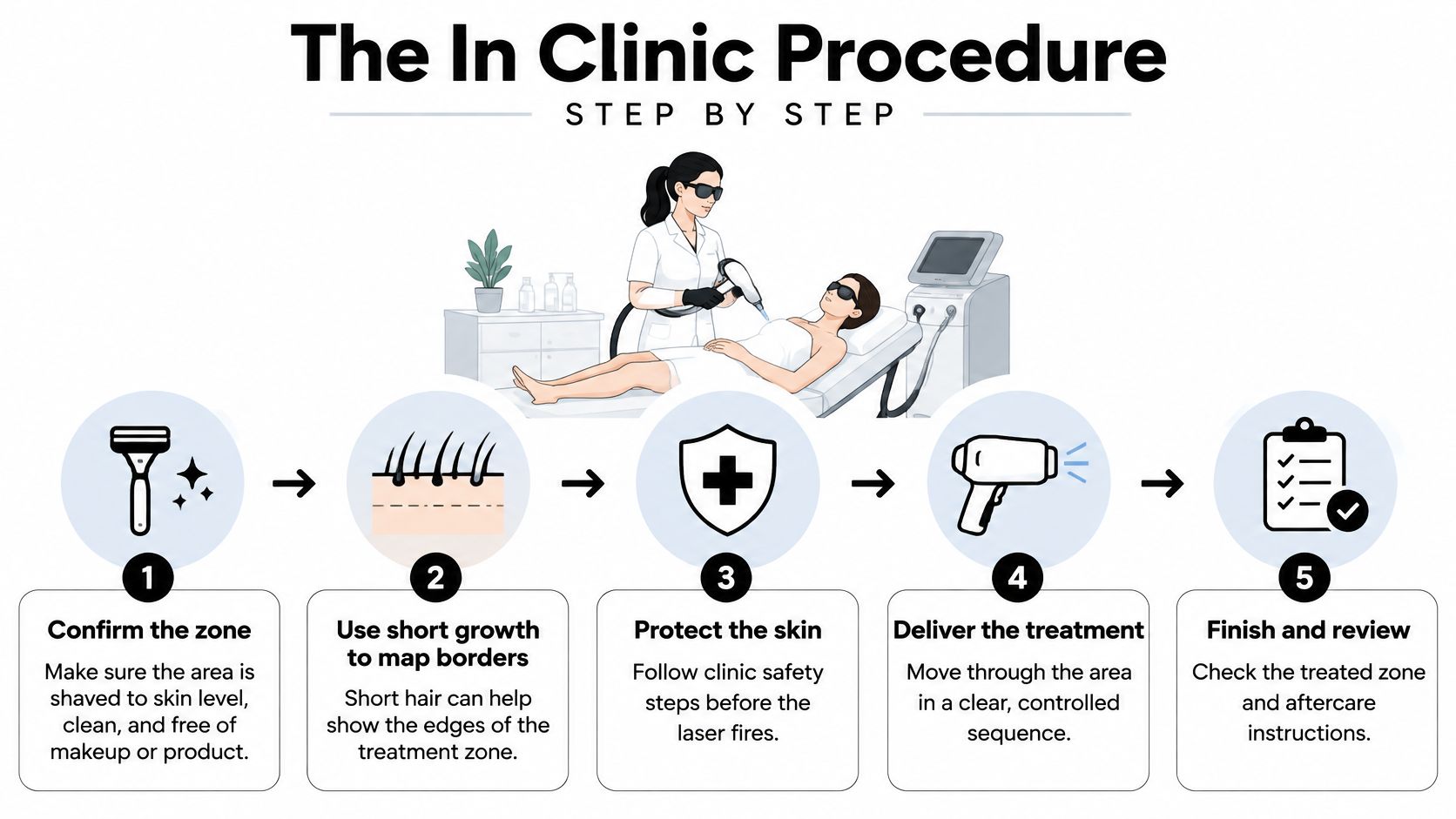
Before the laser fires
Confirm the zone and surface preparation. The clinician checks the borders and makes sure the area is shaved to skin level. Our procedure requires hair at skin level to target the follicle effectively, rather than leaving a long exposed shaft. A day's growth may help identify the boundaries, but it isn't a reason to leave the treatment area untrimmed.
Check that the skin is fully clean. Our treatment area must be washed and free of makeup and topical medication. Underarm deodorant, body lotion, and other residue should also be removed. If a product is prescribed, discuss its use rather than making medication changes yourself.
Put on protective eyewear. Both you and the operator need the appropriate eye protection before the device is enabled. Closing your eyes isn't a substitute.
Apply the device's cooling method. Depending on the system, protection may involve a chilled tip, cooling air, or gel. Cooling helps protect the epidermis while the clinician delivers energy to the follicular target.
Resolve the test-spot decision. If a patch hasn't already been assessed and cleared, the clinician treats a small area and determines the appropriate observation before proceeding. A test spot shouldn't become an automatic immediate full treatment.
During treatment and the final skin check
Treat in a controlled pattern. The operator moves the handpiece systematically, using the coverage pattern appropriate to the device. Passes and any overlap must follow its protocol, without repeatedly heating the same spot indiscriminately.
Speak up about the sensation. Expect a brief snap, often compared with a warm rubber band, along with heat. Coarse hair and areas over bone, such as the shin or jaw, can feel sharper than fleshier areas. Tell the clinician if a sensation changes from a short sting to sustained burning.
Inspect the skin before leaving. Mild redness and small swellings around follicles can resemble a light razor rash. The clinician should distinguish an expected follicular response from injury.
Stop signal: Blistering, white or gray-looking skin, or pain that keeps building needs immediate attention. Don't try to tolerate it to finish the appointment.
A lip or chin treatment involves less surface area than full legs, a back, or a chest. Larger zones take longer because the operator must cover more skin, not because the handpiece should sit heating one location.
Ask for the expected chair time for your exact zones when scheduling. You normally leave the same day, and the treated hair doesn't all disappear while you're on the bed. Before leaving, make sure you know what skin response to expect and how to contact the clinic.
Hair Reduction You Can Expect by Area
If your goal is smooth skin, a useful treatment result may still include some remaining hair. Published area-specific figures describe averages under particular conditions, not a promise that every person will have the same response.
Reported hair reduction after four to five sessions
The review of long-term laser hair removal evidence reports mean reductions for several body areas after 4–5 sessions spaced 6–8 weeks apart. These figures help set expectations; they do not predict an individual result.
Body area | Mean hair reduction | Sessions and spacing | What it does not mean |
|---|---|---|---|
Axillae | 76.1% | 4–5 sessions, 6–8 weeks apart | Not guaranteed permanent removal |
Bikini line | 77.3% | 4–5 sessions, 6–8 weeks apart | Not identical for every hair color |
Legs | 78.5% | 4–5 sessions, 6–8 weeks apart | Not a reason to shorten the gap |
Thorax | 74.1% | 4–5 sessions, 6–8 weeks apart | Not clearance of every follicle |
Back | 74.5% | 4–5 sessions, 6–8 weeks apart | Maintenance may still be needed |
Axillae means underarms; thorax means chest. A reduction percentage describes less hair, not the share of people who became permanently hair-free.
These averages are not a ranking of which area will respond best for you. Hair thickness, pigmentation, device choice, and follow-up duration affect results. Small differences between averages do not establish what will happen on your skin.
Compare your progress fairly
The same review of long-term laser hair removal evidence reports average long-term reduction ranges of 30%–73.61% for Nd:YAG, 35%–84.25% for alexandrite, and 32.5%–69.2% for diode lasers. The ranges reflect differing treatment conditions and follow-up periods, so they are not a direct device comparison.
At follow-up, compare your own progress in consistent ways:
Match the photographs. Keep lighting, angle, distance, and time since shaving consistent.
Separate density from length. A freshly shaved area may look clearer even if the number of growing hairs has not changed.
Describe practical improvement. Tell the clinician whether you shave less often, see patchier regrowth, or notice a change in texture.
Review the remaining target. Fine residual hair may call for a different discussion rather than an automatic increase in fluence.
For example, if your legs look patchy but you want uniform smoothness, ask whether the pattern reflects an uneven response, missed coverage, or hairs at different growth stages. That distinction can help guide the next appointment.
Set a concrete endpoint. Less visible hair or less frequent shaving may meet your goal even while some follicles remain active. If fine hair returns later, consider maintenance according to its visibility and suitability for treatment, rather than expecting every remaining hair to disappear.
Aftercare and How to Book Your First Visit
Keep freshly treated skin cool and avoid adding irritation while it settles. Our stated downtime is typically none, although redness may still be visible when you return to work.
Cool gently. Use a cool compress, without placing ice directly on the skin.
Skip heat and friction. Avoid hot yoga, saunas, hot showers, and tight clothing until sensitivity settles.
Protect from sunlight. Use clothing, shade, and sunscreen rather than exposing the area to develop a tan.
Leave hairs alone. Don't pick, wax, or pluck as treated hair releases. Shave between appointments once the skin is comfortable.
Contact the clinic for blisters, white or gray skin, spreading pigment changes, increasing pain, or signs of infection. Progressive thickening near the face or neck also needs review. Keep our post-laser hair removal aftercare guide accessible.
To arrange a consultation, call 516-321-4959 or email INFO@NYCLASER.COM. We're at 355 Post Avenue, Suite 102, Westbury, NY 11590, with hours Monday through Saturday, 10am to 6pm. Confirm consultation and test-spot arrangements, chair time, medication eligibility, and your ability to keep the recommended appointment gaps.
NYC Laser Hair Removal offers personalized hair-reduction treatment using Splendor X, with skin type and hair color assessed during consultation. Visit NYC Laser Hair Removal to arrange your first consultation and discuss a treatment calendar, preparation requirements, and realistic goals for your chosen areas.
Comments