
What to Expect: what to expect laser hair removal for beginners
So, you’re wondering what to expect from laser hair removal. The simple answer? It's a journey, not a sprint. We’re talking about a series of quick treatments that deliver permanent hair reduction, ultimately leading to incredibly smooth skin. Most of our clients need between 6-8 sessions to get those significant, long-lasting results they’re looking for.
Your Laser Hair Removal Journey at a Glance

It’s best to think of laser hair removal as a complete process with a clear beginning, middle, and end—not just a single appointment. At its heart, it’s a medical procedure that uses a highly focused beam of light to target and damage hair follicles, which is what stops or slows down future growth. This is what makes it a far more permanent solution than the endless cycle of shaving or waxing.
The entire process is designed to be systematic and effective. Each treatment you have builds on the last one, gradually thinning out the hair and reducing its density until you’ve achieved that smooth finish you want.
Understanding the Treatment Lifecycle
Success with laser hair removal is all about timing. The laser is only truly effective when a hair is in its anagen, or active growth, phase. The catch is that only a certain percentage of your hair is in this stage at any given time. That’s why we need multiple sessions to make sure we treat every single follicle as it cycles into the right phase.
This is exactly why your treatment plan will be mapped out over several months, with your appointments scheduled weeks apart. It’s a commitment, for sure, but one that pays off with results that last for years.
At its core, laser hair removal works on a principle called selective photothermolysis. It’s a fancy term that just means the laser's light energy is specifically soaked up by the melanin (the pigment) in your hair. This light converts to heat, which disables the follicle while leaving the skin around it completely unharmed.
To give you a clearer picture, let's break down the entire laser journey from start to finish. This handy table summarizes what you can expect at each stage, so you know exactly what’s happening and what you need to do.
Laser Hair Removal What to Expect at Each Stage
Phase | What to Expect | Key Action |
|---|---|---|
Research & Consultation | You'll gather info, choose a clinic, and have a detailed consultation to confirm you're a good candidate and create your plan. | Book a consultation and ask all your questions. |
Preparation | In the weeks and days before your first session, you'll need to follow specific rules like avoiding sun and stopping waxing/tweezing. | Shave the treatment area 24 hours before your appointment. |
Treatment Sessions | A series of appointments (usually 6-8) spaced 4-8 weeks apart where the laser is applied to the target area. | Be consistent and stick to the schedule your provider gives you. |
Aftercare & Shedding | After each session, you'll follow simple aftercare steps. The treated hairs will begin to shed naturally over 1-3 weeks. | Keep the area cool, moisturized, and protected from the sun. |
Maintenance | Long-term smoothness is the goal. You might need an occasional touch-up session every year or so to manage any new hair growth. | Schedule a maintenance appointment if you notice any new growth. |
Knowing what's coming at each step helps take the mystery out of the process and sets you up for the best possible results.
The Key Phases of Your Journey
To help you feel totally confident and prepared, let's break down the experience into its main components. Knowing what to expect with laser hair removal at each step makes everything feel more manageable.
Consultation and Planning: Your journey kicks off with a one-on-one assessment. This is where we confirm you’re a good candidate and map out a personalized treatment schedule just for you.
Preparation: This phase involves specific pre-treatment care. Think avoiding sun exposure and shaving the target area—all to ensure your session is both safe and effective.
Treatment Sessions: This is the core of the process. You'll come in for a series of appointments where the laser is applied, progressively reducing hair growth each time.
Aftercare and Shedding: Following the post-treatment instructions we give you is so important. It helps your skin heal beautifully and allows the treated hairs to shed naturally.
Maintenance: Way down the road, you might need an occasional touch-up session. This is just to manage any stray new hairs that might pop up over time.
So, Is Laser Hair Removal Right for You?
One of the biggest myths we hear about laser hair removal is that it only works for one specific "type" of person: someone with super fair skin and dark, coarse hair. While that combination was the gold standard back in the day, technology has come a long way. The science still hinges on contrast, but today's lasers are far more intelligent—and safer—for a much wider range of people.
It all comes down to a simple principle: the laser's light energy is absorbed by melanin, the pigment that gives your hair its color. That light turns into heat, which travels down the hair shaft to disable the follicle. Once you understand that, it's easier to see why some factors matter more than others.
How Skin Tone and Hair Color Come Into Play
The most important piece of the puzzle is the relationship between your skin tone and your hair color. For the laser to do its job effectively, it needs to "see" the dark pigment in the hair follicle without getting confused by the pigment in your skin.
Historically, this is why people with light skin and dark hair saw the best results. The contrast was crystal clear, allowing the laser to zero in on the dark hair follicle while leaving the surrounding skin untouched. For clients with darker skin tones, older lasers posed a risk. Because darker skin naturally contains more melanin, those early devices could accidentally heat the skin itself, leading to potential side effects.
Modern Tech for Every Skin Tone
This is exactly where advanced systems like the Splendor X have completely changed the game. Instead of using just one type of laser light, Splendor X uses a brilliant dual-wavelength technology, blending two powerful lasers into one customized treatment.
The Alexandrite (755nm) laser: This wavelength is a powerhouse for treating lighter skin tones (Fitzpatrick types I-III).
The Nd:YAG (1064nm) laser: This one is much safer for darker skin tones (Fitzpatrick types IV-VI) because it’s designed to bypass the melanin on the skin's surface and target the hair follicle deeper down.
By firing both wavelengths at the same time, your technician can perfectly tailor the blend to your unique skin and hair. This means we can safely and effectively treat clients across the entire spectrum, from the very fairest to the deepest, richest skin tones.
Think of it like this: the ability to blend laser wavelengths is like having a custom key made for your specific skin and hair combination. It unlocks incredible results without ever compromising on safety.
This technological leap is at the heart of what you can expect from laser hair removal today. It has opened the door for so many people who were once told they weren't good candidates.
Why Your Hair Color Still Matters
While skin tone isn't the barrier it used to be, your hair color is still a key factor. Because the laser's target is melanin, it needs pigment to work. No pigment, no target.
This means laser hair removal is less effective on hair that doesn't have much color, like:
Blonde hair
Red or auburn hair
White or gray hair
These lighter hairs simply don't have enough melanin to absorb the laser's energy and heat the follicle. During your consultation, we'll take a close look at your hair color to give you a realistic idea of the results you can expect. As a rule of thumb, coarser, darker hair—like what you’d typically find in the underarm or bikini area—responds the fastest and best.
It's also worth noting that certain hormonal conditions, like Polycystic Ovary Syndrome (PCOS), can affect your results. Laser is an amazing tool for managing hormonally-driven hair growth, but you might find you need more sessions or more frequent touch-ups to maintain that smoothness. Being open with us about your medical history helps us build the perfect plan for you.
How to Prepare for Your First Session

Getting the best results from laser hair removal starts long before you walk into our clinic. Think of it like priming a canvas before you paint—the steps you take beforehand directly shape the final outcome. Following a simple prep plan makes your treatment safer, more comfortable, and way more effective.
This isn't just about showing up on time. The weeks leading up to your appointment are crucial for setting the stage. These guidelines help the laser do its job perfectly while minimizing any chance of skin irritation.
Your Four-Week Countdown Checklist
Your prep work officially kicks off about a month before your first session. The number one rule during this time? Protect the hair follicle. The laser needs a target, and that target is the dark pigment inside the hair root.
For the laser to work, the root has to be there. That means you have to stop any hair removal methods that pull hair out from the source.
No More Waxing: This yanks the entire hair out, root and all, leaving nothing for the laser to see.
Pause the Plucking: Just like waxing, tweezing removes the follicle, making the treatment completely ineffective.
Avoid Epilating: Epilators also work by pulling out the hair from the root, so they’re off-limits, too.
If you have a waxing appointment on the books, make sure you cancel it at least four to six weeks before your laser session. From now on, shaving is your new best friend. It's the only approved method because it trims the hair at the surface while leaving the all-important root intact and ready for treatment.
Sun Safety Is Non-Negotiable
The second critical rule is to keep the treatment area out of the sun. Getting a tan—whether from the sun or a tanning bed—ramps up the melanin in your skin. This can seriously confuse the laser, making it difficult for the technology to tell the difference between the pigment in your skin and the pigment in your hair.
A tan essentially creates "background noise" for the laser. By keeping your skin at its natural tone, you give the laser a clear, direct path to the hair follicle, which is essential for a safe and effective treatment.
Treating tanned skin dramatically increases the risk of side effects like burns or pigmentation issues. We need you to diligently avoid direct sun on the area for at least two weeks before your session and commit to wearing a broad-spectrum SPF 30+ sunscreen daily.
The demand for treatments like laser hair removal shows just how much people value effective, long-term solutions. The global market, valued at around USD 713 million in 2021, is expected to jump to over USD 1.3 billion by 2025 and could even hit USD 7.7 billion by 2033. It’s clear that clients prefer investing in lasting results over the endless cycle of shaving and waxing.
The Final 24 Hours
The day before your appointment, you have two simple but vital tasks. First, you’ll need to shave the entire treatment area. This trims the hair above the skin, which prevents the laser from singing any surface hair and ensures all its energy goes straight down into the follicle where it counts.
Finally, show up to your session with clean, bare skin. That means no lotions, creams, deodorants, or oils on the treatment area. These products can create a barrier that interferes with the laser. To get all the details, check out our in-depth guide on how to prepare for laser hair removal.
What Actually Happens During Your Treatment
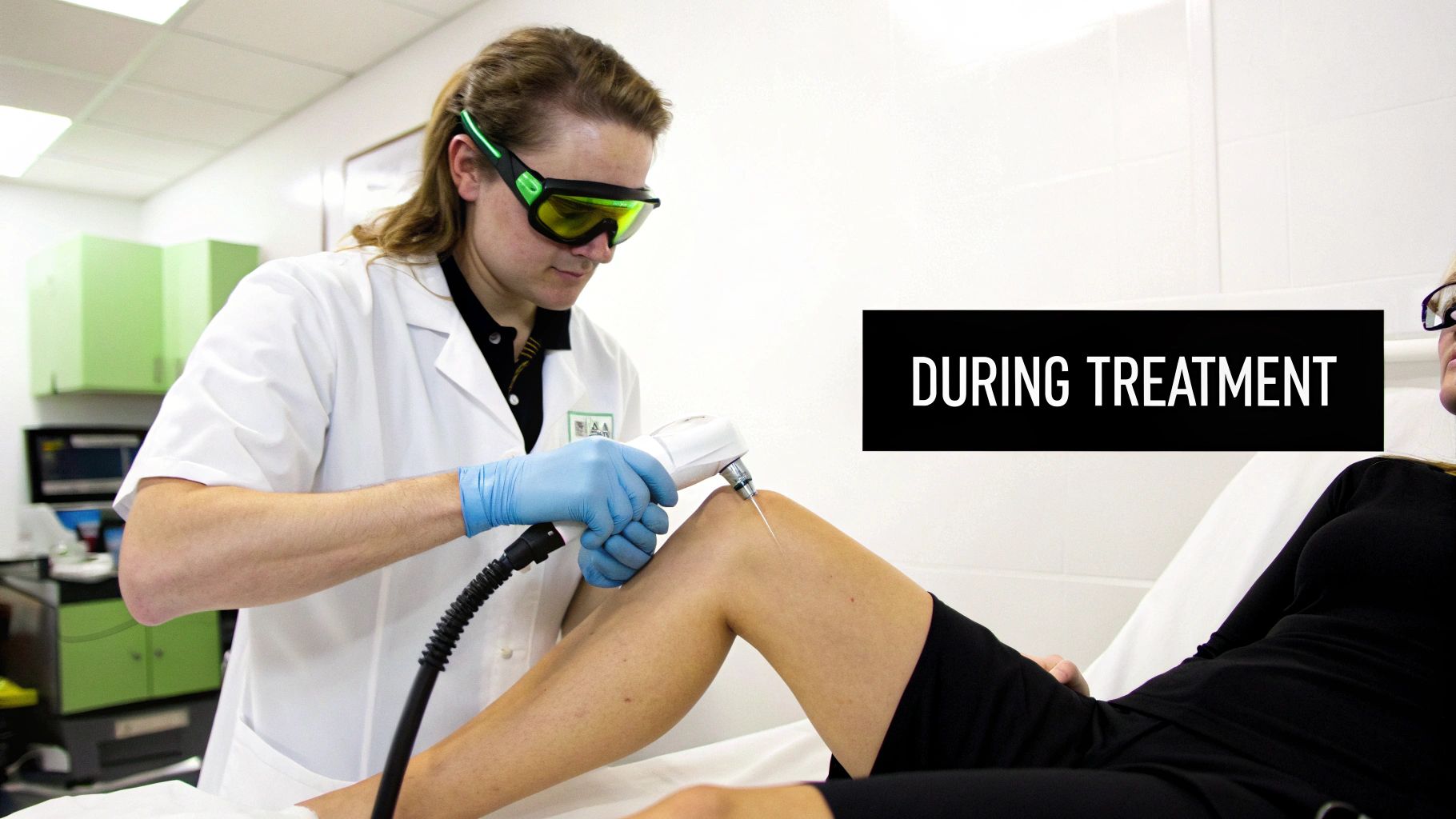
Walking into your first laser hair removal session can feel a bit mysterious, but the process itself is surprisingly straightforward. Our goal is to demystify every step, so you can walk in feeling confident and comfortable, not uncertain.
Your session starts the moment you're welcomed into the treatment room. Your technician will chat with you about the plan for the day, confirm the exact area we're focusing on, and answer any last-minute questions you have. It's a quick check-in to make sure you're both on the same page.
From there, they'll gently cleanse the skin to make sure it's free of any oils or lotions. You'll both pop on a pair of specialized protective glasses—a non-negotiable step to keep your eyes safe from the laser's light. Your safety is always our first priority.
The Treatment Steps, Unpacked
Once you're prepped and settled, the hands-on part begins. Your technician will get the laser ready, carefully calibrating the settings to match your specific skin tone and hair type. This isn't a one-size-fits-all process; that customization is exactly what makes modern laser hair removal so safe and effective.
Here’s a simple play-by-play of what happens next:
Cooling Gel Application: For many areas, we’ll smooth a cool, clear gel over your skin. This isn't just for comfort—it helps the laser's handpiece glide effortlessly and gives your skin an extra layer of protection.
A Quick Test: Before going all-in, the technician will usually do a few test pulses on a small, discreet patch of skin. This lets them see how your skin reacts and confirm the settings are absolutely perfect for you.
The Laser in Action: With everything dialed in, your technician will start moving the laser's handpiece methodically across the treatment area, delivering quick pulses of light. Each pulse treats a small section of skin at a time, targeting dozens of hair follicles at once.
The science behind it is pretty neat. The laser sends out a concentrated beam of light that’s absorbed by the pigment (melanin) in your hair. This light converts to heat, which then disables the follicle's ability to grow new hair. If you want to dive deeper, we break it all down in our guide that explains how laser hair removal works.
What Does Laser Hair Removal Feel Like?
This is probably the number one question we get: "Does it hurt?" The most common comparison is the feeling of a tiny rubber band snapping against your skin. It’s a quick, sharp sensation that’s over in an instant, and most of our clients find it very manageable.
What really sets our treatments apart is the Splendor X’s built-in Cryo-Cooling System. This incredible feature blasts a continuous stream of chilled air onto the skin just before, during, and after each laser pulse. It makes a world of difference in comfort, especially compared to older laser technologies.
The sensation is temporary and focused. Our advanced cooling system numbs the area milliseconds before the laser pulse, effectively minimizing discomfort while protecting your skin.
Keep in mind that the feeling can vary a bit. More sensitive spots, like the upper lip or bikini line, might feel a little more intense than tougher areas like the legs or arms.
How Long Will My Session Take?
The length of your appointment really just depends on the size of the area we’re treating. One of the best parts about laser hair removal is how efficient it is—you can easily schedule smaller treatments during a lunch break.
Here's a realistic breakdown:
Small Areas (like the upper lip or chin): 5 to 10 minutes
Medium Areas (like the underarms or bikini line): 15 to 20 minutes
Large Areas (like full legs or back): 45 to 60 minutes
This speed and convenience are a huge part of why overall satisfaction rates for laser hair removal exceed 90% when it's done correctly. To get those optimal, long-lasting results, most clients need about 6 to 8 sessions. That's because the laser works best when hairs are in their active growth phase, and multiple sessions are needed to catch every follicle at the right time.
What to Expect After Your Session: Aftercare and Shedding
The time you spend caring for your skin after you leave the clinic is just as important as the treatment itself. Think of it as protecting your investment in smoother skin—proper aftercare is what guarantees your skin heals beautifully and you get the best possible results.
Right after your session, it's totally normal for the treated area to feel a little sensitive, almost like a mild sunburn. You might see some temporary redness and slight swelling around the hair follicles. Don't worry, this usually fades within a few hours to a day.
Your First 48 Hours: Cool and Calm
For the first day or two, your only job is to keep your skin cool and calm. Heat can make the area more sensitive, so you'll want to steer clear of anything that might raise your skin's temperature.
Your simple aftercare checklist:
Skip Hot Showers and Baths: Stick to cool or lukewarm water, which will feel much more soothing.
Take a Rest Day: Postpone any strenuous workouts. Sweating can irritate the treated follicles.
Avoid Saunas and Hot Tubs: These are definite no-gos while your skin is in recovery mode.
Use Soothing Gels: A gentle aloe vera gel or a calming, fragrance-free moisturizer can work wonders to reduce any lingering redness.
Basically, just be gentle with your skin. Hold off on using any harsh exfoliants, scrubs, or products with strong active ingredients like retinoids or acids for a few days.
Think of the post-treatment phase as a "cool down" for your skin. The laser just delivered a lot of energy to the follicles, and now they need a calm, cool environment to recover properly. This simple step prevents irritation and sets you up for fantastic results.
Don't Panic: Understanding the Shedding Phase
About 5 to 14 days after your appointment, you'll notice something that seems a little weird at first. Hairs will start to pop up, looking a lot like new growth. This isn't regrowth—it's actually the shedding phase, and it's the best sign that the treatment worked perfectly.
This is just the delayed release of the treated hair from the follicle that the laser zapped. The laser did its job deep under the skin, and now your body is pushing out the dead hairs. It’s physical proof that the follicles are giving up.
You can help this process along by gently exfoliating the area with a soft washcloth starting about a week after your session. Whatever you do, do not pluck or wax these hairs. Just let them fall out on their own or with a little nudge from exfoliation.
Long-Term Care: Your New Best Friend is Sunscreen
As you continue your series of treatments, sun protection becomes your most important habit. Your skin will be more sensitive to UV rays after laser hair removal, and shielding it is non-negotiable for avoiding any pigmentation issues.
Make it a daily ritual to apply a broad-spectrum sunscreen with at least SPF 30 to any treated areas exposed to the sun. This goes for cloudy days, too. Keeping your skin protected not only ensures your safety but also helps maintain an even, clear skin tone—one of the best bonuses of getting rid of unwanted hair.
Mapping Your Results Timeline and Treatment Schedule
When you start your laser hair removal journey, it helps to think of it as a marathon, not a sprint. The goal here is long-term, lasting smoothness, which we achieve through a carefully planned series of treatments. Patience and consistency are your absolute best friends in this process.
It’s also important to know that the industry standard for results is permanent hair reduction, not total removal. What’s the difference? While most of our clients get a dramatic and lasting reduction in hair, it's possible for a few stray hairs to pop up over time due to hormonal shifts or other life changes. For most people, this just means a quick touch-up session once a year or so to maintain that perfectly smooth skin.
Why Multiple Sessions Are Necessary
The science behind the schedule is actually pretty fascinating—it all comes down to your hair’s natural growth cycle. Every single hair on your body goes through three distinct phases, but the laser can only do its job during one of them: the anagen phase, also known as the active growth stage.
At any given time, only about 10-25% of your hair is in this active phase. This is exactly why a single session can't zap all the hair in one go. By spacing your treatments out, we can systematically target new groups of hair follicles as they enter their prime "zappable" anagen phase.
Think of it like trying to catch every train at Grand Central. You can't get them all at once. You have to wait for each one to arrive at the platform. We schedule your sessions to catch each hair follicle as it arrives in its most treatable growth phase.
This strategic timing is why a typical treatment plan involves 6-8 sessions, spaced anywhere from 4 to 8 weeks apart. The exact timing depends on the body area and how quickly its hair grows. Sticking to this schedule is crucial for getting the best possible outcome. You can dive deeper into the specifics in our complete NYC laser hair removal timeline guide.
Your Results Unfold Over Time
The good news? You won't have to wait until your final session to see a difference. One of the most encouraging parts of the process is seeing steady, progressive results after each visit.
Here’s a general idea of what you can expect:
After Your First Session: Get ready for a 10-25% reduction in hair in the treated area. The hair that does grow back will often be finer and lighter than before.
After 2-3 Sessions: You'll notice a significant drop in hair density. There might be some patchy areas where hair has stopped growing entirely, and you’ll definitely find yourself shaving much less often.
After 6-8 Sessions: Most clients are celebrating their final results, with a dramatic reduction in unwanted hair. The skin in the treated area looks smoother and clearer.
The timeline below gives you a visual of what happens right after each treatment, from the initial (and totally normal) swelling to that satisfying shedding phase.
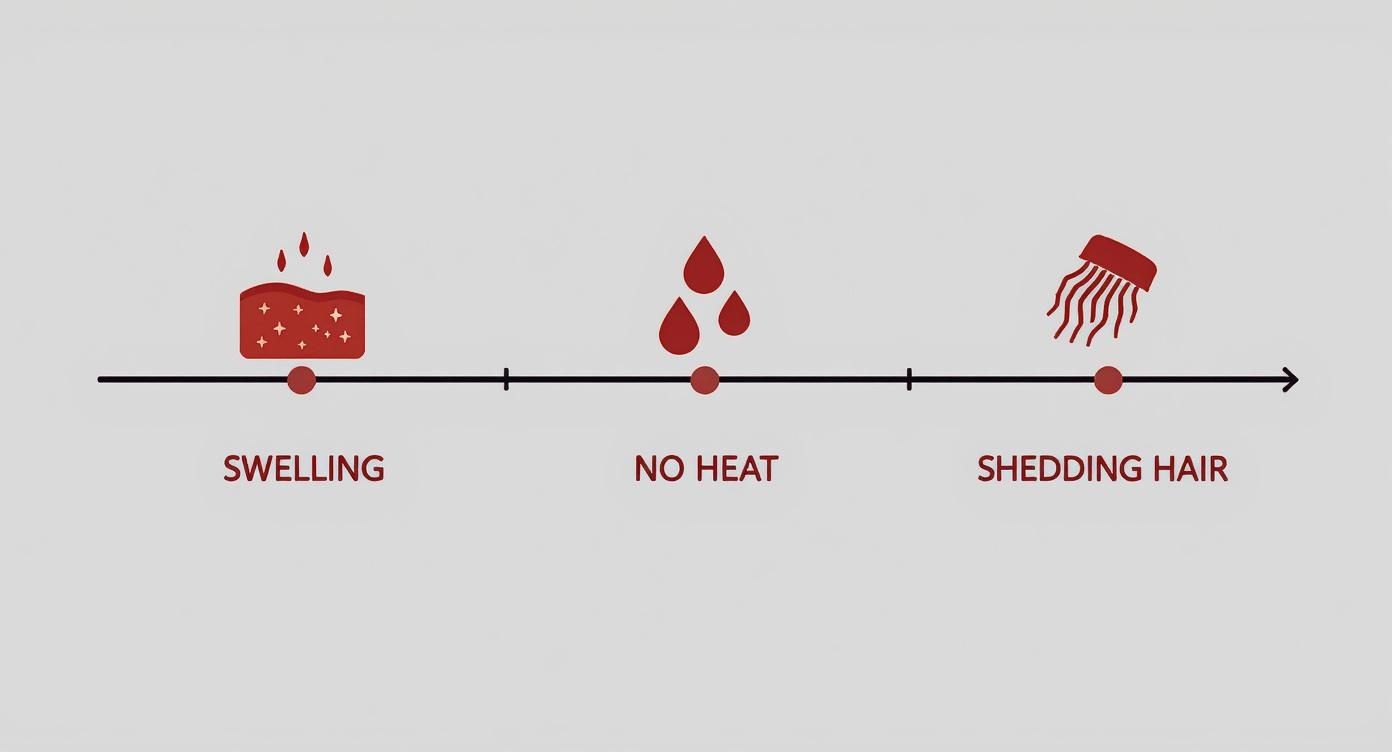
This visual guide breaks down the key aftercare stages, showing the journey from temporary sensitivity to the visible proof that the treatment is working its magic.
Of course, everyone is a little different. Factors like your hair's density, coarseness, and the specific body part being treated can influence your personal schedule. For instance, facial hair often needs more frequent sessions than hair on the legs because it has a faster growth cycle.
This steady, visible progress is a huge reason the treatment is so popular. Laser hair removal has become one of the fastest-growing cosmetic procedures in the world, with the market valued between USD 1.0 to 1.3 billion in 2023. Projections show it could grow to over USD 7 billion by 2035, which really shows how much people are prioritizing smarter self-care routines.
Your Top Questions, Answered
When you're thinking about laser hair removal, a few questions always come to mind first. We get it. Here are the straightforward, honest answers we share with our clients every day to help you feel confident and ready.
Does Laser Hair Removal Hurt?
This is easily the #1 question we hear, and the honest answer is: it really depends on your personal pain tolerance, but the vast majority of our clients find it very manageable. The sensation is most often described as a quick, warm snap, almost like a tiny rubber band flicking against your skin. It’s over in an instant.
What’s made a huge difference is the technology. Our Splendor X laser, for example, has a built-in Cryo-Cooling System. This isn't just a fancy name—it's a device that blasts a constant stream of super-chilled air onto your skin right before the laser pulse. This cooling effect does a fantastic job of numbing the area and making the whole process much more comfortable.
Keep in mind, areas with thinner skin, like your upper lip or bikini line, might feel a bit more sensitive than thicker-skinned spots like your arms or legs.
How Much Does It Cost?
The cost of laser hair removal isn't one-size-fits-all because every treatment plan is unique. The price really comes down to two main things: the size of the area you want to treat and how many sessions you'll need to get the results you're looking for.
Small Areas: Think upper lip, chin, or sideburns. These are the most affordable spots.
Large Areas: A full back or full legs will naturally cost more per session simply because they take more time and resources to treat thoroughly.
Package Deals: We almost always recommend our packages of 3 or 6 sessions. Buying a package upfront offers a significant savings compared to paying for each visit one by one.
The best way to get a clear number is during your free consultation. We’ll sit down, talk about your goals, and give you a customized price quote with no surprises.
Can You Get Laser Hair Removal Over Tattoos?
This is a hard no. You absolutely cannot perform laser hair removal directly over a tattoo. The laser is designed to find and target pigment (the melanin in your hair follicles). The problem is, tattoo ink is also pigment, and the laser can't tell the difference between your hair and your ink.
Treating a tattooed area could cause the laser to heat up the ink, leading to painful burns, blisters, and potential scarring. It can also cause the ink to scatter and distort your artwork. Our technicians are expertly trained to work carefully around the borders of any tattoos to keep both your skin and your art perfectly safe.
What Are the Most Common Side Effects?
Laser hair removal is an incredibly safe procedure, especially when you're in the hands of a certified, experienced technician. The side effects we see are almost always minor and temporary.
It's common to have a little redness and maybe some slight swelling in the treated area right after your session—think of it like a very mild sunburn. This usually calms down within a few hours or, at most, a day. The absolute best way to ensure a quick and smooth recovery is to follow the aftercare instructions, like avoiding direct sun exposure and skipping hot showers for the first 24 hours.
Ready to start your journey to smooth, carefree skin? At NYC Laser Hair Removal, we use advanced Splendor X technology to deliver safe, effective, and comfortable treatments tailored just for you. Book your free consultation today at https://www.nyclaser.com.
Comments