
Brazilian Laser Hair Removal Side Effects: What Is Normal
You're checking your skin the day after a Brazilian laser session. The pubic area looks pink, feels warm, and has tiny bumps around some hairs. By the next morning, you're wondering whether this is ordinary irritation or the beginning of a burn.
The distinction isn't just how the skin looks. It's whether the discomfort is easing, whether the skin surface is intact, and whether anything is spreading. Understanding Brazilian laser hair removal side effects helps you respond calmly without overlooking a reaction that needs care.
Side Effects You Will Likely See and How Long They Last
Say the bumps sit directly around individual hairs, your underwear feels slightly irritating, and a cool compress makes the area more comfortable. That pattern fits a temporary follicular reaction more closely than a spreading injury. It still deserves observation, not scrubbing or extra treatment products.
Perifollicular swelling means swelling around the hair follicles. These small raised bumps aren't automatically pimples, ingrown hairs, or infection. Redness, warmth, and mild tenderness can accompany them as the skin responds to treatment.
The recovery window isn't identical for everyone. Skin pigmentation, treatment settings, local friction, and the intensity of the initial reaction all affect what happens next. A rigid deadline can falsely reassure someone whose symptoms are worsening, so the table emphasizes the direction of change rather than an unsupported countdown.
Brazilian laser side effects by timing, duration and action
Side effect | Usually appears | Typical duration | Normal or act now |
|---|---|---|---|
Redness and warmth (transient erythema) | Around treatment | Transient; should progressively settle | Monitor when mild and improving |
Perifollicular swelling (small raised bumps around follicles) | Around treatment | Temporary; bumps should flatten as irritation settles | Monitor when confined to follicles and improving |
Pain or burning | During treatment or afterward | Should ease rather than intensify | Call if pain escalates or feels severe |
Temporary darkening or lightening | Can become apparent after the initial reaction | May outlast the redness; fading can be gradual | Report a new patch, especially if it spreads or keeps changing |
Blistering or crusting | After treatment | Requires assessment rather than a home recovery deadline | Uncommon; contact the clinic promptly |
Scarring or texture change | May become apparent as the area heals | Can persist | Uncommon; arrange a clinical review |
Unwanted denser hair (paradoxical hypertrichosis) | Becomes apparent during subsequent growth | May persist without evaluation | Rare; arrange a clinical review |
Judge the trend, not just the color
Redness can be less obvious on darkly pigmented skin. Increasing tenderness, swelling, warmth, or a change in surface texture may be more useful clues than whether the area looks bright pink.
A darker patch also isn't a reason to immediately apply acids or brightening products. For background on discoloration, Mesoderm RX's guide to safe treatments for pubic dark spots can help you prepare questions, but newly treated or injured skin needs assessment before pigment treatment.
Practical rule: Mild effects should become less uncomfortable and less extensive. A reaction that grows, spreads, or stops improving deserves a call.
Take a baseline photograph now and another as recovery progresses. Use the same lighting and angle, keep intimate images securely stored, and share them only through the clinic's approved communication channel.
How Often Brazilian Laser Complications Really Happen
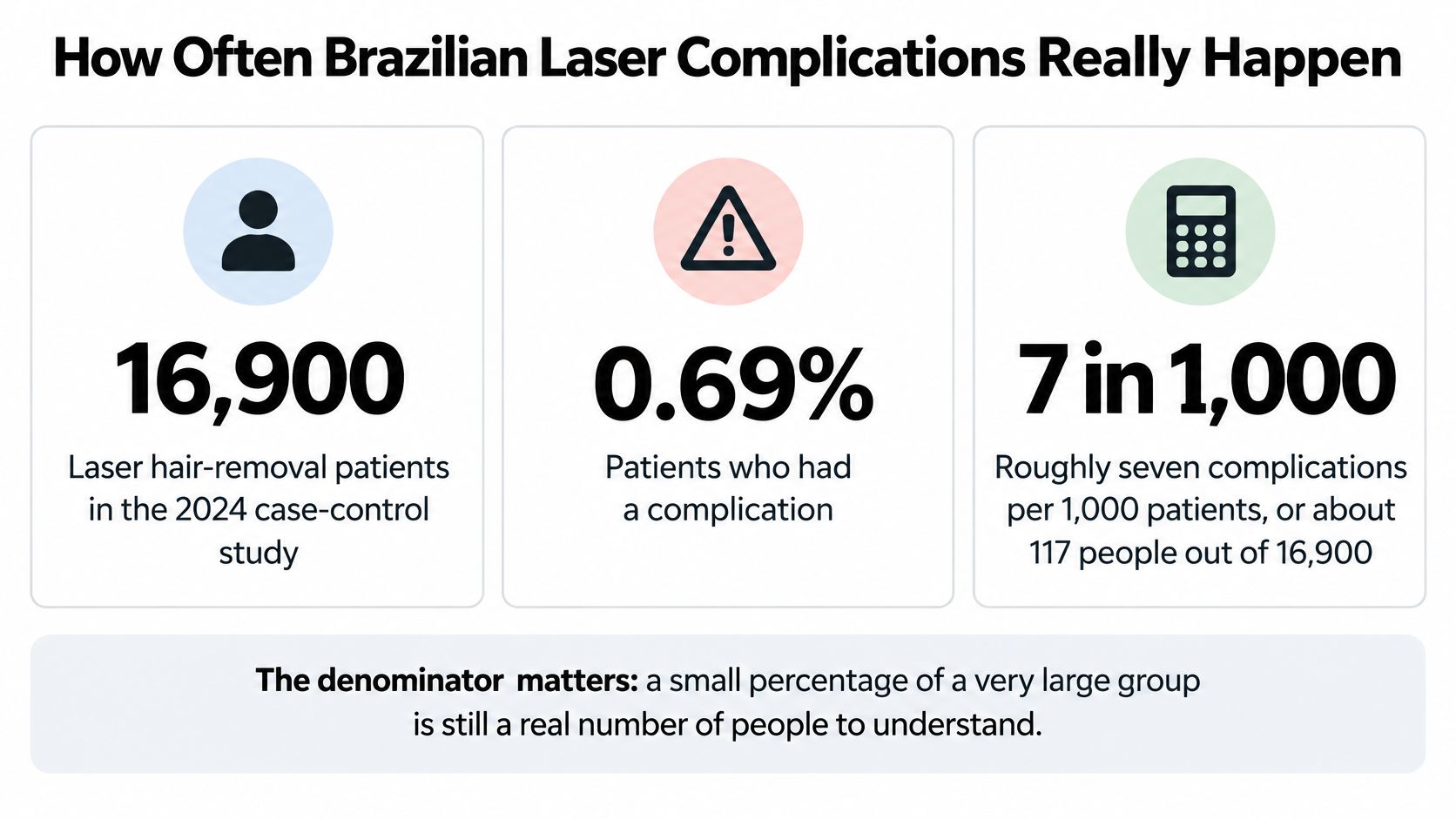
A complication incidence of 0.69% among 16,900 laser hair-removal patients was reported in a 2024 case-control study published in Lasers in Medical Science, equivalent to about seven affected patients per thousand patients, not per thousand treatments.
That distinction matters because a patient may receive multiple sessions. The study also covered laser hair removal generally, so it doesn't establish a Brazilian-specific complication rate.
The visual below summarizes the patient denominator. Despite its Brazilian-focused framing, the underlying study population wasn't limited to Brazilian treatment.
Read complication shares correctly
In that study, petechiae, purpura, and ecchymosis accounted for 31.66% of complications; these are small bleeding spots or bruise-like marks, not necessarily burns. Separately, the Lasers in Medical Science study's pigmentation findings placed pigmentation changes at 20.0% of reported complications, about one in five complications rather than one in five patients.
Measure | Figure | What it means |
|---|---|---|
Overall complication incidence | Small minority of patients | The denominator is patients, not sessions |
Petechiae, purpura and ecchymosis | Largest reported complication category | Small bleeding spots and bruise-like marks |
Pigmentation changes | A share of reported complications | Not the same as the proportion of all patients affected |
Blistering, scarring, infection | Separate shares not reported in the available findings | Their individual frequency can't be calculated from this breakdown |
These findings don't support a precise personal forecast. They also don't tell us how every complication resolved or justify calling every visible mark harmless.
The useful conclusion is narrower: complications were uncommon in this patient group, and pigment changes were an important category. Your own assessment should focus on the skin being treated, the operator's protocol, and whether the clinic recognizes and manages an abnormal reaction promptly.
Who Faces Higher Risk and How Clinics Respond
Laser energy is absorbed by melanin, the pigment found in hair and skin. The intended target is the pigmented hair, but surrounding skin can absorb some energy too. Think of skin pigment as a sponge that takes up part of the energy meant for the follicle.
More epidermal pigment means the clinician must manage that competing absorption carefully. It doesn't mean deeper skin tones are automatically unsuitable for treatment.
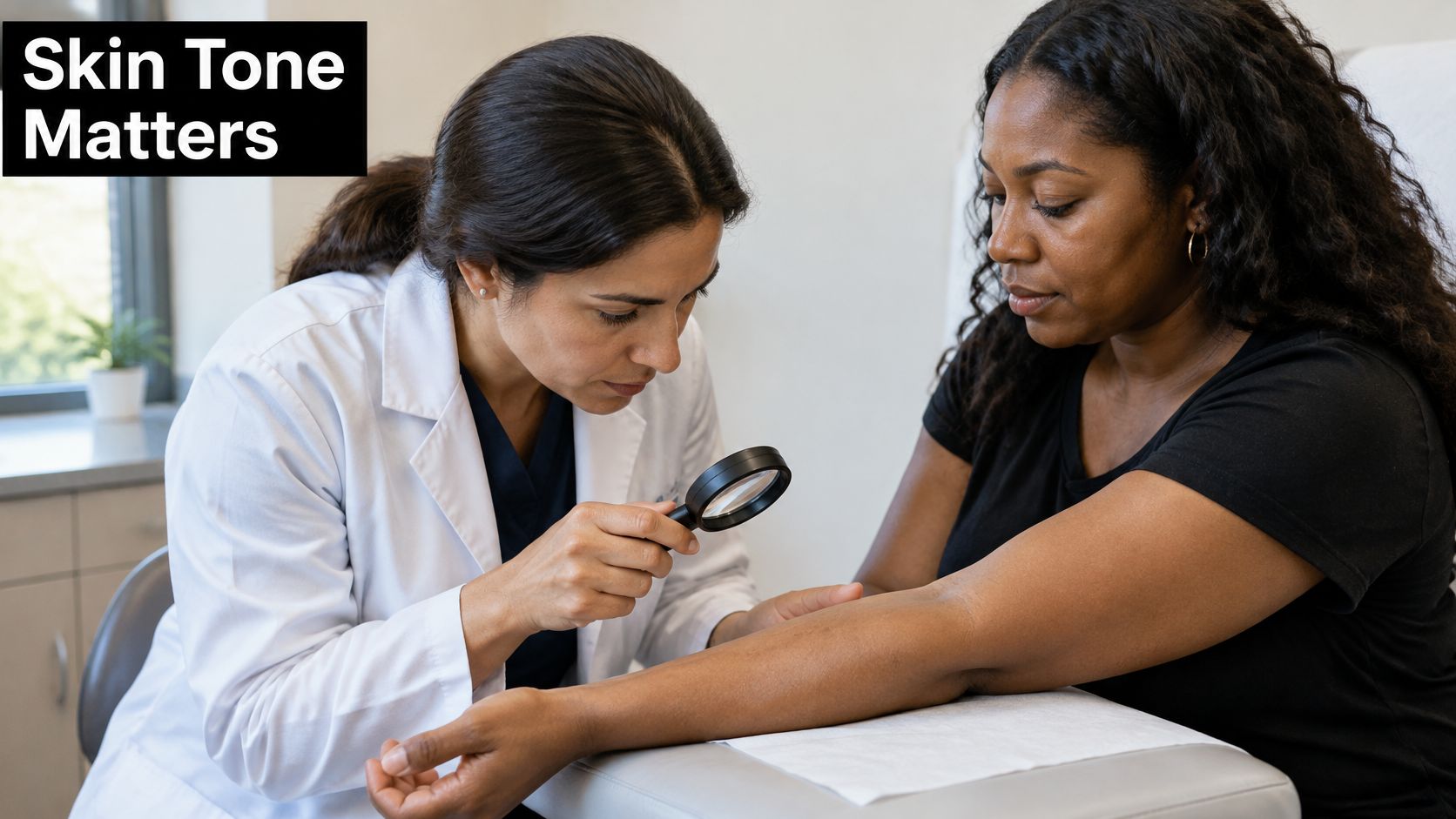
A close skin examination helps the provider assess the actual treatment area rather than judging suitability from your face or forearm alone.
Match the response to the risk factor
The pubic mound, groin folds, and external genital skin may not have identical pigmentation. A provider should inspect these differences and adjust the treatment plan rather than treating the entire Brazilian area as one uniform patch.
Risk factor | Why it raises risk | Practical response |
|---|---|---|
Deeper skin tone | More epidermal melanin competes for laser energy | Individualized settings, documented baseline, and a test spot when appropriate |
Recent tanning or sun exposure | A tan changes the skin's response to treatment | Disclose exposure; postpone treatment on recently tanned or sunburned skin |
Fine or lightly pigmented hair | Hair may absorb too little energy for reliable destruction | Have the provider assess whether the hair is a suitable target |
Irritated or freshly waxed skin | Irritation complicates assessment; waxing also removes the pigmented hair target | Wait for calm skin and suitable regrowth before treatment |
Hormonal drivers of new growth | New hair can develop despite treatment of existing hair | Consider clinical evaluation rather than automatically increasing energy |
Excess topical numbing cream | Excess absorption can cause serious systemic effects | Use only a clinician-approved product and application plan |
Shorter-wavelength laser systems | Greater competing absorption can increase pigment injury risk | Ask which wavelength is appropriate for your skin, not simply which brand is available |
The Fitzpatrick scale describes how skin responds to ultraviolet exposure, but it isn't a substitute for examining the treatment site. A naturally darker groin fold, an active rash, or a recent tan can change the decision even when your general skin classification hasn't changed.
For a consultation-focused explanation, the clinic's guide to laser hair removal for brown skin can help you identify the questions to bring.
Wavelength matters, but it isn't a guarantee
A review published in Lasers in Medical Science reported pigmentary alterations as high as 19% with shorter-wavelength systems, compared with approximately 2–3% using long-pulsed 1064-nm Nd:YAG lasers; pigment complications were more frequent in darker skin, while permanent sequelae remained uncommon.
Those figures describe the systems and populations reviewed, not a head-to-head forecast for your Brazilian appointment. They support thoughtful wavelength selection, not a promise that a particular device eliminates burns or discoloration.
Fluence means the amount of energy delivered over an area. Pulse duration, cooling, treatment coverage, and the operator's response to your skin also matter. Settings that are too aggressive can injure skin, while settings chosen only to minimize sensation may fail to treat the hair adequately.
The accompanying video can be a starting point for discussing the treatment process with your provider.
What a protocol-driven appointment should include
If you're considering NYC Laser in Westbury, ask how the team applies these safeguards to your visit. The clinic offers Splendor X treatments, but the benefit of that platform depends on the settings selected for your skin and hair, not the name on the machine.
A careful assessment should document baseline pigmentation, preferably with consented photographs, and confirm recent tanning, irritation, medications, and previous reactions. When the appropriate settings or skin response are uncertain, a test spot can help guide the plan. It doesn't replace ongoing observation during treatment.
The provider should explain epidermal cooling and agree on the treatment boundaries before beginning. Brazilian treatment should target appropriate external, hair-bearing skin, not mucosal surfaces. You should know what will be covered, what will be excluded, and how to ask for a pause.
A safe appointment includes permission to stop. Unexpected or increasing burning is a reason to reassess, not something you need to tolerate to get results.
Bring a short checklist to any clinic:
Device and wavelength: Which laser will you use, and why does it suit this treatment area?
Individual settings: How will you account for darker patches, hair thickness, and previous reactions?
Test spot: When would you perform one, and how would you review the response?
Cooling and boundaries: How will you protect the skin and exclude mucosal tissue?
Aftercare and contact: What should I use afterward, and who handles concerns outside normal hours?
How to Prepare and Recover Step by Step
Preparation should leave the skin calm and the hair target available. Recovery should reduce irritation while making it easy to recognize a problem.
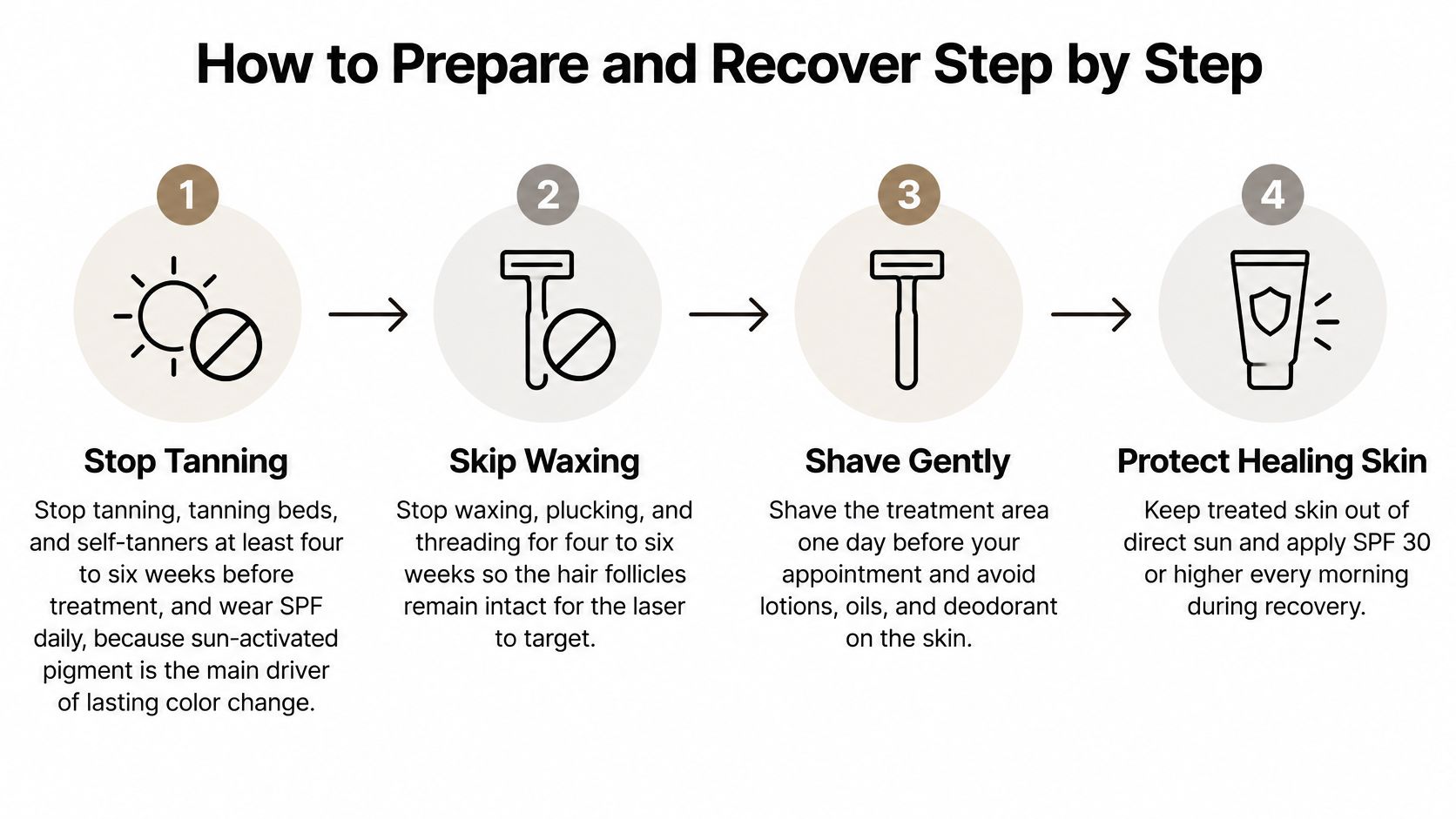
The preparation graphic offers a broad overview. Confirm the timing of each step with your clinician because your skin, products, and treatment plan may require different instructions.
Before the appointment
Arrive without a recent tan. Avoid deliberate tanning and tanning beds, and tell the clinic about sun exposure or self-tanner. Self-tanner isn't the same as a melanin tan, but it changes surface color and should be disclosed; let the provider decide when your skin is ready.
Leave the hair root in place. Skip waxing, plucking, and threading between sessions. Shave gently according to the clinic's preparation instructions, and report razor cuts or irritation rather than shaving repeatedly over tender skin.
Review active products and medication. Tell the provider about retinoids, exfoliating acids, prescription creams, and medicines that may affect light sensitivity. Pause irritating cosmetic products as directed, but don't stop prescribed medication without speaking to the prescriber.
Agree on numbing before applying anything. Confirm the product, amount, application area, and removal instructions. Don't add extra cream, cover it with plastic, or apply it to mucosal or broken skin unless a treating clinician has specifically directed the plan.
The Mayo Clinic's laser hair removal guidance describes temporary discomfort, redness, and swelling, while distinguishing less common blistering, crusting, scarring, and texture changes. Excessive topical anesthetic application also carries potentially life-threatening risks, so comfort planning deserves the same care as laser settings.
Once you're home
Cool without freezing. Apply a clean, cool compress gently to uncomfortable external skin. Don't place ice directly on the area, and avoid rubbing or repeatedly checking by pressing on tender spots.
Reduce friction and heat. Choose loose, breathable underwear and postpone hot tubs, vigorous exercise, and activities that rub the area until irritation has settled. Nuage Wears' underwear fit tips to prevent rubbing can help you identify seams or tight leg openings that press against treated skin.
Keep skin care simple and track recovery. Use a gentle, fragrance-free moisturizer on intact external skin if the clinic recommends it, and protect exposed treated skin from sunlight. Compare securely stored photographs rather than adding exfoliants or pigment products to chase every visible change.
Keep your written instructions accessible. The clinic's Brazilian laser hair removal aftercare guide can support that conversation, but worsening symptoms need direct contact rather than another layer of home treatment.
Rare Reactions Like Scarring and Unwanted Hair Growth
Persistent regrowth doesn't automatically mean the laser needs more power. Before changing settings, the clinician needs to distinguish ordinary remaining hair, hormonal growth, poor treatment response, and paradoxical hypertrichosis.
Blistering, crusting, scarring, and texture changes are uncommon but meaningful because they may require treatment and can leave lasting effects. Don't pick crusts, deliberately burst blisters, or continue laser treatment over an active injury. If you're concerned about a lasting mark, the clinic's explanation of scarring after laser hair removal can help you prepare for a review.
Location changes the unwanted-growth discussion
Paradoxical hypertrichosis means unexpected stimulation or thickening of hair within or near a treated region. It's different from noticing a few surviving hairs after a session.
A systematic review published in the American Journal of Clinical Dermatology covering 9,733 patients estimated pooled prevalence at 3% overall, but only 0.08% in non-facial and non-neck sites. That location difference makes the overall estimate a poor number to present as someone's Brazilian-specific risk.
The non-facial and non-neck category still combines different body sites. It supports counseling that the Brazilian region is substantially lower risk than the face or neck, but it doesn't establish a precise rate for pubic treatment or prove that the risk is zero.
Why adding energy isn't the first response
One proposed mechanism is sublethal heating: the follicle receives heat without enough damage to disable it. Fine, lightly pigmented, or incompletely targeted hairs may be especially difficult to treat effectively.
That explanation doesn't justify turning the energy up without reassessment. The provider must also protect the surrounding skin and decide whether the hair remains an appropriate laser target.
More energy is not a fix for regrowth. First establish what is growing, where it is growing, and why.
A useful evaluation includes:
Distribution: Is the change inside the treated area, along its borders, or elsewhere?
Timing: Did the apparent increase persist through subsequent growth, or was it briefly visible during shedding?
Hair characteristics: Is there more coarse hair in reality, or are the remaining hairs easier to notice?
Other symptoms: Are there changes that make hormonal assessment appropriate, such as irregular menstrual cycles or new hair elsewhere?
Normal shedding can look like growth because damaged hair shafts work toward the surface before releasing. Don't pluck hairs to test what's happening. Compare dated photographs taken under similar conditions, and ask the clinician to assess a sustained increase in density or thickness before scheduling additional treatment.
When to Seek Medical Help and Book a Consultation
Use three levels of response: monitor an improving mild reaction, contact the clinic promptly for possible injury, and seek urgent care for signs of infection or a systemic reaction. You don't need to diagnose the cause before asking for help.
Monitor at home when symptoms are settling
Mild follicular bumps, warmth, and redness can be observed when they're becoming less uncomfortable and the skin remains intact. Use gentle cooling and reduce rubbing. The timing-and-action table near the beginning can help you identify the reaction, but improvement matters more than meeting a fixed deadline.
Call the clinic for a possible treatment injury
Contact the clinic the same day if you develop blisters, open skin, or escalating pain. Ask for assessment rather than permission to continue your usual products.
Arrange a follow-up for a pigment patch that keeps changing, a persistent texture difference, or new hair that is clearly denser. Send photographs through the clinic's approved channel and explain whether the affected area is expanding or becoming more painful.
Seek urgent care for infection or systemic symptoms
Pus, spreading warmth, fever, or rapidly worsening tenderness warrants urgent medical assessment. Don't wait for a routine cosmetic follow-up if you feel unwell.
Facial or throat swelling, trouble breathing, collapse, or a seizure after a numbing product requires emergency services immediately. Bring the product packaging or a photograph of its label if you can do so without delaying care.
Safety first: If you're unsure whether a worsening reaction can wait, seek medical advice rather than treating through it.
If you're considering treatment in Westbury or elsewhere in Nassau County, book a consultation at NYC Laser to review your skin tone, recent sun exposure, hair type, and previous reactions before a first session. Ask for a clear preparation plan and an escalation contact before committing to treatment.
Go ahead when the protocol is clear and the skin is calm; delay when the skin is tanned or irritated.
NYC Laser Hair Removal offers Brazilian and other body-area hair reduction using Splendor X technology with individualized treatment planning. Visit NYC Laser Hair Removal to request a consultation and discuss skin suitability, expected reactions, and the aftercare instructions you'll need before your first session.
Comments