
How to Prepare for Brazilian Laser Hair Removal Safely
You've booked the consultation, or you're about to, and now your calendar is the confusing part. You waxed last week, you have a beach weekend coming up, and you're not sure if you should shave the morning of the appointment or skip it entirely.
That's normal. How to prepare for Brazilian laser hair removal is mostly about working backward from the appointment date and protecting two things, the follicle the laser needs to target and the skin around it. Each cut-off below is tied to a specific safety or result reason, not just clinic preference.
Preparation Timeline From Eight Weeks Out
Brazilian laser works as a planned series, not one visit, because energy primarily affects hairs in the active growth, or anagen, phase. In a 2025 clinical study of 60 patients treated 4 to 6 weeks apart, average hair reduction at six months after the final session was 75.07%. That figure isn't a guarantee, and it shows why patience matters.
Count backward from your appointment date. If you have a summer trip, wedding, or planned tan, move the early checkpoints earlier rather than compressing them.
Your Backward Calendar
When | Action | Why it matters |
|---|---|---|
8 weeks or more before | Book the consultation and patch test; plan sessions 4 to 6 weeks apart | Hair responds in a series, not one visit |
6 weeks before | Stop plucking, electrolysis and waxing (strictest guidance) | Laser needs the follicle bulb intact |
4 weeks before | Minimum cut-off for waxing or threading; start daily broad-spectrum SPF 30 or higher | Protects against new pigment changes |
1 week before | Stop self-tanners and new exfoliating products; confirm no sunburn or rash | Irritated or tanned skin raises patch risk |
24 hours before | Shave the treatment area, leaving slight stubble | Removes surface hair without damaging the follicle |
Appointment day | Arrive with clean, dry skin; no deodorant, perfume, oil or cream | Avoids surface reactions and energy absorption |
6, 9 and 12 months after final session | Compare photos or hair counts | Permanent reduction is judged over this window |
The final row matters more than many people expect. FDA device documentation defines permanent hair reduction as a long-term, stable decrease measured at 6, 9, and 12 months after a treatment regimen. Judge the series months later, not by shedding in the first week.
If you waxed, plucked, threaded, or had electrolysis inside the four-week window, push the first session back until four full weeks have passed.
Don't treat through a problem to keep a date. If sunburn or a new tan appears in the final week, postpone and tell the clinic what changed. A short delay protects your skin and gives the laser a clearer target.
Consultation, Disclosures and Products to Plan Around
Your provider can't choose safe settings without a complete picture of your skin, medicines, and recent procedures. Bring this list to the consultation and don't downplay items because they seem unrelated.
What to Disclose Before Any Energy Is Used
All medicines and supplements: List prescription and nonprescription products, including St John's wort.
Isotretinoin use: Share current or recent use and follow clinic timing on laser hair removal and Accutane planning.
Genital herpes or cold sores: A history may need clinician-directed antiviral prophylaxis, not self-treatment.
Keloid or raised scarring: Mention abnormal scarring anywhere, not only in the Brazilian area.
Active rash or infection: Report irritation, broken skin, or recent flare-ups.
Sunburn and pigment changes: Disclose recent tanning, self-tanner use, and new light or dark patches.
Previous hair removal: State when you last waxed, threaded, used electrolysis, or had laser.
That disclosure shapes wavelength, energy, timing, and whether treatment should wait. Coarse hair or richly pigmented skin isn't a reason to cancel the consultation on your own. Ask for an assessment instead.
Patch Test and Questions to Bring
A patch test treats a small area first. The clinic then watches the reaction for one to three days and records it before a full session. It's a useful checkpoint if your skin is reactive, tanned, or richly pigmented, or if you're unsure how you'll respond.
Ask how settings are chosen for your skin type. Ask how many sessions are planned, what to do if a reaction occurs, and whether the device is cleared for your skin tone. Get the answers in plain terms before you commit to a bundle.
Practical rule: If a product or medicine might affect light sensitivity or healing, ask before you stop it, start it, or apply it.
Products, Medicines and Clothing
Stop topical retinoids and exfoliating acids on the timeline your provider sets, and ask exactly how many days ahead that means. Flag photosensitizing drugs such as doxycycline. Never stop a prescribed blood thinner without asking the prescriber first.
On the day, skip deodorant, perfume, oils, and creams on the treated area. Don't apply numbing cream unless the clinic authorizes the product and timing.
Wear loose cotton bottoms or a skirt. Skip tight synthetic leggings or thongs that rub before the session, and bring a spare loose pair for the trip home. Friction is a small detail that can make a sensitive area feel much worse afterward.
Trimming or Shaving Before Your Session
Shaving the day before is the preferred method. Anything that pulls hair from the root has to stop early, because laser energy targets melanin in the intact follicular bulb and root removal should stop at least 4 weeks beforehand.
This guide shows which methods preserve the target and which remove it.
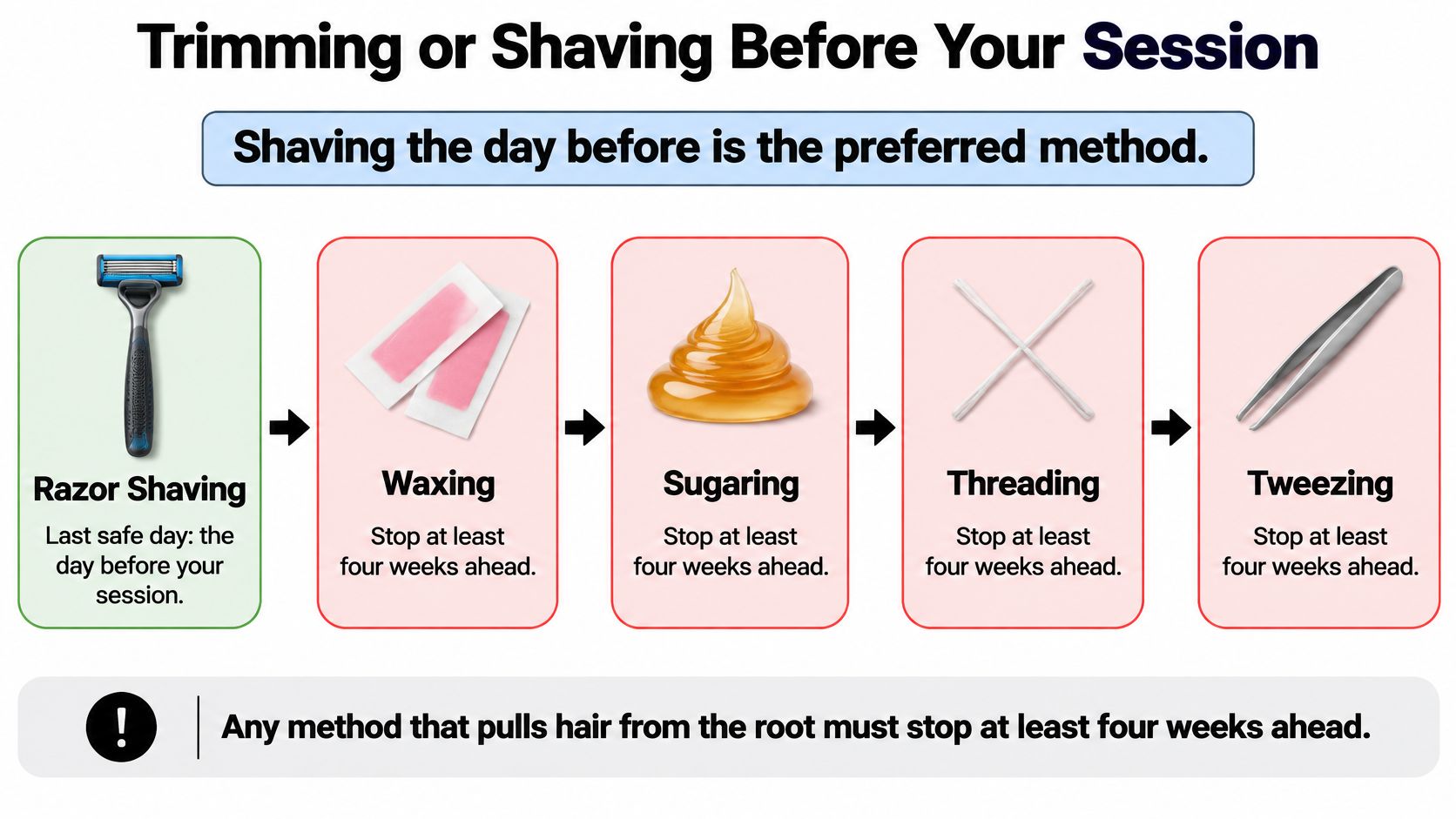
Method | Last safe timing | Effect on laser result |
|---|---|---|
Razor shaving | Day before (about 24 hours) | Preferred; removes surface hair and leaves the follicle intact |
Electric trimmer on short guard | Day before, if provider approves | Acceptable alternative for sensitive skin |
Waxing or sugaring | At least 4 weeks (6 for strict protocols) | Removes the follicle root the laser needs to target |
Tweezing or epilating | At least 4 weeks | Same problem, the follicle is pulled out |
Threading | At least 4 weeks (1 month in a 2024 protocol) | Same problem as waxing |
Electrolysis | At least 4 weeks | Damages the follicle the laser is meant to treat |
Depilatory cream | Ask your provider | Can irritate skin and complicate the treatment area |
Some stricter guidance is longer. StatPearls advises avoiding plucking or waxing for 6 weeks before treatment, while a 2024 protocol recommends avoiding waxing or threading for 1 month. Use the stricter date if your clinic gives you one.
How to Shave Without Creating a New Problem
Use a fresh blade: Shave on dry skin the day before, not the same morning.
Follow growth first: Go with the direction of growth, then against it only if stubble remains.
Rinse and pat dry: Use lukewarm water and avoid scrubbing.
Leave faint stubble: A few millimetres helps the provider see the hair pattern.
Skip after products: Don't use aftershave, scrubs, or creams afterward.
An electric trimmer on a short guard can replace a razor for sensitive skin if your provider approves it. Read the clinic guidance on whether to shave before laser hair removal before you switch methods.
The common mistakes are shaving too close, nicking the skin, and using depilatory cream without asking. A small cut or chemical irritation can force a postponement, even if your timing was otherwise perfect.
Sun, Tanning and Skin Tone Preparation
If your appointment is coming up after a beach trip or outdoor event, check your skin before you confirm the date. A fresh tan can affect both the treatment setting and whether it is safe to proceed. Count backward from your appointment and use the checkpoints below to protect the skin and the result.
Melanin in the top layer of skin competes with the follicle for laser energy. A recent tan can raise the risk of temporary, or rarely lasting, light or dark patches. The provider needs to know about tanning and changes in skin tone before treatment.
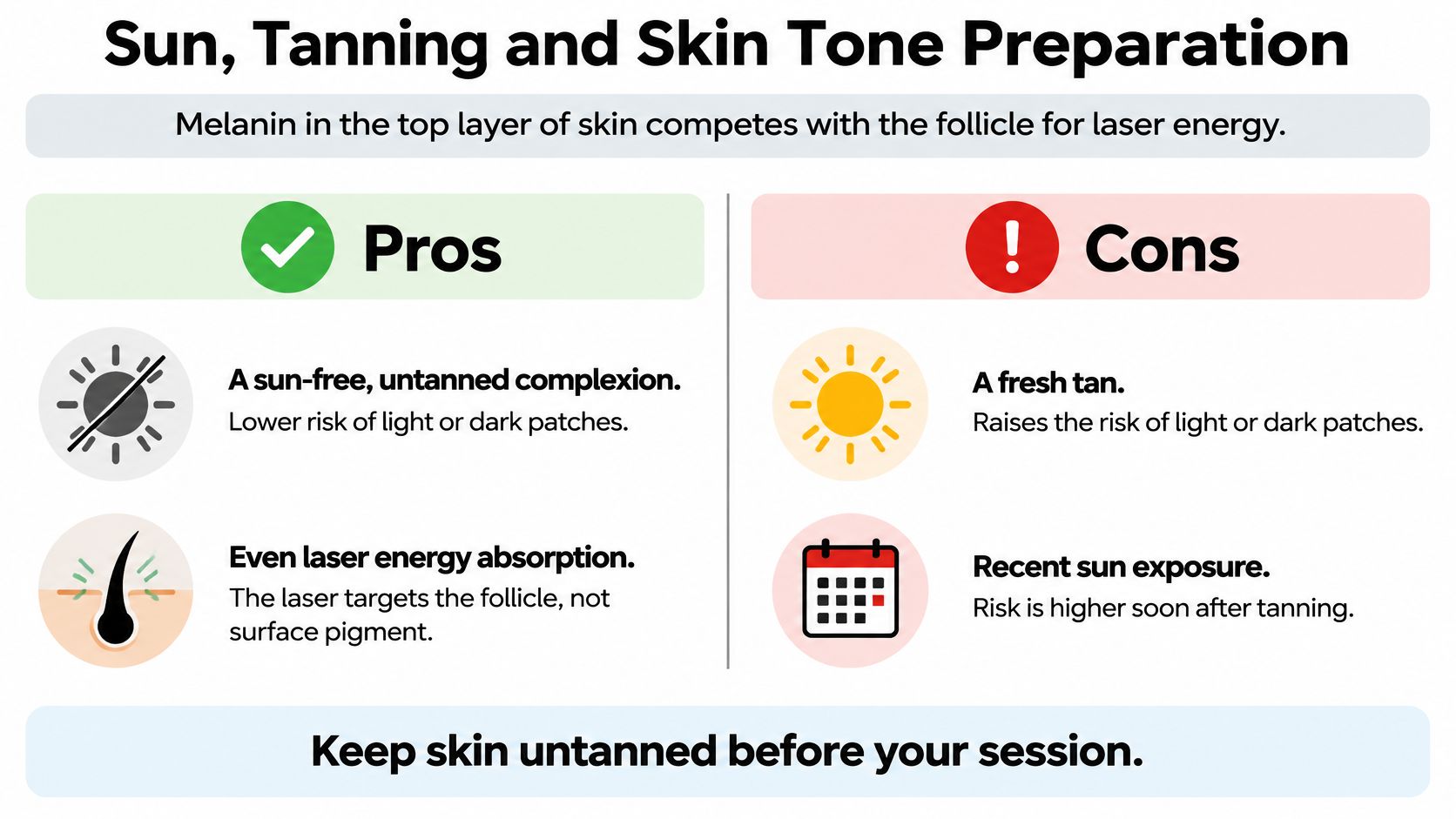
Skin situation | What to do first | Why it matters |
|---|---|---|
Recent natural or booth tan | Wait until the tan fades; tell the provider before booking | Melanin competes with the follicle for energy |
Sunburn | Postpone until the skin has fully healed | Inflamed skin reacts unpredictably |
Self-tanner or sunless spray | Avoid until fully faded; confirm with provider | Tanners add pigment to the treatment area |
Fair skin, no recent tan | From the four-week mark, use broad-spectrum SPF 30 or higher daily | Helps prevent new pigment changes |
Darker or richly pigmented skin | Request a skin assessment, test spot and settings plan | The right device and settings can lower the risk of lasting pigment change |
Recent light or dark patches | Report them before booking | They can affect device choice and energy settings |
From four weeks out, protect the area from sun exposure and avoid sunless tanners. Mayo Clinic advises avoiding sun exposure and sunless tanners and using broad-spectrum SPF 30 or higher. If you develop a tan or sunburn close to the appointment, tell the clinic and wait for guidance rather than trying to keep the original date. This matters after summer travel or outdoor sports on Long Island.
This short video explains the tanning issue in practical terms.
Skin tone also informs device choice. Darker skin does not automatically rule out laser treatment, but it calls for a documented sun history, a skin assessment, a test spot when appropriate, and a clear settings plan. Ask the provider what device and settings they recommend for your skin before booking around a holiday. For more guidance on whether you can tan before laser hair removal, review the timing with your clinic.
Pain Relief Options and What Happens in the Chair
The provider will ask you to undress from the waist down and give you a cover for privacy. Before starting, they check that the skin is clean, dry, and free of cuts or rash. The device delivers short pulses as the provider works across small sections. You can ask a question or request a pause at any time.
Each pulse may feel like a quick rubber-band snap with a brief sensation of heat. A cooling tip helps reduce that heat during treatment. The appointment is usually short, though the exact time depends on the area and pace.
What Discomfort to Plan For
The Brazilian area can feel more sensitive than other areas, and coarse hair may make pulses more noticeable. Sensation also varies across the treatment area and from client to client. Plan for an unfamiliar feeling at your first visit, rather than expecting it to be painless.
As hair becomes finer over a series of sessions, later visits may feel easier to anticipate. They can still be uncomfortable. Tell your provider if the sensation changes or feels different from what you expected.
You do not need to sit through pain that feels wrong. Ask for a pause.
Options to Discuss in Advance
Option | How it helps | Check first |
|---|---|---|
Cooling gel or ice pack | Cools the surface before or after treatment | Ask which product the clinic allows |
Device cooling tip | Cools the skin during each pulse | Ask how the device's cooling feature is used |
Over-the-counter pain reliever | May ease soreness after the session | Confirm the type and timing with your provider |
Topical lidocaine cream | Numbs the skin before treatment | Use only with clinician approval and follow their timing instructions |
Do not apply numbing cream on your own before the appointment. The wrong product, amount, or timing can affect how the clinician assesses your skin. Ask about pain relief when you book, so there is time to get clear instructions before treatment.
During the session, speak up if you need a break, a slower pace, or a settings check. Sharp, escalating, or unexpected pain gives the provider useful information. A brief pause lets them assess what is happening before continuing.
Aftercare Steps and Booking Your Next Session
The first day is about cooling the area and reducing friction. You don't need a complicated routine, and adding strong products early usually makes recovery harder.
This checklist covers the steps to follow before you book the next visit.
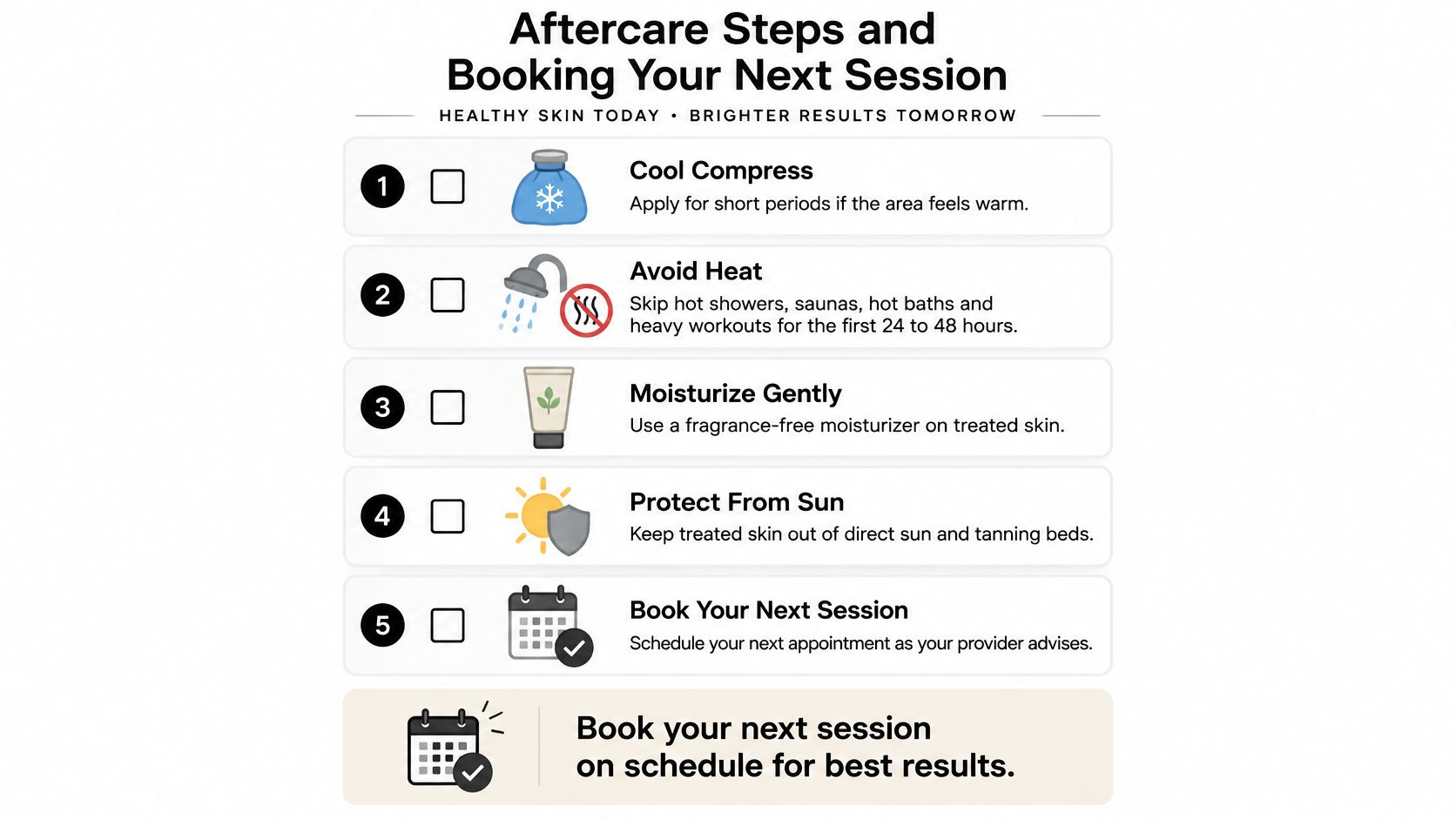
First 24 to 48 Hours
Cool the area: Apply a cool compress for short periods if it feels warm.
Avoid added heat: Skip hot showers, saunas, hot baths, and heavy workouts for the first 24 to 48 hours.
Protect from sun: Keep the area covered and use broad-spectrum SPF 30 or higher daily where skin is exposed.
Pause active products: Skip exfoliants, retinoids, and deodorant on the area until skin is calm.
Reduce friction: Wear loose, breathable clothing and underwear.
Watch for warning signs: Call the clinic for blistering, spreading redness, pus, or fever.
Mild warmth or pinkness can be expected after treatment in a sensitive area. Worsening pain, blistering, or signs of infection aren't things to monitor on your own at home for days.
Keep the Series on Schedule
Book the next session 4 to 6 weeks later, unless your provider gives you a different interval based on regrowth and skin response. Booking too close together doesn't speed the biology of the hair cycle.
Mark the longer checkpoints too. Compare photos or hair counts at 6, 9, and 12 months after the final session, because that's the window that shows stable reduction rather than short-term shedding.
For local booking, NYC Laser Hair Removal is at 355 Post Avenue, Suite 101, Westbury, NY 11590, open Monday to Saturday 10am to 6pm, with single sessions and 3- or 6-session bundles. Bring your preparation dates to the consultation so the team can confirm whether you're ready to treat or should shift the first session.
If you're ready to start your Brazilian series and want your preparation dates checked against your skin, hair, and recent tanning history, book a consultation with the team in Westbury. Visit NYC Laser Hair Removal to choose a single session or a 3- or 6-session bundle and schedule your patch test before your first full appointment.
Comments