
Best Bikini Line Hair Removal: Methods That Actually Work
Standing in front of the mirror twelve hours before a trip, you notice the stubble has already returned. The razor burn from last time is still visible, and one stubborn ingrown hair is making the entire bikini line feel impossible to manage. You start wondering whether you'll be shaving, waxing, or hiding the area forever.
The confusion is understandable. Bikini-line hair is often coarse, the skin is sensitive, and friction from underwear, swimwear, and daily movement can turn a simple grooming routine into irritation, bumps, or discoloration. Every friend, video, and forum seems to recommend a different solution.
The best bikini line hair removal method depends on four decisions: your budget, skin tone, hair color, pain tolerance, and how long you want the result to last. Laser is my leading recommendation for people with suitable hair and skin contrast, but it isn't automatically right for everyone. This guide compares the actual tradeoffs so you can choose a method that fits your life instead of repeating a temporary routine by default.
Why Bikini Line Hair Removal Feels So Complicated
The bikini line is a difficult area because the skin and hair create competing demands. You want a close, clean result, but the skin can react badly to friction, heat, blunt shaving, fragrance, and aggressive exfoliation. A method that works beautifully on the legs may cause more irritation around the groin.
That's why two people can use the same razor or wax and have completely different experiences. One person gets a smooth finish with minimal redness. Another develops bumps, ingrown hairs, and lingering dark marks after a single session.
Clinical reality: A smooth result that lasts only a day isn't necessarily a good result if the next week brings irritation.
The grooming pressure also has a long history. The bikini line became a distinct grooming category after the bikini's introduction in 1946, when women began removing hair outside the panty line to prevent visible regrowth around swimwear. The practice expanded as bikini styles became mainstream, then developed into more complete grooming options such as the Brazilian wax, introduced in New York City in 1987 by the J. Sisters. These milestones are documented in this history of bikini-line hair removal.
Today, the question isn't just whether you can remove the hair. You can. The more useful question is whether you want to keep removing it at the surface, or reduce the amount of hair that grows in the first place.
A reader preparing for a vacation may reasonably choose shaving or waxing because the immediate goal is appearance. Someone dealing with weekly irritation, recurrent ingrowns, or years of appointments needs a different strategy. The right decision accounts for the entire maintenance cycle, not just the next swimsuit day.
The Five Main Bikini Line Hair Removal Methods
Most consultations eventually come down to five categories. Each removes or disables hair differently, and each makes a different compromise between convenience, discomfort, longevity, and skin tolerance.
Shaving and trimming cut hair at or just above the skin's surface. They're inexpensive, private, and easy to control, but regrowth appears quickly and the blunt hair tip can feel rough.
Depilatory creams use chemicals to break down the hair near the skin's surface. They can provide a smooth finish without a blade, but the active ingredients may irritate sensitive bikini skin, so a patch test matters.
Waxing and sugaring pull hair from the root. Wax uses heated or cold adhesive material, while sugaring uses a sugar-based paste. Both last longer than shaving because the visible hair has been removed below the surface, but both can hurt and may trigger irritation or ingrowns.
Electrolysis uses a fine probe to treat individual follicles. It can work on hair colors that lasers struggle to detect, but it's a gradual process because follicles are treated one at a time.
Laser hair removal delivers light energy toward pigment in the hair follicle, producing long-term hair reduction over a course of treatments. It usually suits dark hair best, while the device and wavelength must be selected carefully for the patient's skin tone.
I compare these methods using five practical questions:
Effectiveness: Does it work well on coarse bikini-line hair?
Pain: Can you tolerate the sensation repeatedly?
Cost: Does the recurring expense fit your budget?
Skin and hair fit: Is it suitable for your complexion and hair color?
Maintenance: Will you still need to remove hair every few days or weeks?
There's no universal winner. A first-timer who wants a single smooth result may prefer trimming or shaving. A person with dark coarse hair, recurrent ingrowns, and little patience for upkeep may be better served by laser. Someone with gray or white hair may need electrolysis instead.
How Each Method Compares on Effectiveness Pain Cost and Maintenance
The table below gives a realistic decision-level comparison. Prices vary by provider, treatment area, location, and package, so I'm using relative cost rather than inventing figures that wouldn't apply consistently.
Bikini Line Hair Removal Methods Compared
Method | Results Last | Pain Level | Cost Per Session | Sessions for Long-Term Reduction | Maintenance |
|---|---|---|---|---|---|
Shaving or trimming | Short term, with visible regrowth quickly | Low during treatment, irritation varies | Low | Not designed for long-term reduction | Frequent, often whenever stubble returns |
Depilatory cream | Short term, usually comparable to surface removal | Low if tolerated, but chemical irritation is possible | Low to moderate | Not designed for long-term reduction | Repeat whenever regrowth appears |
Waxing or sugaring | Longer than shaving because hair is removed at the root | Moderate to high | Moderate | Repeated appointments are required | Recurring appointments as hair returns |
Electrolysis | Permanent treatment of individually treated follicles | Variable, often repetitive | Moderate to high over a full course | Many appointments, depending on density and hair color | Occasional follow-up may be needed |
Laser hair removal | Long-term reduction that builds across treatments | Moderate, usually brief pulses | Higher upfront investment | A course is needed. Published bikini-line guidance commonly describes 6 to 8 treatments spaced 4 to 6 weeks apart in this clinical treatment guide | Occasional maintenance may be appropriate |
The table makes the central tradeoff clear. Shaving and cream keep the entry cost low, but they also keep the routine alive indefinitely. Waxing lasts longer per appointment, yet it asks you to keep paying for and tolerating the same removal process.
For sensitive skin, the choice requires more nuance. A person who reacts to wax may tolerate sugaring better, although sugaring can still irritate the area. Someone who reacts to both wax and chemicals may prefer careful trimming, or may consider laser after a proper consultation.
Pain tolerance matters too. Waxing concentrates discomfort into a short, intense pull. Laser usually delivers brief pulses over the area. Electrolysis can be effective for suitable hair colors, but the one-follicle-at-a-time approach makes the process more demanding.
My recommendation: Choose a temporary method when you need flexibility. Choose a reduction method when you're tired of paying in time, irritation, and repeated appointments.
Matching the Right Method to Your Skin Tone and Hair Type
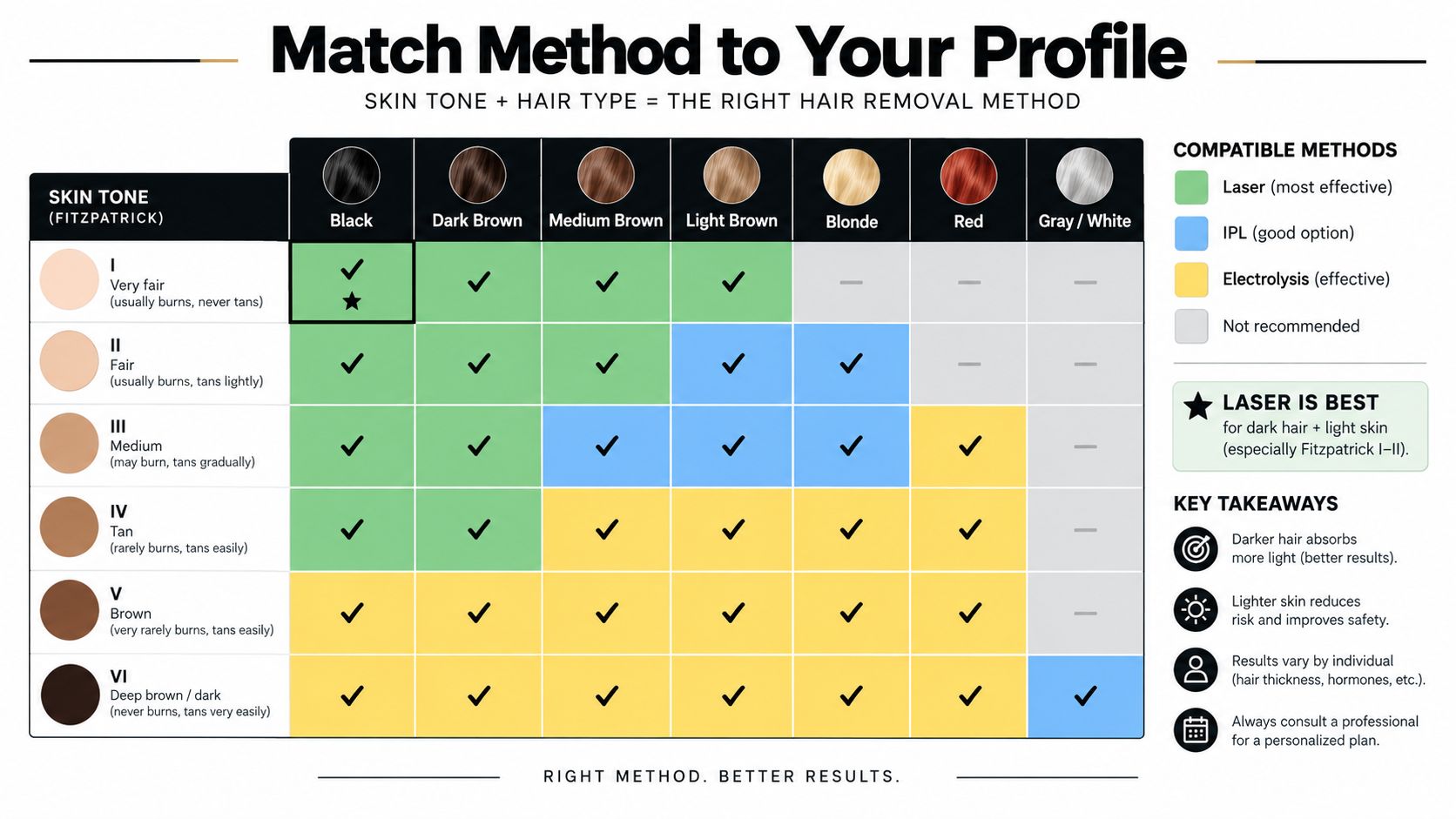
Skin tone and hair color matter more than the brand name on the device. Laser works by directing light toward pigment associated with the hair follicle, so the provider must balance hair targeting against the pigment in the surrounding skin.
Dark hair with lighter skin has traditionally offered the strongest contrast for laser treatment. Darker skin can also respond well, but it requires a wavelength and setting that protect the surrounding pigment. Expert guidance commonly matches 755 nm Alexandrite with lighter skin types and 1064 nm Nd:YAG with darker, more pigmented skin because the longer wavelength is safer in that context. The relevant clinical review of bikini-area wavelength selection explains why device choice and treatment parameters matter.
A multicenter clinical study found mean bikini-line hair reduction of 48.1% ± 20.9% at 3 months, with 45.5% ± 16.9% in lighter skin types and 40.3% ± 17.2% in darker skin types. The study included Fitzpatrick skin types across the lighter and darker groups, and its results support choosing wavelength-based technology for diverse patients. Read the peer-reviewed bikini-line laser study for the full methodology and results.
The response range also varied substantially, which is why a single treatment rarely answers the question. Hair cycle, density, hormone sensitivity, settings, and contrast all influence the outcome.
A practical self-assessment
Dark, coarse hair: Usually a strong laser candidate, provided the provider selects the right wavelength for your skin.
Light blonde, red, gray, or white hair: Laser may respond poorly because there's less target pigment. Electrolysis is often the more logical option.
Very fine hair: Expect a less predictable laser response than with coarse terminal hair.
Darker skin: Ask which wavelength will be used and whether the provider routinely treats your Fitzpatrick range. Don't accept a vague answer.
Tanned or recently sun-exposed skin: Reschedule or disclose it before treatment. Pigment changes affect safety and settings.
For readers with brown or deeper skin tones, the most useful consultation is one that discusses wavelength, cooling, test spots, and realistic reduction rather than making blanket promises. This guide to laser hair removal for brown skin is a helpful starting point before you book.
Prep and Aftercare That Actually Change Your Results
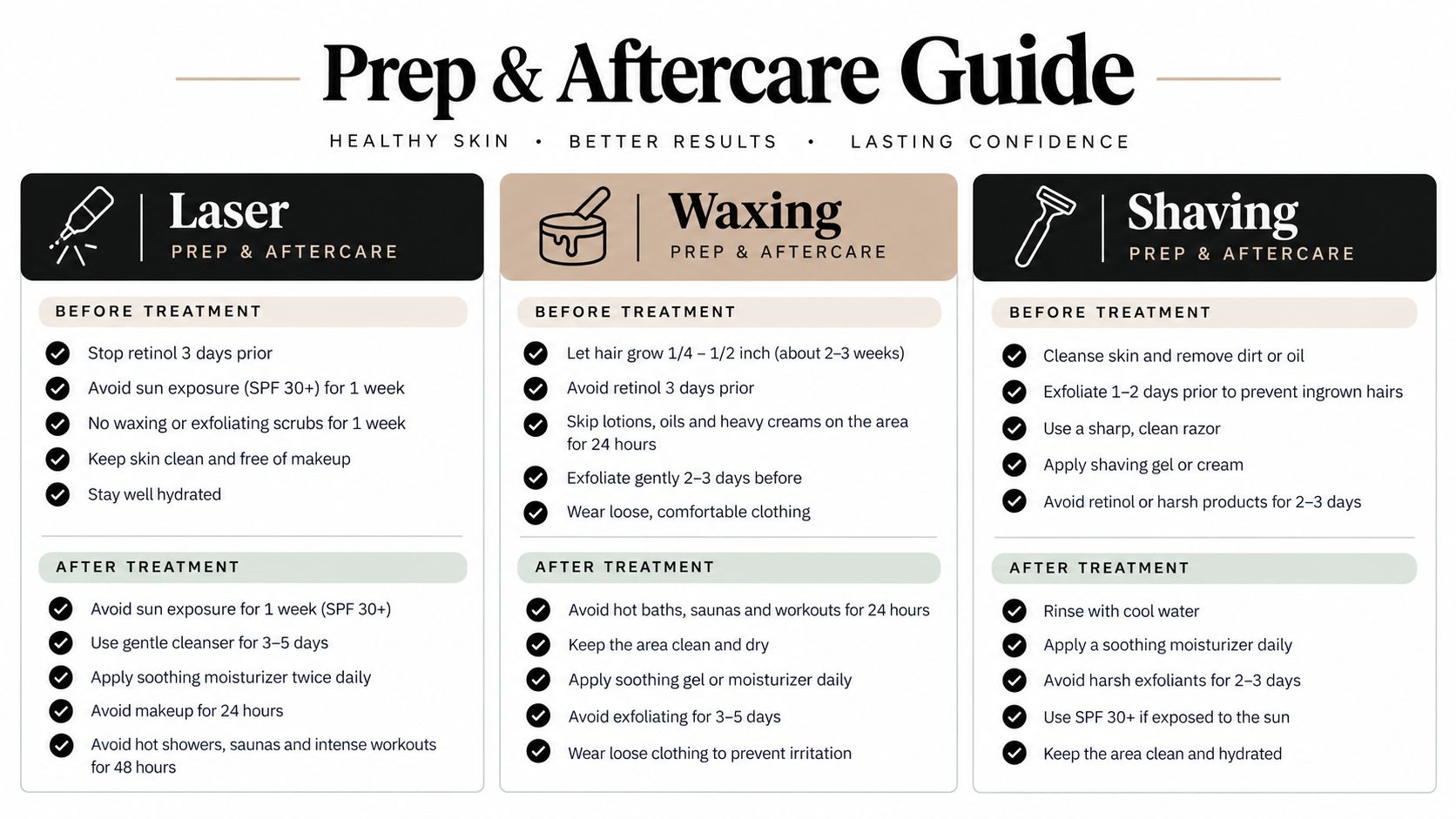
Preparation determines whether a treatment feels controlled or unnecessarily irritating. For laser, shave the area 24 to 48 hours before the appointment. Don't wax, pluck, or thread for 4 to 6 weeks beforehand, because the follicle needs to remain present for the laser to target it.
Arrive with clean skin and no perfume, heavy lotion, or deodorant in the treatment area. If you're using retinoids or other potentially irritating products near the bikini line, ask the provider whether you should pause them. Don't assume a product is harmless just because you've used it elsewhere on your body.
Waxing and sugaring require a different strategy. Let the hair grow enough for the material to grip, then exfoliate gently between appointments rather than scrubbing aggressively just before one. Exfoliation can help reduce trapped hairs, but freshly waxed skin needs time to settle.
Depilatory cream is the method most likely to punish overconfidence. Patch-test according to the product directions before applying it to a larger area, and never leave it on longer because the hair seems resistant. Burning or tingling is a reason to remove the product, not a sign that it's working better.
After treatment, keep the area cool and calm:
After laser: Avoid heat, hot baths, saunas, and intense friction for the first 24 hours. Mild warmth or redness can occur, but increasing pain or blistering needs medical attention.
After waxing or sugaring: Use gentle, fragrance-free care. A silicone-based aftercare product may reduce friction, and loose cotton underwear is preferable to tight synthetic fabric.
After shaving or cream: Moisturize with a bland, fragrance-free product. Avoid deodorant, friction, and irritating products for 48 hours if the skin feels raw or the method has caused tiny abrasions.
For every method: Don't pick bumps. Keep the area clean, wear loose clothing, and avoid turning a short treatment into prolonged inflammation.
For a practical smoothing routine between appointments, follow this bikini-line preparation and aftercare guide. The small details matter. Sleeping in loose clothing after a more irritating treatment can make the difference between calm skin and a week of rubbing and bumps.
Choosing the Best Option for Your Real Life Situation
The right method becomes clearer when you stop asking which option is universally best and ask which problem you're trying to solve.
If you're a first-timer with a low pain tolerance
Start with trimming or shaving if you want control and minimal commitment. Use a clean, sharp razor, shave with the grain if you're prone to ingrowns, and upgrade when repeated irritation or constant upkeep becomes more frustrating than the idea of treatment.
Depilatory cream can be an alternative, but only if your skin tolerates it. A patch test isn't optional for reactive skin.
If your skin reacts easily
Choose sugaring over traditional waxing if you've found wax too harsh, then keep aftercare simple. Skip fragranced products, tight clothing, and aggressive exfoliation immediately after treatment. If both methods trigger problems, a careful shaving plan or a properly selected laser course may be more sensible.
If you have a darker skin tone
Ask about Nd:YAG or a dual-wavelength system, not just the device's brand or the clinic's discount. The provider should explain how they adjust treatment for your pigmentation and whether they perform a test spot when appropriate. I wouldn't choose a bargain IPL treatment without clear evidence that the equipment and operator are suitable for your skin.
If your budget is limited
Use waxing or shaving for immediate events, then compare the long-term commitment of a laser package with what you repeatedly spend on temporary care. A hybrid plan can make sense when you want short-term control while gradually reducing future maintenance.
If you want the least maintenance
Laser deserves serious consideration when your hair is dark enough to respond and the provider can match the wavelength to your skin. Expect a course rather than a one-off appointment, and understand that long-term reduction isn't the same as a guaranteed absence of every hair.

My decision rule is simple: use shaving or trimming for maximum flexibility, sugaring for a gentler temporary option, electrolysis for light hair, and properly selected laser for dark hair when your priority is reducing long-term maintenance.
Why Laser Wins as a Long Term Bikini Line Solution
Laser is the strongest long-term option for many people because it changes the amount of hair you manage instead of asking you to remove the same hair repeatedly. Shaving cuts the visible shaft. Waxing pulls it out temporarily. Laser targets the follicle during its active growth phase and builds reduction over a treatment course.
That difference matters most around the bikini line, where frequent shaving can aggravate razor bumps and waxing can repeatedly inflame already sensitive skin. Patients often seek laser not because shaving is difficult once, but because the cycle keeps returning alongside irritation and ingrown hairs.
Published bikini-line data support a meaningful early reduction, but they also show why expectations must stay realistic. In the multicenter study cited earlier, the average reduction at the measured follow-up was 48.1%, with a broad response range among participants. That is useful evidence for efficacy, not a promise that every patient will reach the same result.
5-Year Cost and Time Comparison: Shaving vs Waxing vs Laser
Method | Avg 5-Year Cost | Hours Per Year | Hair Reduction After 5 Years |
|---|---|---|---|
Shaving | Recurring low-to-moderate expense | Frequent time commitment | None by design |
Waxing | Recurring moderate-to-high expense | Repeated appointment and travel time | Temporary reduction between appointments |
Laser | Higher upfront investment, then lower maintenance burden | Front-loaded treatment time | Long-term reduction for suitable candidates |
I won't pretend there's a universal price calculation. A person who shaves at home, a person who books professional waxing, and a person treating a broader bikini area have entirely different expenses. The honest comparison is that temporary methods continue charging you in time and upkeep, while laser concentrates more of the work at the beginning.
Laser also isn't the right answer for everyone. Very light, gray, or white hair may respond poorly, and active infections or certain medical conditions require a provider's assessment before treatment. Hormonal changes can also influence future growth, so a consultation should cover your medical history and expectations rather than offering a generic package.
Splendor X Treatments and Packages at NYC Laser Hair Removal
A bikini-line appointment should begin with assessment, not a sales script. The provider needs to identify your skin tone, hair color, treatment area, recent sun exposure, medications, and history of irritation or ingrown hairs.
At NYC Laser Hair Removal, the Splendor X platform combines Alexandrite and Nd:YAG wavelengths in one handpiece. That combination allows the provider to select a more appropriate approach for lighter and darker skin tones, including patients whose skin has recently changed with tanning. The clinic offers bikini-line treatment alongside other areas and provides single sessions plus multi-session bundles.
A standard treatment plan commonly involves a series of appointments spaced according to the hair-growth cycle. The exact number depends on your response, density, skin and hair contrast, and whether you're treating a narrow bikini line or a broader area. Ask for the total package price, what area it includes, the cancellation policy, and whether maintenance appointments are priced separately. The clinic's pricing and plans information can help you prepare those questions.
What happens at the first appointment
Consultation: The provider reviews your skin, hair, medical history, and goals.
Treatment planning: You discuss bikini line versus broader bikini coverage, expected reduction, and session spacing.
Patch testing: A test spot may be appropriate when skin sensitivity, pigmentation, or recent tanning makes a cautious start important.
Treatment: The provider cleans the area, positions the handpiece, and delivers controlled pulses. Built-in cooling is intended to keep the experience more comfortable.
Aftercare instructions: You leave with guidance on heat, friction, shaving, and products to avoid.
Shave 24 to 48 hours before the appointment, don't wax or pluck beforehand, and arrive with clean skin free of fragrance and lotion. Wear loose clothing so the area isn't pressed or rubbed immediately afterward. Between laser sessions, shaving is generally compatible with treatment, while root-removal methods such as waxing and plucking interfere with the target the laser needs.
For Long Island and Nassau County readers, the Westbury location offers online booking and appointments Monday through Saturday from 10am to 6pm, as listed in the clinic's publisher information. Bring a list of medications and skincare products, disclose recent tanning, and be ready to describe how your skin has reacted to shaving, waxing, or creams. My practical recommendation is to book a consultation first, confirm the wavelength plan for your skin tone, and choose a bikini-line package only after you understand the expected maintenance.
NYC Laser Hair Removal offers bikini-line and Brazilian laser hair reduction with Splendor X, personalized treatment planning, and multi-session package options for clients seeking less recurring grooming. Visit NYC Laser Hair Removal to review the Westbury location and schedule a consultation.
Comments