
Alexandrite Laser Hair Removal: Results, Risks and Fit
Many clients book alexandrite laser hair removal because their hair is dark. That habit skips the key question. The same pigment that makes this wavelength so good at finding a hair also sits in the skin, in a fresh tan, and in hair that is fine, red, or grey. Fit is a match between skin response, recent sun, and hair colour, not hair colour on its own.
How Alexandrite Light Targets Hair Follicles
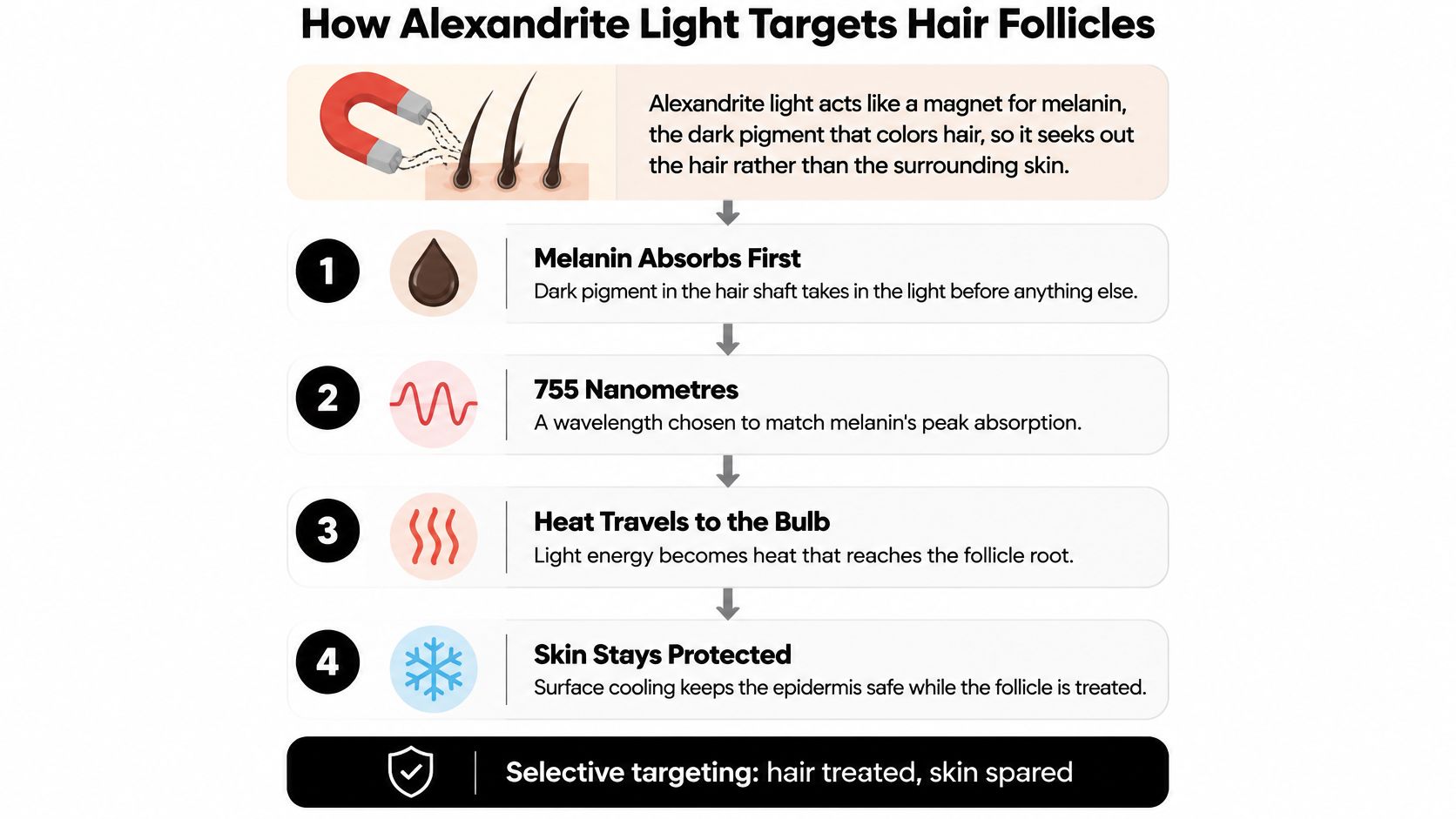
Think of alexandrite light as a magnet for melanin, the dark pigment that colours hair. It is drawn to that pigment far more than to pale surrounding skin. The beam itself is a 755 nanometre wavelength. Pigment in the hair shaft and the follicle takes the light in and turns it into heat. That heat is what injures the follicular matrix, the small factory that builds the next hair.
A long-pulsed system doesn't flash for a vague moment. In one long-term clinical series, clinicians used a 3 millisecond pulse, spot sizes of 10 to 15 millimetres, and fluences generally from 30 to 50 J/cm², as described in a long-term alexandrite study. A wider spot covers more skin per pulse and reaches a bit deeper. Fluence is how much energy lands on each square centimetre. Too little and the follicle shrugs it off. Too much and the surface feels it.
Cryogen spray cools the epidermis in the same instant as the pulse. The surface gets a brief cold burst so the heat stays concentrated where the pigment is darkest, down in the follicle, rather than cooking the top layer.
Why the hair has to be present and growing
The light needs a pigmented target at the skin. Laser treatment needs the hair at skin level to effectively destroy the hair follicle. If you have waxed or plucked the shaft away, there is little melanin left in the path of the beam, and the energy has nowhere useful to go. Shaving is different. The root stays. Only the part above the skin is gone, so the follicle is still a target.
Timing matters just as much. Hair cycles through growth, rest, and shedding. Only hairs in the active growth phase hold a strong connection between shaft and matrix, so only those hairs take a useful hit. Neighbours on the same leg can be weeks apart in their cycle. That is why a single visit never finishes the job, and why a course is the normal plan rather than a one-off.
The sequence you can picture
A hair is in its growth phase, with the shaft still seated in the follicle.
Melanin in that shaft absorbs the 755 nanometre light before the paler skin does.
The absorbed light becomes heat and damages the matrix that would have grown the next hair.
Cryogen cooling protects the epidermis during that same pulse.
Over later sessions, fewer hairs are in a vulnerable phase at once, and regrowth slows.
You can tell the course is working when hair in the treated patch comes back finer, lighter, and slower. A smooth week followed by a few stubborn strands is the cycle, not a failed setting.
Skin Types, Risks and Safety Controls
Why does the same laser clear one leg quickly and barely touch pigment on another person. The answer sits in the skin itself. Alexandrite light hunts melanin wherever it finds it. Follicle melanin is the intended target. Epidermal melanin is competition for that same photon. Untanned lighter skin leaves more energy for the hair. Darker skin, or skin tanned last weekend, narrows that gap and raises heat at the surface.
Skin type | Typical skin | Alexandrite suitability | Clinician adjustment |
|---|---|---|---|
I | Always burns, never tans | High | Standard parameters with cooling |
II | Burns easily, tans lightly | High | Standard parameters with cooling |
III | Sometimes burns, tans gradually | Moderate to high | Test spot and conservative fluence |
IV | Rarely burns, tans easily | Moderate | Test fluence from about 16 J/cm2, adjust to response |
V | Very rarely burns, tans darkly | Limited, case by case | Conservative settings or alternative wavelength |
VI | Never burns, deeply pigmented | Limited, case by case | Clinician-led assessment before any treatment |
Types I and II usually start from standard parameters with reliable cooling, because the epidermis holds little competing pigment. Type III still responds well for many people, yet a test spot plus a conservative fluence keeps a surprise burn from becoming a full area injury. The clearest and most predictable results tend to appear in untanned types I to IV, where surface melanin does not fight the follicle for every pulse.
That table describes tendency, not fate. Two people with type IV can react differently based on recent sun, hair thickness, medications, and cooling quality. Suitability depends on skin response, tanning, and hair colour rather than on hair colour alone. High melanin absorption gives alexandrite its speed on dark coarse hair, and the same property sets its limit when surface pigment is high.
Darker skin is a settings problem, not an automatic no
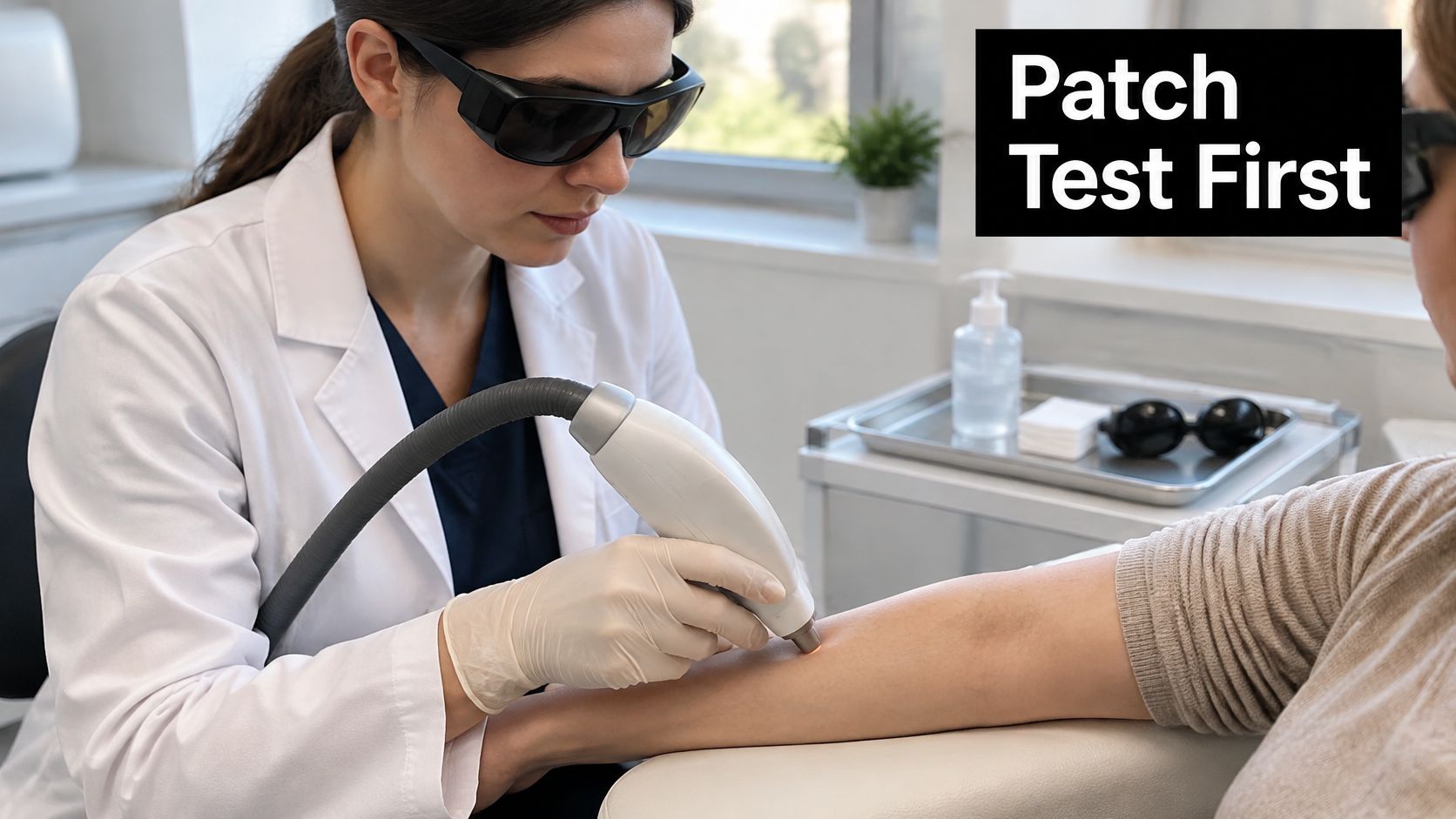
A prospective study of Fitzpatrick skin types IV–VI began with test fluences from 16 J/cm² and chose the final energy from the skin's response, with complications in 2% of cases. The investigators concluded that long pulsed alexandrite could be used safely for hair removal in darker skin tones when energy is individualised.
Pulse length alone does not determine clearance. Fluence, spot size, cooling, hair diameter, and skin phenotype work as a set. A single millisecond value means little until it is matched to live skin response that day. If someone quotes one ideal setting without examining your skin and hair, the quote is incomplete.
Think of the safety margin as heat room. Darker or recently tanned epidermis has a smaller thermal safety margin than untanned lighter skin, because the beam deposits more heat where surface melanin is dense. A tan is extra pigment in the upper skin, not a cosmetic detail. Conservative test spots and steady cryogen cooling keep treatment inside that margin. For a fuller walk through of device choice on deeper pigment, see our note on dark skin hair removal laser choices.
Practical rule: If your skin is browner this month than it was at the consult, say so before anyone raises the fluence. The safe setting matches today's pigment, not last season's photo.
A systematic review of laser hair removal adverse events found that pigmented skin is generally more prone to laser related adverse events, while alexandrite and pulsed diode lasers showed safety profiles comparable to IPL, with higher pain scores for lasers. Comparable means manageable in trained hands when pigment is respected. It never means every device is interchangeable.
Hair colour changes the odds too
Coarse, dark hair is the predictable target. The shaft forms a thick, melanin rich line that heat can follow down to the matrix. Fine, grey, red, or low-contrast hair carries less of that target, so the same fluence can look impressive on a calf and disappointing on a pale chin.
Low contrast deserves a pause. When hair and skin sit close in colour, the light has two places to stick. Energy splits. Follicle heating falls while surface heating rises. That split explains patchy clearing on blond upper lips, grey chins, and red fine shoulder hair. No adjustment fully restores contrast that was never there. Honest screening saves money here. An experienced clinician will say when alexandrite is a poor match and suggest another approach instead of selling extra passes.
What a clinic should do on the day
Good control is procedural. Four checks separate careful care from rushed care.
Check tanning status. Two weeks of sun avoidance is the baseline we ask for, and a new tan is a reason to wait. Tanned skin behaves like darker skin for dosing purposes. Treating through a fresh tan to stay on schedule trades a short delay for a burn risk that was avoidable.
Run a conservative test spot. Watch the skin, then set energy from that response rather than from a preset menu. Perifollicular redness or slight swelling around follicles signals useful follicle heating. Blistering, grey discoloration, or sharp pain signals excess epidermal heating. The test area guides fluence, spot size, and cooling for the full area.
Cool on every pulse. Cryogen should fire with the beam, not as an optional extra. Cooling protects the epidermis while heat builds in the deeper follicle. Skipped cooling, clogged handpieces, or inconsistent technique shrink the safety margin fast, especially on type III and IV skin.
Record the skin's answer. Settings, pulse count, cooling level, and immediate reaction belong in the chart. Memory fades. The next session should start from what today's skin showed, particularly if redness lasted longer than expected or pigment shifted.
Laser hair removal treatments are not recommended for pregnant clients. Clients also should not be on Accutane, Retin-A, or Gold Therapy now or within the past 6 months. After consulting a technician, a bleaching cream such as hydroquinone may be started 4 to 6 weeks beforehand if the skin needs lower surface pigment. The treatment area must arrive clean, washed, and free of makeup and medication.
Common short lived effects include temporary darkening or lightening, folliculitis, blistering, and redness or swelling around treated follicles. Call promptly for blistering, dark patches that are not fading, or pain still sharp after the first day. Mild pinkness that settles within hours is ordinary. Skin that keeps hurting is not. Early contact allows grading of the reaction, wound care advice, and adjustment of the plan before the next visit.
Alexandrite Compared With Other Laser Types
High melanin absorption is the reason alexandrite clears dark hair quickly on lighter skin, and it is also the reason the same device needs more caution when skin carries more pigment. Shorter wavelengths stop more eagerly in melanin. That gives alexandrite at 755 nm a strong grip on a dark, coarse shaft when surrounding skin is fair to olive. Longer wavelengths travel deeper and leave more epidermal pigment alone, so they enter the discussion as skin tone deepens.
Laser type | Wavelength | Best-suited skin | Main trade-off |
|---|---|---|---|
Alexandrite | 755 nm | Fair to olive skin (types I to III, cautious at IV) | Fast on dark coarse hair, higher pigment risk on tanned skin |
Diode | About 800 to 810 nm | Fair to medium skin (types I to IV) | Good balance of speed and depth, varies by device |
Nd:YAG | 1064 nm | Darker skin (types IV to VI) | Lower melanin absorption, slower on fine hair |
Broadband IPL | Broadband, not a single wavelength | Fair skin (types I to III) | Less precise, results depend heavily on the operator |
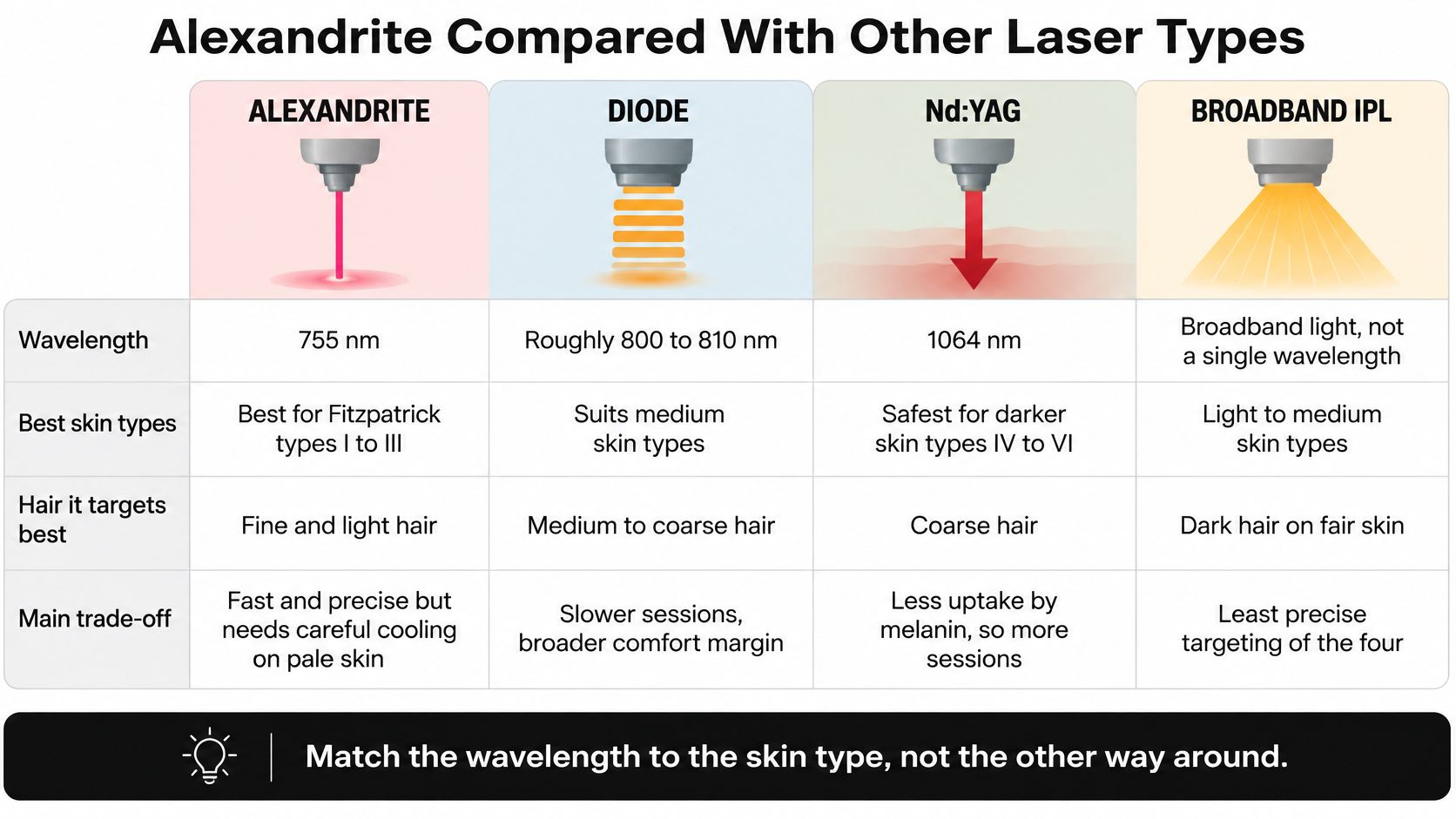
Alexandrite performs best where contrast is high. Dark hair against fair skin gives the pulse a clear target, and large spot sizes allow legs, backs, and chests to be covered in fewer passes. Speed helps comfort and scheduling. It helps safety only when cooling keeps pace with energy, because tanned or olive skin absorbs more heat at the surface.
Diode sits slightly longer in wavelength, near 800 to 810 nm. The balance shifts. Depth increases a little while surface absorption falls a little, which suits many people with medium skin. Devices differ more than the category name suggests. One handpiece may run cooler, faster, or with a different spot size than another, so ask which wavelength and cooling that specific machine uses.
Nd:YAG at 1064 nm absorbs melanin less eagerly than the shorter lines. The epidermis is spared more easily, which makes it the usual option for skin types IV to VI. The trade is efficiency on light, fine, or widely spaced hair. Those follicles hold less target pigment, so extra sessions are common.
Broadband IPL works differently. It releases a band of filtered light rather than one laser line. The filter, the energy setting, the skin cooling, and the number of passes all shape the result. Skilled operation can clear dark hair on fair skin. Less careful operation gives uneven clearing and more surface irritation. Precision is lower by design.
NYC Laser Hair Removal uses Splendor X technology for hair removal. Wavelength choice is made case by case from skin type, hair colour, and thickness. A device name still does not replace the consult. For background on how clinics match platform to person, this comparison of the best laser for hair removal explains the decision in practical terms.
A short clinic walk-through makes the handpiece and cooling easier to picture than a spec sheet does.
Olive skin with coarse dark leg hair and a pale, fine moustache shows why one plan rarely fits the whole body. The legs may suit alexandrite. The upper lip may call for lower energy, another wavelength, or a direct statement that pale fine hair may not clear well.
Suitability follows skin response, tanning, and hair colour together. Recent sun changes the calculation even when the natural tone seems ideal. So does bleached, grey, or red hair, which carries little melanin for any wavelength to grip. Thick dark shafts respond. Thin light shafts resist. The final call belongs in the room, with the skin in front of the person who will set the energy.
Expected Hair Reduction by Body Area
A 2009 retrospective clinical evaluation of 2,359 patients (2,095 women and 264 men, ages 14 to 70), treated from September 2005 to May 2008 across 3,830 sites, found a mean hair reduction of 80.6%, with site highs of 95% for the axillae (24.2% of sites), 92% for the bikini line (16.8% of sites), and 86% for the breast, and complications in 2.2% of cases.
Body area | Reported reduction | Share of treated sites |
|---|---|---|
Underarms (axillae) | 95% | 24.2% |
Bikini line | 92% | 16.8% |
Breast | 86% | Not reported |
All treated sites combined (mean) | 80.6% | 100% |
Underarms were the busiest site in that series, and they also posted the strongest reduction. Bikini line sat just behind on both counts. Breast reduction was still high, though that series didn't publish what share of visits the breast represented. The combined row is the average person in the file, not the promise for your calves.
Why the same course lands differently
Hair on the underarm is often coarse and dense, so each pulse finds a fat pigment target. Bikini and Brazilian zones behave similarly for many people, which is why those areas dominate clinic schedules. Chest and breast hair can be thick too, but it is more mixed with hormone-sensitive follicles, especially in men and in women with hormonal shifts. A back may carry coarse dark hair up high and finer hair near the waist. Legs vary from person to person more than marketing photos suggest.
The evaluation was retrospective. It did not represent every skin type equally, and it describes real-world averages from one treated population. Read 95% as what that axilla group reached, not as a coupon for your underarms after a set number of visits.
Use the table to rank the area you care about, then plan for reduction rather than a blank patch. Ask which of your own areas has the coarsest dark hair, because that patch is the one most likely to track the high end of these figures.
Most frequent effects in that series were transient hyperpigmentation (0.7%), folliculitis (0.5%), transient hypopigmentation (0.5%), and blistering (0.4%). Those rates belong to the same cohort as the reduction numbers, so the safety picture and the result picture come from one chart review, not from a best-case brochure.
How Results Build Across Sessions and Months
Hair grows in cycles, and an alexandrite pulse only disables follicles that hold pigment and sit in the active growth phase. That timing explains why clearing builds across visits instead of finishing in one pass. The light is strongly absorbed by melanin, which gives coarse dark hairs a clear target, and the same strong absorption is why results and skin response depend on tanning, skin response, and hair colour rather than on hair colour alone.
In a 1999 study of 36 subjects, unwanted hair on the face, back, and legs was split into treated and untreated quadrants, and hair counts in treated areas fell by 66% at 1 month, 27% at 3 months, and 4% at 6 months versus baseline. Regrowth stayed significantly delayed compared with untreated areas at 1 week, 1 month, and 3 months.
Time after treatment | Hair count change | What it shows |
|---|---|---|
1 month | 66% fewer hairs | Largest early drop after the first treatment phase |
3 months | 27% fewer hairs | Regrowth emerges from follicles not yet damaged |
6 months | 4% fewer hairs | Little measurable change, maintenance may be needed |
Reading the fade without panic
The one-month drop looks dramatic because treated growing hairs shed while nearby resting follicles stay quiet. Counts rise by three months as follicles missed by the first pulses enter growth. By six months in that early trial, the measured difference versus baseline was small. Single exposure does not lock every follicle, and hairs on a long rest cycle appear later. That pattern is normal.
Pulse durations of 5, 10, and 20 milliseconds at an average fluence of 18 J/cm² gave comparable long-term results in the 1999 work. The 20 millisecond setting trended toward less post-treatment redness and hyperpigmentation. A longer pulse can give similar clearing with a kinder surface. The sensation during the pulse is only one part of the setting choice.
Spacing follows the cycle. Body areas are usually spaced further apart than the face because their growth cycles turn more slowly. Facial hair is revisited sooner so the next wave of growing follicles is caught before it gets long. Your own interval should follow the area and how fast stubble returns, not a generic calendar on a wallet card. Coarse dark regrowth signals follicles worth retreating. Fine pale fuzz absorbs less light, so expectations stay lower there.
The aim is durable reduction, not a promise that every follicle is gone. Maintenance visits cover hairs that were resting during the main course and new growth linked to hormones, age, or medication. If the concern is thinning on the scalp rather than hair you want gone, that is a different clinical path. PRP hair research for Phoenix Valley adults from Arizona Valley Acupuncture is one place to read how platelet-rich plasma is being studied for people who want to keep hair, which is the opposite goal of a clearing laser.
Shedding in the first weeks is the treated hair leaving. New dark strands months later are often a fresh cycle, and they are why a course exists.
Paradoxical Hair Growth and When to Seek Advice
Did the laser make hair grow back thicker? For a small group, that confusing result is real. It is called paradoxical hypertrichosis, hair that returns denser or darker, sometimes in a rim around the treated patch. Clinics do not see it often, yet it feels alarming when it happens to you.
Think through the physics first. Alexandrite light works because melanin absorbs it strongly. That strong absorption clears dark, coarse hair well, and the same sensitivity means the response depends on how surrounding skin and fine hair react. Suitability turns on skin response, recent tanning and hair colour together, rather than on hair colour alone.
A 2025 prospective study of facial alexandrite treatment reported paradoxical hypertrichosis in 16.2% of participants, with higher rates among people with PCOS, irregular menstrual cycles, Fitzpatrick types III–IV, limited sun protection, and those who had 6–10 sessions. Earlier alexandrite research on broader patient groups reported a much lower rate. Those two figures cannot be combined into a personal risk estimate. One is a facial cohort with a specific definition. The other is a broader patient group. Area, enrollment, and how extra growth was counted all shift the percentage.
What it is, and what it is not
True paradoxical growth: Hair looks thicker or darker than before treatment, often on the face or just outside the outlined zone, and it persists after the normal shed-and-rest window.
Temporary shedding: Treated hairs work out of the follicle over days to weeks and can look like stubble on the way out. That is expected, and it is not new growth.
Missed hairs: A gap in the pass, a curved area like the jawline, or a hair that was resting. The pattern looks patchy, not suddenly dense everywhere.
Hormonal progression: Chin or chest hair that was going to increase because of PCOS, medication, or another endocrine shift. Continued passes alone may not stop that pattern, so the cause needs attention.
Fine, light facial hair sits in a gray zone. It holds less melanin for the beam to grip, while nearby skin still absorbs energy. That balance helps explain why the face accounts for many reports, and why careful mapping of the border matters before starting.
When to pause and get checked
Book a medical visit, not another default session, if you notice:
New dense hair on the face or chest that is coarser than the hair you started with.
Irregular cycles, acne flares, or other signs that hormones may be driving the hair.
Growth outside the treated outline, especially a rim of darker hair around a facial patch.
No finer regrowth after several visits on an area that should have responded, such as coarse underarm hair.
Bring a short timeline. Note when sessions happened, when shedding ended, when thicker hair appeared, plus any tanning, new medication, or cycle changes. Photos in the same light help a clinician judge whether this is persistent growth, a resting cycle returning, or hormonal progression.
Fine facial hair and hormonally influenced hair deserve an evaluation before the session count climbs. A clinician may pause, change wavelength, shrink the treatment border, or refer you for assessment of PCOS or another endocrine cause. Sun protection matters here too, because the higher-rate group in the facial study included people with limited sun protection. Treat a new tan as a reason to reassess.
Book a Consultation to Confirm Your Fit
Alexandrite laser hair removal is worth booking when three things line up: your hair is dark and coarse enough to hold melanin, your skin can be treated at a fluence that still protects the surface, and the clinician will change the plan if your skin says no. If any one is missing, a full course is a guess.
Get the follicle ready before you arrive
Stop removing the root. Avoid waxing, plucking, threading, and electrolysis for 4 to 6 weeks. Those methods pull out the pigment the laser needs. Shaving and depilatory creams can stay in the routine until the final prep.
Stay out of the sun for 2 weeks. A tan changes the safety margin. Self-tanner on the area counts too, because it adds colour the device can see.
Arrive clean. The treatment area must be fully washed and free of makeup and medication. Deodorant, oil, and numbing cream left on the skin can interfere with cooling and with how the beam couples to the surface.
Shave to skin level. Do that before the session. A day's growth can stay so the area is easy to recognise, especially on the face or a faint happy trail, but long hair on the surface wastes energy and can singe.
Let the consult set the plan. During the initial consultation, experienced professionals assess your skin type and hair colour and build a personalized treatment plan around you rather than a default package. That is the moment to flag pregnancy, recent isotretinoin, retinoids, gold therapy, and any history of dark or light patches after cuts or acne.
Questions that sort a careful clinic from a rushed one
Ask how the wavelength and fluence were chosen for your skin type today, not for a typical client. Ask what cooling fires with each pulse, and what they do if the test spot looks too red or too quiet. Ask how many sessions they expect for that specific area, and what "reduction" means on your hair, not on an underarm chart. Ask what happens if hair looks denser at the edges after a few facial visits. A good answer includes pausing and, when hormones might be involved, a referral. A weak answer is "we'll just add sessions."
The practical next step is a consult before you commit to a course. Call 516-321-4959 or email INFO@NYCLASER.COM. Bring a list of medicines and an honest note about sun in the last month. The team can confirm whether alexandrite is the right choice for your skin and hair, or tell you if another approach fits better.
NYC Laser Hair Removal in Westbury uses Splendor X for hair removal, offered as single sessions or 3- or 6-session bundles for areas from a small lip to full legs and back. If you want a plan that treats high melanin absorption as both the advantage and the limit, visit NYC Laser Hair Removal and book a consult before you start a course.
Comments