
Dark Skin Hair Removal Laser: A Safe Path to Smooth Skin
Standing in front of the mirror, you may be weighing the same trade-off many people with deeper skin tones face: smoother skin without the cycle of shaving irritation, but no burns, dark marks, or disappointing results. Warnings about laser hair removal and dark skin aren't imaginary. They come from the way light interacts with melanin.
The good news is that modern treatment can be much more precise than early systems were. The important questions are which wavelength the clinic uses, how the clinician sets fluence and pulse duration, how the skin is cooled, and whether the provider has real experience with Fitzpatrick IV to VI skin. This guide walks through those decisions without reducing safety to a slogan.
Why Dark Skin and Laser Hair Removal Is a Real Question
Laser hair removal works by sending light into the hair follicle. Pigment in the hair absorbs that energy, converts it into heat, and the heat disrupts the follicle's ability to produce hair. On darker skin, the surrounding epidermis also contains more melanin, so the skin can absorb part of the same light intended for the follicle.
That competition explains why early commercial systems created genuine concerns for people with Fitzpatrick IV through VI skin. If the epidermis absorbs too much energy, the result can include burns, prolonged inflammation, hyperpigmentation, hypopigmentation, or, in severe cases, scarring. The problem isn't merely that the device has "too much power." The wavelength may be poorly matched to the skin.
What changed in modern treatment
The major historical shift was from early commercial availability in the mid-1990s toward safety protocols designed specifically for skin of color. Long-pulsed 1064 nm Nd:YAG became central because its longer wavelength is absorbed less by epidermal melanin and can reach deeper follicular targets. A 2023 literature review of laser hair removal in darker skin identifies Nd:YAG 1064 nm as the gold standard for darker skin because it lowers the risk of dyspigmentation compared with shorter wavelengths.
That doesn't mean every 1064 nm treatment is automatically safe. A clinician still needs to adjust fluence, pulse duration, spot size, repetition rate, and cooling to the individual. Hair thickness, density, body area, recent sun exposure, and the skin's current condition all affect the margin for error.
Practical rule: A clinic should be able to explain why it selected a particular wavelength and starting setting for your skin, not just name the machine it owns.
How to judge a clinic before treatment
Ask whether the provider:
Treats Fitzpatrick V and VI regularly: Experience matters because darker skin can respond with delayed pigment changes, not only immediate redness.
Uses a long-pulsed Nd:YAG option: The device should be appropriate for darker skin, particularly when the skin has darker pigmentation or has been more sun-exposed recently.
Performs a test area: A small test helps the clinician observe how your skin responds before treating a larger zone.
Explains cooling: Cooling protects the epidermis and can improve comfort, but it doesn't compensate for a mismatched wavelength or excessive fluence.
Sets clear expectations: Darker skin may require more sessions, and fine or hormonally influenced hair may respond less predictably.
The right treatment is therefore a protocol, not a product label. An advanced device in inexperienced hands can still produce a poor outcome, while a careful clinician uses technology, observation, and conservative adjustments together.
The Fitzpatrick Scale and What It Means for Your Treatment
The Fitzpatrick scale helps clinicians estimate how skin reacts to ultraviolet exposure and how much epidermal melanin may compete with laser energy. It isn't a perfect description of every complexion, and it shouldn't replace examining your skin in person. A person can also become temporarily more difficult to treat after tanning or significant sun exposure.
Six types, translated into treatment decisions
Type I: Very fair skin, often associated with a complexion that burns readily. Alexandrite at 755 nm is commonly suited to this low-melanin range.
Type II: Fair skin that burns easily and tans minimally. Alexandrite 755 nm can be efficient when the hair and skin contrast clearly.
Type III: Light to medium skin that may tan gradually. Alexandrite 755 nm or diode 810 nm may be considered, depending on the individual.
Type IV: Olive or light brown skin, including many Mediterranean and South Asian complexions that tan readily. Diode 810 nm may suit selected patients, while Nd:YAG becomes increasingly important as pigmentation intensifies.
Type V: Brown skin, including many deeper South Asian, Middle Eastern, Caribbean, and Latin American complexions. Long-pulsed Nd:YAG 1064 nm is generally the safer established choice.
Type VI: Very dark brown or highly pigmented skin, including many African and Afro-Caribbean complexions. Nd:YAG 1064 nm is the standard wavelength clinicians use to reduce epidermal melanin absorption.
These descriptions are starting points, not assumptions about ethnicity. A clinician should assess your actual skin tone, tanning history, hair color, hair caliber, and treatment area.
Fitzpatrick Type | Skin Description | Recommended Wavelength | Typical Setting Approach |
|---|---|---|---|
I | Very fair, burns readily | Alexandrite 755 nm | Selective settings with attention to hair contrast |
II | Fair, burns easily | Alexandrite 755 nm | Efficient settings when hair is strongly pigmented |
III | Light to medium, tans gradually | Alexandrite 755 nm or diode 810 nm | Individualized settings based on tanning and hair |
IV | Olive to light brown, tans readily | Diode 810 nm or Nd:YAG 1064 nm | Conservative testing, with Nd:YAG favored as pigmentation increases |
V | Brown, tans easily | Nd:YAG 1064 nm | Conservative fluence, longer wavelength, active cooling |
VI | Very deep brown pigmentation | Nd:YAG 1064 nm | Careful test treatment and close monitoring of skin response |
Why the scale affects session planning
The scale helps determine how aggressively a clinician can treat without overheating the epidermis. Lighter skin generally allows more energy to reach the follicle with less competing absorption. Darker skin often requires more conservative settings and therefore may require more sessions to reach a comparable reduction.
A 2023 review found that darker skin types required an average of 7.2 sessions, compared with 5.8 sessions for lighter skin types, while pooled mean hair reduction reached 78.3% at six months across laser types. The same review reported that the most common reactions were temporary erythema and perifollicular edema, with no permanent dyspigmentation or scarring reported in its pooled analysis.
The useful takeaway isn't that your skin type predicts an exact appointment count. It tells the clinician how cautious the starting plan should be and helps you reject promises of identical results after a fixed number of visits.
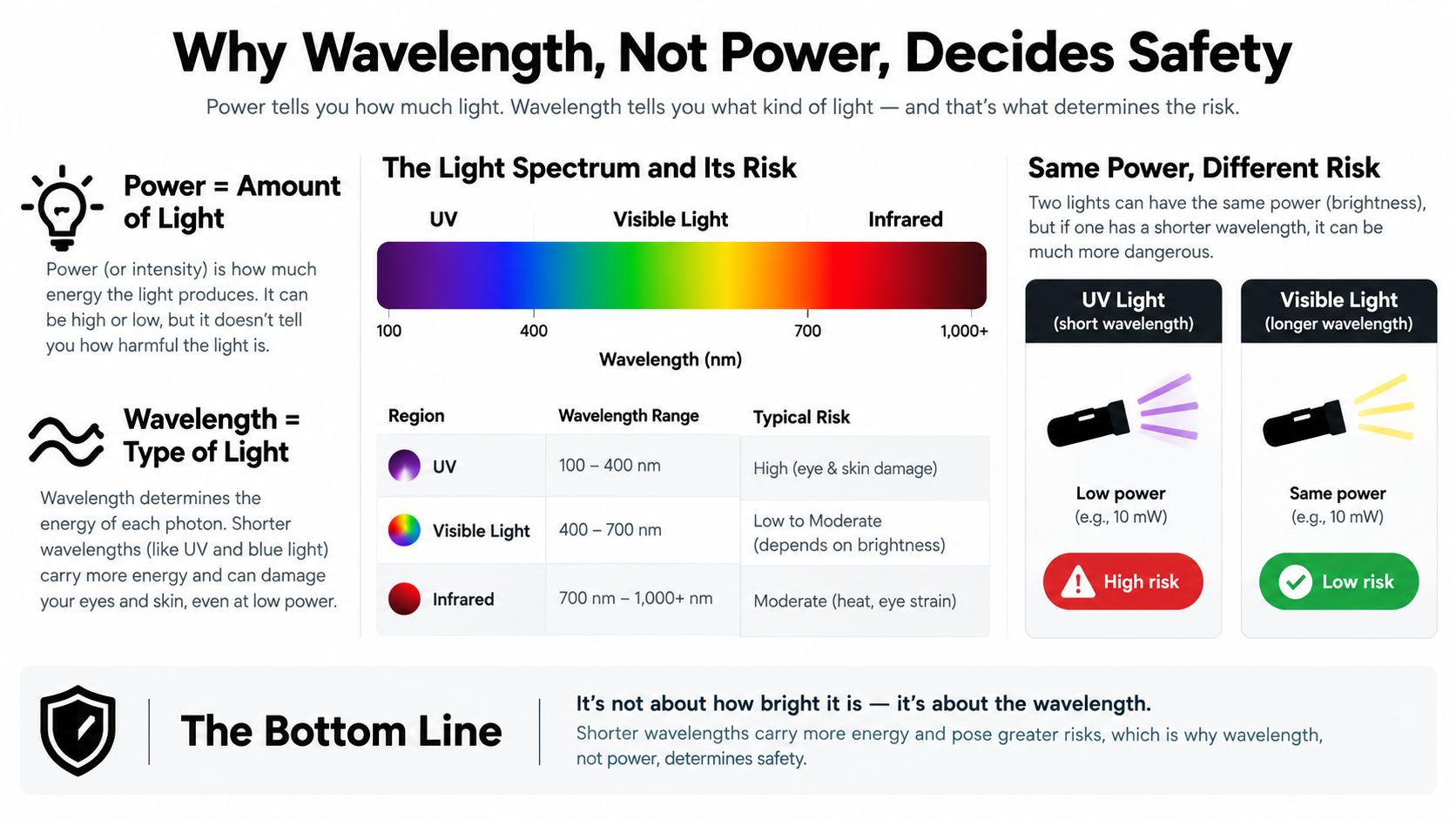
Why Wavelength, Not Power, Decides Safety
A laser doesn't recognize “skin” and “hair” as separate targets. It responds to chromophores, especially melanin. When a shorter wavelength is strongly absorbed by epidermal melanin, the surface can heat before enough energy reaches the follicle.
Why 1064 nm changes the calculation
The 1064 nm Nd:YAG wavelength penetrates further and is less readily absorbed by epidermal melanin than shorter wavelengths. That gives the clinician a better chance of heating the follicle while limiting unnecessary surface heating. The laser still needs enough fluence and an appropriate pulse duration to affect the follicle, but the energy is delivered through a more favorable optical pathway.
Clinical data support that distinction. In a study of phototypes IV to V, long-pulsed Nd:YAG was used with a 10 mm spot size, 30 to 50 J/cm² fluence, and 15 to 30 ms pulse durations over six sessions, with safe and effective hair reduction reported in the study population. The published clinical study illustrates why a clinician discusses more than a device name. Spot size, fluence, pulse duration, and skin type work together.
Why simply increasing power is a poor solution
If the wavelength is poorly matched, increasing energy can increase the amount absorbed by the epidermis as well as the follicle. More power doesn't correct the underlying competition between surface melanin and follicular melanin. It can amplify the risk.
A head-to-head comparison in darker skin makes the wavelength issue clear. Five sessions of long-pulsed 1064 nm Nd:YAG reduced underarm hair counts by 79.4% at six months, while IPL produced a 54.4% reduction in the same comparison. The clinical comparison reported by Black Health also found that side effects remained temporary and that the Nd:YAG-treated group maintained 70% to 90% hair reduction at twelve months.
For a patient, the practical question is simple: “How will you protect my epidermis while treating the follicle?” A good answer includes the wavelength, the starting fluence, pulse duration, cooling method, and how the clinician will respond to the skin's immediate reaction. Laser technology guidance from NYC Laser can help readers understand why wavelength selection matters more than a generic power rating.
How Splendor X Bridges the Fitzpatrick Spectrum
Splendor X uses two laser wavelengths in one platform, 755 nm Alexandrite and 1064 nm Nd:YAG. That combination gives a clinician more than one way to approach different relationships between skin pigment and hair pigment.
The Alexandrite wavelength can be efficient for lighter skin and selected intermediate tones when the provider has assessed the patient carefully. Nd:YAG is the safer default for highly pigmented skin because its longer wavelength reduces epidermal melanin absorption. The device's role is to give the clinician options, not to remove the need for clinical judgment.
Matching the device to skin and hair
A patient with Type II skin and coarse, dark hair may be treated differently from a Type V patient with the same hair caliber. A mixed-tone area, such as a bikini line with lighter surrounding skin and more heavily pigmented folds, may also require a carefully selected mode rather than one fixed setting across the entire zone.
Splendor X can deliver the wavelengths separately or in a blended approach when the clinician believes that combination is appropriate. Its square spot design can help the operator cover treatment areas systematically, while integrated cryogen cooling helps protect the surface and manage discomfort.
Cooling is important, but it has a defined job. It can lower epidermal heat and make pulses more tolerable. It cannot make an unsuitable wavelength appropriate for every patient, and it can't erase the consequences of excessive fluence.
Where the trade-off appears
A dual-wavelength device may reduce the need to switch between platforms during a treatment plan. It can also let a clinician adapt the approach as hair caliber changes or as different areas respond at different rates. The trade-off is that more flexibility places greater responsibility on the operator. The provider must know when to use Alexandrite, when to use Nd:YAG, and when a blended mode isn't justified.
Ask before treatment: “Which wavelength will you use on each area, and what would make you change it during my series?”
The Splendor X machine overview gives additional context about dual-wavelength systems. A consultation should still focus on your skin, hair, treatment area, and test response rather than on the machine's feature list alone.
Session Plans and Realistic Results for Darker Skin
A treatment plan for darker skin should be built around hair-growth cycles and skin tolerance, not a rigid promise. The clinician usually begins with long-pulsed Nd:YAG 1064 nm for Fitzpatrick V and VI, then evaluates shedding, regrowth, irritation, and pigment response before adjusting later sessions.
The target is long-term reduction, not the guarantee that every follicle disappears forever. Hair can be coarse and heavily pigmented in one region, fine in another, and hormonally influenced around the chin or jawline. Those differences change the response.
What the evidence can and cannot promise
The randomized underarm trial discussed earlier involved five Nd:YAG sessions and found 79.4% hair-count reduction at six months, with temporary side effects. That result is useful as a clinical benchmark, but it isn't a promise for every body area. Underarm hair, facial hair, bikini hair, arm hair, and back hair don't share the same density, caliber, or growth pattern.
The broader review also found that darker skin types needed more sessions on average. That pattern has a practical explanation. Clinicians often begin conservatively to protect the epidermis, and a cautious series may take longer than a more aggressive plan on lighter skin.
A planning table without false precision
Body Area | Sessions Needed | Interval | Expected Reduction |
|---|---|---|---|
Chin and facial areas | Individualized series | Scheduled around facial regrowth | Coarse dark hair may respond well, while hormonal or fine hair can need maintenance |
Underarms | Individualized series | Scheduled around the active growth cycle | Strong reduction is possible, with clinical evidence supporting substantial response |
Bikini line | Individualized series | Adjusted to regrowth and skin response | Coarse terminal hair generally offers a clearer target than fine hair |
Arms | Individualized series | Set according to body-area regrowth | Fine or lighter hair may respond less predictably |
Back and chest | Individualized series | Adjusted for density and regrowth | Dense coarse hair may reduce gradually across a larger area |
PCOS and resistant facial hair
People with PCOS may see ongoing new hair growth because the hormonal driver continues after individual follicles have been treated. A 2025 retrospective study on laser hair removal in patients with PCOS and darker skin reflects growing clinical attention to this subgroup, as reported in the PubMed record for that study.
That doesn't mean treatment is pointless. It means the plan should distinguish between treated follicles that stop producing hair and new or newly active follicles influenced by hormones. A clinician may discuss maintenance, repeated treatment, or additional strategies when a chin or jawline plateaus.
Contraindications, Aftercare, and Honest Risk Guidance
A safe treatment plan starts before the first pulse. Tell the clinic about current or recent medicines, active skin conditions, tanning, pregnancy, and any history of unusual scarring or pigment change. A provider should review those details before recommending treatment, not after a reaction occurs.
Pre-treatment questions to answer
Medication history: Mention isotretinoin, photosensitizing medicines, antibiotics such as tetracyclines, supplements, and herbal products. Don't stop a prescribed medicine without speaking to the prescribing clinician.
Active inflammation: Flag eczema, psoriasis, dermatitis, infection, open skin, or a flare in the treatment zone.
Recent pigment exposure: Report sunburn, tanning, or self-tanner. A darker temporary tan changes the amount of epidermal melanin the laser encounters.
Pregnancy: Elective aesthetic treatment is commonly postponed during pregnancy. Ask the provider for individualized guidance.
Scarring history: Tell the clinician about keloids, raised scars, or significant post-inflammatory hyperpigmentation.
Herpes simplex: Facial or bikini treatment may require special discussion if you have a history of outbreaks in the area.
Aftercare should reduce heat and friction while the skin settles. Temporary redness or perifollicular swelling is common, and the pooled analysis cited earlier described those reactions as predominantly transient in the 2023 review. Cooling the area, avoiding direct sun, and following the clinic's instructions on active skincare ingredients, exfoliation, exercise, saunas, and hot environments all help lower the chance of irritation. Do not pick at crusting or pull treated hairs from the follicle.
For skin that is already prone to post-inflammatory color change, a separate guide on laser and hyperpigmentation can help explain why sun avoidance and conservative treatment settings matter so much after each session.
Contact the clinic promptly if you develop blistering, significant pain, spreading swelling, persistent skin breakdown, unusual light patches, or a darkening reaction that continues rather than settling. The Mayo Clinic overview of laser hair removal also notes that darker skin carries a greater risk of burns, scarring, and lasting color change when treatment is mishandled.
A careful provider lowers risk through correct wavelength selection, conservative settings, cooling, test treatment, and follow-up. No responsible clinician should promise that complications are impossible.
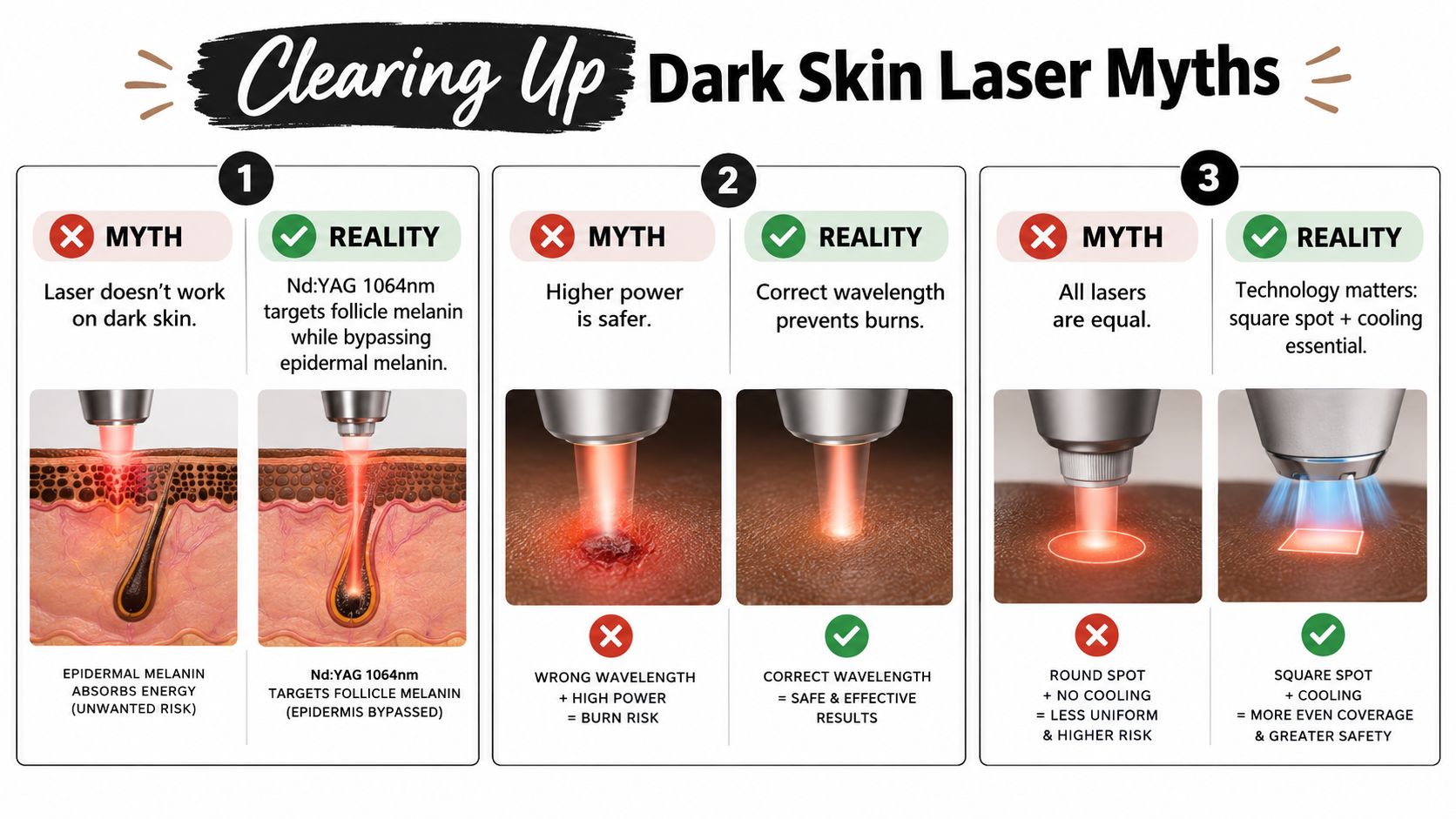
Common Myths Worth Clearing Up
Myth one: laser hair removal can't work on dark skin.
Laser hair removal can work on darker skin when the wavelength and settings match the patient. Long-pulsed Nd:YAG at 1064 nm reaches the follicle while being absorbed less by melanin in the epidermis. That separation matters because the follicle is the target, while excess surface absorption can create unnecessary heat. A reported clinical comparison supports Nd:YAG as a useful option for reducing hair in darker skin.
The accurate rule is simple: dark skin needs selective treatment, not automatic exclusion.
Myth two: all lasers and IPL devices behave alike
They do not. Alexandrite at 755 nm, diode at 810 nm, and Nd:YAG at 1064 nm interact with skin and hair at different depths. IPL releases a broad band of light rather than one selected laser wavelength, so epidermal melanin may compete more strongly with the follicle.
Splendor X helps illustrate why device choice is only part of the decision. Its dual-wavelength design can combine Alexandrite and Nd:YAG energy, allowing the clinician to adjust the balance to the Fitzpatrick range, hair characteristics, and treatment area. Lighter skin may tolerate more Alexandrite contribution, while darker skin generally calls for greater reliance on the 1064 nm wavelength. The device does not remove the need for clinical judgment.
Settings are not one-size-fits-all either. As skin becomes more pigmented, the clinician may alter fluence, pulse duration, spot size, cooling, and the pace of treatment. Cooling protects the surface while the selected energy works toward the follicle. A test area and delayed review help show whether the setting is effective without provoking excessive irritation or pigment change.
Myth three: one session creates permanently smooth skin
One session can affect hairs in the active growth phase, while other follicles remain temporarily unresponsive. Hair cycles overlap like staggered trains, so treatment plans use multiple sessions and reassess the response.
Coarse, dark hair usually provides a clearer target than fine hair. Hormonal areas such as the chin can also produce new growth over time, which may make maintenance appropriate. Darker skin may require a more conservative start, careful adjustment, and patience rather than a higher setting or rushed schedule.
The safest promise is a reasoned plan, not a guaranteed number of sessions.
Your Next Step With NYCLASER
A sound consultation should leave you with answers to three questions:
Does the clinic use an Nd:YAG-capable device? For Fitzpatrick IV to VI, ask specifically about long-pulsed 1064 nm treatment.
Does the operator treat darker skin regularly? Ask about experience with Types V and VI, not only general laser certification.
Will the clinic perform a test treatment? A test area gives the clinician a chance to assess immediate tolerance and delayed pigment response before committing to a larger zone.
Bring a complete list of current medicines and supplements, including isotretinoin, tetracyclines, and St. John's wort. Also bring your recent sun-exposure history and explain any tanning, self-tanner use, keloid formation, post-inflammatory hyperpigmentation, eczema, psoriasis, or herpes simplex in the treatment area.
Describe the hair. Tell the clinician whether it is coarse or fine, dark or light, dense or sparse, and whether growth is concentrated around the chin, jawline, underarms, bikini line, or another area. Hair color and caliber help determine whether the laser has a strong target.
During the consultation, expect skin typing, examination of the treatment zone, a discussion of wavelength and cooling, and a test pulse or test area when appropriate. Ask what settings will be selected and what reaction the clinician considers normal. You should also receive written aftercare instructions that explain sun protection, heat, skincare products, shaving between sessions, and when to call the clinic.
NYCLASER offers Splendor X treatments with 755 nm Alexandrite and 1064 nm Nd:YAG options, along with integrated cooling for a range of skin and hair types. The important point isn't the device alone. Safe treatment depends on how the operator maps its capabilities to your Fitzpatrick type, hair, treatment area, and test response.
Book a consultation only after the provider has answered those questions clearly. Safe laser hair removal on dark skin is a protocol, not a product feature.
NYC Laser Hair Removal offers personalized Splendor X treatments, including 1064 nm Nd:YAG options for darker skin tones and built-in cooling to support comfortable care. Visit NYC Laser Hair Removal to discuss your skin type, hair goals, test-treatment options, and a customized treatment plan.
Comments