
Laser and Hyperpigmentation: Safe Options
The most popular advice about laser and hyperpigmentation is also the least complete: “Just wear sunscreen.” Sun protection matters, but it can't compensate for the wrong wavelength, excessive heat, an unstable pigment condition, or a treatment plan that ignores your Fitzpatrick skin type. For clients with melanin-rich skin, prevention has to begin before the first pulse.
Laser hair removal and pigment treatments can work well, but the risk calculation changes as epidermal melanin increases. A careful practitioner must control energy, pulse delivery, cooling, treatment timing, and aftercare together. The aim isn't just to remove hair or fade a dark mark. It's to do so without creating a new inflammatory trigger.
The Hidden Risks of Laser Treatments on Melanin-Rich Skin
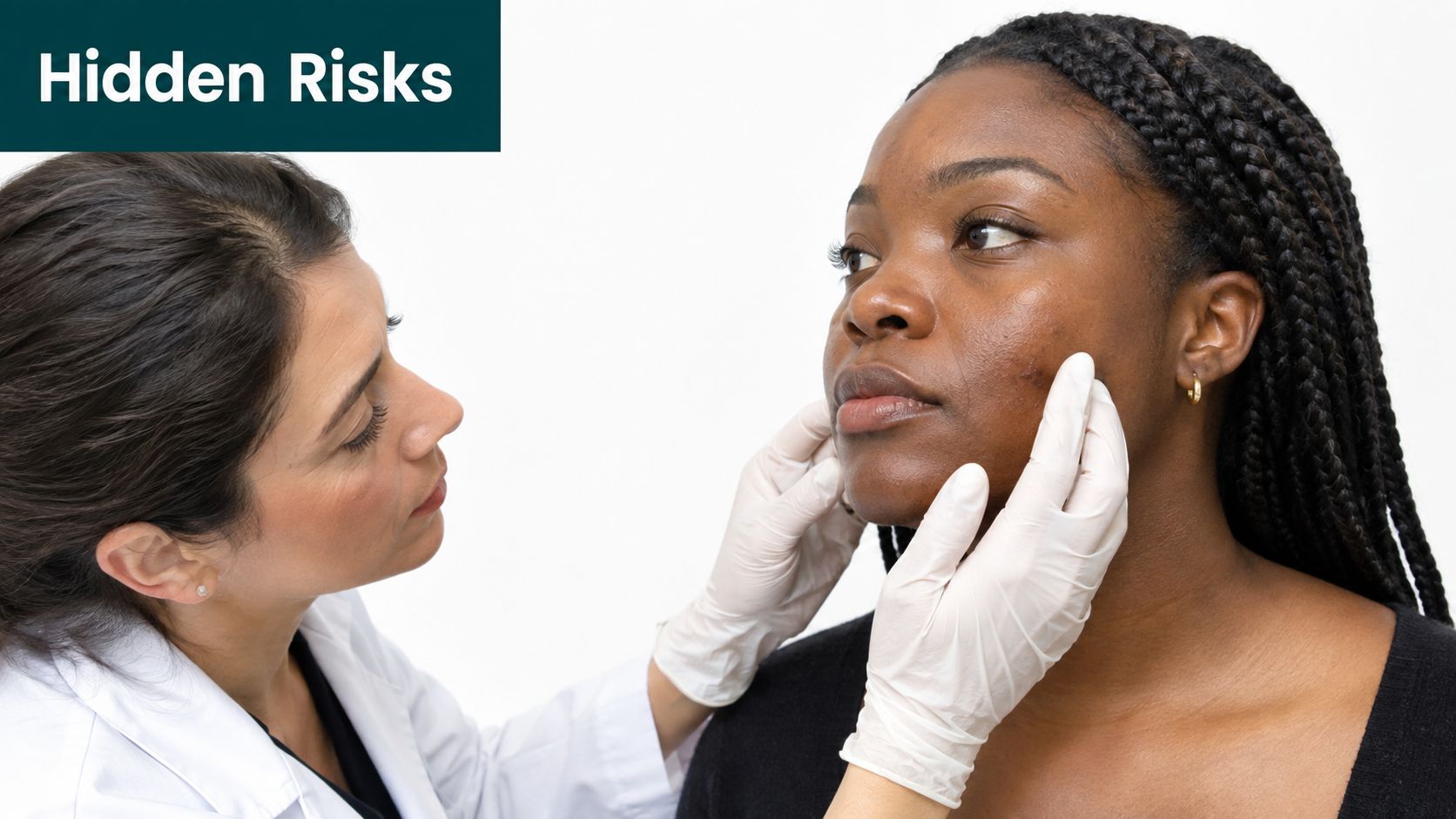
A laser isn't universally safe just because it carries a familiar brand name or has been effective on lighter skin. Epidermal melanin competes with the treatment target for laser energy, particularly when the wavelength is strongly absorbed near the skin's surface. Instead of reaching the hair follicle efficiently, some energy can heat the epidermis and provoke inflammation.
That inflammation can activate melanocytes, the pigment-producing cells in the skin. Laser-induced hyperpigmentation is a recognized adverse effect, especially in Fitzpatrick skin types III to VI, and it can arise from melanin released after melanocyte injury or from increased melanin production after treatment-related inflammation (National Center for Biotechnology Information).
Why the skin can darken after treatment
For hair removal, the practitioner wants thermal injury in the follicle, not unnecessary heating of the surrounding epidermis. Dark, coarse hair contains melanin, which makes it a useful target. The difficulty is that darker skin also contains more competing pigment at the surface.
A treatment can therefore produce a paradoxical result. The follicle may receive too little useful energy, while the epidermis receives enough heat to trigger redness, irritation, or a delayed darkening response. The risk becomes more relevant when the skin is recently tanned, already inflamed, or healing from acne, shaving irritation, waxing, or another procedure.
Practical rule: A darker complexion isn't a reason to avoid laser automatically. It is a reason to demand more careful assessment and parameter selection.
Clients should also distinguish between temporary post-inflammatory hyperpigmentation and a pre-existing pigment disorder. Acne-related marks, melasma, solar lentigines, and irritation-induced discoloration may look similar in a photograph but don't behave identically under laser energy. Treating an active or inflamed condition can add another inflammatory event before the original one has settled.
A useful overview of facial resurfacing technologies can help you understand how different treatments vary in intensity and purpose. The facial resurfacing treatments overview from Skin Perfection is a practical resource, but a general guide can't replace an in-person assessment of your skin, pigment depth, and treatment history.
What a safe consultation should identify
Before treatment, ask whether the practitioner has assessed:
Fitzpatrick skin type: Your likely response to heat and pigment stimulation.
Current inflammation: Acne, dermatitis, ingrown hairs, or irritation can change the risk.
Recent sun exposure: Tanned or sun-stressed skin may absorb energy differently.
Treatment objective: Hair reduction and pigment correction require different targeting decisions.
Previous reactions: A history of darkening after wounds, acne, or procedures deserves attention.
The central question isn't whether laser technology can produce a visible result. It can. The more important question is whether the selected device and settings can produce that result while keeping unnecessary epidermal heat under control.
Evaluating Laser Wavelengths for Skin of Color
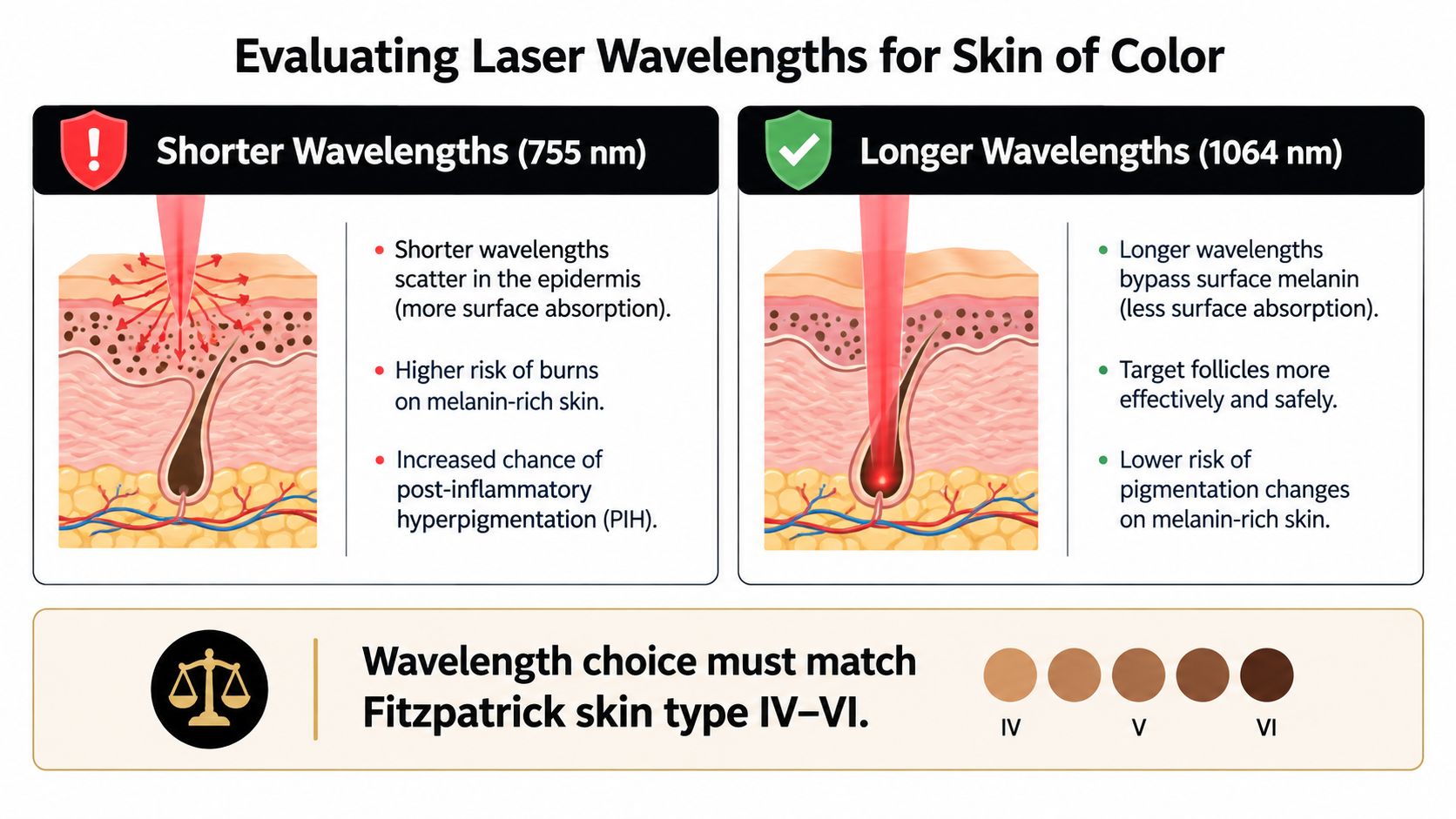
Wavelength choice determines where laser energy travels and how much of it is absorbed by surface melanin. Shorter wavelengths can be useful in carefully selected cases, but they generally create more competition with epidermal pigment when used on darker skin. That makes device selection a clinical decision, not a preference based on whatever machine a clinic already owns.
Why 1064 nm Nd:YAG is the usual safety reference
For laser hair removal in skin of color, the long-pulsed 1064 nm Nd:YAG is widely regarded as the safest commonly used option. Its longer wavelength penetrates more far and is absorbed less by the epidermis than shorter wavelengths, allowing the practitioner to create follicular thermal injury while reducing pigment uptake in darker skin (DermNet).
That doesn't mean Nd:YAG is risk-free. Incorrect fluence, inadequate cooling, overlapping pulses, or treatment over irritated skin can still cause complications. The advantage is that the wavelength gives the practitioner a better starting point for separating follicular targeting from surface pigment absorption.
The practical comparison looks like this:
Treatment consideration | Shorter wavelengths | 1064 nm Nd:YAG |
|---|---|---|
Surface interaction | More epidermal melanin competition | Better epidermal sparing |
Typical concern in darker skin | Heat, irritation, and PIH risk | Safer follicular targeting when correctly used |
Main target | Hair or superficial pigment depending on the device | Deeper coarse hair follicles |
Clinical requirement | Conservative selection and close monitoring | Careful parameters and effective cooling |
For clients comparing platforms, a detailed explanation of laser hair removal technology can help clarify why wavelength, pulse delivery, and cooling matter more than the machine's marketing label.
Treating existing pigment carries a separate risk
Hair removal and hyperpigmentation correction shouldn't be treated as the same procedure. A 2024 systematic review of PIH treatments in skin of color included 41 studies and 877 patients. Laser and energy-based devices achieved complete response in 18.1% of patients, or 56 of 309, while 2.6%, or 8 of 309, experienced worsening PIH. Topical treatments reached complete response in 5.4%, or 20 of 369 patients (Journal of the European Academy of Dermatology and Venereology).
Those findings explain why lasers remain important, but they also reject the idea of a guaranteed clearing treatment. A higher complete-response rate doesn't erase the possibility of worsening pigment. The safest plan matches the wavelength and energy profile to the condition being treated, rather than assuming one device suits every dark mark.
Why Blended Wavelength Technology Changes the Safety Profile
Single-wavelength treatment can work, but it gives the practitioner one primary depth and absorption profile to manage. Blended-wavelength systems approach the follicle with more than one wavelength at the same time, which can allow the treatment energy to be distributed across different depths instead of relying entirely on one beam.
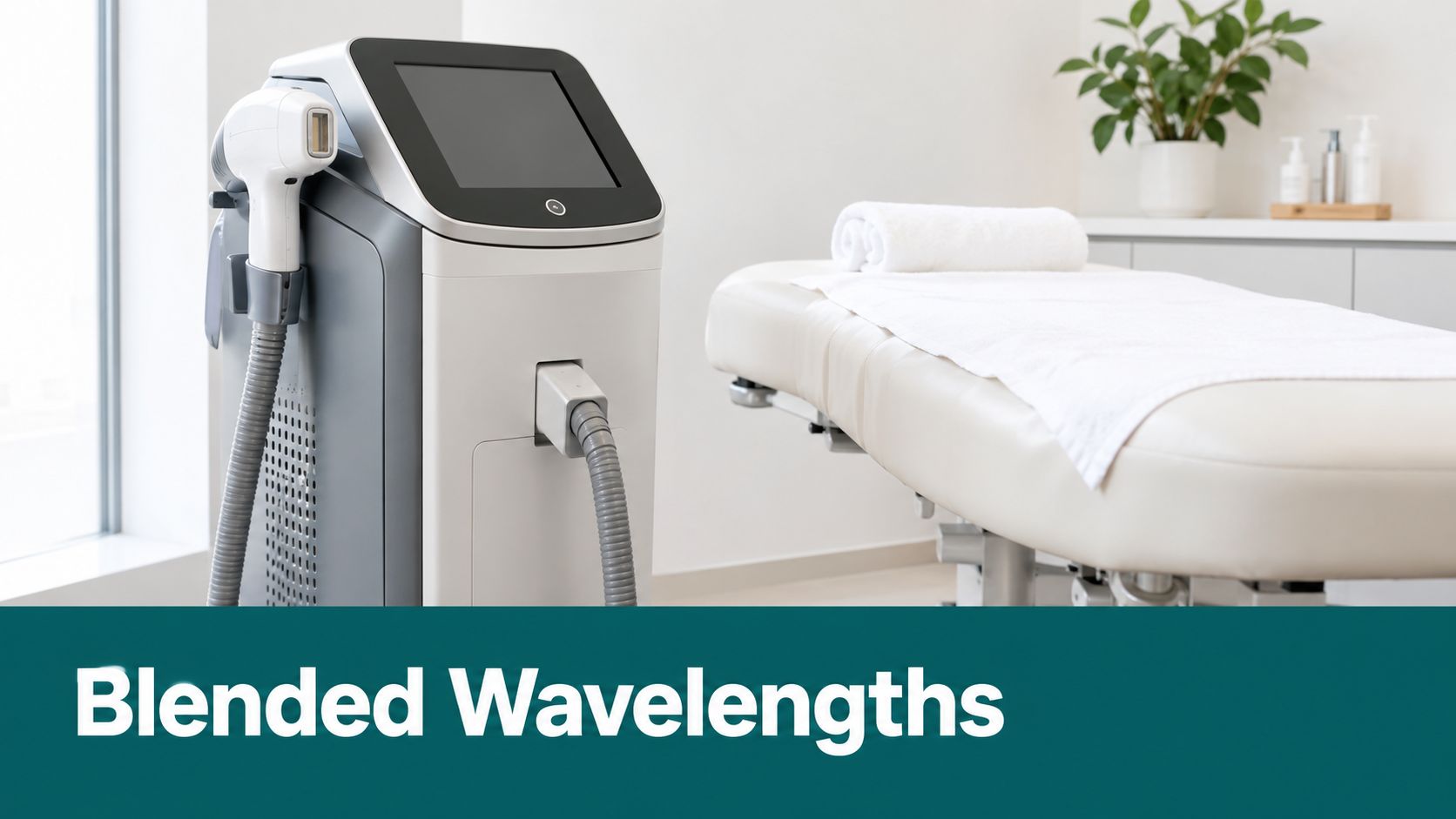
The Splendor X platform, used by NYC Laser Hair Removal, combines Alexandrite and Nd:YAG emission in a dual-wavelength approach. The clinical value isn't the mere presence of two wavelengths. It lies in the ability to adjust the balance between them for the person's skin tone, hair characteristics, body area, and response during treatment.
Sequential delivery versus simultaneous emission
Traditional systems may fire one wavelength and then another in separate passes or separate treatment stages. That can require the practitioner to manage the cumulative surface heat from each delivery. A blended system can emit both wavelengths simultaneously, allowing the clinician to tailor the relative contribution of each wavelength within one pulse.
For melanin-rich skin, that flexibility matters because the practitioner may want deeper follicular penetration without placing unnecessary energy into the epidermis. The Alexandrite component can contribute to targeting in selected circumstances, while the Nd:YAG component supports deeper delivery with lower surface melanin absorption. The appropriate balance still depends on assessment, and dual-wavelength capability doesn't excuse aggressive settings.
A closer explanation of this approach is available in the clinic's guide to dual-wavelength laser, which describes how combined emission can support more individualized treatment planning.
Cooling and coverage are part of safety
Cooling isn't a cosmetic extra. It helps control epidermal temperature during and immediately after energy delivery. When a system provides integrated cooling, the practitioner can protect the surface while maintaining a useful follicular treatment effect.
Spot geometry also affects consistency. A square-shaped spot can support even coverage across larger zones and reduce the uneven overlap that may occur when the practitioner works with a round spot pattern. In practice, the operator still controls the outcome. Consistent passes, appropriate overlap, clean skin, and real-time observation remain essential.
The device should adapt to the skin. The skin shouldn't be forced to tolerate a preset treatment recipe.
Clients should ask whether the clinic can change the wavelength balance, cooling strategy, and fluence according to skin response. They should also ask what the practitioner does if heat, swelling, or unusual discomfort appears during the session. A technology-forward treatment is defined by the combination of device flexibility and clinical judgment.
Evidence-Based Protocols for Preventing Pigmentation Issues
Prevention shouldn't stop at sunscreen. Sun protection remains foundational, but recent evidence points to a broader peri-procedure strategy for people at higher risk of PIH.
That evidence doesn't mean every client should receive every adjunct. Tranexamic acid, corticosteroids, and oral medication require medical screening and should only be considered when a qualified clinician believes they're appropriate.
A practical prevention sequence
Establish a baseline. Photograph the treatment area under consistent lighting and document existing marks, irritation, acne, and prior pigment reactions. A patch test can reveal how the skin responds before a larger area is treated.
Control ultraviolet exposure. Use broad-spectrum sunscreen consistently and follow the clinic's sun-avoidance instructions before and after treatment. Sun exposure can increase the skin's reactivity and complicate the interpretation of post-treatment changes.
Choose conservative parameters. Start with settings appropriate to the skin type and hair target, then adjust according to observed response. Higher energy isn't automatically better if it creates excess inflammation.
Use cooling deliberately. Epidermal cooling can reduce thermal injury and is one of the preventive approaches identified in the network meta-analysis. Cooling should be part of the treatment design, not an emergency response after the skin becomes overheated.
Discuss adjuncts medically. Ask whether topical corticosteroids, vasoconstrictors, tranexamic acid, or another intervention has a role for your risk profile. Don't self-prescribe oral or injectable medication based on an online protocol.
This video can also help clients understand what questions to raise before a cosmetic laser appointment:
A good clinic will explain not only what it plans to use, but why that option is appropriate for your skin and what the backup plan is if inflammation develops.
Managing Expectations for Treating Existing Hyperpigmentation
Treating established PIH is slower and less predictable than treating unwanted hair. Pigment may sit at different depths, the original inflammation may still be active, and the skin can respond to treatment by producing more melanin. For that reason, lasers are often better viewed as one part of a staged plan rather than an instant correction.
A 2024 retrospective review of low-energy 1,927 nm non-ablative fractional laser treatment for PIH in darker skin types reported a mean improvement of 43.24%, judged by two dermatologists, with no side effects observed in the treated patients (Lasers in Surgery and Medicine). That result is encouraging, but it describes one treatment approach and doesn't guarantee the same response for every skin type, pigment pattern, or body area.
When laser should come second
For acne-induced PIH in phototypes IV to VI, a cautious plan often begins with topical care after the acne and active inflammation are controlled. A 2025 review identifies low-fluence Q-switched Nd:YAG as the most studied laser for diffuse PIH, while also noting that improvement may require 6 to 10 weekly sessions, rebound hyperpigmentation can occur after treatment stops, and reported post-laser PIH risk in Asian cohorts ranges from 10% to 36% (PMC review).
Those figures should change the consultation conversation. If a topical regimen can calm the condition without adding procedural inflammation, it may be the sensible first move. Laser becomes more reasonable when the pigment is stable, the trigger has resolved, and the client understands that several sessions and maintenance may be necessary.
Home care can support the process, particularly when it includes professionally selected pigment-modulating ingredients. For background on azelaic acid and related Japanese skincare options, see these Buy Me Japan skincare picks, then confirm any product choice with your treating clinician.
What improvement should mean
A successful plan may produce gradual lightening rather than complete erasure. The practitioner should define how progress will be measured, when photographs will be taken, and what signs indicate that treatment needs to pause. New darkening, prolonged heat, blistering, or increasing tenderness isn't a sign to push through the next appointment.
Your Pre-Care and Post-Care Routine for Optimal Healing
Your daily routine influences whether the skin stays calm after treatment. Follow the clinic's written instructions because the correct timing can vary by device, body area, and your reaction during the session.
Before the appointment
Several days beforehand: Pause irritating active ingredients if your clinician directs you to, particularly retinoids, strong exfoliating acids, and abrasive scrubs. Don't wax or pluck the hair that the laser needs to target.
Before treatment: Avoid deliberate tanning and report recent sun exposure, self-tanner, rashes, acne flares, or medication changes. Arrive with clean skin and no deodorant, fragrance, oil, or body lotion on the treatment area.
On the day: Don't conceal irritation. A practitioner needs to see the skin's true condition before deciding whether to proceed.
After the session
Cool the area according to the clinic's instructions and use only bland, gentle products during the initial recovery period. Avoid hot showers, saunas, intense exercise, friction, tight clothing, and picking at the skin while it feels warm or sensitive.
For facial areas, physical sun protection can be useful alongside sunscreen. A hat, shade, and careful scheduling reduce ultraviolet exposure, while a gentle cleanser helps avoid unnecessary friction. Don't restart retinoids, acids, or exfoliating products until the skin has returned to its usual comfort and your clinician approves.
The after-laser treatment guidance for pigmentation provides a useful reference for questions about healing and daily care. Contact the clinic promptly if you notice blistering, marked swelling, severe pain, or darkening that continues to intensify instead of settling.
Choosing a Technology-Forward Clinic for Your Skin Journey
A suitable device is only one part of safe laser care. The clinic should also know how to assess pigment, classify skin tone, recognize inflammation, select conservative settings, and modify treatment when the skin gives an unexpected response.
During a consultation, ask direct questions:
Which wavelength is appropriate for my Fitzpatrick skin type, and why?
How will you reduce epidermal heat during treatment?
Do you offer a patch test before treating a larger area?
What signs would make you postpone my appointment?
What is your plan if I develop post-inflammatory hyperpigmentation?
Which aftercare products or medications are appropriate for me?
Look for answers that connect technology to your specific skin rather than relying on broad claims about being safe for everyone. A practitioner should explain the role of Nd:YAG delivery, blended wavelengths, cooling, fluence, pulse duration, and treatment spacing in language you can understand.
NYC Laser Hair Removal in Westbury uses Splendor X technology and offers treatment planning for areas ranging from the lip and underarms to the bikini line, back, chest, arms, and legs. Its approach is relevant to this topic because a pigmentation-conscious hair-removal plan depends on matching technology and technique to diverse skin and hair characteristics, not just selecting the most powerful setting.
The safest decision is the one that gives you a clear assessment, a realistic timeline, and an explicit prevention plan. If a clinic dismisses your concern about darkening or promises effortless results without discussing risk, keep looking.
NYC Laser Hair Removal offers personalized laser hair-reduction consultations in Westbury, with Splendor X dual-wavelength technology and treatment planning for diverse skin tones. Visit NYC Laser Hair Removal to discuss your skin type, pigmentation risk, treatment area, and a safety-focused plan before booking.
Comments