
Ingrown Hair Bumps on Legs: What Helps
You shaved your legs last night, and now there are red spots on your calves or thighs just as you're getting dressed. A few itch, one feels tender under your leggings, and the scrub mitt in the shower looks tempting. Before you reach for it, check what you're treating. Not every post-shave bump is an ingrown hair, and harder scrubbing can turn a small irritation into a longer-lasting mark.
Match Your Leg Bump Before You Treat It
A small, localized bump with a visible hair loop is a good fit for an ingrown hair. It may itch, feel tender, or have a pus-tipped surface. But timing alone doesn't confirm the diagnosis: a rash that appears after shaving could also reflect a reaction to a product, friction, or inflammation around several follicles.
The Mayo Clinic's ingrown-hair guidance describes bumps associated with hair removal and cautions against scratching or picking because damaged skin can become infected. A visible hair is a clue, not permission to dig. You don't need to uncover a buried shaft to decide whether a patch needs a grooming break.
Leg bump patterns and the next move
Use the closest pattern below to choose your next step. This is a triage guide, not a substitute for an examination when symptoms are worsening or the appearance is unclear.
Bump pattern | More consistent with | What to do next |
|---|---|---|
One tender bump with a visible hair loop | Ingrown hair | Pause shaving that patch and use mild care |
Itchy cluster after a new product or tight leggings | Irritant or allergic dermatitis | Stop the product and cut friction |
Many pustules that spread or feel warm | Folliculitis, sometimes bacterial | Get a clinician review and don't pick |
Flat dark mark after the bump fades | Post-inflammatory discoloration | Stop scrubbing and avoid more injury |
Fever, fast-spreading redness, or severe pain | Possible infection or abscess | Seek same-day medical care |
An itchy patch deserves a different response from an isolated trapped hair. Say you changed your body lotion and now both thighs itch where you applied it. That pattern makes a product reaction worth considering, especially if there isn't a distinct bump centered on a hair.
Tight leggings can add friction, but they don't establish that an allergy is present. Likewise, pus doesn't tell you everything about the cause. Multiple bumps that are multiplying, warm, or increasingly painful need assessment, rather than an assumption that every follicle contains a hair you should extract.
A flat mark isn't a fresh ingrown
Run a fingertip gently across the area. If the tenderness and raised bump have gone but a brown or gray patch remains, you may be looking at the aftermath of inflammation rather than an active trapped hair. Treating that flat patch like something that needs removal only adds injury.
Small follicular dots can also look different from individual swollen bumps. Our guide to strawberry legs and their appearance can help you describe what you're noticing without calling every dot an ingrown.
The same location-first caution applies elsewhere on the body. If you're also trying to identify a lip lesion, The Patients Guide lip bump advice is a separate resource, not a reason to apply leg-bump care to the lip.
Choose the closest pattern before trying a remedy. If none fits, leave the skin intact and get a diagnosis instead of squeezing it for answers.
How to Calm a Mild Ingrown on the Legs
Use home care only for a localized, mild bump without fever or spreading redness. A hot, enlarging, or increasingly painful area doesn't belong in a wait-and-see routine.
The useful steps are deliberately gentle. You're reducing irritation while watching whether the skin settles, not trying to force the hair through the surface.
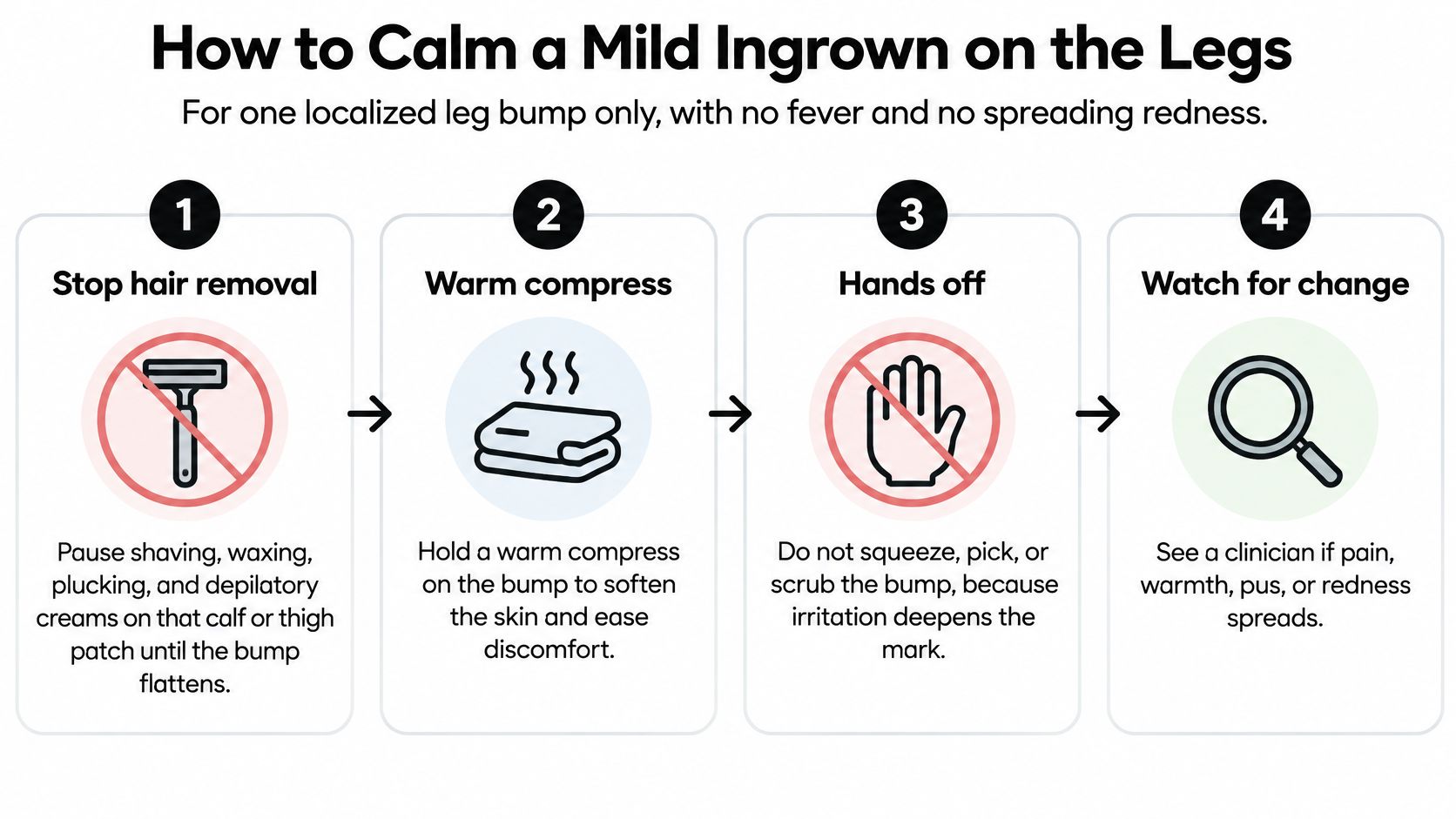
This visual summarizes the home-care approach.
Give the patch a chance to settle
Pause hair removal. Leave the affected calf or thigh patch alone until the bump flattens and the skin is comfortable. Don't switch from a razor to wax, tweezers, or depilatory cream while it's irritated. Changing tools doesn't make inflamed skin ready for another removal method.
Apply a warm, damp cloth. Use a clean washcloth and comfortably warm water, not water hot enough to sting. Hold it gently against the spot to soften the surface and ease discomfort. Don't rub with the cloth afterward or use it to scrape at a visible loop.
Keep cleansing simple. Wash with a mild cleanser and your fingertips, then pat dry. Set aside heavily fragranced products and rich oils that leave the patch coated. Choose loose clothing so seams and tight workout fabric aren't repeatedly rubbing the area.
Leave the bump intact and watch its direction. Don't squeeze a white tip or dig with household tweezers. If a hair needs releasing, a clinician can decide how to do that safely. Look for less tenderness, a smaller bump, and no surrounding spread rather than expecting an immediate change in appearance.
Judge progress by comfort, not perfect color
A bump can feel better before the skin looks completely even. That doesn't mean you should add a stronger product to finish the job. A flat leftover mark and an actively swollen follicle need different decisions.
Practical rule: If your home routine makes the spot sting, bleed, or feel more tender, simplify it rather than adding another treatment.
Avoid checking the bump by pressing it repeatedly. A quick look while washing or changing clothes is more useful than testing whether you can feel the hair underneath.
If the spot isn't moving toward improvement, arrange a review. If pain, warmth, redness, or swelling increases, stop treating it as a straightforward mild ingrown. Worsening symptoms matter more than how clearly you can see a hair.
How a Shaved Hair Becomes a Leg Bump
Say you shave your calf smooth, then notice an itchy bump as the hair starts growing back. The problem may be the direction of that regrowth, not something sitting on top of the skin. Think of the hair as a splinter the skin didn't invite, except the splinter came from your own follicle.
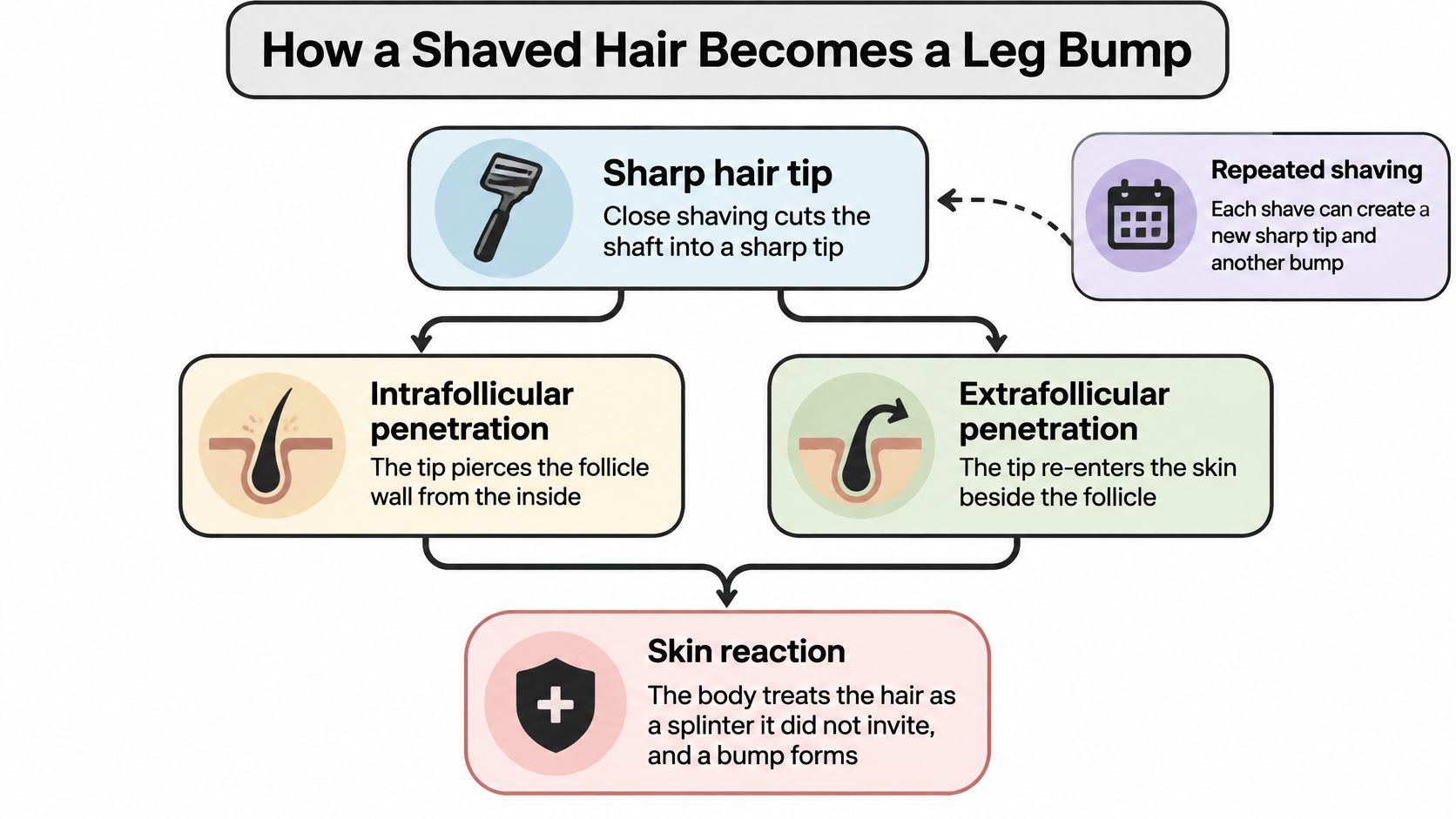
DermNet's explanation of pseudofolliculitis describes how a penetrating hair shaft triggers a foreign-body inflammatory reaction. The surrounding skin becomes irritated because the hair is somewhere it shouldn't be.
The diagram shows the routes a cut hair can take.
The hair can enter from inside or outside
Close shaving leaves a cut tip. With intrafollicular penetration, the growing tip pierces the follicle wall before it has emerged normally. The trouble begins beneath the surface, so there may be no visible loop to find.
With surface re-entry, the hair comes out and then curves back into nearby skin. You may encounter the terms transfollicular or extrafollicular penetration when reading about this outward-and-back route. The practical distinction is where the hair turns inward, not whether you should extract it yourself.
Coarse, curved, and tightly curled hairs are more likely to take that inward turn. That helps explain why someone can use the same razor and shaving gel as a partner yet develop more bumps. Hair shape changes how regrowth meets the skin.
Inflammation doesn't automatically mean infection
Once embedded, the shaft can produce a raised red or skin-colored bump, itching, tenderness, and sometimes a pustule. Those symptoms reflect inflammation around the follicle. They don't, by themselves, prove that bacteria are the original cause.
The legs also combine a large hair-removal area with everyday rubbing and coverage. A freshly shaved thigh may spend the rest of the day under close-fitting exercise clothing, while calves rub against leggings or socks. Friction and occlusion can aggravate an already irritated follicle.
This video offers another visual explanation of ingrown hairs.
The important consequence is mechanical: scraping the surface doesn't necessarily remove the embedded cause. Repeatedly shaving over a bump adds trauma to tissue that's already reacting. Calming the area requires interrupting that cycle, not treating every raised spot as ordinary acne.
Shave So the Next Bump Is Less Likely
Resume shaving only when the skin is calm. Start with warm water, a slick shaving gel, and a sharp blade or an electric shaver. Use short strokes in the direction of growth, light pressure, and as few passes as you can.
The trade-off is a closer shave versus calmer skin. Accepting some texture can be more useful than repeatedly chasing a perfectly smooth finish. The Mayo Clinic explains that close shaving and stretching the skin can encourage hairs to retract and grow inward, and notes that uncomplicated ingrowns often settle within several days, while more severe lesions can persist for several weeks.
Leg hair removal habits and ingrown risk
These are relative comparisons, not guarantees. A method described as lower risk can still cause problems if your skin is irritated or your hair readily curves inward.
Habit | Closeness | Ingrown risk | Best use |
|---|---|---|---|
Single pass with the grain and gel | Moderate | Lower | Calm skin on a routine shave |
Repeated against-the-grain passes | Very close | Higher | Avoid on bump-prone legs |
Stretching the skin while shaving | Close because hair retracts | Higher | Skip so hair doesn't spring under the skin |
Electric shaver | Less close | Often lower | Sensitive skin or coarse curly hair |
Waxing or plucking while skin is inflamed | Removes the whole hair | High irritation | Wait until the area has healed |
Let your leg rest in a comfortable position rather than pulling the skin taut with your free hand. Rinse the blade as you work so it isn't dragging a buildup of gel and cut hair across the skin.
Hair direction may change around the knee and across the thigh. Don't assume a long upward stroke suits the whole leg. Our explanation of shaving in the direction of hair growth can help you map the grain before choosing your strokes.
Make the routine easier to tolerate
Leave a comfortable gap between shaves instead of shaving again because you can feel stubble. If a patch still has raised spots, work around it rather than trying to level it with the surrounding skin.
Once the area is healed, any exfoliation should be light and comfortable. There's no benefit in making the skin raw before a blade touches it. Skip alcohol-heavy products and aggressive acids on a tender patch.
A successful shave isn't only the smoothness you feel afterward. It's also how your legs feel when the hair grows back.
Try the gentler routine across your next shaving cycle and watch for fewer new bumps. Don't judge it solely by closeness. If you still flare despite less frequent, less aggressive shaving, consider a different removal strategy rather than a sharper or harder pass.
Why Scrubbing Harder Leaves Dark Marks
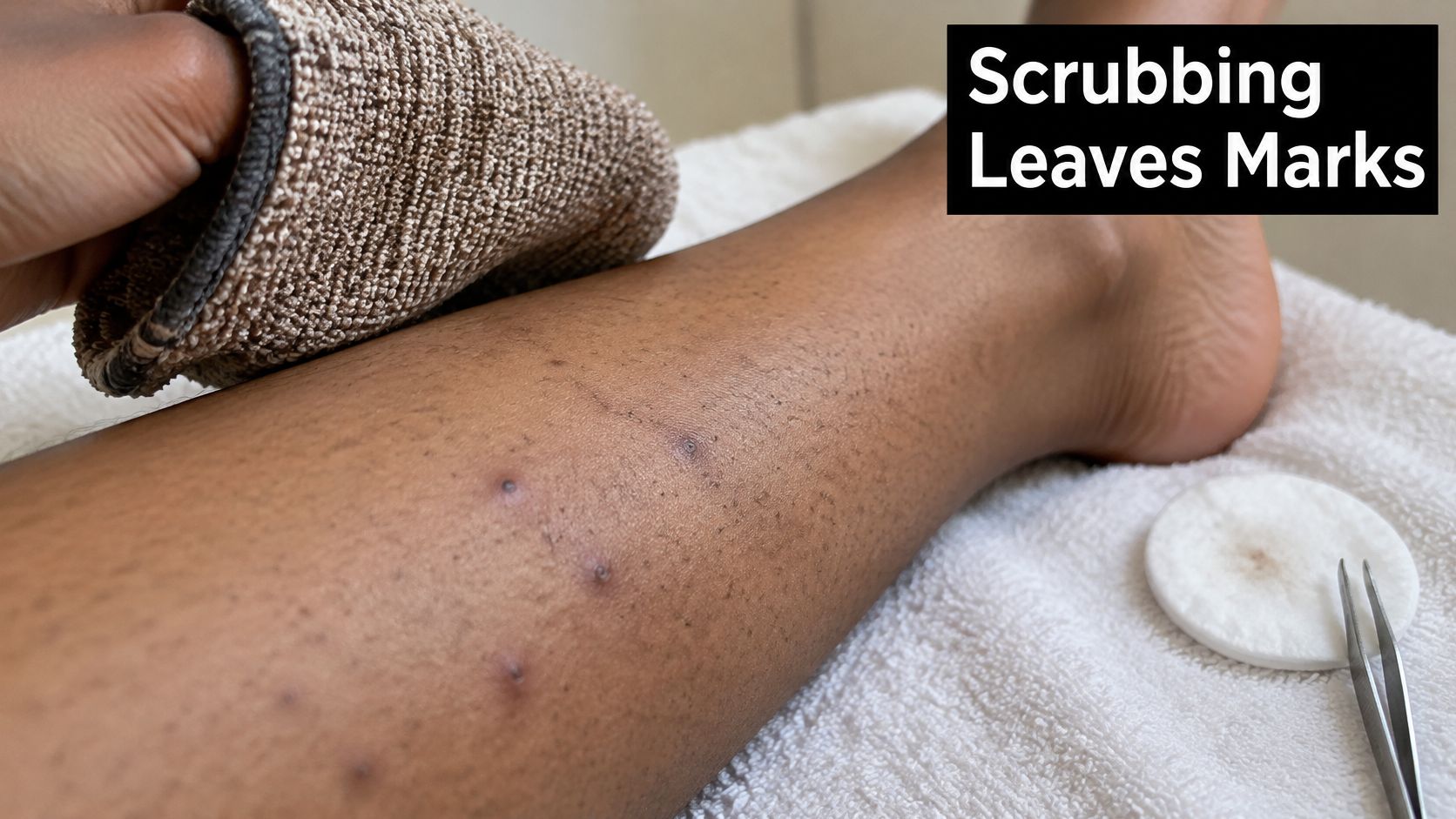
An ingrown hair isn't dirt that needs scrubbing away. A gritty mitt can rub the surface raw without correcting the direction of the hair underneath. Picking, repeated rubbing, and harsh products can add another layer of injury.
On medium-to-dark skin, inflammation can leave post-inflammatory discoloration, including brown or gray marks that remain after the swelling subsides. A darker patch is a reason to protect the skin from more trauma, not proof that you haven't exfoliated enough.
The tools beside a bump can matter as much as the original shaving habit.
Common doesn't mean caused by poor hygiene
Recurring razor bumps are well documented, although the strongest prevalence figures concern beard-area pseudofolliculitis rather than legs. A clinical report on pseudofolliculitis describes the condition in 45% of 50 Black male patients in a U.S. military study, a setting associated with frequent close shaving.
That figure isn't a leg-bump rate. It illustrates how hair texture and repeated grooming can combine in a population exposed to close-shaving requirements. Leg-specific population figures are limited, so a percentage from beard studies shouldn't be presented as your likelihood of developing calf or thigh bumps.
The useful message is simpler: recurring bumps don't establish that you're unclean. Washing harder won't change the curve of a regrowing hair.
Separate pigment care from bump care
If a spot is flat, don't keep searching for something to release. If it's still raised and painful, don't assume a brightening product will resolve the active problem. Our guide to post-inflammatory hyperpigmentation care addresses the discoloration side of that distinction.
For a flat mark: Avoid renewed rubbing, picking, or scraping over it.
For a tender raised spot: Focus on whether the inflammation is improving or needs examination.
For accumulating scars or darker marks: Arrange a clinician visit rather than escalating home exfoliation.
Change the habit, not the pressure: Fewer irritating removal cycles are more useful than a rougher scrub between them.
Signs a Leg Bump Needs a Clinician
Seek same-day medical care for fever, rapidly spreading redness, or severe pain. Don't wait for a visible hair to confirm your suspicion. A deeper infection or abscess can look different from a small, uncomplicated ingrown.
The NHS ingrown-hair guidance advises medical assessment for concerning symptoms and explains that a professional may release a trapped hair or prescribe treatment when needed. Stable but recurring bumps also deserve an appointment, particularly when they leave scars or don't settle.
Symptoms that change the next step
Increasing pain: The area hurts more rather than becoming comfortable.
Warmth and spreading redness: Changes extend beyond the original spot.
Pus-filled or multiplying bumps: Several inflamed follicles or increasing drainage need review.
Persistent or recurrent lesions: The same area keeps flaring or never fully settles.
Fever or feeling unwell: Seek prompt care rather than continuing home treatment.
Use this checklist to describe the changes when contacting a healthcare professional.
Treatment follows the diagnosis
A clinician may release a trapped hair using a sterile needle or blade. For persistent inflammatory swelling, a prescribed topical corticosteroid may be appropriate. Topical or oral antibiotics have a narrower role: they're used when bacterial infection is present.
That distinction matters because pseudofolliculitis is primarily a reaction to penetrating hair, while bacterial folliculitis involves infection around the follicle. Superficial bacterial folliculitis is commonly associated with Staphylococcus aureus. Antibiotics don't correct the direction of a regrowing shaft, so they aren't a general fix for every razor bump.
A deeper, painful lump may require a different procedure from releasing a superficial hair. Don't try to reproduce either treatment with a sewing needle, household tweezers, or squeezing pressure. Home extraction can damage surrounding tissue and make the original problem harder to assess.
While waiting for care, leave the affected patch free of shaving, waxing, tweezing, and depilatory creams. Tell the clinician when it started, whether it followed hair removal or a new product, and whether the redness, pain, or number of bumps has changed.
The visit is for diagnosis and targeted treatment, not a harsher version of a home scrub.
Choose Pause Care or Fewer Shaves
The right next move starts with the pattern, not the product aisle. A mild, localized bump calls for a temporary grooming pause. A recurring crop after nearly every shave calls for a broader change in how often and how closely you remove hair.
For the isolated spot, stick with gentle care and comfortable clothing until the skin is calm. Don't use the appearance of stubble as the signal to restart. Comfort, flattening, and an absence of worsening symptoms are more useful guides.
Choose according to what keeps happening
An occasional mild bump: Give the patch a break, then return to a lubricated, with-the-grain routine.
Bumps after nearly every shave: Reduce removal frequency or consider trimming instead of repeatedly pursuing a closer finish.
A rash linked to a product: Stop the suspected irritant rather than treating each itchy spot as a trapped hair.
Warmth, spreading redness, severe pain, or fever: Choose medical assessment before cosmetic treatment.
Professional laser hair reduction is another option to discuss once active inflammation has settled. Long-lasting reduction isn't a promise that an existing bump, pustule, or dark mark will disappear. The decision should account for your skin type, hair color, and the reason the bumps are occurring.
For Long Island readers considering treatment, our initial consultation assesses skin type and hair color to create an individualized plan. Clients must avoid waxing, plucking, threading, or electrolysis for 4-6 weeks before treatment. That preparation is separate from the immediate decision to leave an irritated patch alone.
You don't need to commit to a long-term treatment just because you have an uncomfortable spot today. Resolve the diagnosis and active irritation first. Then decide whether a simpler shaving routine is enough or whether repeated flare-ups make fewer shaves a worthwhile goal.
The practical choice is home pause care, gentler grooming, or medical review. Match the response to what your skin is doing rather than treating every post-shave change the same way.
At NYC Laser Hair Removal, we offer personalized hair reduction using Splendor X technology, including treatment for full legs. Once inflamed skin has settled, visit NYC Laser Hair Removal to arrange a consultation and discuss whether long-lasting hair reduction fits your skin, hair, and recurring shaving concerns.
Comments