
Laser Hair Removal Patch Test: What Results Mean
A laser hair removal patch test uses a few pulses on a small patch of skin to find a tolerable starting energy and watch for delayed reactions over 48–72 hours. It isn't permanent clearance for every future session.
The common advice to get a patch test and then forget about it misses the important part: the result belongs to a particular area, device, setting, and skin condition. Your clinician needs to know not only how the spot looked before you left, but also what happened afterward. A little redness around individual hairs can be useful information. A blister or a new dark patch means something very different.
What a Laser Hair Removal Patch Test Is For
You arrive expecting to discuss your legs. Instead of beginning across the whole area, the clinician selects a postage-stamp-sized patch and applies a few pulses. That small exposure helps answer a practical question: what starting setting makes sense for your skin without unnecessarily exposing a larger area?
This is risk management, not an allergy test in the usual sense. The clinician is checking how your skin handles controlled laser heat, how uncomfortable it feels, and whether the expected response appears around the hair follicles. A comfortable experience alone isn't enough, because skin changes may develop after you leave.
What the clinician is trying to learn
The test brings together information that a standard device chart can't fully capture:
Your skin response: The clinician looks for a localized follicular reaction rather than widespread overheating.
Your comfort level: Tell them whether the sensation is manageable or sharply painful. You don't need to prove you can tolerate it.
Your treatment expectations: A small test helps distinguish the sensation of treatment from the idea of completely painless hair removal.
Your history: Previous pigment changes, unusual scars, or uncertainty about recent treatments can change the next step.
Not every person needs exactly the same testing approach. Clinical guidance treats patch testing as a useful option for selected patients, rather than a universally mandatory procedure. Substantial anxiety, an unclear medical history, unrealistic expectations, or possible abnormal scarring make careful assessment especially valuable.
Practical rule: A useful result is a documented starting point, not simply a verbal pass.
Why a calm spot isn't a guarantee
A small test can reduce uncertainty, but it can't promise that no complication will occur. Your clinician still needs to consider the treatment area, hair characteristics, device, and current condition of your skin before proceeding.
For a nervous first-timer, the pause has another benefit: you can experience the sensation without committing to a full-area appointment immediately. You can ask questions, watch the spot at home, and make the next decision with more information rather than feeling rushed in the chair.
How to Read the Spot After Two to Three Days
Don't judge the result only while you're still at the clinic. The delayed check matters, because thermal injury and changes in skin color may not be obvious immediately.
A 48–72-hour observation window is a practical benchmark for reviewing a test spot, although the device instructions and your clinician's protocol may require a different or longer assessment. It isn't a deadline after which every possible reaction has been ruled out.
Patch test reactions and what to do next
What you see | When it shows | What it usually means | Next step |
|---|---|---|---|
Pinpoint redness and swelling around follicles | Shortly after treatment | Desired perifollicular endpoint | Settings may guide treatment after the delayed review |
Pinkness that fades, no blister | During the delayed check | Potentially tolerable response | Proceed only after clinician review of the recorded settings |
Marked sensitivity or irritation | Immediately or during follow-up | The setting may be near or beyond your comfort ceiling | Stay conservative; don't raise energy |
Blister, crust, or a burn | During the observation period or later | Possible excessive thermal injury | Don't treat a larger area at that fluence |
Darker or lighter patch | May develop after the initial check | Possible pigment injury | Pause and reassess skin type, tan, and settings |
No redness or swelling at the follicles | Immediate assessment | Energy may be below the intended endpoint | Only the clinician should decide whether to adjust |
These findings guide a conversation, not a home diagnosis. Redness centered on individual follicles isn't the same as broad, painful redness, and redness alone doesn't establish that a setting is effective or safe.
A cohort study of diode hair removal across different ethnic groups recorded at least one side effect in 53% of participants, including sensitivity in 44.1%. Those findings belong to that particular study population, not to every laser patient or device, but they reinforce why discomfort deserves attention rather than dismissal.
What to record at home
Take a clear photograph before the test, then photograph the spot during the clinic's requested follow-up window. Use the same lighting, distance, and angle so a shadow doesn't look like a new pigment change. Include enough surrounding skin to make the test location recognizable.
Track the direction: Is tenderness settling, staying the same, or worsening?
Describe the distribution: Are small bumps centered on hairs, or is the whole patch inflamed?
Report surface changes: Blistering, broken skin, crusting, or a new color difference needs clinical review.
Avoid experimenting: Don't apply acids, retinoids, bleaching products, or unfamiliar soothing remedies to interpret or treat the reaction yourself.
Follow the aftercare instructions you receive. Don't keep cooling a painful spot and assume that reduced sensation proves it's fine. Contact the clinic for anything beyond the mild response you were told to expect, and seek prompt medical assessment for severe or worsening pain, extensive blistering, or signs of infection.
What Happens During the Patch Test Visit
A well-planned visit starts before the laser is switched on. Preparation helps the clinician assess the actual treatment conditions instead of a patch covered with products, irritated by hair removal, or recently exposed to strong sun.
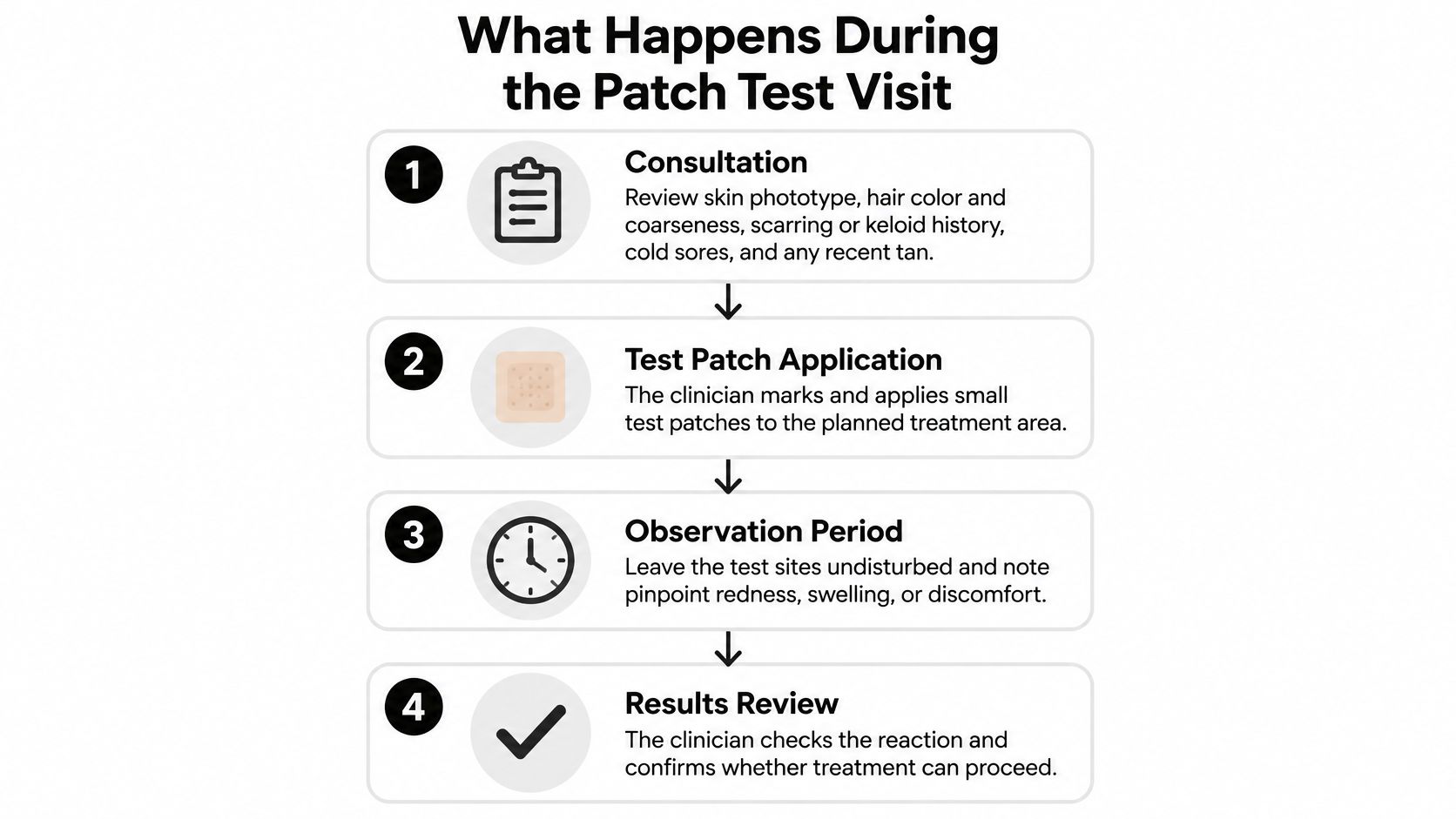
The process moves from consultation to a small exposure, observation, and review.
Prepare the area without removing the target
Review your history before treatment. Discuss your skin's usual response to sun, hair color and coarseness, unusual scars or keloids, cold sores, and recent tanning. Mention pregnancy too. At our clinic, laser hair removal isn't recommended during pregnancy, so testing waits as well.
Avoid root-removal methods for 4–6 weeks beforehand. Our preparation requirements exclude waxing, plucking, threading, and electrolysis during that period. Pulling hair out changes the target the clinician needs to assess.
Shave to skin level. Our treatment preparation requires this, although a day's growth may help make the area recognizable during assessment. If you're unsure whether the clinician wants to see that growth first, confirm the shaving instructions before arriving rather than guessing.
Wash the area fully. It must be free of makeup and medication before treatment. Arrive without lotion or deodorant on the test zone, and disclose prescribed topical products rather than independently changing a medical treatment.
Our guide to the laser hair removal procedure can help you understand how preparation fits into the wider appointment.
Keep the exposure small and the record useful
Test the planned treatment zone. A bikini test should represent bikini skin, and a facial test should represent the intended facial area. A convenient forearm spot doesn't automatically answer either question. The clinician applies the selected pulses with the appropriate device cooling and checks your immediate response.
Document what was done. The record should identify the location, skin phototype, recent ultraviolet exposure, wavelength, spot size, fluence, pulse duration, cooling, and visible endpoint. Your description of discomfort belongs in the discussion too.
Leave with a review plan. Confirm when to send photographs or return, what symptoms require an earlier call, and whether the larger appointment should remain provisional. Don't turn a planned observation period into an immediate full-back or full-leg session because the spot looks quiet at first.
Our treatments typically require no downtime, but no downtime doesn't mean no observation. Before agreeing to expand treatment, ask which settings were recorded and how the delayed response will be reviewed.
Starting Energy by Skin Type and Hair
Fluence means the energy delivered per unit of skin area, usually expressed in joules per square centimeter. It describes energy delivery, not the skin's final temperature. The same number can produce different responses when the wavelength, pulse duration, spot size, cooling, or skin pigmentation changes.
The clinician aims for an appropriate follicular response at a tolerable exposure, not the highest number the machine can deliver. The small red halo and swelling around follicles have a clinical name: perifollicular erythema and edema.
The international guidance on laser and IPL hair reduction describes test patches as a way to guide treatment parameters; illustrative diode fluences in the clinical literature include 30–35 J/cm² for Fitzpatrick II–III skin and 20–24 J/cm² for darker skin types. These examples are not settings to request for yourself or transfer to another laser.
Illustrative diode starting ranges by skin situation
Skin situation | Example diode fluence | Why the test matters | How the clinic should treat the number |
|---|---|---|---|
Fitzpatrick II–III | About 30–35 J/cm² | Assesses tolerance and the follicular endpoint | Published starting guide, subject to delayed review |
Darker skin types | About 20–24 J/cm² | More epidermal melanin increases concern about unwanted heating | Conservative guide adjusted to tissue response |
Recently tanned skin | A more conservative approach, or postpone | Recent pigmentation changes the risk assessment | Don't copy an old untanned setting |
New device or new parameters | Manufacturer test settings only | Pulse duration and spot size alter energy delivery | Individualize rather than transfer numbers |
A recently tanned person doesn't become suitable for treatment just because someone chooses the lower published range. Postponing treatment may be the appropriate decision. Skin phototype and current tanning are related considerations, but they aren't interchangeable.
Why joules alone don't tell the whole story
An individualized diode treatment protocol describes an 805-nm device with pulse durations of 15–400 ms and energy densities of 10–100 J/cm², while treating manufacturer-based patch settings as starting values to modify according to response. That broad operating envelope isn't a treatment target or permission to increase energy toward its upper limit.
Hair matters too. Color and coarseness influence how the clinician selects treatment parameters, while the surrounding skin limits how much unwanted heating is acceptable. Fine hair isn't a reason to keep increasing energy.
Ask what fluence and pulse duration were used, not just whether the machine was set high or low.
Before moving to a large area, the chart needs the immediate endpoint and the delayed result, not merely a device preset. Our guide to choosing a laser for hair removal explains why device choice belongs in that conversation. Published diode examples shouldn't be copied directly onto another technology.
When a Passed Test No Longer Applies
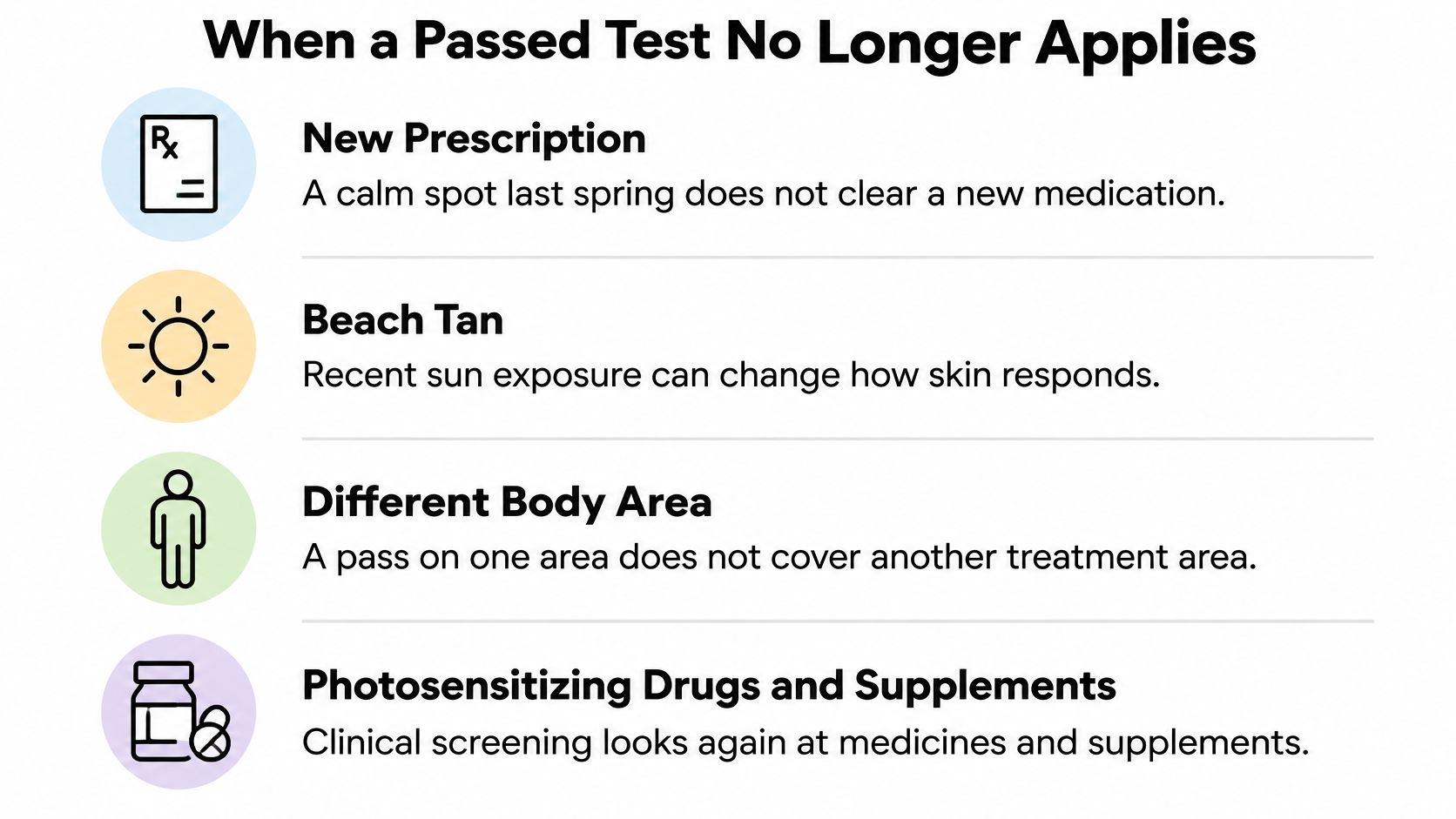
A calm spot last spring doesn't clear a new prescription, a beach tan, or an irritated patch of skin today. Changed conditions require a fresh assessment, even if your previous treatment felt comfortable.
The sensitive-skin screening guidance from Big Country Med Spa identifies photosensitizing medicines and supplements, including doxycycline-class antibiotics and St. John's wort, as matters to review. It also includes isotretinoin, retinoids, corticosteroids, minoxidil, hormonal therapies, and immunosuppressants among medicines that may affect skin response or hair growth.
These are disclosure prompts, not a claim that every medicine on the list interacts with every laser in the same way. Risk depends on the drug, dose, skin condition, treatment area, and clinical assessment.
Tell us what changed before the appointment
Prescriptions and supplements: Include anything started, stopped, or changed since your last visit.
Active skincare: Mention retinoids, exfoliating acids, and products that have caused peeling or stinging.
Skin condition: Report a rash, broken skin, cold-sore symptoms, or a recent pigment change.
Sun exposure: Tell us about a tan even if the skin no longer feels sunburned.
Treatment details: A different body zone, device, or set of parameters may justify another test.
Use this checklist before each visit, not only before your first appointment.
Apply clinic requirements without changing prescriptions yourself
At our clinic, clients must avoid sun exposure for 2 weeks before treatment. Our preparation policy also requires that clients not currently use Accutane, Retin-A, or gold therapy, or have used them within the past 6 months. These are clinic eligibility requirements, not universal waiting periods for every medicine and every laser.
Never stop a prescribed medicine solely to have laser treatment. Speak with the prescribing clinician and tell us what they recommend so treatment can be postponed or reassessed appropriately. Our guidance on laser hair removal and sun exposure can help you plan around outdoor activities.
Safety first: A changed medication list is a reason to review the plan, not a reason to hide the medication or skip doses.
For deeper skin tones, recent tanning, or a history of post-inflammatory pigmentation, the clinician may extend observation rather than accept an early quiet appearance. Call for blistering, spreading redness, a new dark or light patch, or a cold-sore flare. Don't wait for the next scheduled session to mention it.
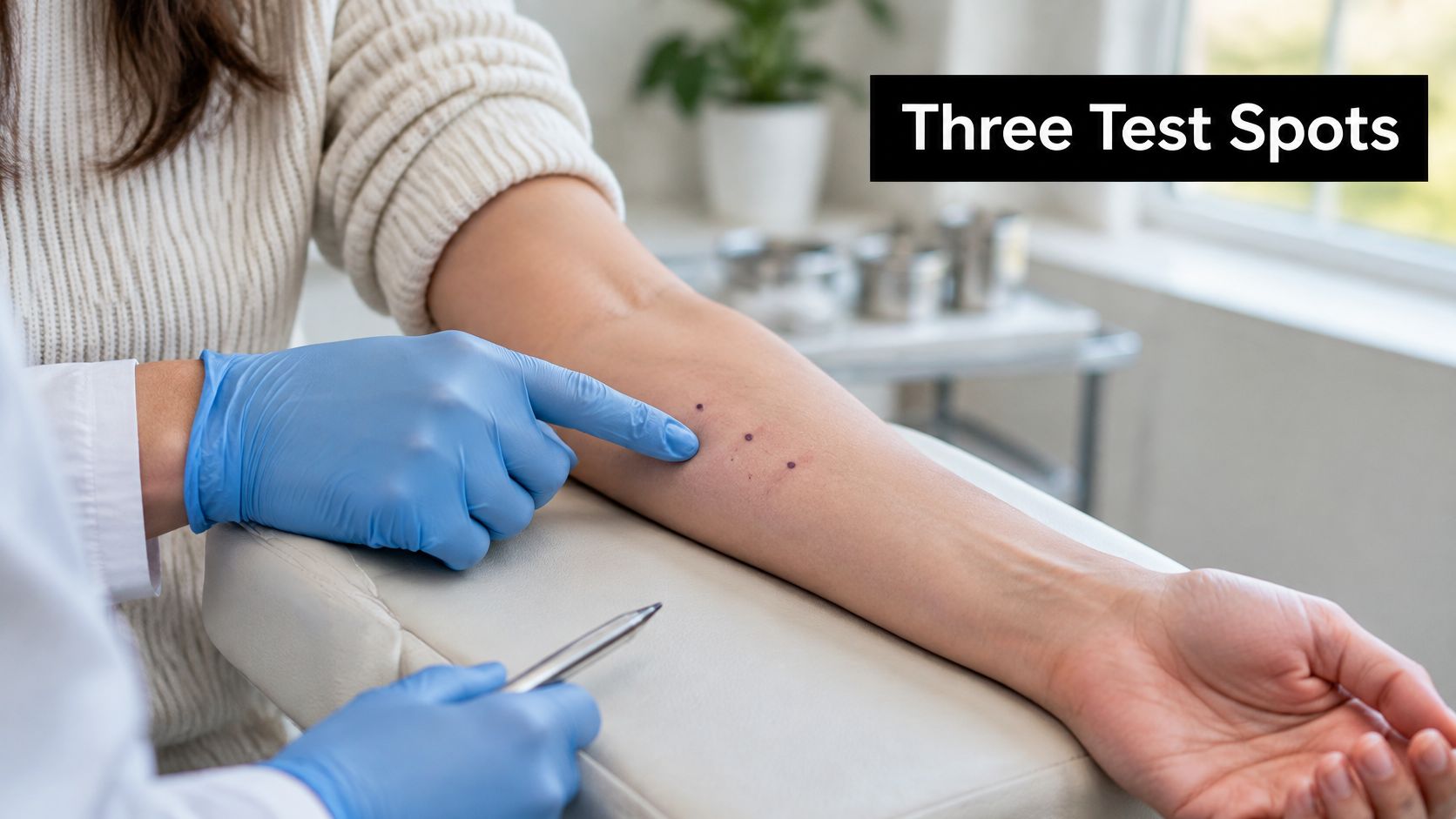
Three Test Spots That Changed the Plan
These hypothetical examples show how the result changes the next decision. They aren't patient stories or promises about how your skin will respond.
A small exposure is useful only when its location and findings match the treatment being considered.
Carry the settings forward for the tested area
Say someone tests an underarm. The clinician sees small follicle-centered bumps, the discomfort settles, and the delayed photographs show calm skin without a surface injury or color change.
The next decision is to use those recorded settings as a guide for the underarms. It isn't an invitation to apply them automatically to the face or full legs. The useful finding is local and specific.
Pause when the color changes
Someone with a deeper skin tone tests the bikini area using a conservative starting approach. The immediate reaction seems manageable, but a darker patch appears during follow-up.
The plan changes to pause, assess, and allow recovery, not repeat the exposure across the whole bikini area. The clinician reviews recent sun, pigment history, cooling, and treatment parameters. A lower setting may eventually be considered, but reducing a number doesn't by itself resolve an active injury.
A review of laser hair removal complications describes burns, folliculitis, pigment changes, paradoxical hair growth, herpes reactivation, and cooling-related injury. These possibilities explain why an apparently quiet start isn't the only information that matters.
The accompanying video offers another way to become familiar with the treatment topic.
Reassess after medication and skincare changes
Someone tolerates an upper-lip test, then begins an antibiotic and a retinoid before the planned treatment. They disclose both rather than assuming the earlier result still applies.
The next step is clinical review, with postponement or retesting if appropriate. A fresh test isn't a workaround for a medicine-related contraindication or an irritated skin barrier.
Before leaving any of these appointments, the person should be able to explain:
What was tested: The actual body location and device wavelength.
What was recorded: Fluence, pulse duration, and the observed response.
What happens next: Which symptoms prompt a call and when delayed color changes will be reviewed.
Book a Consultation Before the First Full Area
For a first-time client considering the back, chest, or full legs, book an assessment before committing to broad exposure. A consultation gives you room to discuss the skin you have now, rather than relying on a treatment someone else tolerated or a setting used elsewhere on your body.
At our Westbury clinic, experienced professionals assess skin type and hair color during the initial consultation to create a personalized treatment plan. We use Splendor X for long-lasting hair reduction. Specialist Tamar has over 17 years of experience in laser hair removal, and that assessment matters when a spot's response needs careful interpretation.
Bring information that changes the decision
You don't need to arrive knowing which settings to choose. Bring an accurate history and be ready to describe what your skin has been through recently.
Recent exposure: Mention sun, tanning, and any lingering irritation.
Medicines and skincare: Bring names of prescriptions, supplements, retinoids, and acids.
Previous reactions: Explain burns, dark marks after irritation, unusual scars, or cold sores.
Hair-removal preparation: Tell us whether the area was recently waxed, plucked, threaded, or treated with electrolysis.
Ask for the proposed test location, fluence, pulse duration, and follow-up instructions. Confirm how photographs should be sent and whether the full-area appointment should wait until the result has been assessed.
The right next appointment is the one your skin is ready for, not necessarily the largest area on your booking list.
If the test produces a blister, burn, or color change, the next decision is reassessment and recovery. It isn't a bigger session using the same exposure.
Call 516-321-4959 or email INFO@NYCLASER.COM to schedule your consultation. Tell us which area you're considering and whether your medicines, skincare, or sun exposure have recently changed so those details can be discussed before treatment.
At NYC Laser Hair Removal, we offer personalized hair-reduction care with an initial assessment of your skin type and hair color. Visit us to discuss a patch-test plan for your intended treatment area and understand what needs to happen before you move to a full session.
Comments