
Laser Hair Removal for Pubic Area: The Ultimate Guide
You're tired of planning your week around shaving, hiding razor burn under swimwear, or scheduling waxing appointments before every holiday. The pubic area makes those routines especially frustrating because the skin is sensitive, hair can grow densely, and repeated friction may leave you dealing with bumps, irritation, or ingrown hairs. Laser hair removal for the pubic area offers a different approach, targeting the follicle rather than cutting or pulling the visible hair.
The right treatment isn't just about choosing the strongest setting. Skin tone, hair characteristics, wavelength, cooling, treatment coverage, and operator experience all affect safety and results. This guide explains how the process works, what Splendor X technology brings to the appointment at NYCLASER, and how to decide whether a bikini line, full bikini, or Brazilian treatment fits your goals.
Moving Beyond Shaving and Waxing
A typical grooming cycle starts with a close shave. The area feels smooth, then stubble appears, followed by itching, razor burn, or an ingrown hair. Waxing may extend the time between appointments, but it can still be uncomfortable and can leave sensitive skin temporarily irritated. Neither method reduces the follicle's ability to produce future hair, so the routine continues.
That repetition is why many clients begin asking about long-term hair reduction rather than another temporary removal method. Laser energy is absorbed by pigment in the hair and converted into heat, which can impair the follicle's ability to regrow hair. The process is gradual, because only follicles in a receptive stage of growth respond well during each appointment.
A 2000 comparative study of 30 volunteers treated the pubic area, along with two other body sites, three times with a long-pulsed ruby laser. At the first follow-up, hair reduction was statistically significant at 38% at 25 J/cm² and 49% at 40 J/cm², while needle electrolysis and hot wax showed no significant decrease in that study. The authors also reported that laser treatment was less painful than the other methods and described it as a promising, well-tolerated approach for pubic-area epilation. Read the PubMed study on pubic-area hair removal methods
Practical rule: Laser is a reduction treatment, not a promise that every follicle will disappear permanently after one appointment.
Before beginning, clients should understand how shaving fits into the plan. Shaving usually leaves the follicle in place for the laser to target, while waxing and plucking remove the hair from the root. NYCLASER's guidance on laser hair removal and shaving helps clarify why preparation matters.
The best candidates are people who want less regrowth, fewer grooming demands, and a carefully managed treatment plan. A consultation should still address recent tanning, medications, skin conditions, active irritation, and the specific coverage you want.
Understanding Your Options Bikini Line vs Full Brazilian
Treatment names vary between clinics, so ask the provider to define the exact borders before the session begins. The difference is mainly how much skin is treated, not how the laser works.
Bikini line
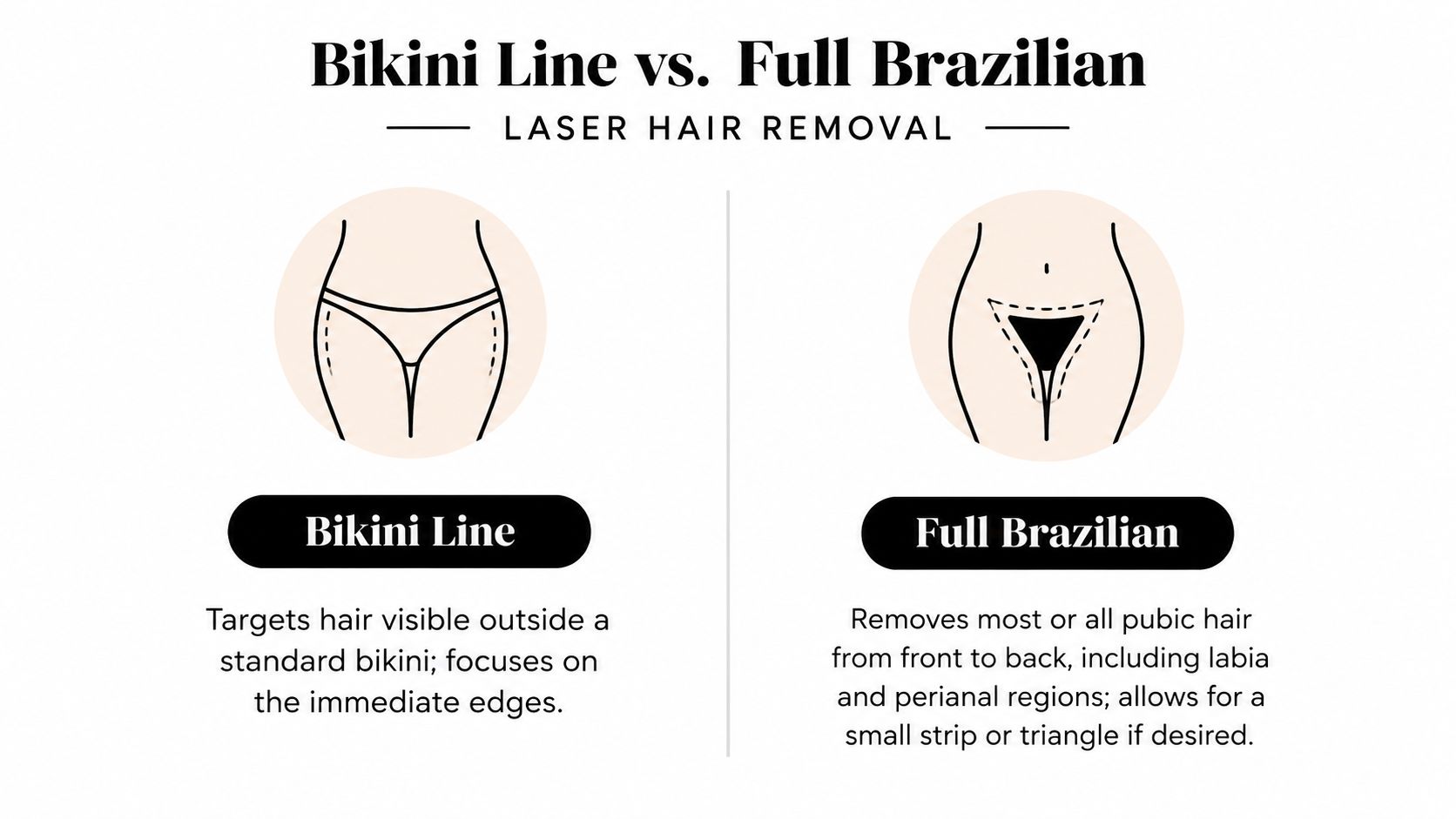
A bikini line treatment focuses on hair that could show outside a standard swimsuit. It generally covers the outer edges and may extend slightly onto the upper inner thighs, depending on the clinic's definition. This option suits someone who wants a cleaner outline without treating the entire pubic region.
Full bikini
A full bikini treatment covers more than the immediate edges. It may include additional hair on the front and inner bikini area while leaving a chosen amount of hair in the center. If you want a neater appearance but aren't ready for complete removal, this middle option can offer flexibility.
Brazilian
A Brazilian treatment usually covers most or all pubic hair from front to back. Depending on the provider and your preference, that can include the mons pubis, labia, and perianal region. Some clients request a small strip, triangle, or other defined shape rather than complete removal.
Discuss the design before you undress. You can also bring a clear description of the result you want, such as “outer edges only,” “front and labia,” or “front to back with a narrow strip.” If you're choosing swimwear around the planned treatment area, browsing Nuage Wears 2026 bikinis can help you think through how much coverage you prefer.
The difference between Brazilian and bikini laser treatments is ultimately a personal choice. A professional provider should explain what will and won't be treated, protect your privacy, and confirm consent before extending the treatment area.
How Laser Technology Works for the Pubic Area
Think of the laser as a carefully aimed source of heat. Darker pigment in the hair follicle absorbs the light, the energy becomes thermal energy, and the heat disrupts the follicle's ability to produce hair normally. The surrounding skin must be protected while the provider delivers enough energy to affect the follicle.
That balance is more demanding in the pubic area. Genital and groin skin may be more pigmented, exposed to friction, and influenced by hormonal changes. Coarse terminal hairs can respond well, but the provider has less room for error when skin pigment absorbs too much energy.
Why wavelength matters
Splendor X, used at NYCLASER, combines Alexandrite and Nd:YAG wavelengths in one platform. This dual-wavelength design allows the provider to select or combine energy according to the client's skin tone, hair characteristics, and treatment area rather than relying on one wavelength for everyone.
Alexandrite energy is commonly associated with effective targeting on lighter skin, where there is greater contrast between the hair and epidermal pigment. Nd:YAG energy penetrates to a greater depth and has lower absorption by epidermal melanin, making the 1064 nm Nd:YAG wavelength a favored option for skin of color. Review the dermatology evidence on laser wavelength selection and pigment risk
That distinction matters in pubic treatments because darker skin can be more vulnerable to pigmentary change if settings, pulse width, fluence, and cooling aren't matched appropriately. Shorter wavelengths such as 755 nm Alexandrite can be highly effective, but they carry greater pigment risk in darker phototypes. A 1064 nm Nd:YAG approach generally offers a wider safety margin for melanin-rich skin, provided a trained operator selects conservative, appropriate settings.
What Splendor X does and doesn't guarantee
Dual-wavelength capability is a meaningful technical advantage, but it doesn't make every treatment automatically safe. The device is only one part of the safety system. Accurate skin assessment, a careful consultation, test-spot judgment when appropriate, correct eye protection, suitable cooling, and an experienced technician remain essential.
Laser works best when the follicle contains enough pigment to absorb the energy. Very light, gray, or some red hairs may respond less predictably because the target pigment is limited. Hormonal changes can also influence regrowth, which is why a responsible clinic discusses reduction and maintenance rather than promising permanent removal.
For clients across different skin tones, the important question goes beyond whether a clinic owns an advanced laser. Ask whether the provider can explain why a particular wavelength and setting suit your skin, how they manage increased pigmentation in the pubic area, and what signs would require the session to stop.
The Step by Step Treatment Process From Prep to Session
A well-run appointment should feel predictable. Preparation protects the skin and leaves the follicle available for the laser, while the consultation gives the technician information needed to adjust the treatment safely.
Before you arrive
Follow the clinic's specific instructions, but the usual preparation includes:
Shave the area beforehand: A close shave leaves less surface hair to absorb energy and helps direct heat toward the follicle. Don't wax, pluck, or thread beforehand because those methods remove the target from the follicle.
Avoid tanning and self-tanner: Recently tanned or artificially darkened skin can increase the chance of irritation and pigmentary complications. Tell the provider about any recent sun exposure.
Come with clean skin: Skip heavy lotion, oil, fragrance, deodorant, and other products on the treatment area unless the clinic tells you otherwise.
Share relevant health information: Mention medications, active rashes, sores, unusual tenderness, previous reactions, and any condition affecting the treatment area.
Wear loose, breathable clothing for the trip home. Tight seams can rub freshly treated skin.
At the clinic
The technician should confirm the treatment area and your desired style before beginning. They'll assess skin tone, hair density, recent exposure to sunlight, and any visible irritation. Ask questions at this stage, especially if you have darker skin, a history of hyperpigmentation, or previous laser reactions.
You'll receive protective eyewear. The provider cleans the skin, positions you privately, and may mark or clarify boundaries for a bikini, full bikini, or Brazilian service. You should be able to request a pause at any time.
During the pulses
The handpiece delivers controlled pulses across the selected area. Many clients describe the sensation as a brief rubber-band snap, warmth, or a quick pinching feeling. Cooling helps reduce surface heat and improve comfort, particularly in a sensitive region.
The session length depends on the treatment coverage, hair density, and clinic workflow. Don't judge quality by speed alone. The technician should move systematically, avoid untreated gaps, and monitor how your skin responds rather than rushing to finish.
Afterward, mild redness or warmth can occur. Your provider should explain what to expect, what products to use, and which symptoms deserve a call to the clinic.
Results and Timeline What to Expect and When
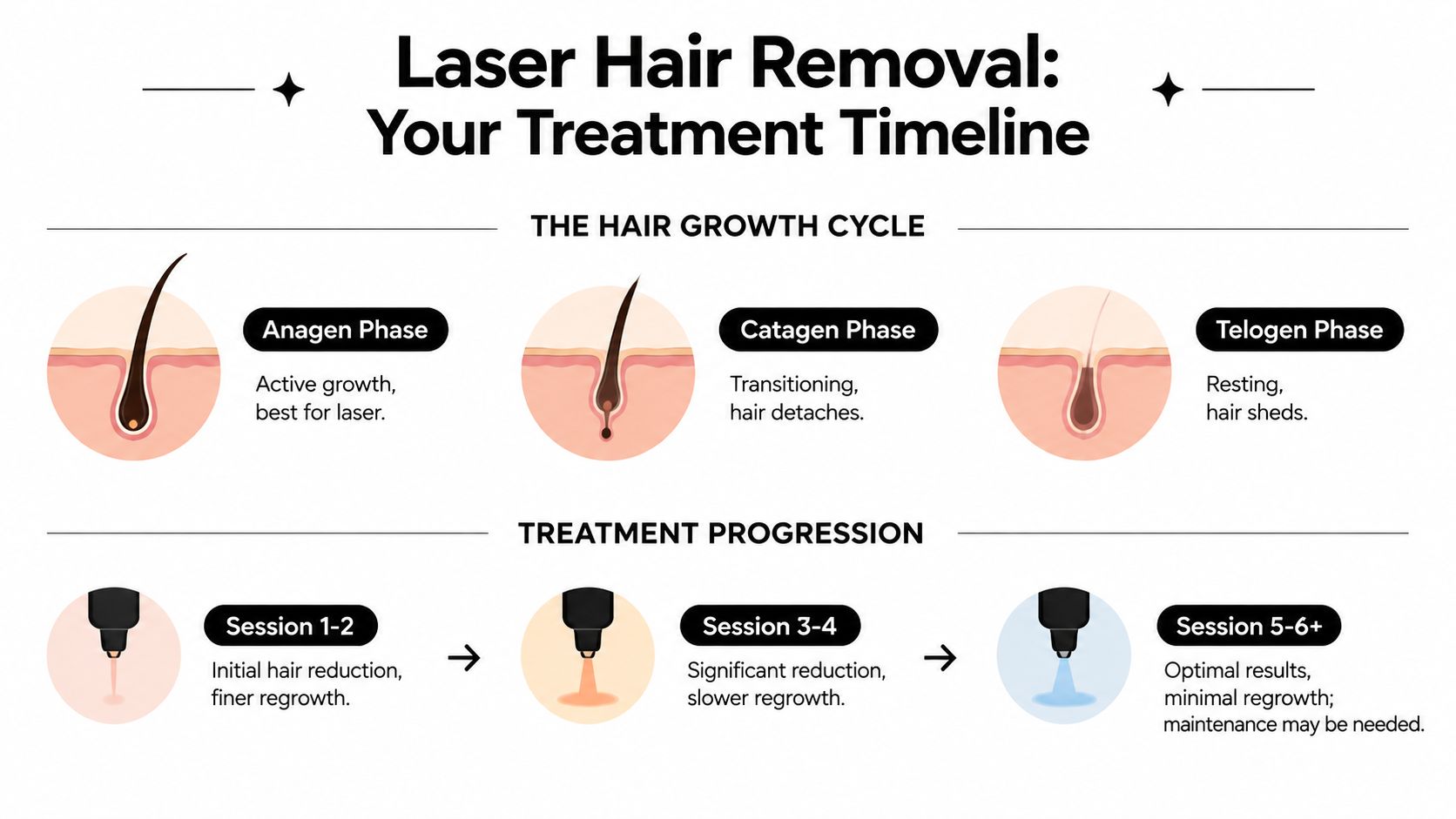
Laser hair removal works across the hair-growth cycle, not all at once. Follicles move through anagen, the active growth phase, catagen, a transitional phase, and telogen, a resting phase. Laser is most effective when the hair is connected to an actively growing follicle with enough pigment to absorb the energy.
That timing explains why one session can't treat every follicle equally. Some hairs may shed after treatment, while others continue growing until they enter a more responsive phase during a later appointment.
What the first appointment tells you
After an initial treatment, you may notice treated hairs appearing to grow before they gradually shed. That visible regrowth doesn't necessarily mean the session failed. The follicle may be releasing the treated hair, or the hair may not have been in the ideal growth phase.
The meaningful result is a pattern that develops over repeated appointments: less density, slower return, and finer remaining hair. Your technician should evaluate the response before changing settings, particularly in darker skin where aggressive escalation can increase risk.
Why a series matters
An evidence-based review of 9 randomized controlled trials and 21 controlled trials found that laser and light-based epilation generally produced partial short-term reduction up to six months. It also found that repeated treatments can improve outcomes and provide partial long-term reduction beyond six months, particularly with Alexandrite and diode lasers. The review found no evidence for complete, permanent hair removal, while postoperative side effects were generally reported as low. Read the evidence-based review of laser and light-based epilation
A clinic may recommend a series based on your hair cycle, response, skin tone, and treatment goals. Some clients need maintenance later because hormonal factors and previously inactive follicles can contribute to renewed growth. The appropriate expectation is long-term reduction with possible maintenance, not a guaranteed permanently hairless result.
Track changes with consistent photos if you're comfortable doing so, using the same lighting and coverage. Day-to-day impressions can be misleading, while a longer comparison makes density and regrowth patterns easier to assess.
Aftercare Risks and Important Safety Considerations
Most clients can return to ordinary activities quickly, but treated pubic skin needs low-friction care immediately afterward. Keep the area clean, avoid unnecessary rubbing, and follow the clinic's product instructions rather than experimenting with strong acids, scrubs, or fragranced products.
The first phase of aftercare
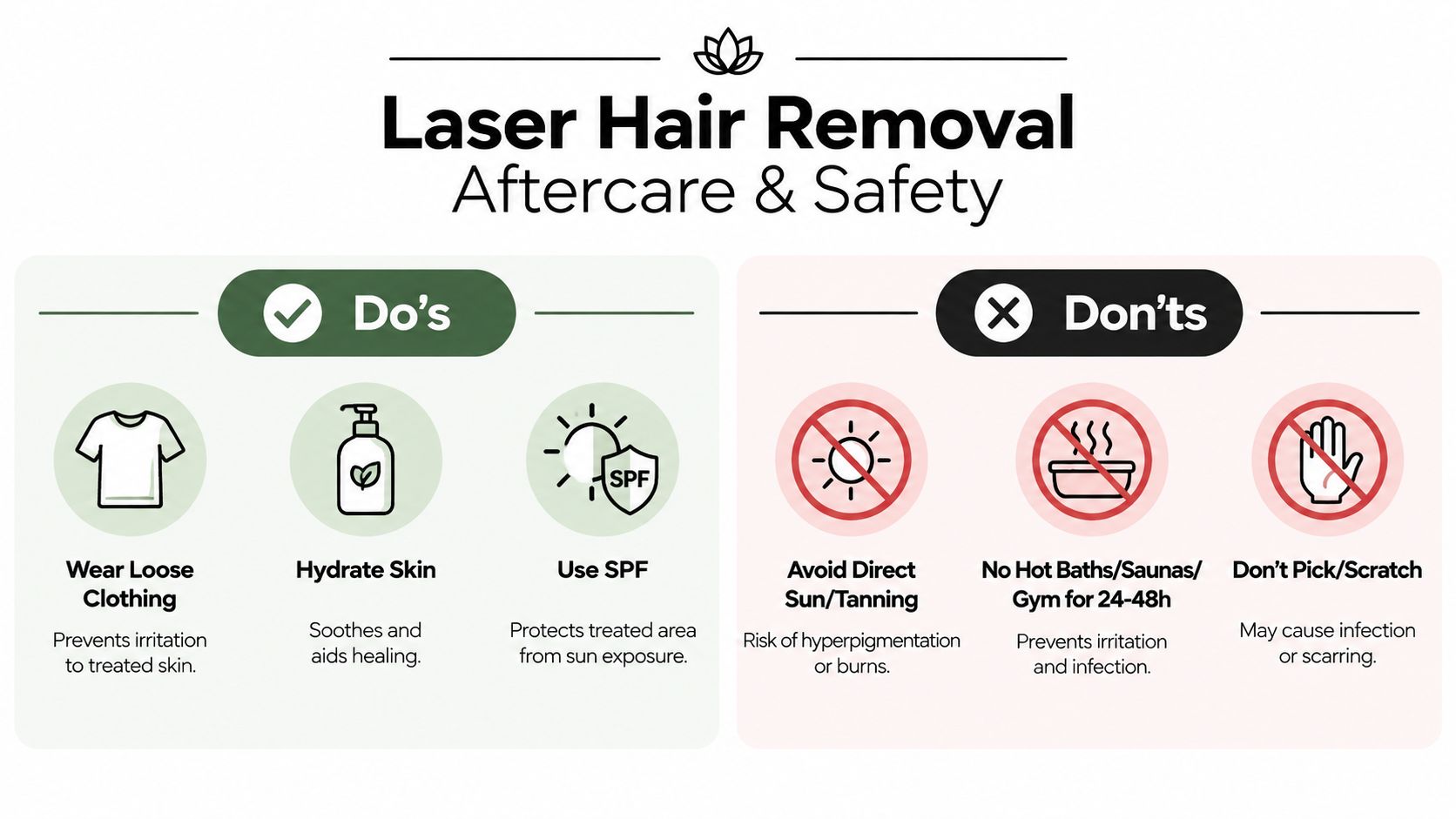
Wear loose clothing: Reduce friction from underwear, seams, and tight garments.
Keep the skin comfortable: Use only the soothing product recommended by your provider, and avoid picking or scratching.
Limit heat and sweat: Avoid hot baths, saunas, and strenuous exercise for the period your clinic advises.
Protect exposed skin from sunlight: Sun exposure can raise the risk of unwanted color changes, so use appropriate sun protection when the area could be exposed.
Temporary redness, warmth, mild swelling, or sensitivity can occur. More concerning reactions include blistering, crusting, pronounced pain, pigmentary change, burns, and, in rare cases, scarring or tissue changes. Pubic and genital skin has a higher technical risk of dyspigmentation, especially in darker skin, so wavelength selection and conservative settings matter.
The NYCLASER guide to laser treatment side effects provides additional context, but contact the clinic promptly if pain intensifies, blisters develop, the skin becomes increasingly swollen, or you see a reaction that doesn't match the instructions you received.
If a burn is suspected, don't apply random household products or break blisters. A practical resource such as the BIOVELVET™ burn care guide can help you understand immediate first-aid principles while you seek appropriate medical advice.
Sexual-health questions
Pubic hair removal and genital skin health deserve a direct conversation. Frequent pubic hair removal has been associated with irritation and infections such as folliculitis, while incorrectly performed laser treatment can cause burns or pigment changes. A clinical study of 809 women reported a positive association between a history of laser hair removal and HPV positivity, with an odds ratio of 4.353 and a 95% confidence interval of 3.157 to 5.989, but the authors emphasized that larger studies are needed before causal conclusions can be drawn. Review the study and its limitations
Don't treat over active sores, unexplained lesions, or significant inflammation without medical guidance. Tell the provider about symptoms before the appointment, and remember that laser hair removal isn't a treatment for HPV or other infections.
Planning Your Treatment at NYCLASER
Choosing a provider for laser hair removal for the pubic area means evaluating more than the booking price. Ask which device is used, whether the clinic can treat your skin tone safely, how the provider defines each treatment area, and what happens if your skin shows an unexpected response.
NYCLASER uses Splendor X, a dual-wavelength platform combining Alexandrite and Nd:YAG energy. The clinic offers single sessions as well as 3-session and 6-session packages, allowing clients to plan a course of treatment instead of treating each appointment as an isolated purchase. Package value depends on the treatment area and the clinic's current pricing, so confirm the exact cost and coverage before booking.

What to bring to your consultation
Bring a list of medications and topical products, details about recent tanning or self-tanner, and a clear idea of whether you want bikini line, full bikini, or Brazilian coverage. You can also ask about test spots, cooling, expected shedding, maintenance, and the clinic's approach to darker skin tones.
The Westbury location at 355 Post Avenue, Suite 101, Westbury, NY 11590, serves Long Island and Nassau County clients. Business hours are Monday through Saturday, 10 a.m. to 6 p.m., and online booking is available through the clinic.
A consultation should leave you with a defined treatment area, a realistic reduction goal, preparation instructions, and a plan for managing side effects. If the provider promises complete permanent removal or dismisses your questions about pigment risk, seek a more careful assessment.
For a visual introduction to the treatment experience, watch the clinic's video after reviewing your consultation questions.
NYC Laser Hair Removal offers personalized bikini, full bikini, and Brazilian laser treatments with Splendor X's Alexandrite and Nd:YAG wavelengths for skin-tone-conscious care. Visit NYC Laser Hair Removal to review treatment options, compare session packages, and book a consultation at the Westbury location.
Comments