
Laser Hair Removal Feet and Toes: What to Expect
“It's a tiny area, so laser should be quick and easy” is common advice about foot hair. The appointment may be short, but small doesn't mean simple. Coarse hairs near the ankle, fine hairs across the foot and isolated toe hairs aren't equally useful targets.
Laser hair removal for feet and toes works best when you match the treatment to the hair that's there. Before committing to a series, you need to know which zones are worth treating, how your skin tone affects safety and what the full plan will cost, not just the first visit.
Feet and Toe Areas at a Glance
Your feet aren't one uniform treatment zone. A practitioner needs to distinguish the top of the foot, the ankle-to-toe area and individual toe surfaces before deciding where to place each pulse.
Feet and toe zones by hair type and ease of treatment
Area | Typical hair | Ease of treatment | Notes |
|---|---|---|---|
Top of the foot | Fine to medium, often sparse | Moderate | Hair is usually easier to reach at skin level |
Ankle to toe, full foot | Coarser near the ankle, finer toward the toes | Moderate | Often planned as one zone with mixed targets |
Individual toes | Fine, light or irregular | Harder | Small targets with weak contrast need careful settings |
Toe joints and knuckles | Uneven thickness, often fine | Harder | Bony surfaces need even contact for good coverage |
Soles | Little or no terminal hair | Not applicable | Usually not treated |
The top of the foot usually offers the most accessible treatment surface. A toe joint presents a different task: the skin curves over bone, and the practitioner must maintain appropriate contact without treating surrounding skin unnecessarily.
Define what full foot means
A full-foot request should identify whether you mean the ankle transition, the top of the foot, all toes or selected toe joints. Don't assume a provider's feet category automatically includes every surface.
For a broader introduction to reducing grooming effort, ProMD Health's resource on smooth skin without daily shaving provides context for considering laser rather than repeated surface hair removal. Your actual treatment map still needs an individual assessment.
Before your consultation, write down the zones that bother you and leave out areas you don't want changed. That list helps establish appointment scope, coverage and reasonable expectations, although hair biology, not surface area alone, determines the series.
How Laser Targets Foot Hair Growth
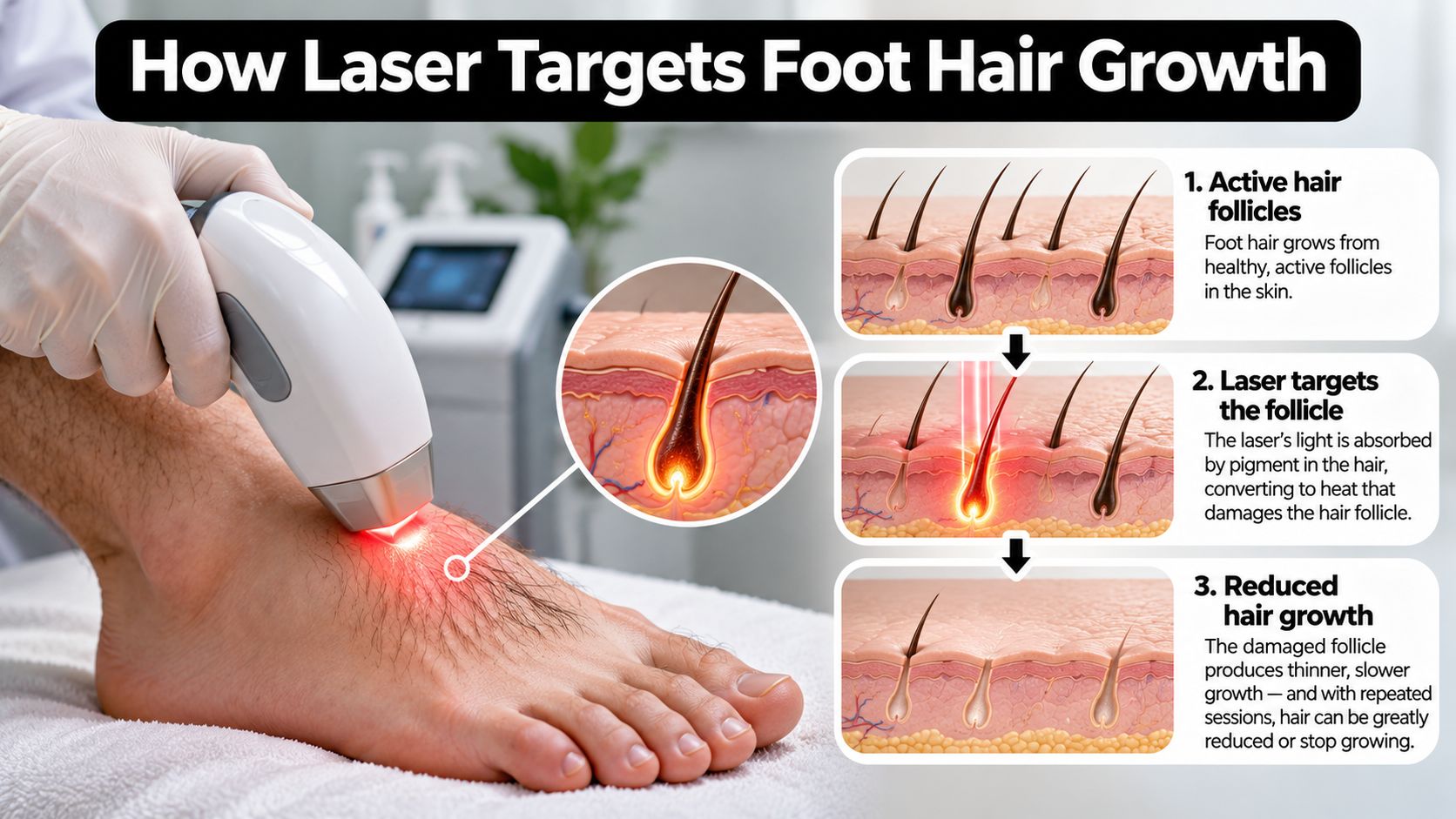
Say you have a visible patch of dark hair across your foot, but only scattered hairs on your toes. A laser pulse doesn't treat every follicle equally just because it passes over the entire patch. Think of a sprinkler that reaches only the plants standing upright: timing determines which targets receive the useful effect.
Laser light is absorbed by melanin, the pigment in hair. The resulting heat can damage follicular structures enough to slow or reduce future growth, while the practitioner uses suitable settings and cooling to protect surrounding skin.
Why the hair cycle matters
During anagen, the active-growth phase, the pigmented hair is closely connected to the structures the treatment needs to affect. This is the most useful treatment window.
Hair then passes through a transition before entering telogen, the resting phase. Resting follicles aren't equally responsive, even when you can still see a hair above the skin.
Shedding eventually releases the old hair. These stages don't happen simultaneously across your foot, so neighboring hairs can be at different points in their cycles.
Hair responds best when it's actively growing, not simply because it's visible.
A newly appearing toe hair after treatment therefore doesn't automatically mean that a previously treated follicle recovered. It may be a hair that wasn't an effective target at the earlier appointment.
What improvement actually means
The appropriate expectation is permanent hair reduction, not a guarantee that every hair will disappear forever. The historical clinical overview collected by Quackwatch explains this distinction and describes outcomes ranging from slowed growth and pigment loss to follicle elimination.
Look for a sustained change in how much hair grows and how often you need to manage it. A smooth-looking foot immediately after shaving isn't evidence of laser success, and visible hair soon after treatment isn't enough to judge failure. Meaningful assessment requires observing regrowth across the treatment series.
Who Is a Good Candidate and How Skin Tone Changes Settings
Dark, coarse hair against lighter skin gives a laser a clear pigment target. But contrast isn't the same as eligibility: people with darker skin can be candidates when the practitioner selects an appropriate wavelength, pulse duration and cooling approach.
Candidate fit by hair and skin case
Case | Likely fit | What to do first |
|---|---|---|
Light skin with dark, coarse hair | Good | Book a consultation and plan a full series |
Medium skin with dark hair | Good with adjusted settings | Ask for a test spot before the first full session |
Light, grey or very pale hair | Poor | Consider electrolysis or trimming instead |
Sparse, fine toe hair | Unpredictable | Weigh trimming against a limited trial before buying a series |
Pregnancy | Not recommended | Postpone treatment until after pregnancy |
At our initial consultation, experienced professionals assess your skin type and hair color to create a personalized treatment plan. Laser hair removal treatments aren't recommended for pregnant clients.
Darker skin needs a different safety calculation
Skin pigment can absorb energy intended for hair. On sun-exposed feet and bony toe surfaces, the practitioner must assess both the hair target and the skin receiving the pulse.
A review in Aesthetic Surgery Journal reported pigmentary alterations as high as 19% with shorter-wavelength systems, particularly in darker skin types, compared with approximately 2–3% for Nd:YAG treatment. Those figures describe reviewed treatment settings and populations, not your personal risk or a foot-specific prediction.
Published device settings aren't recipes to copy. Fluence, which describes delivered energy per area, works together with pulse duration, spot size, wavelength and cooling. A qualified practitioner should consider a test spot and inspect curved toe surfaces for consistent contact.
Our guide to choosing a laser for hair removal can help you understand the device discussion. A brand name alone doesn't explain whether the proposed treatment suits your complexion.
Sparse hair deserves a separate decision
A clinical study in Lasers in Surgery and Medicine1096-9101(2000)26:1%3C33::AID-LSM6%3E3.0.CO;2-K) found greater hair loss at sites with a higher proportion of actively growing hairs, while the immediate effect on resting hairs was minimal. A tiny treatment area therefore doesn't make weak, fine targets more responsive.
Rarely, laser or light treatment can produce paradoxical hypertrichosis, meaning increased hair growth rather than reduction. A review in Dermatologic Surgery identifies darker skin types, dark coarse hair and hormonal conditions as relevant risk contexts; it doesn't establish a foot-specific risk rate.
For isolated pale toe hairs, trimming may be more proportionate. Electrolysis is another option to discuss when pigment is insufficient for laser targeting.
Bring these details to your assessment:
Hair appearance: Note whether the hairs are coarse, fine, dark or pale.
Skin changes: Disclose recent tanning, self-tanner and irritation.
Health history: List medications, skin conditions and hormonal concerns, including PCOS.
Session Count and Spacing Over Time
Expect a series rather than a single appointment. Laser Clinics United Kingdom states that feet-and-toes treatment typically requires 8–12 treatments for long-lasting results. That's a clinic's planning benchmark, not a guaranteed requirement for every person.
A useful timeline follows what you can observe, rather than promising smooth feet by a fixed date.
From baseline to maintenance
Baseline appointment: The practitioner records the treatment boundaries and starting hair pattern. Clear photographs can make later comparisons more meaningful.
Early sessions: Watch for shedding and changes in regrowth rather than judging the result immediately after treatment.
Middle sessions: The practitioner reassesses remaining targets. Coarse hairs and faint residual hairs may no longer justify identical treatment decisions.
Maintenance: If useful targets return, an additional appointment may be appropriate. Maintenance should reflect actual regrowth rather than an automatic calendar commitment.
Say your ankle hair returns clearly while your toe hair remains sparse. The sensible response isn't necessarily to treat both again immediately. Your practitioner should assess whether each zone has enough suitable regrowth to justify another session.
Our explanation of how long to leave between laser hair removal treatments helps frame that conversation. Shorter gaps don't automatically produce faster progress, and longer gaps aren't automatically a mistake for slow-growing toe hair.
Make each appointment useful
A visit generally involves checking the skin, confirming the treatment map, using protective eyewear and delivering pulses with appropriate cooling. You may feel a brief hot pinch or snapping sensation; tell the practitioner if discomfort becomes unexpectedly intense.
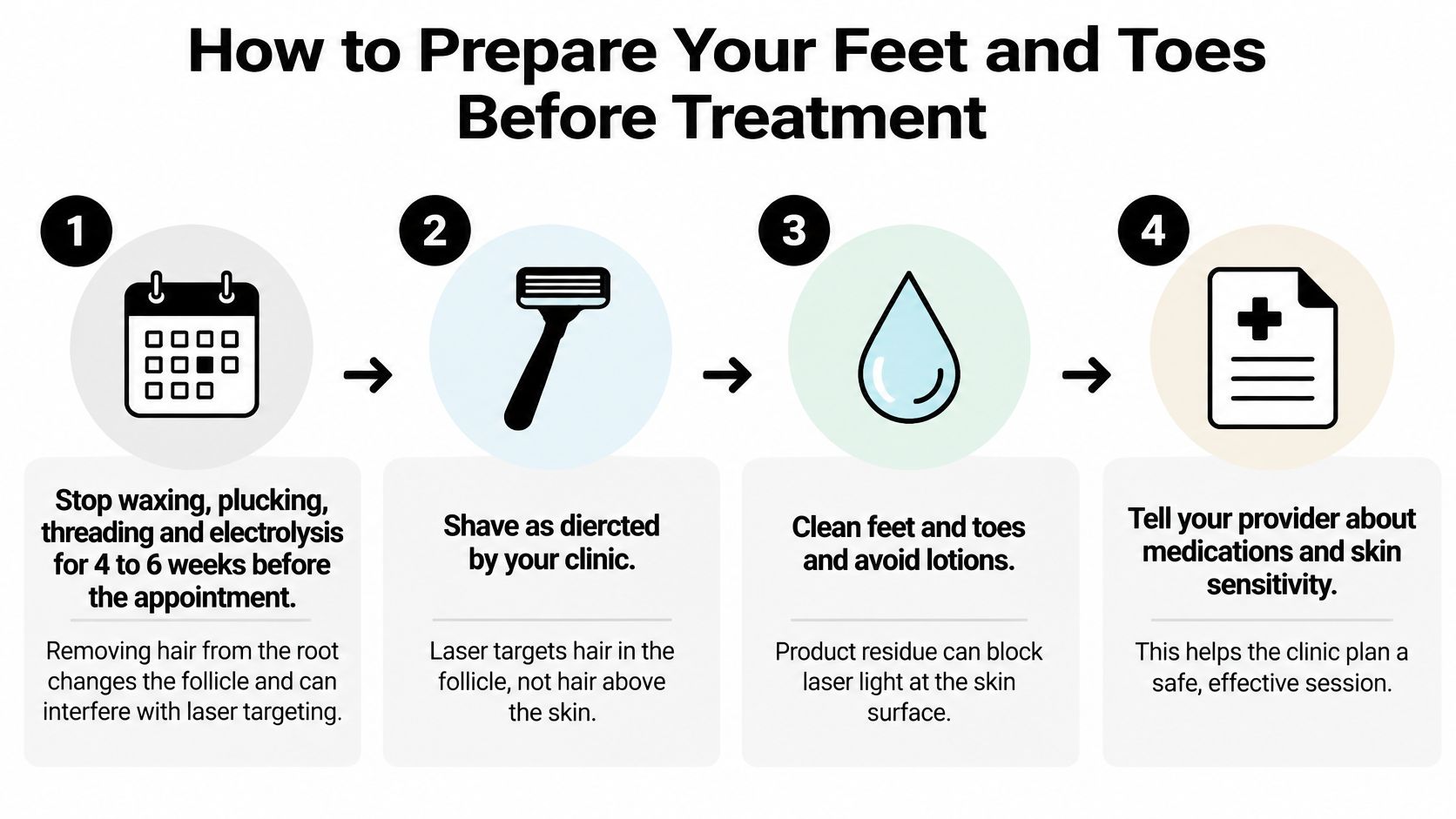
Preparation also determines whether an appointment can proceed. Use this visual reminder alongside your clinic's individual instructions.
Between visits, photograph regrowth under similar lighting before shaving. Record which zones need grooming again and whether the remaining hairs are finer. Those observations give the practitioner something more useful than “I think it's working.”
How to Prepare Your Feet and Toes Before Treatment
Preparation should preserve the hair target while keeping the skin calm and easy to assess. Don't combine several hair-removal methods just before your appointment in an effort to arrive extra smooth.
Follow the preparation sequence
Stop removing hair from the root. Our instructions require avoiding waxing, plucking, threading and electrolysis for 4–6 weeks before treatment. These methods remove or disrupt the pigmented hair target; they don't just shorten it.
Keep the area out of the sun. We require avoiding sun exposure for 2 weeks before treatment. Remember that sandals expose the tops of your feet even when the rest of your legs are covered, and disclose any recent tanning or self-tanner.
Shave to skin level as directed. We need the treatment area shaved to skin level, although a day's growth may help identify the boundaries. Confirm the timing in your appointment instructions rather than deliberately leaving long hairs, especially around toe joints where shaving can be awkward.
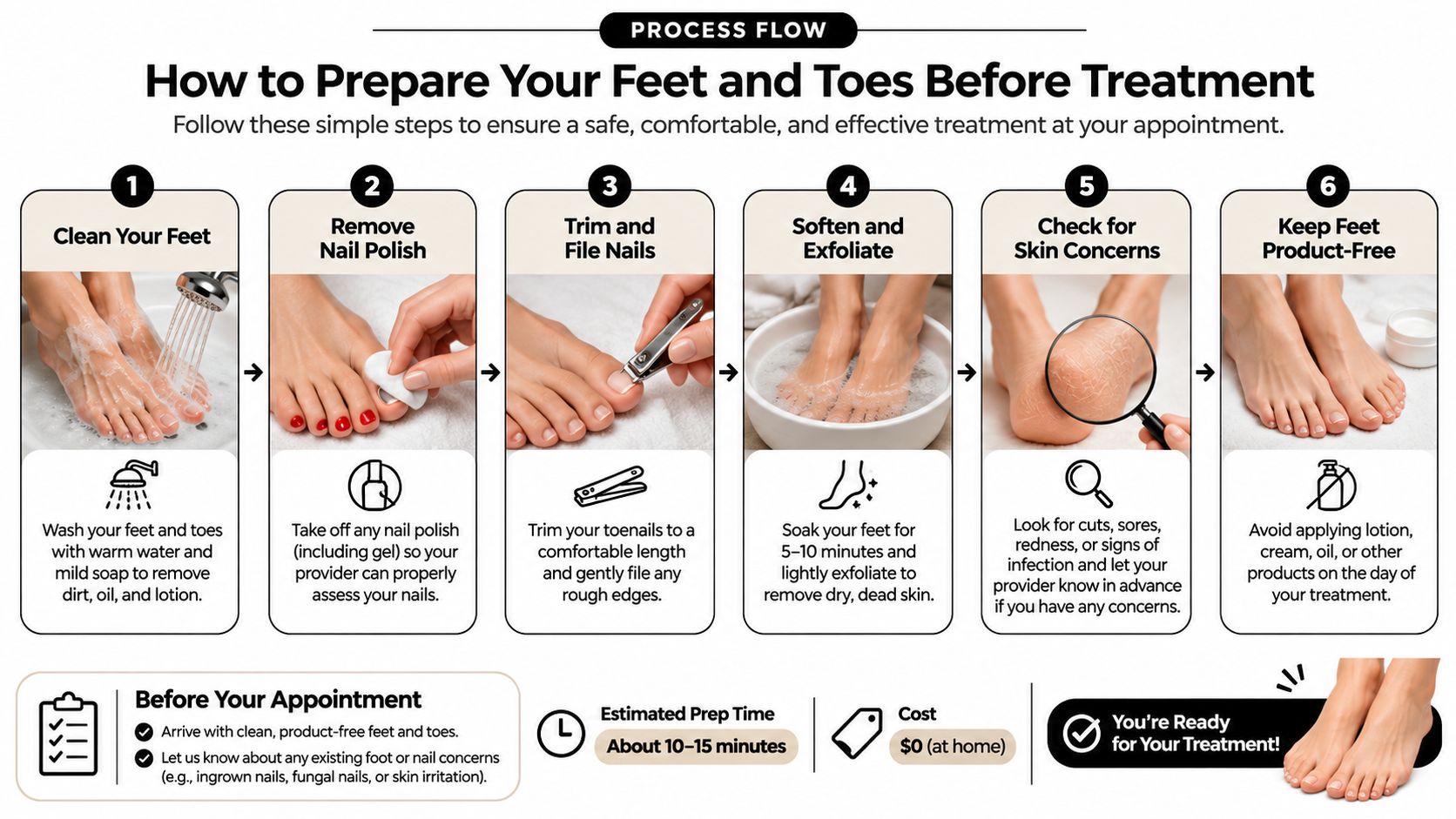
Wash thoroughly and remove surface products. Our preparation instructions require the area to be fully washed and free of makeup and medication. Clean between the toes, remove lotion and tell us about prescribed topical treatments rather than independently stopping medication; ask whether nail polish removal is necessary for your planned coverage.
Don't start lightening products on your own. A skin-lightening cream such as hydroquinone may sometimes be considered 4–6 weeks beforehand, but only after consultation with a technician. It isn't a routine purchase every client needs, and irritated skin isn't a better treatment surface.
Arrive clean and dry with your medication list. Include prescriptions, over-the-counter products and active skin conditions. Mention cuts, rashes, athlete's foot symptoms or a recent reaction so the practitioner can decide whether the skin is ready.
Keep alternatives separate from laser preparation
If you're comparing temporary options, Vitamin Planet's listing for men's hair removal cream 200ml provides product information to review. A depilatory isn't a substitute for your clinic's shaving instructions, and you shouldn't apply it to recently treated or irritated skin without professional guidance.
Check every step against your appointment reminder. If you've waxed, tanned or developed irritation, contact the clinic before traveling rather than hoping it won't affect treatment.
Aftercare and Normal Reactions in the Days After
Our stated downtime is typically none, but that doesn't mean the skin will always look or feel unchanged. Returning to your day and protecting a temporarily sensitive treatment area are compatible.
Brief redness around individual follicles, mild warmth and slight swelling can be expected reactions. The important distinction is whether symptoms settle or become more pronounced.
Normal reactions versus warning signs
More consistent with an expected reaction | Needs clinical advice |
|---|---|
Mild redness centered around follicles | Blisters or broken skin |
Slight warmth that settles | Pain that increases |
Temporary tenderness | Crusting or a spreading irritated patch |
Gradual release of treated hairs | Noticeable new darkening or lightening of the skin |
The StatPearls clinical reference on laser hair removal identifies pigment changes, blistering, crusting and scarring among potential complications. Don't dismiss those changes as necessary evidence that the laser worked.
Reduce heat and rubbing
Use a cool compress if the area feels warm, and choose a gentle, fragrance-free moisturizer if advised. Avoid hot baths, saunas and direct heat while the skin remains sensitive.
Footwear deserves particular attention. A tight shoe tongue can rub the top of the foot, while a toe seam or snug athletic sock can repeatedly press on a treated joint. Choose clean, comfortable footwear that doesn't scrape the area, and postpone activities that cause rubbing if the skin is still tender.
Leave shedding hairs alone: Don't pluck or scrub them out.
Protect exposed feet: Keep treated skin out of direct sun and avoid self-tanner until it has settled.
Follow your individual instructions: Our aftercare instructions provide a reference for looking after treated skin.
Safety check: Increasing pain, blistering or a clear pigment change deserves a call to the clinic, not a wait until your next session.
If a reaction concerns you, take a clear photograph and describe when it started. Seek prompt medical assessment for severe pain or substantial skin injury.
What Feet and Toe Treatment Costs
A low advertised price can mean very different work. One quote may cover the top of the foot only, while another may include the toes, toe joints and ankle transition. Use the listed price as a starting point, then match the same treatment boundaries and payment basis before judging value.
Feet and toe treatment prices listed in 2026
Provider | Service | Listed price | Basis |
|---|---|---|---|
Feet and toes, 10-minute appointment | $35 | Per appointment, listed in 2026 | |
Feet, one session | $29, reduced from $55 | Promotional per-session price, listed in 2026 | |
Toes, one session | $29, reduced from $39 | Promotional per-session price, listed in 2026 | |
Professional feet | From $119; $595 for a six-treatment package | Session and package prices, listed in 2026 | |
NYC Laser | Feet, hands and other Small Areas | $25.00 | Small Areas service |
At NYC Laser, the $25.00 Small Areas service covers feet, along with the lip, chin, sideburns, cheeks, ears, areola, hands and happy trail. That makes the price useful for a client treating feet as part of a smaller zone plan, but it still pays to confirm whether the selected toe and ankle boundaries are included before booking.
Compare the full commitment
Ask for a written estimate based on the recommended series, including any consultation, test-spot or maintenance charges. A package works like a prepaid route map: it only saves money if the route includes the stops you want. Check that the toe line, foot surface and ankle transition match the quote, especially when fine hairs are spread across several small zones.
For wider market context, Yoyime Clinic's laser hair removal prices dubai resource can be viewed as a separate-market reference. Currency, treatment boundaries and package terms need checking before comparing offers across markets.
Budget rule: Compare the expected course of care, not the cheapest first appointment.
Promotions can change. Confirm the current price, expiry terms and whether unused package appointments are refundable before paying.
Confirm Your Plan Before You Book
Start with the outcome you want. Reducing a dark patch across the foot is a different request from removing isolated hairs on selected toes, and you don't have to treat everything because it's available.
Bring your zone list and, if you've already shaved, a clear photograph showing the usual hair pattern. Our consultation assesses skin type and hair color so the proposed plan starts with your targets rather than a standard promise.
Take this checklist to the consultation
Target suitability: Which hairs are likely to respond, and which are too fine or pale to justify treatment?
Skin safety: Why does the proposed wavelength suit your complexion, and is a test spot appropriate?
Appointment timing: What regrowth should be present before returning?
Coverage: Does the quote include the toes, toe joints and ankle transition you selected?
Financial terms: What's included, and what could cost extra?
Aftercare: What changes to footwear, exercise or skin products will you need?
Compare providers on the clarity of those answers, not just the advertised price. A practitioner who can't explain the treatment boundaries or safety decisions hasn't given you enough information to commit.
Our specialist Tamar has over 17 years of experience as a laser hair removal specialist. To arrange a consultation, call 516-321-4959 or email INFO@NYCLASER.COM.
Book the first treatment once the assessment supports it, then agree on follow-up timing based on your response. You should leave knowing what will be treated, what improvement is realistic and when the plan will be reassessed.
NYC Laser Hair Removal offers personalized foot hair reduction using Splendor X technology at our Westbury clinic. Visit NYC Laser Hair Removal to arrange a consultation and discuss whether your foot and toe hair is a suitable target before committing to a series.
Comments