
How to Remove Leg Hair Permanently a Realistic Guide
If you're reading this, you're probably done with the whole shaving-waxing-ingrown-hair cycle. You're looking for something that actually lasts, a real solution for smooth legs without the constant upkeep.
The good news? Achieving that kind of lasting smoothness is more accessible than ever. But let's cut through the noise. To truly get rid of leg hair for good, you have to go after the hair follicle itself.
That means looking beyond temporary fixes and focusing on the only two methods proven to work long-term: laser hair removal and electrolysis.
Tired of Shaving and Waxing? Here’s What Actually Works
This guide is all about those two clinically-proven methods. These aren't just small upgrades from your razor; they're a total shift in how you deal with unwanted hair. We'll get into the real science and practical steps behind the kind of smoothness you've been looking for.

Beyond Temporary Solutions
The desire for a permanent solution comes from a simple truth: the temporary methods are a relentless chore. Shaving lasts a day or two and often comes with razor burn and nicks. Waxing gives you a few weeks of freedom but it’s painful and a leading cause of bumps and ingrown hairs. And those depilatory creams? Quick, yes, but often loaded with harsh chemicals that can irritate sensitive skin.
What sets professional treatments apart is their strategy. Instead of just cutting or ripping hair out, they shut down the factory—the follicle.
Laser Hair Removal: This method uses a concentrated beam of light that gets absorbed by the pigment (melanin) in your hair. That light energy converts to heat, which damages the follicle and makes it unable to grow new hair.
Electrolysis: This technique is more direct. A tiny, fine probe is inserted into each individual hair follicle, delivering a small electrical current that destroys the growth center on contact.
The official goal here is permanent hair reduction. The FDA defines this as a long-term, stable drop in the number of hairs that regrow after treatment. For most people, this means a 70-90% permanent reduction in hair. That's a game-changer.
A New Era of Hair Removal Technology
Modern tech has made these treatments faster, more comfortable, and effective for way more people. For example, advanced systems like the Splendor X laser are revolutionary because they blend two different laser wavelengths. This allows us to safely and effectively treat a much wider range of skin tones—a major hurdle with older lasers.
This innovation has opened the door for so many more people to finally get a real, lasting answer for smooth, hair-free legs. It’s time to forget the daily hassle and dive into the treatments that deliver.
Laser Hair Removal vs. Electrolysis for Legs
When you're ready to ditch the razor for good, the conversation really boils down to two heavy hitters: laser hair removal and electrolysis. Both are designed to permanently disable the hair follicle so it can't grow back, but they get there in completely different ways. Figuring out which path is right for you is all about understanding their unique strengths.
Laser hair removal uses a concentrated beam of light that's absorbed by the pigment (melanin) in your hair. That light converts to heat, which strategically damages the follicle. It’s a game of coverage—a single pulse can treat dozens of hairs at once, making it incredibly efficient for large areas like the legs.
Electrolysis, on the other hand, is all about precision. A technician inserts a sterile, hair-thin probe directly into a single hair follicle. This probe delivers a tiny electrical current that destroys the follicle’s growth center, guaranteeing that specific hair will never return.
To help you choose the best path for your legs, let's break down how these two leading methods stack up against each other.
Laser Hair Removal vs Electrolysis At a Glance
Feature | Laser Hair Removal (with Splendor X) | Electrolysis |
|---|---|---|
Best For | Large areas like full legs, underarms, and back. Great for widespread hair reduction. | Small, targeted areas (like eyebrows), finishing touches, or treating light-colored hairs. |
Treatment Time | Extremely fast. A full leg session takes about 20-40 minutes. | Very slow. Each hair is treated individually; legs can take hundreds of hours. |
How It Works | Light energy is absorbed by hair pigment, heating and disabling the follicle. | A fine probe delivers an electrical current directly into the follicle. |
Ideal Candidate | Works on a wide range of skin tones with dark hair. Splendor X technology is safe for darker skin. | Works on all skin tones and all hair colors, including blonde, white, gray, and red. |
Sensation | Feels like a quick snap of a rubber band. Advanced cooling systems enhance comfort. | A brief sting or heat sensation with each probe insertion. Can become tedious over a large area. |
Cost-Effectiveness | More cost-effective for large areas. Higher per-session cost but requires far fewer sessions. | Billed by time (e.g., 15-minute increments). Total cost for legs can be significantly higher. |
While both methods deliver permanent results, the right choice for legs often comes down to balancing speed, cost, and your specific hair color. For most people looking to treat their full legs, laser is the clear winner for its unmatched efficiency.
Speed and Efficiency: No Contest
When you’re talking about an area as large as your legs, speed is everything. This is where laser hair removal really pulls ahead.
Modern systems like the Splendor X use a large spot size to cover a ton of ground, fast. We can treat both of your full legs in as little as 20 to 40 minutes. Because it zaps multiple follicles at once, you get widespread results in an appointment you can actually fit into your lunch break.
Electrolysis is, by nature, a much more methodical process. Since every single follicle has to be treated one by one, tackling both legs is a massive time commitment. You'd be looking at countless sessions stretched out over a very long period. It’s incredibly precise, but it just wasn't designed for clearing large areas quickly.
For legs, the efficiency of laser treatment is a game-changer. The ability to treat such a large area in under an hour makes it the most practical and realistic choice for anyone with a busy schedule.
Finding Your Perfect Match: Skin Tone and Hair Color
Your unique combination of skin and hair is a huge factor in deciding which method will work best for you. Historically, laser hair removal was most successful for people with light skin and dark hair. The laser needs that contrast to "see" the pigment in the follicle.
But technology has come a long way. The Splendor X system is a perfect example, blending two different wavelengths (Alexandrite and Nd:YAG) to safely and effectively treat a much broader range of skin tones, including darker complexions.
Still, laser has its limits. It struggles with hair that doesn't have much pigment—think blonde, white, gray, or very light red hair. This is where electrolysis shines.
Electrolysis: is effective on any hair color and any skin tone. Because it targets the follicle directly with electricity instead of relying on pigment, it’s the only method that’s FDA-approved for permanent removal of all hair types. Lasers simply can't see those lighter hairs.
This is a critical distinction. If you have a mix of dark and light hairs on your legs, some clients opt for a hybrid approach—using laser to clear the majority of dark hairs and then using electrolysis for the final clean-up. The world of light-based treatments can also get confusing, but you can learn the real difference between IPL and laser hair removal in our guide.
Comparing Comfort and Cost
Let's talk about what the treatments actually feel like. Most clients describe laser on the legs as a series of quick snaps, almost like a rubber band flicking against the skin. It’s a fleeting feeling, and advanced devices like the Splendor X have a built-in cooling system that blasts chilled air onto the skin to keep you comfortable the entire time.
With electrolysis, you'll feel a brief sting or heat sensation as the current is applied through the probe. While it's definitely tolerable, the idea of repeating that process one follicle at a time across both legs can be a bit daunting and uncomfortable over the long haul.
Financially, laser hair removal almost always comes out on top for large areas. While the cost per session is higher, you need significantly fewer sessions to get the job done. Electrolysis is usually billed by the minute or hour, and the sheer number of hours required to treat a person's legs would add up to a much larger total investment.
The demand for these long-term solutions is soaring. The global laser hair removal market is projected to grow from USD 1.42 billion in 2025 to USD 4.60 billion by 2032. Here in the U.S., procedures jumped 25% after 2020. Legs remain a top treatment area for both women (45%) and men (30%), proving that more and more people are choosing a permanent solution over temporary fixes.
Your Laser Hair Removal Journey From Start to Finish
Deciding to go for laser hair removal on your legs is a big move, but it’s a lot less intimidating when you know exactly what the process looks like. Understanding the full picture—from the first chat with a technician to your final session and beyond—takes all the guesswork out of it. This isn't just about zapping hair; it's a carefully planned journey designed for incredible results.
It all starts well before a laser ever touches your skin. The entire experience is built around a plan customized just for you, factoring in your specific skin and hair type. Think of it as a strategic roadmap to permanently smooth legs.
The Initial Consultation: A Custom Roadmap
Your journey kicks off with a consultation. This is your time to lay out your goals, ask every question you can think of, and have a trained technician really assess if this treatment is right for you. They’ll take a close look at your leg hair—its color, its thickness—and evaluate your skin tone, often using something like the Fitzpatrick scale.
This step is critical. Laser hair removal works by targeting the melanin (the pigment) in your hair follicles. While advanced systems like Splendor X are fantastic and safe for a huge range of skin tones, a professional evaluation is the only way to ensure the settings are dialed in perfectly for you. By the end of this meeting, you'll walk away with a clear, personalized treatment plan, including how many sessions you'll likely need and how far apart to space them.
Preparing for Your First Session
Once your plan is locked in, it's time to prep. The steps are simple but absolutely essential for a safe, effective treatment. Your technician will give you a specific checklist to follow in the days and weeks before you come in.
These pre-treatment rules usually include:
Avoiding Sun Exposure: You’ll need to keep your legs out of the sun and away from tanning beds for at least two weeks before your appointment. A tan darkens your skin, which can confuse the laser and raise the risk of side effects.
Pausing Certain Hair Removal Methods: Stop waxing, plucking, or using any depilatory creams on your legs for at least four weeks beforehand. These methods pull the hair out from the root, but the laser needs that hair shaft intact to work its magic.
Shaving the Day Before: You'll be asked to shave your legs 24 hours before you come in. This gets the hair off the surface (so it doesn't get singed) but leaves the follicle right where the laser needs to find it.
What Happens During a Laser Session
On treatment day, you’ll find the session is surprisingly fast. After getting you settled, the technician will clean your legs and might apply a cooling gel. You'll get some protective eyewear, and then they’ll do a few test spots to make sure the laser settings feel comfortable and are working correctly for your skin.
Most people describe the sensation as a quick, warm snap, kind of like a rubber band flicking the skin. It's very tolerable, especially on a large area like the legs. Plus, modern machines like the Splendor X have a built-in dual cooling system that blasts chilled air on your skin at the exact same time as the laser pulse, which makes a huge difference in comfort. A full leg session is incredibly efficient and can be done in just 20 to 40 minutes.
So, how does laser compare to other permanent options? This visual breaks down the two heavy hitters.
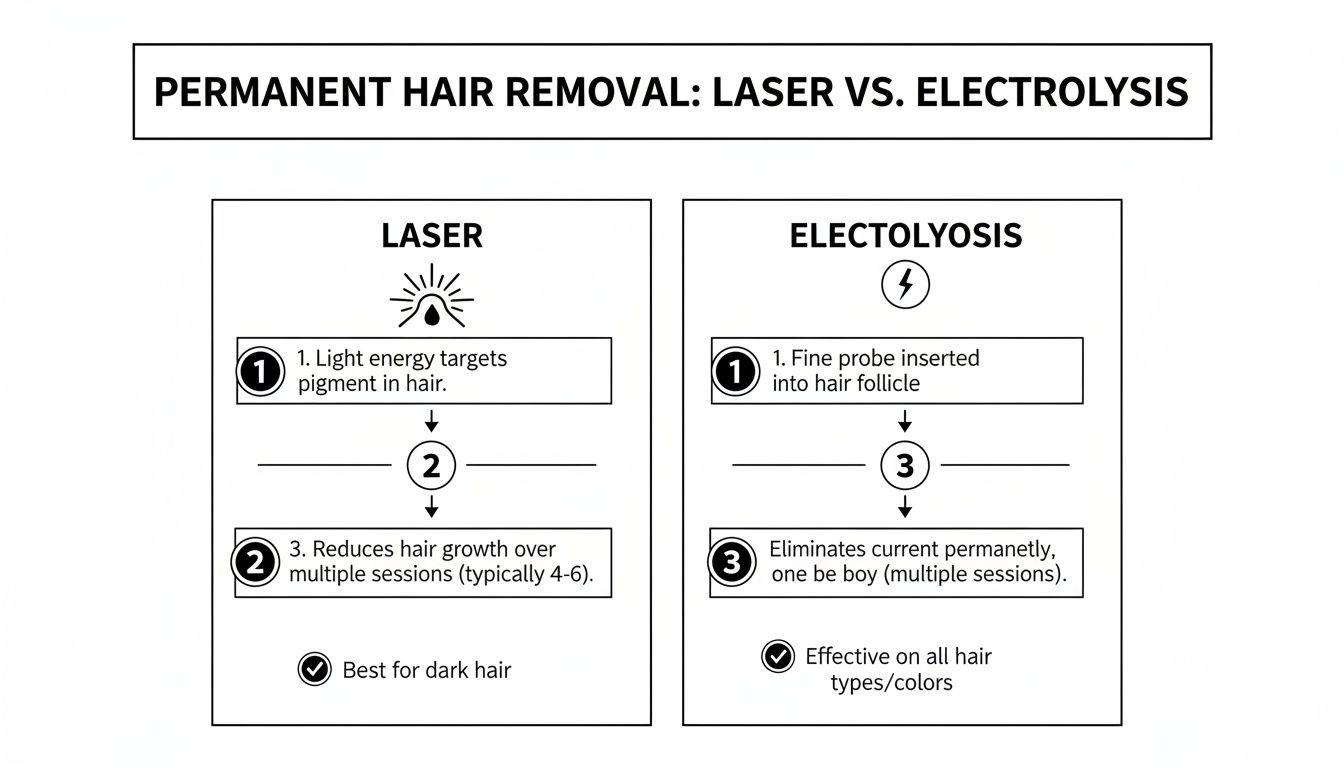
As you can see, laser really shines when it comes to speed and efficiency for big areas, while electrolysis offers pinpoint precision for any hair color.
Aftercare and What to Expect Between Sessions
Right after your session, your legs might look a little red or have some tiny bumps around the hair follicles, a bit like a mild sunburn. This is totally normal and usually calms down within a few hours.
Your technician will give you specific aftercare instructions, but the golden rules are simple: be gentle and keep your skin cool. That means no hot showers, saunas, or intense workouts for the first 24 hours.
Over the next one to three weeks, you'll see what looks like hair growing back. Don't panic! This is actually the treated hairs being pushed out and shed from the follicle—a great sign the treatment is working. Gently exfoliating a few days after your session can help this shedding process along. You can shave between appointments, just remember to keep avoiding waxing or plucking. For a more detailed look at the week-by-week progress, check out our NYC laser hair removal timeline guide.
The proof is in the numbers. Clinics using the latest technology can achieve an 80-95% permanent reduction in leg hair after a series of just 3-8 sessions. It's a low-maintenance solution that people, especially Millennials who now account for 50% of bookings, are actively seeking out.
Could You Be an Ideal Candidate for Laser Hair Removal?
When you start looking into permanent leg hair removal, laser treatment is usually the first stop. But it's not a one-size-fits-all solution. Your success really hinges on a few key factors, and understanding them is the first step toward deciding if this is the right move for you.

The science behind it is actually pretty simple. The laser is designed to find the dark pigment, or melanin, in your hair follicles. That light energy gets absorbed, turns into heat, and essentially disables the follicle's ability to grow new hair. Because of this, the classic "perfect" candidate has always been someone with a strong contrast between their skin and hair color—think light skin and dark, coarse hair. This contrast gives the laser a clear, easy target.
But here's the good news: the old rule that laser hair removal only works for fair skin is officially a myth.
Modern Lasers for Diverse Skin Tones
Technology has come a long way, breaking down those old barriers. The arrival of advanced systems like the Splendor X has been a total game-changer for us and our clients. This machine is brilliant because it blends two different laser wavelengths:
Alexandrite (755nm): This one is incredible for lighter skin tones (Fitzpatrick types I-III). It's super effective because it's strongly absorbed by melanin.
Nd:YAG (1064nm): This is a longer wavelength that safely bypasses the melanin in your skin's surface, making it the gold standard for treating darker skin tones (Fitzpatrick types IV-VI) without risk.
By blending these two, a skilled technician can fine-tune the treatment for just about anyone. It means we can deliver powerful, permanent results without ever compromising the health of your skin.
Key Takeaway: While a good contrast between your skin and hair is still helpful, advanced technology means a darker complexion is no longer an automatic "no." The only way to know for sure is to come in for a professional consultation.
When Laser Hair Removal Might Not Be a Fit
Despite all these incredible advancements, there are still some situations where laser just isn't the right—or safest—choice. It’s so important to be completely open about your health and medical history during your consultation so we can ensure you get a safe, effective outcome.
The dream of ditching the razor has become a reality for millions. The laser hair removal market in North America is projected to hit USD 1.72 billion by 2033, a boom driven by clinics like NYCLASER in Westbury using powerful tech like the Splendor X. For Long Island residents sick of the endless cycle of shaving and waxing—a process that costs the average woman $10,000 over her lifetime—laser offers a real solution with up to 80% less regrowth. Explore more statistics about the laser hair removal market.
Certain factors can unfortunately interfere with the treatment's safety or how well it works.
Important Contraindications to Consider
A few conditions will require you to either postpone or avoid laser treatments altogether. These aren't just suggestions; they're in place to protect your health and make sure you don't have a bad reaction.
Medical and Skin Conditions:
Active Skin Infections: This includes things like cold sores, herpes outbreaks, or any bacterial infection in the area you want treated. The laser can make these issues worse.
Photosensitive Disorders: Conditions like lupus make your skin extremely sensitive to light, which seriously increases the risk of burns or other side effects.
History of Keloid Scarring: If your skin tends to form thick, raised scars, laser treatment could potentially trigger that response.
Medications and Life Stages:
Photosensitizing Medications: Certain antibiotics, acne treatments like Accutane, and even some topical retinoids can make your skin highly reactive to UV light. It's absolutely vital to tell your technician about every single medication you're on.
Pregnancy and Breastfeeding: There just isn't enough research on how laser energy affects you during this time. As a safety precaution, all reputable clinics will not perform treatments on pregnant or breastfeeding clients.
Ultimately, being a good candidate is about more than just your skin and hair color. It’s about making sure the treatment aligns with your overall health to get you the best—and safest—results possible.
Understanding the Cost and Long-Term Value
Let's talk about the investment. When you're looking into permanent leg hair removal, the initial price for laser treatments can definitely feel like a big jump from a pack of razors or a monthly wax. But thinking of it as a one-time hit to your wallet is the wrong way to look at it.
This is a long-term investment in your time, your comfort, and your confidence. You're not just paying to get rid of hair; you're buying back years of freedom from the daily chore of shaving and the endless cycle of paying for temporary fixes.
Breaking Down the Pricing Structure
When you start exploring options for your legs, you'll quickly notice that clinics almost always offer packages. This isn't just a clever marketing trick—it’s a practical approach that's based on the science of how your hair actually grows. A single session can't possibly zap every single hair follicle, so a series of treatments is the only way to get that lasting, silky-smooth result.
Most clinics will price things in two main ways:
Pay-Per-Session: This gives you flexibility, but it almost always ends up being the more expensive route if you're starting from scratch. It’s really best if you just need a single touch-up treatment years down the line.
Package Deals: Buying a series of 6 to 8 sessions upfront is the standard and, by far, the most cost-effective way to go. Clinics give a pretty significant discount on these bundles because they know that's what it takes to deliver genuine, permanent hair reduction.
Think of it like a gym membership. Paying for a full year is a bigger initial expense than a single day pass, but the per-visit cost plummets, making it a much smarter financial move if you're serious about the goal.
The True Value Beyond the Price Tag
The real return on your investment here isn't just about the money. You have to consider the hidden costs of your current routine. It's estimated that the average woman can spend over $10,000 on shaving products in her lifetime. If you're a regular at the waxing salon, that number climbs even higher.
But the value goes way beyond your bank account. Imagine all the time you'll save every single week by just eliminating shaving. Picture the end of painful ingrown hairs, irritating razor burn, and those frantic, last-minute shaves before an unexpected pool day. That kind of freedom and peace of mind is truly invaluable.
The upfront cost of laser hair removal is a trade-off. You're exchanging the endless, small costs of temporary fixes for a one-time investment that delivers a permanent solution.
How to Budget for Your Treatment
Planning for the cost makes the whole process feel so much more manageable. Many clinics—including ours—get that this is a significant purchase and offer options to make it more accessible. Always look for payment plans or financing options that let you spread the cost over several months.
Before you commit, it’s a good idea to do a little research on local pricing. For a clearer picture of what to expect in our area, you can learn more about how much laser hair removal costs in 2024 in our detailed guide. When you start to see the cost as a strategic investment, it becomes obvious why millions of people find the long-term results to be completely worth it.
Your Leg Hair Removal Questions, Answered
Even with all the info, it's totally normal to have a few more questions before you commit. Making the right decision for your body is everything, so we’ve rounded up the most common questions we hear from our clients right here in our Westbury clinic.
Here are the straightforward, expert answers you're looking for.
Is Laser Hair Removal on My Legs Really Permanent?
This is the big one, and the answer is all in the wording. The FDA has cleared laser hair removal for "permanent hair reduction," not 100% removal. What does that actually mean for you? A huge, lasting decrease in hair—most of our clients see a 70-90% reduction after their full course of treatments.
The follicles we successfully zap are gone for good; they won't grow hair again. But our bodies are dynamic. Hormonal shifts down the road (think pregnancy or menopause) can sometimes wake up dormant follicles, leading to a few new, fine hairs.
For the vast majority of people, this translates to years of incredible smoothness. You might just need a quick touch-up session every year or two to keep things absolutely perfect. It is, hands down, the best long-term solution out there.
How Much Does Laser Hair Removal Hurt on the Legs?
Everyone's pain threshold is different, but the consensus is that laser on the legs is very manageable. Most people describe it as a quick snap, like a tiny rubber band against the skin. It’s a fleeting feeling, not a constant ache.
Honestly, the legs are a larger and much less sensitive area compared to the bikini line or upper lip. Plus, the technology we use has made comfort a huge priority.
Our Splendor X system has a built-in cryo-cooling device that blasts chilled air onto your skin at the exact same moment as the laser pulse. This instantly numbs the area and makes the whole experience way more comfortable than a leg wax.
You might feel a little more sensation over bony spots like your shins and ankles, but the whole process is fast and totally tolerable.
How Long Does a Full Leg Laser Session Actually Take?
You can forget about blocking off your whole afternoon. Modern laser tech has made treating full legs incredibly efficient. A complete session for both legs, from upper thighs all the way down to your ankles, usually takes just 20 to 40 minutes.
How is it so fast? It’s all thanks to advancements like the large, square spot size on the Splendor X laser. This lets our technicians cover a big patch of skin with each pulse, making the treatment both speedy and precise. You can easily schedule an appointment on your lunch break and head right back to your day—there’s absolutely no downtime.
How Many Sessions Are Needed for Legs and How Often?
Getting that 70-90% permanent reduction isn't a one-and-done appointment. To get the absolute best results for your legs, we always recommend a series of 6 to 8 sessions. The reason for this is all about your hair's natural growth cycle.
Your hair grows in three phases, but the laser only works when the hair is in its active growth stage, known as the anagen phase. At any given time, only a certain percentage of your leg hairs are actually in this phase.
To make sure we target every follicle as it enters this key stage, we have to be strategic with timing.
Frequency: We schedule leg sessions 6 to 8 weeks apart.
The Strategy: This timing is deliberate. It gives the next group of dormant follicles enough time to enter the anagen phase, making them ready for the laser at your next appointment.
Sticking to this schedule is the single most important thing you can do to get the smoothest, most permanent results from every single session.
Ready to finally break up with your razor? At NYCLASER, our advanced Splendor X technology is the fastest, most comfortable way to get permanently smooth legs. Book your free consultation today and let’s design a treatment plan that’s perfect for you.
Comments