
The Real Difference Between IPL and Laser Hair Removal
The biggest difference between IPL and laser hair removal comes down to the light source itself. A laser uses a single, focused beam of light—think of it as a sniper—to precisely target and destroy individual hair follicles. In contrast, IPL (Intense Pulsed Light) uses a broad spectrum of scattered light that works more like a floodlight, making it far less focused and powerful.
Understanding the Core Distinction
This fundamental difference in technology—a targeted laser beam versus scattered IPL light—is why the two methods deliver such different results in effectiveness, safety, and treatment plans. While both use light energy to damage hair follicles, how they deliver that energy changes everything for you. It impacts the number of sessions you'll need, the comfort level, and whether it’s even safe for your skin tone.
Put simply: a laser is a specialized tool engineered for one job—destroying hair follicles with maximum precision. IPL is a more general tool that can affect hair, but it also scatters a lot of energy into the surrounding skin, making it less efficient and potentially riskier.
Technology and Effectiveness
The single-wavelength, coherent light from a laser can penetrate deeper to zero in on the melanin in the hair follicle without overheating the surrounding skin. This targeted approach is what leads to more effective and permanent hair reduction.
Because IPL's light is scattered and uses multiple wavelengths, less energy actually makes it to the hair's root. This often just damages the follicle instead of destroying it, which means results are less permanent and you'll need more frequent maintenance sessions down the road.
This infographic breaks down exactly how each technology delivers light.
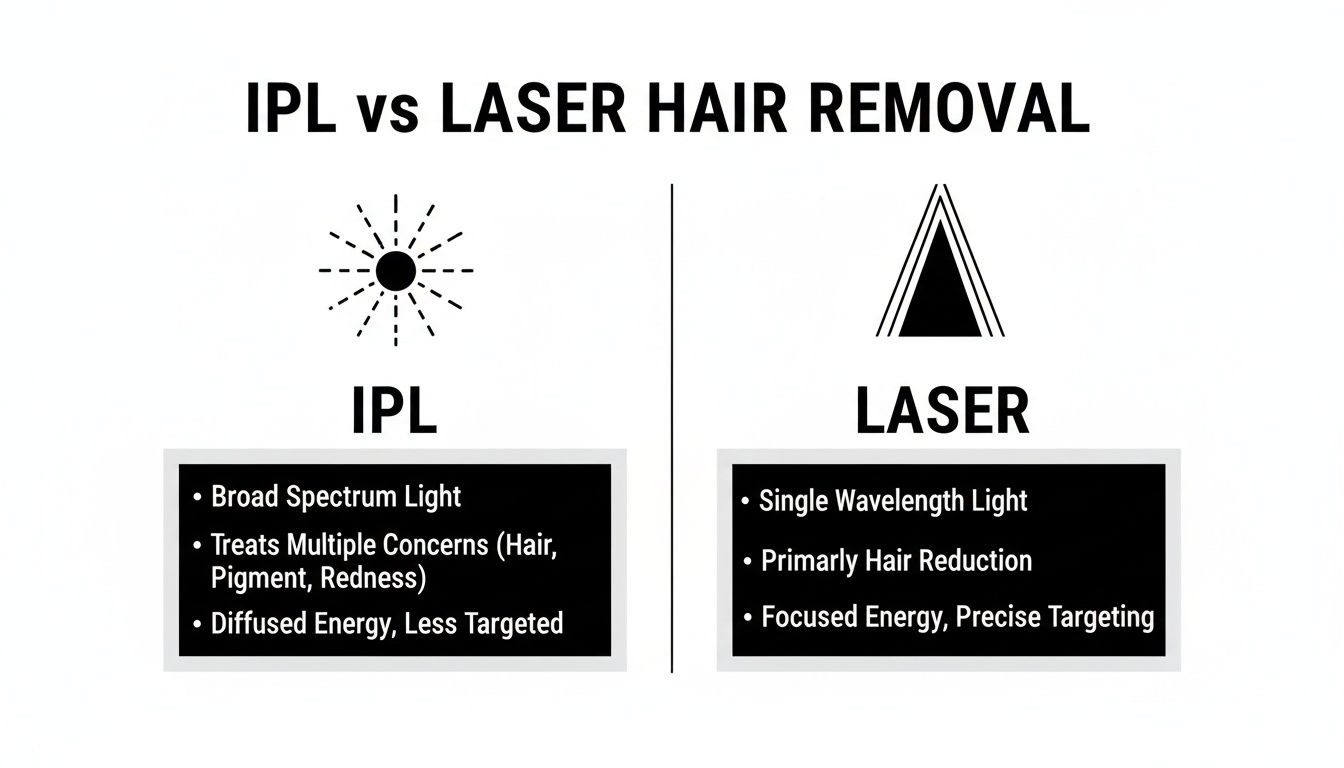
You can see the laser's direct, focused energy path compared to IPL's dispersed, less direct light. It's a clear illustration of why laser treatments are inherently more precise.
Key Takeaway: The precision of a laser's single wavelength is what makes it superior for permanent hair reduction. It's a targeted strike on the follicle, whereas IPL is a less controlled, broader approach.
For a clearer picture, here’s a quick summary of the most important distinctions you need to know when choosing between the two.
At a Glance Comparison IPL vs Laser Hair Removal
This table provides a quick, side-by-side summary of the most critical differences between Intense Pulsed Light (IPL) and Laser hair removal technologies.
Feature | IPL (Intense Pulsed Light) | Laser Hair Removal |
|---|---|---|
Light Source | Broad spectrum, scattered light | Single wavelength, concentrated beam |
Precision | Lower precision, affects surrounding skin | High precision, targets only the hair follicle |
Effectiveness | Less effective; often results in hair reduction | Highly effective; provides permanent hair reduction |
Sessions Needed | Typically 8-12+ sessions | Typically 6-8 sessions for optimal results |
Best For | Lighter skin tones (Fitzpatrick I-III) with dark hair | All skin tones with advanced lasers like Splendor X |
Pain Level | Can be more uncomfortable due to scattered heat | More comfortable with integrated cooling systems |
Ultimately, the choice comes down to your goals. If you're looking for the most effective, precise, and safest path to permanent hair reduction, modern laser technology is the clear winner.
Understanding How Each Technology Works
To really get the difference between IPL and laser hair removal, you have to look at the science behind the light. While both use light to create heat and zap hair follicles, how they generate and aim that light is completely different. It's this core distinction that separates them in terms of effectiveness, safety, and getting predictable results.
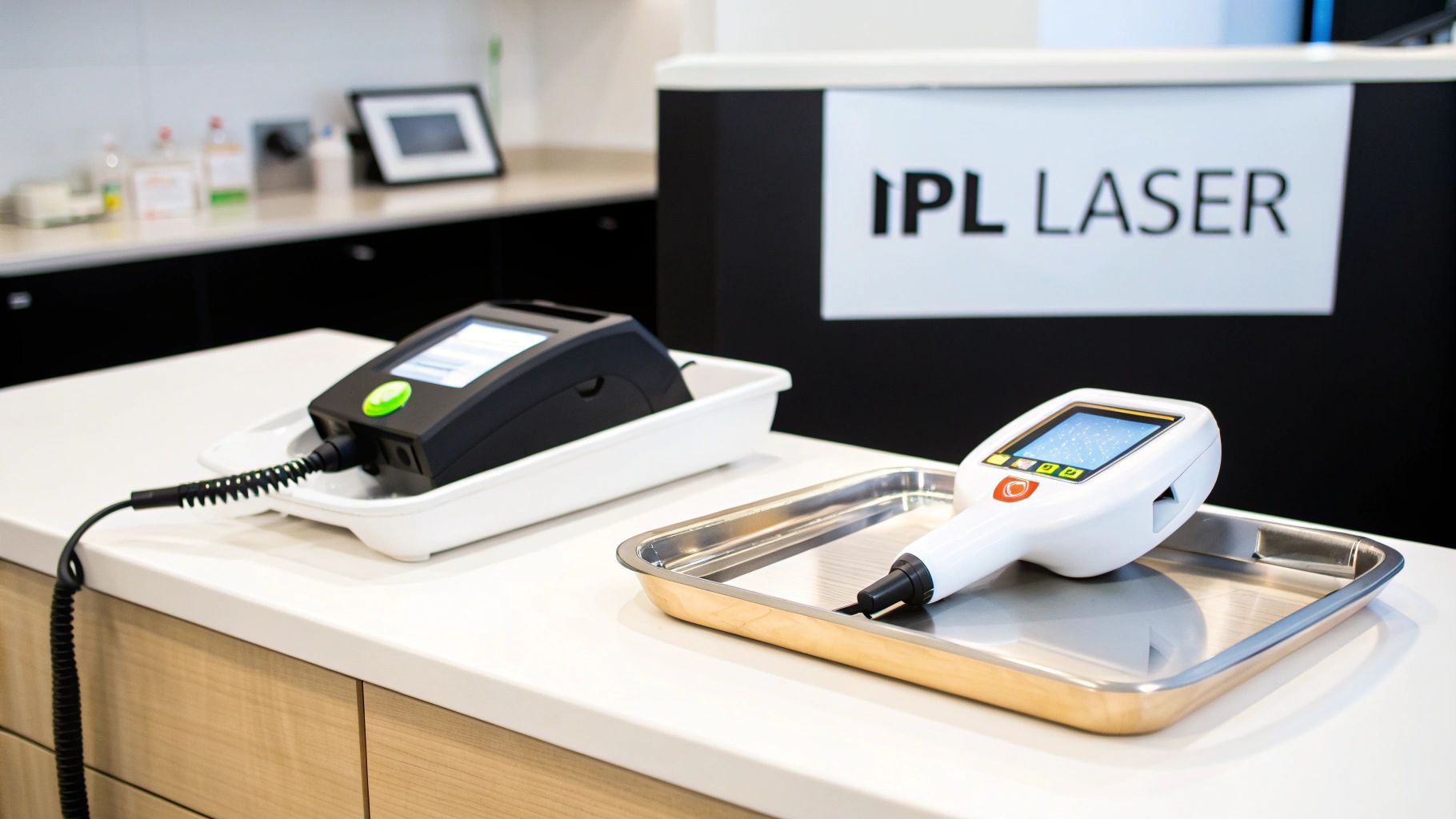
Think about it like this: you could try to hit a tiny target with either a sniper rifle or a floodlight. Professional laser hair removal is the sniper rifle—incredibly precise, powerful, and built for one job only.
The Precision of Laser Technology
Laser systems are based on a principle called selective photothermolysis. It’s a fancy term that just means using a specific wavelength of light (photo) to build up heat (thermo) and destroy a very specific target (lysis)—in our case, the melanin inside the hair follicle.
Each laser is built to emit a single, concentrated wavelength of light. This focused, coherent beam is tuned to be absorbed almost exclusively by the pigment in your hair. The energy travels straight down the hair shaft to the root, where the heat disables the follicle’s ability to grow back hair without frying the surrounding skin.
This targeted approach has some major advantages:
Maximum Energy Delivery: Almost all the light energy goes exactly where it needs to—the follicle.
Deep Penetration: The focused beam can reach deeper, more stubborn follicles with ease.
Enhanced Safety: By ignoring the skin around the hair, the risk of collateral damage is way lower, which makes it a much safer option for a wider range of skin tones.
Laser energy is targeted and precise; IPL energy is scattered and diffuse. This core difference explains why professional laser treatments deliver more reliable, powerful, and safer results for permanent hair reduction.
The science is what makes the results so consistent. If you want to get into the weeds of the process, we have a complete breakdown in our guide on how laser hair removal works. But the bottom line is that you just can't get this level of precision with a broader light source.
The Scattered Approach of IPL
If a laser is a sniper rifle, then Intense Pulsed Light (IPL) is a floodlight. Instead of one focused wavelength, an IPL device blasts out a broad spectrum of different light wavelengths, almost like a high-powered camera flash. The light is scattered, unfocused, and much weaker by the time it gets to the target.
Because it’s scattered, this multi-wavelength light can't be concentrated on the hair follicle as efficiently as a laser. A huge chunk of the energy ends up getting absorbed by the skin around the hair, not just the hair itself.
This unfocused energy delivery comes with some serious drawbacks:
Less Effective Targeting: Since the light isn't optimized to find melanin, less energy actually makes it to the follicle's root. It often just damages the hair instead of destroying it for good.
Superficial Treatment: The scattered light doesn't penetrate very deep, making it less effective on thicker, coarser, or more stubborn hair.
Increased Skin Risk: When the surrounding skin soaks up all that untargeted energy, it raises the risk of side effects like burns, blisters, and pigmentation changes. This is especially true for people with darker skin, where the light has a hard time telling the difference between skin pigment and hair pigment.
This isn't just a small technical detail—it's the main reason laser hair removal consistently beats IPL for achieving permanent hair reduction. The laser’s focused power offers a stronger, more controlled treatment that effectively destroys the follicle while keeping your skin safe.
Comparing Long Term Effectiveness and Results
When you’re investing in hair removal, the real goal is permanence. You want lasting smoothness, not a new cycle of endless upkeep. This is where the biggest difference between IPL and laser hair removal really comes into focus—moving past the tech specs to what you can actually expect long-term.
The debate isn't just about reducing hair. It's about achieving a reliable, durable result that holds up over time. For anyone on Long Island considering a permanent solution for their underarms, legs, or bikini line, understanding how long your results will actually last is everything. It's the difference between a temporary fix and a true solution.
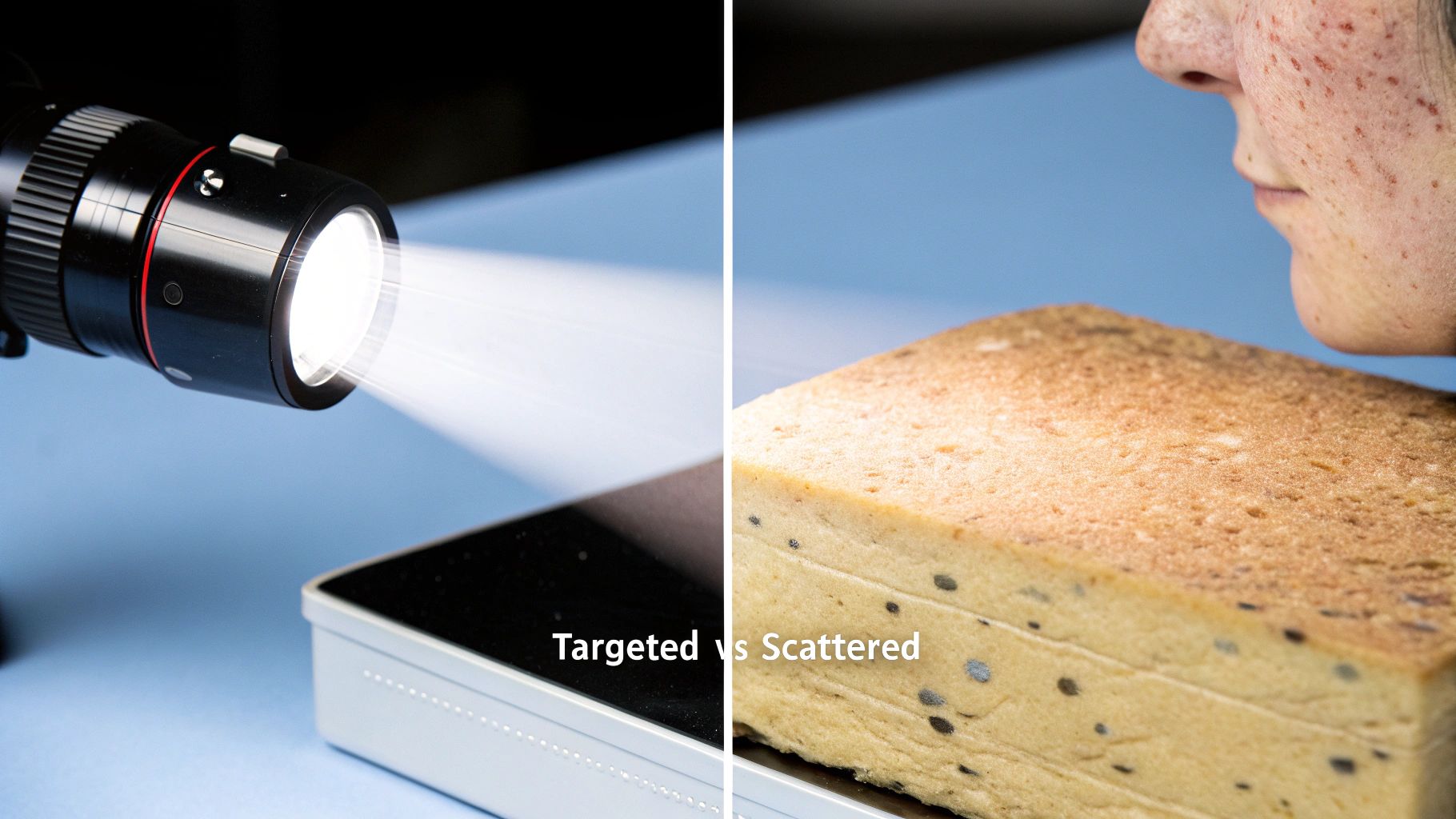
The Clinical Data on Permanent Reduction
The numbers don’t lie. Study after study confirms that professional, medical-grade lasers deliver a much higher percentage of permanent hair reduction than IPL. The laser’s focused, single-wavelength energy is simply better at destroying the hair follicle at its root, which is what stops it from growing back.
This isn’t a small difference; it’s a major gap in performance. A review of multiple clinical trials found that professional lasers consistently outperform IPL. For instance, Alexandrite lasers achieved 35-84.25% long-term hair reduction and Diode lasers hit 32.5-69.2%. Meanwhile, IPL treatments resulted in a noticeably lower reduction of just 27-52.7%. You can dig into these hair removal effectiveness findings on ulike.com.
If you’re looking for the highest possible degree of permanent hair removal, the clinical evidence points straight to laser technology. The data shows professional lasers can achieve up to 85-90% permanent reduction—a number IPL rarely gets close to.
What this means is that after a full course of laser treatments, the vast majority of hair in the treated area is gone for good. Any hair that might eventually regrow is typically much finer, lighter, and far less noticeable.
Durability of Results: Laser vs. IPL
Beyond the initial numbers, the durability of the results is what truly matters day-to-day. Laser treatments are designed for lasting impact, significantly cutting down the need for future maintenance. Once you complete your primary series of sessions, most of our clients only need a touch-up appointment once every year or two—if at all.
IPL, on the other hand, usually requires more frequent maintenance. Because its scattered light is less effective at permanently disabling the follicle, hair is more likely to grow back. Many people who go the IPL route find themselves needing touch-up sessions several times a year to keep their skin smooth. It becomes an ongoing commitment rather than a one-and-done solution.
Let’s break down what this means in the real world:
Laser Results: After completing 6-8 sessions, you can expect a very high degree of permanent hair loss. You might need a single maintenance session every 12-24 months to address any minor regrowth.
IPL Results: After 8-12+ sessions, you'll see a noticeable reduction, but it’s often less complete. You’ll likely need maintenance treatments every 3-6 months to keep the area smooth.
This difference in upkeep is huge. A busy professional from Westbury or Jericho doesn't want to be locked into a quarterly maintenance schedule. They need an efficient solution that delivers dependable, long-lasting smoothness with minimal follow-up.
For a true, lasting solution that frees you from the cycle of hair removal, professional laser treatment is the clinically superior choice. It offers the peace of mind that comes with knowing your results are not only effective but built to last.
Analyzing Safety for Different Skin and Hair Types
When it comes to any light-based hair removal, nothing is more important than safety. The core difference between IPL and laser becomes crystal clear when you look at how each one performs across different skin tones and hair colors. This isn’t a small detail—it’s the fundamental factor that determines who can be treated safely and effectively.
The challenge for any light-based treatment is pretty simple in theory: target the melanin (pigment) in the hair follicle without harming the melanin in the surrounding skin. The more pigment you have in your skin, the higher the risk of something going wrong if the technology isn't smart enough to tell the difference.
Why Laser Is Safer for Diverse Skin Tones
Modern, medical-grade lasers have a massive safety advantage, and it all comes down to precision. A laser emits a single, concentrated wavelength of light that is specifically calibrated to be absorbed by the pigment in the hair—not the skin. This focused beam travels directly to the follicle, destroying it with very little heat transfer to the surrounding tissue.
Advanced systems take this a step further. The Splendor X laser, for example, uses a blended dual-wavelength system, combining Alexandrite and Nd:YAG lasers into one powerful, customizable treatment.
Alexandrite (755nm): This wavelength is a powerhouse for lighter skin tones (Fitzpatrick types I-III) because it’s so strongly absorbed by melanin.
Nd:YAG (1064nm): This longer wavelength is the gold standard for darker skin tones (Fitzpatrick types IV-VI). It bypasses the melanin in the top layer of skin and targets the follicle's root deep below the surface, making it much safer.
By blending these wavelengths, a certified technician can customize the treatment for your exact skin and hair combination. This guarantees a safe and effective outcome across the entire Fitzpatrick scale, something that’s crucial for treating the wonderfully diverse communities across Long Island.
The Risks of IPL for Darker Skin
IPL, on the other hand, uses a broad spectrum of scattered, less-focused light. Think of it as a floodlight instead of a laser pointer. This approach makes it incredibly difficult for the device to distinguish between the melanin in your hair and the melanin in your skin.
For anyone with a darker skin tone, this lack of precision is a serious risk. The scattered energy can easily be absorbed by the epidermis, leading to a whole host of potential side effects:
Burns or blistering
Post-inflammatory hyperpigmentation (dark spots)
Hypopigmentation (light spots)
Scarring
The fundamental safety issue with IPL is its inability to discriminate. Because it can't isolate the hair follicle with the same pinpoint accuracy as a laser, it introduces a much higher risk of damaging the skin, especially when more pigment is present.
While both IPL and laser work best on dark hair against lighter skin, the safety window for IPL slams shut as skin tone gets darker. This is why most reputable clinics will flat-out refuse to perform IPL on anyone with Fitzpatrick skin types IV or higher. For a more detailed look at this, our guide to laser hair removal for dark skin explains why specific laser wavelengths are non-negotiable for safe treatment.
Hair Color and Treatment Limitations
Both technologies need pigment in the hair to work. This means they are generally ineffective on very light blonde, red, gray, or white hair. Those hair colors simply don't have enough melanin to absorb the light and generate the heat needed to destroy the follicle.
That said, a professional laser technician can often treat lighter brown or darker blonde hairs more effectively than an IPL device ever could, thanks to the laser's superior power and targeting. But for hair with little to no pigment, neither option is going to deliver results.
Ultimately, it comes down to prioritizing a safe, predictable outcome. The focused, single-wavelength nature of advanced lasers offers a far more controlled and reliable treatment. It minimizes risks and maximizes results, particularly for anyone with a skin tone that has more natural pigment. The only way to ensure your treatment is both safe and effective is to consult with a certified professional using medical-grade laser technology.
A Practical Look at Pain, Cost, and Session Count
Beyond the science, what really matters is the day-to-day reality of getting hair removal. When you're deciding between IPL and laser, it always comes down to three things: how much it hurts, how much it costs, and how many appointments you’ll need to block off in your calendar. This is where the gap between a professional laser treatment and a standard IPL session becomes crystal clear.
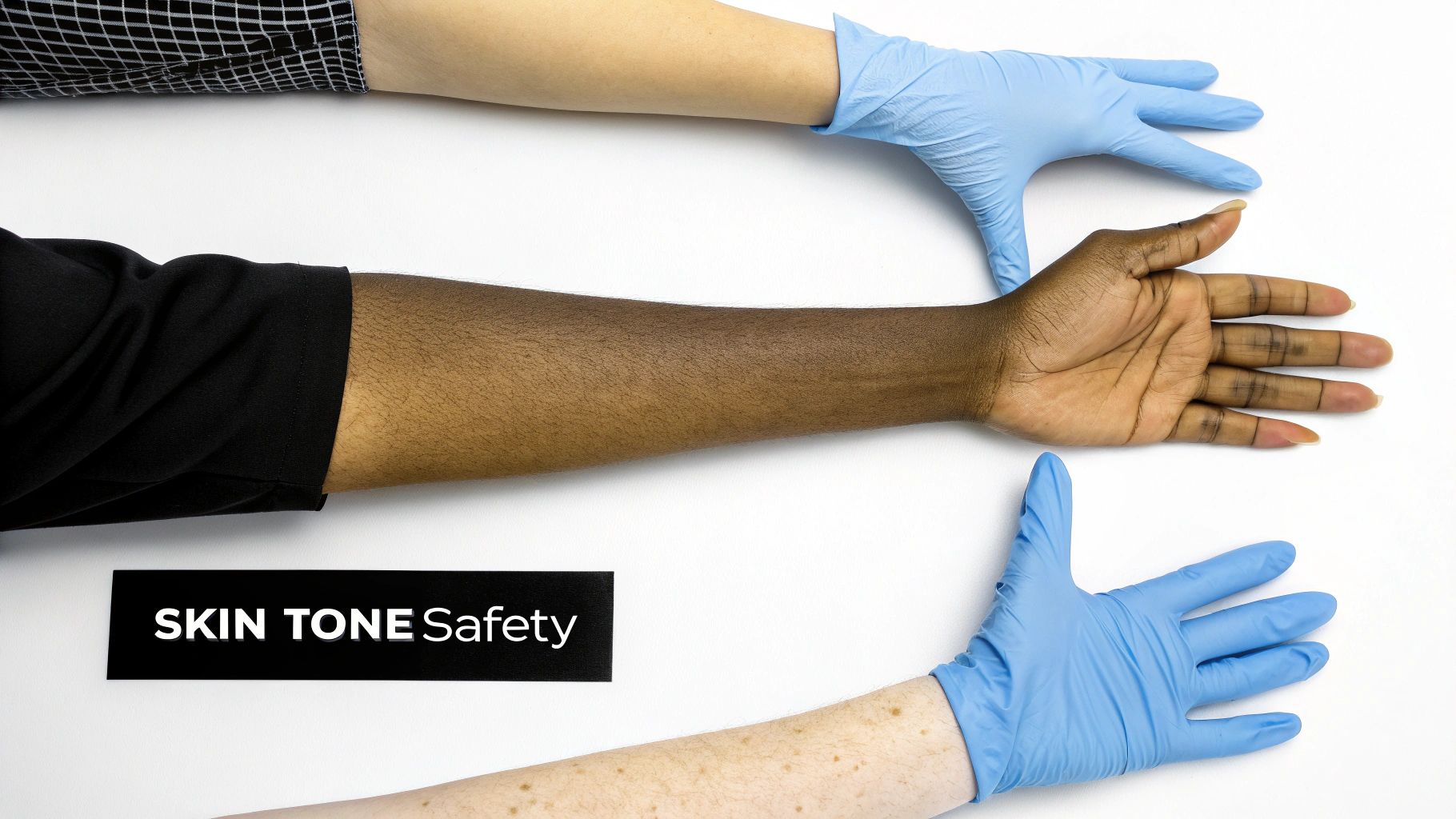
You’ve probably heard the classic "rubber band snap" analogy for both treatments, but honestly, that’s becoming an outdated comparison. Modern, medical-grade lasers have come a long way in the comfort department, creating an experience that’s miles ahead of what most IPL devices can deliver.
Comparing Treatment Comfort and Sensation
How a treatment feels is all about how the energy hits your skin. IPL uses a scattered, broad-spectrum light that heats up not just the hair follicle but also all the surrounding tissue. It's this generalized heat that often causes that sharp, stinging feeling people dislike.
Professional laser systems are far more sophisticated. An advanced device like the Splendor X has a built-in cooling system that chills the skin’s surface right before, during, and after each laser pulse. That technology makes all the difference.
By keeping the top layer of skin cool and comfortable, the laser can send its powerful, targeted energy straight to the follicle with very little sensation. The result is a much more tolerable treatment, especially in sensitive spots like the bikini line or underarms.
The Critical Difference in Session Count
One of the biggest practical differences between laser and IPL is the time commitment. Because a laser's focused energy is so much better at destroying hair follicles, you will almost always need fewer sessions to get the smooth skin you want.
For our busy clients across Long Island, this is a huge deal. Fewer appointments mean less time away from work, family, and everything else on your plate.
The numbers don't lie. Professional laser treatments usually require 6-8 sessions for the best results. IPL, on the other hand, often takes 8-12 sessions or more because its scattered light just isn't as efficient. While lasers can achieve up to 90% permanent hair reduction in just 5-10 sessions, IPL typically delivers around a 60% reduction after 10-15 sessions and requires more frequent touch-ups.
For a detailed timeline, check out our guide on how many laser hair removal sessions you'll actually need.
Analyzing the True Cost Over Time
At first glance, a single IPL session might seem cheaper than a laser session. This is a classic case of being penny-wise and pound-foolish, as it often leads people to a decision that costs them more in the long run. The real value is in the total investment for permanent results.
Let’s break it down with a quick scenario:
Treatment A (IPL): Costs $150 per session and needs 12 sessions for initial clearance. Total initial cost: $1,800. It then requires three maintenance sessions per year at $150 each ($450/year).
Treatment B (Laser): Costs $250 per session and needs 8 sessions for permanent reduction. Total cost: $2,000. Afterward, you might need one touch-up session per year at $250.
While the laser has a slightly higher upfront cost, it saves you $200 in the first year of maintenance alone. Over three years, you'd spend an extra $1,350 on ongoing IPL maintenance, while laser touch-ups would only be $750.
The superior efficiency of laser hair removal means you pay for fewer treatments and spend far less on upkeep. It’s an investment in a more permanent, cost-effective solution.
Why Professional Laser Hair Removal Is the Clear Winner
When you weigh the technology, safety, and results, the choice isn't just between laser and IPL. It's about choosing a professional-grade medical laser treatment over a less precise alternative. This is a decision to prioritize your skin’s long-term health and invest in a permanent solution, not a temporary fix.
Choosing a system like the Splendor X at a certified clinic is about more than the machine itself. It means putting your skin in the hands of an expert who can unlock the full potential of this advanced technology, ensuring every single session is tailored to your exact skin and hair type.
The Power of Blended Wavelengths
What really sets a professional system like Splendor X apart is its sophisticated design. It uses a unique blended wavelength system, combining two of the most trusted lasers in the industry:
Alexandrite (755nm): The go-to for targeting pigment in lighter skin tones with incredible effectiveness.
Nd:YAG (1064nm): The safest wavelength for darker skin tones because it smartly bypasses the melanin in the top layer of your skin.
This dual-laser approach allows a technician to treat virtually anyone on the Fitzpatrick scale with unmatched safety and precision. It takes all the guesswork and risk out of the equation—something the scattered light of an IPL device just can't do, as it often struggles to tell the difference between pigment in your hair and pigment in your skin.
Choosing a professional laser means choosing certainty. The ability to precisely tailor the treatment to your unique skin and hair combination is what guarantees both safety and superior, long-lasting results.
Faster Sessions and Way More Comfort
Another game-changing feature is the applicator design. The Splendor X has a large, square-shaped spot size that covers skin faster and more evenly than the small, circular wands you see on other devices. For larger areas like the back, chest, or full legs, this is a huge win, slashing treatment time significantly.
For our Long Island clients with packed schedules, this means you can get a full back treatment done quickly and get back to your day. Plus, its built-in cooling system continuously chills the skin during the session, making the experience far more comfortable than the sharp, rubber-band snap people often associate with IPL.
When it comes down to it, the difference between IPL and laser is crystal clear once you focus on the final outcome. Professional laser hair removal gives you a definitive path to smooth, hair-free skin, backed by advanced technology, certified expertise, and a commitment to safe, permanent results.
Frequently Asked Questions
Let's wrap up this comparison by tackling some of the most common questions we hear from clients. If you still have a few lingering doubts, these clear, straightforward answers should help you make a fully informed decision.
Is Laser Hair Removal Really Permanent?
The right way to think about it is permanent hair reduction. After a full series of treatments, the vast majority of our clients see up to a 90% reduction in hair growth, which is a game-changer.
Any hair that does grow back is usually much finer, lighter, and way less noticeable. While some people like to book a yearly touch-up session to keep things perfectly smooth, the results are incredibly long-lasting with minimal upkeep.
In contrast, IPL offers a less significant reduction and usually requires more frequent maintenance sessions to keep regrowth under control. So, while neither can promise 100% permanent removal forever, professional laser gets you significantly closer with far less effort over the long run.
Are At-Home IPL Devices a Good Alternative?
For safety reasons alone, at-home IPL devices operate at much lower energy levels than the medical-grade machines we use in our clinic. This makes them significantly less powerful and, honestly, far less effective.
They might slow down hair growth for a little while, but they simply don't have the power to deliver the kind of permanent reduction you get with professional-grade lasers in a clinical setting.
The biggest issue with at-home devices is the risk of user error. Improper use can easily lead to skin burns or pigmentation problems, especially if the device isn't right for your specific skin tone. For safe, effective, and lasting results, professional treatment is always the smarter choice.
Which Treatment Is Better for Sensitive Areas?
When it comes to sensitive spots like the bikini line, underarms, or face, professional laser hair removal is generally the better option. Its precision allows our technicians to target only the hair follicle, which minimizes heat and irritation to the delicate skin around it.
Modern lasers, like the Splendor X, also have advanced, built-in cooling systems that actively cool the skin's surface during the entire treatment. This simple feature makes the whole process much more comfortable and easy to tolerate.
IPL's scattered, broad-spectrum light creates more generalized heat across a wider patch of skin, which can lead to more discomfort in these sensitive zones. A laser’s targeted approach ensures both your comfort and the treatment's effectiveness are maximized exactly where you need it most.
Ready to experience the lasting difference a professional laser treatment can make? The team at NYC Laser Hair Removal uses advanced Splendor X technology to deliver safe, effective, and comfortable results for clients across Long Island. Book your consultation today and start your journey to permanently smooth skin.
Comments