
Epilator vs IPL: Which Hair Removal Method Actually Wins
Most advice on epilator vs IPL starts with the wrong assumption: IPL is newer, so it must be better. That's not how hair removal works. An epilator pulls visible hair from the root regardless of pigment, while IPL depends on the contrast between hair and skin, the device's settings, and your willingness to follow a repeated schedule.
The better choice depends on four questions: What color and thickness is your hair? How much melanin is in your skin? Do you want smooth skin today or gradual reduction? How much time will you spend maintaining the result over a full year? A quick comparison makes the trade-offs clearer.
Decision factor | Epilator | Home IPL |
|---|---|---|
Main action | Mechanically extracts visible hair from the follicle | Uses pulses of light intended to impair regrowth |
Visible result | Immediate smoothness | Gradual reduction after repeated sessions |
Hair color | Works independently of pigment | Less predictable for blond, gray, white, red, or very fine hair |
Skin tone | Not dependent on skin melanin | Requires careful device and setting selection |
Best advantage | Reliable short-term removal | Potentially longer-term reduction |
Main drawback | Repeated discomfort and maintenance | Slow results, screening requirements, and light-related risks |
The rest of the decision falls into three practical groups. The at-home experimentalist wants a manageable tool and may prioritize immediate results. The budget-conscious planner may accept a longer routine if strong hair-skin contrast makes home IPL suitable. The person who has tried both and wants a more durable reduction may need to stop troubleshooting devices and consider professional treatment.
Why This Comparison Is Trickier Than It Looks
The popular “modern technology beats old technology” framing ignores biology. An epilator and an IPL device don't solve the same problem, so declaring one a universal winner is misleading. One removes hair that has already emerged. The other tries to reduce future growth by delivering light to pigmented hair structures over repeated sessions.
The variables that decide the outcome
Hair color is the first screening question. IPL relies on melanin absorbing light, so dark hair usually gives the device a clearer target than blond, gray, white, or very fine hair. An epilator doesn't need that contrast. Its mechanism is physical, not optical.
Skin tone matters just as much. Darker skin contains more melanin that can absorb IPL energy, which can increase the risk of burns or pigment changes when a device isn't suitable or the setting is too aggressive. A person with dark hair and deeper skin tone shouldn't assume that an at-home device is automatically safe just because it has a skin sensor.
Hair thickness changes the experience too. Coarse hair can make epilation more uncomfortable, while IPL may have a more visible target when the hair contains substantial pigment. Fine hair can be harder for IPL to address and may be easier to remove mechanically.
Practical rule: Choose the method that matches your biology first. Convenience, price, and gadget features come second.
The full-year question
An epilator produces a satisfying result in one session, but you'll repeat that work whenever regrowth becomes noticeable. IPL front-loads the effort. You spend more time following a treatment schedule before you know whether the device is delivering meaningful reduction, then continue with maintenance as needed.
That distinction matters to all three reader profiles. If you want reliable short-term control and don't mind repetition, an epilator is sensible. If your hair and skin provide strong contrast and you can follow instructions consistently, home IPL may be worth testing. If your priority is long-term reduction across larger areas, professional assessment deserves a place in the comparison.
How Each Method Works
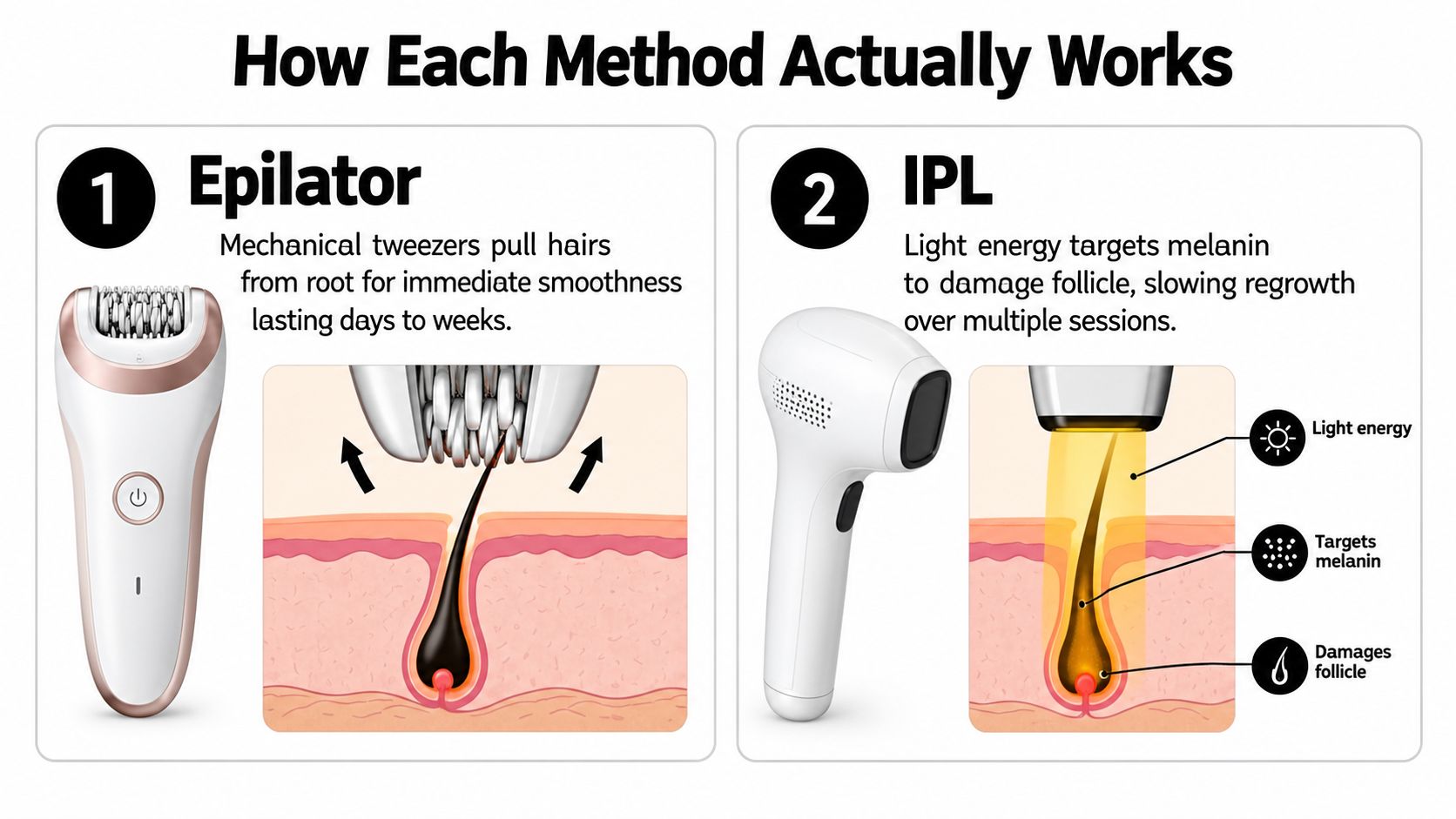
The central difference is the target. An epilator removes hair that has already emerged, while IPL, or intense pulsed light, uses light energy to affect regrowth at the follicle. That distinction determines whether you are buying immediate smoothness or committing to a cumulative reduction routine.
An epilator uses rotating discs or electric tweezers to grasp several visible hairs and pull them from the root. The follicle can continue producing hair, so the result is smooth skin without progressive follicular reduction. This plain-language guide explains what an epilator does.
IPL sends broad-spectrum pulses into the skin. Melanin in the hair shaft and follicle absorbs the energy and converts it into heat intended to impair regrowth. FDA-cleared home devices commonly specify filtered wavelength bands around 510 to 1100 nm or 510 to 1200 nm. Treatment spots and fluence vary by device, as shown in this FDA device submission.
Immediate removal versus cumulative reduction
An epilator gives you a clear result after one pass: judge it by how smooth the skin feels. IPL needs a longer assessment. Hair grows in cycles, and light treatment is more relevant when follicles are in an active growth phase. Repeated treatments therefore matter more than one session.
A 2021 systematic review reported randomized IPL studies using three treatments at two-week intervals. Compared with baseline, hair-count reductions reached 53.6% at six months and 64% at three months, with reductions consistently exceeding 50% across the reviewed trials in the systematic review. Those findings belong to the devices, schedules, skin types, and hair characteristics studied. They are not a personal guarantee for every home user.
What to inspect before buying
Do not compare IPL devices by flash count alone. Check the wavelength range, fluence, pulse behavior, treatment spot, cooling, skin-tone sensing, and the manufacturer's warnings about unsuitable hair and skin combinations. A product page such as Braun Silk Expert Pro 3 at lo la beauty lets you inspect a named device's specifications, but those specifications still need to suit your skin and hair profile.
An epilator presents fewer technical variables. Check its head design, speed settings, wet and dry use, cleaning requirements, and reach across the areas you plan to treat. Extra attachments cannot compensate for a method you will not tolerate or use consistently.
Pain, Results Timeline, and Maintenance Reality
Pain is only part of the decision. The bigger question is how much time you will spend managing regrowth across an entire year. An epilator removes hair immediately, while IPL demands a repeated treatment routine before its reduction becomes clear.
An epilator pulls multiple hairs from the root at once. Expect sharper discomfort on the bikini line, underarms, ankles, and other sensitive areas, especially with dense or coarse hair. The payoff is immediate smoothness. Regrowth follows each person's hair cycle, and the method remains temporary because it removes the hair rather than selectively damaging the follicle.
IPL usually feels like warmth, tingling, or a brief snap. Sensation changes with the device, energy level, hair density, and skin sensitivity. It suits people who would rather tolerate short, regular sessions than repeated pulling. It does not suit anyone unlikely to follow the schedule.
What the timeline really looks like
IPL works gradually. Earlier home-light evidence was uneven, with a 2012 systematic review identifying seven studies and reporting hair reduction ranging from 6% to 72% after repeated treatments in the review of home-use devices. That range makes one point clear: device design, treatment schedule, hair characteristics, and skin response matter more than a box claim. Use progress photos under consistent lighting, rather than judging one session against a polished IPL before and after image.
Maintenance doesn't disappear
Epilation creates a recurring removal task. IPL can reduce the amount of returning hair, but maintenance sessions remain part of the routine, and missed areas can produce uneven results. Across twelve months, the better method is the one you will use consistently, not the one with the more attractive first result.
Safety also affects the time and effort required. A 2023 analysis recorded 1,692 voluntary adverse-event reports associated with home IPL between 2016 and 2021. Skin pain represented 27.8%, thermal burns 18.7%, and erythema 16.0% of those reports in the adverse-event analysis. These reports do not establish the risk for every device or user, but they reinforce the need for skin-tone screening, patch testing, and correct settings. If an epilator's immediate discomfort is your limiting factor, choose IPL only after confirming that your hair and skin combination is suitable.
Skin Tone, Hair Color, and the Melanin Question
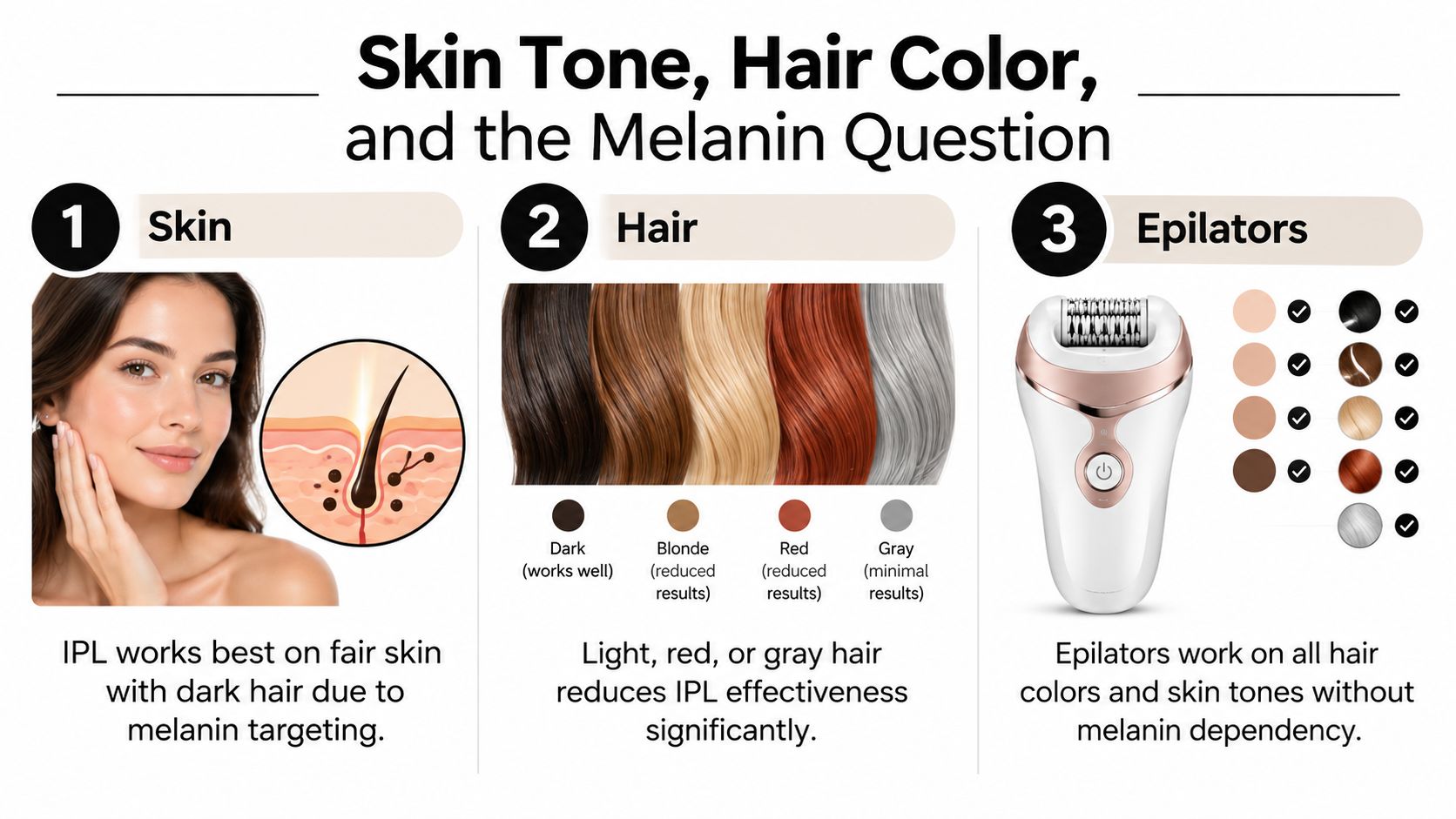
The deciding factor is often contrast, not pain or purchase price. IPL needs enough difference between the hair and surrounding skin to target the follicle's pigment. An epilator removes the hair mechanically, so color contrast does not determine whether it can work.
IPL generally performs more predictably when dark hair grows against lighter skin. Blond, gray, white, red, and very fine hair contain less of the pigment the device targets, so results can be inconsistent. An epilator avoids that limitation and can remove hair regardless of color. For light or low-pigment hair, that makes epilation the more dependable at-home choice.
Why darker skin requires more care
The surrounding skin contains more melanin at darker skin tones. An unsuitable IPL device or an overly high setting can therefore raise the chance of burns or unwanted pigment changes. Darker skin does not automatically rule out light-based treatment, but it does require careful device screening, patch testing, and conservative settings.
A systematic review of home light devices reported hair reduction ranging from 6% to 72%, with adverse effects including redness, swelling, blistering, crusting, and pigment changes. The review also states that low-fluence IPL is preferred for darker skin to balance safety and effectiveness in the systematic review indexed by PubMed. The practical question is whether your device can separate hair pigment from skin pigment well enough for your combination of tone, hair color, and coarseness.
Use this screening sequence
Before buying IPL, check five points:
Natural hair color: Is the hair dark, or is it blond, gray, white, red, or very fine?
Skin tone: Does the manufacturer explicitly support your tone?
Recent tanning: Has sun exposure or self-tanner recently darkened the skin?
Contrast: Is the hair visibly darker than the surrounding skin?
Pigment history: Have you experienced melasma or post-inflammatory pigmentation?
If pigment changes concern you, read this clinician's guide to melasma before choosing a light-based device. Readers with darker skin should also review guidance on dark skin hair removal and laser, where wavelength selection and practitioner judgment receive specific attention.
My recommendation is direct. Choose an epilator when your hair is light, gray, white, or too fine for reliable IPL targeting. If your skin is darker, reject vague “suitable for all skin tones” claims unless the device provides clear guidance for your tone, and test a small area first. IPL wins when dark, coarse hair provides strong contrast and the device can be used safely.
True Cost of Each Method Over Twelve Months
The cheapest device at checkout isn't always the cheaper routine. An epilator usually has a lower purchase price and no light cartridge to manage. Home IPL costs more at the start and demands repeated sessions, so its real cost includes time, consistency, and the possibility that it won't suit your hair or skin.
The dollar figures in many shopping guides vary by brand, model, and retailer, so the useful comparison is the cost structure rather than an invented annual total.
Cost Factor | Epilator | Home IPL |
|---|---|---|
Initial purchase | Usually lower | Usually higher |
Consumables | None for most models | Often none, though some models use replaceable components |
Replacement needs | Head or device replacement over time | Device lifespan, flash capacity, or model-specific parts |
Session pattern | Repeat whenever regrowth becomes noticeable | Repeated sessions during the reduction phase, then possible maintenance |
Time burden | Shorter individual sessions, repeated indefinitely | Longer planned sessions, concentrated during the initial routine |
Main financial risk | Buying a tool you dislike using | Buying a tool unsuitable for your hair or skin |
Count hours, not just receipts
An epilator can be efficient for a small area, but a full-body routine still requires you to manually cover each region. The work repeats because the device removes hair without changing the follicle's ability to produce more.
Home IPL reverses that pattern. Each session can take longer because you need full coverage, proper contact, and careful avoidance of missed patches or repeated flashes. The initial routine may feel inefficient, especially if you're treating several large areas, but the intended payoff is less visible regrowth over time.
The expensive mistake: Buying IPL for light hair or unsuitable skin, then continuing because the device cost feels too high to abandon.
Which budget gets the better fit?
Choose an epilator when your priority is predictability, low entry cost, and immediate control. It's especially rational for occasional use, light or pigment-poor hair, or someone who doesn't want to follow a treatment calendar.
Choose home IPL when you have strong hair-skin contrast, can follow the manual closely, and value the possibility of cumulative reduction more than instant smoothness. Before purchasing, verify suitability rather than assuming a higher price means better performance.
When Professional Laser Becomes the Better Investment
Home IPL is a reasonable experiment for a compatible hair and skin profile. It becomes a poor investment when the device can't identify the hair reliably, when your skin tone falls outside its safe operating range, or when you've followed the routine and still see little meaningful change.
Professional laser adds a third path. At NYCLASER, Splendor X combines Alexandrite and Nd:YAG wavelengths, allowing a practitioner to select technology for a broader range of skin tones and hair characteristics than many home IPL devices. The clinic offers treatment areas ranging from small zones such as the lip and underarms to larger areas including full legs, back, and chest.

Where professional treatment changes the calculation
A clinic can assess skin tone, tanning, hair thickness, and treatment area before selecting settings. That matters when the safety margin is narrow or when a home sensor gives you limited information. It also removes the burden of manually treating every patch with a small consumer device.
Professional sessions require appointments and an upfront commitment to a treatment series. The practical advantage is control over the variables that home users often struggle to manage, including consistent coverage, appropriate energy selection, and adjustment as the hair responds.
For readers comparing treatment providers rather than devices, a dermatology clinic for skin concerns can also be a useful reference point for understanding why medical skin assessment matters before energy-based procedures.
A professional consultation makes the most sense if you have darker skin, coarse dark hair, recurrent ingrown hairs, large treatment areas, or repeated disappointment with home IPL. It's also worth considering if the hours spent epilating or flashing your skin have become a permanent chore rather than a temporary experiment.
Here's what a clinic-based option looks like in practice:
The key question isn't whether professional laser costs more at the start. It's whether the device you already own is compatible with your biology and whether you're willing to keep paying in time for uncertain results.
Which Option Fits Your Profile
The direct recommendation is simple once you stop treating every body and device as interchangeable.
Choose an epilator if
You have light, gray, white, red, or very fine hair, or you don't want to make a pigment-based decision. An epilator also suits people who need immediate smoothness for an event, travel, or occasional maintenance and don't want to follow a multi-session schedule.
Accept the trade-off: the result is temporary, the pulling can hurt, and you may need to manage irritation or ingrown hairs. But the method is honest about what it does. It removes hair now without promising follicular reduction later.
Choose home IPL if
You have meaningful contrast between dark hair and your skin, your device is designed for your tone, and you're prepared to follow the schedule consistently. Look for skin-tone sensing, clear fluence guidance, appropriate cooling, and transparent exclusions. Don't buy based on flash count alone.
Home IPL is a poor choice if you're likely to skip sessions, treat tanned skin, or keep increasing energy because the first results are slow. Repetition only helps when the device is suitable and used correctly.
Choose professional treatment if
You want longer-term reduction, treat large areas, have darker skin that needs careful wavelength selection, or have already tested home IPL without a convincing response. A consultation at NYCLASER can assess whether Splendor X is appropriate for your skin and hair profile and explain available treatment zones and packages.
Use this one-minute checklist:
Is your hair dark enough for light targeting?
Is your skin tone compatible with the specific device?
Do you want smoothness today or reduction over time?
Will you maintain the routine?
Are pain, ingrown hairs, or treatment hours becoming a recurring problem?
If the answers point in different directions, don't force a home-device decision. Get an assessment before spending more money.
Questions Readers Ask After the Comparison
Can IPL and an epilator be used together?
They can be used in the same overall routine, but they serve different purposes. An epilator removes hair from the root, while IPL needs a pigmented hair structure in the follicle to absorb light. If you're following an IPL plan, check the device instructions before epilating between sessions, because removing the hair from the root can interfere with the light target. Shaving is commonly preferred for managing visible hair during an IPL schedule, but the manufacturer's instructions should control.
Is IPL safe during pregnancy or on tattoos?
Pregnancy is a reason to pause home IPL and ask a qualified medical professional before using it. Don't flash directly over tattoos, because the pigment can absorb light and increase the chance of a skin reaction. Avoid treating irritated, damaged, recently tanned, or otherwise abnormal skin, and follow the device's contraindications rather than relying on a generic online checklist.
How long do professional laser results last?
Professional laser is designed for longer-term reduction, not a guarantee that every treated follicle will never produce hair again. Results vary with hair color, hormonal factors, treatment area, skin tone, and the treatment plan. Some people need maintenance after their initial series. That still differs from an epilator, which removes visible hair without selectively reducing follicular regrowth.
What should you do if home IPL stopped working?
First, check whether you're covering every area evenly, following the schedule, using the correct setting, and treating hair with enough pigment. Missed coverage can look like treatment failure. If your hair is too light or fine, the device may lack a reliable target. Don't keep increasing the intensity to compensate for a biological mismatch. A professional consultation is the sensible next step when correct use hasn't produced a clear response or when skin-tone safety is uncertain.
NYC Laser Hair Removal offers personalized laser hair reduction with Splendor X, treatment zones for both small and large areas, and consultation-based planning for different skin and hair profiles. Visit NYC Laser Hair Removal to review the clinic's treatment options and decide whether professional care is a better fit than continuing with an epilator or home IPL.
Comments