
Customized Laser Hair Removal: Your Complete Treatment Guide
You've chosen your treatment area, compared package options, and maybe even pictured the day you won't need to shave it again. Then a provider asks about your skin tone, hair thickness, recent sun exposure, and how your skin reacted to past treatments. That can feel like a lot for a procedure often marketed as simple.
The detail matters. Customized laser hair removal isn't just selecting the lip, underarms, bikini area, or legs on a menu. It means matching the laser wavelength, fluence, pulse duration, cooling, treatment interval, and aftercare to your skin, hair, body area, and response over time. The right plan aims for long-term hair reduction while managing the trade-offs between follicle targeting, comfort, and skin protection.
What Customized Laser Hair Removal Actually Means
A first-time client may arrive expecting a fixed protocol. She has dark hair, wants her underarms treated, and assumes every provider will use the same settings for the same area. A careful consultation changes that assumption quickly. Her skin may be lighter in winter than in summer, her underarm hair may be coarse, and her face may react differently from her legs. Each detail can influence the treatment plan.
Another client may have a similar hair pattern but a darker complexion or recent tanning. The provider may choose a different wavelength, use more conservative energy, add careful cooling, and schedule a test spot before treating the full area. Both clients can receive underarm treatment, but their protocols shouldn't be identical.
Clinical literature describes laser and light-based epilation as partial hair reduction, not a guarantee that every hair will disappear permanently. Repeated sessions generally produce better results than a single procedure, and the measurable benefit commonly extends for approximately 6 months after treatment in the evidence summarized by the NCBI clinical overview of laser hair removal. That makes the plan more important than the sales label.
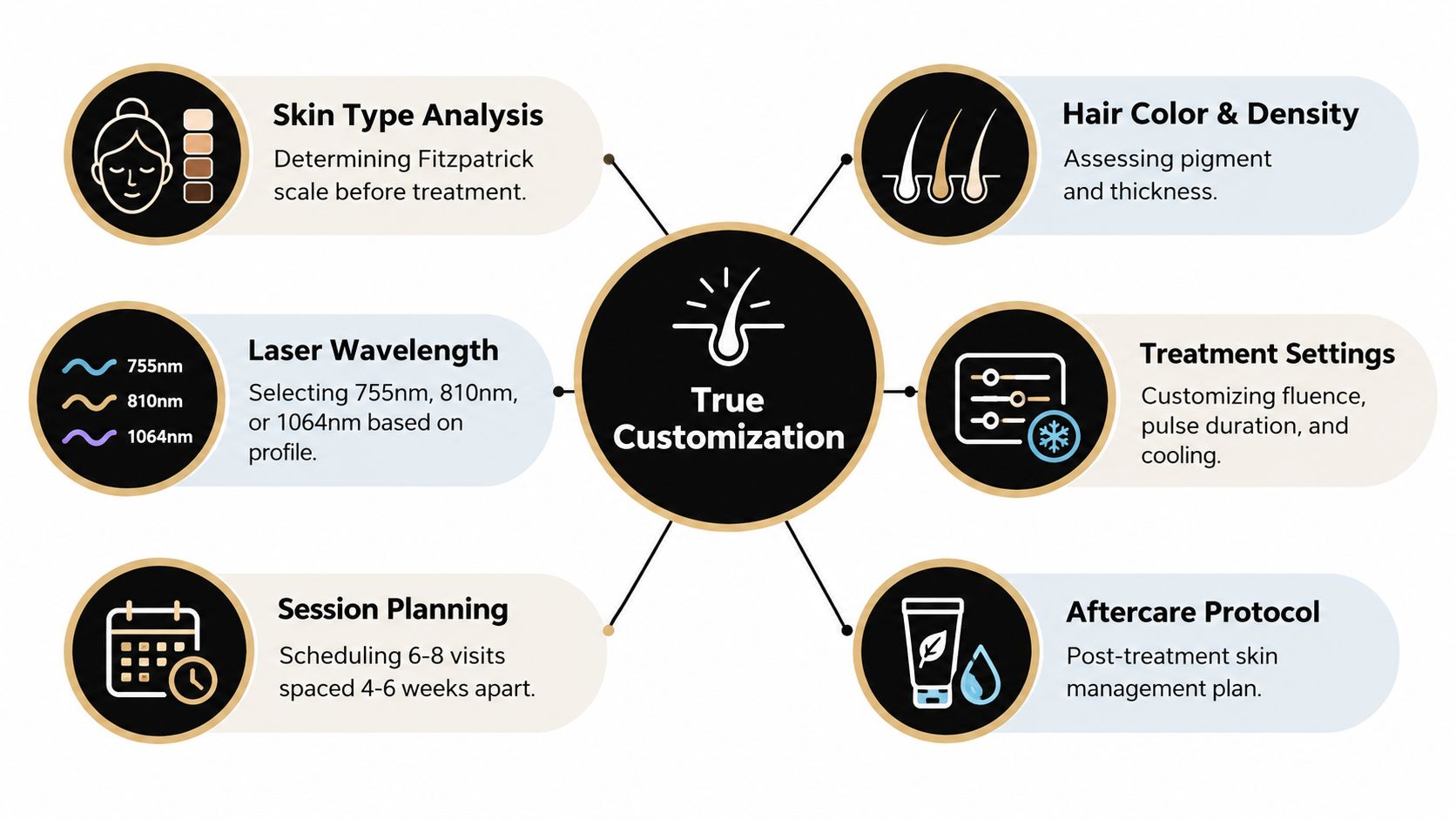
The six decisions behind a real plan
A provider assessing customized care should consider:
Skin assessment: Fitzpatrick skin type, baseline pigmentation, tanning, sensitivity, and previous reactions.
Hair assessment: Color, thickness, density, distribution, and whether the hair contains enough melanin to respond.
Wavelength selection: Alexandrite, diode, or long-pulsed Nd:YAG may suit different skin and hair profiles.
Parameter selection: Fluence, pulse duration, spot size, and cooling work together. Increasing only the energy can create unnecessary risk.
Scheduling: Treatment timing follows regrowth and the hair-growth cycle, not just a package calendar.
Ongoing review: Shedding, regrowth speed, irritation, pigment changes, and plateaus should influence later sessions.
A useful treatment plan stays flexible. It may begin with one set of parameters, then change as hair becomes finer, density declines, or the skin responds differently. Clients who want a clearer explanation of this approach can review personalized laser treatment plans before their consultation.
Practical rule: If every client receives the same wavelength, energy, interval, and aftercare regardless of skin and hair characteristics, the process may be convenient, but it isn't genuinely individualized.
How Your Skin and Hair Type Influence Treatment Settings
Laser hair removal gets called “customized” all the time, but true customization happens in the settings. Two clients can book the same area and need very different treatment because the laser is not only seeing hair. It is also interacting with pigment in the skin, recent tanning, hair thickness, density, and how that area reacted last time.
That is the part generic packages skip.
Laser energy is drawn to melanin in the hair shaft and follicular structures, but epidermal melanin competes for that energy. In practical terms, darker skin or recently tanned skin gives you a smaller margin for error, so wavelength choice and heat management matter more from the first pulse. The dermatology review on laser hair removal parameters describes how wavelength, fluence, pulse duration, and skin-protection measures work together rather than as isolated controls.
Wavelength is usually the first adjustment. Longer wavelengths are absorbed less strongly by epidermal melanin and can penetrate further, which is why long-pulsed 1064-nm Nd:YAG is commonly favored for very dark or tanned skin. Alexandrite and diode systems may fit other cases well, but a responsible choice depends on phototype, current pigmentation, hair characteristics, treatment site, and response to a test spot. One machine is not automatically the right answer for every client.
Fluence is a safety and effectiveness decision
Fluence is the energy delivered over a given area. I do not treat it as a simple power dial, because more energy only helps if the follicle gets enough heat without pushing the epidermis too far. That balance is where true personalization shows up.
The review reports diode fluences of about 30–35 J/cm² for Fitzpatrick II–III skin and about 20–24 J/cm² for darker skin types. Those numbers are examples from the literature, not a preset to copy. Actual settings still have to be adjusted for recent sun exposure, hair caliber, body area, cooling, and the skin's clinical endpoint during treatment.
The endpoint matters. Mild perifollicular erythema and edema, temporary redness and swelling around follicles, can indicate an effective response. Blistering, excessive pain, or pigment change means the plan needs to be reconsidered. In clinic, a slightly conservative start often produces better long-term progress than an aggressive session that leads to healing delays or forces us to stretch the schedule.
Hair color changes the plan too. Dark, coarse hair usually responds more readily because it offers a stronger pigment target. Blond, gray, and white hair do not absorb laser energy the same way, so expectations must be clarified before treatment begins.
Evidence in Fitzpatrick skin types III–VI also supports tailoring the device to the patient rather than the package. The systematic review of laser and IPL treatment across darker skin types found better hair-count reduction with alexandrite than IPL in the analyzed comparison, and lower odds of post-inflammatory hyperpigmentation with long-pulsed Nd:YAG than IPL.
Those findings do not crown one device as universally superior. They show why real customization includes wavelength selection, fluence adjustments, and sometimes rotational protocols as hair becomes finer or the skin responds differently over time. If you want a plain-language overview of how platforms differ, this guide to laser hair removal technology is a useful starting point.
Your First Consultation and Assessment Process
You arrive expecting a quick yes or no. A good consultation is more exact than that. Before anyone treats a single test area, the provider should work through the details that separate a generic package from a plan that actually fits your skin, hair, and goals.
That starts with documentation. The provider should record your skin type, current pigmentation, recent tanning or sun exposure, hair color and thickness, the areas you want treated, your medical history, and any past reactions to laser or light-based treatments. Medications, healing issues, pigment history, and signs of unusual hair growth also matter, because they can change how aggressively settings can be used.
What the provider should evaluate
Expect the assessment to cover:
Skin classification: The Fitzpatrick scale can help estimate how skin responds to light, but it is only a starting point. Current skin condition, recent sun exposure, and visible pigment changes matter just as much in the room.
Hair mapping: The provider should examine density, thickness, color, and distribution. That is where real customization begins. Hair that looks similar at a glance may still call for different wavelength choices, fluence adjustments, or a more gradual approach depending on the area and how the skin behaves.
Baseline review: Existing pigmentation, irritation, scars, ingrown hairs, and active skin issues should be noted before treatment starts, so later responses are interpreted correctly.
Goal setting: “Smooth” means different things to different clients. For some, it means less bulk and slower regrowth. For others, it means fewer ingrowns, easier shaving, or a cleaner border in a high-visibility area.
Preparation guidance: Shaving is generally preferred before treatment, while plucking and waxing should be avoided because the follicle needs to remain available as a target.
A test spot is often part of that first visit. It gives the provider a controlled way to see how your skin responds before committing to a full area, especially if the skin is darker, recently tanned, reactive, or located in a more delicate zone. In practice, this is often where subtle customization happens. One small response can tell you whether to hold the plan steady, reduce fluence, change pulse duration, or schedule more cautiously.
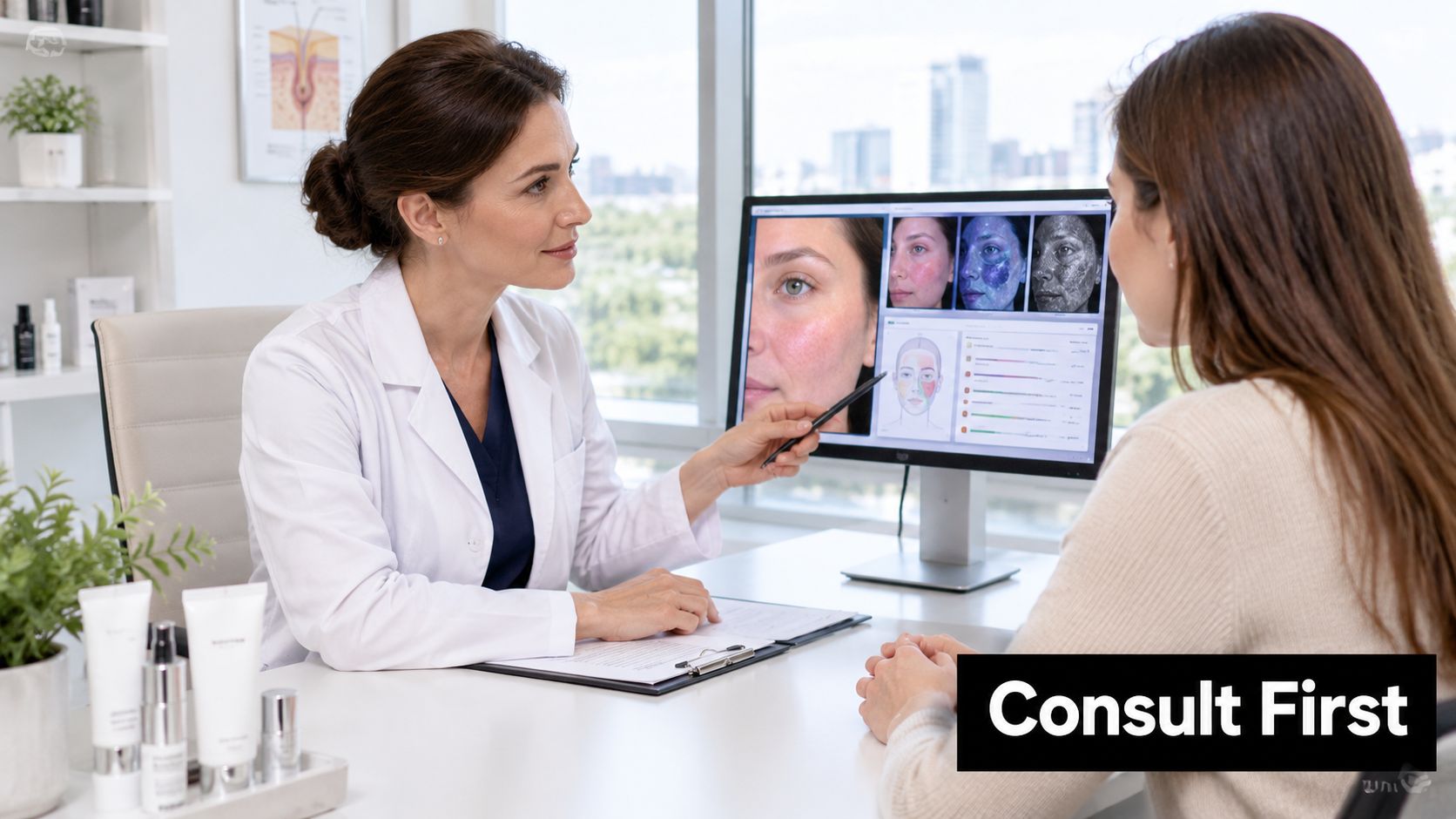
Questions worth asking
Ask which wavelength is being considered and why it suits your skin and hair. Ask how recent tanning changes the plan, what treatment endpoints the provider watches for during the session, how settings are recorded between visits, and what would make the clinic postpone or modify treatment.
A laser test spot is more rigorous than a cosmetic patch test, but the principle overlaps. You introduce a possible irritant or energy exposure carefully, then observe the response before treating more skin. For general skin-testing principles, this resource explains how to avoid skincare reactions with this test.
Why Different Body Areas Require Different Protocols
Your upper lip, underarms, bikini area, and legs don't behave like four sections of the same surface. Hair density, follicle depth, growth rhythm, skin sensitivity, friction, and hormonal influence vary by location. A full-body package may simplify booking, but it shouldn't force one protocol across every zone.
Facial hair often needs closer observation because hormonal influences can sustain regrowth and because facial skin is visible and sensitive. Underarms may contain dense, coarse hair and experience friction from clothing and deodorant. The bikini area combines concentrated pigment, sensitivity, and a high-friction environment. Legs cover a much larger surface and may show more predictable patterns, but the hair can be finer in some areas.
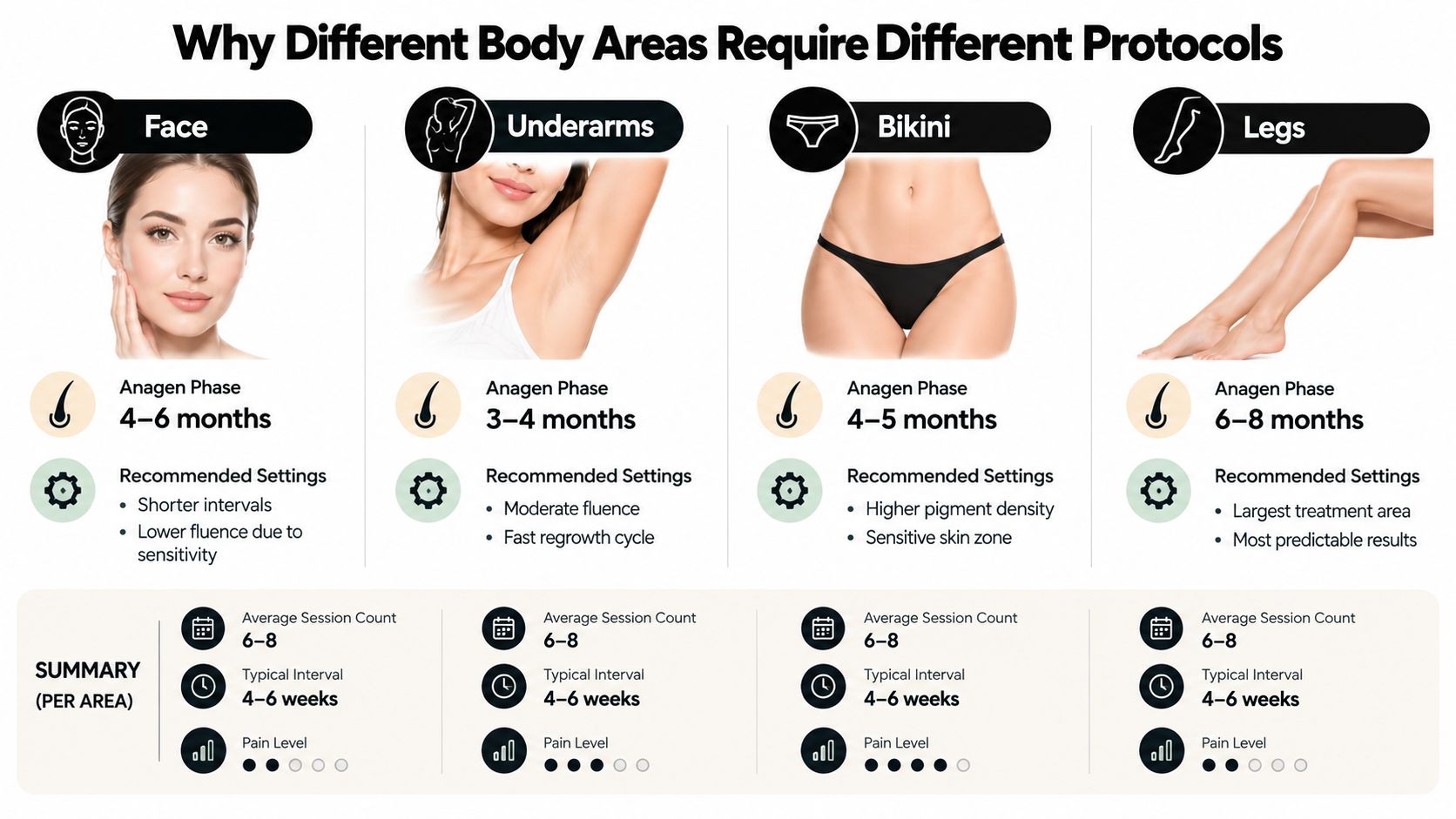
Area-specific decisions matter
A provider may adjust:
Wavelength: The same client may need different wavelength choices across sites when hair depth, skin pigmentation, or sensitivity varies.
Fluence: A sensitive facial zone may call for a more cautious approach than a coarse-hair area, while darker skin needs protection from excessive epidermal heating.
Pulse duration: Hair thickness influences how heat is delivered and contained.
Cooling: Sensitive sites may require particular attention to surface cooling and comfort.
Interval: Sessions should follow visible regrowth and the biology of the treated site instead of rigidly repeating the same appointment gap.
Rotational treatment adds another layer. Some clinicians use different wavelengths across a treatment course when a client reaches a plateau, rather than increasing energy blindly. A 2025 study of 60 patients receiving three-session rotational regimens reported temporary erythema in 99% and perifollicular edema in 98%, with no permanent scarring or pigmentary changes reported during follow-up, as described in the study of rotational laser treatment protocols. Those results are encouraging, but they don't turn rotational treatment into a universal protocol. The provider still has to decide whether the plateau reflects hair biology, treatment timing, settings, hormonal factors, or incomplete coverage.
A plateau is a reason to investigate, not an automatic reason to increase power.
During follow-up, a thoughtful provider tracks whether treated hairs shed, whether regrowth is slower or finer, whether missed patches remain, and whether irritation or pigment changes develop. If one area improves while another stalls, that difference is useful information. It may justify changing the wavelength, interval, cooling strategy, or treatment boundaries rather than applying more energy everywhere.
Understanding Treatment Packages and Zone Options
Treatment zones make planning easier, but they shouldn't replace a clinical assessment. NYC Laser Hair Removal organizes areas into Small, Medium, Large, and Extra Large categories, allowing a client to select a targeted zone or combine broader areas according to personal goals.
Comparing zone sizes
Zone category | Common treatment examples | Practical fit |
|---|---|---|
Small | Lip, chin, or another focused facial area | Useful when one localized area is the priority |
Medium | Underarms, bikini line, or similar regional zones | Suits clients addressing a defined body region |
Large | Full arms, larger bikini options, chest, or abdomen | Better for broader coverage in one region |
Extra Large | Full legs, back, or comparable extensive areas | Designed for clients treating substantial surface area |
The exact zone definition should be confirmed with the clinic because boundaries can differ. A “bikini” appointment may not include the same coverage as a full bikini or Brazilian treatment, and a “back” may be defined differently from shoulders or upper arms.
A single session provides access without requiring a long-term commitment. A 3-session or 6-session bundle can make more sense when your goal is a planned reduction series, but the value depends on whether the area, timing, and expected response fit your needs. Packages don't change the biology of the hair cycle, and a bundle shouldn't pressure you into treating areas you don't want.
A simple decision framework
Choose a smaller zone when you're testing your tolerance, addressing one priority, or uncertain about how your skin and hair will respond. Consider a larger zone when hair growth is continuous across the region and treating only a small portion would leave an unwanted contrast.
Before purchasing, ask what the package includes, whether touch-ups are separate, how long the package remains valid, and whether settings can be adjusted at each appointment. Laser hair removal package guidance can help you compare single appointments with multi-session planning, but the final choice should follow your treatment goals rather than the largest available option.
What to Expect Across Your Treatment Series
You come in after your first session, shave a few days later, and wonder why some hairs seem unchanged. That pattern is normal. Laser hair removal works on follicles that are actively growing and still connected to pigmented hair, so each appointment only catches part of the cycle.
What changes over a series is not just the amount of hair, but the pattern of regrowth. Early on, treated hairs often shed while other follicles keep producing visible stubble. After later sessions, many clients notice that regrowth slows, density drops, and the remaining hair feels finer. In practice, that is why clinics talk about permanent hair reduction rather than promising total removal. The standard is a lasting decrease in regrowing hair after the treatment course is finished, with follow-up measured over time, as noted earlier.
A realistic series has stages
A treatment series is usually planned as repeated sessions, but real customization goes further than booking the same visit over and over. Settings often need to change as the series progresses. A clinic may adjust wavelength choice, fluence, pulse structure, spot size, or cooling based on how quickly you shed, how much coarse hair remains, how your skin reacts, and whether a body area starts responding unevenly. That is the difference between a generic package and an actual protocol.
The NCBI review of laser hair removal reports diode-laser outcomes of roughly 65%–75% hair reduction three months after one to two treatments. The same review cites a series in which approximately 75% reduction in 91% of patients was seen eight months after three to four treatments at 40 J/cm². Those figures are useful for setting expectations, but they are not a personal forecast. Body area, hair thickness, hormones, skin type, device choice, and operator technique all affect the result.
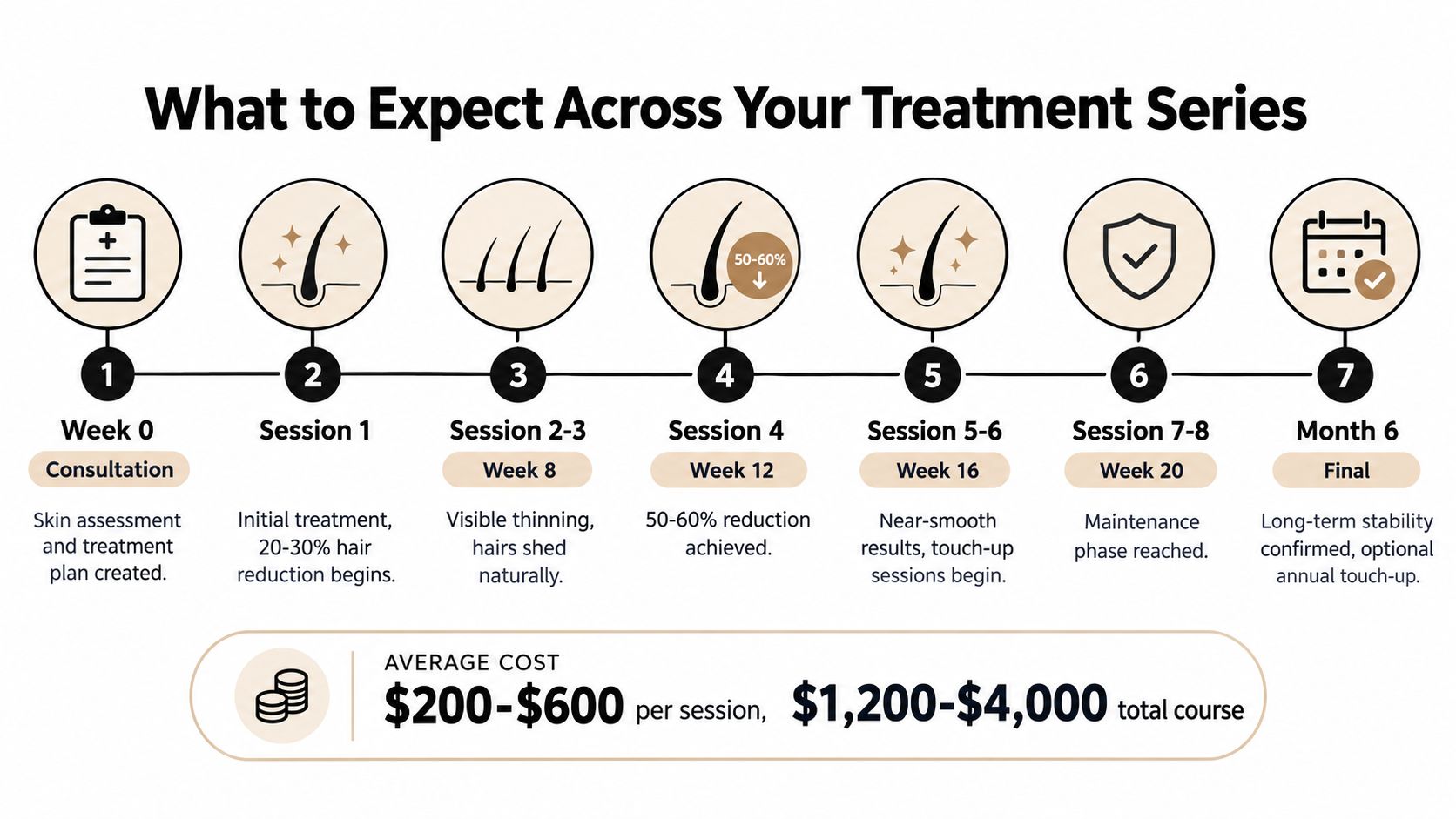
Between appointments, leave the root in place. Plucking and waxing remove the target the laser needs, while shaving usually fits treatment prep. Protect treated skin from sun exposure, follow aftercare closely, and report blistering, unusual pain, ongoing irritation, or pigment changes promptly. Waiting until the next routine visit can make it harder to adjust safely.
Maintenance is part of the plan
Long-term reduction still allows for later regrowth. Hormonal shifts, dormant follicles becoming active, and individual biology can all change what happens after a successful series. Maintenance works best when it follows visible, measurable return of hair, not an automatic package schedule.
Good progress tracking helps. Use consistent photos and note shedding, regrowth speed, texture, missed patches, discomfort, and pigment changes. Those details tell an experienced provider whether to continue the same approach, rotate parameters, change timing, or look for a factor outside the laser itself.
The video below offers a visual introduction to what treatment can involve:
Comments