
Back Hair Removal for Men: Methods, Costs, and Results
You can't see most of your back, can't reach the middle properly, and probably don't want to ask someone to shave it every few days. So the routine becomes familiar: a rushed shave before the beach, missed patches under the shoulders, prickly regrowth beneath a gym shirt, and irritation that lasts longer than the smoothness. Back hair removal for men is not a small-area grooming problem. It's a large, recurring maintenance job.
The right question isn't which method sounds cheapest today. It's which method can handle a broad, often dense area without trapping you in a cycle of stubble, pain, chemical irritation, or repeated appointments. For most men with pigmented back hair, that answer is laser reduction, provided the clinic evaluates your skin, hair, sun exposure, and medical history before treating the entire area.
Why the Back Is the Hardest Area for Men to Manage
A man can shave his chest in front of a mirror. He can reach most of his legs. His back is different. The surface is wide, the hair pattern changes across the shoulders and lower back, and the places he can't see are exactly where razors and trimmers miss.

A typical home attempt starts with a long-handled razor, a bathroom mirror, and more optimism than visibility. The result is often uneven. The upper back gets attention, the center is patchy, and the lower back becomes a guessing game. Within days, short stubble catches on clothing, while friction from gym shirts or backpacks can make the skin feel rough and irritated.
Back hair is also common enough that clinics shouldn't treat it as an unusual cosmetic concern. In a peer-reviewed study of 364 men, 138 participants, approximately 38%, reported hair on their backs, while 306 participants, or 84.1%, reported removing hair from at least one body area below the neck (peer-reviewed study of male body-hair removal). That sample isn't a global census, but it makes the practical point: many men actively manage body hair, and the back is one of the least convenient places to do it alone.
Why temporary methods become a recurring tax
Shaving solves the visible problem briefly, then creates another one. Waxing reaches the whole area but requires regular appointments and a willingness to tolerate painful removal. Creams may cover a broad zone, yet the back is a poor place to experiment with chemical irritation because you may not notice a reaction until it's widespread.
Practical rule: If a method requires someone else to reach your back every time, or leaves you repeating the same full-area process as soon as hair returns, judge it as ongoing maintenance rather than a one-time fix.
That's why a useful guide to hair on the back should focus less on embarrassment and more on logistics. The back is large, difficult to inspect, exposed to sweat and clothing friction, and often covered with hair of varying thickness. A method that works well on a small patch may become frustrating when applied across the entire back.
Comparing Every Back Hair Removal Method Side by Side
For back hair, the important criteria are simple: coverage, durability, discomfort, skin reaction, and repeat cost. A method can be inexpensive per appointment and still become expensive in time and repetition. Another can feel effective for a few weeks but leave you planning the next appointment before the irritation has fully settled.
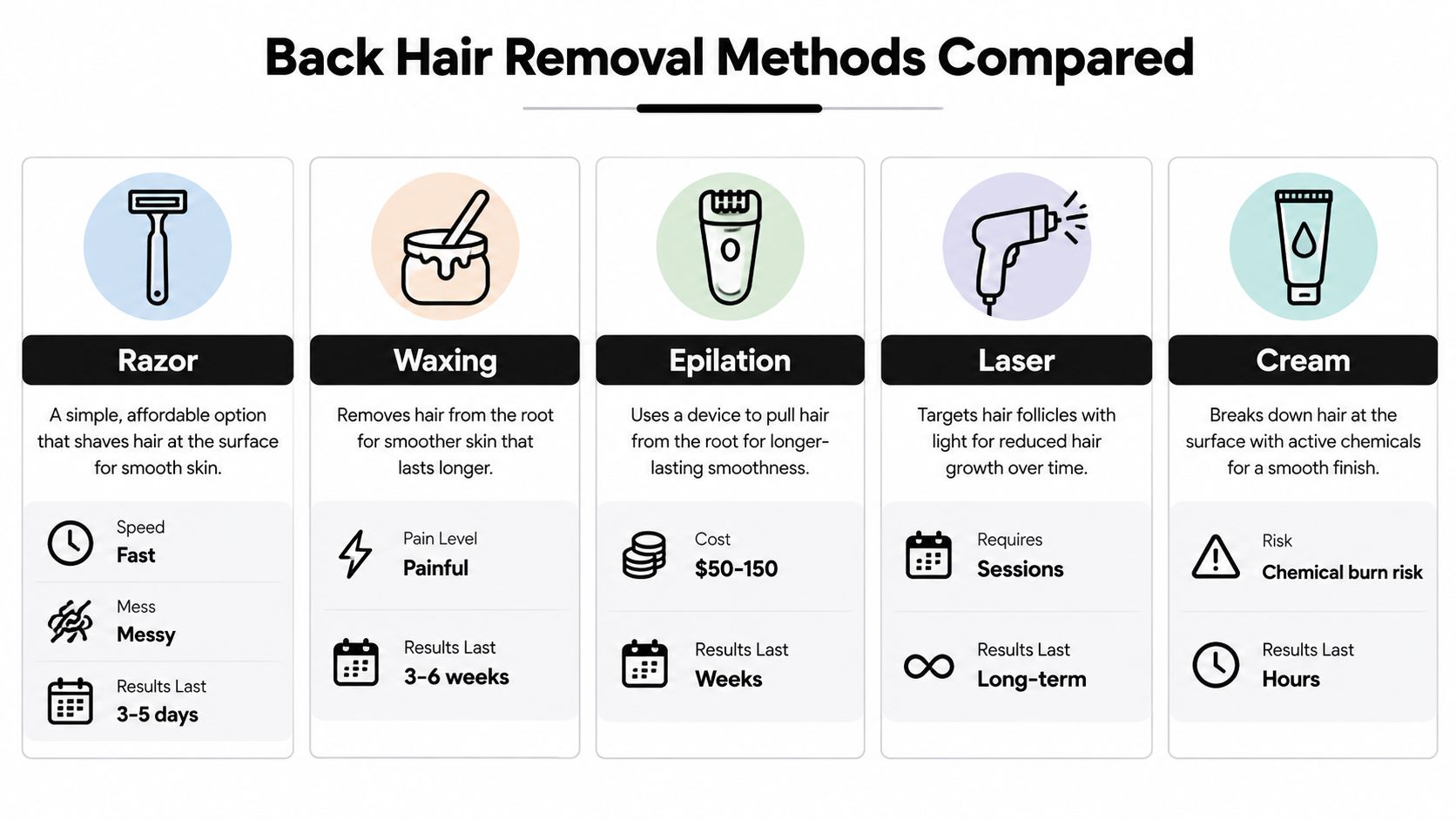
Method | Lasts | Pain | Annual Cost | Works on Dense Growth |
|---|---|---|---|---|
Razor | Short-lived | Low during use, irritation possible | Repeated purchases and time | Yes, but stubble returns quickly |
Waxing | Longer than shaving | High for many clients | Repeated appointments | Yes, if the skin tolerates it |
Depilatory cream | Brief | Low if tolerated, chemical irritation risk | Repeated product use | Sometimes, but patch testing matters |
Electrolysis | Permanent treatment of targeted follicles | Variable | Impractical for full-back coverage | Technically, but too slow for most backs |
Laser | Long-term reduction after a series | Usually tolerable, with brief heat or snaps | Higher upfront commitment, lower routine burden | Often well suited to dark, coarse hair |
Shaving and waxing
Shaving is the method I'd recommend only when you need a temporary result and accept the upkeep. It's cheap, familiar, and fast in the hands of a professional, but it doesn't reduce the follicle. On your back, missed strips and rapid stubble make the result unreliable.
Waxing removes hair from the root, so it can keep the skin smoother for longer than shaving. The trade-off is pain, repeated appointments, and a higher chance of post-treatment bumps when sweat and friction affect freshly treated skin. It's a poor long-term plan for a man who wants consistent full-back reduction.
Creams and electrolysis
Depilatories deserve a cautious approach. A cream that sits too long can irritate or burn skin, and applying it evenly across a back you can't inspect is difficult. Always follow the product instructions and patch test if you use one, but I wouldn't make chemical cream the default strategy for dense full-back growth.
Electrolysis has a legitimate role for individual hairs or small areas because it treats follicles one by one. Full-back treatment, however, demands a level of time and tolerance that most clients won't want.
Laser is the only option in this comparison that scales sensibly to a large back while reducing future growth. The treatment still requires a series, but it replaces endless surface-level removal with follicle-focused reduction. A broader guide to permanent unwanted-hair removal options can help you compare the same principle across other body areas.
How Laser Hair Removal Actually Works on a Man's Back
Laser works by directing light toward pigment in the hair follicle. The absorbed energy creates heat that damages the follicle's ability to produce the same level of growth. Dark, coarse back hair is often a strong target because it contains visible pigment, although the provider still has to balance hair absorption against the pigment in your skin.
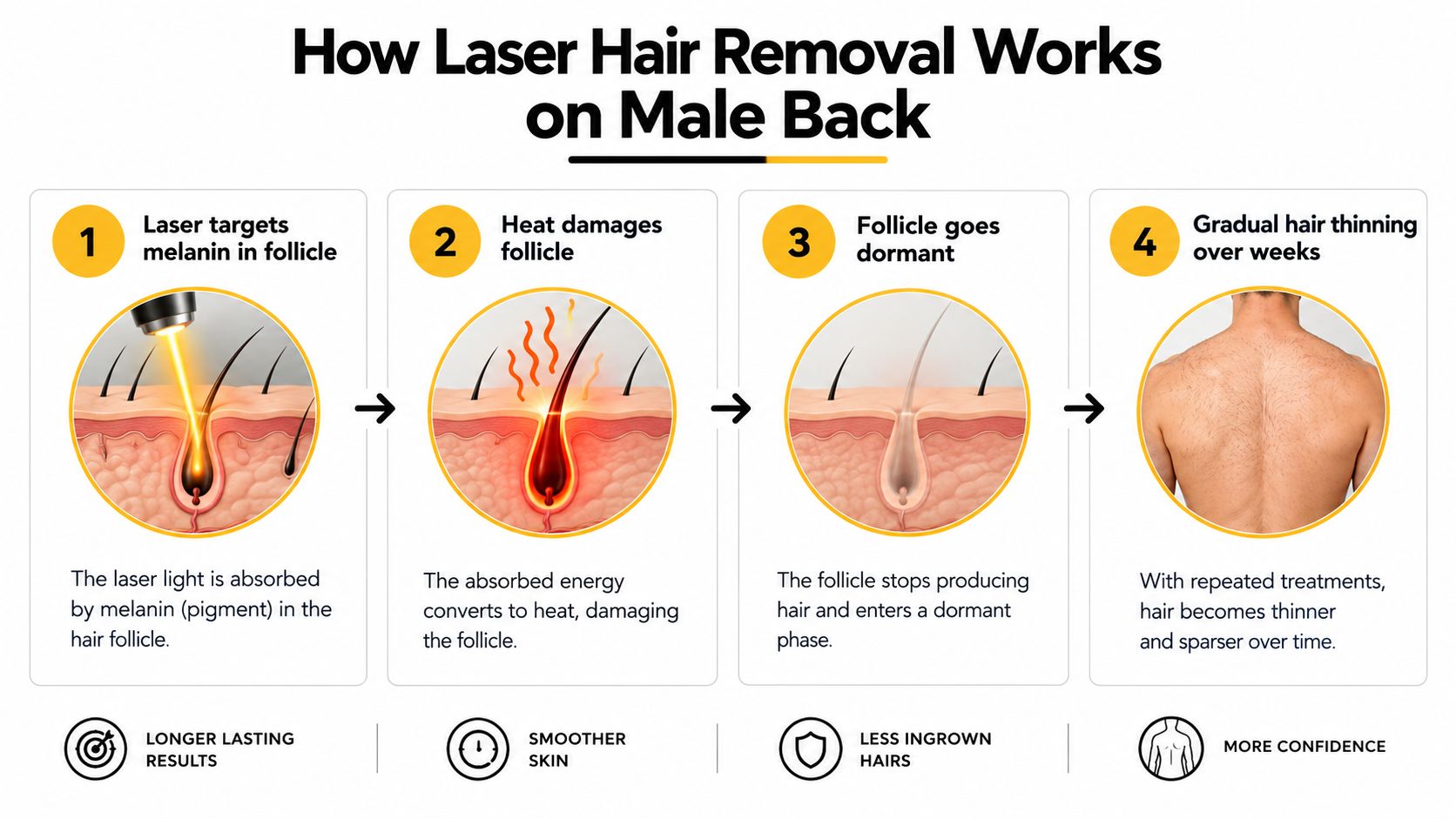
A real appointment should feel controlled, not rushed. The provider reviews your skin tone, recent tanning, hair characteristics, medications, and treatment goals. They inspect the back for tattoos, irritation, acne, or other areas that need to be avoided or handled differently. The skin is then prepared, the device is positioned over the treatment zone, and cooling helps protect the surface while the laser delivers pulses.
Why Splendor X is relevant to variable back hair
Splendor X uses dual-wavelength capability, combining Alexandrite 755 nanometers and Nd:YAG 1064 nanometers in a single pulse. That matters because male back hair isn't uniform. One area may have thick, dark growth, while another has finer or less dense hair. A dual-wavelength platform gives the provider more flexibility than a one-setting approach.
That doesn't mean the machine chooses the treatment plan for you. Laser parameters must be individualized to skin pigmentation, hair diameter, density, and cooling. A literature review describes protocols for chest, abdomen, and back using approximately 24 to 35 J/cm², pulse durations of 30 to 50 milliseconds, and intervals of roughly five weeks, but those figures are reference points, not instructions to copy onto every client (laser hair-removal literature review).
What you're paying for: not just pulses from a device, but assessment, parameter selection, cooling, coverage, and a plan that respects your skin's safety margin.
Expect the back to take longer than a small treatment zone. The exact appointment time depends on the area being treated, hair density, skin findings, and the clinic's workflow. The process should be tolerable, with brief warmth or snapping sensations rather than the sustained pulling associated with waxing.
This overview of laser hair-removal technology gives additional background on the treatment platform and how clinics use laser energy for reduction.
Here's a visual walk-through of the process:
How Many Sessions It Takes and What Reduction Really Means
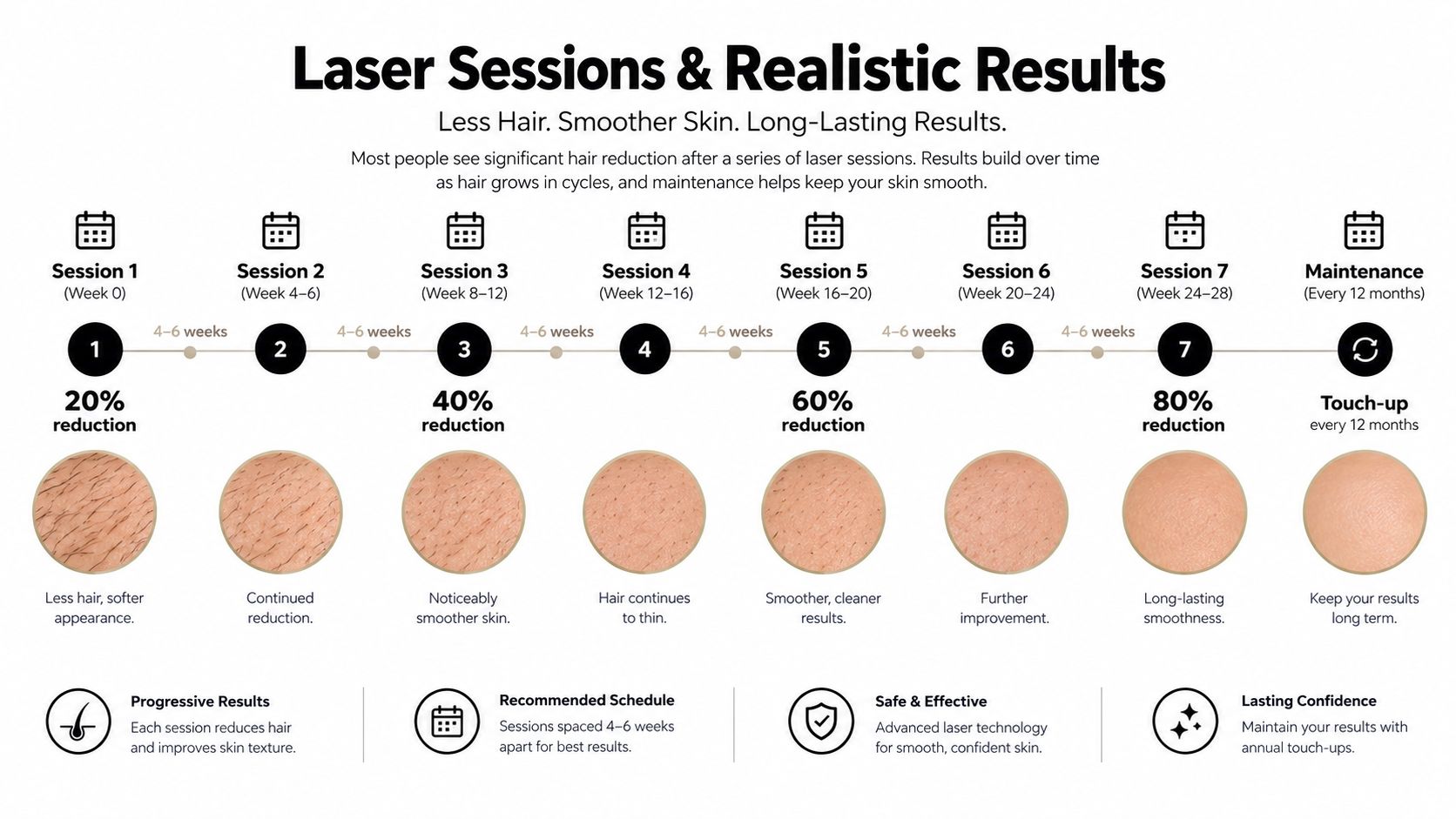
Laser hair removal is a series treatment, not a one-appointment solution. Hair follicles move through growth phases, and laser works most effectively when the target hair is in a responsive growth phase. Treating the same area repeatedly allows the provider to reach follicles that weren't vulnerable during the previous appointment.
For a large male back, plan around six to eight sessions, generally spaced by approximately six to eight weeks, although the provider may adjust timing according to your regrowth pattern and treatment response. A clinic that promises complete clearance after one visit is selling you the wrong expectation.
A 2023 clinical report followed 20 men with a mean age of 30.5 years and treated the chest and back with four 810-nanometer diode-laser sessions, scheduled 40 days apart. The combined treated areas showed 80.6% hair reduction, plus or minus 2.8 percentage points (2023 clinical report on male trunk hair reduction). That result is useful, but it isn't a guarantee, and it applies to the combined chest-and-back region rather than the back alone.
Reduction is not the same as total removal
An 80.6% reduction doesn't mean every client sees a perfectly hairless back. It means the treated region had substantially less hair under that study protocol. The remaining hair may be uneven, finer, lighter, or affected by hormonal regrowth. Some men are satisfied with controlled reduction rather than a completely bare appearance, while others want the closest possible clearance.
Ask for a reduction plan, not a permanent-hair-free promise.
After the initial series, some clients may choose occasional maintenance for new or returning growth. The schedule should respond to what you see, not lock you into an unexplained open-ended contract. A sensible provider will photograph or document the starting point, assess progress during the series, and explain what touch-up treatment would mean for your specific pattern.
Preparing for a Session and Caring for Your Back Afterward
Preparation affects both safety and comfort. The back is difficult to inspect yourself, so arrange help with shaving or ask the clinic whether they provide preparation. Shave rather than wax or tweeze before laser, because the follicle needs to remain present for the laser to target it.
Use this checklist:
Shave before treatment: Follow the clinic's timing instructions, commonly close to the appointment rather than removing the root.
Avoid tanning: Don't arrive with a recent tan or self-tanner on the treatment area. Extra pigment can narrow the safety margin.
Review medications: Tell the provider about new prescriptions, over-the-counter products, and anything that may increase photosensitivity.
Mention tattoos and skin changes: Tattoos on the back require avoidance or shielding, and active irritation should be assessed before treatment.
Plan around outdoor activity: Vacations, beach days, and prolonged sun exposure can force a schedule change.
After treatment, mild redness or warmth can occur. Keep the area cool and clean, avoid hot showers, saunas, and intense friction for the period your provider recommends, and choose loose clothing while the skin settles. Don't scrub freshly treated skin or apply irritating exfoliants immediately.
The back also needs practical sun protection. Use broad-spectrum SPF 30 or higher, as recommended by Mayo Clinic guidance for laser hair removal, and ask someone to help cover the center of your back if you can't apply sunscreen evenly (Mayo Clinic guidance on laser hair removal).
For general aftercare principles around protecting healing skin from friction, heat, and contamination, the Fountainhead New York aftercare guide is a useful practical reference, although laser treatment isn't tattooing and your clinic's instructions take priority.
When Laser Back Hair Removal Is Not the Right Choice
Laser isn't the right tool for every hair or every appointment. The first problem is pigment. White, gray, red, and very light blond hair may respond poorly because the laser needs pigment in the hair to absorb energy. If most of your back hair lacks pigment, ask whether electrolysis or another method makes more sense for the remaining hairs.
Skin tone and recent sun exposure also change the decision. The American Academy of Dermatology states that people of all skin tones can undergo laser hair removal, but the operator must have experience treating that skin tone. Inexperienced treatment can cause burns, blisters, infection, or dark spots (American Academy of Dermatology guidance).
The complication most general articles skip
Paradoxical hypertrichosis means hair becomes unexpectedly denser or darker after treatment. It's uncommon overall, and the evidence is inconsistent. A 2025 retrospective study of 318 patients reported it in 33.3% of male patients and 9.0% of female patients, with the back the most affected male site, occurring in 10 of 63 men, or 15.9%. A broader meta-analysis cited in the same evidence discussion reported a pooled prevalence of approximately 3% overall and 0.08% in non-facial and non-neck areas, showing why no single estimate should be treated as universal (2025 retrospective study on paradoxical hypertrichosis).
The practical response is not panic. It's better screening. A clinic should distinguish normal shedding and uneven regrowth from genuinely increased density, document your baseline, perform a conservative test spot when appropriate, and reassess before committing to a full-back series.
Ask these questions before you book:
Who evaluates my skin and recent sun exposure?
Will you perform a test spot or staged assessment if my risk profile warrants it?
How will you document and manage unexpected increased growth?
What happens if my hair is too light for the laser to target effectively?
If the answers are vague, or the provider guarantees complete removal regardless of skin tone and hair color, choose another consultation.
Packages, Pricing, and What a Back Series Actually Costs
Clinics commonly group treatment zones as small, medium, large, and extra-large. A full male back usually belongs in the extra-large category because the provider is treating a broad surface rather than a narrow strip. Confirm whether shoulders, lower back, and nearby areas are included, since “back” can mean different boundaries from one clinic to another.
The sensible way to compare packages is by commitment level:
Package approach | Best for | What to confirm |
|---|---|---|
Single session | Testing comfort and evaluating the consultation | Whether the payment applies only to the back and what follow-up costs |
Three-session bundle | Seeing a meaningful midpoint change without committing to a full series | Expiration rules and whether the package can be adjusted |
Six-session bundle | Starting a structured reduction series | What additional sessions or maintenance cost later |
NYCLASER lists male back treatment as an extra-large zone, with a typical per-session range of $210 to $450 based on the publisher information provided for this clinic. Pricing can vary with the exact treatment boundary, hair density, package structure, and whether shoulders or other areas are added, so request a written quote rather than relying on a generic area label.
The first appointment should clarify more than price. Ask whether the consultation includes a skin assessment, how the provider handles recent tanning, whether tattoos are shielded, how the Splendor X settings are selected, and what the clinic considers a completed series. If you're treating chest and back together, ask whether the combined plan changes the zone classification or package terms.
Be wary of a “cheap” single session that gives you no pathway to consistent follow-up. For most men, three sessions are useful for evaluating response, while six sessions represent a more serious starting point. Neither guarantees a fixed final result, and any responsible quote should leave room for individual variation.
Getting Started with NYCLASER on Long Island
If your back hair is dark or otherwise pigmented, dense enough to be a recurring nuisance, and you're tired of shaving or waxing the same large area, laser is the method I'd investigate first. It's the only option here that combines broad coverage with long-term reduction rather than cutting or pulling the hair that's already visible.
Splendor X is relevant because male back hair often varies in thickness and density across the treatment zone. Its dual-wavelength capability gives the provider flexibility, but the technology doesn't remove the need for judgment. Your clinic should still review skin tone, tanning, medications, tattoos, hair color, and your preferred level of reduction before treating the full back.
NYCLASER's Westbury location is at 355 Post Avenue, Suite 101, Westbury, NY 11590. The clinic offers single sessions and three- or six-session bundles, and its stated hours are Monday through Saturday, 10 a.m. to 6 p.m. Mention the back specifically when booking so the team can discuss the extra-large zone, expected appointment length, and whether a three-session evaluation or six-session series fits your goal.
Bring these questions to the consultation:
What exact area does the back price include?
How will you adjust treatment for my skin tone and hair density?
What should I do if I've recently been in the sun?
Will you document my baseline and reassess response?
What is the maintenance plan if some hair returns?
Don't sign up because a package sounds convenient. Book when the provider has given you a clear safety assessment, realistic reduction expectations, and a price that matches the area being treated.
NYC Laser Hair Removal offers personalized back-hair reduction for men using Splendor X, with consultation-led planning for large treatment zones and multi-session care. Visit NYC Laser Hair Removal to review the Westbury clinic's options and book a consultation for your back.
Comments