
Bikini Line Hair Removal Laser: Long Island Guide 2026
You've probably reached the point where shaving the bikini line feels less like grooming and more like a recurring chore. The razor burn returns, ingrown hairs appear at the worst time, and waxing brings its own discomfort and scheduling demands. You may also be wondering whether laser treatment will hurt, whether it's safe for your skin tone, and whether the result will justify the commitment.
Bikini line hair removal laser treatment works best when you view it as a staged reduction process, not an instant eraser. Each session targets a different group of active follicles, so the outcome develops gradually. With the right wavelength, conservative settings, and realistic expectations, treatment can reduce recurring grooming without asking you to ignore the sensitive anatomy of the area.
Why Bikini Line Laser Hair Removal Is Worth the Investment
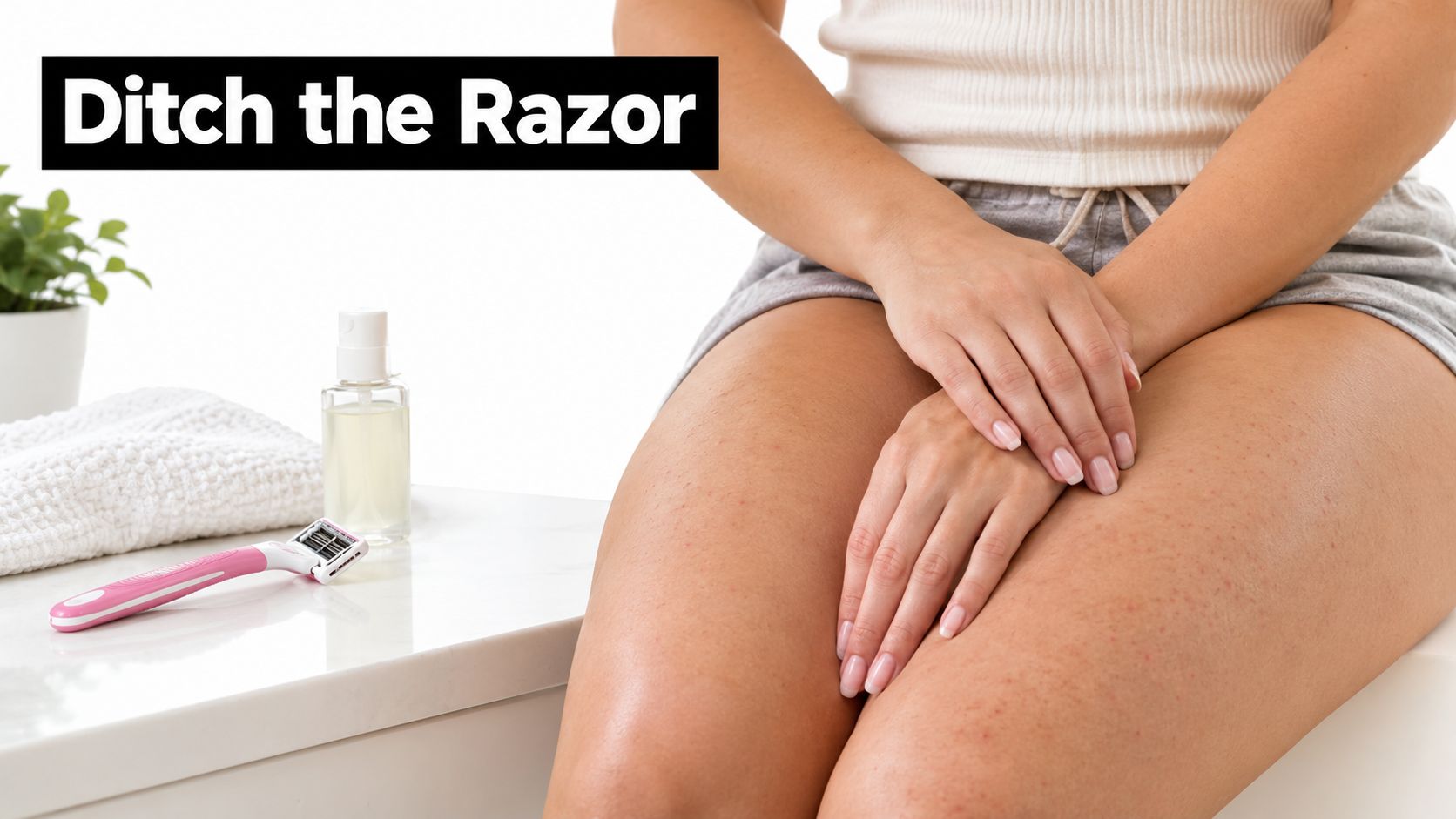
You shave before a beach day, feel smooth for a short time, then notice stubble, irritation, or an ingrown hair. Waxing may last longer, but it still requires appointments and can leave the skin tender. The repeated cycle is frustrating because each method removes visible hair without addressing the follicle's ability to produce new growth.
Laser treatment takes a different approach. Focused light reaches the hair follicle and uses pigment in the hair as a target. The goal isn't to create a perfect result after one appointment. It's to progressively reduce the follicles that respond, session by session, until regrowth becomes less noticeable and less demanding to manage.
From experimental treatment to routine care
Laser hair removal has been used for the bikini line for decades. The procedure was first applied in 1996, and the U.S. Food and Drug Administration approved the first laser hair-removal approach in 1997, according to Mayo Clinic's overview of laser hair removal. By the early commercial era, the technology had moved beyond experimental use and become a mainstream cosmetic treatment.
The bikini line is now considered a standard treatment area, alongside locations such as the legs, underarms, upper lip, and chin. Mayo Clinic also notes that most patients need 4 to 8 treatments spaced several weeks apart for the best results, although a provider may adjust the plan according to hair density, skin response, and treatment goals.
Practical perspective: The value isn't only the appearance of smooth skin. It's reducing how often you have to shave, wax, or manage irritation in a high-friction area.
A long-term convenience decision
Laser hair removal makes sense for someone who is tired of maintaining the same area repeatedly. It can be especially appealing if shaving triggers bumps or if waxing causes persistent sensitivity. The treatment doesn't promise that every follicle will disappear permanently, and it shouldn't be sold that way. The more accurate expectation is long-lasting hair reduction with possible maintenance.
The upfront commitment can feel substantial because the treatment plan involves multiple visits. The payoff is practical rather than dramatic overnight transformation: less visible regrowth, fewer grooming interruptions, and more predictable skin between appointments. A consultation should clarify whether you want a conservative bikini-line shape, a broader treatment area, or a more extensive option, since those choices affect the treatment plan.
How Laser Hair Removal Actually Works
Laser hair removal relies on a principle called selective photothermolysis. In plain language, the device sends a controlled pulse of light toward the pigment in the hair. That pigment absorbs the energy and converts it into heat, allowing the provider to damage the follicle while limiting exposure to the surrounding skin.
Think of the hair pigment as a target inside the follicle. The laser isn't trying to heat the entire surface of the bikini area. It's aiming for the darker structure that can carry energy downward. The result depends on the contrast between the hair and the skin, the selected wavelength, the pulse settings, cooling, and the provider's technique.
Why the hair doesn't vanish immediately
Laser treatment doesn't pull the hair out the way waxing does. The follicle has to respond to the heat, and the treated hair may remain visible before it sheds naturally. That delay can make a first-time client worry that the session failed, even when the expected process is underway.
The more important limitation is the hair-growth cycle. Follicles aren't all active at the same time, and laser energy is most effective when a follicle is in the anagen growth phase. The NCBI clinical reference on laser hair removal explains why repeated treatments are necessary, since a single session cannot reach every follicle during its laser-sensitive stage.
What the treatment schedule is doing
A standard initial regimen is 4 to 6 sessions spaced 4 to 6 weeks apart, according to the same NCBI reference. The interval gives the skin time to settle and allows a different group of follicles to enter a responsive phase. Treating too frequently doesn't automatically accelerate the biology of hair growth.
The bikini area often responds well because pubic hair can contain substantial pigment, which gives the laser a clearer target. Strong contrast, particularly light skin with dark hair, generally allows more efficient energy absorption in the follicle while limiting absorption by the epidermis. That advantage doesn't eliminate the need for individualized settings, especially when the skin contains more melanin.
For a more detailed explanation of device mechanics, laser hair removal technology provides additional context. The useful takeaway is simple: the laser disables responsive follicles progressively, and the visible result should be judged across a series rather than after one appointment.
Safety and Efficacy Across All Skin Tones
The question isn't whether darker skin can ever receive laser hair removal. The question is whether the provider is choosing a wavelength and treatment approach that accounts for the melanin in the skin as well as the pigment in the hair.
Shorter wavelengths, including ruby and alexandrite, can be effective for lighter skin tones. They also interact more readily with epidermal melanin, which can increase the risk of pigment changes in darker skin. Longer wavelengths, such as Nd:YAG, penetrate in a way that reduces epidermal melanin absorption and are generally preferred for darker or tanned skin.
Laser Type | Best For Skin Tone | Safety Profile |
|---|---|---|
Ruby | Lighter skin tones | Can be effective, but carries greater pigment-change risk when the skin contains more melanin |
Alexandrite | Lighter skin tones | Efficient for suitable contrast, with increased caution required for darker complexions |
Nd:YAG | Darker or tanned skin | Reduces epidermal melanin absorption and is commonly selected when pigment safety is a priority |
Why wavelength selection matters
A provider shouldn't select a laser based only on the treatment area. The decision should account for your current skin tone, recent sun exposure, hair color, hair thickness, sensitivity, and history of pigment changes. A test spot and conservative starting settings can provide useful information before treating the full area.
A review published in the Journal of Cosmetic and Laser Therapy reports that temporary effects such as erythema, perifollicular edema, and pain are usually observed after treatment. It also reports pigmentary alterations reaching up to 19% in some studies with shorter wavelengths in darker skin, compared with about 2% to 3% with Nd:YAG in the cited comparisons.
Effectiveness without false promises
Darker skin isn't a reason to assume treatment won't work. It is a reason to demand an appropriate platform and a provider who understands how to control energy delivery. Treatment may require a more cautious progression, and the result can depend heavily on the contrast between hair and skin.
A good consultation should include questions about your skin's response to inflammation, any recent tanning, previous laser treatments, and whether the provider treats the exact anatomical area you want addressed. Laser treatment for a dark bikini area should be approached as a customized procedure, not as a one-setting service applied identically to every client.
Navigating Pain, Risks, and Realistic Results
Most clients describe the laser sensation as a quick snap, prick, or flick similar to a rubber band. The bikini line can feel more intense than areas with thicker skin because it's sensitive and exposed to friction, but the sensation is brief and the provider can adjust technique, cooling, and settings.
Cooling is an important part of comfort and skin protection. A responsible provider should explain what you'll feel, check your reaction during treatment, and avoid escalating energy just to chase faster results. More intensity isn't automatically better, particularly in an area where the skin is thinner and more reactive.
What happens during a typical visit
The provider reviews your skin and hair. Recent tanning, medications, irritation, and previous reactions can affect whether treatment should proceed.
The area is prepared. The skin should be clean and free of products that could interfere with treatment. Protective eyewear is used, and the provider confirms the boundaries of the bikini area.
A test or starting pass may be performed. This helps the clinician evaluate comfort and skin response before proceeding with the full area.
The laser is applied in controlled pulses. You may notice warmth, snapping sensations, or a smell caused by the interaction between the laser and hair. The provider should keep communication open throughout the appointment.
The skin is assessed afterward. Mild redness, tenderness, or perifollicular swelling can occur and is usually temporary. These effects are common responses, but they aren't proof that a treatment was perfectly calibrated, so persistent or severe symptoms deserve prompt attention.
The risks specific to the bikini area
The bikini line, labia, and broader genital region shouldn't be treated as interchangeable. The exact subarea, skin thickness, hair density, and degree of friction all influence the risk profile. A literature review in the Journal of Cosmetic and Regenerative Medicine describes reported complications in genital-area hair removal, including pain, sensory changes, redness, blistering, crusting, pigment changes, burns, and synechia.
That same review documents a second-degree burn case requiring hospitalization after excessive fluence and inadequate cooling. This is why conservative fluence, appropriate cooling, test spots, and informed consent aren't optional details. They are central to safe treatment.
The goal is controlled follicle reduction, not the most aggressive pulse a client can tolerate.
Results should also be assessed. You may notice slower or thinner regrowth before you see a broadly smooth appearance. Hormonal factors, hair color, follicle depth, skin type, and adherence to the treatment schedule can all affect the pace. A clinic that promises instant complete clearance is setting an expectation the biology of hair growth cannot support.
Essential Pre- and Post-Treatment Care
Your preparation affects both comfort and safety. The follicle needs to remain available as a target, while the surface skin should arrive calm, clean, and free from avoidable irritation.
Before the appointment
Avoid waxing, plucking, or threading before treatment because those methods remove the hair from the follicle. Shaving is different. It leaves the follicle in place while reducing the amount of hair above the skin, but follow the timing and shaving instructions supplied by your provider.
Sun exposure and tanning can make the skin more reactive and change how the laser interacts with pigment. Tell the clinic about recent outdoor exposure, tanning products, irritation, rashes, or active skincare products used in the area. Arrive with clean, product-free skin unless the clinic gives you different instructions.
Keep the root intact: Don't pluck or wax between planned laser sessions unless your provider specifically changes the treatment plan.
Reduce friction: Wear loose, breathable clothing and underwear to limit rubbing during the appointment and afterward.
Report relevant changes: Mention new medications, skin conditions, pregnancy concerns, or unusual sensitivity before treatment rather than waiting until the laser is in use.
After the session
The treated skin may feel warm, pink, or tender. Use only the soothing products your provider recommends, and avoid applying fragranced products or aggressive active ingredients to the area while it settles. Friction, intense heat, and activities that leave the area damp or irritated can make discomfort worse.
Don't scrub away visible hairs or try to pull them out. Shedding occurs gradually, and rough exfoliation can aggravate the skin. Once your provider confirms that the surface has recovered, gentle exfoliation may help with routine skin maintenance, but it shouldn't be used to compensate for overly aggressive treatment.
Post-laser skin care guidance can help you organize the practical steps after an appointment. If redness intensifies, blistering develops, pain becomes severe, or pigment changes persist, contact the treating clinic for specific advice instead of attempting to manage the reaction with household products.
What results can reasonably look like
The early result is reduction, not necessarily clearance. A prospective study cited in this report on at-home laser hair removal devices found average bikini-line hair reduction of 48.1% after three months across skin types. The reported reduction was 45.5% for lighter skin types I to IV and 40.3% for darker skin types V to VI.
Those figures help set a useful expectation. Treatment can work across skin tones, but the outcome after an early treatment period is usually partial and staged. Skin type alone doesn't determine success, and clients should also ask which platform is being used, how the settings will be selected, and what maintenance may be appropriate.
Choose NYC Laser for Lasting Results in Westbury
Choosing a clinic for bikini line treatment requires more than checking whether the service appears on a menu. Ask how the provider evaluates skin tone, whether the platform can be adjusted for different complexions, how cooling is used, and whether the treatment plan distinguishes the outer bikini line from more sensitive genital areas.
NYC Laser Hair Removal in Westbury offers bikini line, Brazilian, and other body-area treatments using the Splendor X platform. The clinic describes the system as suitable for customized treatment across diverse skin and hair types. A consultation can help determine whether the intended area is appropriate, what degree of reduction is realistic, and how the treatment settings should be approached.

The Westbury location is practical for Long Island and Nassau County clients who want a professional treatment plan close to home. The clinic offers single sessions as well as 3-session and 6-session packages, giving clients a way to structure a progressive reduction plan instead of treating each appointment as an isolated purchase.
Questions to bring to your consultation
Which area will be treated: Confirm whether your plan covers only the underwear line, an extended bikini area, or a broader Brazilian treatment.
Which wavelength and settings are appropriate: Ask how the provider will account for your current skin tone, hair pigment, tanning history, and sensitivity.
What discomfort control is available: Discuss cooling, communication during the session, and what sensations are expected.
How progress will be assessed: Ask when the clinic expects to review reduction and how it will decide whether settings or scheduling need adjustment.
What aftercare applies to you: Get written instructions for products, friction, heat, sun exposure, and warning signs.
A well-run appointment should leave you informed rather than rushed. You should understand that laser treatment is a sequence of controlled decisions, and that the safest route to lasting reduction may involve gradual progress rather than maximum intensity at the first visit.
For a closer look at how the treatment fits into a typical clinic experience, watch the video below.
If shaving and waxing have become a cycle of irritation and maintenance, book a consultation at NYC Laser Hair Removal to discuss bikini-line reduction with the Splendor X system, your skin tone, and your preferred treatment area. Visit NYC Laser Hair Removal to review the Westbury clinic's options and choose a session or package that fits your goals.
Comments