
Laser Hair Removal Black Skin
You're sitting in a consultation room, ready to ask about laser hair removal, but one question keeps returning: will this treatment be safe for my skin? If you have Black or richly pigmented skin, that concern isn't irrational. The wrong wavelength or overly aggressive settings can raise the risk of burns and pigment changes.
The good news is that laser hair removal for Black skin can be safe and effective when the provider matches the technology and settings to your skin and hair. The important question isn't whether a clinic offers laser treatment. It's whether the team understands wavelength physics, cooling, test spots, treatment intervals, aftercare, and the fact that results build gradually.
Why Laser Hair Removal for Darker Skin Requires a Different Approach
A client with a deep skin tone may arrive expecting a simple answer: safe or unsafe. A responsible clinician gives a more useful answer. Safety depends on which wavelength is used, how much energy is delivered, how long each pulse lasts, how the skin is cooled, and how the skin responds during and after treatment.
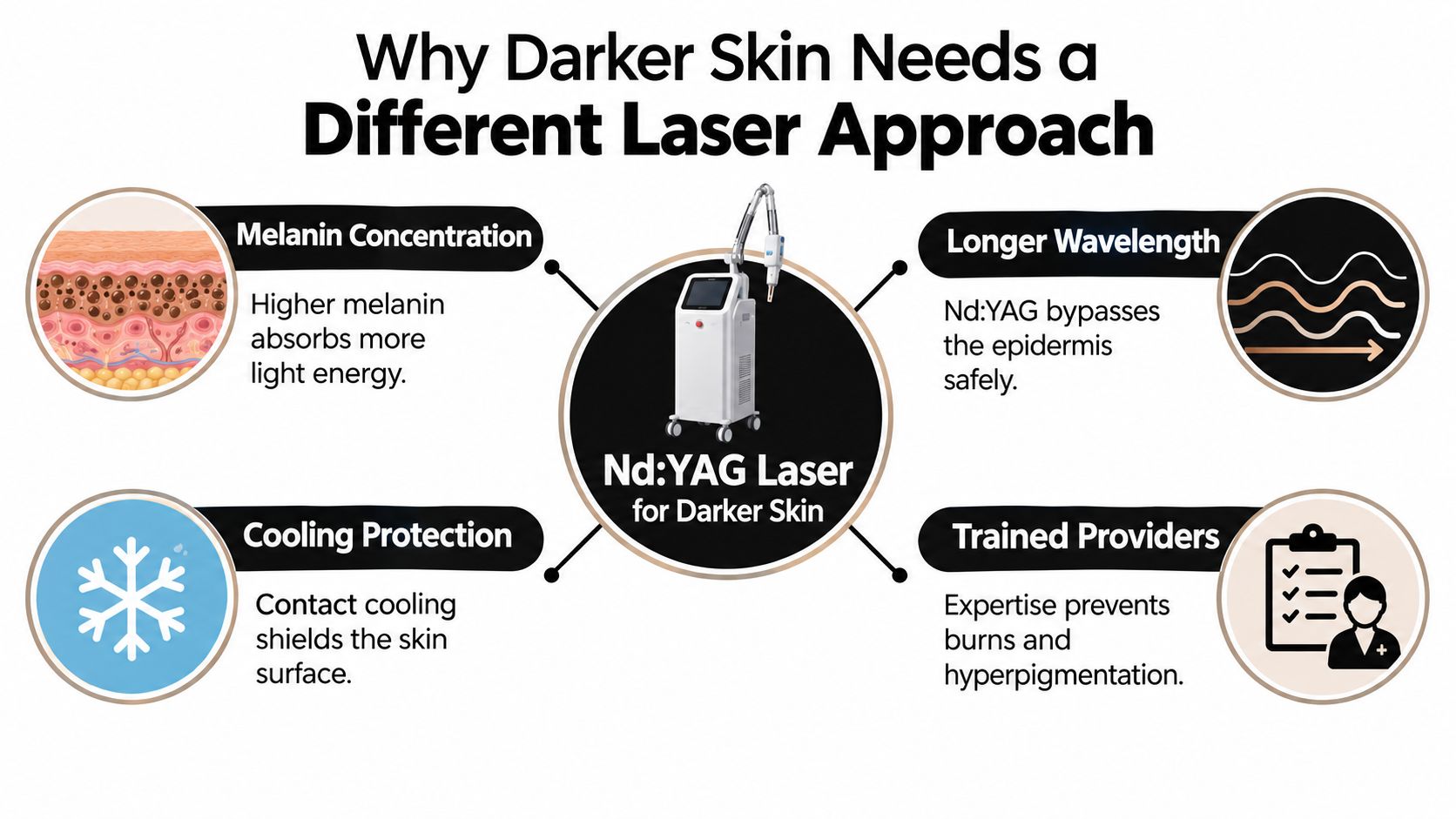
Laser hair removal targets melanin, the pigment in the hair shaft and follicle. Darker skin also contains more melanin in the epidermis, the outer layer of skin. If a laser's light is absorbed too readily by that surface pigment, some of the energy meant for the follicle can heat the surrounding skin instead. That's why burns, blistering, and post-inflammatory hyperpigmentation have historically been important concerns for Fitzpatrick skin types IV through VI.
A foundational safety milestone was the adoption of the long-pulsed 1,064-nanometer neodymium:yttrium-aluminum-garnet, or Nd:YAG, laser. A 2020 clinical review of laser hair reduction in skin of color explains that this wavelength is absorbed less strongly by epidermal melanin than shorter wavelengths. It also describes how epidermal cooling helps protect the skin surface.
The clinical shift
Long-pulsed Nd:YAG became the preferred laser option for darker Fitzpatrick skin types, particularly types III through VI, compared with ruby lasers. That doesn't mean every Nd:YAG treatment is automatically safe. It means the wavelength gives a trained provider a wider margin for controlling heat around the follicle.
The device name is only the beginning. A safe treatment plan also requires conservative energy selection, dependable cooling, a test area, and careful observation of the skin response.
This distinction matters for anyone comparing clinics. “We treat all skin tones” is not enough information. Ask what wavelength the provider uses, whether the team performs a patch test, how settings are adjusted for your hair and skin, and what signs would make them pause or reduce the energy. The treatment should be presented as long-term hair reduction, not a guaranteed promise of permanent removal.
How Nd-YAG Technology Works Safely on Higher Fitzpatrick Types
The simplest way to understand laser safety is to follow the light. The laser must reach pigment in the hair follicle while limiting absorption by pigment in the epidermis. In skin types IV through VI, those two targets are closer competitors for the same energy.
Shorter-wavelength systems, including ruby lasers, are absorbed more strongly by epidermal melanin. IPL, or intense pulsed light, also deserves caution because it delivers a broader range of light rather than a single, highly selective wavelength. That broader absorption can make it harder to concentrate heat in the follicle without heating the surface.
The 1,064-nanometer Nd:YAG wavelength penetrates more extensively and is absorbed less strongly by epidermal melanin. This creates a wider safety margin for darker skin, although it doesn't remove the need for skill. The provider still has to select fluence, pulse duration, spot size, number of passes, and cooling according to the treatment area and hair characteristics.
A systematic review found that long-pulsed Nd:YAG produced significantly less post-inflammatory hyperpigmentation than IPL in hair-reduction studies involving skin of color. The reported odds ratio was 0.26, with a 95% confidence interval of 0.10 to 0.78 in the systematic review of hair reduction in skin of color.
Cooling is part of the treatment
Contact cooling, such as sapphire cooling, helps lower the temperature at the epidermis while the pulse delivers controlled heat deeper in the skin. Cooling can improve comfort, but its more important role is protecting the surface from excessive thermal exposure.
A provider may look for a mild perifollicular response, such as small areas of redness or swelling around treated follicles. Excessive whitening, blistering, severe pain, or a reaction that appears disproportionate is not the intended endpoint.
What to ask about the device
Before booking, ask the clinic:
Wavelength: Is a long-pulsed 1,064-nanometer Nd:YAG mode available for my skin type?
Cooling: Does the device use reliable contact or other epidermal cooling?
Testing: Will you perform a test spot before treating the full area?
Adjustment: How will you change the settings if my skin is recently tanned, irritated, or unevenly pigmented?
A clinic may also provide educational information about YAG laser treatments and their clinical use. The useful part of any consultation is not the marketing label. It's the provider's ability to explain how the selected wavelength and settings protect your particular skin.
What to Expect During Your Treatment Series
Laser hair removal doesn't treat every follicle equally at every appointment. Hair grows through different phases, and the laser works most effectively when a follicle is in a suitable active growth phase. Because follicles aren't synchronized, a single visit can only affect part of the total hair population.
At an appointment, the provider usually prepares the area, applies cooling, and delivers pulses across the skin. Many people describe the sensation as a brief snap or warm prick. The expected immediate response may include mild redness or small swelling around individual follicles, which generally settles relatively quickly.
Why early results can look underwhelming
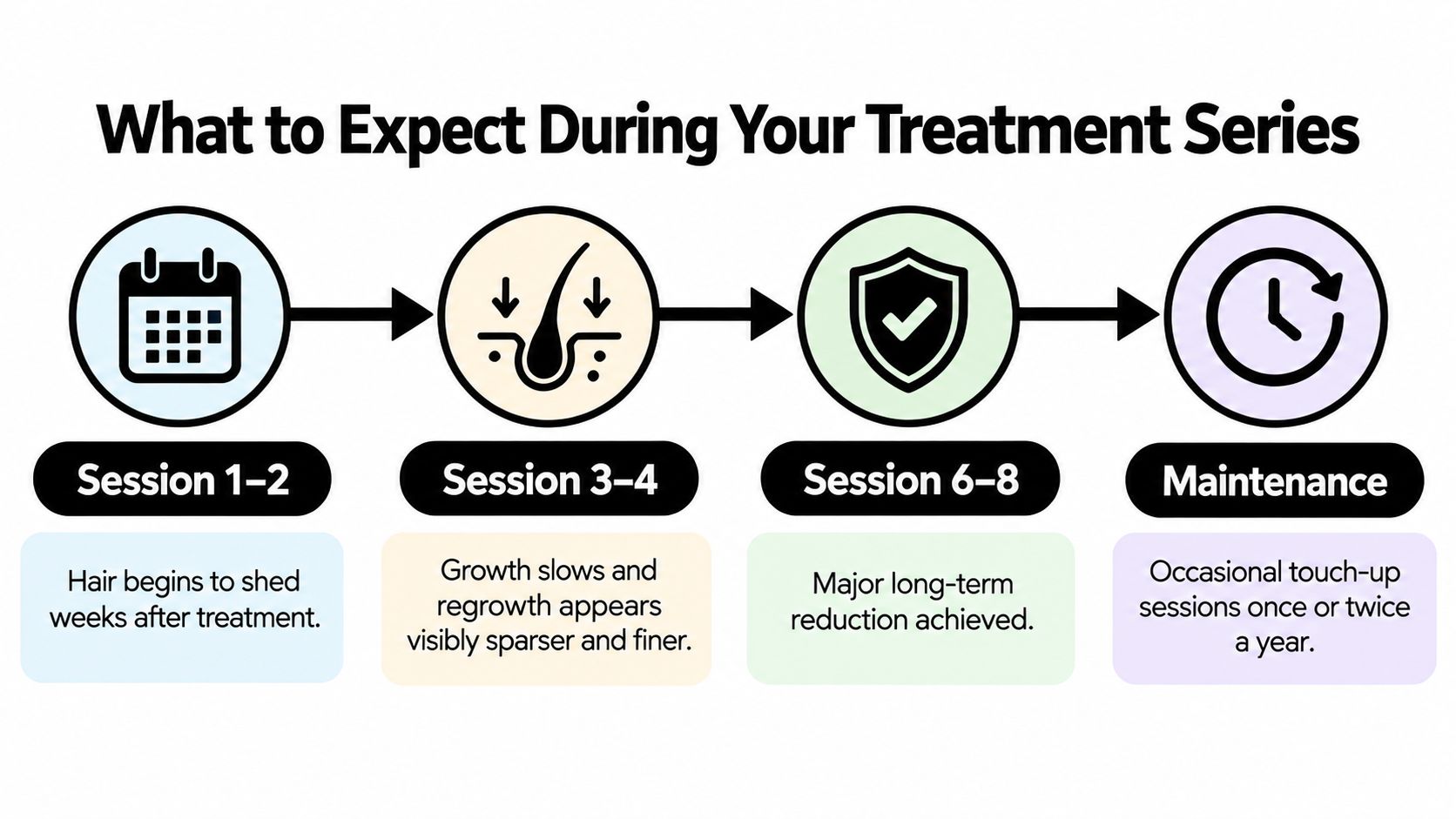
The first appointment isn't a final exam. Some treated hairs may shed after the session, while untreated follicles continue their normal cycle. Over repeated appointments, the clinician can address additional follicles during a more responsive phase.
A 2008 study treated 59 adult women with Fitzpatrick skin types IV and V using long-pulsed 1,064-nanometer Nd:YAG, contact cooling, and a defined treatment protocol. After six sessions, assessed six weeks after the final treatment, 56% achieved the study's strongest response category, 23% were classified as responders, and 20% were classified as failures (study details and outcomes).
The progression is particularly useful for setting expectations. The strongest-response group represented 5% after session three, 15% after session four, 25% after session five, and 56% after session six, with the session-related progression statistically significant at p < 0.001 (the same clinical study).
What your series should include
Your provider should reassess the treated area at each visit rather than repeating identical settings automatically. Hair thickness, body site, recent tanning, treatment response, and any pigment change can all affect the next decision.
Before treatment: Follow the clinic's instructions and disclose recent sun exposure, skin irritation, medications, and previous reactions.
During treatment: Expect controlled follicular heating, not unbearable pain or a sensation of skin burning.
After treatment: Monitor the area for the expected short-lived response and report blistering, unusual darkening, or persistent irritation.
Between appointments: Shave if needed, but don't remove the hair root by waxing or plucking.
Spacing matters because treating too soon can mean the next appointment doesn't align well with the hair-growth cycle. Your provider should explain the interval for the specific body area rather than promise a universal schedule. More guidance on how long to wait between laser hair removal treatments can help you plan a series realistically.
Nd-YAG vs IPL and Older Laser Systems for Darker Skin
A clinic may advertise several light-based devices, but they don't create the same safety profile for pigmented skin. Nd:YAG, IPL, ruby, and other shorter-wavelength systems differ in how strongly they interact with epidermal melanin and how selectively they can heat the follicle.
Long-pulsed Nd:YAG is generally regarded as the safest laser option for skin of color because it penetrates more and is absorbed less by epidermal melanin. Even so, the provider must use suitable settings, cooling, fewer passes where appropriate, and close monitoring. A clinical overview of laser therapy in skin of color emphasizes that “safe for Black skin” isn't a yes-or-no device claim.
Technology | Main concern for darker skin | What to ask |
|---|---|---|
Long-pulsed Nd:YAG | It still requires individualized settings and cooling. | Is the 1,064-nanometer mode being used for my skin and hair? |
IPL | Broad-spectrum light can reduce selectivity in deeply pigmented skin. | Why is IPL appropriate for this area and my Fitzpatrick type? |
Ruby laser | Shorter-wavelength absorption can increase competition from epidermal melanin. | Does the clinic have a safer alternative for my skin? |
Other shorter-wavelength systems | Stronger epidermal absorption may increase heat and pigment risk. | What evidence and experience support using this system? |
Comparative evidence summarized in the clinical review found that, among 109 patients with Fitzpatrick types IV through VI, blistering occurred in 5% with Nd:YAG compared with 14.9% with ruby laser, while hyperpigmentation occurred in 2.1% compared with 9.9%, respectively (review of laser therapy in skin of color).
Those figures don't guarantee an individual outcome, and they shouldn't be treated as a prediction for your appointment. They do show why device selection deserves a direct conversation. If a clinic offers only IPL for hair removal on darker skin, ask the provider to explain the rationale, alternatives, test-spot process, and plan for managing pigment risk.
Before and After Care, The Missing Half of Safe Treatment
A well-chosen laser can still cause problems if the skin arrives irritated or receives too much heat and friction afterward. Darker skin is more vulnerable to both post-inflammatory hyperpigmentation and hypopigmentation after epidermal injury, so preparation and recovery are part of the medical plan, not optional extras.
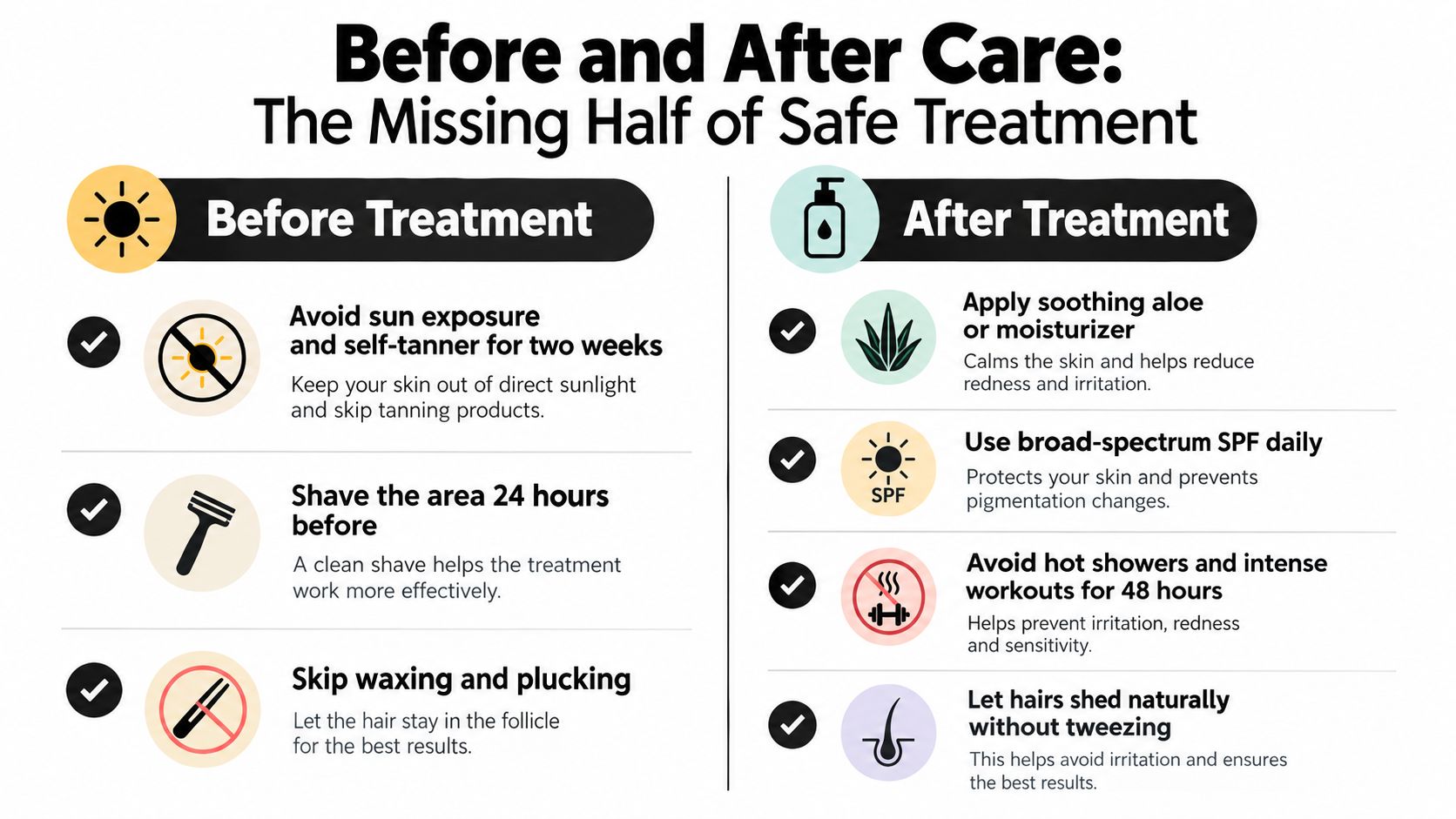
Before treatment, tell the provider if the area is recently tanned, inflamed, affected by dermatitis, or marked by active ingrown hairs. Avoid waxing, plucking, or other methods that remove the root because the follicle needs to remain available for laser targeting. Shaving is generally the preferred way to shorten the hair before treatment.
A practical preparation checklist
Protect the area from sun: Recent sun exposure can change the risk-benefit calculation and may require postponing treatment.
Keep the surface calm: Don't present for treatment with active irritation, dermatitis, or significant inflammation unless the clinician has assessed it.
Preserve the follicle: Shave rather than wax or pluck between sessions.
Share your history: Mention previous burns, pigment changes, medications, and treatments that caused irritation.
Follow the clinic's product instructions: Strong exfoliating products or retinoids may need to be paused according to the provider's assessment.
After treatment, use gentle skincare and strict photoprotection, especially on exposed areas. Avoid adding unnecessary heat, friction, picking, or aggressive exfoliation while the skin settles. Let treated hairs shed naturally instead of trying to pull them out.
Ingrown hairs and dark marks
Laser can help reduce the hair-driven cycle behind ingrown hairs, shaving bumps, and some related inflammation. It isn't the same as directly treating pigmentation. If the skin is already irritated or unevenly pigmented, aggressive treatment can worsen discoloration, while conservative settings may require more sessions.
That's why a clinician should distinguish follicle reduction from pigment correction. Guidance about aftercare following laser treatment for pigmentation may be relevant, but an active hair-removal plan and a pigment-treatment plan shouldn't automatically be combined.
Realistic Outcomes, How Much Hair Reduction Can You Expect
The most useful promise is not “permanent hair removal.” It's long-term hair reduction, with the possibility of maintenance when some follicles become active again. Results vary because hair color, thickness, hormonal status, treatment interval, and the number of completed sessions all influence how much pigment the laser can target.
A 2020 clinical review reports that modern laser hair-reduction studies found average clearance rates of approximately 20% to 75% when outcomes were assessed one to six months after treatment (clinical review of laser hair reduction). That range is broad because studies use different devices, protocols, body sites, follow-up periods, and definitions of success.

The darker-skin study discussed earlier offers a more specific example. After six treatments, 56% of participants reached the strongest response category and another 23% were classified as responders (2008 Nd:YAG study). That result supports completing an appropriate series before judging whether treatment works.
Hair characteristics change the forecast
Coarse, dark hair usually responds more predictably because it contains a stronger target for the laser. Fine, light, grey, or hormonally driven hair may respond less consistently and may need a different discussion about expected reduction.
Uneven skin tone also matters. The provider may need to treat conservatively around areas with active inflammation or pigment instability. A good consultation should explain what improvement is realistic for your specific hair, rather than using another person's result as a guarantee.
Common Misconceptions About Laser Hair Removal for Black Skin
Myth: Lasers aren't safe for Black skin.The more accurate statement is that some wavelengths and settings carry more risk than others. Long-pulsed 1,064-nanometer Nd:YAG, combined with cooling and individualized parameters, has become the preferred option for many darker skin types. The technology improves the safety margin, but provider technique still matters.
Myth: One appointment should remove everything.Hair follicles grow on different schedules, so treatment works progressively. In the clinical study of darker skin, the strongest response increased from 5% after session three to 56% after session six (study results). Early regrowth doesn't automatically mean the treatment failed.
Myth: Laser removes every hair forever.Laser treatment is better understood as long-term reduction. Some hair may remain, and maintenance can be appropriate when hormonal changes or individual follicle behavior lead to renewed growth.
Myth: The same settings work for everyone.A 1064-nanometer Nd:YAG device still needs adjustment. Fluence, pulse duration, cooling, body site, follicle size, tanning, and the skin's previous reaction all influence the plan.
Myth: If a friend had a good result, you'll have the same one.Your hair density, texture, color, growth pattern, and pigment response may be different. Ask for an assessment based on your skin and hair, not a generic package promise.
Frequently Asked Questions for Darker-Skinned Clients
Do I need a patch test?
A patch test is a sensible safety step before treating a full area. It lets the provider assess your immediate response and gives you an opportunity to watch for delayed darkening, lightening, blistering, or prolonged irritation before committing to a larger treatment.
How do I know whether a clinic's technology is appropriate?
Ask whether the clinic offers long-pulsed 1,064-nanometer Nd:YAG and reliable contact cooling for your skin type. Ask why that wavelength is being selected, how the fluence and pulse duration will be individualized, and whether IPL or a shorter-wavelength system is being considered.
What if my hair is fine, light, grey, or uneven?
Laser responds most predictably when the hair is dark and relatively coarse. Fine, light, grey, or hormonally influenced hair may respond less consistently, and conservative treatment may mean you need more sessions. The provider should discuss limitations before you purchase a series.
What reaction is normal?
Mild perifollicular redness or swelling can be an expected response and usually fades within hours. Blistering, severe pain, prolonged redness, marked darkening, or lightening should prompt contact with the clinic and, when appropriate, medical review.
Can laser improve ingrown-hair marks?
Reducing the hair that drives repeated ingrown hairs may reduce future inflammation and help prevent new marks. Laser isn't a direct pigment eraser, and treating actively irritated skin too aggressively can worsen discoloration.
Does lower energy mean ineffective treatment?
Not necessarily. In a clinical study of 55 women with Fitzpatrick types IV through VI, providers individualized fluence between 25 and 40 joules per square centimeter, with fluence significantly affecting outcomes. The 25 joules per square centimeter setting was effective when combined with cooling and repeated sessions, according to the study of Nd:YAG treatment parameters for chin hair.
Before booking, ask the clinic to explain the test spot, wavelength, cooling method, expected response, aftercare, and escalation plan. Clear answers are more valuable than a promise that the treatment is risk-free.
NYC Laser Hair Removal offers personalized laser hair reduction with treatment planning for different skin and hair characteristics, including darker skin tones. Visit NYC Laser Hair Removal to learn about available treatment areas and arrange a consultation before starting your series.
Comments