
Bare Skin Laser Guide: What to Expect
You've got a beach weekend, a wedding, or a morning routine that's become too dependent on a razor. You want bare skin, but you also want to know whether laser hair removal will fit your schedule, suit your skin tone, and deliver something more meaningful than a few smooth days. The most useful answer isn't a promise of completely hair-free skin after one visit. It's a clear plan for preparation, technology, session timing, safety, and maintenance.
Laser hair removal works best when the treatment is treated as a process. The right device matters, but so do your current tan, hair characteristics, treatment settings, cooling, and the practitioner's judgment. A personalized plan can make the difference between steady reduction and a disappointing series of rushed, generic appointments.
Why Your Skin Prep Changes Everything
“Bare skin” doesn't mean arriving with an aggressively scrubbed or chemically treated surface. It means the skin is calm, the hair is shaved close, and the follicle remains available for the laser to target. Shaving removes the visible shaft without removing the follicle. Waxing, threading, or plucking can do the opposite by removing the structure that needs to absorb the laser's energy.
Fresh shaving also reduces unnecessary heat at the surface. A long hair above the skin can absorb energy before it reaches the follicle, which may increase discomfort without improving the result. Follow your clinic's timing instructions, and avoid turning preparation into a last-minute experiment.
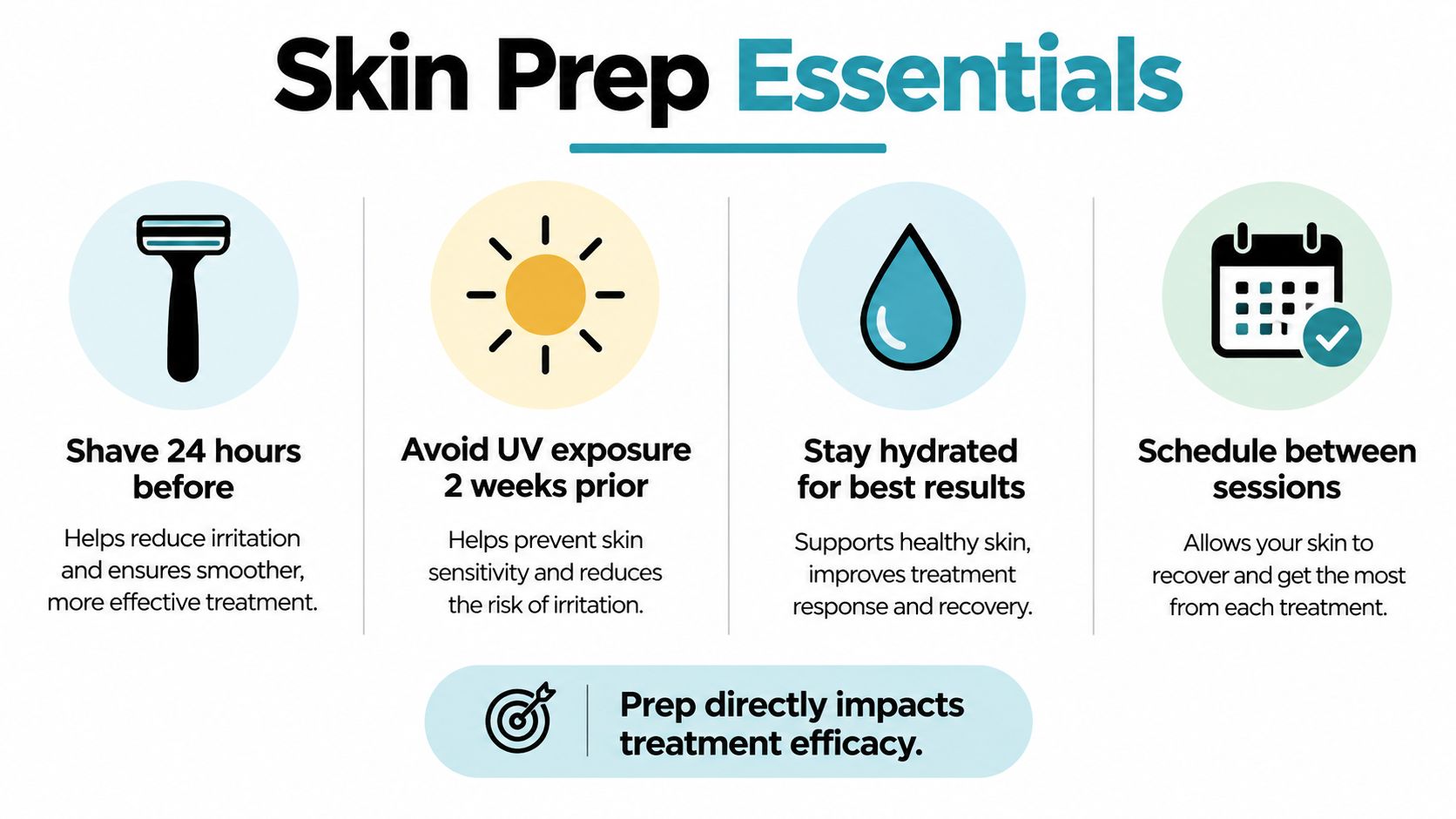
Sun exposure and self-tanner deserve special attention. Additional pigment in the epidermis can compete with the hair for the laser's energy, particularly when the practitioner is treating a darker or recently exposed area. That can increase the risk of irritation or pigment changes and may lead a responsible clinic to postpone treatment or begin more conservatively.
Practical rule: A delayed appointment is safer than treating recently tanned skin with settings chosen for a different baseline.
The preparation window
Use the day before treatment to keep the routine simple. Shave as instructed, wash with a gentle cleanser, and arrive without deodorant, lotion, oil, perfume, or self-tanner on the treatment area unless your provider tells you otherwise. Don't wax or pluck between sessions, because the follicle needs to remain in place for the laser to affect it.
For a broader overview of preparing skin before light-based treatments, this guide to skin prep for red light therapy offers useful general principles around clean, product-free skin. Laser hair removal has different energy and safety considerations, so your treating professional's instructions take priority. You can also review this practical guide on what not to do before laser hair removal before your appointment.
Preparing your bare skin for treatment
Timing | Action | Reason |
|---|---|---|
Before the appointment | Avoid waxing, threading, and plucking | Keeps the follicle present for laser targeting |
The day before | Shave the treatment area as directed | Removes the surface hair while preserving the follicle |
Before treatment | Avoid sun exposure and self-tanner | Helps the practitioner assess your natural skin state and reduce pigment risk |
Appointment day | Arrive with clean skin | Prevents products from interfering with contact, cooling, or assessment |
Between sessions | Follow the recommended schedule | Allows treatment to align with the hair-growth cycle |
The evidence supports patience rather than instant-result expectations. A 2007 meta-analysis reviewed trials published from 1998 through 2003 and measured reduction at least six months after the final treatment. After three sessions, average reductions were 57.5% for diode, 54.7% for alexandrite, 52.8% for ruby, and 42.3% for Nd:YAG lasers (clinical meta-analysis). Preparation doesn't replace a suitable treatment plan, but it helps that plan work under safer, more consistent conditions.
How the Bare Skin Laser Technology Works
The laser isn't scrubbing hair away from the surface. It's using light and heat to affect growth-related structures inside the follicle. The underlying principle is selective photothermolysis. Melanin in the hair shaft and follicular matrix absorbs optical energy, converts it to heat, and transfers that heat to the structures responsible for growth. Wavelength, pulse duration, and cooling help protect the surrounding skin (clinical review of laser hair reduction).
The follicle isn't equally vulnerable at every point in its cycle. That's why a series of appointments is more logical than one high-energy session. Each visit reaches a different group of actively growing hairs, while finer or lighter hairs may respond less predictably because they contain less pigment for the laser to target.
Wavelength is a safety decision
Common systems include alexandrite at approximately 755 nm, diode systems around 800–810 nm, and long-pulsed Nd:YAG at 1064 nm. The longer Nd:YAG wavelength is absorbed less strongly by epidermal melanin and penetrates to greater depths, so practitioners generally favor it for very dark or recently tanned skin. That doesn't make it automatically risk-free. Recent tanning, a history of pigmentation, hair thickness, cooling, test spots, and energy selection still matter.
A diode may be suitable for some skin and hair combinations, while alexandrite can be highly effective for lighter skin with suitable hair contrast. The device label alone can't tell you whether the treatment will be appropriate. A practitioner should evaluate your skin at the appointment, not rely on a generic setting selected for everyone who books the same zone.
Spot size affects large-area treatment
Pulse geometry changes how efficiently energy reaches tissue. In a randomized axillary study, three treatments with an 805-nm diode produced mean clearance of 38.7% with a smaller spot and 50.1% with a spot three times larger, using the same pulse duration, fluence, and epidermal cooling. The larger spot improved clearance by 29.5%, but it also caused significantly more procedural pain (randomized diode laser study).
That trade-off matters on backs, chests, and legs. A larger spot can improve coverage and penetration, but only when the provider manages cooling, pressure, overlap, and comfort. This is why a skilled practitioner's technique matters more than choosing a machine by brand name alone. For a deeper look at device selection and treatment mechanics, see this guide to laser hair removal technology.
What to Expect During Your Session
The first appointment usually starts with questions rather than a laser handpiece. The practitioner reviews your goals, skin tone, recent sun exposure, medications, pigment history, and hair-removal habits. They'll inspect the area and decide whether the treatment should proceed, whether a test spot is appropriate, and which settings balance follicle response with epidermal protection.
You'll wear eye protection while the area is cleaned and marked if necessary. The handpiece then moves across the skin in a controlled pattern. Patients commonly describe the sensation as a brief snap, warmth, or tiny elastic-band flick, although thicker hair, sensitive zones, larger spot sizes, and higher settings can make treatment feel more intense.
Cooling is part of the treatment, not an optional comfort extra. Depending on the system, it may come through the handpiece or a separate cooling method. You should be able to tell the provider if the sensation becomes sharply painful, and they should inspect the skin throughout the appointment rather than treating the area without feedback.
Treatment zone timelines
Area | Duration |
|---|---|
Upper lip or chin | Brief appointment |
Underarms | Short appointment |
Bikini line or Brazilian area | Short to moderate appointment |
Full arms | Moderate appointment |
Full legs | Longer appointment |
Back or chest | Longer appointment |
These are practical categories rather than promises of a fixed clock time. The actual appointment depends on the size of the zone, hair density, the device's spot size, and whether the provider needs extra time for assessment or cooling.
Immediately afterward, temporary redness or perifollicular swelling can occur. These reactions often look like small raised areas around follicles and can be part of the expected response, but intense pain, blistering, spreading swelling, or unusual discoloration deserves prompt clinical advice. A professional should give you specific aftercare instructions, including how to manage heat, friction, sun exposure, and products on the treated area.
Don't judge the whole series by the first session. Some hairs may shed gradually, while others remain visible because they weren't in the right growth phase or contain too little pigment for the chosen technology. The useful measure is the pattern of regrowth across appointments, not whether every hair disappears immediately.
Real Results for Diverse Skin Tones
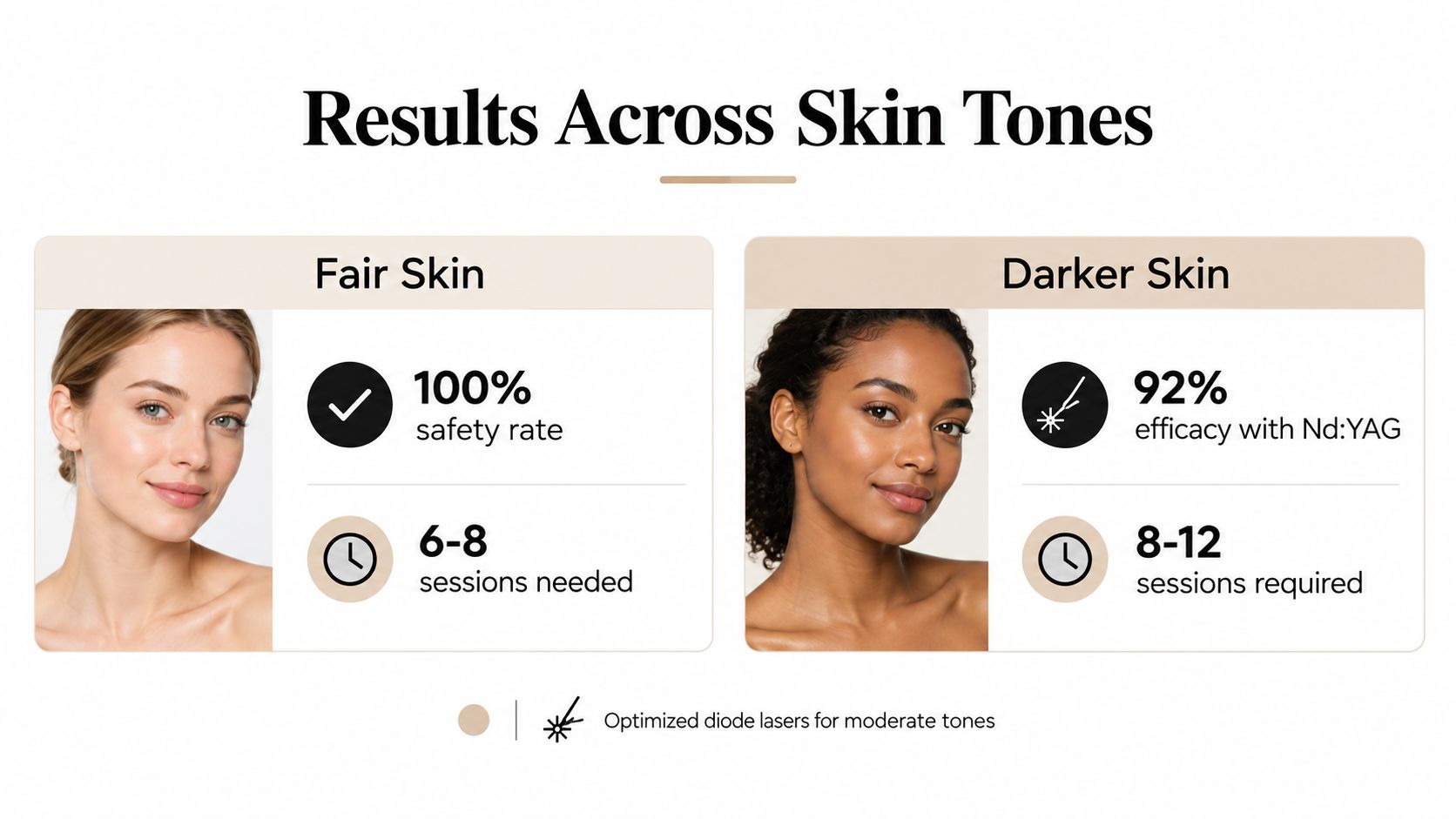
A claim that a laser “works on all skin tones” is incomplete unless it explains how the treatment changes for different skin. Darker skin contains more epidermal melanin, so the practitioner must reduce the chance that the surrounding skin absorbs excessive energy while still delivering enough heat to affect the follicle.
That may mean selecting a longer wavelength, using conservative starting settings, performing a test spot, increasing cooling, or accepting that the treatment plan may need refinement over time. Conservative doesn't mean ineffective. It means the provider is protecting the skin while learning how it responds.
What the evidence actually supports
A systematic review of people with Fitzpatrick skin types III–VI found broadly similar outcomes across in-office lasers and IPL, while laser treatment tended to produce greater hair reduction than IPL. The review also found a lower risk of post-inflammatory hyperpigmentation with long-pulsed Nd:YAG than with IPL, with an odds ratio of 0.26 and a 95% confidence interval of 0.10–0.78 (systematic review of darker skin types).
Those findings don't justify a universal promise. They support an individualized decision. A person with very dark skin, recent tanning, coarse hair, and a history of pigment changes needs a different conversation from someone with lighter, untanned skin and strong hair contrast.
Skin type or situation | Potentially suitable technology | Safety profile |
|---|---|---|
Lighter skin with dark hair | Alexandrite may be considered | Strong hair contrast can support targeting, but settings still require assessment |
Moderate skin tones | Diode may be considered | Requires adjustment for skin tone, hair characteristics, cooling, and comfort |
Darker skin types | Long-pulsed Nd:YAG is commonly favored | Lower epidermal melanin absorption can support safety, but pigment risk remains |
Recently tanned or pigment-prone skin | Treatment may need postponement or conservative testing | Current skin condition matters more than a marketing claim about the device |
A good consultation should address post-inflammatory hyperpigmentation, recent tanning, hormonal symptoms, hair thickness, and how the practitioner will respond if your skin reacts differently than expected. This laser hair removal guide for brown skin can help you prepare practical questions before speaking with a provider.
The safest treatment isn't necessarily the most aggressive one. It's the one that produces a useful follicular response without asking the epidermis to tolerate avoidable injury.
Integrating Treatment into Your Daily Life
Laser hair removal can suit a busy routine because one appointment may take less time than repeated shaving or waxing. A “lunchtime treatment” is realistic for some small areas, but rushing does not remove the need for assessment, preparation, or aftercare. Larger treatment zones may require more planning.
After a session, treated skin can feel warm, look pink, or remain sensitive for a period. Follow your provider's instructions about heat, friction, direct sunlight, exercise, and other activities. If a holiday, formal event, or photo day is approaching, schedule the first appointment early enough to observe your response. Skin reactions vary, and leaving treatment until the last moment adds avoidable pressure.
Plan sessions around observed regrowth
The useful interval depends on the treatment area, growth pattern, hair characteristics, and response recorded at the previous visit. Facial and body hair often require different timing because their growth cycles do not match. Your practitioner should adjust the schedule when regrowth suggests that an earlier or later session would produce a better opportunity for treatment.
A practical calendar test: Book the next visit around observed regrowth and your provider's clinical plan, not around a package deadline.
A 2023 literature review reported a network meta-analysis of 23 randomized controlled trials and 1,486 patients. At six months, average reported reduction was 78% for alexandrite, ranging from 68% to 86%, 73% for Nd:YAG, ranging from 62% to 82%, and 59% for IPL, ranging from 48% to 71% (review and network meta-analysis). Those ranges describe study results, not a promise for a particular body area, skin response, or treatment plan.
A clear schedule also supports the mental side of treatment. Patients are less likely to interpret the laser as ineffective when the provider has explained early shedding, uneven regrowth, finer hairs, and possible maintenance. Visible change may develop gradually, so judging success after one appointment can create unnecessary doubt.
The practical goal is steady reduction that fits around work, travel, exercise, and social commitments. An effective plan should feel manageable, while still giving each session enough time and the right regrowth to do its job.
Navigating Common Myths and Fears
You finish a session, notice some remaining hair, and wonder whether the treatment failed. That reaction is common when expectations are shaped by promises of instant, permanent removal. In practice, laser usually reduces targeted hair progressively. Remaining growth may become finer or less noticeable instead of disappearing at once.
Short-term redness can occur. A 2023 literature review reported mild post-inflammatory hyperpigmentation in about 18% of cases, resolving within 6–8 weeks. Treat that figure as a study finding, not a prediction for your skin. Aftercare matters: protect the area from unnecessary sun exposure, avoid irritating products while the skin settles, and follow the clinic's specific instructions. Contact the provider if pigment changes persist, worsen, or concern you.

The concern about unexpected growth
Paradoxical hypertrichosis means unexpected hair growth in or near a treated area. A systematic review and meta-analysis covering 9,733 patients estimated pooled prevalence at 3%, with a wide 1%–6% confidence interval and substantial study heterogeneity (systematic review of paradoxical hypertrichosis). Location affected the risk strongly. In the analyzed data, it occurred in 0.08% of non-facial and non-neck cases, while the face and neck were higher-risk areas.
The practical response is screening, not panic. Facial and neck treatment deserves particular care when hair is fine, darker, or accompanied by signs that may suggest a hormonal condition. If growth becomes new or denser, contact the provider for reassessment instead of changing products or booking more sessions blindly. Three of four studies in the review reported gradual improvement with continued therapy, but the appropriate response depends on the area, hair type, settings, and clinical assessment.
Separating myths from useful aftercare
“Shaving makes hair grow back thicker.” Shaving cuts the shaft at the surface. It does not change the follicle's structure, although blunt regrowth can feel more noticeable.
“More energy always means better results.” Excessive fluence can increase epidermal injury risk, while insufficient fluence may fail to disable the follicle. Settings must balance effectiveness with skin safety.
“All skin tones use the same settings.” Wavelength, pulse duration, fluence, cooling, recent tanning, and pigment history should guide treatment decisions.
“Every treatment zone carries the same risk.” Facial and neck areas require more caution than many non-facial body areas, particularly when hair is fine or hormonal factors may be involved.
Between appointments, a consistent smooth pubic hair routine can reduce irritation and help prevent waxing or plucking that interferes with follicle targeting. Keep grooming gentle, and use the treating clinic's aftercare instructions as the final guide.
Your Path to Bare, Smooth Skin
A busy schedule can make a generic laser package tempting, especially when an advertisement promises rapid, dramatic change. Effective treatment starts differently. A responsible plan matches your skin, hair, treatment area, and tolerance for downtime, then adjusts settings as your response becomes clear. The goal is reliable reduction with skin safety protected at every visit.
Begin with the area and result you want. Underarms, bikini areas, legs, backs, chests, and facial zones require different planning. Ask whether your hair color and thickness are likely to respond, how recent tanning affects eligibility, which wavelength the provider recommends, and which reactions should prompt a pause or review. Clear answers make the choice less psychological and more practical.
What a responsible plan includes
A professional consultation should provide more than a price or package recommendation. Look for:
A skin assessment: The provider reviews tone, tanning, pigment history, medications, and previous reactions.
A hair assessment: They explain how density, thickness, and color affect the laser's ability to target the follicle.
A treatment rationale: They explain why a diode, alexandrite, Nd:YAG, or another light-based option suits your situation.
A comfort and safety protocol: Eye protection, cooling, test spots when appropriate, and clear aftercare belong in the appointment.
A review process: The clinic tracks your response and changes the plan when your skin or regrowth pattern calls for it.
Guidance from the American Academy of Dermatology describes hair reduction as a process that may require several dermatologist-performed treatments. Hair commonly returns thinner and finer over time, while facial hair in women may need ongoing management. Use that guidance to set expectations, not to treat a general treatment pattern as a personal guarantee. One appointment rarely settles whether a plan is working.
Packages can make a series easier to schedule, but a discount should not replace clinical judgment. Choose a provider who will explain when your skin needs more time, when settings should change, and when another approach makes better sense. Bare skin is the visible result. Confidence comes from knowing the treatment is being managed for your actual skin and hair, not for a generic package.
NYC Laser Hair Removal offers customized laser hair reduction with Splendor X technology for small and large treatment areas, including underarms, bikini areas, legs, backs, and chests. If you want a plan built around your skin tone, hair characteristics, schedule, and comfort, visit NYC Laser Hair Removal to learn more and book a consultation.
Comments