
Leg Laser Hair Removal Guide for Smooth Lasting Results
If you're on Long Island and already thinking about dresses, beach weekends, or just not wanting to shave your legs every other day, you're probably weighing convenience against frustration. A lot of first-time clients come in after the same cycle: shave, get prickly stubble fast, deal with razor bumps, then repeat right before an event. Waxing can stretch things out, but it also means growing hair in between appointments, planning around regrowth, and sometimes trading stubble for ingrowns.
Leg laser hair removal appeals to people for a simple reason. It aims for long-term hair reduction, not a one-time forever fix. That distinction matters. FDA-reviewed clinical data on body areas including the arm and leg found average hair reductions of 37% at 3 months, 48% at 6 months, and 66% at 12 months after the final treatment in one treatment series, which is why realistic expectations matter from day one (FDA-reviewed clinical data).
Legs are also one of the more rewarding areas to treat. They tend to respond well over time because the growth cycle is longer than facial hair, which gives laser a useful advantage when sessions are timed correctly.
Introduction to Effortless Smooth Legs on Long Island
A common Long Island routine goes like this: you book a dinner in Roslyn, a wedding in Garden City, or a beach day out east, then realize your legs need attention again. You shave in a rush, miss spots around the knees, and your skin feels irritated by the next day. If that sounds familiar, you're exactly the kind of person who usually starts asking better questions about leg laser hair removal.

Why Legs Are Such a Popular Area
Legs cover a large area, so the day-to-day upkeep adds up fast. That's why many people feel the payoff more clearly here than in a tiny zone like the upper lip. You can see the difference in routines, wardrobe flexibility, and how often you reach for a razor.
A 2022 review reported some of the strongest long-term trial results on leg hair, with about 72% mean hair reduction at 6 months for legs, compared with 68% for face and 69% for bikini, while axillae reached about 75% in site-specific outcomes (2022 review of site-specific outcomes). That same review also found alexandrite lasers at about 78% hair reduction, Nd:YAG at about 73%, and IPL at about 59% at 6-month follow-up, which helps explain why technology choice matters for legs too.
Legs often give people one of the clearest examples of what laser can do well: gradual thinning, slower regrowth, and less daily maintenance over time.
What First-Time Clients Usually Want to Know
Many aren't confused about the goal. They want smoother legs with less upkeep. The confusion is usually about the process.
Questions tend to cluster around a few practical points:
How it works: Why pigment matters, and why some hairs respond while others don't.
Who qualifies: Whether your skin tone, hair color, or recent sun exposure changes the plan.
How long it takes: Why legs need a series instead of one treatment.
What it feels like: Especially around the shin, knee, and ankle.
How to plan it: Around vacations, weddings, summer, and busy workweeks.
What booking looks like locally: Full legs versus lower legs, package choices, and how to fit sessions into your calendar.
That last part matters more on Long Island than people think. Most clients want something effective, but they also want something that fits real life.
How Leg Laser Hair Removal Works and Why Splendor X Stands Out
A leg session makes more sense once you know what the laser is trying to hit. The goal is not the visible hair above the skin. The goal is the pigment inside the hair structure below the surface, where future growth starts.
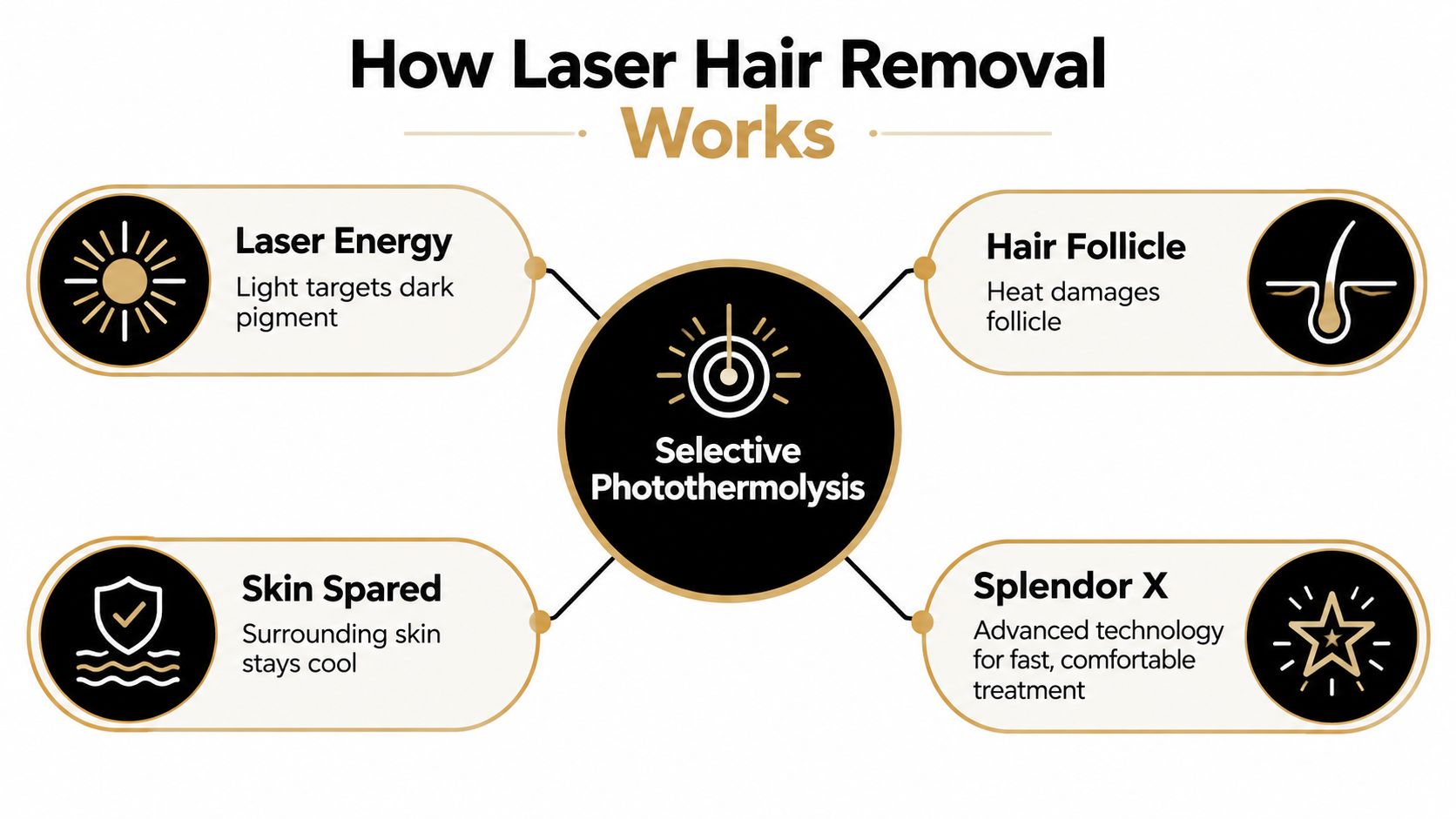
Light is delivered into the treatment area. Dark pigment in the hair absorbs that light, the light becomes heat, and that heat disrupts the follicle enough to reduce how strongly it can grow hair again.
The Simple Version of the Science
Selective photothermolysis is the technical term, but the idea is simple. Selective means the laser is set up to target a specific structure. Photo means light. Thermo means heat. Lysis means disruption.
A flashlight-and-thread comparison helps here. If you shine light across a pale floor with a dark thread on it, the dark thread stands out. Hair with more pigment stands out to the laser in a similar way, which is why darker, coarser leg hair often responds so well.
Only part of your leg hair is in the right growth stage at any given visit. That is why one appointment cannot treat every follicle equally. Some hairs are active and connected in a way the laser can affect well. Others need another cycle.
Why Splendor X Fits Legs So Well
Legs are one of the best places to appreciate good laser design because they cover a lot of surface area. You want even coverage, reasonable treatment time, and settings that match both hair and skin. Splendor X stands out because it combines 755 nm Alexandrite and 1064 nm Nd:YAG in one system, so the provider can adjust the treatment rather than forcing every client into one wavelength.
For a plain-English overview of how that platform is built, NYCLASER's guide to advanced laser technology explains how newer systems are designed for speed, customization, and comfort.
That flexibility matters on Long Island, where clients often book around beach weekends, weddings, travel, and the point in the year when shaving your legs starts feeling like a daily chore again. Legs usually respond well because the hair is often darker and denser than finer facial hair, and the treatment area is large enough that efficiency and consistency make a real difference.
A 2022 review discussing evolving multi-wavelength platforms reflects the broader shift toward more personalized treatment across skin types and body areas, including legs.
Here is what that means in practical terms:
Two wavelength options in one platform: Alexandrite can be useful when there is strong contrast between hair and skin. Nd:YAG can be a better fit for deeper skin tones and certain treatment plans.
Better customization across the whole leg: Lower legs and thighs do not always have the same hair density or texture, so settings may need to change.
Faster coverage for a large area: Legs take time to treat well. A platform built for larger zones helps keep sessions manageable.
Cooling during treatment: Cooling helps make shin, knee, and ankle areas easier to tolerate.
More even passes: Large treatment zones benefit from controlled coverage so missed patches and excessive overlap are less likely.
A quick visual can make that easier to picture:
Why Personalization Matters More Than the Device Name
The machine matters. The plan matters just as much.
One client may have coarse dark hair on the lower legs and much finer hair on the thighs. Another may have deeper skin tone, recent tanning, or a history of post-inflammatory pigment changes. Those details affect wavelength choice, fluence, pulse settings, cooling, and timing.
That is also why dual-wavelength capability should not be confused with piling on more energy. Good treatment is precise treatment. On legs, Splendor X gives the provider more ways to match the session to the person, which is the advantage.
Who Makes a Good Candidate for Leg Laser Treatment
People often assume candidacy is simple. Dark hair means yes, light hair means no, and that's the whole story. In practice, it's more nuanced.
Hair Color Matters More Than Most People Expect
Laser works by targeting pigment in the hair. That means dark brown or black hair usually responds best, because there's a clearer target for the light energy. Coarser hair on the lower legs often gives providers something easier to work with than very fine peach fuzz.
Very light blonde, gray, white, and red hair are trickier because there may not be enough pigment for the laser to recognize reliably. If someone's thigh hair is fine and pale but the lower leg hair is darker, the lower legs may be the better place to start.
The easiest way to think about candidacy is contrast. The clearer the laser can distinguish hair from skin, the more straightforward treatment tends to be.
Skin Tone Is Important, But It Doesn't Automatically Rule You Out
Older conversations about laser made many people with deeper skin tones think they weren't candidates. That's not a safe assumption anymore. What matters is using the right wavelength, the right settings, and a provider who understands how to treat different skin tones thoughtfully.
Systems that include Nd:YAG are often part of that conversation because they can be useful for a wider range of skin tones. Splendor X is designed around that kind of flexibility, which is one reason it gets attention for mixed clientele.
A Few Factors Can Delay or Change the Plan
Even if your hair and skin look like a good match, timing still matters. Treatment may need to be adjusted or postponed if any of these apply:
Recent sun exposure: Tanned or recently burned skin can raise the risk of irritation or pigment changes.
Self-tanner use: Artificial pigment can interfere with treatment accuracy.
Hair removal method: If you've been waxing or plucking, the follicle may not be there for the laser to target.
Certain medications: Some medicines increase photosensitivity, so your provider needs your current list.
Pregnancy: Many clinics postpone elective laser treatment during pregnancy.
Pigment history: If your skin marks easily after irritation, conservative settings and aftercare become more important.
Full Legs or Lower Legs
Goals matter. Some people wear shorts and skirts constantly and want even texture from ankle to thigh. Others mostly care about the lower leg because that's the area they shave most often.
A consultation should sort out:
whether the issue is daily stubble
whether you mainly want help with ingrown-prone lower legs
whether your thigh hair is sparse enough that lower-leg treatment makes more sense
whether your skin does better with seasonal planning, especially if you tan easily in summer
How Many Sessions You Need and What Results to Expect Over Time
You book your first leg session in early spring because you want easier shaving by beach season. That is a smart timeline. Leg laser hair removal usually works best as a series, and legs are one of the areas where planning ahead pays off.
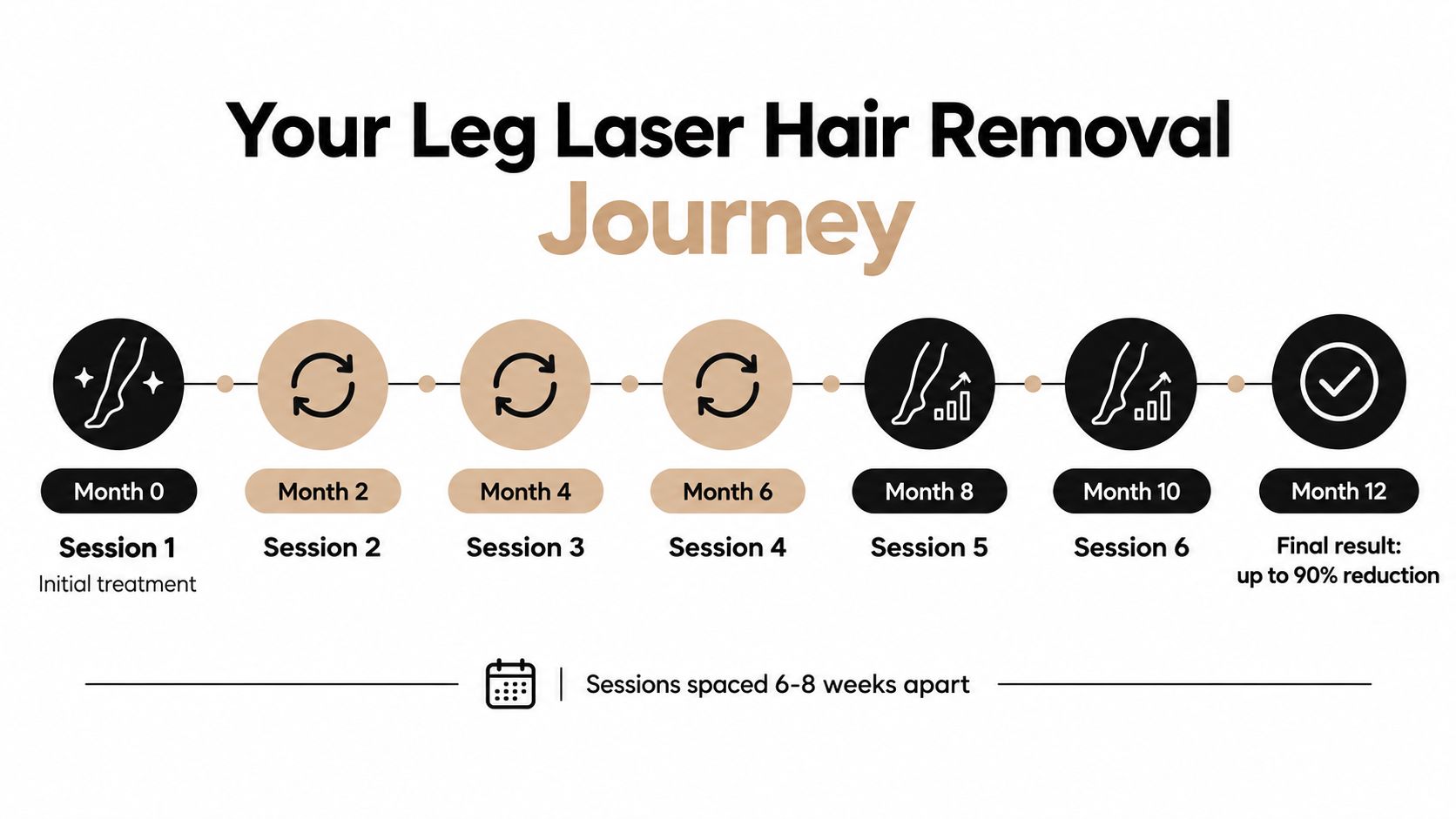
Why You Need More Than One Session
Leg hair does not grow on one master schedule. Each follicle is on its own timer. Laser works best when hair is actively growing, so one visit can only catch part of the hair you see.
A series solves that timing problem. Each appointment targets a new group of follicles as they cycle back into the treatable stage.
For legs, sessions are often spaced about 6 to 8 weeks apart. That rhythm fits the area well and gives your skin time to settle between visits. It also matches real life on Long Island, where clients often plan around vacations, weddings, and when they start living in shorts.
How Many Sessions Is Typical
Many clients need a series of treatments before their legs start feeling low-maintenance. Exact timing depends on your hair density, hair color, skin tone, hormones, and whether you are treating full legs or just lower legs.
A helpful way to picture it is lawn care. One mow improves the look for the week. A season-long plan changes the whole pattern of growth. Laser works in a similar way. The early sessions start the reduction, and the later sessions build on it.
At NYCLASER, clients often ask whether Splendor X changes the timeline. It can improve how efficiently energy is matched to different skin tones and hair patterns because it combines Alexandrite and Nd:YAG wavelengths in one platform. Even with that advantage, a series is still the normal plan for legs. Good technology helps the process work better. It does not turn leg treatment into a one-visit fix.
What Results Usually Look Like Over Time
Results tend to show up in stages, not all at once.
Phase | Timing | What You May Notice |
|---|---|---|
Early visits | First part of the series | Hair sheds after treatment, and regrowth may look patchy or uneven |
Middle of the series | After several spaced sessions | Shaving often becomes less frequent, and hair may start returning finer |
End of the main series | After consistent treatment | Larger areas stay smoother longer, with fewer dense patches |
Maintenance if needed | Months later | Small touch-ups can help if scattered regrowth returns |
That patchy stage confuses a lot of first-time clients. Patchy is usually a good sign. It often means some follicles responded sooner than others, not that something went wrong.
If you want a broader consumer explanation of laser hair removal sessions needed, that guide can help compare how different body areas behave, though your exact leg schedule still depends on your own hair cycle and settings.
Why Legs Often Respond So Well
Legs are a strong treatment area because the hair is often darker and more defined than the finer hair found on some other body parts. The treatment area is also large and consistent, which makes it easier to follow a repeat schedule and track progress from session to session.
Lower legs can still test your patience a bit. The shin and calf sometimes need extra consistency. Full legs may also progress unevenly, with some spots clearing faster than others. That is common.
A Practical Long Island Timeline
If your goal is smoother legs for summer, start well before the first beach weekend. Fall, winter, and early spring are popular times to begin because sun exposure is usually lower and you have room to complete several sessions before peak leg-baring season.
For example, someone starting in January or February may be in a much better position by late spring than someone who waits until May and hopes for instant results. That is one reason seasonal planning matters so much with legs.
The main result to expect is less work. Fewer rushed shaves. Softer regrowth. More days when your legs feel ready without extra effort.
How to Prepare for Your Appointment and Care for Skin After
Good prep helps the laser target the follicle cleanly. Good aftercare helps your skin stay calm and lowers the chance of unnecessary irritation.
Two Weeks Before and the Week Leading Up
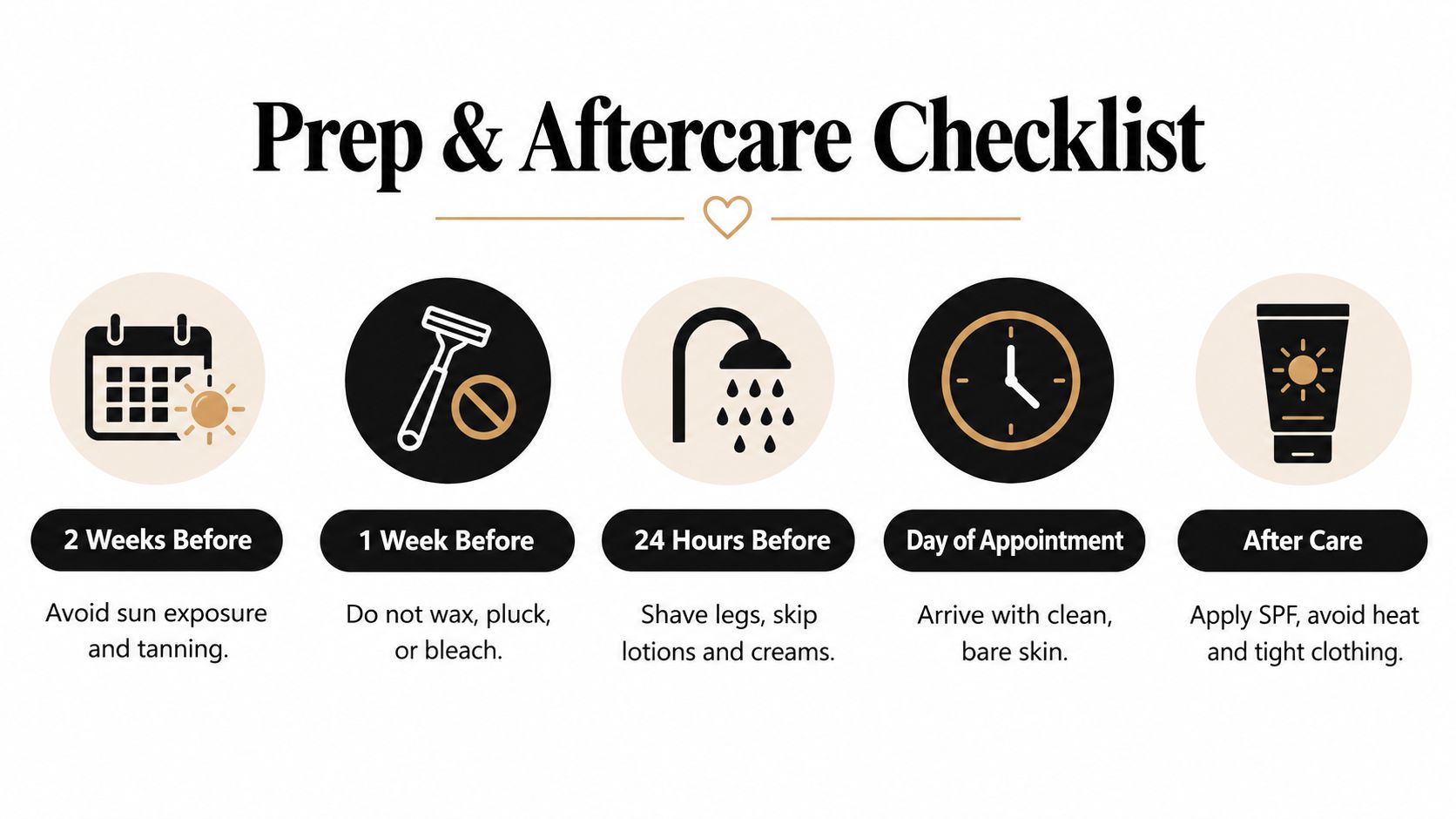
The two main things to protect are your follicles and your skin tone. The follicle needs to be present for treatment. Your skin should be as close to its baseline as possible.
A simple checklist helps:
Avoid tanning: Skip heavy sun exposure and self-tanner before treatment.
Don't wax or pluck: Those methods remove the root the laser needs to find.
Review medications: Let your provider know about anything new that could increase light sensitivity.
Keep the skin steady: Try not to experiment with harsh scrubs or irritating body products right before your appointment.
The Day Before and Day Of
Shaving is different from waxing because shaving leaves the follicle in place. That's why most providers want the area shaved shortly before treatment.
Use this rhythm:
Shave about 24 hours before if your provider recommends that timing.
Come with clean skin and skip body oils, thick lotions, or shimmer products on the legs.
Wear easy clothing, especially if you're treating full legs. Loose pants or a relaxed dress tends to feel better afterward than tight denim.
Bring questions about lower legs versus full legs, expected shedding, and how to handle any irritation afterward.
The First 48 Hours After
After treatment, the skin may feel warm or sensitive for a short period. It is like your skin asking for a quieter routine.
Helpful habits include:
Cool it down: A cool compress or soothing gel can help if the area feels warm.
Skip heat: Avoid very hot showers, saunas, and anything that adds more heat right away.
Hold off on intense workouts: Heavy sweating and friction can be irritating on freshly treated skin.
Protect from sun: If your legs will be exposed, sunscreen matters.
For readers who like ingredient education, this overview of how CBD works for skin gives a general look at why some people explore calming topical products, though you should still follow your laser provider's specific aftercare instructions first.
The Next Two Weeks
This is the stretch when clients often get confused. The hair that looks like it's growing may be treated hair working its way out.
A few rules keep things simple:
Shave if needed: That's usually the safe in-between method.
Don't pluck the shedding hairs: Let them release naturally.
Resume exfoliation gently: Only when your provider says your skin is ready.
Watch for pigment changes: If your skin is prone to dark marks, be extra consistent with sun protection.
For a more treatment-specific routine, this guide to post-laser skin care is useful for understanding how providers think about recovery after laser sessions.
Practical rule: If your skin feels warm, tight, or extra sensitive, simplify everything. Gentle cleanser, simple moisturizer, and sun protection usually beat an overloaded routine.
Pain Level Side Effects and Comfort During Leg Sessions
This is usually the first thing people ask in a consultation. Not price. Not package options. Pain.
What It Usually Feels Like
Most patients describe leg laser hair removal as quick snaps of heat or a rubber-band flick sensation. The feeling changes by area. The shin, ankle, and around the knee often get more attention than the thigh because there is less cushion there.
Many clients find legs more tolerable than underarms or bikini areas. The skin is less delicate, and the session tends to move in a steady pattern rather than focusing on a highly sensitive compact zone.
How Comfort Features Help
A large-area treatment needs two things to feel manageable: speed and cooling. Splendor X is designed with both in mind, which is useful on legs because the treatment field is broad and repetitive.
Comfort usually improves when the provider can:
move efficiently across the legs without overworking one patch
use cooling to reduce surface heat
adjust settings if a certain area feels sharper than expected
slow down around bony spots instead of treating every section the same way
Common Side Effects and Less Common Risks
The most typical short-term reactions are mild redness, perifollicular swelling, and temporary sensitivity. Those usually settle without much disruption when aftercare is followed.
Less common concerns include hyperpigmentation or prolonged irritation, especially if someone has recent sun exposure, unsuitable settings, or aggressive post-treatment heat and friction. That's one reason individualized settings matter.
The earlier leg comparison study is useful here too because it showed an important tradeoff: combining modalities in that controlled setting didn't improve results and did increase hyperpigmentation and pain. More aggressive treatment isn't automatically smarter treatment.
If you're ever unsure whether a reaction is normal, call the clinic. It's better to ask about prolonged redness, unexpected blistering, or marked darkening early than to guess.
Pricing Packages Locations and Booking Your Leg Laser Series
Once you've decided to move forward, the practical question is usually whether to treat lower legs or full legs first. Lower legs make sense when that's the part you shave constantly and you want a smaller commitment. Full legs make sense when you want even coverage from ankle to thigh and don't want a visible contrast line during shorts season.
Package structure matters because leg treatment works best as a series. NYC Laser Hair Removal offers treatment by zone size, with full legs listed among its treatment areas and package options that include single sessions as well as 3-session and 6-session bundles. If you want a local reference point for pricing structure, their full legs cost guide breaks down how this area is categorized.
What Booking Looks Like in Westbury
For Long Island clients, location and hours affect whether you stay consistent. The Westbury office is at 355 Post Avenue, Suite 101, Westbury, NY 11590, and hours are Monday through Saturday, 10am to 6pm. That makes it easier to fit appointments around work, school pickups, or weekend plans.
A straightforward booking plan looks like this:
Choose the area: lower legs or full legs
Book a consultation or first visit: especially if this is your first laser series
Ask about bundles: consistency matters, so package planning can help
Map sessions to your calendar: especially before vacations or event season
If you're comparing laser categories beyond hair removal, it can help to see how differently other treatments are priced and planned. For example, this overview of full-face erbium resurfacing cost shows how resurfacing has a completely different cost logic than a multi-session hair reduction series.
Smooth legs are partly a cosmetic choice, but they're also a time choice. Fewer rushed shaves, fewer last-minute fixes, and less mental energy spent on upkeep is what many people are really buying into.
If you're ready to start a leg series, NYC Laser Hair Removal offers Splendor X treatments in Westbury for clients who want a practical plan for lower legs or full legs. You can book around your schedule, ask about session bundles, and get a treatment approach matched to your skin tone, hair pattern, and Long Island routine.
Comments